Categories
Archive Blogroll Development Challenges, South-South Solutions Newsletters Southern Innovator magazine

The Power of the Word: African Blogging and Books

By David SouthDevelopment Challenges, South-South Solutions

SOUTH-SOUTH CASE STUDY

“Culture is not a luxury … Culture is the spiritual backbone of society”: with these words Jan Kees van de Werk, the Dutch poet and long-standing advocate of African literature, summed up the importance of culture to Africa’s development. Two trends could significantly alter the prospects for African writers in 2007: the new wave of African bloggers and websites that are now emerging, and the increasing awareness of African literature. More traditional writing is now being joined in 2007 by a surge in African blogging. As internet access has increased, and awareness of free blogging websites like WordPress has also shot up, Africans are jumping online to express themselves (see also Development Challenges, March issue).

African literature is gaining an ever-greater audience through high-profile prize-winning. From veteran Nigerian writer and UNFPA Goodwill Ambassador Chinua Achebe winning this year’s Man Booker International Prize, to best-selling French language authors like Ivorian Ahmadou Kourouma (Allah is not Obliged) and Albert Memmi, winner of the French Academy’s Grand Prix de la Francophonie. They are joined by many others gaining international acclaim, including Uganda’s Monica Arac de Nyeko – winner of the prestigious Caine Prize for African Writing – Nigeria’s Chris Abani (Graceland), Cameroon’s Calixthe Beyala (Lost Honor), Congolese writer Daiel Biyaoula (Alley Without Exit) and Mauritius’s Carl de Souza. The Salon International du Livre et de la Presse de Geneva has established the Ahmadou Kourouma Prize, and the new Book Show for African Literature, Press and Culture is scheduled for 2008.

Increasingly, the creative industries are gaining respect as a key part of a vibrant economy. The power of a successful author or musician to generate awareness and excitement about a country and its products, has gained the respect of many governments. And they are also learning to respect the wealth that can be generated. For example, in Britain the creative industries earn almost as much as the powerful financial sector (Work Foundation). The World Bank’s private sector arm, the International Finance Corporation, has singled out Africa’s creative sector for its future investment.

Blogger Titilayo Soremi in Abuja, Nigeria, is typical of the new wave. A business development officer for an NGO, her blog is a vivid snapshot of life in her country. Obed Sarpongin Accra, Ghana is a budding poet and does not shy away from thorny issues. In his current blog, he tackles domestic politics and writes about the on-again, off-again electricity supply. The secretive Kenyan banker known by the name Bankelele is a lover of new ideas judging by his blog. The content is a mix of financial tip-offs and upcoming business investment opportunities in the region, all stirred up with some rather frank thoughts on politics. He has also gone the extra mile and acquired sponsors for his blog (that banking experience is not going to waste).

The Internet age has also given birth to a new phenomenon: the so-called ”long tail” This is best explained by Kelvin Smith in his paper ‘African Publishers and Writers in British and International Markets’: “What now emerges is that more than half the revenue of Amazon is in the ‘bottom’ two million books on the list.

“So, the ‘Long Tail’ principle goes, we are now looking at a technology that can service the needs not of dozens of markets of millions, but millions of markets of dozens. This has great significance for the small publisher, whether that publisher is in a large publishing nation or in a country where publishing is a smaller scale activity.”

It looks as if getting creative is not only fun, it can be the next goldmine for Africa’s entrepreneurs.

Published: August 2007

Resources

Creative Commons License

This work is licensed under a
Creative Commons Attribution-Noncommercial-No Derivative Works 3.0 License.

Update: There is no better proof of concept than impact.

One of the many African blogs and websites to share content from UN e-newsletter Development Challenges, South-South Solutions (2006-2014) and Southern Innovator Magazine (2011-2014).

“Great economic and business reporting! Very helpful for us.” Africa Renewal, Africa Section United Nations Department of Public Information

The story Nollywood: Booming Nigerian Film Industry, from UNDP e-newsletter Development Challenges, South-South Solutions, cited in Innovation Africa: Emerging Hubs of Excellence edited by Olugbenga Adesida, Geci Karuri-Sebina, Joao Resende-Santos (Emerald Group Publishing, 2016).

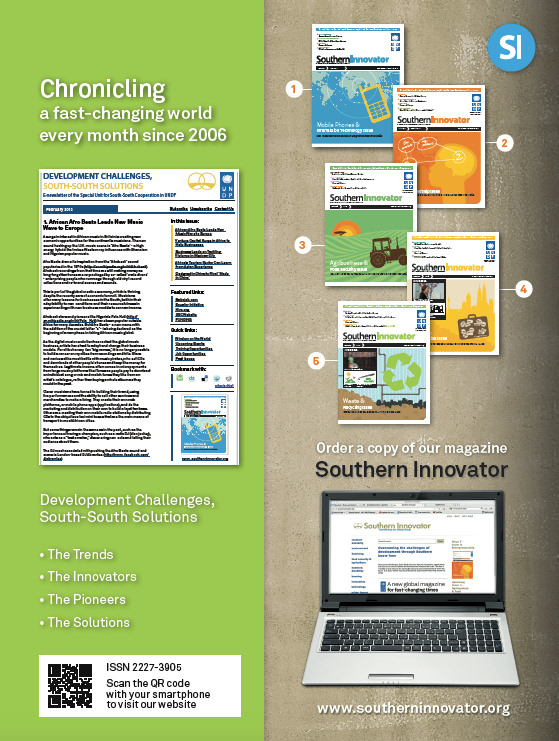
Southern Innovator was published from 2011 to 2015 by the United Nations.

Team | Southern Innovator Phase 1 Development (2010 – 2015)

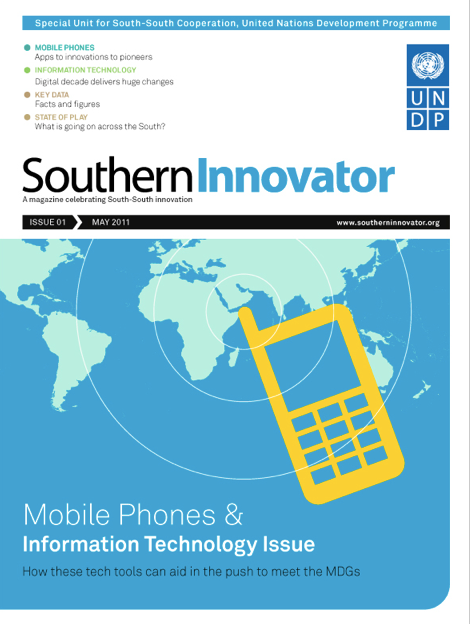
Development Challenges, South-South Solutions was launched as an e-newsletter in 2006 by UNDP’s South-South Cooperation Unit (now the United Nations Office for South-South Cooperation) based in New York, USA. It led on profiling the rise of the global South as an economic powerhouse and was one of the first regular publications to champion the global South’s innovators, entrepreneurs, and pioneers. It tracked the key trends that are now so profoundly reshaping how development is seen and done. This includes the rapid take-up of mobile phones and information technology in the global South (as profiled in the first issue of magazine Southern Innovator), the move to becoming a majority urban world, a growing global innovator culture, and the plethora of solutions being developed in the global South to tackle its problems and improve living conditions and boost human development. The success of the e-newsletter led to the launch of the magazine Southern Innovator.  

Follow @SouthSouth1

Google Books: https://books.google.co.uk/books?id=uXWUyfb4MacC&dq=development+challenges+september+2009&source=gbs_navlinks_s

Slideshare: http://www.slideshare.net/DavidSouth1/development-challengessouthsouthsolutionsseptember2009issue

Southern Innovator Issue 1: https://books.google.co.uk/books?id=Q1O54YSE2BgC&dq=southern+innovator&source=gbs_navlinks_s

Southern Innovator Issue 2: https://books.google.co.uk/books?id=Ty0N969dcssC&dq=southern+innovator&source=gbs_navlinks_s

Southern Innovator Issue 3: https://books.google.co.uk/books?id=AQNt4YmhZagC&dq=southern+innovator&source=gbs_navlinks_s

Southern Innovator Issue 4: https://books.google.co.uk/books?id=9T_n2tA7l4EC&dq=southern+innovator&source=gbs_navlinks_s

Southern Innovator Issue 5: https://books.google.co.uk/books?id=6ILdAgAAQBAJ&dq=southern+innovator&source=gbs_navlinks_s

ORCID iD: https://orcid.org/0000-0001-5311-1052.

© David South Consulting 2023

Categories
Archive Blogroll Development Challenges, South-South Solutions Newsletters Southern Innovator magazine Special Unit for South-South Cooperation United Nations Development Programme United Nations Office for South-South Cooperation

Innovator Stories and Profiles

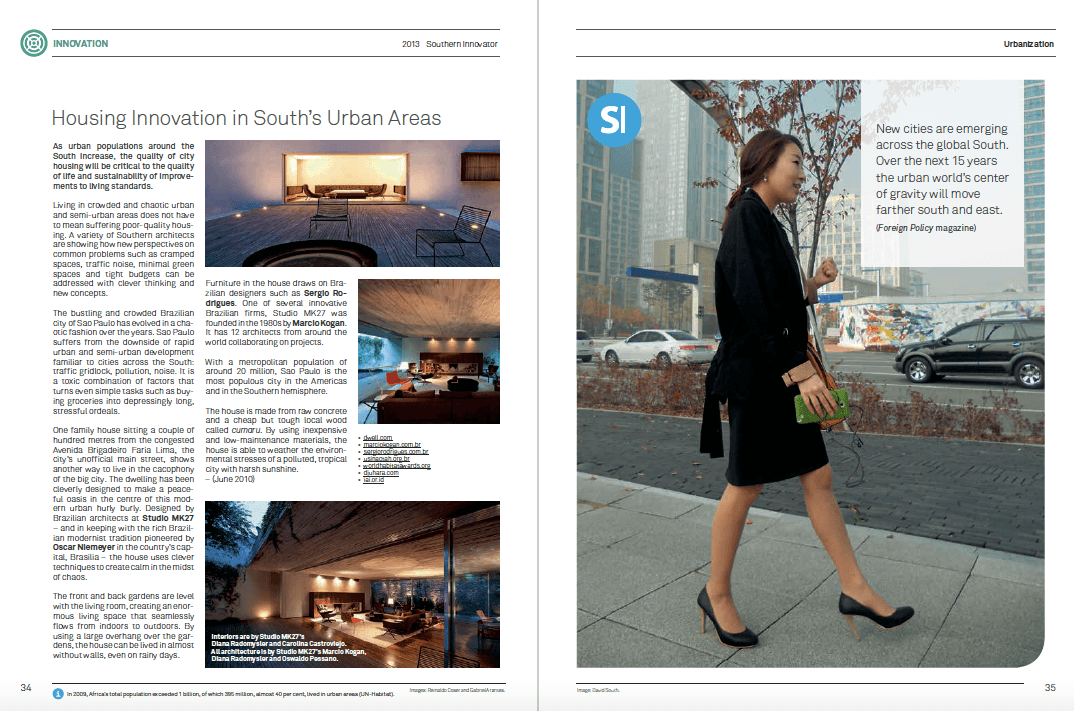
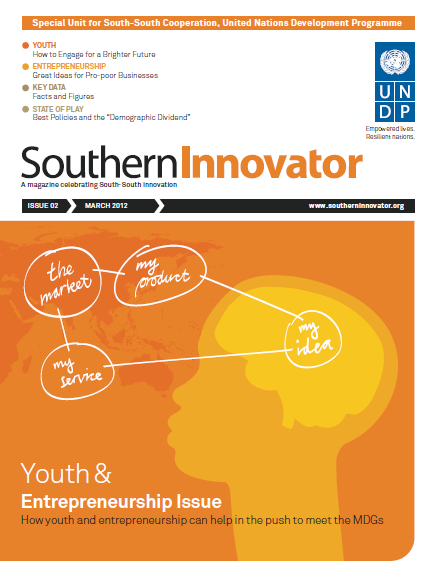
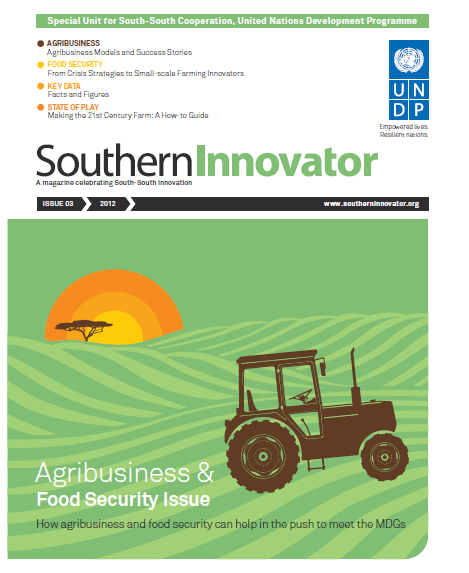
Southern Innovator was initially launched in 2011 with the goal of – hopefully – inspiring others (just as we had been so inspired by the innovators we contacted and met). The magazine seeks to profile stories, trends, ideas, innovations and innovators overlooked by other media. The magazine grew from the monthly e-newsletter Development Challenges, South-South Solutions published by the United Nations Office for South-South Cooperation (UNOSSC) since 2006.

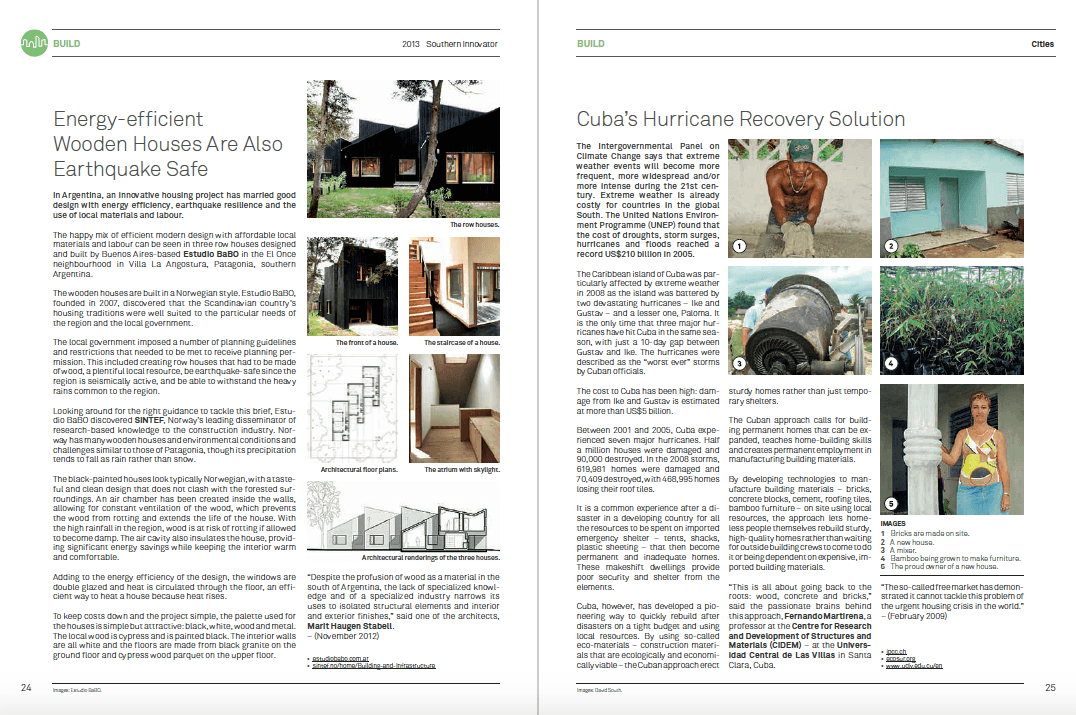
Southern Innovator visited South Korea’s Songdo Smart City in 2012.

Editor and Writer, David South. 
Graphic Designer and Illustrator, Solveig Rolfsdottir. 

This work is licensed under a Creative Commons Attribution 4.0 International License.

ORCID iD: https://orcid.org/0000-0001-5311-1052.

© David South Consulting 2021

Categories
Archive Blogroll Development Challenges, South-South Solutions Newsletters Southern Innovator magazine

Creating Green Fashion in China

By David SouthDevelopment Challenges, South-South Solutions

SOUTH-SOUTH CASE STUDY

China is the world’s largest manufacturer (Euromonitor) and the largest clothing maker, producing a quarter of all textiles and clothing. It is a global fashion production hub, and many major global clothing brands have their products made there – whether they admit it or not.

Although most people probably do not give it a second thought, the fashion and clothing industries can be highly polluting and exploitive. The use of toxic fertilizers to boost cotton yields leaves behind a legacy of contaminated soil and water tables. Dyes used to colour clothing also can be toxic and pollute water. For people working in this industry – many of whom are women – conditions can vary widely and include low pay and high stress.

According to the Ethical Fashion Forum, “it is difficult for companies sourcing from China to be sure of fair working practices. There have been many reports of low wages, long hours, and unfair working conditions in factories in China.”

But one innovative fashion brand is out to transform the way the garment business works in China and to develop a template that could be used in other places such as Africa.

The design duo of Hans Martin Galliker and Amihan Zemp has set up their clothing brand’s studio in one of Beijing’s historic hutong (alley) neighbourhoods – narrow streets of low-rise buildings that were the traditional urban dwelling environments for generations of Chinese people. The NEEMIC (neemic.com) brand, founded in 2011, makes sustainable fashions and champions green production methods in China.

The business’s belief is that the world has enough fabric already to meet the clothing needs of the population. In response, NEEMIC makes its clothing from a mix of recycled natural materials and new organic materials. According to its website, NEEMIC collaborates “with young designers from London to Tokyo to create a particular metropolitan aesthetic.”

“We use the finest natural fabrics for a perfectly comfortable feel,” Galliker said. “We pick the finest natural materials from leftovers of the industry, recycle used clothes, and strive to order new fabrics only from certified organic producers.”

Hans Martin Galliker began as a farming apprentice in his native Switzerland, and brings a practical bent to his approach to fashion. He draws on his knowledge of farming and agriculture to create a unique eco-conscious fashion product in China.

Galliker got his start in fashion working for a brand in Shenzhen, southern China. He worked with the organic farms there, and this inspired him to explore sustainability in fashion design and ways of introducing the principles of fair trade to the fashion and textile industries in China.

Galliker is passionate about taking a different attitude to fashion: “There are many fashion brands and many of them are … meaningless,” he told the China Daily newspaper. “They do fashion which looks more or less … the same, which has no creativity and does a lot of harm to the environment.

“Growing cotton is highly chemicals and labour-intensive, which degrades the soil and pays people very low salaries. And the dyeing and colouring processes pollute rivers and people receive low salaries but have to work long hours. The whole textile industry is really bad for the environment.”

NEEMIC has completed three collections of clothing since it was founded in 2011.

“We started selling some of our designs at a boutique in Beijing that focuses on upcycling fashion. People like it and want to buy more,” said Galliker.

Upcycling is the process of converting waste material into new products (http://en.wikipedia.org/wiki/Upcycling).

And to counter any negative perceptions that organic cotton clothing can only ever be unfashionable, Galliker is out to prove it is possible to create stylish organic clothing.

On top of building the brand, Galliker also works to educate the industry and change ways. He is also setting up a branch in China of the Hong Kong Organic Textile Association (http://neemic.asia/organic), which encourages fashion designers to jointly buy organic materials. He also publishes a website on sustainable agricultural practices in China, with details on current policies on organic farming.

“It is very normal for Chinese farmers to use many fertilizers, but the environment is going bad and consumers do not like this kind of farming,” Galliker points out. “For farmers, it’s not meaningful to produce only to make money to live a decent life. It should be more than that.”

The NEEMIC operation is lean: the Beijing studio does all the designing of the clothes, programming of the multilingual websites and runs the online shopping and payment sites.

For now, the goal is to not only increase the use of organically grown materials but also to introduce the fair trade concept into China.

“In two years we want to do fair trade production,” Galliker said.

And he has Africa in his sights with his green fashion template.

“In the long term we will have many successful projects here or non-profit companies … a lot of creative force and investment so that we can help rural regions in Africa to do sustainable agriculture projects.”

Published: December 2012

Resources

1) Ethical Fashion Forum: The Ethical Fashion Forum is the industry body dedicated to a sustainable future for fashion. A not for profit organisation, EFF aims to make it easy for fashion professionals to integrate sustainability at the heart of what they do. Website: http://www.ethicalfashionforum.com/

2) Hong Kong Organic Textile Association: Its mission is to promote organic textiles in Hong Kong Website: http://www.facebook.com/HKOrganicTextileAssociation

3) Tips on how to upcycle. Website: http://www.independent.co.uk/property/interiors/the-insider–how-to-upcycle-without-much-effort-2343100.html

4) How to create a Lookbook for a fashion brand. Website: http://noisetteacademy.com/2011/05/creating-a-lookbook/

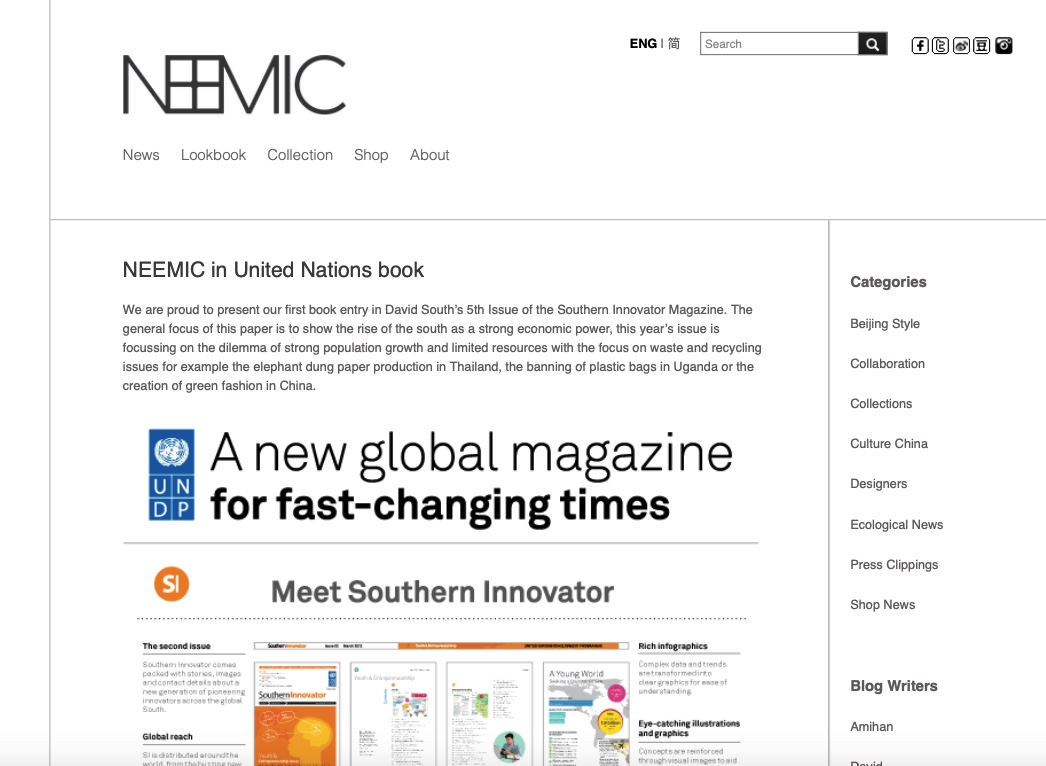
“We are proud to present our first book entry in David South’s 5th Issue of the Southern Innovator Magazine. The general focus of this paper is to show the rise of the south as a strong economic power, this year’s issue is focussing on the dilemma of strong population growth and limited resources with the focus on waste and recycling issues for example the elephant dung paper production in Thailand, the banning of plastic bags in Uganda or the creation of green fashion in China.” https://neemic.asia/ecological-news/neemic-southern-innovator-book

https://davidsouthconsulting.org/2021/02/09/african-fashions-growing-global-marketplace-profile/

https://davidsouthconsulting.org/2021/01/05/afropolitan-african-fashion-scene-bursting-with-energy/

https://davidsouthconsulting.org/2022/10/09/fashion-closes-gap-between-catwalk-and-crafts/

https://davidsouthconsulting.org/2022/11/17/fashion-recycling-how-southern-designers-are-re-using-and-making-money/

https://davidsouthconsulting.org/2022/11/16/favela-fashion-brings-women-work/

https://davidsouthconsulting.org/2020/04/30/local-fashions-pay-off-for-southern-designers/

https://davidsouthconsulting.org/2022/10/24/made-in-africa-fashion-brand-pioneers-aim-for-global-success/

https://davidsouthconsulting.org/2021/10/04/putting-quality-and-design-at-the-centre-of-chinese-fashion/

https://davidsouthconsulting.org/2021/03/05/southern-innovator-issue-5/

Development Challenges, South-South Solutions was launched as an e-newsletter in 2006 by UNDP’s South-South Cooperation Unit (now the United Nations Office for South-South Cooperation) based in New York, USA. It led on profiling the rise of the global South as an economic powerhouse and was one of the first regular publications to champion the global South’s innovators, entrepreneurs, and pioneers. It tracked the key trends that are now so profoundly reshaping how development is seen and done. This includes the rapid take-up of mobile phones and information technology in the global South (as profiled in the first issue of magazine Southern Innovator), the move to becoming a majority urban world, a growing global innovator culture, and the plethora of solutions being developed in the global South to tackle its problems and improve living conditions and boost human development. The success of the e-newsletter led to the launch of the magazine Southern Innovator.  

Follow @SouthSouth1

Google Books: https://books.google.co.uk/books?id=q1KeBgAAQBAJ&dq=development+challenges+december+2012&source=gbs_navlinks_s

Slideshare: http://www.slideshare.net/DavidSouth1/development-challengessouthsouthsolutionsdecember2012issue

Southern Innovator Issue 1: https://books.google.co.uk/books?id=Q1O54YSE2BgC&dq=southern+innovator&source=gbs_navlinks_s

Southern Innovator Issue 2: https://books.google.co.uk/books?id=Ty0N969dcssC&dq=southern+innovator&source=gbs_navlinks_s

Southern Innovator Issue 3: https://books.google.co.uk/books?id=AQNt4YmhZagC&dq=southern+innovator&source=gbs_navlinks_s

Southern Innovator Issue 4: https://books.google.co.uk/books?id=9T_n2tA7l4EC&dq=southern+innovator&source=gbs_navlinks_s

Southern Innovator Issue 5: https://books.google.co.uk/books?id=6ILdAgAAQBAJ&dq=southern+innovator&source=gbs_navlinks_s

Creative Commons License

This work is licensed under a
Creative Commons Attribution-Noncommercial-No Derivative Works 3.0 License.

ORCID iD: https://orcid.org/0000-0001-5311-1052.

© David South Consulting 2023

Categories
Archive

Development Challenges, South-South Solutions Newsletter

By David SouthDevelopment Challenges, South-South Solutions

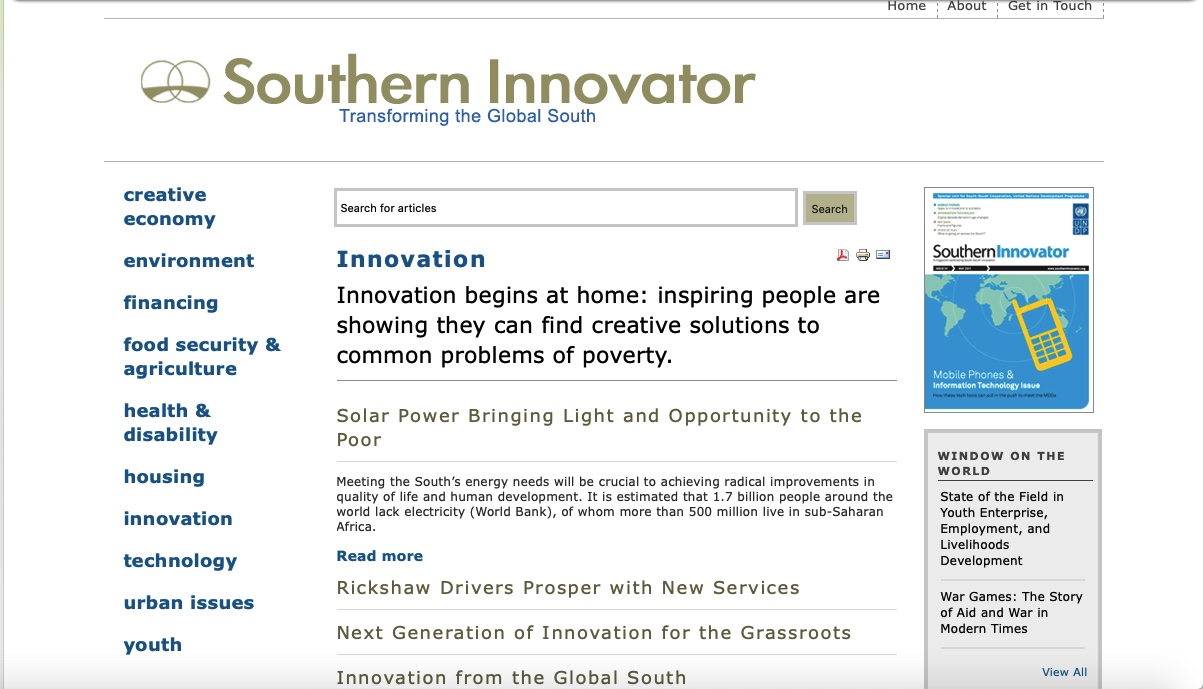
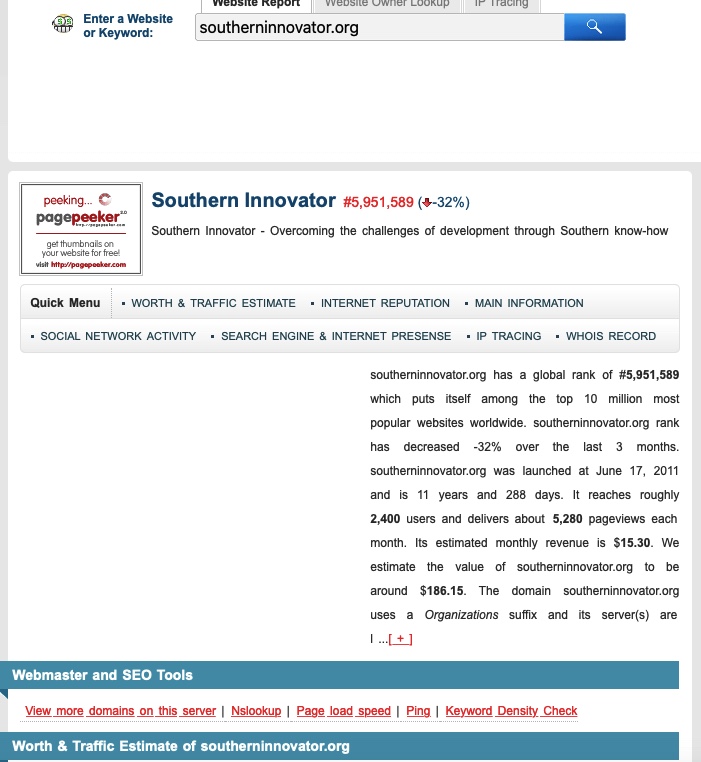
The original southerninnovator.org website launched in 2011, in tandem with the first issue of Southern Innovator Magazine, and ranked midway in the top 10 million most popular websites in the world. Its content has been cited in books, scholarship and strategic plans.

ISSN 2227-3905

Development Challenges, South-South Solutions is the monthly e-newsletter for the United Nations Office for South-South Cooperation in UNDP (formerly the United Nations Development Programme’s South-South Cooperation Unit). I research and write all stories (since January 2007). You can view the original website here. The stories are in English, French and Spanish.

The original WordPress website for Development Challenges, South-South Solutions (southsouthnews.wordpress.com). It was launched in 2006 and eventually became southerninnovator.org in 2011. The magazine Southern Innovator was also launched in New York in 2011.
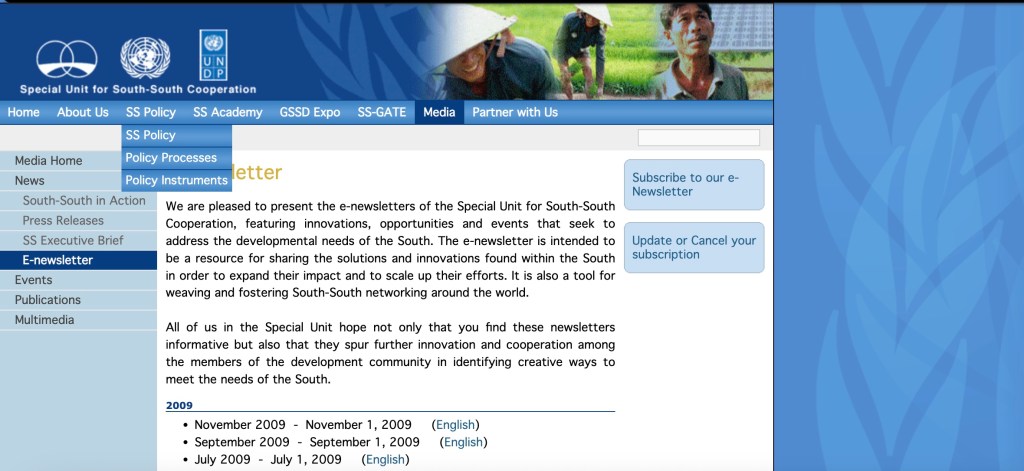
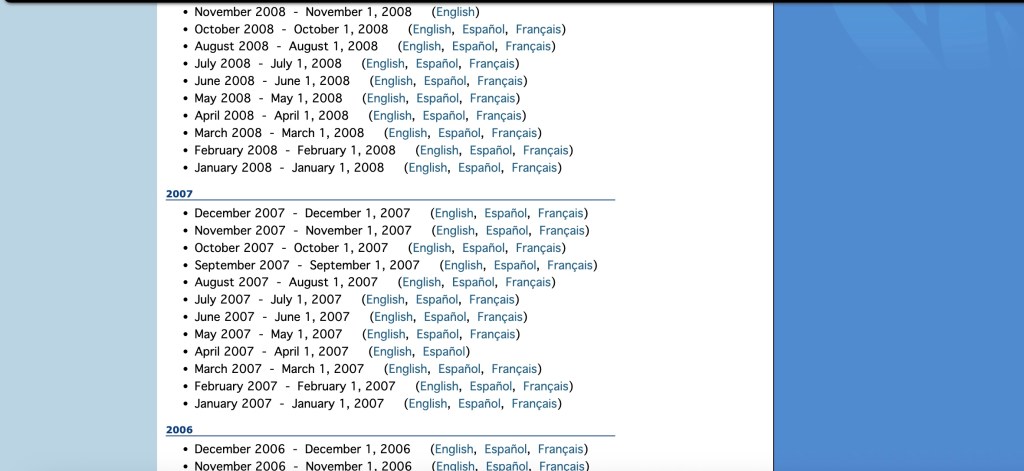
The newsletter archive on the website for UNDP’s Special Unit for South-South Cooperation circa 2011 (including issues in English, French and Spanish). 2011 was an important year as the e-newsletter Development Challenges, South-South Solutions scaled into a dedicated web archive, http://southerninnovator.org, a sister magazine, Southern Innovator (https://unsouthsouth.org/2014/12/25/southern-innovator-magazine/), and pollinated its content across multiple platforms, capitalising on the platform and social media explosion of the time.

Here is a good background article on the rise of South-South cooperation, how it is altering global trade and power relationships, and what the future holds: South-South Cooperation Defies the North. And here is some historical background from Wikipedia: South-South Cooperation.

Development Challenges, South-South Solutions reaches a global audience of influential decision-makers on the frontlines of international development in the South. More than 2,000 subscribers read the newsletter every month (academic institutions, UN agencies, private sector companies, UNDP Country Offices, financial institutions including the IMF and World Bank, inter-governmental organisations, UNDP knowledge networks around the world, and all South-South focal points in West Africa).

Remember to think of Development Challenges, South-South Solutions when you have a Southern innovation to share with the world. You can read our archive of stories online here: http://ssc.undp.org/index.php?id=66

From Special Unit for South-South Cooperation: 2008 Reflections: “As part of the strategy to foster South‐South cooperation within and across regions, the Division has continued to invigorate and re‐enforce a South‐South cooperation focal point system. These efforts included the publication and distribution of a monthly e‐newsletter, Development Challenges: South-South Solutions, which presents a briefing for South‐South focal points, Southern academics and development professionals on practical solutions to development challenges found throughout the South. Over the course of 2008, twelve e‐newsletters were released via e‐mail and published on the website of the Special Unit.”

What are people saying about Development Challenges, South-South Solutions? Read some comments here.

Contact me by email about the newsletter here: developmentchallenges@googlemail.com.

Contact me by email about the new global magazine Southern Innovator here: southerninnovator@yahoo.co.uk

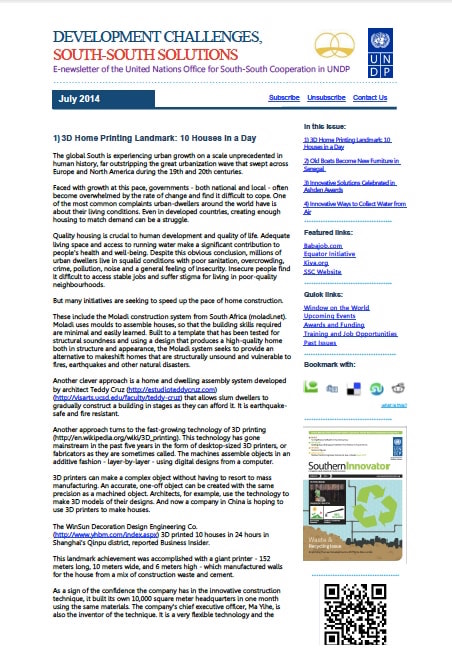
July 2014 issue of Development Challenges, South-South Solutions: The last issue is available online for download. Support the e-newsletter for 2017: we are seeking additional funding so we can improve the reader experience and frequency of the e-newsletter. Since first launching in 2006, we often heard from readers how they valued the stories in the e-newsletter and how it has helped in raising the profile of innovators across the global South (“Congratulations on another great newsletter that’s packed with fascinating information! I really enjoy getting it each month.”). Additional resources would enable us to improve the way readers can access and receive the e-newsletter, enable the e-newsletter’s contributors to travel and report on developments, and allow us to offer daily and weekly updates and a wider range of resources online and on mobile platforms. Additional funds help in maintaining the quality of the e-newsletter, something that has been appreciated by readers (“Great economic and business reporting! Very helpful for us.” Africa Renewal). It will also allow the e-newsletter to spin-off quality resources for innovators, such as the influential magazine Southern Innovator. Contact the United Nations Office for South-South Cooperation if you wish to support the e-newsletter for 2017: UNOSSC.

“What a tremendous magazine your team has produced! It’s a terrific tour de force of what is interesting, cutting edge and relevant in the global mobile/ICT space… This is great, engaging, relevant and topical stuff.” Rose Shuman, Founder & CEO, Open Mind and Question Box, Santa Monica, CA, U.S.A.

“Great economic and business reporting! Very helpful for us.” Africa Renewal, Africa Section, Strategic Communications Division, United Nations Department of Public Information

“The reviewer observed that, although the Policy and UN Coordination Unit had produced all of the reports requested by intergovernmental bodies, especially for the High-level Committee, it had not been able to produce many of the publications (evidence-based analytical reports) that had previously been within its purview. Such publications included Southern Innovator magazine and the monthly e-newsletter “Development Challenges, South-South Solutions”. In the case of Southern Innovator, one issue (No. 5 on waste and recycling) was published during the four-year period of the framework but did not have wide online distribution, and issue No. 6 was awaiting funds for publication. The e-newsletter was last issued in July 2014 even though the reviewer found it a good way to communicate with focal points at the national and inter-agency levels. In fact, the shortage of funds for those knowledge products was the main reason that they had ceased being produced during the evaluation period.”  Final evaluation of the performance of the United Nations Office for South-South Cooperation  under its strategic framework, 2014-2017, in light of the adoption of the 2030 Agenda for Sustainable Development

Note: Unfortunately, the reason for “the shortage of funds” was down to suspension of funding to the UNOSSC in 2015 and 2016 pending two internal UN audit investigations after arrests made in 2015 by the Federal Bureau of Investigation (FBI) revealed a bribery and money laundering network targeting the United Nations via various NGOs, including the UN-based news organisation South-South News. The case eventually made its way to the Supreme Court of the United States.

Back Issues

Development Challenges, South-South Solutions Newsletter | 2011-2014

2014

Development Challenges, South-South Solutions Newsletter | 2007-2010

2013

https://www.slideshare.net/DavidSouth1/development-challenges-july-2013-issue

2012

https://www.slideshare.net/DavidSouth1/development-challenges-july-2012-issue

2011

https://www.slideshare.net/DavidSouth1/development-challengessouthsouthsolutionsdecember2011issue

2010

2009

2008

https://www.slideshare.net/DavidSouth1/development-challenges-may-2008-issue

2007

“Beautiful, inspiring magazine from UNDP on South-South innovation. Heart is pumping adrenaline and admiration just reading it.”

This work is licensed under a Creative Commons Attribution 4.0 International License.

ORCID iD: https://orcid.org/0000-0001-5311-1052.

© David South Consulting 2025