Environmental Public Awareness Handbook: Case Studies and Lessons Learned in Mongolia
Environmental Public Awareness Handbook: Case Studies and Lessons Learned in Mongolia by Robert Ferguson.Environmental Public Awareness Handbook: Case Studies and Lessons Learned in Mongolia by Robert Ferguson.
Mongolian Green Book by Robert Ferguson et al.Mongolian Green Book by Robert Ferguson et al.
More books by Rob Ferguson:
The Devil And The Disappearing Sea: Or, How I Tried To Stop The World’s Worst Ecological Catastrophe (Raincoast Books).
Mongolian Rock and Pop Book
Mongolian Rock and Pop Book: Mongolia Sings its Own Song by Peter Marsh.
Mongolian Rock and Pop Book: Mongolia Sings its Own Song by Peter Marsh.
Pop music helps fuel Mongolia’s market economy by Oyuntungalag.As cited in the book Collaborative Nationalism: The Politics of Friendship on China’s Mongolian Frontier by Uradyn E. Bulag (Rowman & Littlefield Publishers, 2010).
Mongolia Update 1998
Mongolia Update 1998 by David South and G. Enkhtungalug.
Other
Wild East: Travels in the New Mongolia
Wild East: Travels in the New Mongolia by Jill Lawless (ECW Press, 2000) is one of many books featuring content and resources resulting from the two-year publishing programme of the UNDP Mongolia Communications Office (1997-1999).
Wild East: Travels in the New Mongolia by Jill Lawless.Wild East: Travels in the New Mongolia by Jill Lawless.A review of Wild East: Travels in the New Mongolia in the journal Mongolian Studies (2002) by Alicia J. Campi.“Yet Ulaanbaatar is often ignored or downplayed in Western accounts (see, for example, Croner (1999) and Severin (1991); but see Lawless (2000) for a partial exception). Most Westerners who visit Mongolia seem anxious to get out to the countryside, to see the “real” Mongolia of nomads …” from Truth, History and Politics in Mongolia by Christopher Kaplonski (2004).
In Their Own Words: Selected Writings by Journalists on Mongolia, 1997-1999
In their own words: Selected writings by journalists on Mongolia, 1997-1999 by David South and Julie Schneiderman.
Bonn, Germany: “The training allows us to learn about western theories of journalism,” says Mr. Nyamjav, editor of the Erkh Choloo (Freedom) newspaper. A UNDP project in Mongolia has brought journalists from Ulaanbaatar, Mongolia’s capital, to run an investigative journalist training programme for their colleagues in the rural community of Moron. The programme introducing investigative journalism to students consists of a workshop and various field assignments. Here, I report on day two of the training.
9:00 a.m.
Eleven student journalists and the two trainers, Ms Oyunsetseg and Mr. Batbold from the Press Institute of Mongolia, quickly run through the day’s schedule. The journalists will spend the next two hours interviewing subjects for their stories. All the journalists say this is the first time they’ve explored in detail this sub-category of journalism. Not all the students are experienced journalists, but this is made up for by the quality of the two facilitators, both of whom keep the workshop lively.
11:30 a.m.
The debate begins over the choice of stories. One team has chosen to look at poverty alleviation projects at the Bak (local government) level. They want to write a story looking at poor accountability for loans, the practice of nepotism and the ability of recipients to start small businesses. The team investigating power black-outs wants to conduct further interviews with the poorest people affected by such interruptions.
4:00 p.m.
Back at the offices of the Erkh Choloo newspaper, editor Nyamjav discusses the week’s news with his graphic designer. The skills of the staff impress me. While they have only one computer and barren offices, the paper won an award from the Press Institute for being the best local paper in 1997. The newspaper will be cut off from local government subsidies for printing at the end of this year and is already making plans to find other sources of revenue. Nyamjav is pleased with the results of the UNDP project, saying: “It has noticeably changed our stories – I know how to criticise reporters and push them to be more investigative.”
8:30 p.m.
Outside Ulaanbaatar a petrol shortage has hit hard. At a Moron filling station drivers patiently wait for new supplies to arrive or to receive their ration. Not only is there no fuel, there is also no electricity. On a field assignment the journalists investigating the power black-outs interview Mr. Sukhbaatar the power station director who says 3,500 households owe the utility Tug 27 million (US$27,411). It is the poorest households that are unable to pay in the Ger districts. A Ger is a Mongolian felt tent. Without payment, their power is cut off.
9:00 p.m.
I am asked to conduct a one-hour discussion of my experiences as an investigative journalist in Canada and England. The debate afterwards is lively. A common question is how to deal with pressure from government and corporations to alter the content of stories. The difficulty the regional journalists have in distributing newspapers to remote communities is a common complaint. They ask how international donors could help in this matter, pointing out that in the past the government subsidised newspaper distribution to a greater extent. They would like to be linked with international journalists in some way, preferably through an association.
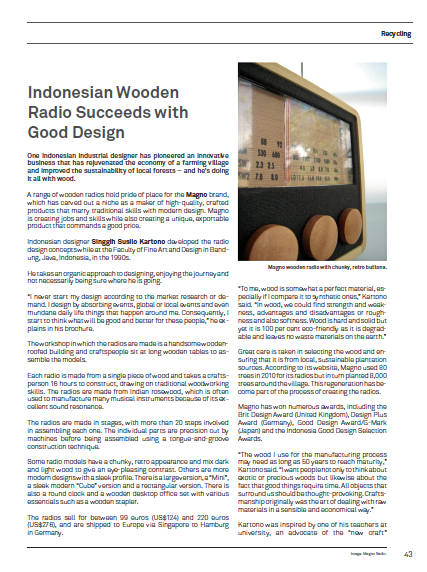
One Indonesian industrial designer has pioneered an innovative business that has rejuvenated the economy of a farming village and improved the sustainability of local forests – and he’s doing it all with wood.
A range of wooden radios (wooden-radio.com) hold pride of place for the Magno brand (http://www.magno-design.com/?id=wr01a), which has carved out a niche as a maker of high-quality, crafted products that marry traditional skills with modern design. Magno is creating jobs and skills while also creating a unique, exportable product that commands a good price.
Indonesian designer Singgih Susilo Kartono developed the radio design concepts while at the Faculty of Fine Art and Design in Bandung, Java, Indonesia in the 1990s.
He takes an organic approach to designing, enjoying the journey and not necessarily being sure where he is going.
“I never start my design according to the market research or demand. I design by absorbing events, global or local events and even mundane daily life things that happen around me. Consequently, I start to think what will be good and better for these people,” he explains in his brochure.
The workshop in which the radios are made is a handsome wooden-roofed building and craftspeople sit at long wooden tables to assemble the models.
Each radio is made from a single piece of wood and takes a craftsperson 16 hours to construct, drawing on traditional woodworking skills. The radios are made from Indian rosewood, which is often used to manufacture many musical instruments because of its excellent sound resonance.
The radios are made in stages, with more than 20 steps involved in assembling each one. The individual parts are precision cut by machines before being assembled using a tongue and groove (http://en.wikipedia.org/wiki/Tongue_and_groove) construction technique.
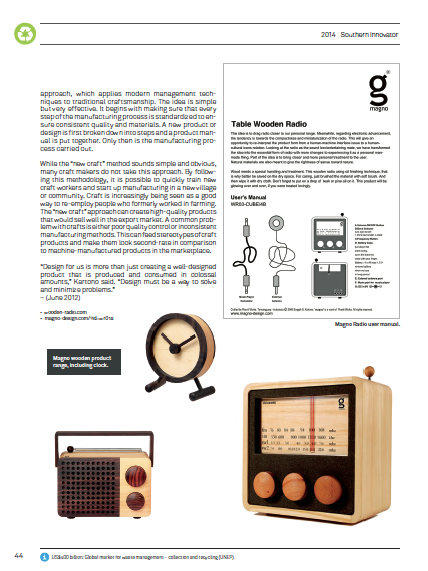
Some radio models have a chunky, retro appearance and mix dark and light wood to give an eye-pleasing contrast. Others are more modern designs with a sleek profile. There is a large version, a ‘Mini’, a sleek modern Cube’ version and a rectangular version. There is also a round clock and a wooden desktop office set with various essentials like a wooden stapler.
The radios sell for between Euros 99 (US $124) and Euros 220 (US $276), and are shipped to Europe via Singapore to Hamburg in Germany.
“To me, wood is somewhat a perfect material – especially if I compare it to synthetic ones,” Kartono said. “In wood we could find strength and weakness, advantages and disadvantages or roughness and also softness. Wood is hard and solid but yet it is 100 per cent eco-friendly as it is degradable and leaves no waste materials on the earth.”
Great care is taken in selecting the wood and ensuring it is from local, sustainable plantation sources. According to its website, Magno used 80 trees in 2010 for its radios but in turn planted 8,000 trees around the village. This regeneration has become part of the process of creating the radios.
Magno has won numerous awards, including the Brit Design Award (UK), Design Plus Award (Germany), Good Design Award/G-Mark (Japan) and the Indonesia Good Design Selection Awards.
“The wood I use for the manufacturing process may need as long as 50 years to reach maturity,” Kartono said. “I want people not only to think about exotic or precious woods but likewise about the fact that good things require time. All objects that surround us should be thought-provoking. Craftsmanship originally was the art of dealing with raw materials in a sensible and economical way.”
As Kartono tells it, he faced the typical university graduate’s dilemma about his career path. Should he work as an in-house designer in a city or return to his home village of Kandangan and start a business? His choice was unusual. Once somebody with a university education leaves a small village, it is rare they return. And at first, Kartono did not.
But he was drawn back by the dire situation in the village, and decided to apply his knowledge of product design to revive its economic fortunes. He started by visiting just twice a year because that was all he could afford. This had the advantage of giving him perspective on the situation in the village.
“At first glance, these changes (happening to the village) were seen as a ‘progress,’” he said. “But when I looked more closely I concluded that it was only the ‘surface’ which experienced change. The basic structure of the village did not undergo any changes; moreover, some was actually deteriorating.”
He concluded that the village was being damaged by various government attempts to modernize agricultural practices. The debt problems this caused meant many farmers lost their farms and were forced to seek work in the city or look for another way to make money.
Craft work seemed to be the answer to this problem. It has many advantages, as Kartono sees it. It is something that can grow and fits well with village lifestyles. It is labour intensive, doesn’t need sophisticated technology and can use already existing local resources.
Kartono was inspired by one of his teachers at university, an advocate of the ‘New Craft’ approach, which applies modern management techniques to traditional craftsmanship. The idea is simple but very effective. It begins with making sure every step of the manufacturing process is standardized to ensure consistent quality and materials. A new product or design is first broken down into steps and a product manual is put together. Only then is the manufacturing process carried out.
While the New Craft method sounds simple and obvious, many craft makers do not take this approach. By following this methodology, it is possible to quickly train new craft workers and start up manufacturing in a new village or community. Craft is increasingly being seen as a good way to re-employ people who formerly worked in farming. The New Craft approach can create high-quality products that would sell well in the export market. A common problem with crafts is either poor quality control or inconsistent manufacturing methods. This can feed stereotypes of craft products and make them look second-rate in comparison to machine-manufactured products in the marketplace.
“Design for us is more than just creating a well-designed product that is produced and consumed in colossal amount,” Kartono said. “Design must be a way to solve and minimize problems.”
Published: June 2012
Resources
1) Cradle to Cradle: Remaking the Way We Make Things by William McDonough and Michael Braungart. It is a manifesto calling for the transformation of human industry through ecologically intelligent design. Website: http://www.mcdonough.com/cradle_to_cradle.htm
2) Rio+20: At the Rio+20 Conference, world leaders, along with thousands of participants from governments, the private sector, NGOs and other groups, will come together to shape how we can reduce poverty, advance social equity and ensure environmental protection on an ever more crowded planet to get to the future we want. Website: http://www.uncsd2012.org/
Sharp design throughout is key to this radio’s success. It confirms gaining the edge with a new product in the marketplace is achieved when the maker has considered aesthetics, quality assembly and clear, eye-catching graphics. Make sure to budget for the services of a good product designer and graphic designer to stand out from the crowd. Don’t let your source of income and profit fail to excite a potential customer.
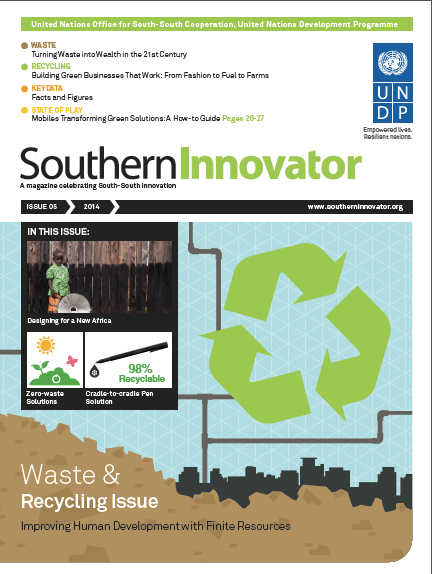
Development Challenges, South-South Solutions was launched as an e-newsletter in 2006 by UNDP’s South-South Cooperation Unit (now the United Nations Office for South-South Cooperation) based in New York, USA. It led on profiling the rise of the global South as an economic powerhouse and was one of the first regular publications to champion the global South’s innovators, entrepreneurs, and pioneers. It tracked the key trends that are now so profoundly reshaping how development is seen and done. This includes the rapid take-up of mobile phones and information technology in the global South (as profiled in the first issue of magazine Southern Innovator), the move to becoming a majority urban world, a growing global innovator culture, and the plethora of solutions being developed in the global South to tackle its problems and improve living conditions and boost human development. The success of the e-newsletter led to the launch of the magazine Southern Innovator.
Increasing the quantity and quality of food in Africa will be critical to improving the continent’s human development. And a key element in giving Africa a more secure food supply will be boosting science and knowledge on the continent and making sure it is focused on Africa’s needs and situation.
One pioneering scientist is looking to the humble chicken to tackle two big problems in Africa: food security and household incomes. By pumping up the weight and productivity of African chickens, she hopes to eradicate hunger and boost household incomes.
Kenyan scientist Sheila Ommeh (http://www.awardfellowships.org/participants/success-stories/108-sheilaommeh.html ) is showing how local knowledge can give farmers the edge when it comes to improving Africa’s animal stock. An animal geneticist, she is trying to create a disease-resistant African chicken that can also produce plenty of eggs.
Her pioneering work is about trailblazing “a big chicken agenda in Africa,” she explained to TrustLaw, a global hub for free legal assistance and information on good governance and women’s rights. She grew up in an area – Mount Elgon in western Kenya – where raising chickens was the primary source of both income and food. Her family raised chickens and the income from this helped to pay for her schooling.
Raising chickens is common in rural Kenya, and many of the people doing it are women.
Based on her experience, she saw how virulent diseases kill chicken flocks and destroy family incomes and disrupt lives – diseases like Newcastle (http://www.avianbiotech.com/diseases/newcastle.htm) and Gumboro (gumboro.com).
She works at the International Livestock Research Institute (ilri.org) based in Nairobi, Kenya. The ILRI “works at the crossroads of livestock and poverty, bringing high-quality science and capacity-building to bear on poverty reduction and sustainable development” and conducts research in Africa, South and Southeast Asia and China.
“I’m really passionate about giving back to the community an improved chicken that will really help their lives,” she explains.
Another project she is working on is the development of a drought-tolerant chicken. This chicken could prove very helpful in parts of Africa suffering from drought and hunger, like in the Horn of Africa.
Women are considered to be the majority producers of food in Africa yet just one in four people working in agricultural research in Africa is a woman, according to TrustLaw.
Ommeh has a PhD in chicken genetics and is a staunch believer in seeking out solutions to Africa’s problems within Africa: “In my view = it’s about time Africa looked for solutions in Africa for Africa,” she told a group of British Members of Parliament.
She will continue her research by looking at native African chickens. She is worried indigenous African chickens are being wiped out by cross-breeding and the introduction into the continent of exotic breeds, which are making African chickens more susceptible to viruses.
Her goal is to produce a disease-resistant breed of chicken weighing four kilograms and laying 250 eggs a year. This would be a big increase on current average weights, and a trebling of the yield.
“Definitely the incomes of these households will increase and that will (create) a rippling effect that will trickle up … And we hope that in 10 to 15 years the poverty issue in Africa will not be so serious,” Ommeh said.
“Chicken is a small livestock but I believe it has the capacity to have a big impact.”
For female scientists working in agriculture, African Women in Agricultural Research and Development (AWARD) (http://awardfellowships.org/) is seeking researchers looking to boost their technical and leadership skills. It is hoped that supporting more women researchers will have the effect of turning research priorities towards the needs of smallholder farmers, who make up the majority of farmers in Africa.
3) Poultry Research Centre: From the University of Alberta, the website offers resources and contacts on poultry sciences. Website: http://www.poultryresearchcentre.com/
Development Challenges, South-South Solutions was launched as an e-newsletter in 2006 by UNDP’s South-South Cooperation Unit (now the United Nations Office for South-South Cooperation) based in New York, USA. It led on profiling the rise of the global South as an economic powerhouse and was one of the first regular publications to champion the global South’s innovators, entrepreneurs, and pioneers. It tracked the key trends that are now so profoundly reshaping how development is seen and done. This includes the rapid take-up of mobile phones and information technology in the global South (as profiled in the first issue of magazine Southern Innovator), the move to becoming a majority urban world, a growing global innovator culture, and the plethora of solutions being developed in the global South to tackle its problems and improve living conditions and boost human development. The success of the e-newsletter led to the launch of the magazine Southern Innovator.










 David South Consulting
You must be logged in to post a comment.