Tag: UNDP

  • Mobile Phone Peacekeeping

    Mobile Phone Peacekeeping

    By David SouthDevelopment Challenges, South-South Solutions

    SOUTH-SOUTH CASE STUDY

    Last month UN secretary-general Ban Ki-moon pointed out the urgent need for interesting and relevant content to attract Africans to the internet. Official statistics can make for grim reading: the continent has less bandwidth than Ireland (World Economic Forum). While it is true Africa is restricted by serious technological and economic disadvantages, African ingenuity, creativity and hard work are bypassing these impediments to get things done nonetheless. While word has got out about the impressive take-up of mobile phones in Africa, the new world of Web 2.0 is also spawning a new generation of inspiring African technology whizzes transforming perceptions and grabbing the world’s attention.

    Alongside the combination of innovation and affordability that has made Africa the fastest growing mobile phone market in the world, there is a home-grown technology boom underway: “African firms are already participating in the forefront of technological developments and investment opportunities,” according to the Africa Competitiveness Report 2007.

    Powerful and easy-to-use Web 2.0 tools are being used by Africans during times of crisis. Among the most innovative are “mash-ups” – a term once used to refer to the musical style of combining two or more song tracks that has come to mean the blending together of various software programmes. These Web 2.0 software mashups combine weather information, maps, webcams, population figures, even restaurant locations – in fact any application that can be easily added to a website. The possibilities are limitless, and this is what is causing so much excitement for development in the South.

    In Kenya, a website called Ushahidi (Swahili for testimony), is using ICT (information and communications technology) and mobile phones to save lives in the post-election violence. People on the ground can send in live situation reports and alerts through the web and mobile phones to the website, which then maps violence in real time.

    According to the site’s originator, Kenyan Ory Okolloh, Ushahidi.com “is a tool for people who witness acts of violence in Kenya in these post-election times. You can report the incident that you have seen, and it will appear on a map-based view for others to see.”

    It has been put together by Kenyan web developer David Kobia (also the developer of Mashada, an online African community), and inspired by African blogger Erik “Hash” Hersman and other Kenyan bloggers and activists.

    At the start of the violence, Okolloh had put out a message for help on the web. “Google Earth supposedly shows in great detail where the damage is being done on the ground,” Okolloh said on the site. “It occurs to me that it will be useful to keep a record of this, if one is thinking long-term. For the reconciliation process to occur at the local level the truth of what happened will first have to come out. Guys looking to do something – any techies out there willing to do a mashup of where the violence and destruction is occurring using Google Maps?”

    The website came together quite quickly: after initial discussions amongst the team of five on January 5, it was live by January 9 (they estimate 40 hours for development and 20 to 30 hours for testing and promotion).

    For others who want to do the same, the key is good relationships, not necessarily technology, the Ushahidi team says. “My advice is to make sure you’re well networked with the right people before something like this is needed,” said Erik Hersman, who runs Afrigadget and White African blogs. “By the time you need a site like Ushahidi, it’s too late to start making connections, it’s time to build … everyone needs the passion to fulfill the vision of the project.”

    And to keep it going is not that time consuming, they say. The largest part of their time is spent keeping in contact with NGOs and a volunteer network in Kenya, and verifying the information.

    “My advice would be to keep things as simple as possible.,” said Kenyan David Kobia. “Mashups are basically methods of relaying data, so simplicity is absolutely key.”

    “The feedback has been phenomenal. Ushahidi’s graphical representation of events illustrates to some degree the magnitude of the events to people outside Kenya. The enormity of the situation can be understood better as events unfold, keeping everyone in the loop with a point of reference – people tend to become apathetic when regular news moves from the front page.”

    Ushahidi has been praised for providing NGOs, the international community and humanitarian agencies with vital information they can use to help people.

    Kobia has also launched a new mashup to promote Kenyan unity called  ihavenotribe.

    AfricaNews.com has also been turning to mobile phones to get the news out on the Kenyan crisis. The agency’s reporters use internet-enabled mobile phones with portable keyboards to transmit photos, video and text for reports. All of it is uploaded to the www.africanews.com website. Some are calling this the first use of mobile phone journalism in Africa.

    Published: February 2008

    Resources

    • Pambazuka News Action Alert blog for Kenya updates.
    • Web 2.0 tools that are for free and how to use them: an excellent resource from San Francisco’s  Techsoup.
    • An excellent set of links to Web 2.0 tools and which ones are free, is here:  directimpactnow.com
    • Mashups.com has the latest news and links to get involved in this new internet phenomenon:
    • Programmable Web: This outstanding website links to all active mashups on the web by category and gives real-time reports on progress and lots of links and support to get started.
    • African Web 2.0: 2007 was a busy year for African Web 2.0 sites, as they have grown in number and sophistication. Here you can see an at-a-glance collage of the sites’ logos and links to them:  flickr.com
    Creative Commons License

    This work is licensed under a
    Creative Commons Attribution-Noncommercial-No Derivative Works 3.0 License.

    ORCID iD: https://orcid.org/0000-0001-5311-1052.

    © David South Consulting 2023

  • Help is at Hand for India’s Beleaguered Bus-riders

    Help is at Hand for India’s Beleaguered Bus-riders

    By David South, Development Challenges, South-South Solutions

    SOUTH-SOUTH CASE STUDY

    The website is a simple affair: a distinctive logo sits above a lean-looking booking system that allows users to enter their journey start and end destination, date and then click for available buses and prices. Its simplicity is deceptive: redBus is a smart technological solution to a very complicated problem in India: booking and buying a bus ticket. The service it offers – relief from a chaotic, frustrating and time-consuming task – is transforming the experience of travel in India.

    Based in India’s technology hub of Bangalore (http://en.wikipedia.org/wiki/Bangalore), redBus (redbus.in) is a web start-up begun by young whizzes from technology companies who decided to take a risk and venture out and do something new.

    Back in 2005, redBus’ three founders, all graduates of one of India’s top engineering schools, were working in Bangalore for well-known information technology companies such as IBM, Texas Instruments and Honeywell.

    As they tell the story on their website, it was the difficulty of getting a bus home during the Hindu religious festival of Diwali that prompted the inspiration. The trip was a last-minute decision, and buying bus tickets proved far from easy. On top of failing to get a ticket from various travel agents, journeying around Bangalore meant encountering the city’s traffic gridlock.

    This experience led to the idea of developing a service to book bus tickets over the Internet.

    RedBus quickly evolved into an innovative service offering multiple options to customers. They can call a phone number and speak to a customer service representative or use a mobile phone to book a ticket. RedBus claims to have sold more than 8,000,000 tickets to date.

    Tickets are also delivered to customers in major cities in advance of their travel. Even more conveniently, redBus developed a service called mTicket. It sends the ticket by SMS (mobile phone text message) straight away when a customer makes a booking. The mTicket appears on the display screen of the mobile phone and the customer just has to show their mTicket to the driver to board the bus.

    RedBus uses partnerships to expand their distribution network, and this means redBus tickets can be purchased at more than 75,000 outlets. The company now works with more than 350 bus operators, allowing customers to book tickets on more than 4,500 routes across India.

    The service set out to achieve two goals: create a one-stop shop for ticket purchases, and to make it possible for customers to get tickets when they needed them and not be told they have been sold out.

    Indians were already having success with booking airline tickets online. But nobody else had thought of doing central, online sales for bus tickets before.

    Research was behind redBus’ success. The founders interviewed bus operators, consumers and venture capitalists before setting up the business.

    They then set about writing the code for the Internet service and put together a business plan and presented it to The Indus Entrepreneurs (TiE) (tie.org) – a network of mentors who help young entrepreneurs. With the support in place, they were able to leave their well-paying, secure jobs to start redBus.

    Among the many challenges they faced was changing the mindset of bus operators used to dealing only with travel agents working out of sales offices.

    It also took time for the concept to take off. But as word-of-mouth got around, more people started to use the website. The young team grew from just three to 50 within nine months.

    Their business success, as they describe it, is the result of listening to, and soliciting feedback from their customers. They say it has helped them identify what is going wrong and fix it, and describe their business culture as “learn, implement, grow.” They also have a culture of sharing ideas and mistakes to encourage learning. It seems it is this buzzy, youthful and always-learning business culture that is behind redBus’ success.

    Resources

    1) IDiscoverIndia: A website detailing how to explore India’s vast bus network.Website: http://www.idiscoverindia.com/Travel_Info/india_travel_bus.html

    2) TiE: Fostering Entrepreneurship Globally: The Indus Entrepreneurs (TiE),was founded in 1992 in Silicon Valley by a group of successful entrepreneurs, corporate executives, and senior professionals with roots in the Indus region. TiE’s mission is to foster entrepreneurship globally through mentoring, networking, and education. Dedicated to the virtuous cycle of wealth creation and giving back to the community, TiE’s focus is on generating and nurturing our next generation of entrepreneurs. Website: tie.org

    Creative Commons License

    This work is licensed under a
    Creative Commons Attribution-Noncommercial-No Derivative Works 3.0 License.

    ORCID iD: https://orcid.org/0000-0001-5311-1052.

    © David South Consulting 2021

  • Human Development Report Mongolia | 1997

    Human Development Report Mongolia | 1997

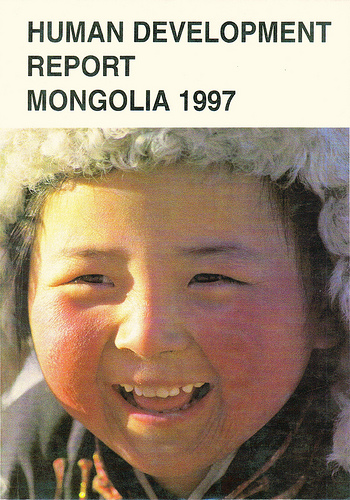
    This groundbreaking Mongolian Human Development Report – the country’s first – went beyond just chronicling Mongolia’s state of development in statistics and graphs. It placed the story of the Mongolian people during the transition years (post-1989) at its heart, using photographs, stories and case studies to detail the bigger narrative at play.

    Designed, laid out and published in Mongolia, the report broke with the practices of many other international organisations, who would publish outside of Mongolia – denying local companies much-needed work. The report’s costs helped to kick-start a publishing boom in the country and significantly raised standards in design and layout. The foundations laid down by the project producing the report ushered in a new age in publishing for Mongolia.

    The report’s launch was innovative, not only being distributed for free across the country, but also part of a multimedia campaign including television programming, public posters, town hall meetings and a ‘roadshow’ featuring the report’s researchers and writers.

    The initial print run of 10,000 copies was doubled as demand for the report increased. To the surprise of many, once hearing about the free report, herders would travel to the capital, Ulaanbaatar, to pick up their copy. The report proved people cared passionately about the development of their country and that development concepts are not to be the secret domain of ‘development practitioners’.

    You can read the report’s pdf here: books.google.co.uk/books?id=dx7Q-yJot_cC&printsec=fro…

    The MHDR 1997 was so popular it had two print runs. It has been cited in many books, journals and publications. It was the first exhaustive account of the country’s turbulent transition years and mapped the extent of poverty in the country.
    The Human Development Report Mongolia 1997 is available in many library collections around the world. In this case, the Oulu University Library Finland.
    The award-winning UN/UNDP Mongolia Development Portal was launched in 1997. It quickly became the go-to source on Mongolia’s development challenges.
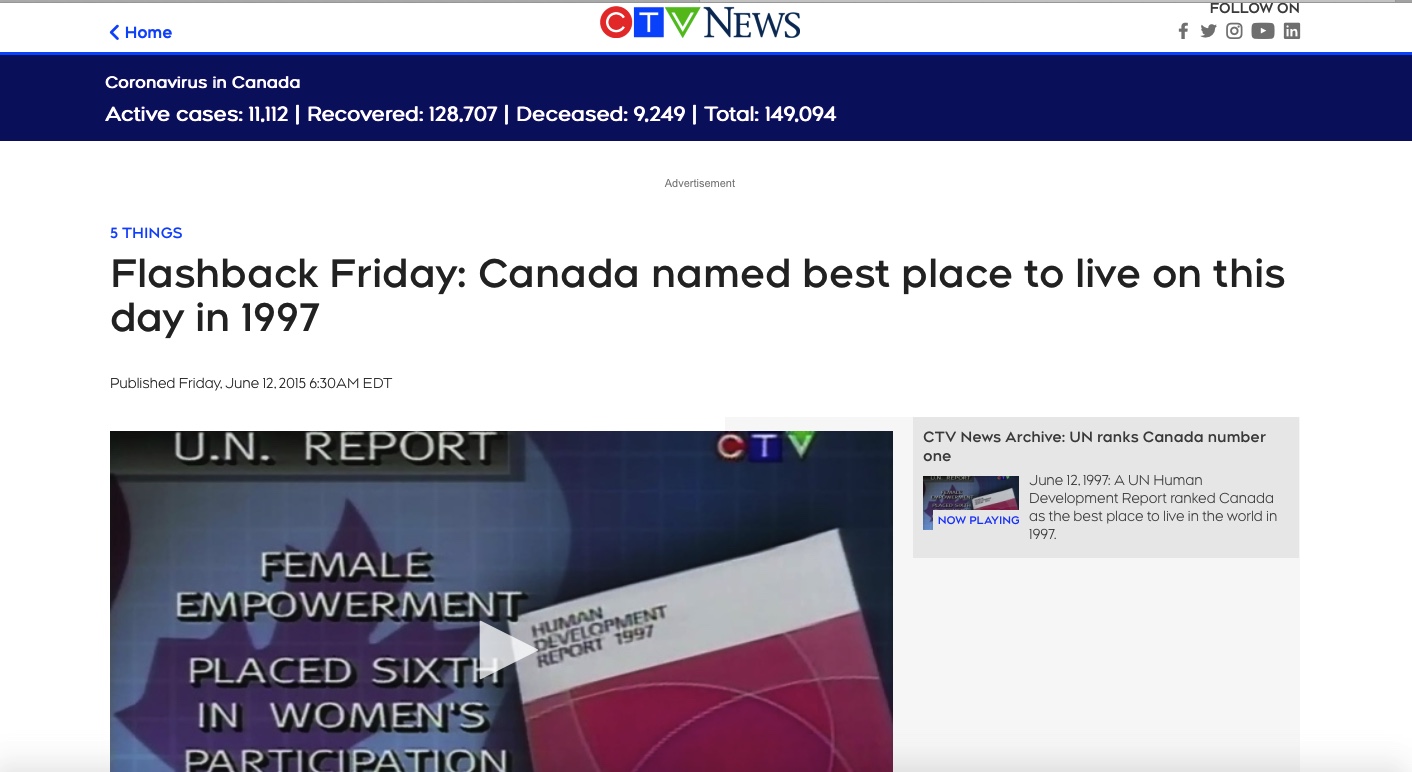
    CTV News: “Canada named best place to live on this day in 1997”. I considered it an enormous privilege to be given the opportunity to work with fellow Canadians on sharing our experiences with Mongolia during the 1990s crisis.

    “On this day in 1997, Canada was on top of the world. Or at least, on top of the United Nations’ annual ranking of the best places to live in the world.

    “CTV News archival footage captured a proud moment for Canada on June 12, 1997, as then-National News anchor Lloyd Robertson hailed the UN ranking as a “report card to be proud of.”

    “It’s not quite straight As but Canada is still at the head of the class,” Robertson said. “In fact, it’s No. 1 in the world.”

    Related Links

    “Canada beat out France, Norway, the United States and Iceland for top spot on the UN human development list, which ranks countries based on a variety of factors linked to quality of life.

    “It was the fourth straight year Canada topped the list.

    “Canada earned top marks in the life expectancy, health, education and income categories, which helped propel the country’s overall Human Development Index score to No. 1 in the world.”

    This work is licensed under a Creative Commons Attribution 4.0 International License.

    ORCID iD: https://orcid.org/0000-0001-5311-1052.

    © David South Consulting 2023

  • New African Film Proving Power of Creative Economy

    New African Film Proving Power of Creative Economy

    By David SouthDevelopment Challenges, South-South Solutions

    SOUTH-SOUTH CASE STUDY

    A new movie is generating excitement around life in the war-torn, chaotic and impoverished Democratic Republic of the Congo(http://en.wikipedia.org/wiki/Democratic_Republic_of_the_Congo – the central African nation – and proving how versatile and resilient a creative economy can be in a crisis.

    Viva Riva! (http://www.vivarivamovie.com) is set in the capital, Kinshasa, and gives a raw portrayal of sex, violence and gangsters in the city. The film has already won a fistful of awards, and will now be released in 18 African countries.

    Written and directed by Djo Tunda Wa Munga, it is being hailed as the first feature-length film to be made in the Democratic Republic of Congo in 25 years. The industry was shut down by long-serving dictator and President Mobutu Sese Seko, who was overthrown in 1997 in the First Congo War by Laurent-Désiré Kabila, who was supported by the governments of Rwanda, Burundi and Uganda.

    Africa has a rich film history but its movies have struggled to reach commercial audiences – both on the continent and around the world – outside of showcases at film festivals. Without access to a wide audience, filmmakers are not able to make the sort of profits possible for films with a wide commercial distribution. It has also been hard to compete with the big budgets and the big publicity machines of traditional film centres like Hollywood or Europe. But it looks like Viva Riva! could change that situation.

    Indigenous African filmmaking took off as countries became independent of their colonial European rulers in the 1960s and 1970s. One example is the Senegalese film comedy Xala (http://www.imdb.com/title/tt0073915/), directed by Ousmane Sembéne, and considered a classic. Previous portrayals of Africa have mostly been viewed through the cinematic lens of Europeans.

    As the second largest country in Africa, the Congo has an estimated population of over 71 million (2011 estimate), with Kinshasa home to more than 8 million people (CIA – The World Factbook). It has suffered badly from war and chaos and has some of the world’s worst statistics for rape and sexual violence brought about by these conditions. The so-called Second Congo War began in 1998 and is considered the world’s deadliest conflict since the Second World War.

    As a result, the world’s biggest United Nations peacekeeping mission is in the country in an attempt to stabilise the situation. (http://www.un.org/en/peacekeeping/missions/monuc/).

    Filmmaking forms part of the creative economy, a vital and growing sector in many countries. As the Creative Economy Report 2010 states: “A new development paradigm is emerging that links the economy and culture, embracing economic, cultural, technological and social aspects of development at both the macro and micro levels. Central to the new paradigm is the fact that creativity, knowledge and access to information are increasingly recognized as powerful engines driving economic growth and promoting development in a globalizing world.”

    For example,Nigeria’s US $2.75 billion annual film industry is the third largest in the world, following the U.S. and India. Nigeria’s ‘Nollywood’ produces more than 1,000 films a year, creating thousands of jobs, and is the country’s second most important industry after oil. In recognition of its importance, the country’s government has invested in the industry, reforming policies and providing training to promote film production and distribution.

    The Creative Economy Report 2010 has highlighted a few key trends for the global South. It found that creative industry products, especially domestically consumed ones like videos, music, video games and TV programmes, are weathering the global economic crisis well. It also found the creative economy can help boost economies and bring countries out of recession if the right government policies are in place.

    The exporting of creative goods and services continues to grow, doubling from 2002 to 2008. This represented a 14 percent per year growth rate. The global South’s exporting of creative goods reached a high of US $176 billion by 2008 and represented 43 percent of the world’s total creative industries trade.

    The majority of the world’s mobile phones are now in developing countries, representing a vast, new platform for distributing, sharing and selling cultural products and services. Broadband Internet is also being rolled out to more countries and represents an enormous emerging opportunity waiting for enterprising people to seize.

    The report also found more and more cities across the global South are placing creative economies at the centre of their urban development, emphasising culture and creative activities.

    For Viva Riva!, the next stop is Africa-wide release in Botswana, Burkina Faso, Kenya, Lesotho, South Africa, Swaziland and Uganda. The film’s producers have their sights set on even more countries in central and West Africa.

    “We want to show that you can release African films acrossAfrica,” co-producer Steven Markovitz told The Guardian. “As far as we can tell, it’s unprecedented. No one has tried to do an Africa-wide release in so many countries.”

    There is more at stake with the film than just Congolese pride: it is about proving an African film can successfully take on the slick and well-funded film distribution machines deployed byAmerica’s Hollywood and European film distributers.

    With the African middle class growing and a burgeoning African consumer class now clearly identified, many see this as the right time to make African film pay.

    “African cinemas have been dominated by Hollywood and European cultural programmes catering to the intellectual elite, not tapping into a growing middle class who are interested in seeing films about themselves and their neighbours,” Markovitz told The Guardian.

    “There is an audience, a real market for African films. They have disposable income and they want to be entertained. We hope that this will create a pipeline for further African titles on the continent.”

    Viva Riva! is in French and Lingala (http://en.wikipedia.org/wiki/Lingala_language). The story revolves around a hustler who makes quick cash stealing oil and celebrates by going on a hedonistic romp through Kinshasa’s night clubs.

    The film had its international debut at the 2010 Toronto International Film Festival and won the 2011 MTV Movie award for best African film.

    Markovitz is from South African film production company Big World Cinema (http://www.bigworld.co.za). The producers hope the film will appeal to both French speakers and English speakers.

    “There are distribution challenges in Africa but we thought this one presents an opportunity to make it happen,” he said. “Some African films have felt like homework but this is an entertaining action film and we think it can cross language barriers. We have to try things out.”

    Critics have said good things about the film. The Nigerian actor and director Akin Omotoso told The Guardian: “I loved Viva Riva! Absolute breath of fresh air, an adrenalin rush from top to bottom, a great gangster flick.”

    The film is unique as an African production that has “captured not just international attention but the continent’s attention”, he added.

    “I think it stands a good chance; as we know, it’s up to the audience but either way it has made history.”

    Published: November 2011

    Resources

    1) UNCTAD Global Database on the Creative Economy. Website:http://unctadstat.unctad.org/ReportFolders/reportFolders.aspx?sCS_referer=&sCS_ChosenLang=en

    2) Creative Economy Report 2010: Creative Economy: A Feasible Development Option. Website:http://www.unctad.org/Templates/WebFlyer.asp?intItemID=5763&lang=1

    4) Dictionary of African Filmmakers from Indiana University Press. Website:http://www.iupress.indiana.edu/product_info.php?products_id=76770

    6) The Filmmakers Guide to South Africa is the most recognised, established and representative brand marketing the South African film industry locally and internationally. Website: http://www.filmmakersguide.co.za

    7) Youth Filmmakers Africa: An initiative in Kenya to inspire the next generation of filmmakers. Website:http://www.indiegogo.com/Youth-Filmmakers-Africa

    Other Film Stories

    https://davidsouthconsulting.org/2022/03/30/angolan-film-grabs-attention-at-film-festival/

    https://davidsouthconsulting.org/2022/04/01/bolivian-film-schools-film-scene-paying-off/

    https://davidsouthconsulting.org/2022/10/21/local-animation-a-way-out-of-poverty/

    https://davidsouthconsulting.org/2021/02/04/new-cuban-film-seeks-to-revive-sector/

    https://davidsouthconsulting.org/2020/11/30/nollywood-booming-nigerian-film-industry/

    https://davidsouthconsulting.org/2022/03/30/riverwood-kenyan-super-fast-super-cheap-filmmaking/

    Creative Commons License

    This work is licensed under a
    Creative Commons Attribution-Noncommercial-No Derivative Works 3.0 License.

    ORCID iD: https://orcid.org/0000-0001-5311-1052.

    © David South Consulting 2023