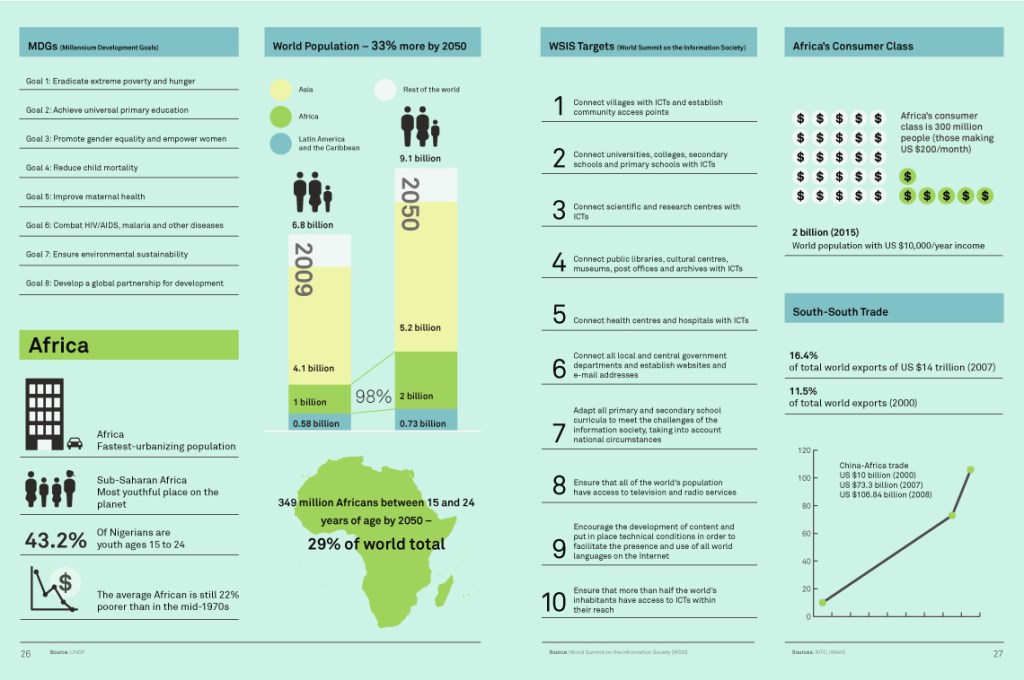
Tag: UNDP

  • Solar Solution to Lack of Electricity in Africa

    Solar Solution to Lack of Electricity in Africa

    By David SouthDevelopment Challenges, South-South Solutions

    SOUTH-SOUTH CASE STUDY

    Electricity is critical to improving human development and living standards. Yet, for many in the global South, electricity is either non-existent or its provision is patchy, erratic, unreliable or expensive.

    Just as Africa has been able to jump a generation ahead when it comes to communications through the mass adoption of mobile phones – a much cheaper option than trying to provide telephone wires and cables across the continent – so it could also bypass the burdensome costs of providing electricity mains to everyone by turning to smaller electricity generation technologies such as solar power. This is called “off-grid” electricity.

    The UN has set the goal of universal access to modern energy services by 2030. A report issued in April 2010 by United Nations Secretary-General Ban Ki-moon’s Advisory Group on Energy and Climate Change (AGECC) calls for expanding energy access to more than 2 billion people (http://www.unido.org/fileadmin/user_media/Publications/download/AGECCsummaryreport.pdf).

    The report found that a lack of access to modern energy services represents a significant barrier to development. Some 1.6 billion people still lack access to electricity.

    A reliable, affordable energy supply, the report says, is the key to economic growth and the achievement of the anti-poverty targets contained in the Millennium Development Goals.

    When a person has electricity and the lighting it powers, it is possible to do business and study late into the night. Electric lighting also makes streets and living areas safer. Electricity can power a plethora of labour-saving and life-enhancing consumer goods: televisions, refrigerators, vacuum cleaners, air conditioners and fans, washing machines, clothes dryers, computers. And electricity recharges that most essential item, the mobile phone, on which millions rely to do their daily business.

    After witnessing the struggle African health clinics have to access electricity, a Nairobi, Kenya-based company has developed a simple solution to ensure a steady supply of solar electricity. One Degree Solar’s (http://onedegreesolar.com/) founder, Gaurav Manchanda, developed and sells the BrightBox solar-charging system for lights, mobile phones, tablet computers and radios.

    He first gained experience working in the West African nation of Liberia with the Clinton Health Access Initiative (http://www.clintonfoundation.org/main/our-work/by-initiative/clinton-health-access-initiative/about.html). Working at the country’s Ministry of Health, he found most health clinics operated without electricity.

    He identified solar power as the only viable energy source. Trying to deliver fuel to power generators by the road network had two impediments: the diesel fuel was expensive and the road conditions were poor.

    After seeing that large solar-power systems required significant maintenance and upkeep, he started to explore the possibility of low-cost, and simple-to-use solar electricity products that would be useful to community healthcare workers.

    This became the beginning of One Degree Solar and its mission.

    The company’s main product is the BrightBox, a cleverly designed solar charger. A bright orange box with a folding, aluminum handle at the top for easy carrying, it switches on and off simply with a bright red button. It has a waterproof solar panel. The BrightBox has USB (universal service bus) (http://en.wikipedia.org/wiki/Universal_Serial_Bus) ports so that mobile phones and radios can be plugged in. It is also possible to plug in four lights at once with the four outports on the side of the box.

    It meets the standards set by the Lighting Africa initiative (http://lightingafrica.org/specs/one-degree-brightbox-2-.html) of the International Finance Corporation and the World Bank.

    One Degree Solar claim it is possible to set up a BrightBox in 10 minutes. When the indicator light has turned green, the box is fully charged and capable of providing 40 hours of light.

    A full charge can power two light bulbs for 20 hours. Manchanda told How We Made It In Africa (http://www.howwemadeitinafrica.com/) that he has sold 4,000 units of the BrightBox since its launch in October 2012.

    According to The Nation, the BrightBox is currently retailing in Kenya for Kenyan shillings 7,000 (US $82).

    One Degree Solar’s product range is sold to local resellers and distributors. The products are designed to be repaired using locally sourced parts and can be fixed by local electricians.

    Most of the sales so far have been in Kenya but the firm has also sold units to other countries.

    Testimonials on the BrightBox website tell of the transformation to people’s lives the clean energy source makes: “BrightBox has helped us in so many ways! We used to spend 800 Shillings (US $9.50) a month for two paraffin lanterns. The fumes smelled and always made us feel sick.”

    Manchanda is a strong believer in Africa’s potential and its future and dismisses those who are negative about the continent.

    “That was not a holistic assessment, but rather, an unnecessary and damaging generalization,” he told How We Made It In Africa. “Fortunately, most news outlets in Africa are now available online and offer a wider range of perspectives. The middle class is booming in certain countries. We have seen the success of mobile phones in enabling people to access other services. I think hope and progress come with innovation. Technology access has helped create entirely new markets and reach populations that otherwise could have taken decades to service with traditional approaches.

    “India was in a similar space 15 years ago before the Internet boom, and today parts of Nairobi (Kenya) are just like Delhi (India): people have a cell phone or two, there are large shopping malls, a booming middle class, and new construction everywhere.”

    Published: June 2013

    Resources

    Global Off-Grid Lighting Association: Global Off-Grid Lighting Association (GOGLA) has been established to act as the industry advocate with a focus on small and medium enterprises. It is a neutral, independent, not-for-profit association created to promote lighting solutions that benefit society and businesses in developing and emerging markets. GOGLA will support industry in the market penetration of clean, quality alternative lighting systems. Website: http://globaloff-gridlightingassociation.org/

    Solar Sister: Solar Sister eradicates energy poverty by empowering women with economic opportunity. Website: http://www.solarsister.org/

    Solarpod: Sunbird Solar/Thousand Suns manufactures, sources and distributes the portable solar generator range. Website: http://www.thousandsuns.com/

    4) Little Sun: An attractive, high-quality solar-powered lamp in the shape of a hand-sized sun developed by artist Olafur Eliasson and engineer Frederik Ottesen. Website: http://www.littlesun.com/

    Southern Innovator logo

    London Edit

    31 July 2013

    Development Challenges, South-South Solutions was launched as an e-newsletter in 2006 by UNDP’s South-South Cooperation Unit (now the United Nations Office for South-South Cooperation) based in New York, USA. It led on profiling the rise of the global South as an economic powerhouse and was one of the first regular publications to champion the global South’s innovators, entrepreneurs, and pioneers. It tracked the key trends that are now so profoundly reshaping how development is seen and done. This includes the rapid take-up of mobile phones and information technology in the global South (as profiled in the first issue of magazine Southern Innovator), the move to becoming a majority urban world, a growing global innovator culture, and the plethora of solutions being developed in the global South to tackle its problems and improve living conditions and boost human development. The success of the e-newsletter led to the launch of the magazine Southern Innovator.

    Creative Commons License

    This work is licensed under a
    Creative Commons Attribution-Noncommercial-No Derivative Works 3.0 License.

    ORCID iD: https://orcid.org/0000-0001-5311-1052.

    © David South Consulting 2023

  • African Afro Beats Leads New Music Wave to Europe

    African Afro Beats Leads New Music Wave to Europe

    By David SouthDevelopment Challenges, South-South Solutions

    SOUTH-SOUTH CASE STUDY

    A surge in interest in African music in Britain is creating new economic opportunities for the continent’s musicians. The new sound heating up the U.K. music scene is “Afro Beats” – a high energy hybrid that mixes Western rap influences with Ghanaian and Nigerian popular music.

    Afro Beats draws its inspiration from the “Afrobeat” sound popularized in the 1970s (http://en.wikipedia.org/wiki/Afrobeat).Afrobeat recordings from that time are still making money as long-forgotten tunes are re-packaged by so-called ‘crate divers’ – enterprising people who rummage through old vinyl record collections and re-brand scenes and sounds.

    This is part of the global creative economy, which is thriving despite the recent years of economic turmoil. Musicians offer many lessons for businesses in the South, both in their adaptability to new conditions and their resourcefulness in experimenting with new business models to earn an income.

    Afrobeat stars and pioneers like Nigeria’s Fela Kuti (http://en.wikipedia.org/wiki/Fela_Kuti) have been popular outside Africa for many decades. But Afro Beats – a new name with the addition of the crucial letter “s” – is being declared as the beginning of a new phase in taking African music global.

    As the digital music revolution has rocked the global music business, artists have had to adapt and change their business models. For all but a very few “big names,” it is no longer possible to build a career on royalties from recordings and hits. Stars and novices alike must battle with music pirates, who sell CDs and downloads of other people’s tunes and keep the money for themselves. Legitimate income often comes in micropayments from large music platforms like iTunes as people pay to download an individual song or mix and match tunes they like from an artist’s catalogue, rather than buying a whole album as they would in the past.

    Clever musicians have turned to building their brand, using live performances and the ability to sell other services and merchandise to make a living. They create their own web platforms, or mobile phone apps (applications), and do the marketing and distribution on their own to build a loyal fan base. Others are creating their own mobile radio stations by distributing CDs to the ubiquitous taxi mini buses that are the main means of transport in most African cities.

    But some things remain the same as in the past, such as the importance of having a champion, such as a radio DJ (disc jockey), who acts as a “taste maker,” discovering new acts and telling their audience about them.

    The DJ most associated with pushing the Afro Beats sound and scene is London-based DJ Abrantee (http://www.facebook.com/djabrantee).

    “I’ve been playing this music to three or four thousand people at African events in the U.K. for years,” DJ Abrantee told The Guardian. “For years we’ve had amazing hiplife, highlife, Nigerbeats, juju music, and I thought: you know what, let’s put it all back together as one thing again, and call it Afro Beats, as an umbrella term. Afrobeat, the 60s music, was more instrumental – this Afro Beats sound is different, it’s inter-twined with things like hip-hop and funky house, and there’s more of a young feel to it.”

    Abrantee (abrantee.com) promotes Afro Beats in the United Kingdom in myriad ways: he broadcasts six days a week on a radio station, including an Afro Beats-themed show on Saturdays. He travels around to DJ and takes Ghanaian and Nigerian tunes with him. He says Africa is so musically vibrant, he can’t keep up with it all.

    “This is specifically the western African sound: there are a lot of shared ideas between these two neighbouring countries,” he explained to The Guardian. “I see Afro Beats as music which makes the heart beat. And it’s funky, and hyped, and energetic and young.”

    Afro Beats has also been able to reach a young audience. “It’s striking how young they are – when I do these Afro Beats events there’s thousands of people, and they’re all youngsters, really.”

    One of the Afro Beats stars is D’Banj (mohitsrecords.com/d-banj) – a Nigerian rap star – who has been receiving attention for his song Oliver Twist.

    The Afro Beats sound is also provoking a new interest in all things African amongst youth with African parents. This is a big change from when American “cool” set the trends. As DJ Abrantee notes, “the parents are really pleased, and proud, that their kids are all of a sudden embracing their culture. It didn’t used to be cool, but now they’re going through their parents’ record collections going, ‘Have you got this old song by Daddy Lumba?’.”

    Some of the Afro Beats leaders include Sarkodie’s ‘U Go Kill Me’, Ice Prince’s ‘Oleku’, Atumpan’s ‘The Thing’, Castro ftAsamoah Gyan’s ‘African Girls’.

    Afro Beat’s popularity in Britain has led to African artists collaborating with musicians in the UK. Afro Beats musician Sarkodie has collaborated with London-based artists Donaeo and Sway.  DJ Abrantee sees this trend continuing and expanding. “You’re going to see more U.K. artists doing Afro Beats collaborations now,” he said.

    Other Nigerian artists who have benefited from the increasing awareness are Wiz Kid, 2Face Idibia and P-Square (mypsquare.com).

    Abrantee believes Ghana and Nigeria are having a big impact on the global music scene.

    “The floodgates have opened. Music is always evolving, and everyone’s always looking for the next drug. Funky house has died out, grime is still there but it’s gone back underground, electro-pop’s got U.K. urban music in the charts, but that’ll die out, it’s got a short shelf-life. … and people are finally noticing I’m getting 3,000 people coming out to dance to Afro Beats.”

    British-Ghanaian hip-hop performer Sway sees connections between Afrobeat and Afro Beats.

    “Fela Kuti is obviously a massive legend in the game, and what he was doing is not too different to what D’Banj is doing now – taking western influences and adding them to African culture, and coming up with something new, that appeals to everyone,” he said.

    And technology is seen as the binding element that is connecting African music and musicians to other scenes.

    “African music in Africa is evolving in relation to what’s going on abroad too,” said Sway. “Via the Internet they’re picking up certain trends much quicker: so for example you have Auto-Tune and western styles of singing cropping up on all these Afro Beats tracks.”

    And Sway believes the quality of production of African music has improved: “There’s been a serious change in the music coming out of Africa lately.

    “The sound is heavier and clearer, the videos are better, there’s been a positive growth in the African music scene. It was just a matter of time before people paid attention.

    “When you’ve got African swag and African traditions combined with up-to-date western styles, and singing in English, well – you’ve got a winning formula on your hands.”

    Published: February 2012

    Resources  

    1) Mongolian Rock Pop book: In the Mongolian language, this UNDP book details how pop musicians led on business innovation during the turbulent transition years of the 1990s. Website: http://www.scribd.com/doc/23917535/Mongolian-Rock-and-Pop-Book

    2) Afrobeat: An interactive exploration of Afrobeat and its participants from National Geographic. Website: http://worldmusic.nationalgeographic.com/view/page.basic/genre/content.genre/afrobeat_686/en_US

    3) DJ Abrantee: More from the champion of the Afro Beats scene. Website: http://www.abrantee.com

    https://davidsouthconsulting.org/2022/11/21/africa/

    https://davidsouthconsulting.org/2022/11/19/african-culture-as-big-business/

    https://davidsouthconsulting.org/2022/11/17/african-ingenuity-attracting-interest/

    https://davidsouthconsulting.org/2022/10/26/africas-consumer-market-in-spotlight-for-2011/

    https://davidsouthconsulting.org/2021/03/12/afro-coffee-blending-good-design-and-coffee/

    https://davidsouthconsulting.org/2021/01/05/afropolitan-african-fashion-scene-bursting-with-energy/

    https://davidsouthconsulting.org/2022/11/17/cashing-in-on-music-in-brazil/

    https://davidsouthconsulting.org/2022/12/18/disabled-congolese-musicians-become-world-hit/

    https://davidsouthconsulting.org/2022/10/20/ghana-wants-to-tap-global-trendy-party-scene/

    https://davidsouthconsulting.org/2022/10/24/made-in-africa-fashion-brand-pioneers-aim-for-global-success/

    https://davidsouthconsulting.org/2021/11/09/mauritanian-music-shop-shares-songs-and-friendship/

    https://davidsouthconsulting.org/2023/02/07/mongolian-rock-and-pop-book-mongolia-sings-its-own-song/

    https://davidsouthconsulting.org/2020/12/17/mongolias-musical-entrepreneurs-led-way-out-of-crisis-2018/

    https://davidsouthconsulting.org/2021/11/09/ring-tones-and-mobile-phone-downloads-are-generating-income-for-local-musicians-in-africa/

    https://davidsouthconsulting.org/2022/06/25/shoes-with-sole-ethiopian-web-success-story/

    https://davidsouthconsulting.org/2021/03/05/southern-innovator-issue-2/

    https://davidsouthconsulting.org/2021/11/09/taxis-promote-african-music-beats/

    https://davidsouthconsulting.org/2022/04/15/youth-surge-in-the-south-a-great-business-opportunity/

    Development Challenges, South-South Solutions was launched as an e-newsletter in 2006 by UNDP’s South-South Cooperation Unit (now the United Nations Office for South-South Cooperation) based in New York, USA. It led on profiling the rise of the global South as an economic powerhouse and was one of the first regular publications to champion the global South’s innovators, entrepreneurs, and pioneers. It tracked the key trends that are now so profoundly reshaping how development is seen and done. This includes the rapid take-up of mobile phones and information technology in the global South (as profiled in the first issue of magazine Southern Innovator), the move to becoming a majority urban world, a growing global innovator culture, and the plethora of solutions being developed in the global South to tackle its problems and improve living conditions and boost human development. The success of the e-newsletter led to the launch of the magazine Southern Innovator.  

    Creative Commons License

    This work is licensed under a
    Creative Commons Attribution-Noncommercial-No Derivative Works 3.0 License.

    ORCID iD: https://orcid.org/0000-0001-5311-1052.

    © David South Consulting 2023

  • Model Cities Across the South Challenge Old Ways

    Model Cities Across the South Challenge Old Ways

    By David SouthDevelopment Challenges, South-South Solutions

    SOUTH-SOUTH CASE STUDY

    Pioneering thinking about how resources are used and how people live their lives is taking place in the dynamic economies of the global South. Facing a vast population surge to urban areas, these include attempts to build “green” cities and low-waste, smart and digital communities.

    These model cities are clever solutions for the world’s growing – and urbanizing – populations coping with a stressed and damaged environment. Unlike one-off technologies and ideas developed in isolation, the model cities approach starts from scratch. They become living laboratories on which research and development take place at the heart of the community, not just the preserve of aloof academics hidden away in labs.

    This is critical work because the world is rapidly urbanizing and needs solutions to ensure this process does not lead to chaos and misery. How these cities turn out could hold the fate of humanity and much is at stake. According to a report by the International Institute for Environment and Development, Africa now has a larger urban population than North America and 25 of the world’s fastest growing big cities. Getting to grips with urban development will be critical for the future of the continent and the wellbeing of its people.

    By 2025, Asia could have 10 or more cities with populations larger than 20 million (Far Eastern Economic Review). People will be living in densely populated cities and they will need to be smart cities if they are to work.

    In the United Arab Emirates (http://en.wikipedia.org/wiki/Abu_Dhabi), Masdar City (http://www.masdar.ae/en/home/index.aspx), is a model city not only being built, but being used as way to develop commercially successful environment technologies – renewable energy solutions and clean technologies – that will turn into future income for the city and Abu Dhabi.

    The traditional approach in other countries has been to keep scientists and innovators disconnected from the living, breathing city. They toil away in labs or universities and only really get to test their technologies and theories after going through lengthy testing and approval by a city’s government. As Masdar’s website says, this city will develop “from research to commercial deployment – with the aim of creating scalable clean energy solutions.”

    The planned community will be 6 square kilometres in size and wants to be “one of the most sustainable cities in the world”. Located 17 kilometres from Abu Dhabi, it hopes to be a pedestrian-friendly town home to 40,000 residents. At the heart of Masdar City is the Masdar Institute: a research university developed with the Massachusetts Institute of Technology (MIT). The students are the city’s first residents and a range of top international companies are planning to locate in there as well. German technology company Siemens will place its Middle East headquarters in Masdar and its Center of Excellence in Building Technologies R&D centre. Others joining them include GE, BASF, Schneider and the Korea Technopark Association.

    The Surbana Urban Planning Group (www.surbana.com) spent five decades developing its experience with the rapid growth of Singapore (http://en.wikipedia.org/wiki/Singapore): a city-state boasting the highest quality of life in Asia (Economist Intelligence Unit) which took itself from an impoverished city to one of the world’s leading export and manufacturing economies. Surbana built 26 planned townships in Singapore that now house 85 percent of the city’s 4.5 million residents. It specializes in designing, implementing and maintaining complex urban areas.

    Singapore has pioneered a number of ways to house a large population within a small territory. This experience is now being put to work in China at the Tianjin Eco-City development (http://www.tianjinecocity.gov.sg/masterplan.htm). Known for high pollution levels due to heavy industry Tianjin will undergo a big change. The project aims to develop a template that can be used for other cities throughout China and around the world.

    The 30-square-kilometre Tianjin Eco-City is being built around a wetland and river. The idea is to offer its residents an environment with easy access to recreational spaces and the natural environment. The transport system will avoid cars and instead use a light rail system as the main mode of transport. It should be home to 350,000 people.

    Cleverly, each suburban area will have commercial sub-centres to enable as many people as possible to work locally and avoid the need to commute long distances. The Eco-City will be built by assembling “eco-cell” – like a bee’s honeycomb – neighbourhoods self-contained with schools, child care, commercial and work areas, and parks. This set up is geared to collecting a common mistake in other new developments that only consider housing, forgeting about how people work, shop and recreate.

    There will be seven distinct neighbourhoods: Lifescape, Eco-Valley, Solarscape, Urbanscape, Windscape, Earthscape and Eco-Corridors (http://inhabitat.com/tianjin-eco-city-is-a-futuristic-green-landscape-for-350000-residents/). An “Eco-Valley” will run through the city as a green spine connecting north and south.

    It is hoped the city will be completed by 2020. Just 10 minutes’ drive from the Tianjin Economic-Technological Development Area (http://en.investteda.org/) business parks, the residents should be well served for jobs.

    In South Korea, the Digital Media City in Seoul (http://dmc.seoul.go.kr/eng/index.do) bills itself as a “harmony of nature, high-tech, and culture”. The Seoul municipal government devised the DMC in the 1990s to capitalize on the economic and social benefits of being the world’s most digitally wired nation.

    The DMC project serves the nation’s larger goals of transitioning from a manufacturing to an innovation economy and promoting Seoul as an east-Asian hub for commerce. The DMC is about creating new business opportunities.

    But this isn’t just about business and research and development: it is a comprehensive digital economy experience, with schools, housing for the affiliates of international firms, moderate and lower-income housing, commercial and convention facilities, entertainment zones, and the city’s central rail station are all located in or near the Digital Media City.

    Published: February 2011

    Resources

    1) More Urban, Less Poor: The first textbook to explore urban development and management and challenge the notion unplanned shanty towns without basic services are the inevitable consequence of urbanization. Website: www.earthscan.co.uk

    * Arrival City: The Final Migration and Our Next World by Doug Saunders. Website: www.arrivalcity.net

    https://davidsouthconsulting.org/2022/03/29/model-city-to-test-the-new-urbanism-concept-in-india/

    https://davidsouthconsulting.org/2022/10/06/africas-fast-growing-cities-a-new-frontier-of-opportunities/

    https://davidsouthconsulting.org/2020/12/04/big-data-can-transform-the-global-souths-growing-cities/

    https://davidsouthconsulting.org/2022/10/19/chinese-building-solution-for-rapidly-urbanizing-global-south/

    https://davidsouthconsulting.org/cities-urbanization/

    https://davidsouthconsulting.org/2021/10/21/cities-for-all-shows-how-the-worlds-poor-are-building-ties-across-the-global-south/

    https://davidsouthconsulting.org/2020/12/11/cyber-cities-an-oasis-of-prosperity-in-the-south/

    https://davidsouthconsulting.org/2017/11/08/eco-cities-up-close-2013/

    https://davidsouthconsulting.org/2022/03/20/global-south-eco-cities-show-how-the-future-can-be/

    https://davidsouthconsulting.org/2021/11/12/global-souths-rising-megacities-challenge-idea-of-urban-living/

    https://davidsouthconsulting.org/2022/11/16/housing-innovation-in-souths-urban-areas/

    https://davidsouthconsulting.org/2020/12/14/innovation-in-growing-cities-to-prevent-social-exclusion/

    https://davidsouthconsulting.org/2022/10/10/more-futuristic-african-cities-in-the-works/

    https://davidsouthconsulting.org/2021/11/12/new-cities-offering-solutions-for-growing-urban-populations/

    https://davidsouthconsulting.org/2017/11/08/smart-cities-up-close-2013/

    https://davidsouthconsulting.org/2021/10/22/south-south-cooperation-for-cities-in-asia/

    https://davidsouthconsulting.org/2021/03/05/southern-innovator-issue-4/

    https://davidsouthconsulting.org/2022/09/26/3d-home-printing-landmark-10-houses-in-a-day/

    https://davidsouthconsulting.org/2022/11/17/tiny-homes-to-meet-global-housing-crisis/

    Development Challenges, South-South Solutions was launched as an e-newsletter in 2006 by UNDP’s South-South Cooperation Unit (now the United Nations Office for South-South Cooperation) based in New York, USA. It led on profiling the rise of the global South as an economic powerhouse and was one of the first regular publications to champion the global South’s innovators, entrepreneurs, and pioneers. It tracked the key trends that are now so profoundly reshaping how development is seen and done. This includes the rapid take-up of mobile phones and information technology in the global South (as profiled in the first issue of magazine Southern Innovator), the move to becoming a majority urban world, a growing global innovator culture, and the plethora of solutions being developed in the global South to tackle its problems and improve living conditions and boost human development. The success of the e-newsletter led to the launch of the magazine Southern Innovator.  

    Creative Commons License

    This work is licensed under a
    Creative Commons Attribution-Noncommercial-No Derivative Works 3.0 License

    ORCID iD: https://orcid.org/0000-0001-5311-1052.

    © David South Consulting 2023

  • Asian Factories Starting to go Green

    Asian Factories Starting to go Green

    By David SouthDevelopment Challenges, South-South Solutions

    SOUTH-SOUTH CASE STUDY

    Media headlines have recently highlighted the growing air pollution crisis in Asia’s expanding cities. This is caused by a mix of factors – the growing number of vehicles, coal-powered factories, people burning dirty fuels to heat their homes, and poor enforcement of standards – and has severe consequences for human health. If it’s not tackled, more and more countries will see large rises in respiratory problems, cancers and early deaths from pollution-caused illnesses (http://www.nrdc.org/air/).

    The World Health Organization (WHO) says air pollution is the world’s largest environmental health risk, killing 7 million people every year. Asia has the largest number of air pollution deaths in the world, with 3.3 million deaths linked to indoor air pollution and 2.6 million deaths related to outdoor air pollution (Clean Air Asia).

    While most of the Asian countries where this is a problem are also aggressively growing their economies in order to get richer and raise living standards, there is a rising awareness of the need to balance a modern, industrial economy with human health and the environment.

    One solution is to adopt green and sustainable building standards when constructing new factories. This is more than just a public relations exercise: the energy savings possible from building smart pay off in the long run. And green factories not only pollute less, they save lives and the environment.

    Asia plays a critical role in producing the world’s consumer products, from the small and simple to the highly complex components used in 21st-century computing technologies.

    Intel (intel.com), the manufacturer of electronic devices and the computer chips that go inside them, is trying to lead the way. It has built a US $1 billion manufacturing plant 16 kilometers outside Ho Chi Minh City, Vietnam, and it is designed to exceed Vietnamese environmental and sustainability guidelines and laws.

    Opened in 2010, it boasts the country’s largest solar power system. It is also currently working on a water reclamation system to reduce water consumption at the plant by 68 per cent, according to The New York Times. It is hoping to receive certification from the US Green Building Council (usgbc.org).

    It is all part of a wider trend that is starting to reverse the damaging, short-termist approach of the past. More and more Western multinationals and their Asian suppliers are building environmentally sound factories in the developing world.

    According to the US Green Building Council, around 300 manufacturing facilities in Asia are either certified or are awaiting Leadership in Energy and Environmental Design (LEED) certification. The LEED certification recognizes the building has met certain standards in becoming a ‘green’ building.

    Going green is more and more part of corporate policy for companies that want to avoid the bad publicity of disasters such as the garment factory collapse that killed 1,135 people in Bangladesh in April 2013.

    But it is not just driven by a desire to avoid bad publicity: large corporations that build factories in the global South are also realizing there are big financial savings to be made.

    Intel has been able to reduce its global energy costs by US $111 million since 2008. It did this by investing US $59 million in 1,500 projects to boost sustainability across its facilities worldwide. The projects have reduced carbon dioxide emissions equivalent to the amount produced by 126,000 American households per year.

    Intel’s solar array in Vietnam, which cost US $1.1 million, offsets the equivalent of 500 pollution-belching motorbikes every day.

    How effective are LEED-certified buildings? The New York Times reported that a 2011 survey compared a typical shoe factory with a LEED factory run by the American sport shoe maker Nike. It found the LEED factory used 18 per cent less electricity and fuel and 53 per cent less water.

    And this trend is creating a new economy unto itself. As an example, a new marketplace for industrial efficiency upgrading is developing in India. Power outages are frequent in India, so finding a way to save electricity and alternatives to dependence on the national power grid is attractive to any economic enterprise.

    Prashant Kapoor, principal industry specialist for green buildings at the International Finance Corporation (IFC), believes demand for upgrades is strong enough that various companies can specialize in this field and profit from it.

    And things are also happening in the notoriously smog-choked cities of China. By the end of 2012, China had certified eight factories and 742 buildings as LEED, according to the China buildings programme at the Energy Foundation (ef.org) in San Francisco.

    Damien Duhamel of Solidiance (solidiance.com), a firm that advises businesses on how to grow in Asia, believes avoiding risk caused by environmental accidents or scandals is heightened by the growing presence of social media, which amplifies negative publicity.

    “The next battle will be here” for higher corporate environmental standards, Duhamel believes. “This is why some smart companies – Intel, for example – took the steps of being proactive.”

    Published: April 2014

    Resources

    1) Leadership in Energy and Environmental Design (LEED): LEED, or Leadership in Energy & Environmental Design, is a green building certification program that recognizes best-in-class building strategies and practices. Website: http://www.usgbc.org/leed

    2) US Green Building Council (USGBC): Its mission is to transform the way buildings and communities are designed, built and operated, enabling an environmentally and socially responsible, healthy, and prosperous environment that improves the quality of life. Website: http://www.usgbc.org/

    3) Dwell: Dwell magazine is focused on demonstrating that modern design can be both functional and comfortable. Website: dwell.com

    4) Inhabitat: Design for a Better World: Inhabitat.com is a weblog devoted to the future of design, tracking the innovations in technology, practices and materials that are pushing architecture and home design towards a smarter and more sustainable future. Website: inhabitat.com

    5) Solidiance: Singapore-based consulting firm specializing in Asia’s green-building sector. Website: solidiance.com

    6) Clean Air Asia: Clean Air Asia was established in 2001 as the premier air quality network for Asia by the Asian Development Bank, World Bank, and USAID. Its mission is to promote better air quality and livable cities by translating knowledge to policies and actions that reduce air pollution and greenhouse gas emissions from transport, energy and other sectors. Website: cleanairinitiative.org

    7) Southern Innovator Issue 4: Cities and Urbanization: This issue is packed with ideas on to how make cities and urban environments greener and reduce air pollution. Website: http://www.scribd.com/doc/133622315/Southern-Innovator-Magazine-Issue-4-Cities-and-Urbanization and here: http://tinyurl.com/oc2mqgm

    8) Better Air Quality Conference 2014 and 8th Regional Environmentally Sustainable Transport Forum in Asia:  From 19 to 21 November 2014 in Colombo, Sri Lanka, BAQ is the leading event on air quality in Asia, covering the key sectors of transport, energy, industry and climate change, with a particular emphasis on government policies and measures. Website: http://cleanairinitiative.org/portal/node/12274

    9) Tianjin Eco-city: The Sino-Singapore Tianjin Eco-city’s vision is to be a thriving city which is socially harmonious, environmentally-friendly and resource-efficient. Website: tianjinecocity.gov.sg

    10) Songdo: Songdo International Business District (IBD) officially opened on August 7, 2009 as a designated Free Economic Zone and the first new sustainable city in the world designed to be an international business district. Website: songdo.com

    https://davidsouthconsulting.org/2022/09/27/caribbean-island-st-kitts-goes-green-for-tourism/

    https://davidsouthconsulting.org/2021/01/25/creating-green-fashion-in-china/

    https://davidsouthconsulting.org/2021/02/01/ethiopia-and-djibouti-join-push-to-tap-geothermal-sources-for-green-energy/

    https://davidsouthconsulting.org/2023/02/03/environmental-public-awareness-handbook-case-studies-and-lessons-learned-in-mongolia/

    https://davidsouthconsulting.org/2021/08/29/indian-business-model-makes-green-energy-affordable/

    https://davidsouthconsulting.org/2022/11/11/innovation-cairos-green-technology-pioneers/

    https://davidsouthconsulting.org/2021/10/22/innovations-in-green-economy-top-three-agenda/

    https://davidsouthconsulting.org/2021/08/07/mongolian-green-book/

    https://davidsouthconsulting.org/2022/04/14/prisons-with-green-solutions/

    https://davidsouthconsulting.org/2021/02/04/us-450-million-pledged-for-green-economy-investments-at-kenyan-gssd-expo/

    Development Challenges, South-South Solutions was launched as an e-newsletter in 2006 by UNDP’s South-South Cooperation Unit (now the United Nations Office for South-South Cooperation) based in New York, USA. It led on profiling the rise of the global South as an economic powerhouse and was one of the first regular publications to champion the global South’s innovators, entrepreneurs, and pioneers. It tracked the key trends that are now so profoundly reshaping how development is seen and done. This includes the rapid take-up of mobile phones and information technology in the global South (as profiled in the first issue of magazine Southern Innovator), the move to becoming a majority urban world, a growing global innovator culture, and the plethora of solutions being developed in the global South to tackle its problems and improve living conditions and boost human development. The success of the e-newsletter led to the launch of the magazine Southern Innovator.  

    Creative Commons License

    This work is licensed under a
    Creative Commons Attribution-Noncommercial-No Derivative Works 3.0 License

    ORCID iD: https://orcid.org/0000-0001-5311-1052.

    © David South Consulting 2022