Tag: UNDP

  • Ambitious Schemes Hope to Advance Economic Development

    Ambitious Schemes Hope to Advance Economic Development

    By David SouthDevelopment Challenges, South-South Solutions

    SOUTH-SOUTH CASE STUDY

    Sometimes it takes a bold, fresh start to speed up economic and human development goals. Taking a large-scale approach has been used around the world, either establishing new trade zones or even a new city.

    Two recent examples in Nigeria and Afghanistan are attempting to speed economic development in their respective countries, with both receiving help from experienced Asian practitioners of rapid economic development.

    The role models for this approach are the so-called “Asian Tigers”: they include Taiwan, Hong Kong, Singapore and South Korea. They are admired because each country rose from extreme poverty to become some of the Earth’s richest nations. Importantly, what they did stands as proof that extreme poverty can be escaped from; people can become much wealthier in just a decade or two.

    The pioneer of using trade zones to speed development is the Asian city state of Singapore (http://www.gov.sg/government/web/content/govsg/classic/home)..Fifty years ago it was one of Asia’s poorest countries. With its port (http://www.mpa.gov.sg/) it had a way to turn things around but it also realized in the early 1960s it could not just compete by having cheap labour, something that was plentiful across the developing world (http://www.mti.gov.sg/MTIInsights/Pages/Economic-History-and-Milestones.aspx). It needed unique technical skills that could not be found elsewhere.

    The country was unable to create products and services that it could export and compete in global markets because of a lack of skills, the Government determined. Authorities employed a mix of measures to make the country attractive to foreign companies to boost skills. These included fair enforcement of local laws, tax incentives and upgraded infrastructure, much of it paid for with an infrastructure tax, rather than borrowing. With the influx of new thinking and high-quality skills, new technologies and new ways of doing things, in time, a culture of innovation became hardwired into the way things were done in Singapore.

    Beginning in 1961 with the Jurong Industrial Estate (http://infopedia.nl.sg/articles/SIP_246_2004-12-16.html), the Singapore government set aside land to develop the economy by attracting international businesses and boosting its existing port facilities. It also established the Economic Development Board (EDB) in 1961 and the Singapore Tourism Promotion Board (STPB) in 1964.

    By creating favorable conditions for international businesses to come in and operate, Singapore quickly developed to become one of Asia’s wealthiest trading and manufacturing centres.

    This is a strategy China successfully implemented in the 1980s and 1990s and in turn generated the largest and quickest population shift out of poverty in human history, turning the country into an economic powerhouse.

    The secrets to making this strategy work include understanding what modern infrastructure requirements are necessary for international businesses. These days, this means speedy and generous bandwidth for the Internet, modern airports, roads, security, and quality housing and food.

    One of the biggest contemporary challenges is competition. Whereas Singapore was a pioneer in its day, now, many countries across the global South are pursuing this strategy to spur growth. An international company has many options to consider, and will more than likely gravitate towards the country that makes the best offer with the least risk.

    Trade zones are places ripe with opportunity for innovators. New places tend to be seeking the latest in information and communication technologies, the latest in transportation options, modern housing and office facilities. All of these changes require innovators with fresh thinking to make them work. It is also often easier to introduce new ways of doing things to places that are not coping with legacy infrastructure and old habits and ways.

    Billing itself as a “new model city,” the Lekki Free Zone Lagos, Nigeria (lekkizone.com) in West Africa is trying to bring a fresh start to the city and the region. It is a joint partnership between investors from China and Nigeria.

    Its goal is to better connect regional markets to the global economy. The free trade zone hopes to remove barriers to growth and to attract international investment, becoming the top destination for inward investment in Africa. The project is being run by the Lagos State Government but funded with private capital investment.

    Nigeria has been looking into Free Zones since 1982, as it sought additional ways to earn income apart from oil exports. The Export Processing Zone Act 63 was passed in 1992 and the Calabar Export Processing Zone was eventually set up in 1999 (http://www.nepza.gov.ng/index.php?option=com_content&task=view&id=18&Itemid=34). Since then, a slew of Free Zones have been set up, or are in the works.

    The Lekki Free Zone is envisioned as a high-tech zone that will eventually lead to the creation of 2 million jobs. The Zone’s investors are targeting businesses working in oil and gas, petrochemicals, electronics, light and heavy equipment, machinery and automobiles, pharmaceuticals, textiles, shopping and banking and financial services.

    Lagos State is home to 21 million people, and the current city of Lagos is on course to become the third-largest megacity in the world. Officials claim the area has an economic growth rate of 16.8 per cent per year.

    The 16,500 hectare Lekki Free Zone, to the southeast of the city, is divided into two parts: an industrial zone and a residential zone. The residential zone will include apartments and villas, shopping malls and plazas, hospitals and clinics, schools and research and development centres and a hotel, tour and recreational centres, golf courses, gyms and water sports facilities.

    Located on the southern coast of Nigeria with connections to the Atlantic Ocean and the Gulf of Guinea, the Lekki Free Zone says it will give companies access to the largest consumer market in Africa, with a potential reach of 500 million people.

    The companies will also be able to draw on Nigeria’s natural resources, including oil, natural gas, timber, rubber, cocoa, Arabic gum and sesame seeds as examples.

    Another new beginning is being sought in war-torn Afghanistan, which is working on building a new city close to the capital, Kabul.

    Kabul New City started construction in 2013 and is planned to be a city of canals, parks and villas. It will be home to 1.5 million people, cost US $33 billion and take 15 years to complete. It is being partly funded by Japan.

    It is a very ambitious scheme for a country that has been mired in conflict for decades. It is hoped the initial seed capital invested by Japan will attract other investors to fully fund the project. Japan got the project going with a commitment to contribute US $106 million between 2009 and 2015.

    The site of Kabul New City is 19 kilometres from the existing Kabul, near the Bagram airbase used by NATO forces in the country.

    Foreign military forces are looking to leave Afghanistan in 2014 and the new city offers a fresh start for the country after years of conflict.

    Located in an area surrounded by the Marko mountains, it is in “one of the safest areas of Afghanistan,” Abdul Habib Zadran, Chief Financial Officer of the Dehsabz-Barikab City Development Authority (http://www.dcda.gov.af/), the agency in charge of the project, told The Sunday Times.

    The project could be a significant leap ahead in modernization from the current conditions in Kabul, where the streets are in poor condition and buildings in disrepair. Kabul was originally built for 800,000 people, according to The Sunday Times, but now has over 4 million residents. Projections forecast the city growing to 6.5 million people by 2025. Kabul will experience extreme pressure to handle this growing population and find the resources to serve it.

    The homes would receive electricity from solar panels and renewable energy sources. Kabul New City will need to tackle the problem of access to enough water to service the growing new city’s population. Plans are afoot to provide water from rivers north of the city.

    The master plan for the new city has been designed by Zahra Breshna (breshna-consulting.com), an Afghan-German company which has also built the new Kabul Bank headquarters. The company calls the project “a new beginning for Kabul.”

    Published: May 2013

    Resources

    1) Tianjin Eco-city: The Sino-Singapore Tianjin Eco-city’s vision is to be a thriving city which is socially harmonious, environmentally-friendly and resource-efficient. Website: tianjinecocity.gov.sg/

    2) Songdo International Business District: Songdo International Business District (IBD) is home to the UN’s Green Climate Fund and is a smart city located in the Republic of Korea built to the highest green building standards. Website: songdo.com/

    3) Singapore: An island and islets in the heart of Southeast Asia, between Malaysia and Indonesia. Website: http://app.www.sg/

    4) Djibouti Free Zone: Djibouti Free Zone was created with one primary goal in mind – to bring about a sea-change in the way Africa thinks and does business. No red tape, ruthless efficiency and genuinely exhaustive services – in essence, we offer the ideal conditions for trade and commerce to flourish in. Website: djiboutifz.com/

    5) Cisco Smart + Connected Cities: Cisco Smart+Connected Communities solutions use intelligent networking capabilities to bring together people, services, community assets, and information to help community leaders address these world challenges. Website: http://www.cisco.com/web/strategy/smart_connected_communities.html

    6) IBM Smarter Cities: Smarter cities drive sustainable economic growth and prosperity for their citizens. Their leaders have the tools to analyze data for better decisions, anticipate problems to resolve them proactively and coordinate resources to operate effectively. Website:http://www.ibm.com/smarterplanet/us/en/smarter_cities/overview/

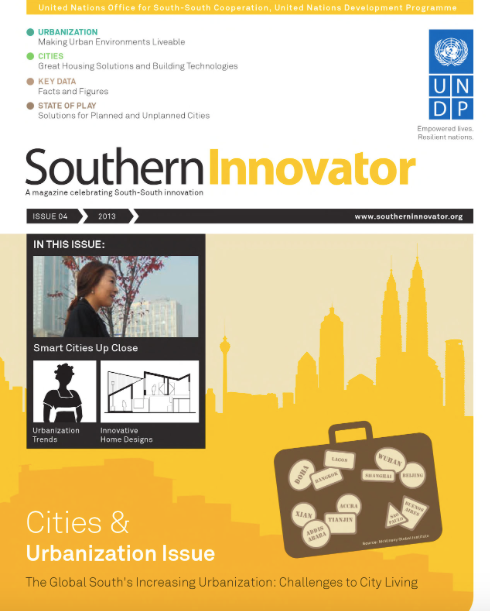
    7) Southern Innovator Magazine Issue 4: Cities and Urbanization. Website: http://www.scribd.com/doc/133622315/Southern-Innovator-Magazine-Issue-4-Cities-and-Urbanization

    Southern Innovator logo

    London Edit

    31 July 2013

    Development Challenges, South-South Solutions was launched as an e-newsletter in 2006 by UNDP’s South-South Cooperation Unit (now the United Nations Office for South-South Cooperation) based in New York, USA. It led on profiling the rise of the global South as an economic powerhouse and was one of the first regular publications to champion the global South’s innovators, entrepreneurs, and pioneers. It tracked the key trends that are now so profoundly reshaping how development is seen and done. This includes the rapid take-up of mobile phones and information technology in the global South (as profiled in the first issue of magazine Southern Innovator), the move to becoming a majority urban world, a growing global innovator culture, and the plethora of solutions being developed in the global South to tackle its problems and improve living conditions and boost human development. The success of the e-newsletter led to the launch of the magazine Southern Innovator. 

    Creative Commons License

    This work is licensed under a
    Creative Commons Attribution-Noncommercial-No Derivative Works 3.0 License.

    ORCID iD: https://orcid.org/0000-0001-5311-1052.

    © David South Consulting 2023

  • Pioneering African Airlines Help to Expand Routes

    Pioneering African Airlines Help to Expand Routes

    By David SouthDevelopment Challenges, South-South Solutions

    SOUTH-SOUTH CASE STUDY

    The last decade has seen a revolution in African air travel. The number of air routes has grown and this has paralleled the economic growth across the continent. As demand has been strong for Africa’s resources, it has also fueled a consumer boom that is benefiting an increasing number of people.

    More and more people can afford to fly and flights are taking Africans to cities across Africa and out of Africa to visit cities around the world. These flights also bring in a growing number of tourists and business people.

    As growth continues despite the many obstacles and challenges, and as urbanization rolls onwards, new routes have sprung up linking the continent’s cities to each other and to the world. National and local airlines have evolved to meet growing demand for flights, with the big global airlines moving in to compete.

    Africa’s airlines, tourism and airport authorities gathered in early 2013 to discuss how better to link the continent up by air, and the fruits of this collaboration are coming to light.

    A recent new entrant is Fastjet (http://www.fastjet.com/us/). Bringing the highly competitive budget airline model to Africa that has proven so successful in Europe, it is owned by Britain’s Easyjet and has its hub in Dar es Salaam, Tanzania. It will offer low-cost flights to South Africa, Zambia, and Rwanda in autumn 2013 and, ambitiously, hopes to become “Africa’s first pan-continental low-cost airline” (BBC). It has 10 aircraft.

    If people book early, they can snag a one-way flight between Johannesburg and Dar es Salaam for just US $100.
    Fastjet is also creating a low-cost airline in Nigeria in partnership with Nigeria’s Red 1 Airways (red1air.com).

    One airline also expanding its routes is Daallo Airlines (daallo.com) from the small nation of Djibouti (http://en.wikipedia.org/wiki/Djibouti) in the northeast Horn of Africa.

    Its website shows straight away how the airline is able to help link up cities normally left out of global air routes. Flights can be booked for journeys between Djibouti and Somalia, a country only now beginning to recover from decades of civil war and anarchy. Daallo also flies to Nairobi, Kenya, the East African hub for international agencies and corporations, to Dubai in the United Arab Emirates, to Jeddah in Saudi Arabia and Hargeisa, capital of the autonomous region of Somaliland (http://somalilandgov.com/).

    It also offers weekly cargo flights to these destinations. Daallo has a Boeing 777 and an Antanov AN-12.

    Djibouti is tiny but well positioned as a transport and shipping hub. It has invested heavily recently in its port facilities and benefits from good security, with a large U.S. base located in the country, Camp Lemonnier (http://www.cnic.navy.mil/regions/cnreurafswa/installations/camp_lemonnier_djibouti.html), home to Combined Joint Task Force – Horn of Africa.

    Further improving flight access in Africa, in August 2013, South Africa saw a new low-cost airline enter the marketplace. Safair (safair.co.za) is operating 10 daily flights between Johannesburg and Cape Town using Boeing 737-400s.

    Ethiopian Airlines (http://www.flyethiopian.com/en/default.aspx) has also started a strategic partnership with Malawi Airlines as part of its Ethiopian Vision 2025. This will make the capital of Malawi, Lilongwe, Ethiopian Airlines’ third hub on the African continent. It has its main hub in Addis Ababa, Ethiopia and its West African hub in the Togo capital Lomé.

    Published: October 2013

    LINKS:

    1) Routes Online: The Routes business is focused entirely on aviation route development and the company’s portfolio includes events, media and online businesses. The company organizes and operates world-renowned airline and airport networking events through its regional and World Route Development Forums. They are held in key markets throughout the year in Asia, Africa, Europe, the Americas and the CIS. Website: http://www.routesonline.com/

    2) IATA: The International Air Transport Association (IATA) is the trade association for the world’s airlines, representing some 240 airlines or 84 per cent of total air traffic. IATA support many areas of aviation activity and help formulate industry policy on critical aviation issues. Website: http://www.iata.org/Pages/default.aspx

    3) Airlines International magazine: Airlines International is IATA’s flagship magazine, available in print, on tablets and online. Website: http://www.iata.org/publications/airlines-international/Pages/index.aspx

    4) African Airlines Association: “To be the leader and catalyst for the growth of a globally competitive and integrated African airline industry”. Website: afraa.org

    Development Challenges, South-South Solutions was launched as an e-newsletter in 2006 by UNDP’s South-South Cooperation Unit (now the United Nations Office for South-South Cooperation) based in New York, USA. It led on profiling the rise of the global South as an economic powerhouse and was one of the first regular publications to champion the global South’s innovators, entrepreneurs, and pioneers. It tracked the key trends that are now so profoundly reshaping how development is seen and done. This includes the rapid take-up of mobile phones and information technology in the global South (as profiled in the first issue of magazine Southern Innovator), the move to becoming a majority urban world, a growing global innovator culture, and the plethora of solutions being developed in the global South to tackle its problems and improve living conditions and boost human development. The success of the e-newsletter led to the launch of the magazine Southern Innovator. 
    Creative Commons License

    This work is licensed under a
    Creative Commons Attribution-Noncommercial-No Derivative Works 3.0 License.

    ORCID iD: https://orcid.org/0000-0001-5311-1052.

    © David South Consulting 2023

  • The Water-Free South African Bathing Solution

    The Water-Free South African Bathing Solution

    By David SouthDevelopment Challenges, South-South Solutions

    SOUTH-SOUTH CASE STUDY

    As the world’s population grows from its current 7 billion to a projected 9 billion in 2050 (UN), competition for access to the Earth’s resources will become fiercer. The most essential resource for life on the planet – and an increasingly precious resource – is water. Water is necessary for the very survival of humans, animals and plants, and is also used in vast quantities by industries and farms.

    As demand increases, water resources will need to be conserved more and more, while clever ways will have to be developed to use less water. And there is also another factor to consider for the world’s poor: many millions live in very constrained conditions in urban and rural areas. For their health and dignity, the ability to wash every day is critical. Being clean is vital to being able to economically advance in life: it is something that sounds obvious but is often not a possibility for many millions of people living in slums.

    Many will face lives where water is an uncertain resource that will be either expensive to purchase or will require lots of labour to obtain.

    Anyone who can come up with a way to help bring the dignity of being clean and healthy while also saving water is onto a winner.

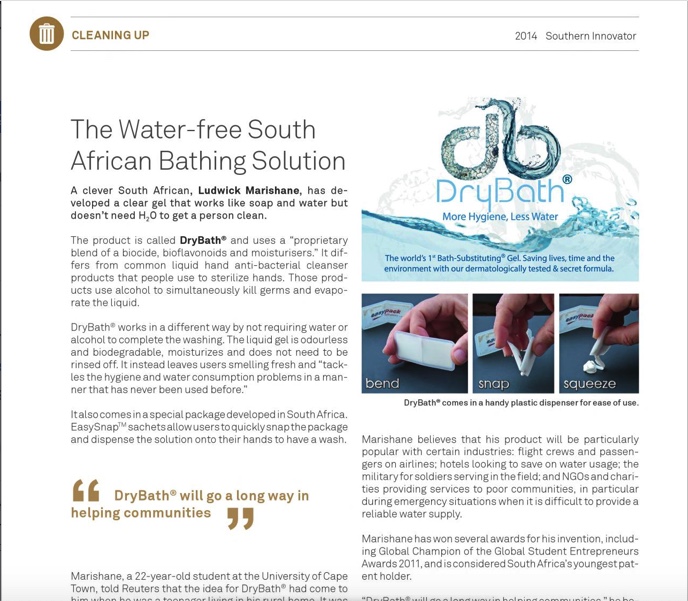
    A clever South African, Ludwick Marishane, has developed a clear gel that works like soap and water but doesn’t need H2O to get a person clean.

    The product is called DryBath (http://headboy.org/drybath/) and uses a “proprietary blend of a biocide, bioflavonoids and moisturisers.” It differs from common liquid hand anti-bacterial cleanser products that people use to sterilize hands. Those products use alcohol to simultaneously sterilize germs and evaporate the liquid.

    DryBath works in a different way by not requiring water or alcohol to complete the washing. The liquid gel is odourless, biodegradable and moisturises and does not need to be rinsed off. It instead leaves users smelling fresh and “tackles the hygiene and water consumption problems in a manner that has never been used before.”

    It also comes in a special package developed in South Africa. EasySnap™ sachets allow users to quickly snap the package and dispense the solution on to their hands to have a wash. EasySnap is a rectangular sachet that is snapped in the middle to open.

    Marishane, a 22-year-old student at the University of Cape Town, told Reuters that the idea for DryBath came to him when he was a teenager living in his rural home. It was wintertime and his friend didn’t want to bother washing because there was no hot water available.

    “He was lazy and he happened to say, ‘why doesn’t somebody invent something that you can just put on your skin and you don’t have to bathe’,” Marishane said.

    That was when the light bulb went off in his head.

    Intrigued, he started doing research on his web-enabled mobile phone. He trawled through the search engine Google and the online encyclopedia Wikipedia to find what would work as a water-free wash. After six months of research, he came up with the formula for DryBath and acquired a patent.

    Now the strategy of Headboy Industries Inc. (headboy.org) – the company set up by Marishane – is to sell DryBath to corporate clients and in turn donate a free sachet for each sale to DryBath’s global charity partners, who will distribute DryBath to poor communities either for free or at a subsidized cost.

    Marishane believes his product will be particularly popular with certain industries: flight crews and passengers on airlines; hotels looking to save on water usage; the military for soldiers serving in the field; and NGOs and charities providing services to poor communities, in particular during emergency situations when it is difficult to provide a reliable water supply.

    Marishane has won several awards for his invention, including Global Champion of the Global Student Entrepreneurs Awards 2011, and is considered South Africa’s youngest patent holder.

    “DryBath will go a long way in helping communities,” he believes.

    Published: September 2012

    Resources

    1) How to register for a patent in South Africa. Website:https://www.sabs.co.za/index.php?page=patents

    2) SABS Design Institute: The SABS Design Institute promotes the benefits of good design in order to stimulate the economic and technological development of South Africa. Website: https://www.sabs.co.za/index.php?page=designinstitute

    Development Challenges, South-South Solutions was launched as an e-newsletter in 2006 by UNDP’s South-South Cooperation Unit (now the United Nations Office for South-South Cooperation) based in New York, USA. It led on profiling the rise of the global South as an economic powerhouse and was one of the first regular publications to champion the global South’s innovators, entrepreneurs, and pioneers. It tracked the key trends that are now so profoundly reshaping how development is seen and done. This includes the rapid take-up of mobile phones and information technology in the global South (as profiled in the first issue of magazine Southern Innovator), the move to becoming a majority urban world, a growing global innovator culture, and the plethora of solutions being developed in the global South to tackle its problems and improve living conditions and boost human development. The success of the e-newsletter led to the launch of the magazine Southern Innovator. 
    Creative Commons License

    This work is licensed under a
    Creative Commons Attribution-Noncommercial-No Derivative Works 3.0 License.

    ORCID iD: https://orcid.org/0000-0001-5311-1052.

    © David South Consulting 2023

  • Cash Machines for the Poor

    Cash Machines for the Poor

    By David SouthDevelopment Challenges, South-South Solutions

    SOUTH-SOUTH CASE STUDY

    Access to basic banking services for the poor is weak at the best of times. Many are openly discriminated against as a ‘bad risk’ by banks, and denied the sort of banking services middle and higher income people take for granted. Yet it is a myth that the poor do not have money or do not wish to save and invest for their future or for business.

    The so-called Bottom of the Pyramid (BOP) – the four billion people around the world who live on less than US $2 a day – are being targeted by a wide range of businesses. Indian business consultant and professor CK Prahalad, the man who coined the term BOP, has gone so far as to claim this is a market potentially worth US $13 trillion, while the World Resources Institute puts it at US $5 trillion in its report, The Next 4 Billion.

    And contrary to popular perception, the poor do have buying power, as has been documented by Massachusetts Institute of Technology (MIT) professors Abhijit Banerjee and Esther Duflo in their paper “The Economic Lives of the Poor”. Surveying 13 countries, they found those living on less than a dollar a day, the very poor, actually spent 1/3 of their household income on things other than food, including tobacco, alcohol, weddings, funerals, religious festivals, radios and TVs. The researchers also found that the poor increasingly used their spending power to seek out private sector options when the public sector failed to provide adequate services.

    India, where 63 percent of the BoP market is rural and 304.11 million people are illiterate (Human Development Report), makes for a particularly tricky market to reach with bank machines: the average transaction is just 100 rupees (£1.25).

    But a Madras-based company has come up with the Gramateller – a low-cost, blue-and-white bank machine custom-designed for the poor and illiterate. Vortex received funding of 2 million rupees (US $48,000) from an investment company, Aavishkar, that specializes in micro-venture capital — small sums for new business ideas. The advantage of micro-venture capital funding is its longer payback time: a young company does not get driven out of business by having to pay back the cash before the idea has been realized. Normally, venture capital helps a business to grow quickly but the venture capitalist wants to see an immediate profit on the investment.

    Vortex’s chief executive officer, V.Vijay Babu, said: “The idea was conceived by Prof. Jhunjhunwala of IITM (Indian Institute of Technology Madras) in the course of an exploratory project focused on using ICT to deliver modern banking services to rural India.”

    “It was found that branch-based banking is too expensive to be extended to remote rural locations where the volume and size of transactions are small. Using conventional ATMs (automatic teller machines) as a channel posed many difficulties because these ATMs were not built to operate in [illiterate] environments. Hence the need for developing an ATM specific to this context.”

    Costing just a 10th as much to build as an ordinary cash machine, Gramateller has a fingerprint scanner for the illiterate, and is able to accept dirty and crumpled bank notes. Vortex came up with an ingenious solution to do this, said Babu: “Vortex developed a beltless dispenser design that in many ways mimics the way a human teller would pick and count notes.”

    Vortex hopes to massively expand access to cash machines: at present, India has just 30,000 machines, or one for every 43,000 people (the US has a machine for every 1,000 people). These machines are being piloted with India’s biggest private bank, ICICI, and they have garnered interest from Indonesian banks as well.

    “We are running pilots for two leading banks with about 10 ATMs,” said Babu. “Though it is still early, the initial response has been very encouraging – rural users find fingerprint authentication intuitive and simple and the ATM convenient and easy to use. A few users also gave feedback that our ATMs look less intimidating, maybe because it is placed in a non-air conditioned room with easy access and also is different in shape from a typical ATM.”

    Furthermore the cash machines have taken a beating to see if they are robust enough for rural India: “The ATMs were tested for extended operating cycles under the harshest of environments that would prevail in the rural context — using soiled currencies, operating in non-air conditioned and dusty environments, subjecting the machine to typical fluctuations in line voltages and power outages. User-acceptance was tested by enlisting the participation of rural and semi-urban people to carry out test transactions.”

    As for thieves getting their hands on the cash before the poor, Vortex maintains the machines will not become the victim of thieves: each machine will only carry a fifth of the money of city-dwelling bank machines.

    Elsewhere in the South, a South African research and analysis company BMI-TechKnowledge (http://www.bmi-t.co.za/) in its latest report identifies a boom in banking services across Africa. In particular, South Africa, Botswana, Namibia, Angola, Mauritius, Tanzania, Kenya, Ghana, Nigeria, Egypt and Morocco – all have seen surges in profit and services as a result of improving banking regulations and political conditions. Maybe future markets for the Gramateller to reach Africa’s poor lie ahead?

    Published: August 2008

    Resources

    • Unleashing India’s Innovation: Toward Sustainable and Inclusive Growth, a report by the World Bank.
      Website: web.worldbank.org
    • xigi.net (pronounced ‘ziggy’ as in zeitgeist) is a space for making connections and gathering intelligence within the capital market that invests in good. It’s a social network, tool provider, and online platform for tracking the nature and amount of investment activity in this emerging market also referred to as blended value investing. xigi’s goal is to help this international emerging market to grow through market formation activities that guide and educate a growing wave of new money, while connecting it to the emergent entrepreneurs and deals on the internet.
      Website: http://www.xigi.net/
    • The new report Global Savings, Assets and Financial Inclusion by the Citi Foundation is packed with innovative approaches that are allowing the BoP (bottom of the pyramid) to use their income to build assets and more sustainable livelihoods.
      Website: http://www.newamerica.net
    • NextBillion.net: Hosted by the World Resources Institute, it identifies sustainable business models that address the needs of the world’s poorest citizens.
      Websites: http://www.nextbillion.net/ and World Resources Insitute

    Development Challenges, South-South Solutions was launched as an e-newsletter in 2006 by UNDP’s South-South Cooperation Unit (now the United Nations Office for South-South Cooperation) based in New York, USA. It led on profiling the rise of the global South as an economic powerhouse and was one of the first regular publications to champion the global South’s innovators, entrepreneurs, and pioneers. It tracked the key trends that are now so profoundly reshaping how development is seen and done. This includes the rapid take-up of mobile phones and information technology in the global South (as profiled in the first issue of magazine Southern Innovator), the move to becoming a majority urban world, a growing global innovator culture, and the plethora of solutions being developed in the global South to tackle its problems and improve living conditions and boost human development. The success of the e-newsletter led to the launch of the magazine Southern Innovator. 
    Creative Commons License

    This work is licensed under a
    Creative Commons Attribution-Noncommercial-No Derivative Works 3.0 License.

    ORCID iD: https://orcid.org/0000-0001-5311-1052.

    © David South Consulting 2023