Many people have been shocked by recent stories about the proliferation of counterfeit drugs and the rate at which they are killing and harming people in Nigeria. The International Narcotics Control Board found that up to 50 percent of medicines in developing countries are counterfeit. This has driven home the point that without the presence of legitimate players in the African drug market, the illegal sharks will step in to make large profits – and a literal killing.
To counter this negative trend, what is most needed is support for reliable Africa-based companies: businesses that are long-term, sustainable and not living from one grant to the next. But as experience has shown around the world, nurturing businesses requires certain fundamentals: they must work to be profitable, they must find a market and exploit it, and they need cash infusions that are timed to the company’s growth, not to the cycle of international donors. This role, often served in developed countries by venture capitalists, who want a fast return of 35 percent – is too onerous a burden for most African businesses. What African companies need is a more conservative, long-term approach; one that expects returns of between five and 10 percent.
Kenyan company Advanced Bio-Extracts (ABE) is one good example. Only 18 months old and based in Nairobi, the company produces one of a new generation of low-cost anti-malarials known as artemisinin-based combination therapies (ACTs). The drug is produced from the green leafy plant Artemisia, or sweet wormwood. The company is the first in Africa to make this drug, and employs 7,000 local farmers in Kenya, Tanzania and Uganda, as well as scientists.
ABE has received two infusions of cash from non-profit social venture capitalists Acumen, as well as investment from Swiss drug giant Novartis. Acumen has so far invested US $9.6 million in 11 active investments focused on a diverse set of health challenges, including basic healthcare access in rural areas and treatment for malaria and HIV/AIDS.
“We are commercializing a product that had never been commercialized,” said ABE’s owner, Doug Henfrey, to the New York Times. “Those little windows of support make these things happen. We could not have done it otherwise.”
Acumen’s Kenya country director, Nthenya Mule, said “there are positive things happening in Africa, but they are not happening overnight, and some are happening quietly. ABE is exemplary. You will not see it as front-page news, but in 18 months they set up a factory with 160 people interfacing with 7,000 farmers and supplying one of the major pharma companies in the world.”
Stimulating private sector solutions to African healthcare problems is receiving an additional boost from a new fund established by the World Bank’s private sector arm, the International Finance Corporation. To be launched later in 2007, it will offer cash and loans totaling US $500 million to commercial healthcare projects in Africa. According to its own statistics, 60 percent of health expenditure in sub-Saharan Africa is privately funded, and the market, excluding South Africa, is worth US $19 billion.
Published: May 2007
Resources
Roll Back Malaria Partnership: Launched in 1998 by the World Health Organization. UNICEF, UNDP and the World Bank to coordinate the global campaign, to fight malaria.
A paper on the global threat of counterfeit drugs: Click here
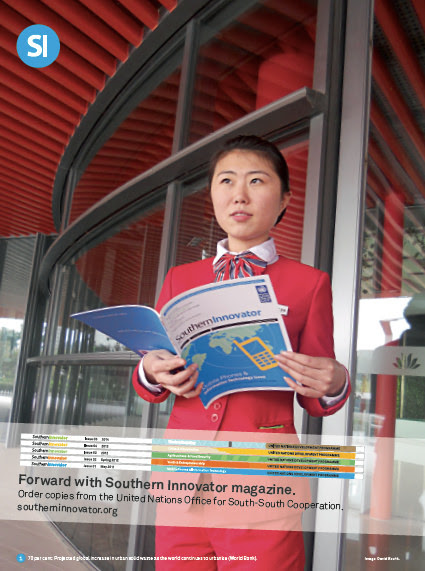
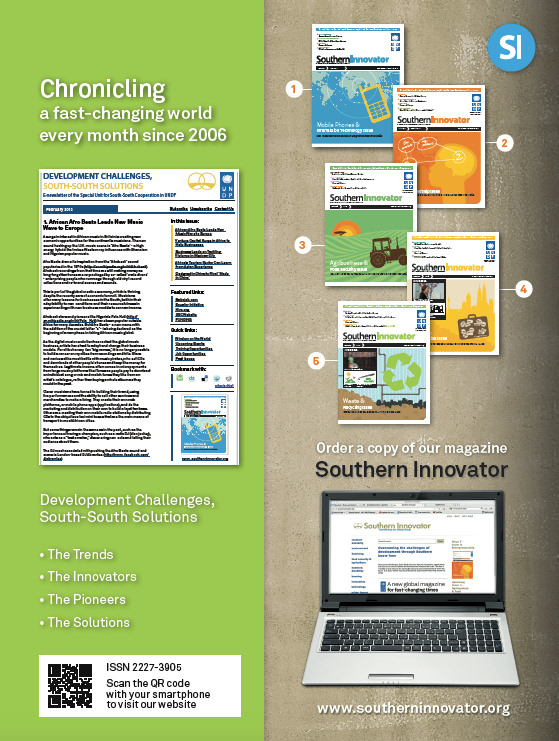
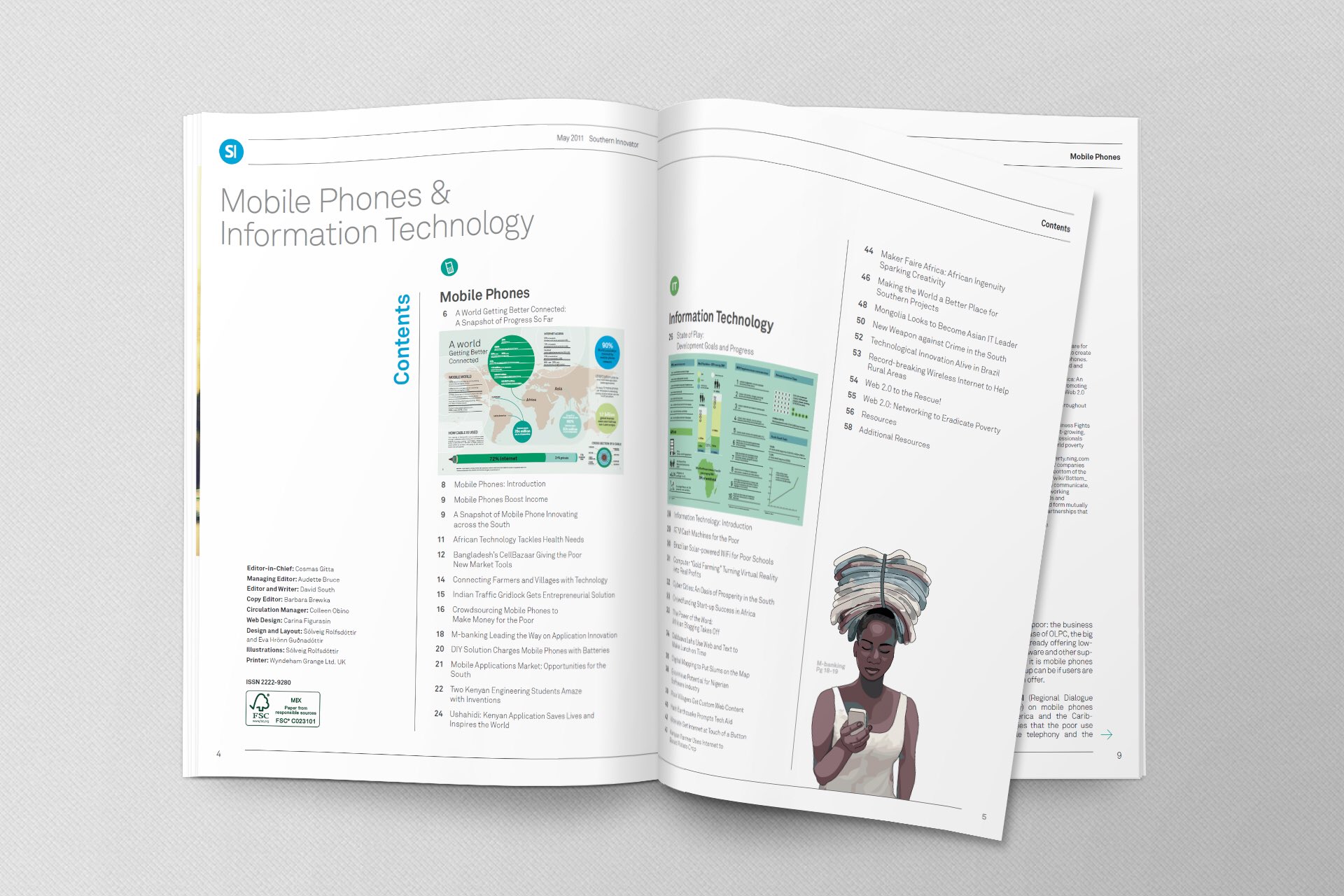
Development Challenges, South-South Solutions was launched as an e-newsletter in 2006 by UNDP’s South-South Cooperation Unit (now the United Nations Office for South-South Cooperation) based in New York, USA. It led on profiling the rise of the global South as an economic powerhouse and was one of the first regular publications to champion the global South’s innovators, entrepreneurs, and pioneers. It tracked the key trends that are now so profoundly reshaping how development is seen and done. This includes the rapid take-up of mobile phones and information technology in the global South (as profiled in the first issue of magazine Southern Innovator), the move to becoming a majority urban world, a growing global innovator culture, and the plethora of solutions being developed in the global South to tackle its problems and improve living conditions and boost human development. The success of the e-newsletter led to the launch of the magazine Southern Innovator.
Africa’s potential economic powerhouse lies in its small and medium enterprises (SMEs). Foreign direct investment (FDI) into Africa ebbs and flows based on the state of the global economy – and most of it is directed towards large enterprises and multinational companies.
Finding ways to support grassroots SMEs has the potential to truly build in sustainable prosperity for the continent and construct stable middle class jobs.
But building a continent-wide network of investors, and directing that investment at the grassroots business entrepreneurs who employ the majority of Africans, is not easy.
Foreign direct investment to Africa rose fivefold from 2000, peaking at US $72 billion in 2008 (African Economic Outlook). A surge in raw material prices fed this boom. FDI is, however, unevenly distributed and much of it goes to extractive industries like mining and oil and gas in a handful of countries. When the global economic crisis hit, FDI inflows to African countries fell by 20 per cent, to US $59 billion in 2009.
Venture Capital for Africa: Connecting Entrepreneurs and Investors (http://vc4africa.biz), is a free service trying to nurture the SME sector and help entrepreneurs overcome the challenges of funding start-ups in Africa. Members are expected to contribute, collaborate and show their seriousness, bringing resources or their ideas and enthusiasm.
It has a detailed website with a mix of resources available. People can register and connect with others, check out venture ideas and the most popular ones in the past day to month, read about featured entrepreneurs, register as an investor looking for investees, and meet-up with others in their city. This includes expatriate communities in places like Oslo, Norway.
VC4Africa believes its mission is to champion entrepreneurship, and particularly SMEs, as the main driver of Africa’s economic growth. These businesses provide the majority of the continent’s employment and income. And as it says on its website, they offer “hope for a better future.” It is estimated SMEs contribute two thirds of national income for many African countries and are a major source of middle class jobs.
VC4Africa believes “that the most meaningful impact will still come from grass roots level i.e. entrepreneurs bold enough to start potentially great companies. It aims to connect these individuals with the additional network,knowledge and capital they need to realize their potential.”
VC4Africa started from a group on the social media and connecting platform Linkedin in 2008. It claims to be the largest online community “dedicated to entrepreneurs and investors building companies on the continent.” It is a free service and was founded by “serial entrepreneurs” Bill Zimmerman, formerly of Microsoft in the USA, and Ben White, founding member of AfriLabs (afrilabs.com), a network of technology incubators. Both have extensive experience founding and investing in technology initiatives in Africa.
VC4Africa is sponsored by a long list of well-known names in supporting African entrepreneurs: Acumen Fund (acumenfund.org), Afribiz (afribiz.info), AfricaNews.com, How We Made It In Africa.com, iHub Nairobi (ihub.co.ke), and others.
Consulting firm McKinsey (mckinsey.com) believes Africa’s more than 1 billion citizens should be seen as consumers and says the continent’s growing number of middle-income consumers now outstrips India’s. It boldly claims consumer spending will reach US $1.4 trillion in Africa by 2020, up from US $860 billion in 2008. Ventures that target these consumers could do very well indeed.
The future is looking good for the venture capital model if VC4Africa continues with its successes. Two of VC4Africa’s ventures – BongoLive and Njorku – were hailed by Forbes Africa magazine in February 2012 as top start-ups in Africa.
Founded in 2010, BongoLive is a mobile and SMS services company in Tanzania. Njorku, founded in 2011, is a Cameroonian career and recruitment services platform focused on Africa.
A long and impressive list of African ventures is being supported by the VC4Africa network. Not all will succeed, and they are in very different stages of development, from embryonic to established. The failure rate for start-ups anywhere is always high. But this doesn’t have to be a bad thing. What tends to happen from experience in other countries is this: a buzz is generated as like-minded people gather around a tech scene. They feed off each others’ideas and when one idea dies, it is often feasted on – like a lion on a wildebeest – and becomes the meal for another start-up. Or, the idea is taken on board by a more established outfit.
The dynamic around tech start-ups can seem strange to more traditional business cultures. Tech start-ups tend to be more forgiving of failure and more willing to see all their labour as part of a bigger thing. It is accepted that some ideas will fly, and others will die. It is not a culture heavily laden with the shame that can be associated with more traditional business failures.
Some of the ventures supported by VC4Africa include:
MXit – Founded in 2003, MXit was one of the first Mobile Instant messaging services in the world and in Africa, and has a user base of about 45 million. (South Africa)
Dropifi – Founded in 2011, Dropifi helps businesses better respond to incoming messages via their websites, and also includes analytics for website owners. (Ghana)
FloCash – Founded in 2010, FloCash allows anyone with an email address and mobile number to send and receive money across Africa simply and easily. (UK)
Bandeka – Founded in 2011, Bandeka is an exclusive social network for building relationships/dating. (Ghana and Nigeria)
Motribe – Founded in 2011, Motribe is a mobile platform enabling users, brands, agencies and publishers across the world to build and manage their own mobile social communities. (South Africa)
Hummba – Founded in 2011, Hummba is a social and travel networking website that lets users download free audio travel guides and share travel experiences directly from mobile phones.
10Layer – Founded in 2011, 10Layer is a CMS (content management) system targeted specifically at newsrooms. (South Africa)
Published: February 2012
Resources
1) African Venture Capital Association is a not-for-profit entity founded to promote, develop and stimulate private equity and venture capital in Africa. AVCA is committed to promoting high ethical standards of business conduct and professional competence in the private equity and venture capital industries. Website: avcanet.com
4) The Co-Creation Hub Nigeria, a technology innovations center in Lagos, is working to start 30 profitable social tech ventures in the next two years. “The thinking behind CcHub is that the techies should not believe that they can just stay in a corner and create solutions for the market”, says Bosun Tijani, CEO of CcHub Nigeria. “You need to engage the market in the creation process and that is where co-creation comes into play.” Website: cchubnigeria.com
Development Challenges, South-South Solutions was launched as an e-newsletter in 2006 by UNDP’s South-South Cooperation Unit (now the United Nations Office for South-South Cooperation) based in New York, USA. It led on profiling the rise of the global South as an economic powerhouse and was one of the first regular publications to champion the global South’s innovators, entrepreneurs, and pioneers. It tracked the key trends that are now so profoundly reshaping how development is seen and done. This includes the rapid take-up of mobile phones and information technology in the global South (as profiled in the first issue of magazine Southern Innovator), the move to becoming a majority urban world, a growing global innovator culture, and the plethora of solutions being developed in the global South to tackle its problems and improve living conditions and boost human development. The success of the e-newsletter led to the launch of the magazine Southern Innovator.
The global South is currently experiencing the biggest surge in urban population ever seen in human history. This transformation from urban to rural is happening in many different ways across the global South. Some countries have highly detailed plans and are building new cities from scratch, while other countries feel overwhelmed by their booming urban populations.
By 2025, it is estimated the developing world could become home to 37 megacities with more than 10 million residents (http://en.wikipedia.org/wiki/Megacity) (The Guardian). Sixty years ago there were just two megacities: New York and Tokyo. Today, there are between 21 and 23, and the UN is forecasting that by 2025 Asia will have nine new megacities. By 2025, the majority of the world’s megacities will be in the global South.
But how will these cities be built? How will they use resources well and ensure the rapidly rising new buildings are safe and healthy?
A Chinese innovator and Internet sensation has developed a way to rapidly build high-density, high-rise structures that are also safe and meet strict earthquake-proofing standards. Building upwards is an efficient way to get more use out of space and to free up land for things like parks.
Just as the first megacities such as New York began building skyscrapers a century ago, going upwards will be the solution many of the new megacities will choose as they feel the pressing twin demands of rising populations and financial restraints.
The BROAD Group calls itself “an enterprise based on the vision of unique technologies and the philosophy of preserving life.”
The company is a pioneer in making non-electric air conditioning equipment, energy systems, and sustainable building technology.
The company has come a long way since it was started in 1988 with just US $3,000. By 1995, it had shed its debts and loans. It sees its mission as confronting the two major crises facing the world today: atmospheric pollution and global warming. The company hopes to evolve into a social enterprise.
BROAD calls itself a world leader in making central air conditioning powered by natural gas and waste heat (http://en.wikipedia.org/wiki/Broad_Group). The company is currently exporting its systems to more than 60 countries and was an official supplier to the 2010 Shanghai Expo.
BROAD has recently been expanding its product range and moving into constructing sustainable buildings. In particular it is developing an expertise in rapid construction techniques. This is important in the modern world as cities across the global South experience population growth and the pressing need to house people and create workplaces efficiently. BROAD is proud of the 15-storey hotel in Dongting Lake in Hunan Province it built in just six days, which became a hit on YouTube (http://www.youtube.com/watch?v=sjGhHl-W8Wg). After this achievement, BROAD constructed a 30-storey hotel in 15 days.
Part of the BROAD Group, Broad Sustainable Building (BSB) claims to make the “World’s first factory-made building.” BROAD says its buildings are sustainable because they efficiently use recycled construction materials, rely on materials free of formaldehyde, lead, radiation and asbestos and avoid “construction sewage” dust or waste.
BROAD was provoked into making sustainable buildings after the Wenchuan Earthquake in 2008 (http://quake.mit.edu/~changli/wenchuan.html). A year after the earthquake, 300 researchers from BROAD developed an earthquake-resistant building technology.
The factory-made building works like this: a “main board” is prepared with a floor and ceiling, ventilation, water supply and drainage, electricity and lighting. This is then placed on a truck and taken to the building site. All the workers need to do on site is assemble the building by screwing in the bolts and finishing it with the painting and other decorating. This makes the time spent assembling the building on site, according to BROAD, just 7 per cent of the total construction hours. This means 93 per cent of the building is prefabricated in a factory compared to an industry norm of 40 per cent.
BROAD’s latest project and biggest challenge is to build Sky City One (http://skycityone.wordpress.com/) – the world’s tallest tower at 220 floors and 838 metres – in Changsha in just 90 days. A mix of residential, commercial and retail space, it will allow between 70,000 and 120,000 people to work and live. The start date could be November 2012 and the building completed by early 2013.
The finished building will be 10 metres taller than the current tallest tower, the Burj Khalifa (http://www.burjkhalifa.ae/) in Dubai.
Published: October 2012
Resources
1) 20th Century World Architecture: The Phaidon Atlas by The Phaidon Editors, Publisher: Phaidon. Focusing on 750 of the most outstanding works built between 1900 and 1999, the book features every imaginable building type. Website:http://uk.phaidon.com/store/
2) Megacities Foundation: The Megacities initiative originates from the awareness of the future role of cities as the dominant type of settlement for humanity. Cities will play this role not just as a matter of fact but out of necessity as the only way of housing the world’s increasing population. Website:http://megacities.nl/
3) Andrew Marr’s Megacities: A BBC series exploring the rise of the megacities and what life will be like for their residents. Website:http://www.bbc.co.uk/programmes/b011ql6k
Development Challenges, South-South Solutions was launched as an e-newsletter in 2006 by UNDP’s South-South Cooperation Unit (now the United Nations Office for South-South Cooperation) based in New York, USA. It led on profiling the rise of the global South as an economic powerhouse and was one of the first regular publications to champion the global South’s innovators, entrepreneurs, and pioneers. It tracked the key trends that are now so profoundly reshaping how development is seen and done. This includes the rapid take-up of mobile phones and information technology in the global South (as profiled in the first issue of magazine Southern Innovator), the move to becoming a majority urban world, a growing global innovator culture, and the plethora of solutions being developed in the global South to tackle its problems and improve living conditions and boost human development. The success of the e-newsletter led to the launch of the magazine Southern Innovator.
Despite the global economic downturn, many countries of the South are seeing rapid economic growth. That can have a down side: inflation (http://en.wikipedia.org/wiki/Inflation). Inflation can be caused by variety of factors – too much money chasing too few goods, deliberate government policies to increase demand for goods and services, environmental disasters creating scarcity, or poor investment in infrastructure straining against rapid economic growth. But when it gets out of control for life-essential goods like food, then people need solutions to survive.
In India – home to more poor people than all of sub-Saharan Africa – rising inflation has prompted the Reserve Bank of India to raise interest rates, which in turn leads to more expensive loans and credit, just when funds need to be borrowed to invest in infrastructure improvements for the country.
India’s finance minister, Pranab Mukherjee, has warned that the rising interest rates necessary to fight inflation will hurt India’s economic growth.
India has seen inflation jump from single digits in 2008 to double digits this year. Consumer price inflation for industrial and farm workers in India rose by 14 percent, government data show – up from 5.51 percent in January 2008 (It hit 16.22 percent in January 2010, according to the Indian Ministry of Labour).
And it is the poorest who suffer the most from inflation. Inflation in India has led to worker protests for wage increases and rising prices for essentials like food: a life-and-death issue for the poor.
Other countries across the South are also experiencing high inflation, the worst being Venezuela. India has the highest inflation after Venezuela’s 32 percent rate, according to Bloomberg data compiled from 82 countries.
The UN’s trade and development body, UNCTAD, has called for new measures to tackle inflation. “In the past few decades, monetary policies have been more and more gradually based on inflation targeting,” said Supachai Panitchpakdi, secretary-general of UNCTAD. “I see there should be other instruments to contain inflation rather than monetary policies.”
Frustration with inflation has even been taken up by India’s vibrant entertainment industry, Bollywood (http://www.bollywoodworld.com).
The song “Mehangayi Daayan” (“The Inflation Witch”) in a film produced by acting star Aamir Khan has the lyrics, “my husband’s earnings are good but his second wife — inflation — is eating them up.”
E-Choupal (http://www.echoupal.com) has developed a reputation for both controlling prices and increasing incomes for poor farmers. Started in 2000 by the major Indian company ITC Limited (http://www.itcportal.com), it links farmers to the latest prices for products including soybeans, wheat, coffee and prawns.
E-Choupal works through computers set up in rural areas. It has built one of the largest internet initiatives in rural India, reaching 4 million farmers in 40,000 villages. It does this through 6,500 computer kiosks located in the homes of farmer-coordinators called Sanchalaks. The kiosks offer weather reports and the latest market prices, important scientific developments, risk management advice, and help with sales and marketing. The computer is in the Sanchalak’s house and connects to the internet by telephone. Each computer can serve around 600 farmers in the surrounding area.
Indian agriculture suffers from being very fragmented, with poor infrastructure and an army of middlemen looking to get the best price for themselves at the expense of farmers and consumers. Indian farmers are heavily in debt and plagued by a very high suicide rate as a result (http://en.wikipedia.org/wiki/Farmers’_suicides_in_India). This agricultural crisis has a direct impact on India’s ability to meet its development goals and lift many millions more out of poverty in the future.
E-Choupal sees itself as creating a “virtuous circle of higher productivity, higher incomes, enlarged capacity for farmer risk management, larger investments and higher quality and productivity.”
E-Choupal has increased yields for farmers, reduced transaction costs, and raised the quality of output leading to rising farmer incomes.
It is clear from experience in other countries that better access to price information helps control price inflation. E-Choupal has the advantage of providing both information and the means to access it: a big problem in rural India. Most poor Indian consumers do not have access to the internet and make food purchases from small vendors, whom they must trust to set the right price for products.
Economic commentator Paranjoy Guha Thakurta told AFP of the political dangers: “There’s a huge amount of discontent and anger across the country and certainly among the poor. Speak to the person on the street and their biggest problem is inflation.”
Published: August 2010
Resources
Olam: A global food supply company in ‘agri-products’ that got its start in Nigeria. It shows how a Southern brand can grow and go global, and overcome the difficulties of cross-border trade. Website: www.olamonline.com
Model Village India: A pioneering initiative is reviving impoverished rural villages. Drawing on self-organizing methods used in India since 1200 BC, the Model Village India is based around India’s democratic system of Panchayats: a village assembly of people stemming back to pre-colonial times. Website: www.modelvillageindia.org.in
e-Choupal: Hope or Hype? By Neeraj Dangi and Harjit Singh, American Journal of Economics and Business Administration 2 (2): 179-184, 2010. Website: http://tinyurl.com/3682r3p
Development Challenges, South-South Solutions was launched as an e-newsletter in 2006 by UNDP’s South-South Cooperation Unit (now the United Nations Office for South-South Cooperation) based in New York, USA. It led on profiling the rise of the global South as an economic powerhouse and was one of the first regular publications to champion the global South’s innovators, entrepreneurs, and pioneers. It tracked the key trends that are now so profoundly reshaping how development is seen and done. This includes the rapid take-up of mobile phones and information technology in the global South (as profiled in the first issue of magazine Southern Innovator), the move to becoming a majority urban world, a growing global innovator culture, and the plethora of solutions being developed in the global South to tackle its problems and improve living conditions and boost human development. The success of the e-newsletter led to the launch of the magazine Southern Innovator.








 David South Consulting
You must be logged in to post a comment.