Tag: UNDP

  • Global South’s Rising Economies Gain Investor Spotlight

    Global South’s Rising Economies Gain Investor Spotlight

    By David SouthDevelopment Challenges, South-South Solutions

    SOUTH-SOUTH CASE STUDY

    A new book is arguing that the world’s attention should switch away from BRICS countries – Brazil, Russia, India, China and South Africa – and take another look at nations and regions elsewhere across the global South. It argues many are lodestones of future growth and prosperity in the making and will see dramatic changes over the next decade.

    The story of the BRIC and BRICS countries is an impressive one. In just eight years from 2000 to 2008, the BRIC countries’ combined share of total world economic output rose from 16 to 22 per cent. This led to a 30 per cent increase in global output during the period, showing how key these countries were to global prosperity in the 2000s. BRIC countries make up nearly half the world’s population and are regional leaders. Taken together, their gross domestic products (GDPs) are not far behind the United States.

    Ruchir Sharma’s Breakout Nations: In Pursuit of the Next Economic Miracles (http://www.amazon.com/Breakout-Nations-Pursuit-Economic-Miracles/dp/0393080269) argues that the BRICS are now entering a more stable growth path and thus will not see the rapid-fire expansion and quick profits investors have become used to in the past decade.

    “The BRICs,” Sharma told Forbes magazine, “were last decade’s team.”

    The BRIC acronym (http://en.wikipedia.org/wiki/BRIC) was coined in 2001 by Goldman Sachs managing director Jim O’Neill, in a 2001 paper titled “Building Better Global Economic BRICs” (http://www.goldmansachs.com/ourthinking/brics/building-better.html). O’Neill predicted that this handful of countries would dominate the growth and economic development story for the years 2000 to 2010. This was because they all shared a similar stage of advanced economic development.

    The BRIC states first began meeting together in 2006. South Africa was added in 2010 to form the BRICS acronym.

    The buzz surrounding the BRICS countries over the past decade has been justified by their impressive growth rates, declining poverty levels,modernizing economies and societies and growing middle class populations.

    China alone had seen its gross domestic product grow by US $5 trillion between 2001 and 2011.

    Now, Sharma argues, it is someone else’s turn.

    Sharma is head of emerging markets with Morgan Stanley Investment Management in New York, and Breakout Nations looks at where the next economic surprise stories will take place.

    “A breakout nation is a nation that will grow above expectations, and will grow more than nations with similar per capita income,” Sharma told Forbes. “You can’t bunch all of the emerging markets together anymore. The last decade saw these countries behaving the same economically, but I think that is behind us now. Investors today will really have to pick their spots.”

    He points out that Indonesia was the best performing emerging market in 2011 and has an economy that will surpass a trillion dollars in the coming years.

    He also believes Sri Lanka and Nigeria are economies to watch.

    Sharma says funds flowing into emerging market stocks grew by 478 per cent from 2005 to 2010, a massive jump compared to 2000 to 2005, when they grew by 92 per cent.

    As he sees it, China has now reached middle-income status and its growth rates will not be as high as they have been for the past two decades. In his research, he found that countries like Japan, South Korea and Taiwan all slowed down once their per capita income went past US $5,000.

    Investors who watch the emerging markets predict the hot growth areas for the next decade will be around energy, technology, and agricultural resources.

    Sharma picks out Indonesia, Turkey, the Philippines, Poland and the Czech Republic for future investment interest, but urges caution with thinking all emerging economies are on course to boom.

    “You’ve got to pick your spots, rather than just assume that because you put a tag of emerging on a particular nation, it’s going to boom,” Sharma told The Globe and Mail newspaper.

    To make sense of the complexity of fast-emerging economies, a flurry of new investor acronyms has popped up. One of the country clusters is called the CIVETS: Colombia, Indonesia, Vietnam, Egypt, Turkey, South Africa (http://en.wikipedia.org/wiki/CIVETS).

    The MINTS (Mexico, Indonesia, Nigeria and Turkey) are also set for great growth in the next decade, many investors believe.

    Then there is the N-11 or Next 11. This is the MINTS plus Bangladesh, Egypt,Iran, Pakistan, the Philippines, South Korea and Vietnam.

    And after that there is VISTA (Vietnam, Indonesia, South Africa, Turkey and Argentina). While clearly the creative juices are flowing at investment houses as they come up with ever-catchier acronyms, a more serious point is being made: many countries in the global South, for the first time in history, are no longer solely dependent on the Western economic system for demand.

    These countries, investors note, now have an unprecedented range of options uncoupled from the political, financial and economic legacy of Western developed nations. They say that many nations in the global South are set for a runaway investment boom because they are making changes and modernizing their economies faster than many expect.

    As the BRICS economies mature and slow down and take on different priorities based around improving the quality of life of their citizens, those seeking faster profits will look elsewhere. This trend is even happening within the BRICS, as Chinese and Brazilian companies offshore work to Vietnam and Colombia.

    There are many new centres of economic activity and rising prosperity across the emerging markets that often fail to gain wider attention. Few would probably know that the Northeast Asian nation of Mongolia – mired in the 1990s in the worst peacetime economic collapse in half a century (http://www.scribd.com/doc/20864541/Mongolia-Update-1998-Book) – is now the world’s fastest-growing economy (http://www.worldbank.org/en/news/2012/02/28/what-behind-mongoliaeconomic-boom) and one of the top places for mobile phone usage and penetration (http://www.businessmongolia.com/mongolia/2012/03/19/mongolia-ringing-the-changes/).

    Then there is Myanmar (formerly Burma), where many are hoping recent moves toward democracy and improvements in diplomatic relations will lead to an economic boon for the region. Investors are also targeting Kazakhstan in Central Asia.

    Reflecting these changing realities, Standard Bank, Africa’s largest bank, has been documenting the rising role played by the Chinese currency in international trade. A recent report forecast US $100 billion (R768 billion) in Sino-African trade would be settled in the Chinese currency, the renminbi, by 2015. This would be double the trade between China and Africa in 2010. It also found 70,000 Chinese companies are using the renminbi in international trade transactions.

    Published: April 2012

    Resources 

    1) Beyondbrics blog: A blog by the Financial Times calling itself “The Ft’s emerging markets hub”. Website: http://blogs.ft.com/beyond-brics/

    2) BRICS Summit: The Fourth BRICS Summit was hosted in New Delhi on 29 March 2012 under the overarching theme of “BRICS Partnership for Global Stability, Security and Prosperity.” The Summit has imparted further momentum to the BRICS process. Website: bricsindia.in

    3) Market Oracle: A good source for updates on investor sentiment about the emerging market economies. Website: marketoracle.co.uk

    4) Monocle magazine: “A briefing on global affairs, business, culture and design” often featuring trends in the emerging market countries. Website: monocle.com

    5) BRICS Information Centre, University of Toronto. Website: brics.utoronto.ca

    https://davidsouthconsulting.org/2022/04/15/african-youth-want-to-do-business-in-fast-growing-economy/

    https://davidsouthconsulting.org/2022/03/20/global-south-eco-cities-show-how-the-future-can-be/

    https://davidsouthconsulting.org/2021/07/19/global-south-trade-boosted-with-increasing-china-africa-trade-in-2013/

    https://davidsouthconsulting.org/2022/10/20/global-souths-middle-class-is-increasing-prosperity/

    https://davidsouthconsulting.org/2022/10/20/global-souths-rising-economies-gain-investor-spotlight-2/

    https://davidsouthconsulting.org/2021/11/12/global-souths-rising-megacities-challenge-idea-of-urban-living/

    https://davidsouthconsulting.org/2022/11/15/indonesian-middle-class-recycle-wealth-back-into-domestic-economy/

    https://davidsouthconsulting.org/2022/10/20/trade-to-benefit-the-poor-up-in-2006-and-to-grow-in-2007/

    https://davidsouthconsulting.org/2022/11/20/venezuelas-currencies-promote-cooperation-not-competition/

    https://davidsouthconsulting.org/2022/10/10/wireless-internet-culture-helping-zimbabwe-economy-recover/

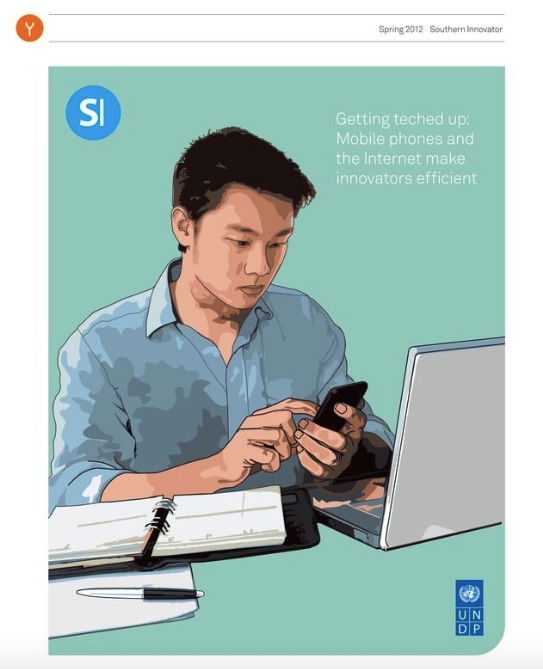
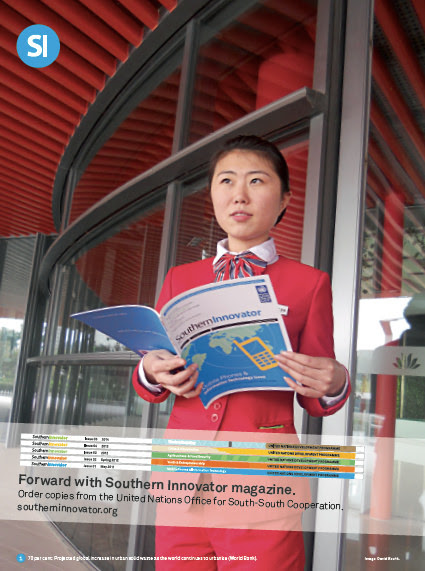
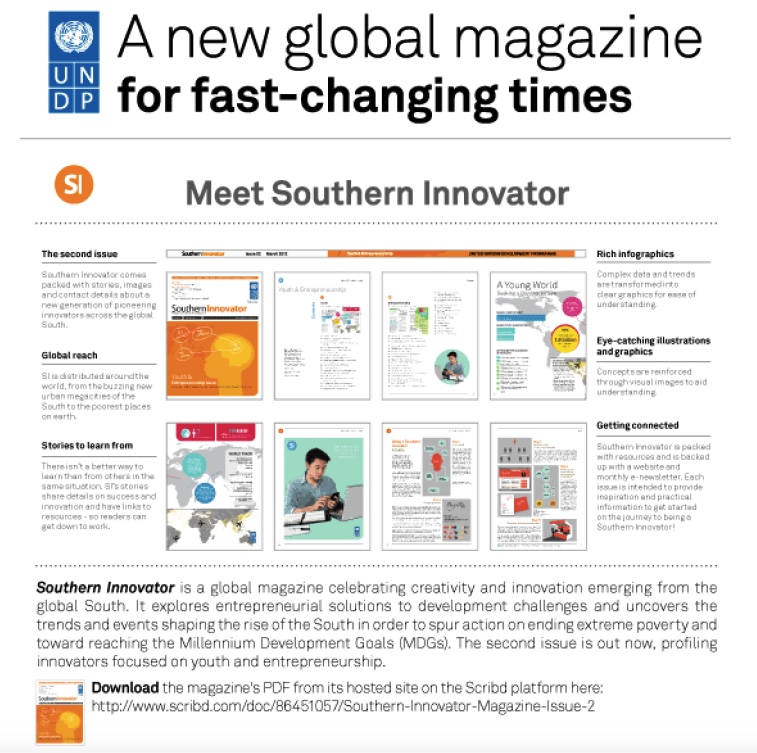
    Development Challenges, South-South Solutions was launched as an e-newsletter in 2006 by UNDP’s South-South Cooperation Unit (now the United Nations Office for South-South Cooperation) based in New York, USA. It led on profiling the rise of the global South as an economic powerhouse and was one of the first regular publications to champion the global South’s innovators, entrepreneurs, and pioneers. It tracked the key trends that are now so profoundly reshaping how development is seen and done. This includes the rapid take-up of mobile phones and information technology in the global South (as profiled in the first issue of magazine Southern Innovator), the move to becoming a majority urban world, a growing global innovator culture, and the plethora of solutions being developed in the global South to tackle its problems and improve living conditions and boost human development. The success of the e-newsletter led to the launch of the magazine Southern Innovator. 

    https://davidsouthconsulting.org/2021/03/05/southern-innovator-issue-2/

    Creative Commons License

    This work is licensed under a
    Creative Commons Attribution-Noncommercial-No Derivative Works 3.0 License.

    ORCID iD: https://orcid.org/0000-0001-5311-1052.

    © David South Consulting 2022

  • China Consumer Market: Asian Perspective Helps

    China Consumer Market: Asian Perspective Helps

    By David SouthDevelopment Challenges, South-South Solutions

    SOUTH-SOUTH CASE STUDY

    The rise of China since 1989 has been the most remarkable development story of our times. The number of people lifted out of poverty is historically unprecedented: 65 percent of Chinese people lived below the poverty line in 1981; in 2007 it was 4 percent (World Bank).

    Many commentators have focused on China’s astonishing work ethic, vast labour resources and ability to export great quantities of products. But while China has been busy meeting the needs of the world economy, domestic Chinese consumption has received less attention.

    Yet, with the Chinese firmly established as keen savers and very ambitious to improve their living standards, a vast new opportunity has emerged: the Chinese consumer market. But it will be a tricky market to tap. Chinese consumers are notorious bargain hunters and prefer to save and invest rather than consume. Poor rural families earning less than US $200 per person a year still are able to save 18 percent of their income.

    This makes a lot of sense: social supports have been stripped away as China’s economy embraced the market system. If you do not save and invest, then you will not have the resources to meet the costs of education and health care, for example. China has also seen a dramatic move to urban areas, with over 43 percent of the population now urban.

    China, despite all the hype, is still a marketplace that is difficult to easily enter for Western brands and businesses. And this makes for an opportunity for local brands to raise their game.

    In order to compete in the consumer market, businesses need to do more than compete on price: they need to also offer something more and that usually involves building a strong brand.

    The Chinese urban consumer market could grow from around US $570 billion in 2005 to around US $4.7 trillion by 2025 (PWC) (http://www.pwc.co.uk). Fast growth will be seen in discretionary spending, things other than food, clothing and utilities.

    While Chinese businesses have focused on export markets and meeting the needs of the global marketplace – a focus which has been very successful and led to remarkable wealth gains – the Chinese consumer has come lower down the list of priorities.

    Growing the domestic consumer market offers a substantial wealth-creating opportunity. Since the global economic crisis erupted in 2008, it has become apparent that the old model of exporting vast quantities of products to Western consumers alone will not be enough to keep living standards rising. Western economies are highly indebted and will take many years to recover from the mistakes and debts from the boom years and the economic crisis.

    This is an opportunity for South-South trade, which made up 20 percent of global exports by 2010. Foreign direct investment to developing economies rose by 10 percent in 2010 due to a rapid economic recovery and increasing South-South flows.

    One company successfully targeting this market is the Singapore-based Banyan Tree Hotels and Resorts brand (www.banyantree.com), which bills itself as specializing in luxury sanctuaries to rejuvenate the body, mind and soul. It is notable for deliberately not competing on price but on its brand reputation and for tailoring its offering explicitly to Asian tastes. The company claims its resorts are “naturally-luxurious, ecologically sensitive, culture-aware experiences for the discerning, responsible traveller.”

    The first Banyan Tree resort was built in Phuket, Thailand in 1987. It now employs 8,200 people from 50 nationalities in 26 resorts. Founder and executive chairman Ho Kwon Ping focused from the start on the business’s brand as critical to driving the growth of the company.

    He told INSEAD Knowledge: “The difference between us and some others is that, for many other companies having a strong brand is a reward for being successful in many things that you do but it’s sort of coincidental. It comes afterward; it’s a reward for success in other areas. For us, we’ve always said from the very beginning – having a strong brand is imperative for our survival.”

    Banyan Tree has also eschewed quick-growth models, instead trying to do as little environmental damage as possible and to include community development and environmental projects at each resort.

    Its Banyan Tree Ringha resort in China’s Yunnan province tries to bring the atmosphere of the fictional earthly paradise of Shangri-La to China. Ringha Valley sits near the Temple of the Five Wisdom Buddhas, 3,600 meters above sea level. The resort has 15 one-bedroom suites, 11 two-bedroom lodges, and six spa suites, decorated in a Tibetan style. The area is home to the Naxi people who trace their origins to nearby Tibet (http://en.wikipedia.org/wiki/Naxi_people).

    The accommodation is rustic and the resort is located in the middle of a village. Visitors can see farmers at work right from the resort. Overlooked by Tibetan mountains and settled in a lush, fertile valley the sight was picked for its tranquillity and isolation. The appeal of the area to tourists is clear: mountain peaks, deep canyons, rivers, valleys, streams and tranquil lakes. And in polluted urban China, it is an area free from pollution.

    The resort is built from transplanted Tibetan farm houses and offers hikes, mountain lakes, hot springs, gorges, forests. There are Asian touches like a welcome at the resort of Tibetan horns, songs and a tea ceremony.

    Tourism is transforming the area. Towns and villages have been renovated to showcase traditional architecture.

    The hotel and resort chain gets its name from the tradition of ancient merchants gathering under the branches of the banyan tree to conduct business in the cool shade.

    “The 21st century is really going to be the age of Asia – both India and China,” said Ho Kwon Ping. “The huge consumer markets are going to be Asian … Now there’s a real opportunity for people of Asian origin, who have an instinctive cultural feel for where their consumers are moving towards, to come out and create a brand which can be primarily rooted in their own Asian context, but have a global relevance.”

    Published: March 2011

    Resources

    1) How big will the Chinese consumer market get by 2025? A report by PriceWaterhouseCoopers. Website: http://tinyurl.com/5upqew8

    2) An interactive map of Africa’s new wealth and where to find it. Website: http://online.wsj.com/article/SB10001424052748704720804576009672053184168.html#project%3DAFRICAMAP0111%26articleTabs%3Dinteractive

    3) A video on the rising African consumer market. Website: http://annansi.com/blog/2010/12/growth-and-spending-of-african-consumer-video/

    4) Environmental Public Awareness Handbook: Case Studies and Lessons Learned in Mongolia: Tested approaches to community development and environmental protection in Asia. Website: http://www.scribd.com/doc/28633063/Environmental-Public-Awareness-Handbook-Case-Studies-and-Lessons-Learned-in-Mongolia-Part-One?in_collection=2521442

    https://davidsouthconsulting.org/2022/10/26/african-trade-hub-in-china-brings-mutual-profits-2/

    https://davidsouthconsulting.org/2022/10/26/africas-consumer-market-in-spotlight-for-2011/

    https://davidsouthconsulting.org/2020/12/10/china-sets-sights-on-dominating-global-smartphone-market/

    https://davidsouthconsulting.org/2022/11/21/chinese-trade-in-angola-helps-recovery/

    https://davidsouthconsulting.org/2021/03/20/computer-gold-farming-turning-virtual-reality-into-real-profits/

    https://davidsouthconsulting.org/2021/01/26/designed-in-china-to-rival-made-in-china/

    https://davidsouthconsulting.org/2022/11/15/indonesian-middle-class-recycle-wealth-back-into-domestic-economy/

    https://davidsouthconsulting.org/2022/10/04/popular-chinese-social-media-chase-new-markets/

    https://davidsouthconsulting.org/2022/11/17/pulque-aztec-drink-ferments-new-economy/

    https://davidsouthconsulting.org/2022/10/26/shopping-and-flying-in-africas-boom-towns/

    https://davidsouthconsulting.org/2020/04/17/virtual-supermarket-shopping-takes-off-in-china/

    Development Challenges, South-South Solutions was launched as an e-newsletter in 2006 by UNDP’s South-South Cooperation Unit (now the United Nations Office for South-South Cooperation) based in New York, USA. It led on profiling the rise of the global South as an economic powerhouse and was one of the first regular publications to champion the global South’s innovators, entrepreneurs, and pioneers. It tracked the key trends that are now so profoundly reshaping how development is seen and done. This includes the rapid take-up of mobile phones and information technology in the global South (as profiled in the first issue of magazine Southern Innovator), the move to becoming a majority urban world, a growing global innovator culture, and the plethora of solutions being developed in the global South to tackle its problems and improve living conditions and boost human development. The success of the e-newsletter led to the launch of the magazine Southern Innovator. 
    https://davidsouthconsulting.org/2021/03/05/southern-innovator-issue-1/

    https://davidsouthconsulting.org/2021/03/05/southern-innovator-issue-2/

    Creative Commons License

    This work is licensed under a
    Creative Commons Attribution-Noncommercial-No Derivative Works 3.0 License.

    ORCID iD: https://orcid.org/0000-0001-5311-1052.

    © David South Consulting 2023

  • Online Education Could Boost African Development

    Online Education Could Boost African Development

    By David SouthDevelopment Challenges, South-South Solutions

    SOUTH-SOUTH CASE STUDY

    Education is recognized as a major catalyst for human development. During a high-level meeting on the Millennium Development Goals (MDGs) (http://www.undp.org/content/undp/en/home/mdgoverview.html) in 2010, UNESCO – the United Nations Educational, Scientific and Cultural Organization – pointed out the necessity of making rapid gains in education if all the MDGs are to be achieved. The goals deadline is 2015 – just two years away.

    Two of the eight goals are directly related to education systems. MDG2 focuses on boosting universal primary education by 2015, and MDG3 calls for the elimination of barriers to primary and secondary education for women and girls.

    UNESCO found that between 2000 and 2007, the share of total government education expenditure devoted to primary education across sub-Saharan Africa fell from 49 per cent to 44 per cent (Rawle, 2009). It also found total aid for education was on the decline and foreign aid for basic education began to stagnate in 2008. This contrasted, UNESCO stated, with the “strong advances made over the past decade.”

    Overall, in the countries of sub-Saharan Africa, resources for education fell by US $4.6 billion a year on average in 2009 and 2010 (UNESCO, 2010).

    With funding for education dependent on fluctuating factors such as foreign aid, government budgets and the state of the global economy, alternatives are needed to retain the gains made in education and to improve them even further.

    Thankfully, one new innovative learning tool, dubbed massive open online courses (MOOCs) (http://en.wikipedia.org/wiki/Massive_open_online_course), is about to have a major impact in Africa. Rapid improvements in access to the Internet in Africa means that online learning tools could be a growing solution to the education deficit.

    MOOCs mean people will have access to a global treasure trove of free online courses in science, technology, engineering and math. Many believe the leapfrog into digital education will do for education what mobile phones have done for African’s ability to communicate and do business.

    These online courses vary in approach – some have set start and finish dates and can last from six to 10 weeks, while others are more loosely structured. But they all offer students the ability to learn from online video lectures and use online forums as a replacement for seminars, debates and question-asking.

    According to a recent paper by Harvard University Professor of International Development Calestous Juma, “There is a real possibility for Africa to dramatically improve its teaching – especially in science, technology, engineering, and math – through the deployment of MOOCs.”

    The diffuse nature of the Internet means many of the drivers behind promoting this trend in Africa will be found at the regional rather than the national level. The Internet helps remove the dependence on national governments and their education policies and funding – or lack thereof – to further education goals. This means the ability to make the most of the powerful new resource of MOOCs will be amplified by innovators within Africa, from entrepreneurs to information technology pioneers.

    Their solutions will help make it easier to access these learning resources.

    MOOCs are a variation on OpenCourseWare (http://en.wikipedia.org/wiki/OpenCourseWare) university courses, created for free distribution on the Internet. MOOCs bypass the hazard in the past of digital courses going missing or being mislaid: they are online and always available. Nobody can mislay the content by accident.

    The Khan Academy (khanacademy.org) is one of the best-known popular MOOCs pioneers. It was founded in the United States in 2008 by Salman Khan, who quit his job as a hedge fund manager to run the business full time. Khan is academically highly accomplished – he has three degrees from MIT and an MBA from Harvard University. The Khan Academy targets mainly secondary school students and claims to have 5.5 million unique users a month. It is run as a not-for-profit and receives donations to keep it going.

    It does this with a staff of just 37: proof of how much can be achieved when the power of the Internet is leveraged to pass on knowledge.

    The Khan Academy platform greets readers with questions such as “What is the eccentricity of an ellipse?” or “What if there’s a negative exponent?” And if you do not know, you better get cracking doing their problem sets. Students can practice their math skills, answer other students’ questions or watch a video walk-through of the services on offer on the website. The main categories are math, science and economics, computer science, the humanities and help with preparing for various standardized tests such as the GMAT (Graduate Management Admission Test). There are over 4,000 videos on offer on the website.

    “Each video is a digestible chunk, approximately 10 minutes long, and especially purposed for viewing on the computer,” the website states.

    “I teach the way that I wish I was taught. The lectures are coming from me, an actual human being who is fascinated by the world around him,” states Khan.

    MOOCs offer not just course materials, videos, readings and problem sets but also discussion forums for the students, professors/teachers and tutorial assistants to build a community. This is considered an ideal model for reaching students over great distances and in remote regions. So-called “open” educational resources are used and often no fees or tuition are charged.

    The OpenCourseWare (OCW) (http://ocw.mit.edu/index.htm) project at the Massachusetts Institute of Technology (MIT) seeks to “publish all of our course materials online and make them widely available to everyone,” according to Dick K.P. Yue, Professor at MIT’s School of Engineering.

    Through its website, it offers nearly all of MIT’s course content, a treasure trove from one of the top research universities in the world, a long-standing home for pioneers and innovators in science and technology.

    By way of the Internet, anybody anywhere in the world can access this resource. The most visited courses online as of February 2013 included undergraduate “Introduction to Computer Science and Programming,” “Physics I: Classical Mechanics,” “Introduction to Electrical Engineering and Computer Science I,” “Principles of Microeconomics,” “Introduction to Algorithms,” and “Principles of Chemical Science.” There are 2,150 courses and so far 125 million visitors to the website.

    Having access to the courses allows teachers to gain new insights into the subjects they teach and benefit from the impressive resources of MIT.

    MIT also sees it as a way to aid people to tackle the big development issues of our time, including climate change and health problems such as cancer.

    Other MOOCs providers include Peer-to-Peer University (https://p2pu.org/en/), Udemy (udemy.com), Coursera (coursera.org), Udacity (udacity.com), and
edX (edx.org), a not-for-profit partnership between Harvard and MIT to develop courses for interactive study on the Internet.

    In the United Kingdom, the Open University (open.ac.uk) and Futurelearn (http://futurelearn.com/) also offer online courses, as does Open2Study (http://www.open.edu.au/open2study) in Australia.

    Boosting access to MOOCs presents a great business opportunity for Africa’s mobile phone entrepreneurs and its mushrooming information technology (IT) hubs (https://africahubs.crowdmap.com/).

    “I view online learning as a rising tide that will lift all boats,” Anant Agarwal, professor of electrical engineering and computer science at MIT and president of edX, told The Financial Times. “It will not only increase access, it will also improve the quality of education at all our universities.”

    All of this matters because it means Africans will increasingly have the tools to participate in the global marketplace of ideas and products and services on a more level playing field. By far the biggest obstacle to competing is the lack of timely information and knowledge about what is happening in the global economy. It is a frequent complaint, from the farmer desperate for the latest news on market prices and trends and innovations, to the strivers in the growing megacities of the continent who have their sights set on global success.

    Published: May 2013

    Resources

    1) African Union’s High Level Panel on Science, Technology and Innovation. Website: http://belferinthenews.wordpress.com/2012/08/03/calestous-juma-to-co-chair-new-au-panel-on-science-technology-and-innovation/

    2) Queen Elizabeth Prize for Engineering: The Queen Elizabeth Prize for Engineering is a new global engineering prize that will reward and celebrate an individual (or up to three individuals) responsible for a ground-breaking innovation in engineering that has been of global benefit to humanity. Website: http://www.qeprize.org/

    3) Belfer Center for Science and International Affairs: The Belfer Center is the hub of the Harvard Kennedy School’s research, teaching, and training in international security affairs, environmental and resource issues, and science and technology policy. Website: http://belfercenter.ksg.harvard.edu/

    4) A place to host MOOC news and information. Website: http://mooc.ca/

    5) OpenCourseWare Consortium: The OpenCourseWare Consortium is a collaboration of higher education institutions and associated organizations from around the world creating a broad and deep body of open educational content using a shared model.  Website: http://www.ocwconsortium.org/

    6) Engineering the Future by Calestous Juma, Professor of the Practice of International Development at Harvard Kennedy School. Website: http://www.technologyandpolicy.org/2013/03/18/engineering-the-future/#.UUeWY1fm8
g4

    7) Hiobo MoPC: Joining the ongoing push to drive down the price of personal computers in Africa is the latest offering from Mauritian information technology company, Hiobo. Website: http://www.hiobo.com/mopc/

    Southern Innovator logo

    London Edit

    31 July 2013

    Development Challenges, South-South Solutions was launched as an e-newsletter in 2006 by UNDP’s South-South Cooperation Unit (now the United Nations Office for South-South Cooperation) based in New York, USA. It led on profiling the rise of the global South as an economic powerhouse and was one of the first regular publications to champion the global South’s innovators, entrepreneurs, and pioneers. It tracked the key trends that are now so profoundly reshaping how development is seen and done. This includes the rapid take-up of mobile phones and information technology in the global South (as profiled in the first issue of magazine Southern Innovator), the move to becoming a majority urban world, a growing global innovator culture, and the plethora of solutions being developed in the global South to tackle its problems and improve living conditions and boost human development. The success of the e-newsletter led to the launch of the magazine Southern Innovator. 

    Creative Commons License

    This work is licensed under a
    Creative Commons Attribution-Noncommercial-No Derivative Works 3.0 License.

    ORCID iD: https://orcid.org/0000-0001-5311-1052.

    © David South Consulting 2023

  • Global South’s Middle Class is Increasing Prosperity

    Global South’s Middle Class is Increasing Prosperity

    By David SouthDevelopment Challenges, South-South Solutions

    SOUTH-SOUTH CASE STUDY

    The global middle class is on the rise – and this is creating both challenges and opportunities. As poverty rates have come down across the global South, many countries have seen a rise in the proportion of their population categorized as “middle class”. Globally, being middle class is defined as a person able to consume between US $4 a day and US $13 a day (ILO).

    According to the Organization for Economic Cooperation and Development (OECD), most of this growth will be in Asia and the region will soon make up 66 per cent of the world’s middle class. Historical experience shows that members of the middle class quickly become absorbed in spending their accumulated capital on housing, equipment, industry and business, health and education. In countries with a growing middle class, policy makers need to show a strong interest in creating stable economic conditions to encourage this expanding consumption and domestic demand, the OECD advises.

    Growth of the world’s middle class took off after 2001, with an additional 400 million workers joining this group. The McKinsey group of consultants found the total number reached 2 billion in a dozen “emerging nations” in 2010, collectively spending US $6.9 trillion every year (McKinsey).

    Forecasters predict a further increase in the middle class across the global South will bring with it a surge in consumption (a combination of spending and demand). Areas being highlighted by various studies and reports include China’s small and mid-size cities, other areas of East Asia and Africa.

    Middle class spending in these dozen emerging nations could reach US $20 trillion during the next decade – twice the amount of consumption occurring in the United States right now (McKinsey).

    The result is a re-shaping of populations, with growing numbers of people now neither rich nor desperately poor, but landing in the middle of the income distribution.

    And local competitors in the global South are fighting hard for these consumers on their own turf.

    The Hangzhou Wahaha (http://en.wahaha.com.cn/) beverage maker in China has been able to compete against multinationals such as Coca-Cola and PepsiCo, according to McKinsey. It has turned itself into a US $5.2 billion business using a multi-pronged strategy: targeting rural areas, catering to local needs, keeping costs low and positioning itself as the patriotic choice.

    And this change is also occurring in Africa, where a growing middle class is fuelling sales of refrigerators, television sets, mobile phones, motors and automobiles across the continent, according to the OECD. In Ghana, for example, car and motorcycle ownership has risen by 81 per cent since 2006.

    According to the African Development Bank (AfDB), Africa’s middle class has reached 34 per cent of the population, or 350 million people. In 1980, it was 126 million people, or 27 per cent of the population.

    Countries with the largest middle classes in Africa include Tunisia and Morocco, while Liberia and Burundi have the smallest number of people in the middle class.

    The economic growth that is fuelling this middle-class surge is coming from a combination of increasing investment in the services sector, the tapping of the natural resource sector and better economic policies in the past two decades. Africa’s middle class is driving growth in the private sector and boosting demand for goods and services, most often also provided by the private sector.

    “The liberalization of African economies has resulted in improved efficiencies and led to a rapid growth in the service sector, which has spurred the growth of the middle class,” Lawrence Bategeka, a principal researcher at the Uganda-based Economic Policy Research Centre, told The East African newspaper.

    How important the middle class is to increasing consumption levels can be seen in the cases of Brazil and South Korea.

    According to the OECD, both countries had similar income levels and growth rates in the 1960s. But by the 1980s, high income inequality in Brazil capped the middle class at 29 per cent of the population. In South Korea in the 1980s, the middle class population reached 53 per cent. This larger middle class population enabled South Korea to switch from an export-driven growth strategy to domestic consumption.

    While Brazil wasn’t able to do this at the time, it has since made impressive gains in reducing poverty – from 40 per cent of the population in 2001 to 25 per cent in 2009. This has seen the middle class grow to 52 per cent of the population and boosted domestic consumption.

    While a rising middle class in the global South is good news for improving human development and living standards, the OECD found much of the new middle class was vulnerable and could easily slip out of that category. They also often lacked enough income to purchase more expensive durable goods such as automobiles (OECD Yearbook 2012).

    The success of this fragile but growing middle class will be key to how well the global economy fares in the coming years.

    A new report by the UN’s International Labour Organization (ILO) argues that the global South’s growing middle classes are just the thing to spur growth across the wider world economy.

    “Over time, this emerging middle-class could give a much needed push to more balanced global growth by boosting consumption, particularly in poorer parts of the developing world,” said Steven Kapsos, one of the authors of the report.

    In Indonesia, an example of the economic impact of the middle class trend in action can be seen in the surging life insurance business.

    Association of Indonesian Life Insurance Companies (AAJI) chairman Hendrisman Rahim believes the growing middle class are potential customers for the country’s thriving life insurance industry.

“They are the ones who have the need to be insured and can afford to purchase a policy. Extremely rich people are financially capable [of buying], but may not have the need. Extremely poor people have the need, but require financial assistance to be insured,” he said to the Jakarta Post.

    As the Indonesian middle class increases, the life insurance industry is expecting to see revenue rise by 30 per cent in 2013.

    Published: February 2013

    Resources

    1) The $10 Trillion Dollar Prize by Michael J. Silverstein. Website: amazon.com

    2) The Middle of the Pyramid: Dynamics of the Middle Class in Africa. Website: http://www.afdb.org/en/blogs/afdb-championing-inclusive-growth-across-africa/post/the-african-consumer-market-8901/

    3) McKinsey Quarterly: Capturing the world’s emerging middle class. Website:http://www.mckinseyquarterly.com/Capturing_the_worlds_emerging_middle_class_2639

    4) OECD Observer: An emerging middle class by Mario Pezzini. Website:http://www.oecdobserver.org/news/fullstory.php/aid/3681/An_emerging_middle_class.html

    Southern Innovator logo

    London Edit

    31 July 2013

    Development Challenges, South-South Solutions was launched as an e-newsletter in 2006 by UNDP’s South-South Cooperation Unit (now the United Nations Office for South-South Cooperation) based in New York, USA. It led on profiling the rise of the global South as an economic powerhouse and was one of the first regular publications to champion the global South’s innovators, entrepreneurs, and pioneers. It tracked the key trends that are now so profoundly reshaping how development is seen and done. This includes the rapid take-up of mobile phones and information technology in the global South (as profiled in the first issue of magazine Southern Innovator), the move to becoming a majority urban world, a growing global innovator culture, and the plethora of solutions being developed in the global South to tackle its problems and improve living conditions and boost human development. The success of the e-newsletter led to the launch of the magazine Southern Innovator. 

    Creative Commons License

    This work is licensed under a
    Creative Commons Attribution-Noncommercial-No Derivative Works 3.0 License.

    ORCID iD: https://orcid.org/0000-0001-5311-1052.

    © David South Consulting 2023