Tag: UNDP

  • Kenyan Mobile Phone Innovations

    Kenyan Mobile Phone Innovations

    By David SouthDevelopment Challenges, South-South Solutions

    SOUTH-SOUTH CASE STUDY

    A couple of enterprising Kenyan engineering students are showing how mobile phones are an inventor’s dream. Their two inventions – one a way to re-charge phones while bicycling, the other an aid for catching fish – show the potential for adapting this technology to the needs of the poor.

    The rapid spread of mobile phones across the South is giving rise to a flurry of invention and experimentation. While many of the new mobile phone-users do not have much money, they are often driven by poverty to invent solutions – and in so doing prove the phones offer many ways to generate income.

    According to the International Telecommunications Union (ITU), Africa is the world’s fastest-growing mobile phone market, and the number of subscribers surpassed 300 million in 2008. The number of mobile phone users in the world passed 4 billion in 2008, and the fastest growth was in the South (ITU). The trend towards increasing development of inexpensive handsets means more phones will be reaching even more poor people in the future.

    Kenya has seen blistering growth in mobile phone ownership: from just 200,000 users in 2000, there are now more than 17.5 million people with mobile phones out of a population of 38.5 million

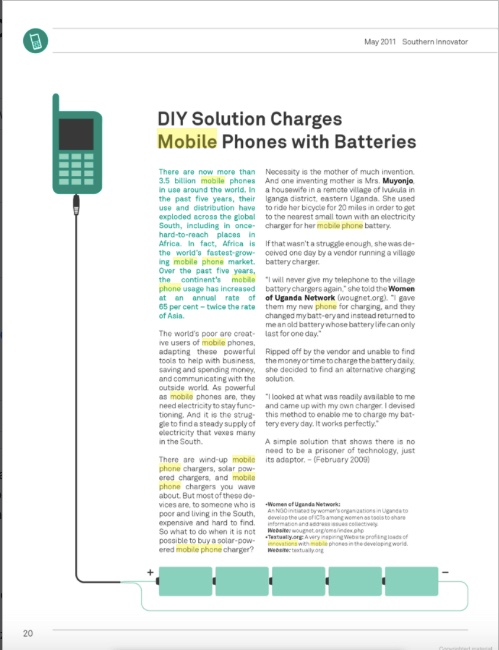
    As powerful as mobile phones are, they need electricity to keep working. The struggle to find a steady supply of electricity vexes many in the South, so finding cheap or free ways to recharge the phones represents a huge market opportunity.

    While mobile phone recharging has become a business in its own right across the South, it is costly as well as time-consuming. Some people spend hours just getting to recharging stations.

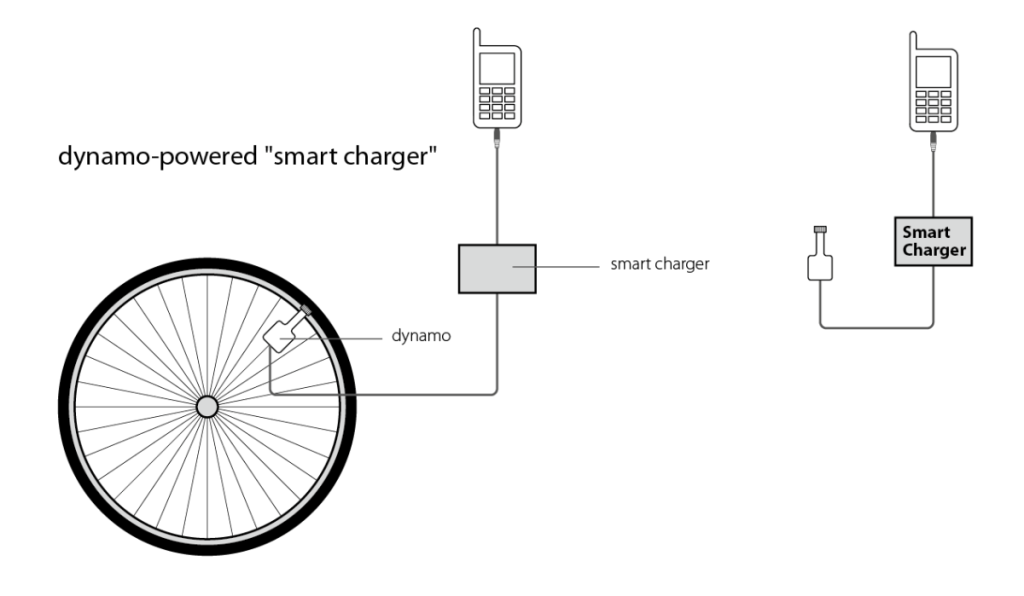
    To tackle this chronic problem, Engineering students Pascal Katana and Jeremiah Murimi of the Department of Electrical and Information Engineering at the University of Nairobi, Kenya (http://uonbi.ac.ke/departments/index.php?dept_code=HE&fac_code=32) have invented a device called the “smart charger.” It is powered by the dynamo that is standard issue with most bicycles sold in Kenya. Dynamos on the bicycle’s back wheel are little electricity generators that use pedal power to illuminate the bike’s lights.

    It takes an hour to charge the mobile phone by peddling the bicycle: around the same time it takes to charge a phone using an electricity plug. A one-time charge for somebody can cost up to US $2 at a recharging service. But the smart charger sells for 350 Kenyan shillings (US $4.50) – around the cost of two charges.

    “We both come from villages and we know the problems,” Murimi told the BBC.

    “The device is so small you can put it in your pocket with your phone while you are on your bike.”

    The smart charger has been assembled from bits and pieces the duo found: “We took most of (the) items from a junk yard,” Katana said. “Using bits from spoilt radios and spoilt televisions.”

    To test the experimental device, workers at the university campus were recruited to have a go.

    “I use a bicycle especially when I’m at home in the rural areas, where we travel a lot,” said campus security guard David Nyangoro. “It’s very expensive nowadays charging a phone. With the new charger I hope it will be more economical, as once you have bought it, things will be easier for you and no more expenses.”

    Kenya’s National Council for Science and Technology (http://www.ncst.go.ke/) has now backed the project and the students are exploring ways to mass-produce the smart charger.

    Another invention by Katana has adapted a mobile phone to improve fishermen’s success, according to Afrigadget (www.afrigadget.com). It amplifies the sounds made by fish as they feed. As the sound is broadcast outwards from the feeding, other fish are attracted to the same place, believing there is more food. A GPRS/GSM (http://en.wikipedia.org/wiki/General_Packet_Radio_Service) mechanism in the fishing net is triggered when there is enough fish in the net, and an SMS text message is sent to the fisherman letting him know it is time to haul in the net.

    It looks like Pascal Katana can re-charge your phone and fill your plate!

    Published: August 2009

    Resources

    1) Entrepreneurs can track the growth of the mobile phones market here. Website: http://www.wirelessintelligence.com

    2) SMS Bootcamp: The “SMS Boot Camp” at the University of Nairobi, is a project-based course enabling teams of students to launch and market their own SMS services to the millions of mobile phone users in Kenya. A small amount of seed funding will be available to the best teams interested in turning their project into a commercial venture. Website: http://eprom.mit.edu/entrepreneurship.html

    3) Mobile Active.org: MobileActive.org is a community of people and organizations using mobile phones for social impact. They are committed to increasing the effectiveness of NGOs around the world who recognize that the over 4 billion mobile phones provide unprecedented opportunities for organizing, communications, and service and information delivery. Website: www.mobileactive.org

    4) Textually.org: is the entry point of three weblogs devoted to cell phones and mobile content, focusing on text messaging and cell phone usage around the world, tracking the latest news and social impact of these new technologies. Website: http://www.textually.org/

    5) Ushahidi: is a website that was developed to map reports of violence in Kenya after the post-election fallout at the beginning of 2008. The new Ushahidi Engine is being created to use the lessons learned from Kenya to create a platform that allows anyone around the world to set up their own way to gather reports by mobile phone, email and the web – and map them. It is being built so that it can grow with the changing environment of the web, and to work with other websites and online tools. Website: http://blog.ushahidi.com/

    6) Google Android: Get inventing! This software enables anyone to start making applications for mobile phones. And it offers a platform for developers to then sell the applications to others. Website: www.android.com/

    7) Afrigadget: is a website dedicated to showcasing African ingenuity. A team of bloggers and readers contribute their pictures, videos and stories from around the continent. Website: http://www.afrigadget.com
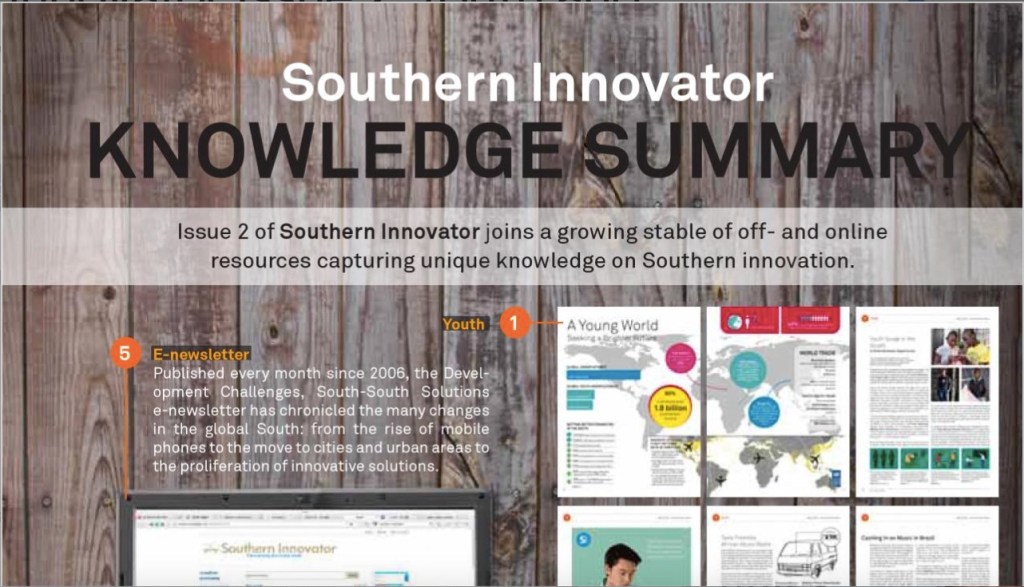
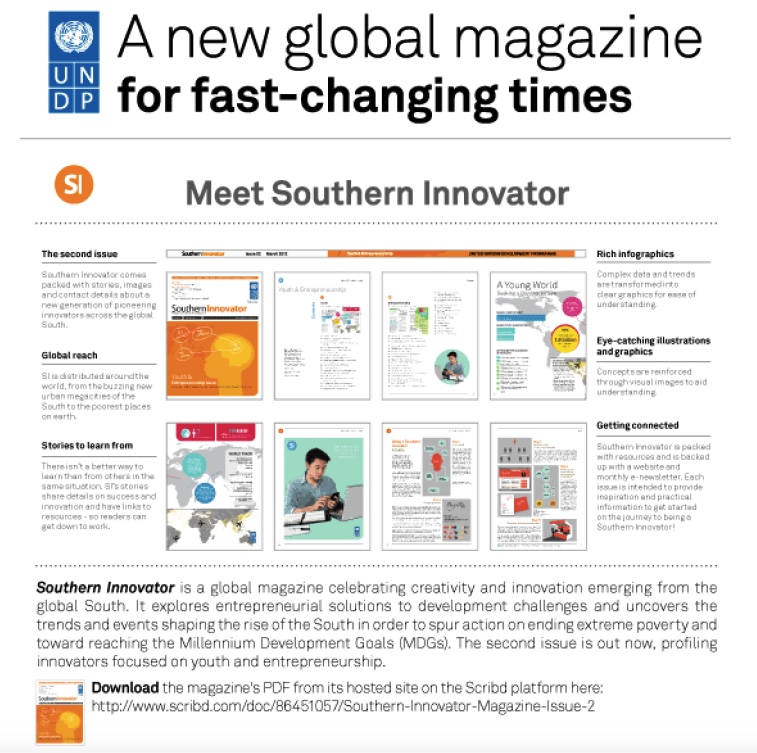
    Development Challenges, South-South Solutions was launched as an e-newsletter in 2006 by UNDP’s South-South Cooperation Unit (now the United Nations Office for South-South Cooperation) based in New York, USA. It led on profiling the rise of the global South as an economic powerhouse and was one of the first regular publications to champion the global South’s innovators, entrepreneurs, and pioneers. It tracked the key trends that are now so profoundly reshaping how development is seen and done. This includes the rapid take-up of mobile phones and information technology in the global South (as profiled in the first issue of magazine Southern Innovator), the move to becoming a majority urban world, a growing global innovator culture, and the plethora of solutions being developed in the global South to tackle its problems and improve living conditions and boost human development. The success of the e-newsletter led to the launch of the magazine Southern Innovator. 

    Creative Commons License

    This work is licensed under a
    Creative Commons Attribution-Noncommercial-No Derivative Works 3.0 License.

    ORCID iD: https://orcid.org/0000-0001-5311-1052.

    © David South Consulting 2023
  • Electric Bicycles Become Urban Transport Success

    Electric Bicycles Become Urban Transport Success

    By David SouthDevelopment Challenges, South-South Solutions

    SOUTH-SOUTH CASE STUDY

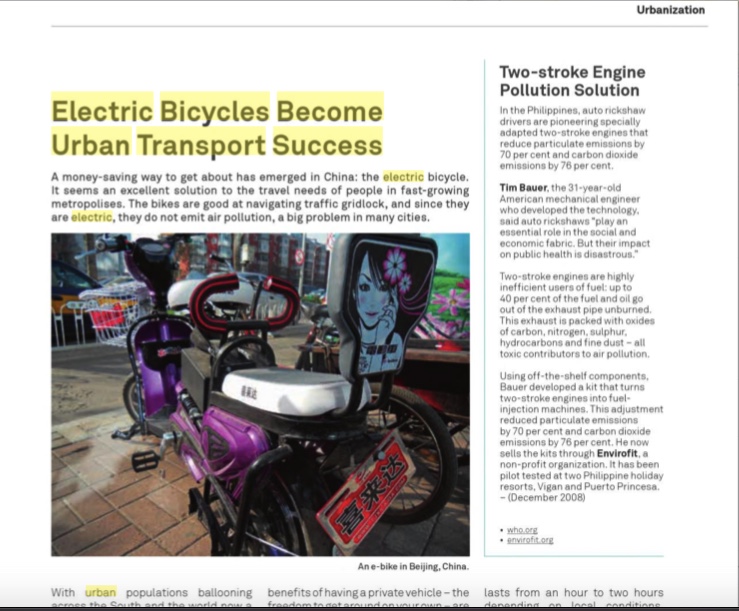
    A money-saving way to get about has emerged in China: the electric bicycle. It seems an excellent solution to the travel needs of people in fast-growing metropolises. The bikes are good at navigating traffic gridlock, and since they are electric they do not emit air pollution, a big problem in many cities.

    With urban populations ballooning across the South – and the world now a majority urban place – the challenge of moving people around economically and cleanly is a big issue. While turning to cars seems an appealing option for people who have raised their incomes, the resulting traffic jams and pollution are a major drawback. Gridlock (http://en.wikipedia.org/wiki/Gridlock) is a daily reality in cities across Asia and Africa.

    The success of e-bikes in China is striking: It is estimated there are four times more electric bikes than cars in the country, 120 million in all. According to the Electric Bikes website (www.electricbikee.com), the number of electric bicycles produced each year has grown from 200,000 eight years ago to 22 million in 2008. It is estimated to be a US $11 billion a year business: a true Southern success story that is going around the world.

    A typical electric bicycle has a rechargeable power pack, with a battery that takes up to four hours to charge and lasts from an hour to two hours depending on local conditions, like hills. The batteries can range from heavy lead acid models (around only 100 charges) to nickel metal to lightweight, long-lasting lithium batteries. The batteries range from 12 volts to 36 volts. How long a battery lasts depends on its energy retention ability, road and temperature conditions and the rider’s weight.

    And while some cities are turning to encouraging more peddle power with human-powered bicycles, this is an unappealing option in hot or humid climates. Who wants to turn up at work hot and sweaty?

    In China, a highly competitive market of manufacturers has sprung up in the last 10 years to provide e-bikes for every taste and need.

    China has a long tradition as a cycling nation: in the 1980s, four out of five commuters used bicycles. But that changed dramatically as people bought cars with their rising incomes.

    In the capital, Beijing, rapid economic development and rising incomes have led to serious traffic congestion. There are over 4 million cars on Beijing’s roads. The pollution in the city is very bad and has led to various campaigns to ban high-polluting vehicles.

    The ensuing traffic gridlock means the benefits of having a private vehicle – the freedom to get around on your own – are eroded as a driver wastes time in long commutes. So, many have turned to the nimble electric bicycles.

    One resident, David Dai, told the BBC “It takes only 10 minutes to ride my electric bike from home to work.”

    “If I took the bus, I’d have to spend time waiting for it, and then I could be trapped in a traffic jam. It could take me half an hour to make the same journey.”

    Competition is fierce in the electric bike market, with shops sometimes sitting side-by-side.

    A manager of a Beijing electric bicycle store, Zhang Zhiyong, puts the success down to this: “Beijing is not like other smaller cities – it’s big. If people ride their bicycles to work, they get really tired. If they drive to work, the roads are often congested,” he told the BBC.

    “But an electric bike is environmentally friendly and convenient. Promoting the use of these bikes would benefit us all.”

    And the price is a definite incentive: just 2,680 yuan (US $390), while cars sell for thousands of dollars.

    The electric bicycles are so successful they are now growing faster than cars in a country that has become the fastest growing car market in the world.

    Some believe the bikes are just a stop gap before people get enough money to buy automobiles. But the bigger trend of growing urban populations and the ensuing traffic jams will ensure they remain a practical option to get around the gridlock.

    Published: April 2010

    Resources

    1) Electric Bike Website: Home to news and links to manufacturers. Also lots of resources on how to convert peddle bikes into electric bikes. Website:http://www.electricbikee.com/

    2) The Luyuan Electric Vehicle Company of Jinhua City in China has been making the bikes for 10 years. They come fully equipped with lights, baskets, fenders and in many colours. Website: http://en.luyuan.cn/?gclid=CJXu_tr576ACFclr4wodG1GsGQ

    3) Empowered Ebikes: An online retailer of e-bikes specializing in urban commuters. Website:http://www.empoweredebikes.com/index.php

    4) Made-in-China.com: A large list of e-bike manufacturers in China and how to contact the dealers and manufacturers. Website: http://www.made-in-china.com/products-search/hot-china-products/E-bike.html

    5) Pedego: An American company making high-end e-bikes. Website: http://www.pedegoelectricbikes.com/index.php

    Development Challenges, South-South Solutions was launched as an e-newsletter in 2006 by UNDP’s South-South Cooperation Unit (now the United Nations Office for South-South Cooperation) based in New York, USA. It led on profiling the rise of the global South as an economic powerhouse and was one of the first regular publications to champion the global South’s innovators, entrepreneurs, and pioneers. It tracked the key trends that are now so profoundly reshaping how development is seen and done. This includes the rapid take-up of mobile phones and information technology in the global South (as profiled in the first issue of magazine Southern Innovator), the move to becoming a majority urban world, a growing global innovator culture, and the plethora of solutions being developed in the global South to tackle its problems and improve living conditions and boost human development. The success of the e-newsletter led to the launch of the magazine Southern Innovator. 

    Creative Commons License

    This work is licensed under a
    Creative Commons Attribution-Noncommercial-No Derivative Works 3.0 License.

    ORCID iD: https://orcid.org/0000-0001-5311-1052.

    © David South Consulting 2023

  • Tapping the Power of Child Play

    Tapping the Power of Child Play

    By David SouthDevelopment Challenges, South-South Solutions

    SOUTH-SOUTH CASE STUDY

    Children are an amazing source of energy. Each generation fizzes with the restlessness and optimism of youth. But all that energy is expended in the playground, leaving behind nothing but the sound of laughter. What if that energy could actually be harnessed and turned into electricity? And electricity to power the cash-strapped school the children need to attend to get a good head start in life?

    Meeting the Millennium Development Goal of achieving universal primary education would be significantly helped if schools had electricity and in turn the ability to use computers and the Internet. As well, school buildings can be used to their maximum if they have lights for night schools, and expand to secondary and adult education. It is typical practice in Africa to use schools in the evenings for older students. But usually they only have kerosene lamps to turn to for light.

    The need is urgent for electricity for schools in Africa: even sub-Saharan Africa’s richest nation, South Africa, has 5,131 schools without electricity. And in the battle for energy, schools have to compete with businesses and cities, as increasing demand makes power outages more common.

    Child-power is currently used to run Playpumps’ merry-go-rounds, drawing water from wells. But a children’s see-saw hopes to use the same principle to bring light to power-starved African schools. Children in Uganda are involved in a pilot test of a see-saw that generates electricity with the simple up-and-down motion of the playground ride. The electricity generated is sent to a storage battery via an underground cable. Just five to 10 minutes on the see-saw can generate enough electricity to light a classroom for an evening.

    The see-saw is being tested in the Ugandan city of Jinja, made from locally sourced parts, and has been designed by 23-year-old British design student Daniel Sheridan. He was inspired after volunteering on a school trip to the island of Wasimi, south of Mombasa, Kenya, while building a school and teaching.

    “The number of children we saw there that loved to play, and their vibrancy, I thought it would be great if I could somehow make use of this,” he told the BBC. “They don’t have Gameboys and all the rest. They are just so genuine and keen to help – they would grab the wheelbarrows we were working with given the chance.”

    Sheridan won £5,500 (US $10,930) to further develop the idea at various university student enterprise award schemes. The money is being used for prototype development.

    “The current need for electricity in sub-Saharan Africa is staggering. Without power, development is extremely difficult. The potential for this product is huge and the design could be of benefit to numerous communities in Africa and beyond.”

    After the prototype testing in Uganda he hopes to either start a business or charity to manufacture the see-saws. His dream?

    “Ultimately I would love to design a whole playground of different pieces of equipment that could generate enough electricity to power a whole village.”

    Published: April 2008

    Resources

    • Playpumps International: More child-powered ways to make a difference: these water pumps draw water from a well while children spin on the merry-go-round. Website: www.playpumps.org
    • OUiP! Or Optimized Universal Interface Platform: This white plastic handheld electronic bar uses the child’s play motion to power it, while it makes noises and displays images. Website: www.thinkthing.net
    • Sprig Toys: Electro-mechanical toys made from wood and recycled plastic that are run on child-power only. Website: www.sprigtoys.com

    Development Challenges, South-South Solutions was launched as an e-newsletter in 2006 by UNDP’s South-South Cooperation Unit (now the United Nations Office for South-South Cooperation) based in New York, USA. It led on profiling the rise of the global South as an economic powerhouse and was one of the first regular publications to champion the global South’s innovators, entrepreneurs, and pioneers. It tracked the key trends that are now so profoundly reshaping how development is seen and done. This includes the rapid take-up of mobile phones and information technology in the global South (as profiled in the first issue of magazine Southern Innovator), the move to becoming a majority urban world, a growing global innovator culture, and the plethora of solutions being developed in the global South to tackle its problems and improve living conditions and boost human development. The success of the e-newsletter led to the launch of the magazine Southern Innovator. 

    Creative Commons License

    This work is licensed under a
    Creative Commons Attribution-Noncommercial-No Derivative Works 3.0 License.

    ORCID iD: https://orcid.org/0000-0001-5311-1052.

    © David South Consulting 2023
  • Reality Television Teaches Business Skills in Sudan

    Reality Television Teaches Business Skills in Sudan

    By David SouthDevelopment Challenges, South-South Solutions

    SOUTH-SOUTH CASE STUDY

    Learning how to thrive in a market economy does not necessarily come naturally. But for young people who have grown up under a different economic system or known nothing but economic chaos, learning business skills can give them the tools to get on in life.

    With youth unemployment rates high around the world, it is clear many young people may never get the jobs they expect unless they start businesses themselves.

    In 2013, 73.4 million young people were out of work, an increase of 3.5 million from 2007. A report by the International Labour Organization (ilo.org) found persistent unemployment around the world in the wake of the global economic crisis, a proliferation of temporary jobs and growing youth discouragement in advanced economies; and poor quality, informal, subsistence jobs in developing countries. School-to-work transition surveys of developing countries showed that youth are far more likely to land low-quality jobs in the informal economy than jobs paying decent wages and offering benefits.

    High youth unemployment often has nothing to do with poor educational achievement (many unemployed youth have high school educations or university degrees), but is often caused by other factors, including lack of access to capital, rigid labour markets, skills mismatched to demand in the economy (for example construction and building trades), or a gap between personal aspirations and the true state of the country’s economic development.

    But rather than despair, it is possible to show youth how to turn things around and use business skills to re-shape economies in their favor. Youth tend to bring to the economy energy and drive combined with new ideas and experiences calibrated to the demands of the 21st century. By harnessing this, youth can find a unique space in the marketplace. In turn, young people can lead in reviving damaged economies and making their countries wealthier and healthier. Many youth have grown up around the emerging digital economy and the use of mobile phones. Being comfortable with the 21st century digital economy will unleash many economic opportunities that favor youth.

    The British Council says that “creative entrepreneurship is considered the most efficient model for youth in the developing world who are facing huge difficulties in finding employment”. The entrepreneurship or creative investment industry is one of the fastest-growing sectors in the world.

    Understanding what works for youth business entrepreneurship has become a specialty in its own right. Using the media to teach skills and inspire youth to action is one proven approach.

    One recent example is a successful television programme from the Republic of the Sudan. Called Mashrouy (mashrouy.com), it is modeled on reality TV programmes such as The Apprentice, which features serial U.S. entrepreneur Donald Trump (http://www.bbc.co.uk/programmes/b00q3fkq) and the BBC’s Dragon’s Den (http://www.bbc.co.uk/programmes/b006vq92), where contestants pitch their ideas to a panel of judges to see if they can get funding for their business idea.

    In Mashrouy, 12 contestants battled it out to see who had the best business idea. They undertook various challenges and the original 12 were whittled down to three contestants. Live on air in December 2013, viewers voted for their favorite contestant and the winner (https://www.facebook.com/Mashrouy) received a prize of 200,000 SDG (US $35,211), while the second prize winner received 150,000 SDG (US $26,408) and the third prize winner received 100,000 SDG (US $17,605). All three were then taken to London in the United Kingdom to meet other creative entrepreneurs and receive valuable business advice.

    The Sudanese show (http://sudan.britishcouncil.org/our-work/mashrouy) is supported by the British Embassy and the British Council, and is working with the Sudanese Young Businessmen Association and major Sudanese companies to spread the idea of entrepreneurship among the youth of Sudan.

    Sudan suffered a brutal civil war on and off throughout the 2000s, leading to the partition of the original country into the Republic of the Sudan and the new nation of South Sudan in 2011.

    Faced with Sudan’s serious youth unemployment – as high as 34 per cent – and a fragile economy, the TV show’s producers wanted to encourage youth to start businesses.

    The contest was aimed at youth between 18 and 40 and appeared on the Blue Nile (http://bnile.tv/blue.html) channel.

    “At a time of national economic hardship, it has kindled the imagination of Sudanese youth,” wrote journalist Isma’il Kushkush (https://twitter.com/ikushkush) in The New York Times.

    For the show, a panel of experts picked 12 projects out of 2,500 applications. Each of the 12 finalists was given a chance to do a “pitch,” giving a quick summary of their business idea and trying to get the panel excited about the idea and its potential. The idea that generated the most excitement won.
    The 12 pitches included an idea for an ostrich farm and a plan to export spicy peanut butter. The winner, 32-year-old Samah al-Gadi, wants to use a locally available weed-like river plant to make bags and furniture. She said she got up the courage to be on the show from a supportive mother.

    “Amid ululations, screams and clapping, a jubilant Ms. Gadi raised both hands above her scarf-covered head, flashing victory signs,” The New York Times said. “Her mother, sitting at a dinner table, was brought to tears.”

    The women-owned social enterprise Making Cents International (makingcents.com), based in Washington, D.C., USA, has been gathering resources on youth entrepreneurship since 1999. It has put together a custom “curricula to develop the mindset, skillset, and toolset that enable entrepreneurs and enterprises to participate in profitable markets; financial institutions to serve new populations; and individuals to obtain meaningful work”.  This is available in 25 languages. It also hosts the Global Youth Economic Opportunities Conference in Washington, DC, held this year from 6 to 8 October 2014 (http://youtheconomicopportunities.org/conference).

    Published: April 2014

    Resources

    1) Khartoum Teaching Centre: The British Council is a world leader in English language training and teaching. It offers general English courses for adult learners of all levels, totaling 60 hours of tuition over 10 weeks. Website: http://sudan.britishcouncil.org/learn-english/courses

    2) Start-up Chile innovation fund: Start-Up Chile is a program created by the Chilean Government, executed by Corfo via InnovaChile, that seeks to attract early stage, high-potential entrepreneurs to bootstrap their startups in Chile, using it as a platform to go global. Website: startupchile.org

    3) Global Youth Economic Opportunities Conference 2014: From 6 to 8 October Youth entrepreneurship conference in Washington, D.C., USA. Website: youtheconomicopportunities.org/conference

    4) Making Cents International: The Youth Economic Opportunities learning platform is the first community of practice and knowledge exchange portal developed by and for the youth economic opportunities sector. Website: youtheconomicopportunities.org

    5) Mongolian Rock Pop book: A book published by UNDP in the Mongolian language on how the country’s rock and pop musicians led on business innovation using creative marketing and publicity during the country’s turbulent transition during the 1990s. Website: http://tinyurl.com/p25scqq

    Development Challenges, South-South Solutions was launched as an e-newsletter in 2006 by UNDP’s South-South Cooperation Unit (now the United Nations Office for South-South Cooperation) based in New York, USA. It led on profiling the rise of the global South as an economic powerhouse and was one of the first regular publications to champion the global South’s innovators, entrepreneurs, and pioneers. It tracked the key trends that are now so profoundly reshaping how development is seen and done. This includes the rapid take-up of mobile phones and information technology in the global South (as profiled in the first issue of magazine Southern Innovator), the move to becoming a majority urban world, a growing global innovator culture, and the plethora of solutions being developed in the global South to tackle its problems and improve living conditions and boost human development. The success of the e-newsletter led to the launch of the magazine Southern Innovator. 

    https://davidsouthconsulting.org/2021/03/05/southern-innovator-issue-2/

    Creative Commons License

    This work is licensed under a
    Creative Commons Attribution-Noncommercial-No Derivative Works 3.0 License.

    ORCID iD: https://orcid.org/0000-0001-5311-1052.

    © David South Consulting 2023