Tag: UNDP

  • From Warriors to Tour Guides

    From Warriors to Tour Guides

    By David SouthDevelopment Challenges, South-South Solutions

    SOUTH-SOUTH CASE STUDY

    In the wake of conflict, demobilizing combatants is as critical as ending the fighting if there is hope for the peace to last. When conflict ends, former fighters usually find themselves unemployed. But tourism is proving a viable way to deal with the social and political dangers of neglecting former fighters post-conflict.

    Global tourism accounts for more than 10 per cent of global GDP and eight per cent of total employment worldwide. It grew by six per cent in 2007, according to the UN World Tourism Organisation. The Asia-Pacific region grew by 10 per cent, and Africa by eight per cent.

    Ironically, much conflict has taken place in areas of natural beauty that offer a strong pull to tourists. While perception judging from the media is that conflict is getting worse, in fact trends show the opposite: according to Global Conflict Trends, “The levels of both interstate and societal warfare declined dramatically through the 1990s and this trend continues in the early 2000s, falling over 60% from their peak levels.”

    A lot is at stake and it proves it is worthwhile to make peace pay – and that it is possible.

    Battle-hardened rebels like 28-year-old Marjuni Ibrahim lived in the jungle and fought as guerrillas in Aceh, Indonesia. On the northwestern tip of Indonesia, Aceh was devastated by both a 30-year war that killed 15,000 people and the 2004 tsunami. Marjuni lost his sister and parents in the tsunami, in which more than 170,000 died or are missing.

    Much of the coastline was destroyed, but the shock of the catastrophe pushed both sides into peace talks. The separatist Free Aceh Movement (GAM) battled the Indonesian army (TNI) up to 2005, when they signed a peace agreement.

    Marjuni is now cashing in on a guerilla’s best survival technique: being tough. He now takes adventure and extreme-hiking enthusiasts deep into the jungle, where they once fought and lived. It is a habitat of steep, rocky trails, enormous teak trees – all with the reward of pristine waterfalls and refreshing rock pools for the hardy travelers.

    The tours target mainly the community of aid workers in the area helping to re-build Aceh, but the hope is to expand: “I want to make the Acehnese aware of the potential for community-based tourism, and put Aceh on the map as a friendly tourism destination”, said Mendal Pols, a Dutch tour operator and founder of Aceh Explorer on the island, to Reuters.

    The jungle is home to endangered Sumatran tigers, deer and hornbills.

    “The area is very beautiful. I like trekking and I was interested to see what life was like during the conflict,” said Hugo Lamer, a Dutch trekker. “It’s difficult to imagine but three or more years ago they were running around here with guns and fighting the TNI. When I went, they took us to a place where they had lost some of their friends. And then you realize that we are there for fun, but for them this was really serious.”

    In Vietnam, the famous Cu Chi Tunnels, formerly used by the Vietcong during the Vietnam War, have become major tourist attractions. The vast network of underground tunnels in Ho Chi Minh City link up with a tunnel network stretching across the country, and were used as hiding spots and as supply routes, hospitals, food and weapon dumps and living quarters.

    In Rwanda, the government turned to tourism to help heal the wounds of the massacre that led to the deaths of almost 1 million people in 1994. It markets its population of mountain gorillas, diverse landscape with volcanic ranges, hills, lakes and savannah. But it is also not covering up the past: genocide sites are also on the tourist itinerary. And it is meant to shock: in the town of Murambi, classrooms still contain the bodies of the people who were killed there, covered in lime to preserve them. In Kigali, a museum documents the genocide. Survivors lead the tours to help them heal from the horror.

    The goal is to restore the country’s tourism industry and generate US $100 million a year by 2010. It is currently bringing in US $45 million. The approach is to target the ethical end of the tourism market. The idea is to use tourism as a means to avert the tensions that helped to cause the genocide in the first place: poverty, illiteracy and government hording all the wealth. The idea is to employ as many people as possible and spread the wealth as wide as possible.

    Published: March 2008

    Resources

    • The UN Environment Programme has a special division to advise on post-conflict and disaster management.
      Website: http://postconflict.unep.ch/

    Development Challenges, South-South Solutions was launched as an e-newsletter in 2006 by UNDP’s South-South Cooperation Unit (now the United Nations Office for South-South Cooperation) based in New York, USA. It led on profiling the rise of the global South as an economic powerhouse and was one of the first regular publications to champion the global South’s innovators, entrepreneurs, and pioneers. It tracked the key trends that are now so profoundly reshaping how development is seen and done. This includes the rapid take-up of mobile phones and information technology in the global South (as profiled in the first issue of magazine Southern Innovator), the move to becoming a majority urban world, a growing global innovator culture, and the plethora of solutions being developed in the global South to tackle its problems and improve living conditions and boost human development. The success of the e-newsletter led to the launch of the magazine Southern Innovator.

    Creative Commons License

    This work is licensed under a
    Creative Commons Attribution-Noncommercial-No Derivative Works 3.0 License.

    ORCID iD: https://orcid.org/0000-0001-5311-1052.

    © David South Consulting 2022

  • Mountain People: Innovative Ways to Help the World’s Most Vulnerable

    Mountain People: Innovative Ways to Help the World’s Most Vulnerable

    By David SouthDevelopment Challenges, South-South Solutions

    SOUTH-SOUTH CASE STUDY

    Physically isolated and socially and politically marginalized, mountain dwellers are among the most vulnerable in the world, according to the Food and Agriculture Organization. A disproportionate number of the world’s 840 million chronically undernourished people live in highland areas — about 270 million mountain people lack food security, with 135 million suffering chronic hunger. Large numbers of additional people in lowland areas also depend on mountains.

    In October in Rome, more than 60 representatives from mountain countries around the world called for a coherent approach to sustainable agriculture and rural development in the world’s highland areas to address this crisis. First identified as a problem back at the 1992 Earth Summit in Rio, the degradation of mountain eco-systems and the poverty of those living there, has only worsened with increasing conflict and war. Mountain forests are rapidly vanishing across the globe.

    Mountains occupy 24 per cent of the earth’s landscape, and are home to 12 per cent of the world’s people; a further 14 per cent live beside mountains. Most are in the Andes, the Hengduan-Himalaya-Hindu Kush system, and a number of African mountains. Many mountain people are from ethnic minorities, and are often frozen out of political or commercial power. Poverty is common: more than 60 per cent of the rural Andean population lives in extreme poverty, and most of the 98 million Chinese considered to be among the world’s “absolute poor”, are ethnic minorities who live in mountains.

    Mountains make up a quarter of the world’s landscapes, and mountain watersheds are critical to water supply – up to 80 per cent of the planet’s fresh surface water comes from mountains. Over half of the world’s population depend on mountains for water, food, hydro-electricity, timber and mineral resources (UN University Mountain Programme).

    By their way of life, mountain peoples have expertise in small-hold farming, medicinal uses for native plants, and sustainable harvesting of food, fodder and fuel from forests.

    In China, the MinYiYuan company has developed a model to help the millions of impoverished Chinese in the countryside who are being left out of the country’s current economic boom. While many are migrating to the cities to work as labourers, mostly women and children are left behind in villages, with few options to support themselves.

    Cai Tingfen saw an opportunity to help the ethnic minority population of Liupanshui City in Guizhou Province. Founded in 2005, MinYiYuan bridges the handcraft culture of the region with the bigger national economy. Its model is unique: rather than buying ready-made handicrafts from craftspeople, MinYiYuan sets the design standards for the quality of the raw materials and sources them itself. This avoids problems with inconsistencies and guarantees customers get a reliably high-quality product. The craftspeople use these raw materials to make handcrafts in their homes, and the finished goods are bought back by the company.

    The company buys cotton, hemp and Chinese herbs from local farmers, luring them away from livelihoods that cause deforestation. In 2006, the MinYiYuan Folk Art Centre sold 60,000 (batik) wax prints, 8,000 embroideries, and 20,000 ethnic handicrafts. It made 1.13 million yuan (US $149.319). The company is ambitious, and is already looking to building a research and development base to integrate design, manufacturing, packaging and sales.

    Another model that is working is in the Philippines. After the Mount Pinatubo volcano eruptions in the early 1990s, the Aetas people of Luzon found their community was buried under ash and stone. Unable to work the land anymore and live off of the fish and wildlife, the Aetas were close to starvation. Many migrated to the cities to look for work: And without many relevant urban skills, most ended up living in squalor.

    One by-product of the volcanic explosion was vast quantities of pumice stone, used in the garment industry to produce ‘stone-washed’ denim. Entrepreneurs were soon turning up to gather the stones.

    The Asian Institute for Technology helped the Aeta people organize themselves in marketing social enterprises to gather, market and sell the stones to the many garment makers in the Philippines. By forming cooperatives, the Aeta are able to change the power dynamics with the garment companies: where they had to sell very cheaply to middlemen, the cooperatives enable them to charge more and make a liveable income, allowing them to stay in the community and avoid environmentally more harmful ways to make a living.

    In Peru, coffee growers in the mountains have banded together as a social enterprise and use market solutions to increase living standards. The Cepicafe brand in the Piura Mountains, promotes its Fair Trade practices to secure higher prices for the growers. It does this by countering the increasing competition in the coffee market and lower world prices for the beans, with better quality coffee grains and bypassing middlemen to access markets directly.

    Cepicafe raises the skills of the growers by providing education to increase productivity and quality, while reducing the farms ecological impact. The premium that fair trade is able to get is then used to improve the farmers’ lives with better housing, new clothes, shoes, better diets, and access to medicine.

    They have 51 grassroots member organizations, totaling to 4,800 small-scale coffee producers. Over 18 per cent are women. By introducing a business culture and using radio programmes to further spread knowledge, productivity and quality have increased.

    Cepicafe’s access to markets in the US and Europe means it can pay between 60 and 80 per cent more than local buyers.

    Published: November 2007

    Resources

    • Mountain Forum: created in 1995, it is a great resource for sustainable mountain development and conservation.
    • The Mountain Institute: A non-profit organization dedicated to conservation, community development and cultural preservation in the Andean, Appalachian and Himalayan mountain ranges.
    • Adelboden Group: Established in 2002, it exists as a forum to discuss mountain policies, exchange experience and coordinate planning.

    Development Challenges, South-South Solutions was launched as an e-newsletter in 2006 by UNDP’s South-South Cooperation Unit (now the United Nations Office for South-South Cooperation) based in New York, USA. It led on profiling the rise of the global South as an economic powerhouse and was one of the first regular publications to champion the global South’s innovators, entrepreneurs, and pioneers. It tracked the key trends that are now so profoundly reshaping how development is seen and done. This includes the rapid take-up of mobile phones and information technology in the global South (as profiled in the first issue of magazine Southern Innovator), the move to becoming a majority urban world, a growing global innovator culture, and the plethora of solutions being developed in the global South to tackle its problems and improve living conditions and boost human development. The success of the e-newsletter led to the launch of the magazine Southern Innovator.

    Creative Commons License

    This work is licensed under a
    Creative Commons Attribution-Noncommercial-No Derivative Works 3.0 License.

    ORCID iD: https://orcid.org/0000-0001-5311-1052.

    © David South Consulting 2022

  • Chinese Trade in Angola Helps Recovery

    Chinese Trade in Angola Helps Recovery

    By David SouthDevelopment Challenges, South-South Solutions

    SOUTH-SOUTH CASE STUDY

    Two-way trade between Africa and China has been an outstanding success story of the past decade. It has led to significant new investment in the continent and brought many new job opportunities. The Chinese community in Africa comprises a mix of entrepreneurs and workers. In formerly war-torn Angola, Chinese workers and investors have led an economic boom as the country recovers from decades of conflict.

    The Chinese are generally young, well-educated, English-speaking, ambitious and hard-working. Estimates put the number of Chinese people in Angola at 100,000, and about 1 million across Africa.

    The reason these bright young things need to come to Africa goes back to the essential reality of modern China: despite rapid economic growth, per capita incomes classify it as a poor country. While the outside world sees the glitzy, go-go progress of China’s cities, the country’s rural poor go unseen. Around 400 million of China’s 1.3 billion people have annual per-capita income equivalent to US $8,000, while the remaining 900 million have per-capita incomes as little as one-tenth that amount.

    Some 6.3 million people in China will graduate this year from university, and it is still very hard for a well-educated Chinese person to get a good job right away. More than a quarter of these graduates will be unemployed, according to the Education Ministry.

    There has also been disquiet in parts of Angola over China’s role, with some calling it “neo-colonialism”. But clearly, both Africa and China have much to gain by increasing cooperation.

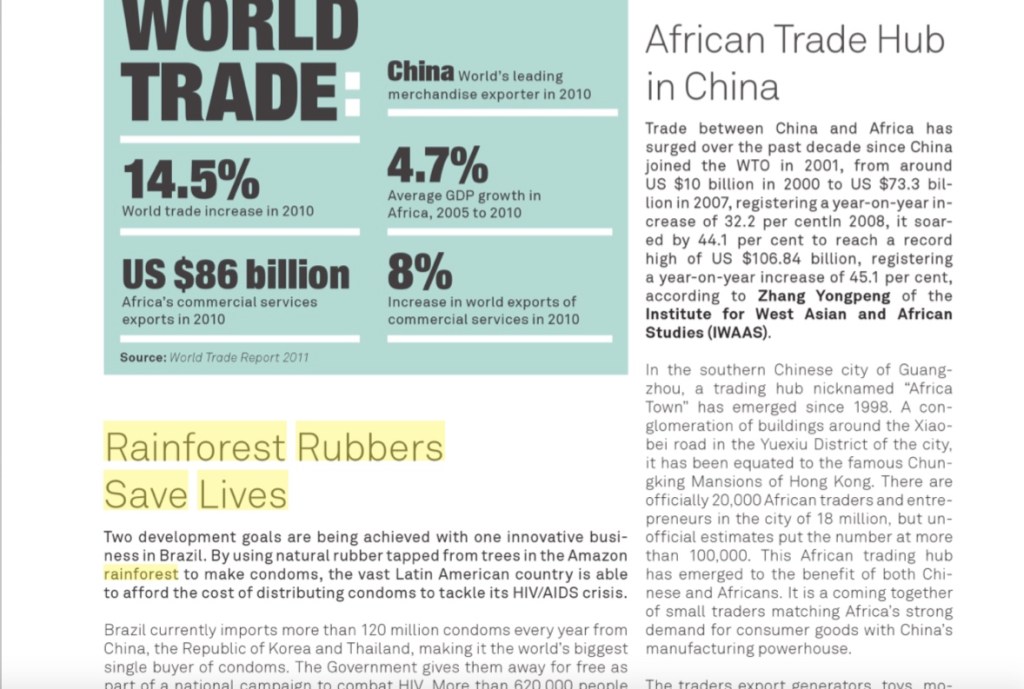
    In the southern Chinese city of Guangzhou (http://en.wikipedia.org/wiki/Guangzhou), a trading hub nicknamed “Africa Town” has emerged since 1998. There are officially 20,000 African traders and entrepreneurs in the city of 18 million, but unofficial estimates put the number at more than 100,000. This African trading hub has emerged to the benefit of both the Chinese and Africans. It is a coming together of small traders matching Africa’s strong demand for consumer goods with China’s manufacturing powerhouse.

    In Angola, the mix of entrepreneurs and workers is having a big impact on the country’s development.

    Betty, a 22-year-old Chinese woman who has various projects in Angola, including the local Chinese language newspaper, is a typical go-getter.

    “I am doing much better here than if I had stayed in China,” she told the BBC.

    Another beneficiary of the two-way trade is Deng, a construction a worker: “I earn twice as much as I would at home and I have got a better job,” he said.

    For most Chinese, foreign travel is still rare and the excitement of going to Africa to work both attracts and repels because of the continent’s reputation.

    “At first I found it frightening, “said Wang. “You hear lots of stories of Chinese people being robbed by the locals.” But he found “there are great opportunities here.”

    Another, Jet, who runs an air conditioning business, came to Angola five years ago.

    “Everything had been destroyed,” he recalled. “There were no roads, railways, shops, nothing. Some Western companies were already here selling their products but I knew I could import things cheaper from China.”

    The large infrastructure projects being undertaken by major Chinese companies are also creating new opportunities. Many Chinese labourers are working on building roads, railways, hospitals and vast housing complexes.

    One of the more visible symbols of Chinese investment in Angola is the restoration of the Benguela Railway (http://en.wikipedia.org/wiki/Benguela_railway), considered one of the great routes of Africa and built by British contractors. An engineering triumph, its 1,344 kilometres (835 miles) of track stretch up the Angolan coast, right into southern Congo. The railway took almost 30 years to build in the late 19th and early 20th centuries, but little remained. Until very recently all but a tiny stretch of the line was closed. Now Chinese investment is rebuilding the railway and bringing economic improvement in its wake.

    “I couldn’t do this before the railway was fixed,” a woman using the train to get to the market to sell her plump red tomatoes told the BBC. “Before, I had to travel by car which was much more expensive.”

    And her income has improved along with the refurbished railway. “I am not rich, but a bit richer,” she said.

    And unlike the British, who used the railway to export copper without paying for the resource, the Chinese labourers are getting paid and the Angolan government is paying back the Chinese loan for the railway repairs by selling oil overseas for a market rate.

    Published: October 2010

    Resources

    https://davidsouthconsulting.org/2022/06/02/afghanistans-juicy-solution-to-drug-trade/

    https://davidsouthconsulting.org/2022/11/02/african-online-supermarket-set-to-boost-trade/

    https://davidsouthconsulting.org/2022/10/26/african-trade-hub-in-china-brings-mutual-profits-2/

    https://davidsouthconsulting.org/2022/04/12/djibouti-re-shapes-itself-as-african-trade-hub/

    https://davidsouthconsulting.org/2021/07/19/global-south-trade-boosted-with-increasing-china-africa-trade-in-2013/

    https://davidsouthconsulting.org/2022/10/26/perfume-of-peace-helps-farmers-switch-from-drug-trade/

    https://davidsouthconsulting.org/2021/07/19/south-south-trade-helping-countries-during-economic-crisis/

    https://davidsouthconsulting.org/2021/03/05/southern-innovator-issue-2/

    https://davidsouthconsulting.org/2022/11/01/southern-innovator-magazine-2010-2014/

    https://davidsouthconsulting.org/2022/10/20/trade-to-benefit-the-poor-up-in-2006-and-to-grow-in-2007/

    https://davidsouthconsulting.org/2022/10/05/women-empowered-by-fair-trade-manufacturer/

    https://davidsouthconsulting.org/2022/06/16/women-mastering-trade-rules/

    Development Challenges, South-South Solutions was launched as an e-newsletter in 2006 by UNDP’s South-South Cooperation Unit (now the United Nations Office for South-South Cooperation) based in New York, USA. It led on profiling the rise of the global South as an economic powerhouse and was one of the first regular publications to champion the global South’s innovators, entrepreneurs, and pioneers. It tracked the key trends that are now so profoundly reshaping how development is seen and done. This includes the rapid take-up of mobile phones and information technology in the global South (as profiled in the first issue of magazine Southern Innovator), the move to becoming a majority urban world, a growing global innovator culture, and the plethora of solutions being developed in the global South to tackle its problems and improve living conditions and boost human development. The success of the e-newsletter led to the launch of the magazine Southern Innovator.

    Creative Commons License

    This work is licensed under a
    Creative Commons Attribution-Noncommercial-No Derivative Works 3.0 License.

    ORCID iD: https://orcid.org/0000-0001-5311-1052.

    © David South Consulting 2023

  • African Bus to Tackle African Roads

    African Bus to Tackle African Roads

    By David SouthDevelopment Challenges, South-South Solutions

    SOUTH-SOUTH CASE STUDY

    Roads in many parts of Africa are rough at best, and hostile to vehicles designed with smooth, flat highways in mind. Even in countries like South Africa, where modern highways are common, a quick turn off the smooth highway to visit many communities will mean tackling makeshift dirt roads. In these conditions, buses imported from Western Europe are at a disadvantage when they hit the bone-jarring reality of potholed roads.

    In the West African country of Ivory Coast, a manufacturer has decided to tackle the problem head on by designing and manufacturing a long-distance passenger bus just for African conditions.

    The engineering arm of the national transport company, Sotra (http://www.sotra.ci/sotraindustries.php) (http://www.sotra.ci/index.php?rub=act), decided it could save money and create a bus better suited to African conditions.

    “We want the transfer of technology in Africa,” Mamadou Coulibaly, Sotra Industries director, told the BBC. “And we want to build our own buses with our specification.

    “In Europe the technology is very sophisticated with lots of electronic devices. In Africa we don’t need this.

    “We just need robust buses because our roads are not very well done like in Europe. This is an African design for Africa.”

    The African bus has fewer seats than European ones, and it can pack 100 people inside. It is a successful formula that has now attracted orders from other African countries.

    Three buses are already in operation and more are in the works on a production line. They are designed and made in the largest city, Abidjan, building on an existing chassis and engine base made by European truck company Iveco. Sotra plans to build 300 buses a year in three models: coach, urban and tourist.

    “I think it’s a good thing,” Isaac Gueu, an Abidjan accountant, told the BBC. “It’ll help students to move about in more comfort.”

    Not only is the accomplishment impressive as an example of made-in-Africa manufacturing, but it was also completed while the country was going through a civil war and political crisis.

    Sotra is an experienced manufacturer, and built its reputation with reliable boat-buses (http://tinyurl.com/bot6fv) that ply the country’s lagoons.

    Africa’s roads lag behind the rest of the world: In 1997, Africa (excluding South Africa) had 171,000 kilometres of paved roads — about 18 percent less than Poland, a country roughly the size of Zimbabwe. As efforts to complete the trans-African highways continue (http://en.wikipedia.org/wiki/Trans-African_Highway_network), the quality of existing roads is deteriorating. In 1992 about 17 percent of sub-Saharan Africa’s primary roads were paved, but by 1998 the figure had fallen to 12 percent (World Bank). More than 80 percent of unpaved roads are only in fair condition and 85 per cent of rural feeder roads are in poor condition and cannot be used during the wet season. In Ethiopia, 70 percent of the population has no access to all-weather roads.

    Africa also has an appalling road accident rate, mainly attributed to the use of minibuses and other makeshift buses. Each year the number of road deaths and disabilities due to road accidents rises. It is estimated if things carry on as they are, the number of yearly traffic deaths across the continent will reach 144,000 by 2020, a 144 percent increase on today’s deaths.

    A properly designed bus is a safer option than trying to pack passengers into a tippy minibus.

    On top of making road passenger travel safer and more comfortable, Sofra is creating jobs in Africa and reducing dependence on imports. Beholden to importing sophisticated goods from outside the continent, Africa’s wealth is spent to the benefit of others, and at the expense of high-value jobs at home.

    Coulibaly is confident Sotra will reach its goal.

    “We have been to school in Europe and we think that we are able today to build our own buses; there are no special difficulties,” he said.

    In Nigeria, Innoson Vehicle Manufacturing Company Limited (INNOVEMCO) (http://innosongroup.com/ ) is, in collaboration with Chinese manufacturers, building a huge auto plant in Nnewi (http://en.wikipedia.org/wiki/Nnewi) where a wide range of commercial and utility vehicles will be produced for the Nigerian market and some countries in West Africa.

    Published: February 2009

    Resources

    • Africar: A South African company making four-wheel drive vehicles. Websites: http://www.africarautomobiles.co.za/africar-home.htm
    • AfriGadget is a website dedicated to showcasing African ingenuity. A team of bloggers and readers contribute their pictures, videos and stories from around the continent. The stories of innovation are inspiring. It is a testament to Africans bending the little they have to their will, using creativity to overcome life’s challenges. Website: http://www.afrigadget.com/

    Development Challenges, South-South Solutions was launched as an e-newsletter in 2006 by UNDP’s South-South Cooperation Unit (now the United Nations Office for South-South Cooperation) based in New York, USA. It led on profiling the rise of the global South as an economic powerhouse and was one of the first regular publications to champion the global South’s innovators, entrepreneurs, and pioneers. It tracked the key trends that are now so profoundly reshaping how development is seen and done. This includes the rapid take-up of mobile phones and information technology in the global South (as profiled in the first issue of magazine Southern Innovator), the move to becoming a majority urban world, a growing global innovator culture, and the plethora of solutions being developed in the global South to tackle its problems and improve living conditions and boost human development. The success of the e-newsletter led to the launch of the magazine Southern Innovator.

    Creative Commons License

    This work is licensed under a
    Creative Commons Attribution-Noncommercial-No Derivative Works 3.0 License.

    ORCID iD: https://orcid.org/0000-0001-5311-1052.

    © David South Consulting 2022