Financial transactions and banking with mobile phones have been a Kenyan success story.
Now, one service, M-Shwari, has reached a significant milestone in the history of m-banking (mobile phone banking): it was able to record a billion Kenyan shillings (US $11,926,100) in savings deposits in a month after its launch in November 2012 and reached deposits of Kenyan shillings 2.8 billion (US $33 million) by February of 2013. This outstripped the Kenyan shillings 378 million (US $4 million) in loans lent by the service, reports Daily Nation.
M-Shwari is a mobile phone banking product that allows people to save and borrow money by phone and earn some interest too. The service offers small emergency loans to customers, offering a financial lifeline to people who would have been frozen out of financial services in the past.
There is no need to have any contact with a bank or bother with paperwork. And loans are instant because they are small.
Safaricom Chief Executive Officer Bob Collymore told the Daily Nation “Trends show that it has become more of a savings service than a lending service. This is what we intended since the beginning.”
As of February 1.6 million customers had used the service.
Both these developments are solid proof that innovation aimed at drawing in the poor into the mainstream economy not only works, it is profitable and exportable.
M-Shwari (http://www.safaricom.co.ke/personal/m-pesa/m-shwari/m-shwari-faqs) works like this: a customer can save as little as one Kenyan shilling to receive an interest rate of up to 5 per cent. If they want a loan, then they can borrow from 100 Kenyan shillings (US $1.19) to a maximum of 20,000 Kenyan shillings (US $238) for a processing fee of 7.5 per cent which will need to be paid back after 30 days.
By offering greater access to loans, M-Shwari s increasing competition in the banking sector and giving customers a choice.
It joins an ongoing revolution in access to credit for the poor. Powerful mobile phones enable individual depositors and businesspeople to organize their financial affairs and business needs on the phone. This is a revolutionary development in many places where people previously had to contend with poor access to financial services – or no access at all.
M-Shwari and products like it allow people to borrow, save and conduct transactions with family, friends, business partners and customers over their mobile phones.
M-Shwari is a collaboration between Kenyan telecoms company Safaricom and the Commercial Bank of Africa. It is being hailed as an example of how banks and telecommunications companies can cooperate to offer innovative financial products to the country.
For the unbanked in India, the initiative between Vodafone India (https://www.vodafone.in/pages/index.aspx) and ICICI Bank, India’s largest private bank, has started to roll out the Kenyan M-PESA mobile phone banking platform in India as of April 2013. They are hoping to open up access to banking to 700 million Indians who currently do not have bank accounts or access to banking facilities. The rollout starts in the country’s eastern regions of Kolkata and West Bengal (CNN).
It looks like access to banking services for the poor in the global South will soon undergo radical change with these large-scale initiatives.
2) iHub Nairobi: Nairobi’s Innovation Hub for the technology community is an open space for the technologists, investors, tech companies and hackers in the area. This space is a tech community facility with a focus on young entrepreneurs, web and mobile phone programmers, designers and researchers. Website: ihub.co.ke/
4) Appfrica: Founded in 2008 in Kampala, Uganda, Appfrica is an innovative global consultancy specializing in market research studies, custom technology solutions and investment in emerging markets. Website: http://appfrica.com/
London Edit
31 July 2013
David South Consulting first launched in Toronto, Canada in 1991. In 2010 it had a brand re-launch, with a new logo and website developed in Reykjavik, Iceland using 100% renewable energy.
Development Challenges, South-South Solutions was launched as an e-newsletter in 2006 by UNDP’s South-South Cooperation Unit (now the United Nations Office for South-South Cooperation) based in New York, USA. It led on profiling the rise of the global South as an economic powerhouse and was one of the first regular publications to champion the global South’s innovators, entrepreneurs, and pioneers. It tracked the key trends that are now so profoundly reshaping how development is seen and done. This includes the rapid take-up of mobile phones and information technology in the global South (as profiled in the first issue of magazine Southern Innovator), the move to becoming a majority urban world, a growing global innovator culture, and the plethora of solutions being developed in the global South to tackle its problems and improve living conditions and boost human development. The success of the e-newsletter led to the launch of the magazine Southern Innovator.
Informa Telecoms and Media estimates mobile networks now cover 90 per cent of the world’s population – 40 per cent of whom are covered but not connected.
The rapid growth in take-up has made mobile phones the big success story of the 21st century. With such reach, finding new applications for mobile phones that are relevant to the world’s poor and to developing countries is a huge growth area. It is estimated that by 2015, the global mobile phone content market could be worth over US $1 trillion: relegating basic voice phone calls to just 10 per cent of how people use mobile phones.
Leonard Waverman of the London Business School has estimated that an extra 10 mobile phones per 100 people in a typical developing country, leads to an extra half a percentage point of growth in GDP per person.
The experience of the US $100 laptops from the One Laptop Per Child Project (OLPC) offers an important lesson on making technology work for the poor: the business model has to come first. In the case of OLPC, the big computer manufacturers are already offering low-cost laptops with extensive software and other support: and out-selling OLPC. And it is mobile phones that are proving how fast take-up can be if users are willing to pay for the service on offer.
A new report by the DIRSI (Regional Dialogue on the Information Society) on mobile phones and poverty in Latin America and the Caribbean, unearths the strategies the poor use to access and use mobile telephony, and the main barriers to increasing usage. It also looks at how mobile phones have improved the lives of the poor.
The poor use them to strengthen social ties, increase personal security, and improve business and employment opportunities. Few share their phones and most own them. The only exceptions are Colombia and Peru, where the incentive is to share ownership. Most importantly, the study found that mobile phones are not a luxury good, but the most cost-effective solution to many problems.
Some 250 million Indians today have mobile phones. Many of them are people who make just US $2 or US $3 a day. More and more are getting access to computers and the internet, even in villages.
India’s Mapunity is pioneering ways to reduce the stress and anguish of the daily commute to work – something that seriously erodes people’s quality of life and affects their health. Owner Madhav Pai is using SMS technology to improve transportation in Bangalore by providing the Bangalore Traffic System’s information on bus routes, locations and congestion – all in real time – to mobile phones. The service is free for subscribers to Airtel, and at a small cost for others.
The service works by collecting information on cell phone signal density to build up a map of congestion at different intersections in the city. Tracking congestion has had two benefits: it not only shows where the trouble spots are, it has also enabled mobile phone companies to know where to place extra relay towers to boost capacity and reduce network overload.
This technology effectively turns the mobile phone into a GPS (global positioning system) mapper, with real-time updates.
In Nairobi, Kenya computer science graduate Billy Odero’s MoSoko uses an SMS text bulletin board system for buying and selling via mobile phones. He got the idea when he had to move out of his university dormitory and needed to sell things to the other students. He was also interested in finding an apartment to share with other newly graduated students somewhere downtown. Tired of sifting through irrelevant ads on bulletin boards, Billy developed an SMS bulletin board system to help connect buyers and sellers in Nairobi. Sellers text into the MoSoko SMS gateway with information regarding the type of item they would like to sell (a bicycle, TV, couch), their location, and the asking price for the item. This information is stored in a database and can be easily accessed via SMS by potential buyers.
More ingenuity can be found in Fultola, Bangladesh. A modest internet café with just four workstations it may be, but remarkably all four can access the internet: through just one mobile phone. This is all possible because of something called an EDGE-enabled (Enhanced Data Rates for GSM Evolution) mobile phone. One of the computers acts as a web server, while the other three workstations are connected to a small device no larger than a cigarette packet. All of this is wireless and possible because of the EDGE-enabled Motorola clamshell mobile phone using a USB cable connection to the server. The project is being supported by the Ndiyo Project, Grameen Phone and Grameen Telecom.
People use the internet centre to keep in touch with relatives, check market prices, and seek job opportunities or access government websites. The project was co-ordinated by a team working for the GSM Association, the global confederation of mobile phone operators. The aim was to explore the extent to which mobile networks could provide Internet connectivity in developing countries, and to demonstrate the extent to which mobile telephony can increase access to online resources.
In Ghana, mPedigree uses mobiles to fight counterfeit drugs. The plague of counterfeit medicines in Africa kill thousands, and it is estimated between 10 and 25 per cent of all drugs sold in the developing world are fakes (BASCAP – Business Action to Stop Counterfeiting and Piracy). And in Africa, this may be over 50 per cent (USFDA).
mPedigree founder Ashifi Gogo started his company to use mobile phones to protect people against counterfeit drugs and vaccines. “Buying medicine here is like Russian roulette,” said Gogo. “I don’t want people to have to choose between a drug that’s safe and more expensive and a drug that’s cheap and not genuine. Those choices shouldn’t be there.”
Ghanaian Gogo (also a graduate of Dartmouth’s Thayer School of Engineering), lets consumers send an SMS to mPedigree to verify if a drug is legitimate while they are thinking about buying it in the drug store or the street market. The consumer types in the serial number found on the drug’s packet to a short code (a five-digit number similar to the ones used to top-up mobile phone credits). The consumer then receives an SMS response verifying the drug’s authenticity.
To publicise the service, mPedigree advertises in parallel with existing drug promotion campaigns by legitimate pharmaceutical companies. It is also getting publicity help from the local mobile phone provider, Mobile Content in Ghana.
Gogo hopes to expand the service to Nigeria and Mozambique – and eventually the rest of Africa.
Gogo is really enjoying the whole experience of setting up this business: “It’s fun!” he said. “It just feels so good doing this work.”
Published: December 2007
Resources
IdeaMamaClub: This online invention and business start-up incubator connects inventors and social entrepreneurs with investors, creative support and global business networks.
Stockholm Challenge Awards 2008: An initiative of the Global Knowledge Partnership (GKP), it has four categories and looks for innovative projects in ICT.
Terranet: A Swedish company, it has developed a way to make calls between a network of cellphones in a geographically close area, free. A powerful development for entrepreneurs in the South looking for free calls. They are piloting this technology in Ecuador.
SME Toolkit: A free online resource aimed at the South to help entrepreneurs and small businesses access business information, tools, and training services to be able to implement sustainable business practices.
Entrepreneurial Programming and Research on Mobiles: EPROM, part of the Program for Developmental Entrepreneurship within the MIT Design Laboratory, aims to foster mobile phone-related research and entrepreneurship. Key activities include: development of new applications for mobile phone users worldwide.
David South Consulting first launched in Toronto, Canada in 1991. In 2010 it had a brand re-launch, with a new logo and website developed in Reykjavik, Iceland using 100% renewable energy.
Development Challenges, South-South Solutions was launched as an e-newsletter in 2006 by UNDP’s South-South Cooperation Unit (now the United Nations Office for South-South Cooperation) based in New York, USA. It led on profiling the rise of the global South as an economic powerhouse and was one of the first regular publications to champion the global South’s innovators, entrepreneurs, and pioneers. It tracked the key trends that are now so profoundly reshaping how development is seen and done. This includes the rapid take-up of mobile phones and information technology in the global South (as profiled in the first issue of magazine Southern Innovator), the move to becoming a majority urban world, a growing global innovator culture, and the plethora of solutions being developed in the global South to tackle its problems and improve living conditions and boost human development. The success of the e-newsletter led to the launch of the magazine Southern Innovator.
Expertise: Crisis leadership, mission leadership, strategy, communications, web strategy, digital media, crisis recovery, public health, Northeast Asia, UN system.
Location: Ulaanbaatar, Mongolia 1997 to 1999
UN/UNDP Mongolia Communications Coordinator:David South
The question posed itself from the start of the assignment: In the middle of a major crisis, is it possible to recover quickly while simultaneously growing and modernizing the United Nations mission (this was the dawn of the digital revolution)? It was only possible by teaching and mentoring colleagues, offering leadership, vision, strategy, and practical actions to get there – all with a budget and mandate for two years.
The mission had to tackle in particular, three, severe crises: the country’s turbulent transition from Communism to free markets and democracy, the social and economic crash this caused, and, later in 1997, the Asian Financial Crisis (Pomfret 2000)* – all combined with the political instability this exacerbated. Richard Pomfret said in 1994, “In 1991 Mongolia suffered one of the biggest peacetime economic collapses ever (Mongolia’s Economic Reforms: Background, Content and Prospects, Richard Pomfret, University of Adelaide, 1994).” From Curbing Corruption in Asia: A Comparative Study of Six Countries by Jon S. T. Quah: “The combined effect of these three shocks was devastating as ‘Mongolia suffered the most serious peacetime economic collapse any nation has faced during this century’. Indeed, Mongolia’s economic collapse ‘was possibly the greatest of all the (peaceful) formerly’” Communist countries.
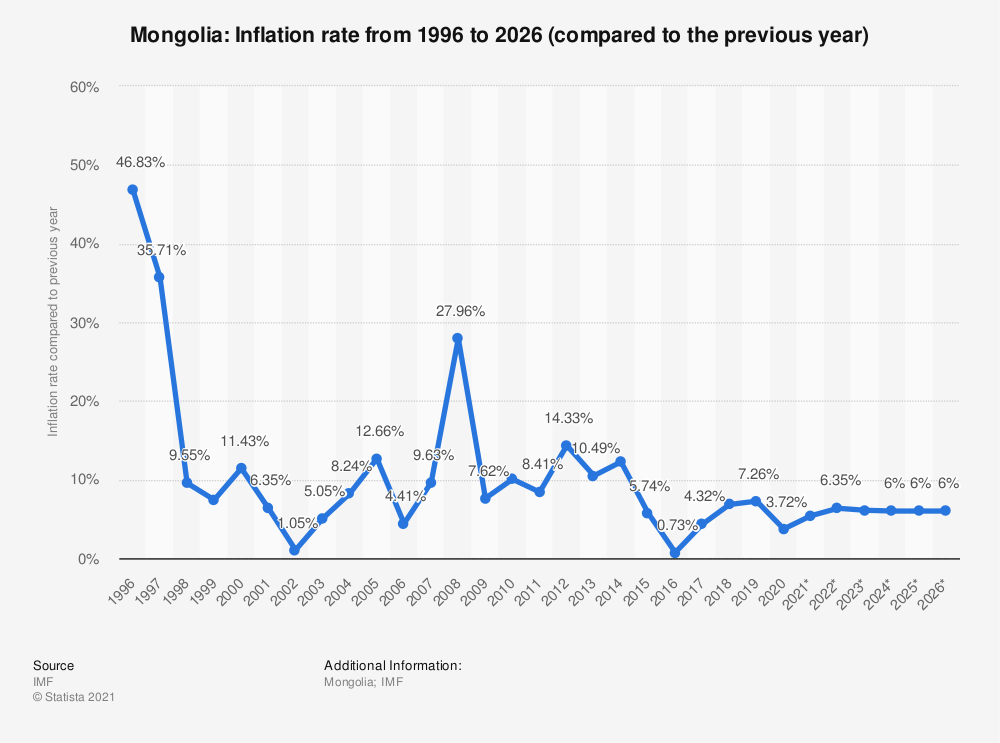
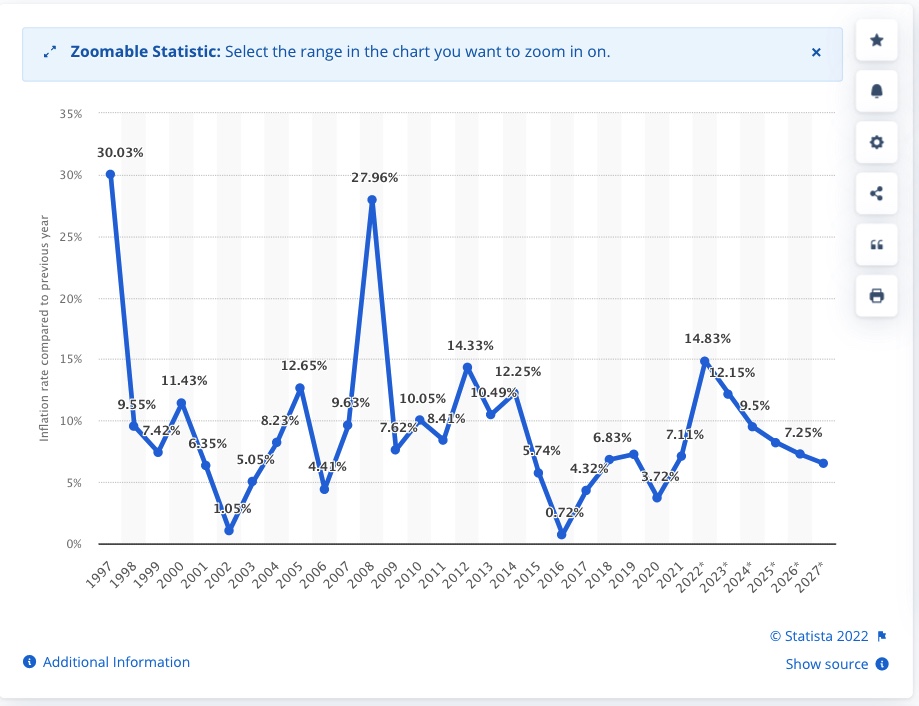
A dramatic decline in inflation paired with political and economic stabilisation allowed Mongolia to enjoy the fruits of the fast-growing economies of the 2000s. Source: Statista.
During the last 16 years the financial and monetary system of our country saw the worst crisis in 1991-1994, there was a recovery in 1995-1997 and another crisis in 1997-1999. However, it has entered a stable stage since 2000.
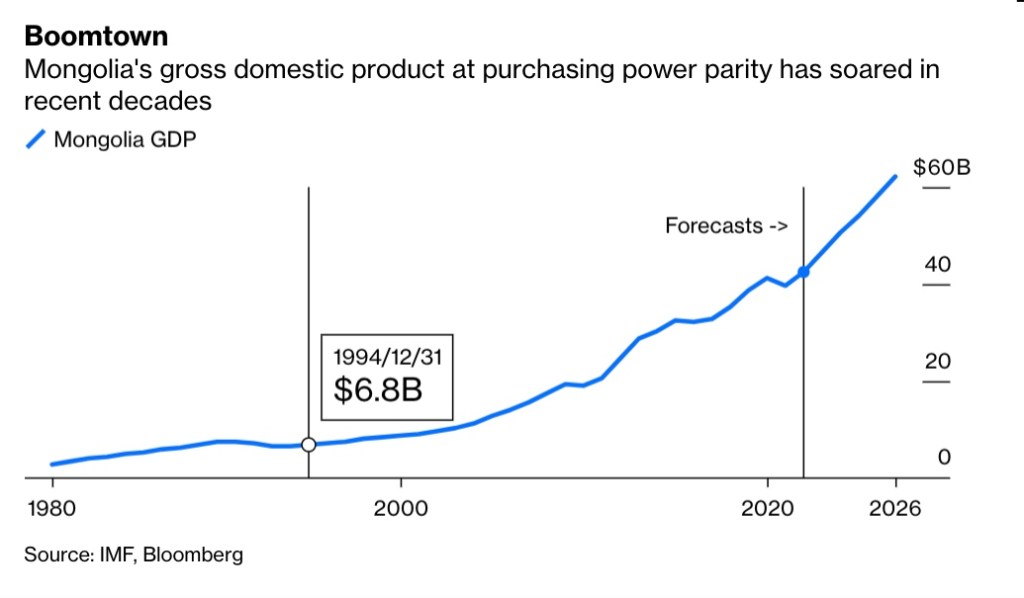
A resources “boomtown” throughout the 2000s. Source: Bloomberg. When I left in 1999, Mongolia’s PPP was US $8.8 bn; today (2021) it is US $42.4 bn. Graph from Migration under economic transition and changing climate in Mongolia, Journal of Arid Environments, Volume 185, February 2021. “Urbanization in Mongolia accounted for over 80% of all migration, mostly into the capital city Ulaanbaatar (UB), where nearly 70% of recent population growth was from migration.” As can be seen in this chart, Mongolia’s economic growth since 2000 has benefited greatly from its proximity to China.
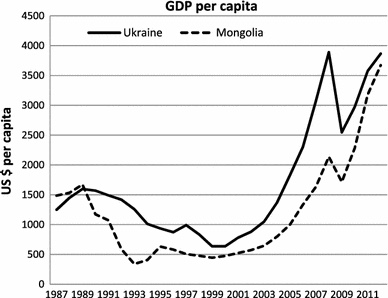
As this chart shows, increasing connectivity had a profound impact on living standards in Ukraine and Mongolia post-2000. The extreme turbulence Mongolia experienced in the 1990s – after the collapse of support mechanisms from the Soviet Union – calmed down as Mongolia integrated with the global economy, especially a booming China. Read about my work in Ukraine here: UN Ukraine Web Development Experience | 2000.
The Economist: “Those free-trading Mongolians” was published Apr 24th 1997. I arrived in May of 1997 to find a country on the cusp of great and turbulent change.
In this role, I pioneered innovative uses of the Internet and digital resources to communicate the UN’s work and Mongolia’s unfolding crises. The UN called this work a “role model” for the wider UN and country offices. A survey of United Nations country office websites in 2000 ranked the UN Mongolia website I launched in 1997 and oversaw for two years (1997-1999), third best in the world, saying: “A UN System site. A very nice, complete, professional site. Lots of information, easily accessible and well laid out. The information is comprehensive and up-to-date. This is a model of what a UNDP CO web site should be.” (http://www.scribd.com/doc/274319690/UNDP-Mongolia-United-Nations-2000-Survey-of-Country-Office-Websites)
“The years 1998 and 1999 have been volatile ones for Mongolia, with revolving door governments, the assassination of a minister, emerging corruption, a banking scandal, in-fighting within the ruling Democratic Coalition, frequent paralysis within the Parliament, and disputes over the Constitution. Economically, the period was unstable and rife with controversies.” Mongolia in 1998 and 1999: Past, Present, and Future at the New Millennium by Sheldon R. Severinghaus, Asian Survey, Vol. 40, No. 1, A Survey of Asia in 1999 (Jan. – Feb., 2000). pp. 130-139 (Publisher: University of California)
As part of a strategic plan to raise awareness of Mongolia’s development challenges and to spur action on meeting them, a Communications Office was established for the UN mission in 1997 – a structure that is commonplace in UN missions today. The Office also led on digital communications, marking many firsts, from the first digital photo and video library, the first online magazine, the first web portal, the first online newsletter, and many other firsts. It gathered numerous stories on resilience in a crisis, and documented in data and storytelling the country’s development challenges, while introducing a transparent way of working and communicating unprecedented for the time (the country was still recovering from the state secrecy of its years under Communism), and led on modernizing communications in the country. Acting as a strategic hub, the Communications Office and its dynamic and talented team, were able to leverage the existing budget to spur action on many fronts, including:
I launched it in 1997 in the middle of a major crisis, and oversaw its expansion and development for two years. A pioneering digital resource, this award-winning United Nations Mongolia development web portal was singled out by UN headquarters in New York as an example of what a country office website should be like. It featured extensive resources in both Mongolian and English and also was home to the bilingual online magazine, Ger – Mongolia’s first web magazine. It can be viewed at www.archive.org and there is more at Wikipedia here: https://en.wikipedia.org/wiki/Ger_(magazine).
Media
Working with journalists and media both within Mongolia and outside, the Communications Office was able to significantly raise awareness of Mongolia and its development challenges. This was reflected in a substantial increase in media coverage of the country and in the numerous books and other publications that emerged post-1997. The book In Their Own Words: Selected Writings by Journalists on Mongolia, 1997-1999 (ISBN 99929-5-043-9) published by UNDP Mongolia archived the stories by theme.
Ger Magazine
Ger Magazine (the Mongolian word for home and traditional tent dwelling) was published as the country’s first e-magazine in 1998. There were four issues in total from 1998 to 2000. The launch issue was on the theme of youth in the transition. Mongolia was transitioning from Communism to free markets and democracy and this had been both an exhilarating time and a wrenching time for young people. The magazine drew on talented journalists from Mongolia and the handful of international journalists based there to create a mix of content, from stories about life adapting to free markets to stories on various aspects of Mongolian culture and life.
The second issue of the magazine proved particularly effective and inspiring, with its modern life theme and cover story on a thriving Mongolian fashion scene.
Archived issues of the magazine can be found at the Wayback Machine here: https://archive.org/. Just type in the UN Mongolia website address for the years 1997 to 1999: http://www.un-mongolia.mn.
An online survey of the state of Mongolia’s media and its history (www.pressreference.com/Ma-No/Mongolia.html), had this to say: “An interesting variation from some of the other publications available is Ger Magazine (published online with guidance from the United Nations Development Program, UNDP), which is concerned with Mongolian youth in cultural transition. The name of the magazine is meant to be ironic because a ger is the Mongolian word for yurt—a yurt being traditional nomadic housing—but the magazine is about urbanization and globalization of Mongolian youth.”
Blue Sky Bulletin
The Blue Sky Bulletin newsletter was launched in 1997 initially as a simple, photocopied handout. It quickly founds its purpose and its audience, becoming a key way to communicate what was happening in the country and a crucial resource for the global development community, scholars, the media and anyone trying to figure out what was happening in a crazy and chaotic time. It eschewed the typical ‘grip and grin’ content found in many development newsletters and instead offered stories, data and insights useful to anyone seeking to understand Mongolia’s development challenges. The Blue Sky Bulletin was distributed via email and by post and proved to be a popular and oft-cited resource on the country. The quality of its production also paralleled Mongolia’s growing capacity to publish to international standards, as desktop publishing software became available and printers switched to modern print technologies. The Blue Sky Bulletin evolved from a rough, newsprint black and white publication to becoming a glossy, full-colour, bilingual newsletter distributed around Mongolia and the world.
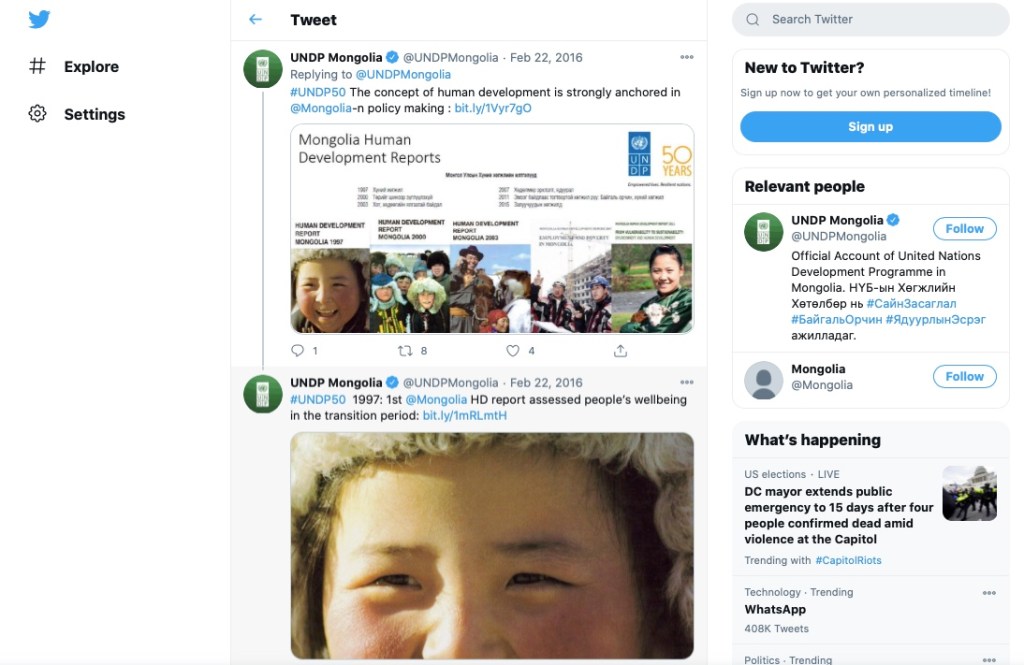
The Mongolian Human Development Report 1997 (MHDR), the country’s first, placed the story of the Mongolian people during the transition years (post-1989) at its heart, using photographs, stories and case studies to detail the bigger narrative at play.
This groundbreaking Mongolian Human Development Report – the country’s first – went beyond just chronicling Mongolia’s state of development in statistics and graphs. Designed, laid out and published in Mongolia, the report broke with the practices of many other international organisations, who would publish outside of Mongolia – denying local companies much-needed work and the opportunity to develop their skills. The report’s costs helped to kick-start a publishing boom in the country and significantly raised standards in design and layout in the Mongolia. The foundations laid down by the project producing the report ushered in a new age in publishing for Mongolia.
The report’s launch was innovative, not only being distributed for free across the country, but also part of a multimedia campaign including television programming, public posters, town hall meetings and a ‘roadshow’ featuring the report’s researchers and writers.
The initial print run of 10,000 copies was doubled as demand for the report increased. To the surprise of many, once hearing about the free report, herders would travel to the capital, Ulaanbaatar, to pick up their copy. The report proved people cared passionately about the development of their country and that development concepts are not to be the secret domain of ‘development practitioners’. The report also became an English language learning tool as readers compared the Mongolian and English-language versions.
1997 saw the launch of the first human development report for Mongolia.
Mongolian AIDS Bulletin
UNDP acted swiftly to address a breaking HIV/AIDS crisis in 1997, offering a key lesson for others working in public health (the Ebola Crisis and global air pollution crisis both show those lessons have still yet to be fully absorbed).
Assembled by a team of health experts after the Fourth International Congress on AIDS in Asia and the Pacific, the Mongolian AIDS Bulletin was published in 1997 in the middle of an HIV/AIDS crisis. It provided timely information and health resources in the Mongolian language and was distributed across the country.
“Mongolia’s first AIDS Bulletin marked the beginning of the UNDP Response to HIV/AIDS/STDs Project back in the autumn of 1997. Over 5,000 copies of the magazine were distributed across the country, offering accurate information on the HIV/AIDS situation. The project has been pivotal in the formulation of a national information, education and communication (IEC) strategy, bringing together NGOs, donors, UN agencies and the government.”
Source: YouandAids: The HIV/AIDS Portal for Asia Pacific
Green Book
In the Mongolian language, the Mongolian Green Book details effective ways to live in harmony with the environment while achieving development goals. Based on three years’ work in Mongolia – a Northeast Asian nation coping with desertification, mining, and climate change – the book presents tested strategies.
EPAP Handbook
The Environmental Public Awareness Handbook was published in 1999 and features the case studies and lessons learned by UNDP’s Mongolian Environmental Public Awareness Programme (EPAP). The handbook draws on the close to 100 small environmental projects the Programme oversaw during a two-year period. These projects stretched across Mongolia, and operated in a time of great upheaval and social, economic and environmental distress. The handbook is intended for training purposes and the practice of public participation in environmental protection.
In its 2007 Needs Assessment, the Government of Mongolia found the EPAP projects “had a wide impact on limiting many environmental problems. Successful projects such as the Dutch/UNDP funded Environmental Awareness Project (EPAP), which was actually a multitude of small pilot projects (most costing less than $5,000 each) which taught local populations easily and efficiently different ways of living and working that are low-impact on the environment.”
Mongolia Updates 1997, 1998, 1999
Mongolia Update 1998 detailed how the country was coping with its hyperinflation and the Asian economic crisis.
1998 proved a tumultuous year for Mongolia. The country’s existing economic crisis caused by the transition from Communism to free markets was made worse by the wider Asian Crisis. The government was destabilised, leading to an often-confusing revolving door of political figures. In order to help readers better understand the political changes in the country, a special edition of Mongolia Update was published that year.
UNDP Mongolia: The Guide
The Guide, first published in 1997, provided a rolling update on UNDP’s programmes and projects in Mongolia during a turbulent time (1997-1999). The mission simultaneously had to deal with the 1997 Asian Crisis (http://en.wikipedia.org/wiki/1997_Asian_financial_crisis) and the worst peacetime economic collapse in post-WWII history.
Each edition came with short project and context summaries, key staff contacts, and facts and figures on how the country was changing. For the first time, any member of the public could grasp what the UN was up to in the country and be able to contact the project staff. An unusual level of transparency at the time for a UN mission.
Memoranda of Understanding
Three Memoranda of Understanding were negotiated with the Mongolian Government to help focus efforts and aid the attainment of internationally-agreed resolutions. This was affirmed by a series of youth conferences, One World, held in 1998 and 1999.
Strategy and Leadership in a Crisis
The scale and gravity of the crisis that struck Mongolia in the early 1990s was only slowly shaken off by the late 1990s. The economic and social crisis brought on by the collapse of Communism and the ending of subsidies and supports from the Soviet Union, led to a sharp rise in job losses, poverty, hunger, and family and community breakdowns.
The challenge was to find inspiring ways out of the crisis, while building confidence and hope. The sort of challenges confronted by the UNDP Mongolia Communications Office included:
1) A food crisis: agricultural production was down sharply, and the traditional nomadic herding economy, while at peak herd, was failing to get the meat to markets and to a high enough standard to restore export levels to where they once were. As a result, a cross-border trading frenzy became the solution to falling domestic food production and availability.
2) HIV/AIDS/STDs crisis.
3) A major banking crisis.
4) Both the Asian Financial Crisis and the Russia Crisis.
5) An ongoing political crisis and an inability to form stable governments.
UN Annual Reports
Editor and designer. 1998 Report called by Under-Secretary-General Nafis Sadik “a clear, well-written, attractive and colourful report.”
One of many documents from that time held in the United Nations Archives Search Engine. In this case, reporting on Mongolia’s follow-up to global conferences to then-Secretary-General Kofi A. Annan in 1999.
Mongolia’s Follow-Up To The UN Global Conferences (1999) UNDP Mongolia Communications Office, Ulaanbaatar, Mongolia.
Production/Design Supervision: David South, UNDP Communications Coordinator; Proof Reading: N. Oyuntungalag, UNDP Communications Officer/David South (1999).
1998: International media tours of the country, launching of Mongolia’s first online magazine, Ger, distribute globally a regular newsletter on Mongolia’s development challenges, Blue Sky Bulletin. Open United Nations Info Shop for the public. Assist the Government of Canada to connect with Canadians working with the United Nations in Mongolia during the first official visit by a Canadian Government Minister.
1999: Launch a string of books documenting insights gleaned from the Mongolia development experience.
Testimonials
“Mongolia is not an easy country to live in and David [South] showed a keen ability to adapt in difficult circumstances. He was sensitive to the local habits and cultures and was highly respected by his Mongolian colleagues. … David’s journalism background served him well in his position as Director of the Communications Unit. … A major accomplishment … was the establishment of the UNDP web site. He had the artistic flare, solid writing talent and organizational skills that made this a success. … we greatly appreciated the talents and contributions of David South to the work of UNDP in Mongolia.” Douglas Gardner, UN Resident Coordinator and UNDP Resident Representative Mongolia
Impact
Micro
strategic communications approach including establishing the UN/UNDP Mongolia Communications Office and team and strategic communications plan
led on digital transformation, including use of digitial media (photo/video archive) and digital publishing (web site, online magazine and newsletter, etc.)
established and ran the United Nations Info Shop – a one-stop resource open to the public with archive of development publications and current periodicals and Internet access
began largest bilingual online and offline publishing programme in country – led on publishing and design modernisation
laid down the foundations for many UN initiatives in Mongolia that are still underway. Contributed to stabilizing the country in a turbulent time. Mongolia was briefly the fastest-growing economy in the world by 2011
championed transparency and access to information and media freedoms
oversaw a period in which Transparency International found lower levels of perceived corruption
managing editor for country’s first Human Development Report
Macro
raised profile of country and its development challenges. Donor pledges rose
2 international media tours
strong relationship with Mongolian and international journalists
championed innovators in commnications
crisis response: AIDS, economy, political
country’s largest website and one of its first. Called “Godfather of the Mongolian web”
called a “role model” for the wider UN
led on new approach to UN communications in the digital age
design-led approach
transparent and timely updates
negotiated three Memoranda of Understanding (MOUs): youth, food security and nutrition, STDs/HIV/AIDS
The response by the UNDP Mongolia Communications Office has been cited in numerous articles, books, publications and stories. It has also contributed to the development of the human development concept and understanding of human resilience in a crisis and innovation in a crisis.
This resource was praised for having: “Very useful references and original materials that documented UNDP Mongolia work. I needed to trace community-based development, and this book provided a valuable source.” Review on Google Books
In 2001, the UN won the Nobel Peace Prize for “their work for a better organized and more peaceful world” and its communications innovations, with work such as that in Mongolia being cited as a contributing factor to the awarding of the Prize.
The Nobel Peace Prize 2001 joint winners.
In 2000, the Millennium Development Goals (MDGs) were launched in a 15-year bid to use a focused approach to development centred around eight goals to accelerate improvements to human development. From 2000 to 2005, consulting work was undertaken in various UN missions (Mongolia, South Africa, Turkmenistan, Ukraine) to communicate the goals and to reshape communications activities around the goals.
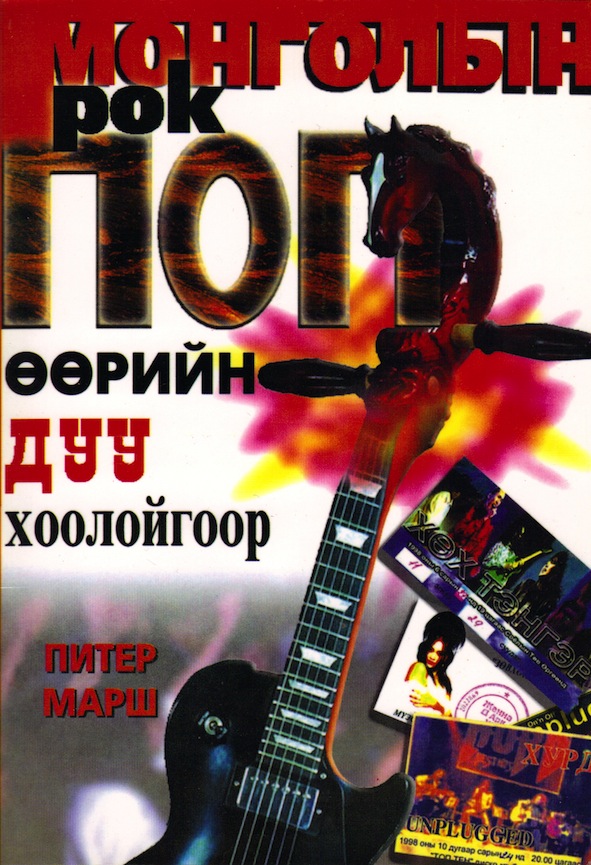
It was the late 1990s. Mongolia was still recovering from “one of the biggest peacetime economic collapses ever” (Mongolia’s Economic Reforms: Background, Content and Prospects, Richard Pomfret, University of Adelaide, 1994). But it was the country’s young musicians who were showing the way out of the crisis, setting an example for entrepreneurship in the new, free-market economy that emerged in the country after 1990.
As UNDP Communications Officer N. Oyuntungalag wrote in the Blue Sky Bulletin (BSkyB) newsletter, “A thriving pop and rock scene has emerged over the last four years. .. The energy of these musicians and singers has not gone unnoticed by the burgeoning advertising market. Pop bands are promoting many things, from face creams to beer. … [but] there has been little serious writing on the business of popular music.”
As the book’s author, American ethnomusicologist Peter Marsh, said in an interview with UNDP’s Blue Sky Bulletin newsletter, “we thought our book would provide important ideas about the direction and nature of the nation’s development.
“My impression about Mongolian pop-rock is that it is a lively, diverse and at times innovative Mongolian art form that closely reflects many of the hopes, fears and aspirations of its primary audience, Mongolian youth.”
The book still stands as an unusual and innovative contribution to thinking around the role played by youth in development and business and in crisis recovery.
Google Books Key Words: авдаг адил аль англи аялан байж байлаа байх байхад байхгүй бараг барууны бас бензин Бид нар бидний биз бизнес бий биш болох бөгөөд бусад бүжиг бүр бүтээлчид бүх гадаад гадаадад














 David South Consulting
You must be logged in to post a comment.