From experience, the importance of crafting a vision prior to the execution of a strategy is key to success and inspiring others. If done well, the vision can do much of the work for you. An inspiring vision will bring others on board, aligning them to your strategy. Some examples of vision leading to strategic success can be found in the following Case Studies from David South Consulting:
In the autumn of 1997, a national contest – Let’s Make Life Better! – was launched to inspire and mobilise Mongolian youth between the ages of 20 and 30. The idea was simple: for youth to come up with the best ideas to “design their own small and local development project.”
Launched with a cross-country advertising campaign, the prize of US $1,000 to implement the winning project (a substantial sum of money at the time) drew 580 project proposals by the contest deadline of December 15, 1997.
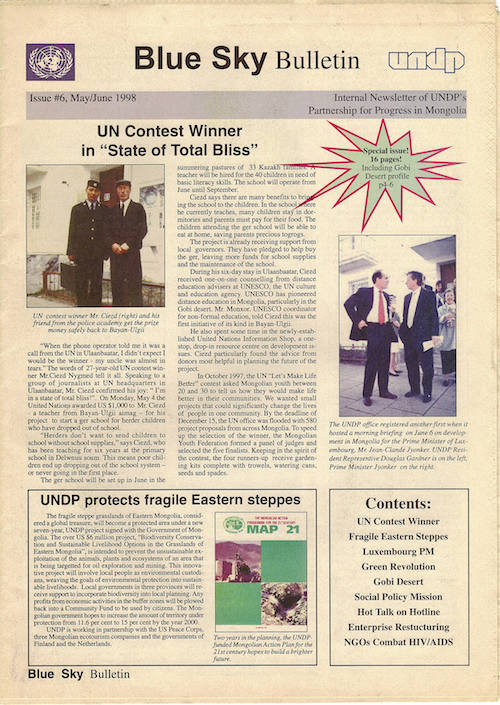
So many of the ideas were excellent, they were later to receive support from either the government, NGOs or international organisations. Read the story in theBlue Sky Bulletinnewsletter about the contest’s winner below:
Editor: David South
Publisher: UNDP Mongolia Communications Office
Published: Blue Sky Bulletin, Issue Number Six, May/June 1998
“When the phone operator told me it was a call from the UN in Ulaanbaatar, I didn’t expect I would be the winner – my uncle was almost in tears.”
The words of 27-year-old UN contest winner Mr. Ciezd Nygmed tells it all. Speaking to a group of journalists at UN headquarters in Ulaanbaatar, Mr. Ciezd confirmed his joy: “I’m in a state of total bliss!”
On Monday, May 4 the United Nations awarded US $1,000 to Mr. Ciezd – a teacher from Bayan-Ulgii aimag – for his project to start a ger school for herder children who have dropped out of school.
“Herders don’t want to send children to school without school supplies,” says Ciezd, who has been teaching for six years at the primary school in Delwnuu soum. This means poor children end up dropping out of the school system – or never going in the first place.
The ger school will be set up in June in the summering pastures of 33 Kazakh families. A teacher will be hired for the 40 children in need of basic literacy skills. The school will operate from June until September.
Ciezd says there are many benefits to bringing the school to the children. In the school where he currently teaches, many children stay in dormitories and parents must pay for their food. The children attending the ger school will be able to eat at home, saving parents precious togrogs.
The project is already receiving support from local governors. They have pledged to help buy the ger, leaving more funds for school supplies and the maintenance of the school.
During his six-day stay in Ulaanbaatar, Ciezd received one-on-one counselling from distance education advisers at UNESCO, the UN culture and education agency. UNESCO has pioneered distance education in Mongolia, particularly in the Gobi desert. Mr. Monxor, UNESCO coordinator for non-formal education, told Ciezd this was the first initiative of its kind in Bayan-Ulgii.
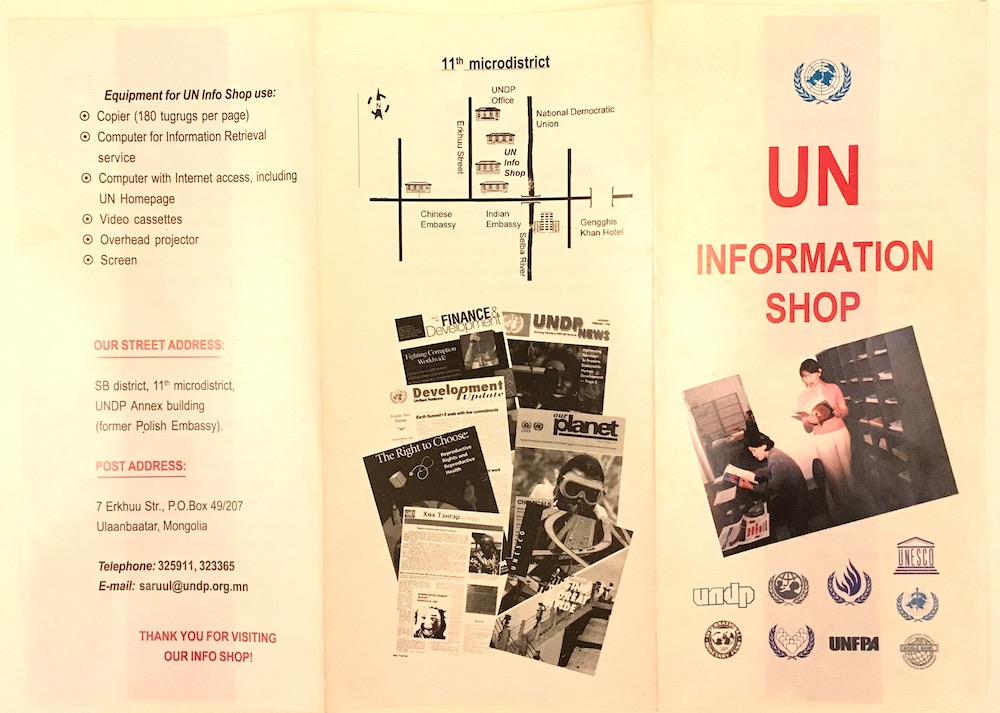
He also spent some time in the newly-established United Nations Information Shop, a one-stop, drop-in resource centre on development issues. Ciezd particularly found the advice from donors most helpful in planning the future of the project.
In October 1997, the UN “Let’s Make Life Better!” contest asked Mongolian youth between 20 and 30 to tell us how they would make life better in their communities. We wanted small projects that could significantly change the lives of people in one community. By the deadline of December 15, the UN office was flooded with 580 project proposals from across Mongolia. To speed up the selection of the winner, the Mongolian Youth Federation formed a panel of judges and selected the five finalists. Keeping in the spirit of the contest, the four runners-up receive gardening kits complete with trowels, watering cans, seeds and spades.
The United Nations Information (UN Info Shop) was established by UNDP Mongolia in 1997 and was managed by the UNDP Mongolia Communications Office. Context is everything. At this time, Mongolia was still recovering from the chaotic and turbulent transition from Communism to free markets and democracy begun at the start of the 1990s, called by some “one of the biggest peacetime economic collapses ever (Mongolia’s Economic Reforms: Background, Content and Prospects, Richard Pomfret, University of Adelaide, 1994)”. There was a thirst for information: access to the Internet was still limited and access to mobile phones was just the preserve of the rich. As a legacy of the past, information, especially that about the outside world and the country’s true economic and social conditions, was restricted. During the years of Communism, even simple travel from one place to the next was strictly regulated.
While today we can take it for granted that the Internet, and mobile and smart phones, deliver the world’s information in seconds, this just was not the case in the late 1990s in Mongolia.
The UN Info Shop quickly became a crucial resource for students (many schools and universities were nearby) and it became a first stop for many wishing to access the Internet. It also substantially raised the profile of the UN in the country as the public could, for the first time, enter the UN building and discover what the UN was doing in the country. They could also visit the UNDP Mongolia Communications Office and meet its team.
P. Dagmidmaa reads the Human Development Report Mongolia 1997 in the UN Info Shop.
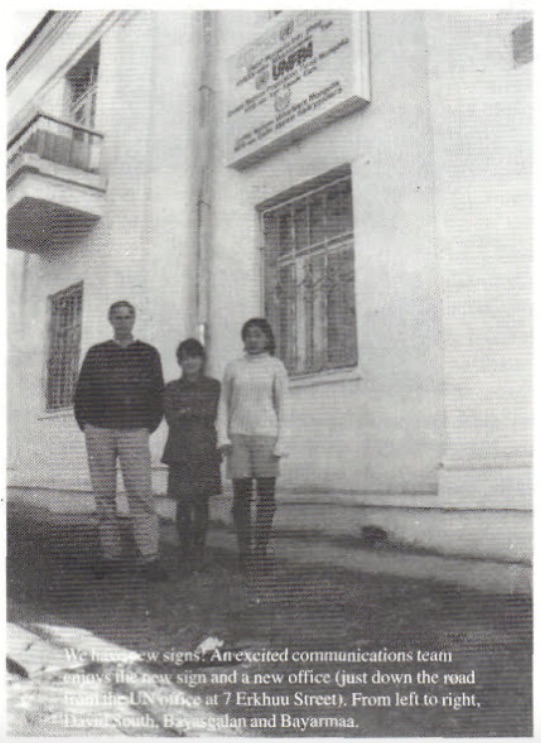
The UNDP Mongolia Communications Office Team 1998 outside the UN Info Shop in the capital, Ulaanbaatar: David South, Bayasgalan and Bayarmaa.
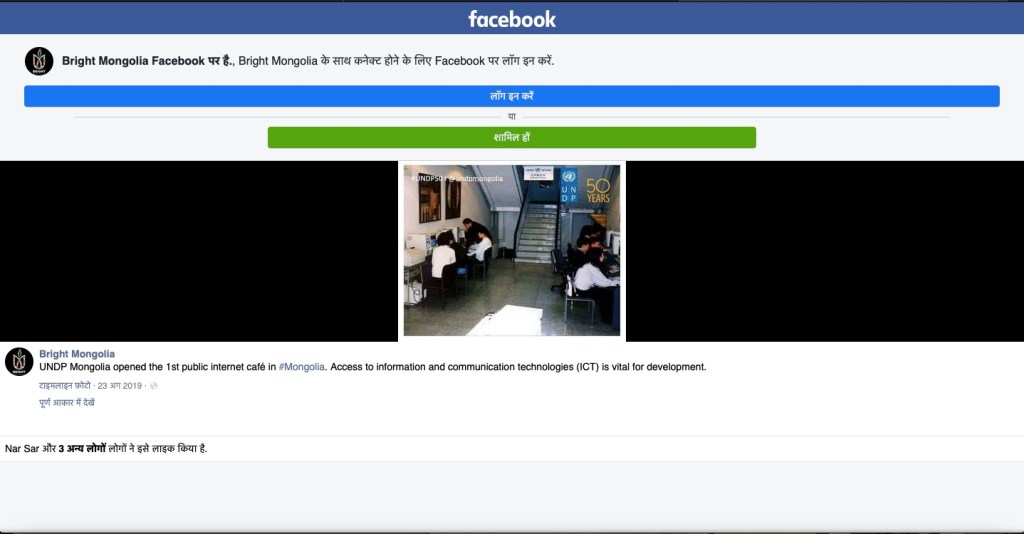
“UNDP Mongolia opened the 1st public internet cafe in Mongolia.” The internet cafe was part of the UN Mongolia Info Shop.
Many initiatives grew from the talented and dynamic UNDP Mongolia Communications Office team. Here are links to some of them:
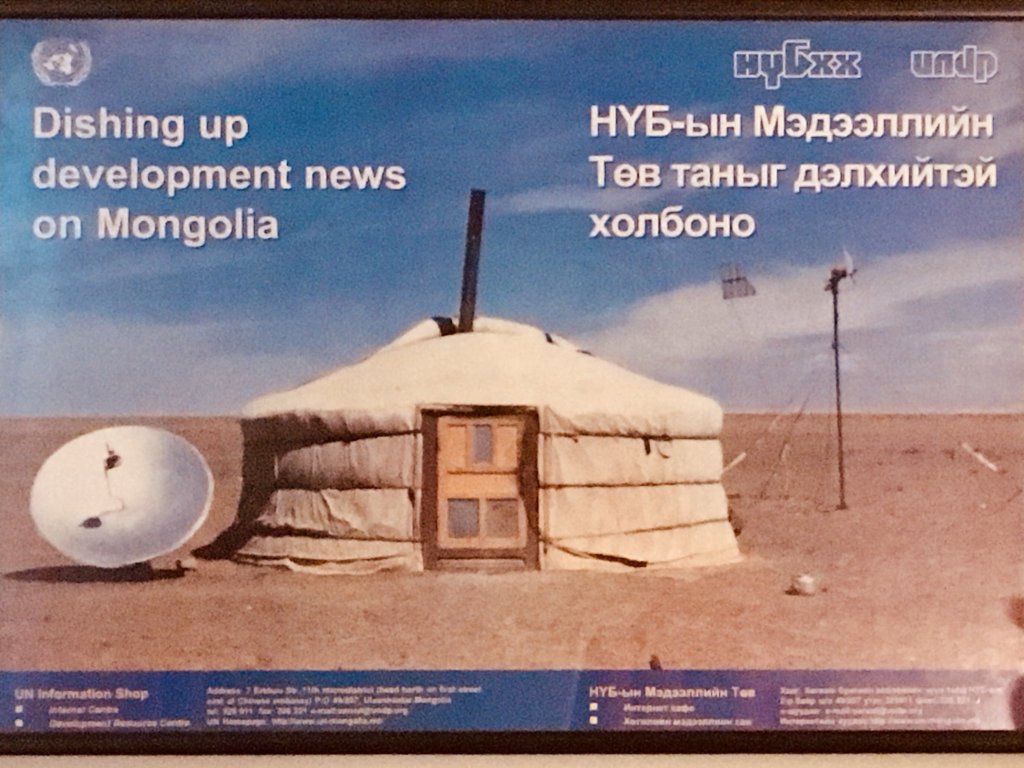
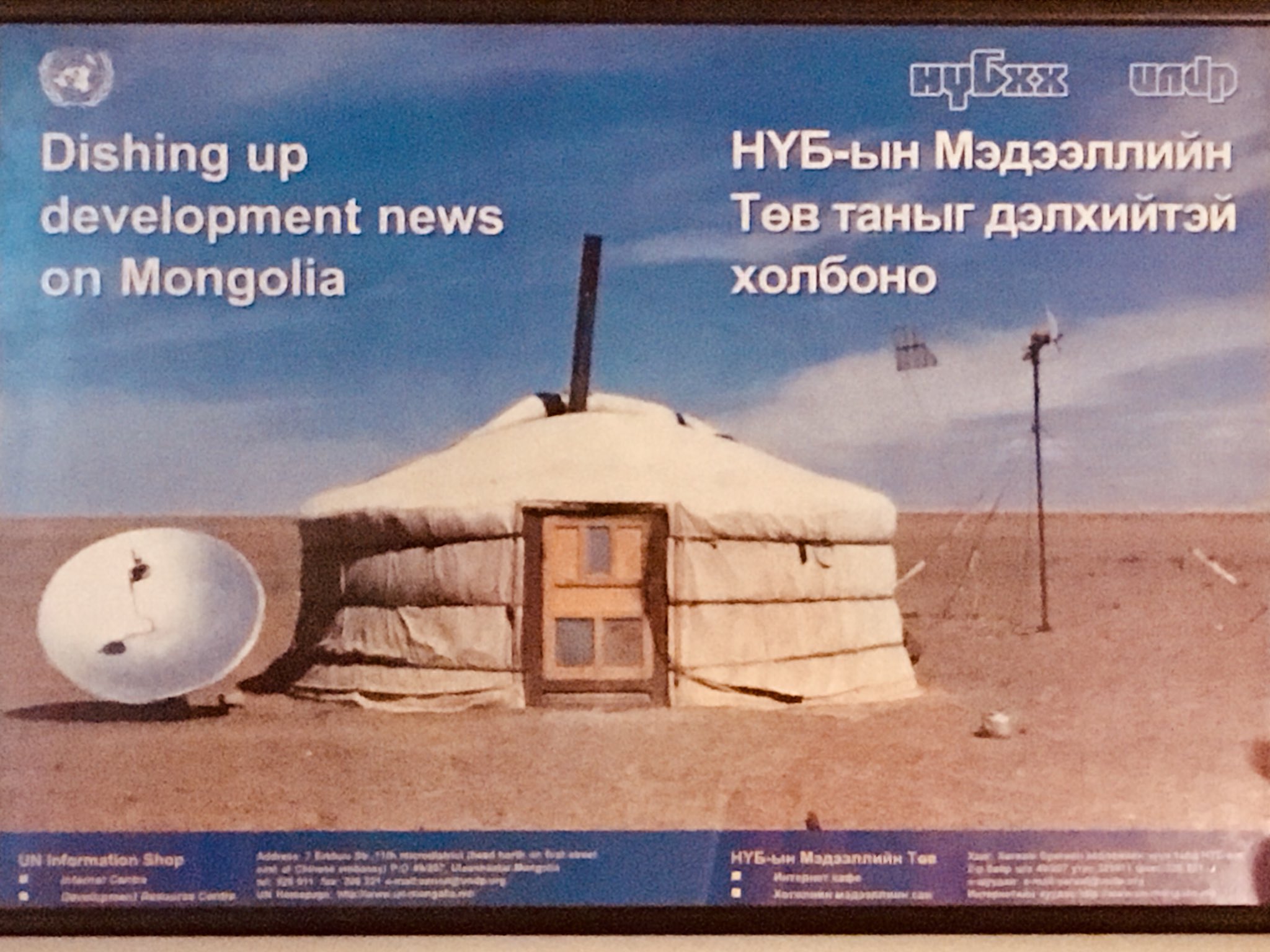
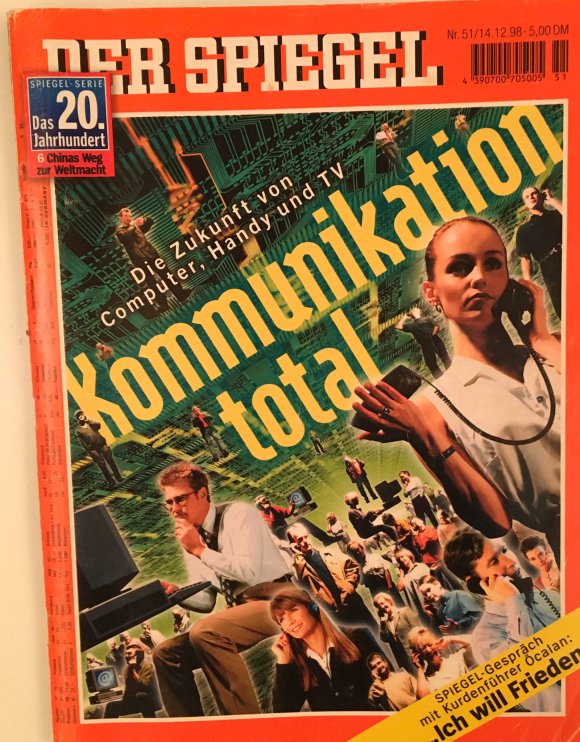
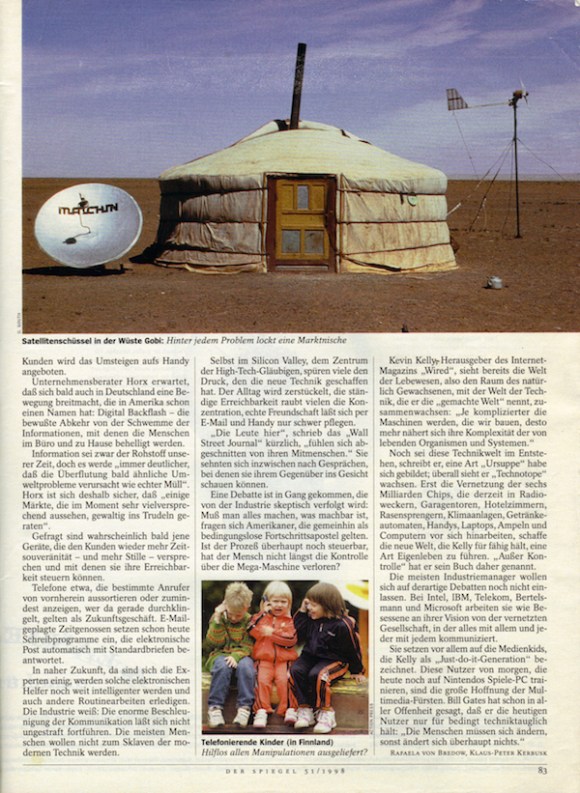
In 1998 Der Spiegel’s “Kommunikation total” issue profiled the global connectivity revolution underway and being accelerated by the Internet boom of the late 1990s. It chose my picture of a satellite dish and a ger in the Gobi Desert to symbolise this historic event.







 David South Consulting
You must be logged in to post a comment.