Tag: UNDP Mongolia

  • Philippine Conference Tackles Asia’s AIDS Crisis

    Philippine Conference Tackles Asia’s AIDS Crisis

    Mongolians attend for first time

    By David South

    UB Post (Ulaanbaatar, Mongolia), October 28, 1997

    Manila, Philippines – More than 2,500 delegates have gathered in the steamy hot Philippine capital to renew the fight against HIV and AIDS.

    Working up a sweat alongside other participants at the Fourth International Congress on AIDS in Asia and the Pacific are nine Mongolians – a first that isn’t going unnoticed.

    The Congress opened Saturday (October 25) to the pounding beat of a theme song performed by teenagers, championing defiance of death and celebration of life.

    That tone was echoed by Dr Peter Piot, executive director of UNAIDS, the Joint United Nations Programme on HIV/AIDS. He said the epidemic can be slowed down with the right public health measures – a positive message for Mongolia as it grapples with an STD crisis that many believe leaves the country at risk of an HIV/AIDS epidemic.

    The magnitude of that epidemic outside Mongolia is startling. Around the world, 23 million people are infected with HIV, the virus that causes AIDS. Between 5 and 7 million of them live in the Asia/Pacific region.

    “The point is that prevention is feasible,” Piot told the Congress. “The results can be seen in those countries in the Asia-Pacific region where the epidemic has stalled or is in retreat.

    “A good indicator for unsafe sexual behaviour is the STD rate. I am impressed at the sustained decline in STD rates in Australia, Hong Kong, Singapore and Thailand over the past decade.

    “But I am concerned actual declines in HIV in this region have occurred only in Australia, New Zealand and Thailand.”

    The countries to Mongolia’s immediate south and north are experiencing exploding health crises. In China, HIV/AIDS is increasing at a rapid rate due to factors including growing prostitution, drug use and travel – all by-products of a booming economy. The infected population is estimated at 400,000 and is expected to reach 1.2 million by the year 2000, according to China’s national AIDS committee.

    To the north in Russia, a complete collapse in the public health system has dramatically slashed life expectancy and led to an upsurge in many diseases, including tuberculosis and HIV/AIDS.

    With many Mongolians doing business in both these countries, there are numerous opportunities for AIDS to enter the country.

    A wide range of topics is under discussion at the gathering, with women, youth and STD-control measures of particular interest to the Mongolian delegates.

    For the Mongolians, the Congress is an opportunity to learn from other countries’ successes and failures in the fight against AIDS.

    Mongolia’s nine-member delegation includes four doctors – Dr K. Davaajav, head of the AIDS/STD Department of the Research Centre for Infectious Diseases, Health Ministry representative Dr S. Enkhbat. Medical University director Dr Lkhagvasuren and Dr Darisuren from the United Nations Population Fund.

    Also in the team are Democrat MPs B. Delgermaa and Saikhanbileg, UNICEF’s B. Bayarmaa and two representatives from women’s NGOs: S. Tsengelmaa from the Women’s Information and Research Centre and N. Chinchuluun, executive director of the Mongolian Women Lawyers Association.

    On Sunday, several presentations focused on the difficulties of getting people to use condoms.

    In Fiji, studies found the majority of the population was aware of AIDS and had access to condoms, but still chose not to use them.

    Lisa Enriquez, a Filipino woman who is HIV-positive, gave a sobering speech on the epidemic.

    “One of the most important things I’ve learned from the epidemic is human nature. AIDS is such a humanizing disease. It reminds us of being human, complete with all the weaknesses and imperfections of being human.

    “Let us not kid ourselves: changing behaviour is not easy. One doesn’t change because somebody tells him or her to do so.

    “We will need to get our act together, institutionalize our efforts and continue working harder with passion and perserverance.”

    The Congress continues until October 30.

    More on the Congress here: Fourth International Congress on AIDS in Asia and the Pacific

    “The Fourth International Congress on AIDS and Asia in the Pacific convened 3,000 scientists, people working in the communities, and people living with HIV/AIDS to discuss the state of AIDS in Asia and the Pacific and how the problem is being addressed now and into the future. The following topics addressed at the Congress are explored: the extent of the HIV epidemic, HIV risk behaviors, women and HIV, clinical manifestations of HIV infection, antiretroviral therapy, and perinatal HIV transmission. HIV is spread differently among these countries and a nation’s wealth largely determines its ability to execute prevention programs and patient access to therapy. Most patients in Asia pay for their own medications. It is hoped that more prosperous and technologically advanced nations will demonstrate stronger leadership and commitment in the fight against AIDS in the region.” Phanuphak P. Fourth International Congress on AIDS in Asia and the Pacific. J Int Assoc Physicians AIDS Care. 1998 Feb;4(2):22-5. PMID: 11365085.

    More on HIV/AIDS:

    https://davidsouthconsulting.org/2020/12/18/feds-call-for-aids-blood-system-inquiry-some-seniors-infected/

    https://davidsouthconsulting.org/2020/12/17/lamas-against-aids/

    https://davidsouthconsulting.org/2017/08/15/mongolian-aids-bulletin/

    https://davidsouthconsulting.org/2022/10/31/rainforest-rubbers-save-lives/

    Creative Commons License

    This work is licensed under a
    Creative Commons Attribution-Noncommercial-No Derivative Works 3.0 License.

    ORCID iD: https://orcid.org/0000-0001-5311-1052.

    © David South Consulting 2023

  • “Buying into capitalism”

    “Buying into capitalism”

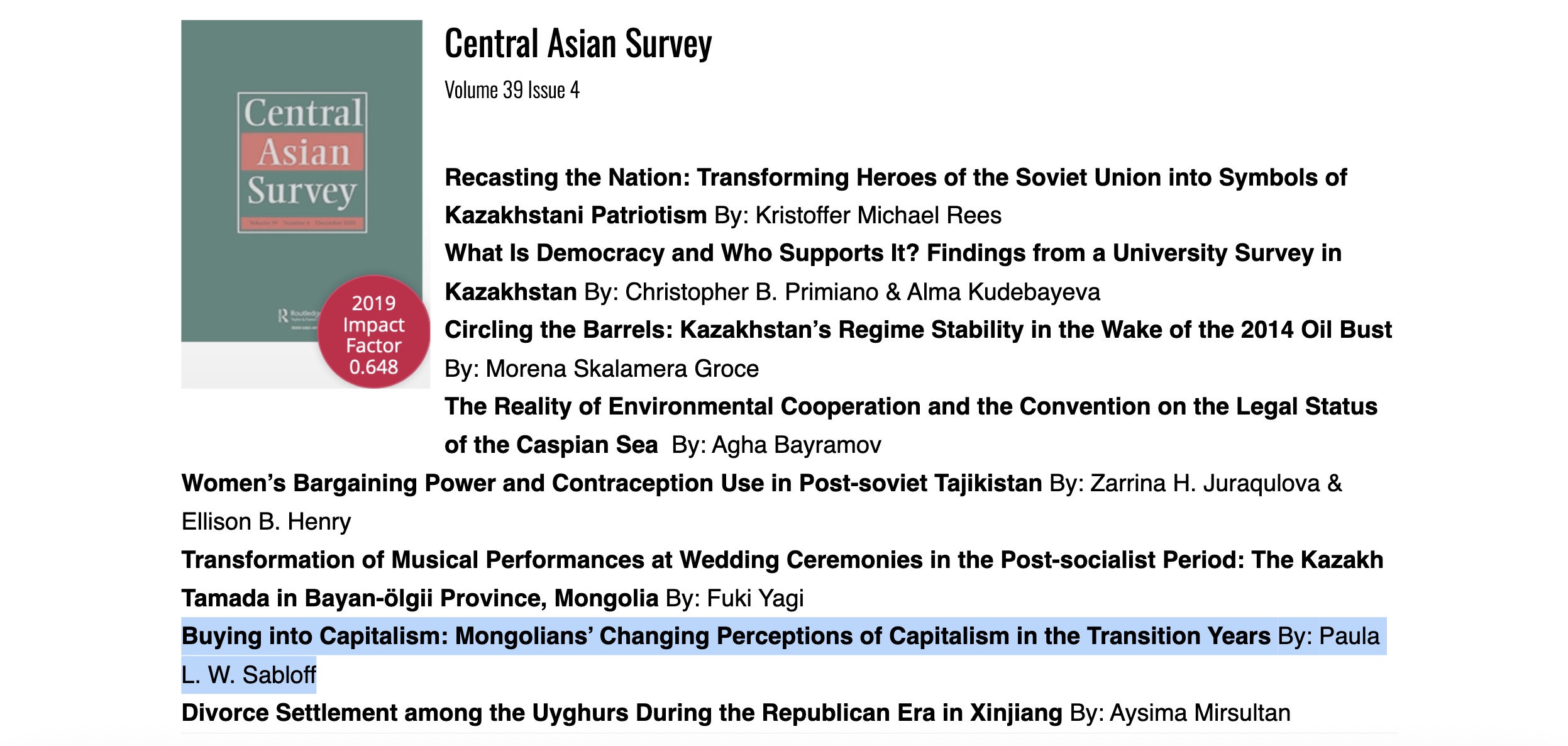
    Buying into capitalism: Mongolians’ changing perceptions of capitalism in the transition years by Paula L. W. Sabloff (12 Oct 2020).

    It was a pleasure to have the opportunity to comment on a draft of Buying into capitalism: Mongolians’ changing perceptions of capitalism in the transition years by External Professor Emeritus Paula L. W. Sabloff from the Santa Fe Institute (12 Oct 2020: Central Asian Survey). 

    “A political anthropologist, she uses complex-systems tools to analyze three different databases: Mongolians’ changing ideas on democracy and capitalism, the emergence of early states all over the world, and 19-20th century Cozumel.”

    The Santa Fe Institute “is the world’s leading research center for complex systems science.”

    Paula L. W. Sabloff (2020) Buying into capitalism: Mongolians’ changing perceptions of capitalism in the transition years, Central Asian Survey, 39:4, 556-577, DOI: 10.1080/02634937.2020.1823819.

    ORCID iD: https://orcid.org/0000-0001-5311-1052.

    © David South Consulting 2024

  • Starting From Scratch: The Challenge Of Transition

    Starting From Scratch: The Challenge Of Transition

    By David South (Canada), UNV Information Officer, UNDP, Mongolia

    UNV News #78 November 97

    After seven years of transition to a market economy, Mongolia – a former satellite of the Soviet Union that has had a democratic government since 1992 – has been profoundly changed. Where it once had a rigid communist government and few contacts with the west, Mongolia has pursued rapid economic, political and social liberalisation. Mongolia has a small population – 2.3 million – spread out over a vast territory wedged between Russia and China.

    Communication has in many ways deteriorated over the past seven years as the old communication networks from the communist era have not been fully replaced by the private sector. More and more it became apparent that government and the private sector were almost working in the dark in understanding how transition has affected Mongolians.

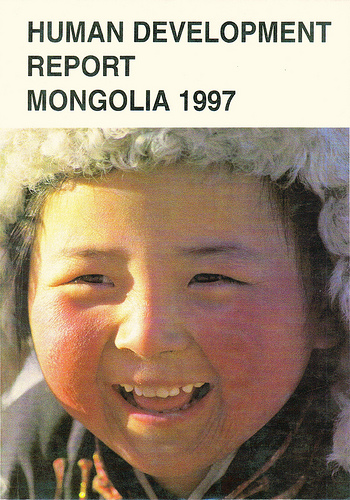
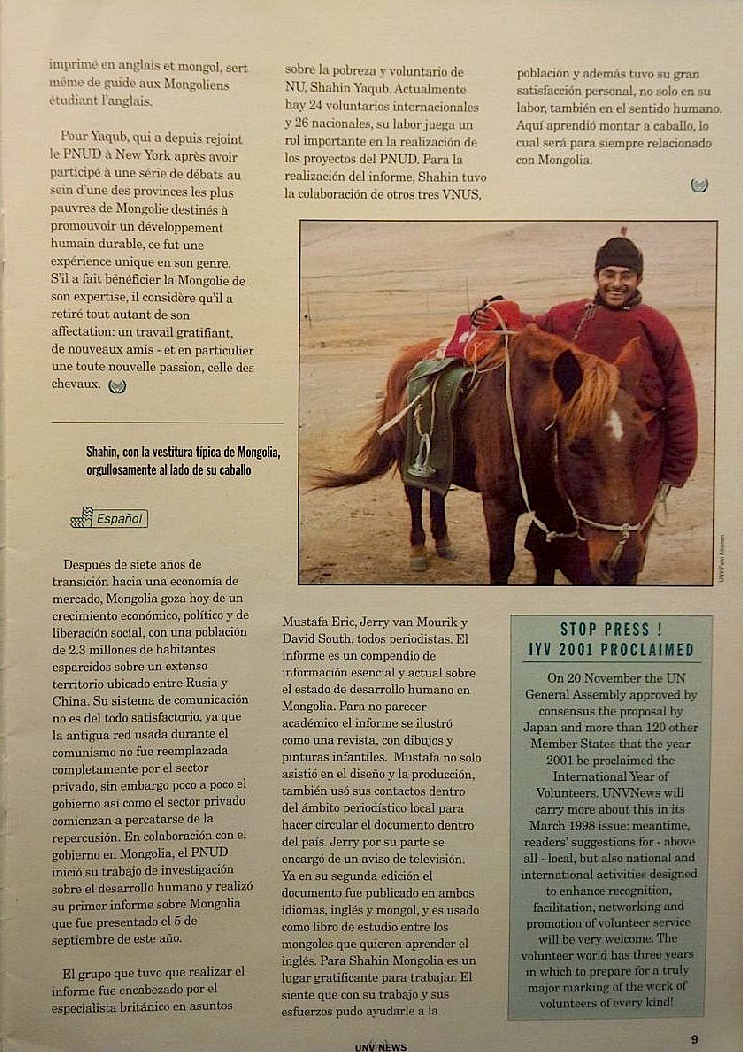
    In partnership with the Mongolian government, UNDP initiated the researching of Mongolia’s first human development report back in the middle of 1996. It was launched on September 5 of this year, with UNVs playing a key role. To lead the team in producing the report, British poverty specialist and UNV Shahin Yaqub was brought in. Only 29-years-old – one of the youngest UNVs in Mongolia – Yaqub joined a rapidly expanding UNV presence in the country. There are now 24 international UNVs and 26 Mongolian UNVs deployed throughout the country in UNDP’s projects.

    The thirst for expertise in Mongolia – a country undergoing the growing pains of transition to a market economy – has placed high demand on UNVs. UNVs occupy senior roles in all of UNDP’s projects.

    The 1997 Mongolian Human Development Report is a prime example of the important goal of capacity building conducted by the UNDP. For Yaqub, the report’s principal author, it was like starting from scratch. A poverty research office had to be set up before the work could begin. A team of Mongolia’s top statistical researchers had to be trained in the latest methodologies for social research.

    Yaqub was excited by the project. He said: ”There was no office when I first came. We had to organise the office to understand who does what and basically create the focal point for poverty analysis in Mongolia”.

    Yaqub also had some of his basic assumptions tested. The small population of this country – only 2.3 million – had meant the previous communist regime was able to build up a large archive of statistics on the population. A good portion of the information was not up to international standards, but it potentially represented a wellspring of data to start from. “Mongolia is number-rich. To even have that kind of data is very rare for a developing country. But unfortunately we found all this information was stored on Russian mainframe computers that didn’t work anymore!”

    During the actual production of the report, Yaqub was joined by three more UNVs: Mustafa Eric, a Turkish journalist working with the Press Institute of Mongolia, Jerry van Mourik, a Dutch journalist now working as the Support Officer to the United Nations Resident Co-ordinator, and UNDP Information Officer David South, a former journalist with the Financial Times in London, England.

    The high-profile role played by media UNVs was crucial if the report was to not end up collecting dust on a government shelf. The report is a repository of essential and new information on the state of human development in Mongolia, including data showing rising poverty rates and serious threats to food security. Like all human development reports produced by UNDP, it was not meant to be a prescriptive tract, but a lubricant for a national debate on sustainable development in Mongolia. This altered the design and presentation of the report.

    Instead of looking academic, the report took on the appearance of a magazine, from its cover to colourful children’s paintings inside. UNV Mustafa not only assisted with the report’s design and production, he also used his contacts in the Mongolian media to ensure the report was distributed across the country. UNV van Mourik assisted with publicity, including producing an emotionally-charged television commercial weaving together vignettes from Mongolia’s recent history to tell the story of human development.

    Already in its second print run in both English and Mongolian, the report has been adopted as their study guide by Mongolians wanting to learn English.

    “Mongolia is a rewarding place to work,” said Yaqub. “As a technical specialist and UNV, what you bring to the job is valued. I researched poverty for five years before coming to Mongolia and I felt I had something to contribute. But I also realised I had something to learn as well. You always have to keep in mind you are bringing your own baggage to the job – be it cultural, emotional or intellectual. Coming from an academic background, I was not afraid to be told I was wrong.”

    Yaqub, who had worked in poverty analysis in the Philippines and Bangladesh before coming to Mongolia, will never forget the country that sparked his new passion: horses.

    “You give up things as a volunteer – your time, your income, all the things you took for granted back home. But what you give up is compensated by rewarding work and good friends. When I learned to ride a horse, I can place it directly and clearly to Mongolia – that memory will always be with me.”

    Just before Yaqub left Mongolia for work with UNDP in New York, he participated in a series of public debates in one of Mongolia’s poorest provinces, Khuvsgul aimag. The public debates are used to introduce the report to the grassroots while sparking discussion on sustainable human development.

    Starting from scratch – The challenge of transition

    Résumé en Français

    UNV News #78 November 97

    Sept années de transition vers une économie de marché et une libéralisation rapide tant économique et politique que sociale, ont profondément transformé la Mongolie, vaste territoire à faible densité de population bordé par la Russie et la Chine. Les communi-cations se sont fortement détériorées et ni le gouvernement ni le secteur privé ne se trouvaient manifestement en mesure d’évaluer l’impact de la transition sur la population. En collaboration avec le gouvernement, le PNUD a donc procédé à l’établissement du premier rapport sur le développement humain en Mongolie, publié en septembre de cette année.

    Plusieurs VNU parmi le nombre croissant de volontaires actuellement en poste en Mongolie au sein de projets du PNUD – 24 internationaux et 26 nationaux – y ont pris une part prépondérante, tout particulièrement Shahin Yaqub, spécialiste britannique en recherche sur la pauvreté. Pour Yaqub, puis pour ses trois collègues VNU Mustafa Erik, Jerry van Mourik et David South, le défi consistait à partir de rien – pas de bureau, une base de statistiques existante… mais sur des ordinateurs russes hors service – pour mettre sur pied un rapport riche en informations qui, une fois terminé, n’irait pas dormir sur l’étagère d’un bureau gouvernemental mais servirait de base à une action durable à l’échelon national. Grâce au format adopté – un magazine abondamment illustré – , à sa présentation par les médias – notamment la télévision – et à sa diffusion à travers le pays entier, c’est chose faite. Le rapport, imprimé en anglais et mongol, sert même de guide aux Mongoliens étudiant l’anglais.

    Pour Yaqub, qui a depuis rejoint le PNUD à New York après avoir participé à une série de débats au sein d’une des provinces les plus pauvres de Mongolie destinés à promouvoir un développement humain durable, ce fut une expérience unique en son genre.

    S’il a fait bénéficier la Mongolie de son expertise, il considère qu’il a retiré tout autant de son affectation: un travail gratifiant, de nouveaux amis – et en particulier une toute nouvelle passion, celle des chevaux.

    Starting from scratch – The challenge of transition

    Resumen en Español

    UNV News #78 November 97

    Después de siete años de transición hacia una economía de mercado, Mongolia goza hoy de un crecimiento económico, político y de liberación social, con una población de 2.3 millones de habitantes esparcidos sobre un extenso territorio ubicado entre Rusia y China. Su sistema de comunicación no es del todo satisfactorio, ya que la antigua red usada durante el comunismo no fue reemplazada completamente por el sector privado, sin embargo poco a poco el gobierno así como el sector privado comienzan a percatarse de la repercusión. En colaboración con el gobierno en Mongolia, el PNUD inició su trabajo de investigación sobre el desarrollo humano y realizó su primer informe sobre Mongolia que fue presentado el 5 de septiembre de este año.

    El grupo que tuvo que realizar el informe fue encabezado por el especialista británico en asuntos sobre la pobreza y voluntario de NU, Shahin Yaqub. Actualmente hay 24 voluntarios internacionales y 26 nacionales, su labor juega un rol importante en la realización de los proyectos del PNUD. Para la realización del informe, Shahin tuvo la colaboración de otros tres VNUS, Mustafa Eric, Jerry van Mourik y David South, todos periodistas. El informe es un compendio de información esencial y actual sobre el estado de desarrollo humano en Mongolia. Para no parecer académico el informe se ilustró como una revista, con dibujos y pinturas infantiles. Mustafa no solo asistió en el diseño y la producción, también usó sus contactos dentro del ámbito periodístico local para hacer circular el documento dentro del país. Jerry por su parte se encargó de un aviso de televisión. Ya en su segunda edición el documento fue publicado en ambos idiomas, inglés y mongol, y es usado como libro de estudio entre los mongoles que quieren aprender el inglés. Para Shahin Mongolia es un lugar gratificante para trabajar. El siente que con su trabajo y sus esfuerzos pudo ayudarle a la población y además tuvo su gran satisfacción personal, no solo en su labor, también en el sentido humano. Aquí aprendió montar a caballo, lo cual será para siempre relacionado con Mongolia.

    https://davidsouthconsulting.org/2020/12/19/case-study-4-un-undp-mongolia-1997-1999/

    Citation

    O’Brien, Gantsetseg and Trotman, Greg (1999) “Selection and Preparation of Australian Expatriates and Business People for Postings in Mongolia,” University of the Sunshine Coast, Department of Marketing, International Business & Tourism, Working Paper 99/3.

    This work is licensed under a Creative Commons Attribution 4.0 International License.

    ORCID iD: https://orcid.org/0000-0001-5311-1052.

    © David South Consulting 2025

  • Memoranda Of Understanding And Negotiator | 1997 – 2014

    Memoranda Of Understanding And Negotiator | 1997 – 2014

    DS Consulting logo copy

    Astute negotiation skills have been required to see through complex, multi-partner projects, or to see through difficult transitions (in particular digital). While working for the United Nations in Mongolia (1997-1999), I led negotiations on three Memoranda of Understanding with the Government of Mongolia: Youth, Food Security and Nutrition and Human Rights (Blue Sky Bulletin).

    As head of the UNDP Mongolia Communications Office (1997-1999), I was at the centre of a fast-expanding UN mission in the midst of a major crisis (called “one of the biggest peacetime economic collapses ever”, Mongolia’s Economic Reforms: Background, Content and Prospects, Richard Pomfret, University of Adelaide, 1994). Everything we did required solid negotiation skills that were sensitive to the culture and understood how to get things done in that context. People were under a great deal of pressure and the times were characterized as “volatile ones for Mongolia, with revolving door governments, the assassination of a minister, emerging corruption, a banking scandal, in-fighting within the ruling Democratic Coalition, frequent paralysis within the Parliament, and disputes over the Constitution. Economically, the period was unstable and rife with controversies.” Mongolia in 1998 and 1999: Past, Present, and Future at the New Millennium by Sheldon R. Severinghaus, Asian Survey, Vol. 40, No. 1, A Survey of Asia in 1999 (Jan. – Feb., 2000). pp. 130-139 (Publisher: University of California). 

    Award-winning, this work was called a “role model” for the wider UN and country offices.

    While heading a multi-institutional major project for the UK’s National Health Service (2001-2003) under the Modernisation Plan, I had to daily negotiate with colleagues and staff across professions, institutions and with senior managers and executives. Introducing new ways of doing things requires a fineness of touch and a strategic mind to see how small steps eventually achieve goals. Award-winning, this work was called one of the “three most admired websites in the UK public and voluntary sectors”, and a UK Government assessment called the overall GOSH Child Health Web Portal a role model for the NHS.

    Since 2007, I have been working on media products for the United Nations Office for South-South Cooperation (UNOSSC). This has required contacting and networking with people across the global South. The goal was to raise the profile of South-South cooperation in the UN system and the profile of the growing numbers of innovators across the global South resulting from the rapid expansion of mobile and information technologies, and in turn transform the UN’s strategic and funding priorities. This was successful and acknowledged in the Strategic Plan for UNDP 2014-2017 and its first UNDP Youth Strategy 2014-2017.

    © David South Consulting 2017