Tag: UNCTAD

  • Book Boom Rides Growing Economies and Cities

    Book Boom Rides Growing Economies and Cities

    By David SouthDevelopment Challenges, South-South Solutions

    SOUTH-SOUTH CASE STUDY

    Along with growing economies, the global South is seeing growing numbers of readers and a newly flourishing publishing industry. The creative economy – of which book publishing is part – is experiencing a jolt from a combination of expanding economies and urbanizing cities. Just as the first settled cities of ancient Mesopotamia (today’s Iraq) spawned literature and learning, so the rapidly urbanizing South is changing dynamics and creating the space and demand for books.

    The creative economy is seen as the “interface between creativity, culture, economics and technology in a contemporary world dominated by images, sounds, texts and symbols” (UNCTAD). It has been shown to be an effective way for emerging economies to leapfrog into high-growth areas in the 21st century world economy.

    Telling stories about local conditions and people’s rapidly changing lives is proving a commercial success formula. Fast-growing India is forecast to become the largest market for English language books within a decade. India’s economic boom, which saw 6.7 percent growth in 2009, and its expanding middle class are driving demand for books. India saw the number of literate people pass 66 percent by 2007.

    “It is a forward-looking generation,” said Manish Singh, country manager for publisher Harlequin Mills and Boon, to The Guardian newspaper.

    Estimates of India’s book reading market put the number of readers at just 5 million out of a population of over 1 billion people. But according to Anantha Padmanabhan, the director of sales in India for publisher Penguin, “that is set to increase dramatically.”

    A survey by Tehelka (http://www.tehelka.com) found Indians are favouring stories about local conditions and set in the places where they live.

    India’s most popular current writer is Chetan Bhagat, a former investment banker. He has sold more than 3 million books in the last five years. His latest, Two States, sold a million copies in four months.

    Bhagat writes about the country’s aspiring middle class. His publisher, Rupa (http://www.rupapublications.com/Client/home.aspx), believes he appeals to a “pan-Indian, pan-age group.”

    Bhagat puts his success down to the way the stories are written. “This is not like the mature English literature market,” he said. “It needs an English that is highly accessible, simple, and with stories that are still interesting and relevant.”

    Book prices in India have stayed affordable for the middle classes. A book can cost from US $1.85 to US $2.65 for a paperback – still a high cost for the poor, however, who live on a dollar a day.

    In Egypt, around 30 percent of the population is illiterate and book reading has been historically very low: it has been claimed an average literate Egyptian reads a quarter of a page of a novel per year. From this low base, a best seller only needs to sell a few thousand copies.

    However, in Egypt small-scale independent publishers are starting to make an impact. Mohamed Hashem – founder of the Dar Merit publishing house (http://www.zoominfo.com/Search/ReferencesView.aspx?PersonID=1007104230) – has built from scratch in 12 years one of the country’s most critically acclaimed publishers: all from a tiny apartment in a rundown Cairo building.

    “We can’t compete with the big firms in terms of profits,” he told The Guardian, “but the new wave of authors will always be sitting here. Yes, we have poverty and limited resources. But we also have the future.”

    Launched to counter what Hashem felt was an unimaginative book market, his stable of authors have shaken up the Arabic fiction world. The global success of Alaa al-Aswany’s The Yacoubian Building (http://en.wikipedia.org/wiki/The_Yacoubian_Building) is proof Hashem’s gamble on edgy talent was correct: rejected by two government-run publishing houses, the book went on to be a hit in English and Arabic and has been made into a film.

    Hashem is being credited with unleashing a wave of new talented authors that has pushed literature out from being the preserve of a select group.

    One of its successful authors, Hamdi Abu Golayyel – winner of the country’s top literary prize, the Naquib Mahfouz medal – believes “Merit has changed the way pioneering literature emerges in Egypt.”

    “Before, you had the innovative writers – there are normally no more than five or six in a generation – meeting together in mutual isolation, because popular opinion rejected them.”

    Merit “had the drive and ambition to support and distribute new and younger authors properly. Today innovative writing is wanted by the people.”

    Hashem’s secret in attracting talented writers has been more than just business savvy: he also gives them “the freedom to write in my own way,” according to writer Ahmed Alaidy.

    The writers also have a credibility advantage: they are writing about their circumstances rather than just imagining what it would be like. Writer Hani Abdel Mourid comes from Cairo’s traditional garbage-collecting neighbourhood; another author, Mohamed Salah Al Azab, has written a book named after the folding seats on Egypt’s lively minibuses.

    Demographic changes and Cairo’s relentless expansion are being cited as the catalyst for the new writing.

    “The fact that the city has grown the way it has,” says Samia Mehrez, a literature professor in Cairo, “the fact that what we used to call the periphery is now the centre, that is very important.”

    “The year we started, we published five titles and the number of people interested could be counted in the dozens,” he told The Guardian. “Now we have 600 titles under our belt, and thousands are interested. It’s my duty to try and expand that circle. We’re chipping away at a wall, and slowly we’re making progress.”

    Published: May 2010

    Resources

    1) Creative Economy Report 2008. An economic and statistical assessment of creative industries world-wide as well as an overview of how developing countries can benefit from trade in creative products and services produced by UNCTAD and the Special Unit for South-South Cooperation in UNDP. Website: http://www.unctad.org/en/docs/ditc20082cer_en.pdf

    2) Global Creative Economy Convergence Summit 2009: The summit is about the successful and emerging creative technologies and initiatives that are driving economic growth locally, nationally and internationally. Website: http://www.gcecs2009.com/

    3) A directory of Indian publishers. Website: http://www.publishersglobal.com/directory/publishers-by-country.asp?publishers-of=India

    4) Full Circle Publishing: A successful Indian publishing company. Website: http://www.atfullcircle.com/

    5) Jaipur Literature Festival: Described as the ‘greatest literary show on Earth’, the Jaipur Literature Festival is a sumptuous feast of ideas.The past decade has seen it transform into a global literary phenomenon having hosted nearly 2000 speakers and welcoming over a million book lovers from across India and the globe. Website: https://jaipurliteraturefestival.org/

    https://davidsouthconsulting.org/2021/09/23/david-south-consulting-books-1997-2014/

    https://davidsouthconsulting.org/2022/06/15/e-books/

    https://davidsouthconsulting.org/2022/11/23/publications/

    https://davidsouthconsulting.org/2022/10/26/south-gets-reading-bug-with-more-festivals/

    Development Challenges, South-South Solutions was launched as an e-newsletter in 2006 by UNDP’s South-South Cooperation Unit (now the United Nations Office for South-South Cooperation) based in New York, USA. It led on profiling the rise of the global South as an economic powerhouse and was one of the first regular publications to champion the global South’s innovators, entrepreneurs, and pioneers. It tracked the key trends that are now so profoundly reshaping how development is seen and done. This includes the rapid take-up of mobile phones and information technology in the global South (as profiled in the first issue of magazine Southern Innovator), the move to becoming a majority urban world, a growing global innovator culture, and the plethora of solutions being developed in the global South to tackle its problems and improve living conditions and boost human development. The success of the e-newsletter led to the launch of the magazine Southern Innovator. 

    Creative Commons License

    This work is licensed under a
    Creative Commons Attribution-Noncommercial-No Derivative Works 3.0 License.

    ORCID iD: https://orcid.org/0000-0001-5311-1052.

    © David South Consulting 2022

  • South Gets Reading Bug with more Festivals

    South Gets Reading Bug with more Festivals

    By David SouthDevelopment Challenges, South-South Solutions

    SOUTH-SOUTH CASE STUDY

    There is no better indicator of significant economic progress than the rise and rise of book festivals across the South. These symbols of intellectually curious and globally aware middle classes are also boosting economies and contributing to a bigger, more sophisticated creative economy – something that will drive future growth across many sectors.

    The trend is most advanced in Asia, where according to the OECD, “large numbers of Asians are expected to become middle class in the next 10 years” (OECD Working Paper No. 285). But the rising middle class can also be found across the South – and so can the new book festivals.

    According to Sanjoy Roy, managing director of New Delhi-based festival producer Teamwork Productions (www.teamworkfilms.com) ,” India’s rising economic growth has ensured that the great middle class is happy to travel and to spend.”

    “More and more Indians are taking to tourism both local and international. India’s large middle-aged upper middle class and wealthy sector feeds occasions like the literature festival, ensuring attendance, making it a word of mouth must-be-seen, must-attend occasion on the social season calendar.”

    Recognition of the importance of this trend can be seen in the recent growth in book festivals associated with the Hay Festival (www.hayfestival.com) based in Hay-on-Wye, Wales. There are now Hay festivals in Beirut, Lebanon; Bogota and Cartagena, Colombia; Zacatecas, Mexico; Nairobi, Kenya; the Maldives; and the Indian state of Kerala.

    The festivals are part of the powerful global creative economy, which is seen as the “interface between creativity, culture, economics and technology in a contemporary world dominated by images, sounds, texts and symbols” (UNCTAD). The cultural sector has been shown to be an effective way for emerging economies to leapfrog into high-growth areas in the 21st century world economy.

    Roy also confirms the economic impact of book festivals. He produces India’s Jaipur Literature Festival (www.jaipurliteraturefestival.org) , which attracted over 32,000 visitors this year. The hard numbers show the economic impact of the event: “Approximately 3,000 room nights were booked by visitors during this period at an average of US $100 per night,” Roy said. “Our own spend in Jaipur during this period was approximately US $500,000. Shopping, meals and transport spend I would peg at between US $200,000 and US $300,000.”

    The OECD defines the global middle class as those living in households with daily per capita incomes of between US$10 and US$100. It calculates that Asia accounts for less than one-quarter of today’s middle class, but says that share could double by 2020. Within a decade, “more than half of the world’s middle class could be in Asia and Asian consumers could account for over 40 per cent of global middle class consumption.”

    The World Bank takes an even more optimistic view, seeing this burgeoning middle class’ spending power as being triggered once people get out of the desperation of a subsistence existence. This means the “developing world’s middle class is defined as those who are not poor when judged by the median poverty line of developing countries, but are still poor by US standards. The “Western middle class” is defined as those who are not poor by US standards.” Although barely 80 million people in the developing world entered the Western middle class over 1990-2002, it found an extra 1.2 billion people joined the developing world’s middle class. Four-fifths came from Asia, and half from China (World Bank).

    With the rise of the creative sector, significant innovation will come from the global South, according to the director of the Hay Festival, Peter Florence.

    “The digital revolution will be absolutely essential to developing countries,” he told the Associated Press. “They are going to skip two levels of publishing industry tradition. The mobile phone is more important for writers in those societies than pen and paper is. That is a very interesting continuation of oral culture. At the same time the West has decided to start moving from audio editions to digital downloads, oral culture is just moving straight into digital culture in many places around the world.”

    The impact of a growing middle class can be seen in fast-growing India, which is forecast to become the largest market for English language books within a decade.

    A survey by Tehelka (www.tehelka.com) found Indians favour stories about local conditions and set in the places where they live.

    India’s most popular current writer is Chetan Bhagat, a former investment banker. He has sold more than 3 million books in the last five years. His latest, Two States, sold a million copies in four months.

    Bhagat writes about the country’s aspiring middle class. His publisher, Rupa (www.rupapublications.com/Client/home.aspx) , believes he appeals to a “pan-Indian, pan-age group.”

    For Roy, it is still too early to tell how the new Hay Kerala festival in the state capital, Thiruvananthapuram, will affect the economy of the area (the first one is from November 12 to 14, 2010).

    “In the long term we hope this too becomes like Jaipur, attracting an international and national audience from outside the state,” he said. “Kerala has a robust economy. What it may do is increase the total tourist influx into the city and divert some of the annual Goa traffic to its own benefit.”

    Roy says the Hay Festival Kerala will follow the programming pattern of other Hay festivals, combining international authors with a strong local flavour.

    “India is celebrating its golden age in the creative arts and literature not just in English but across all official and subsidiary Indian languages,” he said. “The depth, scope, extent and range of writing in both fiction and non-fiction is incredible.”

    Drawing on his success with the festival in Jaipur, Roy has advice for others in the South looking for creative economy success.

    “It’s all about location, location, location,” he said. “A festival city like that of Cannes, Venice, Edinburgh, Avignon, Hay are special. Choose the right location, be inclusive and bring the local community on board and have the power to sustain – and in due course with a strong programming base, the festival will grow.

    “Every festival will have its own learning (curve) and those who take these on board will find it easier to be successful.”

    Published: June 2010

    Resources

    Development Challenges, South-South Solutions was launched as an e-newsletter in 2006 by UNDP’s South-South Cooperation Unit (now the United Nations Office for South-South Cooperation) based in New York, USA. It led on profiling the rise of the global South as an economic powerhouse and was one of the first regular publications to champion the global South’s innovators, entrepreneurs, and pioneers. It tracked the key trends that are now so profoundly reshaping how development is seen and done. This includes the rapid take-up of mobile phones and information technology in the global South (as profiled in the first issue of magazine Southern Innovator), the move to becoming a majority urban world, a growing global innovator culture, and the plethora of solutions being developed in the global South to tackle its problems and improve living conditions and boost human development. The success of the e-newsletter led to the launch of the magazine Southern Innovator. 
    Creative Commons License

    This work is licensed under a
    Creative Commons Attribution-Noncommercial-No Derivative Works 3.0 License.

    ORCID iD: https://orcid.org/0000-0001-5311-1052.

    © David South Consulting 2023

  • Dabbawallahs Use Web and Text to Make Lunch on Time

    Dabbawallahs Use Web and Text to Make Lunch on Time

    By David SouthDevelopment Challenges, South-South Solutions

    SOUTH-SOUTH CASE STUDY

    The developing world’s rapidly growing cities are bringing with them whole new ways of living and working. One rapidly expanding category of citizen is the office worker. A symbol of growing prosperity, the office worker also tends to be a time-poor person who often must commute large distances between home and workplace.

    These long commutes mean that many workers have lost the old ability to go home for lunch. This has led to an expanding new field of business: catering to all these office workers’ appetites.

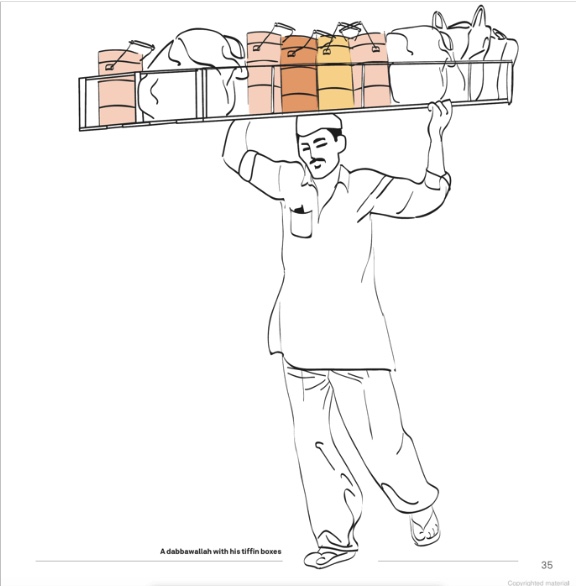
    Every morning Mumbai’s legendary dabbawallahs (it means “box-carrier” or “lunchpail man”) fan out across the city to collect freshly prepared lunches from people’s homes and restaurants. They then efficiently use the transport network to quickly deliver lunches to the customers’ workplaces. Once just for the elite, the dabbawallah lunch has become the norm for Mumbai’s middle class office workers. Lunches are packed into small, metal tiffin boxes, ingeniously organized so each component of the meal is sealed in its own section and kept warm.

    With a plethora of religious and cultural practices, Indians are particular about what they eat. In Mumbai there are 200,000 office workers receiving cooked lunches every day delivered straight to their desks. This is done by an army of 5,000 dabbawallahs. While their delivery accuracy was already impressive – only six deliveries in a million go astray – they realized they had to adapt to the city’s rapid changes. In addition to their network using trains, hand-carts and bicycles to get the lunches to desks, they have turned to the internet and mobile phone SMS text messaging to take orders.

    It is a 125-year old industry that has grown at the rate of five to ten per cent a year and all are paid the same no matter what their function in the business.

    With foreign direct investment into developing countries surging – according to the United Nations Conference on Trade and Development (UNCTAD), it rose by 12 per cent from 2005 to 2006 – the number of office workers is on the rise too.

    The trend is especially pronounced in India, which is on track to overtake the United Kingdom as the world’s fifth largest economy by 2010, according to investment bankers Goldman Sachs.

    India’s cities are booming. Mumbai is one of the top five global megacities as well as the world’s most crowded metropolis. The dabbawallahs are an excellent example of how a business can move with the times.

    A key component in India’s new-found success has been a willingness to do things better and become more efficient; the key to this is often information technology. The new technology for the dabbawllahs has been built for them by software engineer Manish Tripathi – he has even been adopted as an honorary tiffinwallah.

    “When people move to Mumbai for work, and need a lunchbox carrier, who do they ask?” he said. “They ask their friends, or their neighbour. Now, they just need to go to the website and they can find out how to get in touch with us. They can also get in touch with us via SMS.”

    The move online has been a great success said Tripathi: “We get 10 to 15 enquiries more a day via SMS and the website.”

    Raghunath Medge from the dabbawallahs cooperative said they are also making money by selling advertising on table mats. They have also turned to being a health service: they distribute health advice, beginning with this year’s World AIDS Day. An “AIDS kit”, comprising a car calendar and fliers on testing and counselling tied neatly with a red ribbon, was distributed ahead of World AIDS Day December 1.

    “The kit was attached to empty lunch boxes and delivered to about 100,000 clients’ homes,” said Raghunath Megde,

    Targeting hungry office workers is a goldmine for others too: in Saigon, Vietnam, the Ben Thann restaurant capitalised on its proximity to an area with a fast-growing office worker population to increase its profits. “Since our restaurant began serving lunch for office workers our business has increased by 60 per cent. This increase in number of guests enjoying the new menu was the main reason for Ben Thanh’s decision to introduce a buffet lunch,” said Nguyen Thi Thu Thao, deputy manager of Ben Thanh Restaurant.

    In the past, the dabbawallahs were visited by Prince Charles and British entrepreneur multimillionaire Richard Branson, to study their working methods. It looks like this next round of innovation will equally grab the world’s attention.

    Published: December 2007

    Resources 

    • The New York Times has an excellent slideshow of the dabbawallahs at work: Click here to view 
    • The official website of the dabbawallahs: http://www.mydabbawala.com/

    “I think you [David South] and the designer [Solveig Rolfsdottir] do great work and I enjoy Southern Innovator very much!” 

    Ines Tofalo, Programme Specialist, United Nations Office for South-South Cooperation
    Creative Commons License

    This work is licensed under a
    Creative Commons Attribution-Noncommercial-No Derivative Works 3.0 License.

    ORCID iD: https://orcid.org/0000-0001-5311-1052.

    © David South Consulting 2023

  • Women Mastering Trade Rules

    Women Mastering Trade Rules

    By David SouthDevelopment Challenges, South-South Solutions

    SOUTH-SOUTH CASE STUDY

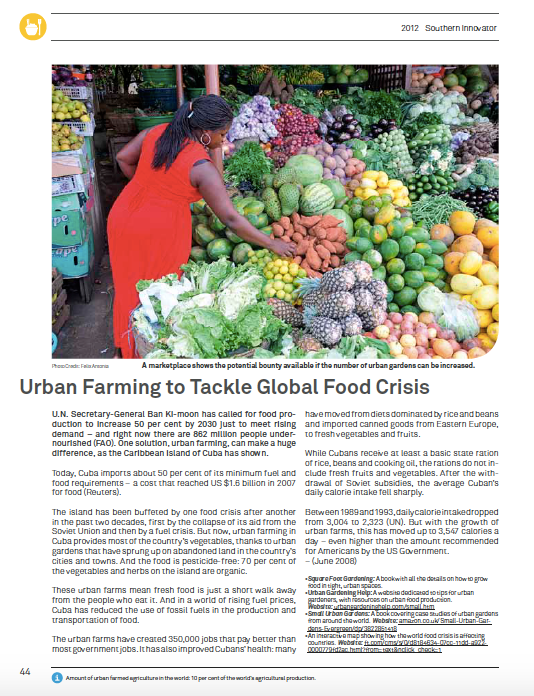
    Market trading is a vital lifeline for most people in the South. Plenty of delights usually await people in the market, where live animals, herbs and spices, fresh fruits and vegetables, and life’s necessities compete for customers’ money. The formal and informal food sector plays a crucial role in empowering women and providing food to the poor. Women are often those mostly responsible for selling fresh products and street food, and running small catering operations. By being a vendor and getting food at a lower cost, they are able to contribute to their families’ food security.

    Trading and selling in the marketplace can be one of the best options for poor women. By trading, women gain economic independence, learn vital business skills and enjoy the social benefits of interacting with others. But the highly individualistic nature of market trading has its downside: traders must do everything themselves and a day not spent at market is a day’s income lost. They also can only buy in small quantities, and usually pay a higher price. Or don’t know what the competitive price is, so are in a weaker bargaining position with wholesalers.

    Making market trading more efficient has huge advantages, the primary one being more money for the trader.

    Women market traders in Nigeria are improving their efficiency and income with mobile phones. Rural women market traders in the Obiaruku market are using mobile phones to call their suppliers, access information like commodity prices, and contact customers. A survey of the traders found 95 per cent thought mobile phones had a big impact on their business. This has included fewer trips to suppliers, a quicker way to get help when they have been robbed, and opportunities to top-up incomes by selling airtime, handsets or mobile phone accessories.

    In Nigeria, mobile phone use has shot up at a rate of 25 per cent a year. A recent study found that out of a population of 140 million, 12.1 million now have mobile phones and 64 million use mobile phones through street-side phone centres. Phones are also helping women market traders to keep tabs on price fluctuations – giving them an advantage when bargaining with crafty – mostly male – suppliers. A weak bargaining position is a common problem: In Ghana, for example, product producers are forced to sell through “market queens” who take advantage of the lack of price transparency and do not always pay producers fairly (De Lardemelle, 1995).

    In the Madurai region in southern India, women market traders are using a system called CAM. It allows them to record all their business transactions. CAM uses a Nokia 6600 mobile phone to record daily transactions. This includes small loans, buying livestock, or operating tiny retail businesses. The phone’s camera takes pictures of bookkeeping forms to identify and track all documents. The phone then asks the user to input numbers to the data fields. At the last key, the data is sent via text message to a central server. According to Tapan Parikh, a professor at the University of California at Berkeley School of Information in the United States, the most successful technological solutions work because they include village leaders, customers, NGOs, and others in the design process. “This is the only way to ensure long-term sustainability and benefit,” he said.

    In Soweto, South Africa a simple solution to a chronic problem for women market traders has emerged. After seeing hundreds and sometimes thousands of women selling their goods in the marketplace, it became clear they all had one thing in common: they closed on Mondays. They did this because they needed to go to the wholesaler to buy their goods. And they mostly did this by piling into taxis to get there. It hurt the profitability of their businesses in many ways: there was the cost of the taxi, the fact they could only buy small amounts to squeeze in the taxi, a day’s business was lost, and the lack of a discounted, bulk price.

    But the solution to this problem is a bright one: the women place a bulk, wholesale order with a go-between who works with a computer out of a former shipping container. He logs the orders into his computer and sends one big order. The wholesaler is happy with the big order, and delivers it and gives him a 15 per cent discount. This is his profit. The women pay the same price as before, but do not have to pay for the taxi and the goods are delivered directly to them. On top of this, the women can stay open on Monday and make more money!

    Published: May 2008

    Resources

    Creative Commons License

    This work is licensed under a
    Creative Commons Attribution-Noncommercial-No Derivative Works 3.0 License.

    ORCID iD: https://orcid.org/0000-0001-5311-1052.

    © David South Consulting 2023