Categories
Archive Development Challenges, South-South Solutions Newsletters

From Warriors to Tour Guides

By David SouthDevelopment Challenges, South-South Solutions

SOUTH-SOUTH CASE STUDY

In the wake of conflict, demobilizing combatants is as critical as ending the fighting if there is hope for the peace to last. When conflict ends, former fighters usually find themselves unemployed. But tourism is proving a viable way to deal with the social and political dangers of neglecting former fighters post-conflict.

Global tourism accounts for more than 10 per cent of global GDP and eight per cent of total employment worldwide. It grew by six per cent in 2007, according to the UN World Tourism Organisation. The Asia-Pacific region grew by 10 per cent, and Africa by eight per cent.

Ironically, much conflict has taken place in areas of natural beauty that offer a strong pull to tourists. While perception judging from the media is that conflict is getting worse, in fact trends show the opposite: according to Global Conflict Trends, “The levels of both interstate and societal warfare declined dramatically through the 1990s and this trend continues in the early 2000s, falling over 60% from their peak levels.”

A lot is at stake and it proves it is worthwhile to make peace pay – and that it is possible.

Battle-hardened rebels like 28-year-old Marjuni Ibrahim lived in the jungle and fought as guerrillas in Aceh, Indonesia. On the northwestern tip of Indonesia, Aceh was devastated by both a 30-year war that killed 15,000 people and the 2004 tsunami. Marjuni lost his sister and parents in the tsunami, in which more than 170,000 died or are missing.

Much of the coastline was destroyed, but the shock of the catastrophe pushed both sides into peace talks. The separatist Free Aceh Movement (GAM) battled the Indonesian army (TNI) up to 2005, when they signed a peace agreement.

Marjuni is now cashing in on a guerilla’s best survival technique: being tough. He now takes adventure and extreme-hiking enthusiasts deep into the jungle, where they once fought and lived. It is a habitat of steep, rocky trails, enormous teak trees – all with the reward of pristine waterfalls and refreshing rock pools for the hardy travelers.

The tours target mainly the community of aid workers in the area helping to re-build Aceh, but the hope is to expand: “I want to make the Acehnese aware of the potential for community-based tourism, and put Aceh on the map as a friendly tourism destination”, said Mendal Pols, a Dutch tour operator and founder of Aceh Explorer on the island, to Reuters.

The jungle is home to endangered Sumatran tigers, deer and hornbills.

“The area is very beautiful. I like trekking and I was interested to see what life was like during the conflict,” said Hugo Lamer, a Dutch trekker. “It’s difficult to imagine but three or more years ago they were running around here with guns and fighting the TNI. When I went, they took us to a place where they had lost some of their friends. And then you realize that we are there for fun, but for them this was really serious.”

In Vietnam, the famous Cu Chi Tunnels, formerly used by the Vietcong during the Vietnam War, have become major tourist attractions. The vast network of underground tunnels in Ho Chi Minh City link up with a tunnel network stretching across the country, and were used as hiding spots and as supply routes, hospitals, food and weapon dumps and living quarters.

In Rwanda, the government turned to tourism to help heal the wounds of the massacre that led to the deaths of almost 1 million people in 1994. It markets its population of mountain gorillas, diverse landscape with volcanic ranges, hills, lakes and savannah. But it is also not covering up the past: genocide sites are also on the tourist itinerary. And it is meant to shock: in the town of Murambi, classrooms still contain the bodies of the people who were killed there, covered in lime to preserve them. In Kigali, a museum documents the genocide. Survivors lead the tours to help them heal from the horror.

The goal is to restore the country’s tourism industry and generate US $100 million a year by 2010. It is currently bringing in US $45 million. The approach is to target the ethical end of the tourism market. The idea is to use tourism as a means to avert the tensions that helped to cause the genocide in the first place: poverty, illiteracy and government hording all the wealth. The idea is to employ as many people as possible and spread the wealth as wide as possible.

Published: March 2008

Resources

  • The UN Environment Programme has a special division to advise on post-conflict and disaster management.
    Website: http://postconflict.unep.ch/

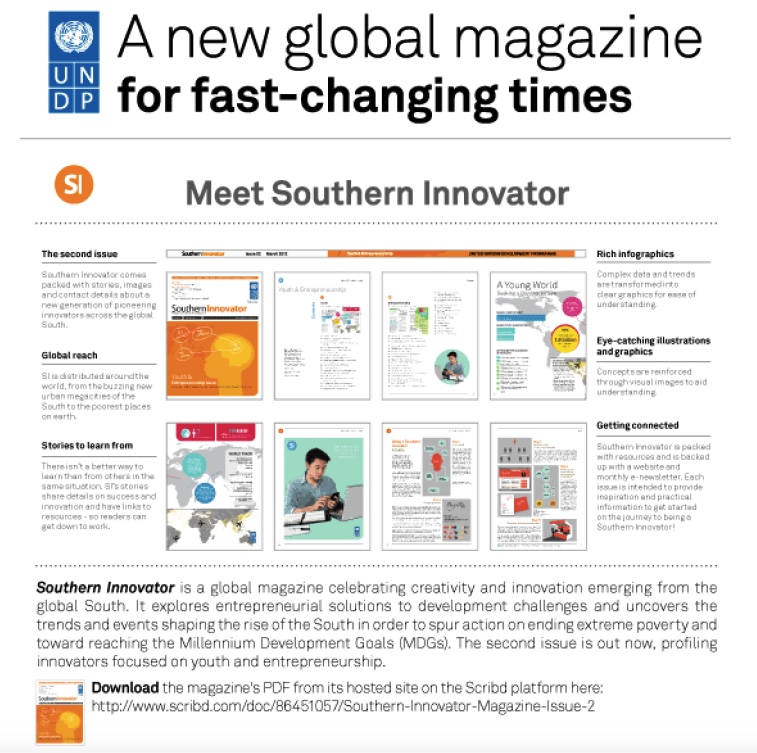
Development Challenges, South-South Solutions was launched as an e-newsletter in 2006 by UNDP’s South-South Cooperation Unit (now the United Nations Office for South-South Cooperation) based in New York, USA. It led on profiling the rise of the global South as an economic powerhouse and was one of the first regular publications to champion the global South’s innovators, entrepreneurs, and pioneers. It tracked the key trends that are now so profoundly reshaping how development is seen and done. This includes the rapid take-up of mobile phones and information technology in the global South (as profiled in the first issue of magazine Southern Innovator), the move to becoming a majority urban world, a growing global innovator culture, and the plethora of solutions being developed in the global South to tackle its problems and improve living conditions and boost human development. The success of the e-newsletter led to the launch of the magazine Southern Innovator.

Creative Commons License

This work is licensed under a
Creative Commons Attribution-Noncommercial-No Derivative Works 3.0 License.

ORCID iD: https://orcid.org/0000-0001-5311-1052.

© David South Consulting 2022

Categories
Archive Development Challenges, South-South Solutions Newsletters

Ecotourism to Heal the Scars of the Past

By David SouthDevelopment Challenges, South-South Solutions

SOUTH-SOUTH CASE STUDY

The legacy of underdevelopment during the communist era in parts of Eastern Europe is now being seen as an advantage in the global tourism trade. Well off the beaten path for tourists, areas as diverse as Chechnya and Romania are working to turn their rustic rural hinterlands into a strategic advantage in grabbing the market for ecotourists. Ecotourism – tourism that takes people to fragile and beautiful areas – is one of the tourism industry’s fastest growing areas.At stake is the lucrative and ever-growing world tourism market. Global tourist arrivals passed 800 million in 2006, with tourism in the world up by 5.5 per cent (World Tourism Organization), earning US $680 billion globally. In 1993, just seven per cent of travel was nature tourism; that share has now passed 20 per cent.

Romania, now a member of the European Union, boasts rural countryside like Europe of old: all hillsides are common land and there are no walls or fences to impede the view. Life is heavily dominated by agriculture and the rhythms of farm life.

Southern Transylvania is a high plateau of wooded hills and valleys and shielded by the Carpathian Mountains.

“The Carpathians of central and eastern Europe,” said Achim Steiner, head of the UN Environment Programme, “are among the world’s richest regions in terms of biodiversity and pristine landscapes. I have no doubt that the Carpathians, like the Alps, the Himalayas and the Rocky Mountains, will become world famous for walking, hiking, climbing, wildlife watching, photography and similar leisure pursuits.”

In order to preserve this way of life and generate income, various schemes are encouraging low-key tourism. This takes the form of renovating decaying farm buildings for guesthouses. The guesthouses are kept clean and simple and the focus is on typical local food like hearty stews and soups and pork sausages.

Much of this has been paid for by the Mihai Emenescu Trust, a charity seeking to preserve the traditions of the Saxon villages.

Patrick Holden of the Soil Association, a patron of the Mihai Eminescu Trust, thinks the organic agricultural methods of the local farmers could be a model for the rest of Europe.

Romania is also part of the Organization for Black Sea Economic Cooperation (BSEC), which is taking the lead in promoting ecotourism as an economic development option.

Ex-communist nation Bulgaria has also turned to ecotourism, launching its “Ecotourism: Naturally Bulgaria” campaign in September.

Even the once-war-torn Russian republic of Chechnya is trying to radically re-shape people’s perceptions. It is hard to believe, but the former site of a bitter civil war that left the capital Grozny in ruins now wants to be Russia’s Switzerland.

Shatoy region in southern Chechnya, during Soviet times, saw 20,000 visitors every month to ski, ride horses, and hike in the Caucasus Mountains. The new government plans to spend UK £40 million on new hotels, reconstructing old holiday camps, building spas and health centres. The region’s head of government, Mr Khasukha Demilkhanov, is confident that natural beauty can compete with the West: in the Argun Gorge, he pointed out to the Guardian newspaper, the scene is reminiscent of a 19th century woodcutting. Stone towers litter the hills, alpine meadows are full of wild flowers, the mountains are snow-capped and new roads have been built.

The Chechens hope to start with Russian holidaymakers and extreme tourists from the West, before moving more into the mainstream market.

Published: October 2007

Resources

  • Ecotourism.org: The International Ecotourism Society.
  • Ecotourism Kazakhstan: Kazakhstan has put together a dedicated website on ecotourism.
  • Planeta: one of the first ecotourism resources to go online (since 1994) and still offers plenty of information for those wanting to start a business.

https://davidsouthconsulting.org/2022/10/20/african-tourism-leads-the-world-and-brings-new-opportunities/

https://davidsouthconsulting.org/2022/10/20/africas-tourism-sector-can-learn-from-asian-experience/

https://davidsouthconsulting.org/2022/02/07/boosting-tourism-in-india-with-surfing-culture/

https://davidsouthconsulting.org/2022/09/27/caribbean-island-st-kitts-goes-green-for-tourism/

https://davidsouthconsulting.org/2023/02/03/environmental-public-awareness-handbook-case-studies-and-lessons-learned-in-mongolia/

https://davidsouthconsulting.org/2022/11/21/from-warriors-to-tour-guides/

https://davidsouthconsulting.org/2022/11/23/kenyan-safari-begins-minutes-from-airport/

https://davidsouthconsulting.org/2021/08/07/mongolian-green-book/

https://davidsouthconsulting.org/2022/10/10/a-solution-to-stop-garbage-destroying-tourism/

https://davidsouthconsulting.org/2021/03/05/southern-innovator-issue-2/

https://davidsouthconsulting.org/2021/03/05/southern-innovator-issue-5/

https://davidsouthconsulting.org/2023/01/17/war-peace-and-development-may-2018/

Development Challenges, South-South Solutions was launched as an e-newsletter in 2006 by UNDP’s South-South Cooperation Unit (now the United Nations Office for South-South Cooperation) based in New York, USA. It led on profiling the rise of the global South as an economic powerhouse and was one of the first regular publications to champion the global South’s innovators, entrepreneurs, and pioneers. It tracked the key trends that are now so profoundly reshaping how development is seen and done. This includes the rapid take-up of mobile phones and information technology in the global South (as profiled in the first issue of magazine Southern Innovator), the move to becoming a majority urban world, a growing global innovator culture, and the plethora of solutions being developed in the global South to tackle its problems and improve living conditions and boost human development. The success of the e-newsletter led to the launch of the magazine Southern Innovator.

Environmental Public Awareness Handbook: Case Studies and Lessons Learned in Mongolia by Robert Ferguson.
Creative Commons License

This work is licensed under a
Creative Commons Attribution-Noncommercial-No Derivative Works 3.0 License.

ORCID iD: https://orcid.org/0000-0001-5311-1052.

© David South Consulting 2023

Categories
Archive Development Challenges, South-South Solutions Newsletters

Tourist Passion for Quirky Holidays Helps South

By David SouthDevelopment Challenges, South-South Solutions

SOUTH-SOUTH CASE STUDY

Conventional thinking holds that any country with a poor or non-existent reputation in the international media will not attract tourists. But this conventional thinking is wrong: The hottest tourist trend for 2009 is directly benefiting the South’s more out-of-the-way and under-appreciated countries. So says a travel expert who specializes in overlooked travel destinations.

Prior to the economic downturn, tourism accounted for more than 10 percent of global GDP and 8 percent of total employment worldwide. It grew by 6 percent in 2007, according to the UN World Tourism Organization. Tourism in the Asia-Pacific region grew by 10 percent and Africa by 8 percent.

But it has since declined by 8 percent between January and April of 2009 compared to the same period in 2008. Destinations worldwide recorded a total of 247 million international tourist arrivals in those four months, down from 269 million in 2008 (UNWTO World Tourism Barometer).

This means competition is heating up for tourists. Well-travelled tourists are now looking for out-of-the-way places and places far off the beaten track. They want to be unique and have a tale to tell when they get home.

Tony Wheeler, author of the book Bad Lands: A Tourist on the Axis of Evil and co-founder of the Lonely Planet travel guides, said “Lots of tourists want to be the first through the door.”

During the Fitur Travel Fair in Madrid in January 2009, Myanmar (formerly Burma) appeared for the first time. Europe’s biggest travel fair also saw Zimbabwe, the Palestinian territories and Iran chasing travellers to come and see the sights.

Wheeler told Britain’s Daily Telegraph newspaper that, ironically, the more negative reports in the media a country gets, the more this new breed of tourist want to visit and find out the truth.

And his travel experiences have taught him, for example, the Burmese people do not believe in isolation and boycotts, as he wrote in the Guardian.

“Over the three decades since my first visit, tourism has grown from 20,000 tourists a year to more than 100,000.”
“Cutting the country off from the rest of the world isn’t going to help. We recently received a letter from one of our Burma authors saying the psychological damage of being isolated can be as bad as the economic damage.”

North Korea – which was labelled part of the “axis of evil” by President George W. Bush – saw its foreign tourist numbers rise to 4,500 in 2008 from just 600 in 2001.

Ross Kennedy of Africa Albida Tourism, which operates safari lodges in Zimbabwe, said bad headlines hurt but presenting an alternative view can reverse apprehension and lure tourists to come.

The lodges saw a 4 percent rise in visitors in 2008 in spite of chaotic elections in Zimbabwe that drew negative press.

“You certainly can’t write off an entire destination because of the choices or behaviour of a few individuals,” Kennedy told the Telegraph.

Tourism is now generally recognized to be one of the largest industries in the world, if not the largest. It has grown rapidly and almost continuously over the past 20 years, and is now one of the world’s most significant sources of employment and of Gross Domestic Product (GDP). Tourism particularly benefits the economies of developing countries, where most of the sector’s new tourism jobs and businesses are being created.

Tourism, because it is a labor-intensive industry, is seen as a great way both to reduce poverty and to meet all the Millennium Development Goals. It favours small-scale businesses, it is decentralized and can diversify regional economies, it is relatively non-polluting and can contribute to the conservation and promotion of natural and cultural heritage, and most importantly it can act as a catalyst for kick-starting other sectors of the economy.

In Iran, the Laleh Kandovan International Rocky Hotel, located in the province of East Azerbaijan in the north-west of the country, has been luring in tourists with the villages’ cave homes. Located in the village of Kandovan, where residents speak a Turkish dialect, the homes look like craggy sandcastles with holes in them; around 700 people live in the hollowed out rocks.

Prior to the hotel opening, it was only possible to visit for a day and the locals, who make their money harvesting fruit and walnuts, were suspicious of outsiders.

Kandovan means “Land of the Unknown Carvers”. An added attraction to visiting Kandovan is the mystery surrounding the houses. No one knows how long people have been there or when the homes were carved out of the rock. Others claim it is the biblical land of Nod, where Cain was left to wander after murdering his brother Abel.

The hotel occupies a hillside of caves and has a large restaurant and rooms that blend traditional décor like Persian rugs with modernist touches like recessed lighting. The rooms offer under-floor heating and some even have whirlpool baths. The hotel currently has 10 rooms, but plans to expand to 30.

Published: July 2009

Resources

United Nations World Tourism Organization (UNWTO). Website: www.unwto.org

Magic Carpet Travel: It specializes in trips to Iran and bookings for the Laleh Kandovan International Rocky Hotel. Website: www.magic-carpet-travel.com

African Travel and Tourism Association: ATTA creates the platform for buyers across Europe to meet suppliers of African tourism products at networking events, trade shows and through its links with the media. Website: www.atta.co.uk

Planeta: One of the first ecotourism resources to go online (since 1994) and still offers plenty of information for those wanting to start a business. Website: www.planeta.com

Off The Beaten Track Travel Magazine: Off The Beaten Track is a site for the traveller who avoids the beaten path of mass tourism. Website: www.off-the-beaten-track.net

World Tourism Cities: Developing Tourism Off the Beaten Track, edited by Robert Maitland and Peter Newman, Publisher: Routledge. Website: www.amazon.com

https://davidsouthconsulting.org/2022/10/20/african-tourism-leads-the-world-and-brings-new-opportunities/

https://davidsouthconsulting.org/2022/10/20/africas-tourism-sector-can-learn-from-asian-experience/

https://davidsouthconsulting.org/2022/02/07/boosting-tourism-in-india-with-surfing-culture/

https://davidsouthconsulting.org/2022/09/27/caribbean-island-st-kitts-goes-green-for-tourism/

https://davidsouthconsulting.org/2022/11/20/ecotourism-to-heal-the-scars-of-the-past/

https://davidsouthconsulting.org/2022/11/23/kenyan-safari-begins-minutes-from-airport/

https://davidsouthconsulting.org/2022/10/10/a-solution-to-stop-garbage-destroying-tourism/

https://davidsouthconsulting.org/2021/03/05/southern-innovator-issue-2/

Development Challenges, South-South Solutions was launched as an e-newsletter in 2006 by UNDP’s South-South Cooperation Unit (now the United Nations Office for South-South Cooperation) based in New York, USA. It led on profiling the rise of the global South as an economic powerhouse and was one of the first regular publications to champion the global South’s innovators, entrepreneurs, and pioneers. It tracked the key trends that are now so profoundly reshaping how development is seen and done. This includes the rapid take-up of mobile phones and information technology in the global South (as profiled in the first issue of magazine Southern Innovator), the move to becoming a majority urban world, a growing global innovator culture, and the plethora of solutions being developed in the global South to tackle its problems and improve living conditions and boost human development. The success of the e-newsletter led to the launch of the magazine Southern Innovator. 

Creative Commons License

This work is licensed under a
Creative Commons Attribution-Noncommercial-No Derivative Works 3.0 License.

ORCID iD: https://orcid.org/0000-0001-5311-1052.

© David South Consulting 2023