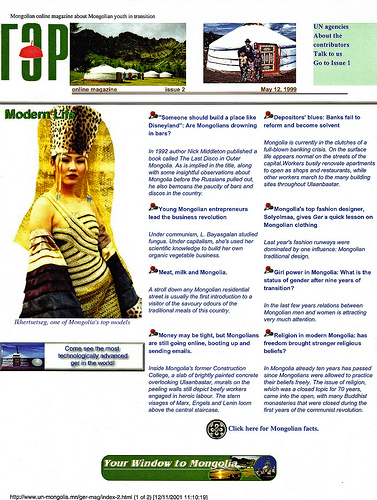
It could be said that there is no girl who does not dream of becoming a model. Many Mongolian girls, particularly Ulaanbaatar city girls, are flocking to attend courses in modelling in the last few years. Some say models are mushrooming in Mongolia, a country known for its fresh-faced people and robust physiques.
Ger interviewed S. Ikhertsetseg, one of the twin top models of Mongolia.
When did you first appear on the fashion stage?
“When we were 15 we played piano for the state concert on International Women’s Day on March 8. The ( Best Fashion) company was in trouble and they did not have anyone to wear some leather fashions for the show in the concert. It was fortuitous that we were asked to be the models. We kept it secret from our parents until we received a prize from Mongolia’s top fashion show, Goyol (or beauty) , in 1988. That was a year after the state concert. Being a fashion model was not considered so desirable as it is now. We were busy studying at music school and our parents did not know what we were doing.”
What do you think of today’s models?
“In the early days of fashion shows in Mongolia in the 1980s, we did not have many competitors. These days there are many beautiful Mongolian models we have to compete with, but only a few are very good. If someone is lucky, they have the potential to compete at the world level. Personally, I don’t like models who are too trained by courses.”
Do you think becoming famous is pure luck?
“Of course it is luck. But that doesn’t mean it isn’t a lot of hard work. You must send photos to agencies, and then only then, will someone see your photo – that is luck.”
What about design and fashion in Mongolia? Are Mongolians fashion sensitive?
“I can not say Mongolians are sensitive to fashion. I think our designers should work harder. Design is not a dress or a suit. It is everything, the whole cornucopia of details. I do not think we are going to compete with Europe, which has a long history of making clothing, rich in colors or designs. There is a big difference between fashion in the West and in Mongolia.”
Mongolia has a lively free press who sometimes step over the line when it comes to gossip and scandal reporting. These so-called “yellow” newspapers have damaged many people’s reputations. This had also happened to you. Some newspapers called the two of you the Barbie girls in Beijing, earning a lot of money.
“Yes, they did say those bad things. We replied to them.”
Was it before the court?
“No, that is a personal question.”
What was the result?
“The newspapers didn’t do that again.”
What do you do now?
“Both of us keep up the fashion work and also teach piano. Music is our profession and love. We founded the Association of Models of Mongolia to protect their rights and strengthen their position in the society.”
In the Mongolian language, the book explores how Mongolia’s vibrant rock and pop music scene led on business innovation and entrepreneurship in the country during the transition years (post-1989). Written by an ethnomusicologist, it details the key moments and events in this story, while splicing the narrative with first-person interviews with the major players.
MTV is available on cable television, bootleg CDs blare from kiosks and the latest news on the Spice Girls is available in one of dozens of entertainment newspapers. Despite the flood of foreign music it is local musicians who the youth turn to to voice their new-found freedoms, dreams and angst. Pop music researcherPeter Marsh swings to the new beat of the steppe…
It is something that would have horrified the old socialist leaders. Pop singer T. Ariunaa – Mongolia’s answer to Madonna – is doing what she does best: pushing the barriers of what a performer can and can’t do. Notorious in the local press as “Mongolia’s Queen of the Erotic,” she struts onto the stage of the Non-Stop – one of the newest and trendiest disco clubs in the Mongolian capital, Ulaanbaatar – wearing a black silk robe over black lingerie bikini underwear. Jumping into her hit song, “Telephone Number”, she sings the lines,
When you begin to take off your shirt, I am happy you’re staying;
When your hot breath is near me, the lights go out,
Cheekily writhing her torso, seductively opening and closing her robe, she teases her audience. And her audience, mostly Mongolian youth from the late teens to early thirties, take it all in with good humour, smiling and giggling. Whether they like her music or not, they appreciate what she’s doing and are having fun. The message of free expression is reflective of the enormous changes in attitudes over this decade.
“I like Ariunaa very much,” says 30-year-old Sukhbaatar, a graphic designer. Wearing a dress shirt, slacks and noticebly shiny shoes, he’s sitting with his two friends, glasses of beer in hand, watching the show. “She has a powerful voice,” he says gesticulating towards the stage. “She has a peculiar style, and this kind of style should be developed in Mongolia.
“But we don’t admire her as a singer,” he says with a wry laugh.
Not long ago, when this landlocked Northeast Asian nation was still subject to Soviet-backed socialist rule, pop-rock musicians like Ariunaa would never have been allowed to bring such explicit expressions of ‘the erotic’ anywhere near the public stage. Ariunaa’s boldness and charisma, which have made her one of Mongolia’s most well-known and controversial young pop stars, show something of the new openness and growing diversity that characterizes the emerging popular music industry in capitalist Mongolia. There are girl bands like Spike, boy bands like Nomiin Talst and Camerton and pop divas like Saraa.
A typical concert in Ulaanbaatar, like this one at the Non-Stop – a converted public gymnasium which opened earlier this year – consists of a succession of live Mongolian bands interspersed with breaks for dancing to Western pop, disco and techno music. The styles of music in these concerts fall into what the Mongolians call pop-rock, which ranges from rock ‘n’ roll, soft rock, and heavy metal rock to techno, hip-hop and rap. Mongolian music fans today now have a wide choice of styles to choose from.
Someone who would know about this well is the ‘elder statesman’ of rock, D. Jargalsaikhan. Wearing leather cowboy boots, sequined leather pants and a leather jacket, and with his black hair streaming down over his shoulders, Jargalsaikhan sees the new diversity of groups as a positive sign of the times, as he said in a recent newspaper interview.
“In the stores today there are maybe 10 different varieties of sausage: salted, unsalted, spiced and so on. You can then look at them all and then choose the one you want, like spiced sausage. It’s the same thing with the music business in Mongolia today. In the era of the market economy many different bands and singers have come out, and the listeners can choose the recordings of those bands and music styles that they like. … The most important thing is that the other bands or styles of singers should not be ignored. All of them have a wish to do something. Usually, those who criticize different styles or forms of music are people with too much time on their hands.”
Although turning 40 this year, Jargalsaikhan is not a man with too much time on his hands. As head of the Mongolian Singer’s Association, his many responsibilities keep him on the run. In between numerous breaks to answer calls on his cell phone, Jargalsaikhan tells me about being a rocker in the 1970s and ’80s, which he terms the “Golden Era” of rock in Mongolia, and the difficulties they faced. “Because Mongolia was ruled by one party, the Revolutionary [Socialist] Party [from 1921 to 1990], there was little foreign influence allowed into the country. Rock and pop were not to be found on the [state-controlled] radio or TV, and aside from records and cassettes brought into the country by individuals coming from Europe and Russia, people here had very little experience with the music. … It was easier for the early rock-pop musicians to take examples from folk music, which was close to them, which they had been listening to since their childhood.” Much of the early music included settings of popular folk songs and melodies in the rock genre. And the youth, eager for alternatives to the state-sponsored cultural offerings, found the music to their liking.
The popularity of this early rock-pop, or so-called folk-pop groups soon drew the attention of the socialist party, which saw opportunities to use the music for the purpose of advancing its mission in Mongolia. In exchange for the state government’s granting of musical instruments, rehearsal and performance spaces, and concert and touring opportunities, the early bands were closely watched, their actions restricted by suspicious government officials. “Everything was planned by the government, and we had to do what it had planned,” says Jargalsaikhan. “For example, when we were abroad, we couldn’t go to the discos nor arrive at the hotel late. We couldn’t go where we wanted. There were conflicts between the singers and musicians and the government representatives [sent to oversee the tour]. If I spoke to foreigners, I would be considered a spy. Who I spoke with was also controlled. At that time, the social condition in Mongolia was like that of North Korea today.”
Considered by the government to be a “capitalist art,” the direct imitation of Western rock was not allowed. Mongolian bands instead had to create a unique Mongolian style of the music that drew from traditional folk or classical musical and literary traditions. Band members were often compelled to compose songs to lyrics written by members of the powerful Mongolian Union of Writers. “It was difficult for musicians to play their own compositions, and they were often forbidden to do so,” recalls Jargalsaikhan. “For the concert programmes, our songs had to include the topics of Mongolia and the Soviet Union, as well as the Mongolian love for Nature or for Father and Mother. … The topic of love between a man and woman was considered to be too personal for the public stage, and was almost forbidden.”
But rock and pop musicians gained more and more freedoms of expression as political and social reforms were introduced in Mongolia throughout the 1980s. “The rock-pop musicians of the 1970s became more skilled and their abilities improved,” says Jargalsaikahn. “They began to compose at the level of professional composers. Also, the older generations wanted to give more artistic freedoms to the youth at the same time as the Party controls were being lifted.” And the youth, in turn, were more intent on creating traditions of music of their own generation. “The young rock-pop musicians wanted to hand-down their own music to the next generation-their own pop-rock art.
Jargalsaikhan gained fame throughout Mongolia for his 1988 song “Chinggis Khan,” when he was lead singer of the band by the same name. Making use of traditional folk music instruments alongside of the group’s electric guitars, synthesizers and drums, the song praises the 13th century Mongolian leader as a great, if historically misunderstood, man who always had in mind the good of the Mongolian nation–and this at a time when expressing such sentiments could have landed him in prison. “I had to show my civil courage to sing this song. But many of my friends and fellow composers encouraged me to write and perform it.”
His was the voice of a new generation, one seeking more freedoms to express Mongolian identity in new ways. The efforts of many musicians of his generation contributed to the popular political movements and protests that eventually led, in 1990, to the downfall of the socialist government and the introduction of democratic and market economic reforms throughout the nation.
In the new social and cultural climate of the late-1980s and early ’90s, musicians saw it as their responsibility to introduce Western rock music and popular culture to Mongolia. Besides Jargalsaikhan’s Chinggis Khan (“soft rock”), other groups came onto the popular music scene, including bands like Haranga (“heavy-metal/grunge”) and Hurd (“metal rock”).
The leader and percussionist of the group Hurd (“Speed”), D. Ganbayar, saw it as a national service to his people to introduce his group’s unique form of Western-style rock. “The Mongolian people, and especially the youth, don’t want [their bands] to imitate Western rock art. They want a pop-rock with its own specific character, music that’s different from other types of Western rock-pop, music with its own national character.” Wearing a leather jacket and black hair down to his chest, Ganbayar, moves to the edge of his chair. “No one but us will introduce this kind of music to the Mongolian people. We serve our people. It’s our duty to introduce Western music to the Mongolian people through the Mongolian language and Mongolian melodies. We want to show that Mongolian rock-pop has its own unique character.”
Nearing a decade of life, Hurd continues to experiment with new sounds and performance styles. They recently softened their driving, heavy metal style in two “Unplugged” concerts given at another new disco club in Ulaanbaatar, Top Ten, a cavernous warehouse located in a former cultural centre. This was the first time any rock group had tried such a concert idea in Mongolia. Even on acoustic guitars, however, the group, consisting of a bass, two guitars, drums, percussion and keyboards, managed to fill the club with their sound and fury. Their fans packed the house, and the lead singer, Tumurtsog, needed little effort to get them to sing along with him on many songs.
Hurd and Haranga are still very popular groups in Mongolia, but in the past years few new heavy metal or hard rock groups have come onto the pop-rock scene here. Instead, a new generation of popular singers and music groups have been working their way up and into the limelight of the concert stages. These are youths that mostly eschew the long hair and leather jackets of the older groups in favor of short, styled hair and suits and ties. The music would be recognized in the West as techno, hip-hop, and pop along the lines of the Backstreet Boys, Celene Dion and the Spice Girls, and is almost always electronically produced in recording studios and then backgrounded to the singers and dancers themselves on stage with the use of a tape player.
Mostly in their late teens and early 20s, these performers appeal to Mongolian audiences with their singing, dancing and stage presence. One of the most popular of the current crop of bands is Har Sarnai (“Black Rose”), a “hip-hop techno” male duo, famous for their dancing, nationalistic song lyrics and sometimes outrageous clothes and hair styles.
In their concerts they often come out on stage wearing specially designed silken dels (traditional Mongolian robes worn by both men and women), with sunglasses and big bushy black and gray colored wigs on their heads. As the heavy techno beat of one of their most famous songs, “Alarm,” begins, they launch into their synchronized dance routines and lyrics, which exhort Mongolians to wake up from their dreaming and set to work producing a new society. Their audiences watch from their tables-as Mongolians hardly ever dance while the bands are performing-clearly enjoying the show.
“Har Sarnai is my favorite band,” says 19-year-old Buyanbaatar, a student at the Mongolian State University. “I like how different they are. Their clothes, their behavior on stage is different. And the songs that they sing, their dances and their clothes and style are all well suited together.”
Even older youth, like Sukhbaatar, age 30, mirror these sentiments. “I like Har Sarnai because I like their style and their dancing very much. I also like their unique styles of hair.” His friend Tsooj, age 31, adds, “In America you have rap bands, like New Kids [on the Block], and they dance really well. We like dancing very much. We are not too old for this!”
To both of them, the infectiousness of the new music pop scene transcends traditional age definitions. “I started to listen to music from the Beatles and other foreign bands. But now it’s become very nice in Mongolia. It’s just impossible not to be a fan because we are young people. We don’t think we are old. We are young enough, and we are here to support our favorite bands, and we will scream and whistle with everyone else!”
How audience members of different age groups can mix together at concerts and share such similar tastes in musical genres is perhaps unique to Mongolia. “One of the reasons why even the older generations like the new bands of the younger generations,” says Norov-Aragcha, a professional artist, aged 38, “is that in their youth, when they were 18 or 20, such bands didn’t exist here. We like new things like the younger people, and this music is new to Mongolia.”
But while he appreciates the new opportunities that the new bands have to perform their music in Mongolia, Norov-Aragcha adds that something is certainly missing from their music. “I like Ariunaa, and appreciate what she does. But all these bands and singers [of the young generation], although they have their own styles, they are generally on one level. None of them stands out from the rest. Maybe because of my profession, I prefer something new, something very different from the others. Haranga and Jargalsaikhan, they are our generation. They have feelings, they are making efforts with their music, and they are honest to their music. In their time [late-1980s and early 1990s] it was very difficult, but they did it. They have real talent, real feeling in their music.”
“Now I’m looking at all these new bands and singers, but still the one that I want hasn’t appeared. … That is, something which suits today’s conditions and atmosphere. … Something very powerful, very hard. Something like a Kurt Cobain.”
While not new to Mongolia, pop-rock’s growing diversity certainly is. The general feeling these days seems to be one of celebration of its freedoms and appreciation of its diversity, without the isolation of audiences into genres that is typical in the West. Given the difficulties Mongolia’s youth now face as they struggle to adapt to a society undergoing enormous change, a Mongolian “Kurt Cobain” may be just around the corner.
Background: This is the original text from the brochure UNDP in Mongolia: The Guide first published in 1997. It, for the first time, provided a rolling update on what the United Nations was doing in Mongolia, offering key contacts and data to help advance human development in the country. It introduced transparency to the UN’s work in the country and made it easier to hold programme and project staff to account.
Mongolia – Population
With an area of more than 1.5 million square kilometres and a population of 2.38 million as of October 1997, Mongolia has a population density of only 1.5 people per square kilometre, one of the lowest in the world. The country has a relatively low growth rate of 1.6 per cent (1995), down from 2.5 per cent in 1989. At this rate, Mongolia’s population will reach 2.5 million by the year 2000.
Despite the popular image of Mongolians as nomadic herders, it is an increasingly urbanized country – 51.9 per cent of the population is urban, 48.1 per cent rural. More than one quarter of Mongolians live in the capital city, Ulaanbaatar. The other major urban centres are Darhan (pop. 90,000) and Erdenet (pop. 65,000 ).
The country is divided into 21 aimags (provinces), plus the autonomous capital region. The aimags are:
In the centre: Tuv, Uvurhangai, Arhangai
In the north: Bulgan, Selenge, Hovsgul, Zavhan, Darhan-Uul, Orhon
In the east: Hentii, Dornod, Suhbaatar
In the west: Hovd, Uvs, Bayan-Olgii, Gov-Altai
In the south: Dundgov, Dornogov, Omnogov, Bayanhongor, Gobisumber
The People:
About 86 per cent of the country’s population are Kalkh Mongols. Another 7 per cent are Turkic in origin, mostly Kazakhs living in the western aimags of Bayan-Olgii and Hovd. The rest belong to a wide variety of ethnic groups, including the Buryat, Dariganga, Bayad, Zakchin and Uriankhai. Mongolia’s smallest ethnic group is the Tsaatan, about 200 of whom live as reindeer herders in the far north of the country.
During the communist period, Mongolia was home to tens of thousands of Russians. Few remain.
More than 4 million Mongols live outside Mongolia, in Russia and the Chinese province of Inner Mongolia.
Human Development:
– Mongolia’s per capita GDP is U.S. $359 (1995). But this fails to take into account the cashless subsistence and barter economy widespread in rural areas.
– Poverty, though widespread, is difficult to tabulate. 1996 government figures put the poverty rate at 19.2 per cent – 19.8 per cent for rural areas, 18.7 for urban areas. But State Statistical Office figures for October 1997 indicate 36.8 per cent of urban residents and 27.5 per cent of rural Mongolians live below the poverty line.
– Omnogov, Gobisumber, Hovsgol, Ovorhangai and Bayanhongor are the aimags with the highest poverty rates.
– The average monthly household income in September 1997 was 58,516.7 tugrugs (U.S. $73). Average expenditure was 58,124.8 tugrugs. In 1995, 48 per cent of household expenditure went on food. In poor households, the figure was 64 per cent.
Social Data:
Life expectancy: 63.8 years (1995)
Infant mortality rate: 40 per 1000
Under five mortality rate: 56.4 per 1000
Maternal mortality rate: 185.2 per 100,000 (1995)
One-year-old immunization rate: tuberculosis 94.4 per cent, measles 85.2 per cent (1995)
Access to safe drinking water: rural 89.9 per cent, urban 46.1 per cent (1995)
Access to sanitation: 74 per cent (1995)
Adult literacy rate:
men 97.5 per cent,
women 96.3 per cent
Primary school net enrollment: 93.4 per cent
Secondary school net enrollment: 56.9 per cent
Physicians: 26 per 10,000
Hospital beds: 9.9 per 1000
Daily calorie intake: 2278.2
Data 1996 unless otherwise indicated. Sources: State Statistical Office, Human Development Report Mongolia 1997
Mongolia – Economy
An Economy in Transition:
After 70 years of centrally planned economy, Mongolia is embracing free-market principles with a vengeance. Economic liberalization began under the Mongolian People’s Revolutionary Party government in the early 1990s. The Democratic Coalition government, elected in June 1996, has vowed sweeping economic changes, including privatization of state assets, liberalization of trade and promotion of foreign investment.
The foreign investment law now encourages foreign investment in the form of share purchases, joint ventures and wholly foreign-owned concerns. Mining companies are given significant tax holidays. In May, 1997 parliament abolished customs duties expect on alcohol, tobacco and oil products.
All of this has been a shock to Mongolia and Mongolians. The country’s GDP shrank by a third in the early 1990s, though it has slowly recovered since. Inflation topped 300 per cent in 1993, but was brought down to below 50 per cent by 1997. The tugrug fell from 40 to U.S. $1 in 1991 to 800 to the dollar in 1997. Unemployment officially stands at 6.5 per cent – unofficial estimates are much higher.
The government’s ambitious privatization scheme has stalled; manufacturing and exports are down; imports are up. Adding to the problems is the fact that world prices for Mongolia’s major export items – copper and cashmere – have fallen.
The state retains at least 50 per cent ownership of the nation’s flagship enterprises, including the national airline, MIAT, the Gobi cashmere company and the power stations.
Mongolia has a resource-based economy, exporting mostly raw materials and importing mostly processed goods. The top exports are mineral products, textiles, base minerals, hides, skins and furs and animals and animal products. The major imports include petroleum products, industrial equipment and consumer goods.
Mongolia’s major trading partners are its two neighbours, China and Russia, though Korea and Japan are becoming more important – and the number-one export destination is Switzerland.
Sidebar: The rural economy
Half of Mongolia’s population is rural, and herding remains the backbone of the Mongolian economy. Agriculture accounts for 30 per cent of the nation’s GDP. The number of herding households grew during the economic turmoil of the early 1990s, and now stands at more than 170,000; there are 30 million head of livestock in Mongolia. Herders produce meat, skins and furs; more and more herders are investing in cashmere goats, a substantial money-earner.
Cultivation of crops, on the other hand, is limited. Before 1990, Mongolia was self-sufficient in cereals and even exported to the Soviet Union. But the sector suffered badly in the early 1990s. The 1997 harvest was 239,000 tonnes, 56 per cent of 1991-95 levels and only 40 per cent of pre-1990 harvests. Mongolia must now import 40 per cent of its cereal needs, a factor that contributes to a vulnerable food-security situation. Cultivation of vegetables is up, but remains minor – only 31,000 tonnes in 1997.
Sidebar: Rich in resources
Mongolia is resource-rich. This vast territory contains 15 per cent of the world’s supply of fluorspar and significant deposits of copper, molybdenum, iron, phosphates, tin, nickel, zinc, tungsten and gold, as well as at least 100 billion tonnes of coal.
Copper is the nation’s number one export.
Minerals account for more than a third of Mongolia’s GDP and earn half of its hard currency. Gold production is increasing.
Mongolia also contains significant reserves of oil, which could transform the economy. But infrastructure and transportation limitations mean that commercial extraction is limited. The completion of a pipeline to China could change all this.
Economic Data:
Exchange rate: $1 = Tg 808 (Nov 1997)
GDP: Tg 185.5 billion (1996)
GDP per capita: Tg 228,605 (1996)
Inflation: 325 per cent (1992), 53 per cent (1996)
State budget expenditure: Tg 203.6 billion (Jan-Oct 1997)
State budget revenue: Tg 176 billion (Jan-Oct 1997)
Seven decades of communist rule in Mongolia began to crumble in 1990, when the collapse of the old Eastern Bloc brought the first pro-democracy demonstrations. The ruling Mongolian People’s Revolutionary Party, which had already initiated a Mongolian version of glasnost, permitted the nation’s first multiparty elections in July, 1990.
Superior organization helped the MPRP win both the 1990 and 1992 elections (taking 71 of 76 parliamentary seats in the latter), but reform picked up speed. In 1992, the country adopted a new Constitution that enshrined human rights, private ownership and a state structure based on separation of power between legislative and judicial branches.
In the June 1996 election, major opposition groups united to form the Democratic Coalition, made up of the National Democratic Party, the Social Democratic Party, the Believers’ Party and the Green Party. Somewhat to its own surprise, the Coalition won a healthy 50 of 76 seats in the State Ikh Hural, or parliament. The composition of the Hural is now: National Democrats 35, Social Democrats 15, MPRP 25, Mongolian Traditional United Party 1.
In addition to their economic reforms, the Democrats have carried out radical restructuring of government, slashing the number of Ministries from 14 to 9.
The government has a healthy majority, but tensions sometimes emerge between the coalition partners. Mongolia’s transition to democracy has been remarkably peaceful, and the young democracy is robust – there are now more than 20 political parties in the country.
But economic hardship has caused resentments. In the 1997 Presidential election, voters elected N. Bagabandi, the candidate of the MPRP. In the fall of 1997, the government had to face demonstrations from students and pensioners and an opposition campaign that led to a confidence vote in parliament — a vote the government easily survived.
Political structure:
Mongolia has a parliamentary system of government, with a 76-seat legislature called the State Ikh Hural. The President, directly elected for a four-year term, is second in authority to the legislature, but he appoints judges and has the power of veto (which can be overturned by a 2/3 vote in parliament).
Chronology:
1911 collapse of Manchu Qing Dynasty; Mongolia declares its independence
1919 China invades Mongolia
1921 with Soviet help, Mongolia gains final independence from China
1924 Mongolian People’s Republic declared
1990 pro-democracy protests; Constitution amended; first multiparty elections
1992 second multiparty elections; new Constitution adopted
1996 Democratic Coalition elected as Mongolia’s first non-communist government, headed by Prime Minister Enkhsaikhan
1997 N. Bagabandi from the MPRP elected President
Voter turnout:
1996 elections: 92.2 per cent
1996 local Hural: 64.0 per cent
1997 presidential: 85.1 per cent
Mongolia – Society and Culture
Mongolia has a unique and durable traditional culture, centred around the herding lifestyle. Herders remain semi-nomadic, moving their animals with the seasons as they have for centuries
Many urban Mongolians retain strong links to the land, both literal and sentimental, and the country’s performing and visual arts often celebrate the landscape and the animals — especially horses — that are central to Mongolian life. Mongolia has several distinctive musical instruments and styles, including the morin khuur (horsehead fiddle), the long song (urtyn duu) and the throat-singing style known as khoomi.
After seven decades of communism, Mongolians are once again celebrating their traditional culture, and embracing the image and legacy of the most famous Mongolian of all time – Chinggis Khan, who in the 13th century initiated the Mongol Empire, the greatest land empire the world has ever known. He gives his name to everything from a brand of vodka to a luxury hotel, and centres for academic Chinggis research have been set up.
In sports, Mongolians favour the “three manly sports” — wrestling, archery and horse racing — that form the core of the annual festival known as Naadam. Mongolian wrestlers have won a number of medals at international competitions and are even entering the field of Japanese Sumo.
The 1990s have seen a flowering of freedom of expression. Mongolia has an extraordinary 525 newspapers and a wide range of magazines, while the first private radio and television stations have been established.
Religion:
Mongolians have been Buddhists since the 16th century, when the Mongolian king, Altan Khan, was converted by Tibetan lamas. In the pre-revolutionary period, Mongolia was ruled by a series of Living Buddhas, or Jebtzun Damba. The eighth, and last, Jebtzun Damba was removed after the communist takeover.
Traditionally, monasteries were centres both of learning and of power. It’s estimated Mongolia had 100,000 monks, or lamas, in 1921 — one third of the male population. In the 1930s, this power became the focus of a ruthless series of purges that reached a climax in 1937. Most of the country’s monasteries were destroyed, and as many as 17,000 monks were killed.
Today, Mongolia is once again embracing its Buddhist heritage. Monasteries are being restored, and are once again crowded with worshippers. The Dalai Lama is an enormously popular figure and has visited the country several times.
For many Mongolians, Buddhism is flavoured with traces of Shamanism, an even more ancient spirituality.
Mongolia also has a significant Muslim community — about 6 per cent of the population. These are mostly ethnic Kazakhs living in the far west of the country. The opening-up of the country has led to an influx of Christian missionaries, and this remains a source of some tension and debate.
A Young Country:
Mongolia is a remarkably young country — more than 60 per cent of the population is below the age of 30, and 40 per cent of Mongolians are younger than 16. This young generation, with its embrace of Western styles and ideas, is changing the complexion of the country. Western pop music and North American sports like basketball have a huge following among Mongolia’s youth. So, too, do homegrown artists like the pop groups Nikiton and Spike and the singer Saraa.
Social Data:
Television sets: 6.2 per 100 (1995)
Newspapers: 2 per 100 (1995)
Number of telephones: 82,800
Marriage: 10.9 per 1000 over 18
Divorce: 0.7 per 1000 over 18
Number of pensioners: 287,200
Crimes reported: 20,454 (Jan-Oct 97)
As percentage of same period in 1996: 114.4 per cent
Data 1996 unless indicated. Sources: State Statistical Office, Human Development Report Mongolia 1997
Results Review and FY 2002 Resources Request (USAID/Mongolia March 17, 2000):“Improving Productivity and Exports: A key to Mongolia’s growth is increasing non-traditional exports. However, with less than ten years of free-market experience, Mongolia has little experience on how to accomplish this objective. In response, USAID began a six-month program in January2000 to: 1) instruct Mongolians on the principles of competitive analysis; 2) establish benchmark data that will help Mongolians to rank their country against others vis-a-vis key competitiveness indicators; 3) create Mongolian-specific case studies to illustrate successful competitive behavior or pinpoint obstacles and constraints; 4) work with business leaders from garment, cashmere, meat, information technology and tourism industries to apply competitiveness tools and focus attention on key priorities for government and private sector action. Over six hundred influential Mongolians from government, private sector and academia are participating in the process. USAID hopes to assist in developing a national action plan for competitiveness in the fall, once a new government is in place.
The Global Bureau’s Global Technology Network (GTN) which develops business linkages between U.S. and Mongolian firms has been active for two years. GTN efforts have fallen short of expectations with only three relatively modest linkages established in 1999. In January 2000,through its relationship with the International Executive Service Corps (IESC), GTN sponsoredMongol Construct 2000, a trade mission to the United States for construction firms. The purpose ofthe mission was to learn about advanced construction techniques and develop linkages with U.S.firms. In 2000 IESC will expand its assistance to a select group of garment manufacturers, who areattempting to establish non-traditional markets.“
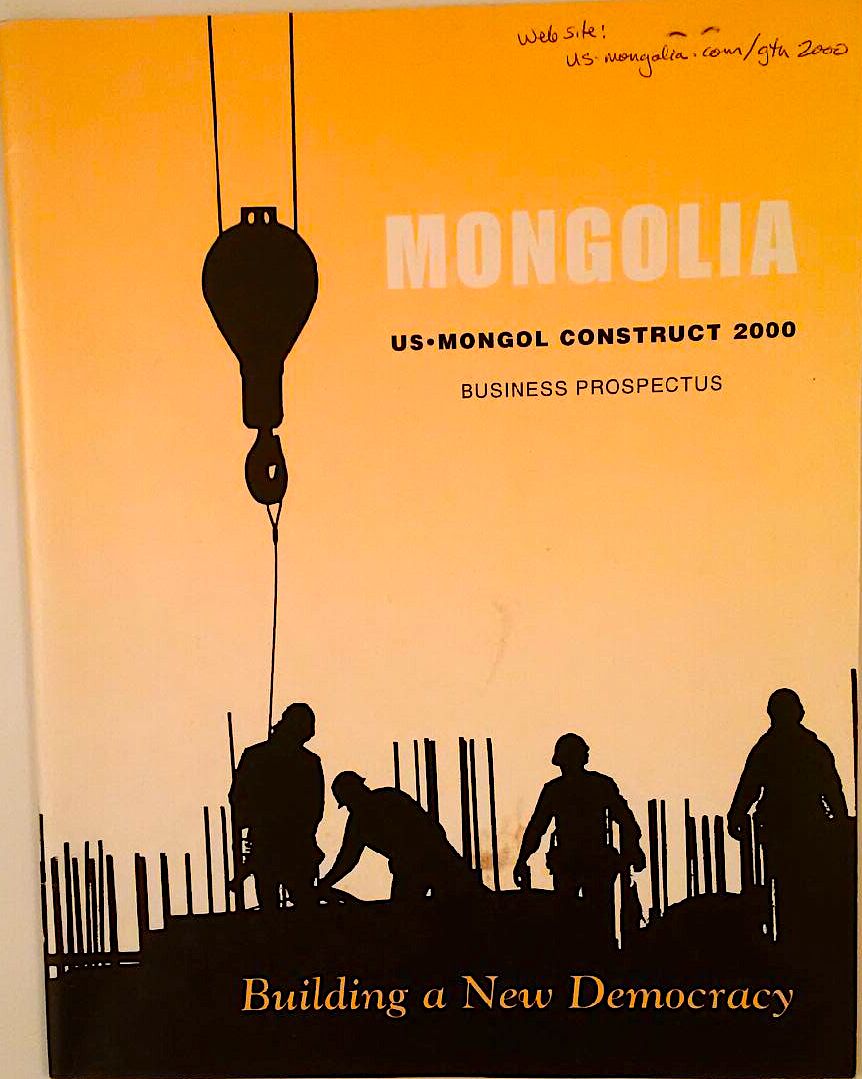
Background: This excerpted text is from a business prospectus prepared in 1999 for USAID to promote construction opportunities in Mongolia to the US construction industry. At the time, Mongolia was in the grip of a severe crisis, called one of “the biggest peacetime economic collapses ever”. By 2012, Mongolia was called the “fastest growing economy in the world”. It is proof the foundations for Mongolia’s recovery from crisis were laid in the late 1990s.
“No other Asian country enjoys more political freedom today than Mongolia. And no other Asian country has shown greater commitment to open markets. But Mongolia has received little reward for its efforts.” Fortune Magazine, December 1998
Discover a New Democracy
Mongolians are some of the highest per capita donor recipients in the world: On average US $50 per person. The vast majority of this aid is targeted at infrastructure projects. Mongolia in 2000 is an opportunity waiting for American business. Democratic, with a free market economy, the country offers regulatory freedom, a belief in the private sector setting standards and a pro-Western attitude friendly to American companies.
Mongolia’s history is marked by the rise and fall of cities, the ebb and flow of political and economic systems. The country has experienced being the largest empire for its time in the 13th century, to being occupied by foreign powers. Economically and socially the country has lived through feudalism, communism and now, capitalism. The one thing that has remained stable throughout this rich history has been the nomadic way of life. Livestock remains to this day a major pillar of the economy and contributes to one of the country’s major foreign currency earners, cashmere wool.
After over 70 years of communist rule, Mongolians finally turned their backs on communism and robustly embraced free markets and democracy in 1996 with the election of the Democratic Coalition. A gradual opening up of the country had begun under the ruling Mongolian People’s Revolutionary Party after the collapse of the Soviet Union and under pressure from peaceful public demonstrations.
After the fall of the Soviet Union, the country suffered what many economists have called the largest peacetime economic collapse in the 20th century.
While it is a fact that Mongolia’s economy is severely underdeveloped, both in terms of infrastructure and diversity, it is also true the country is the freest in Asia. As Fortune Magazine noted in a December, 1998 issue, “No other Asian country enjoys more political freedom today than Mongolia. And no other Asian country has shown greater commitment to open markets. But Mongolia has received little reward for its efforts.” Mongolia, for American business, offers a win-win situation, an opportunity to join in the building of a strong democracy in Asia while tapping the rich resources, both natural and in human capital. American businesses can enjoy a regulatory environment that is more flexible than in the United States, and a government that lets businesses do what they do best: serve the needs of customers and make money.
Youthful
A Bright Young Future
Demographically, Mongolia is a very young country. A by-product of high birth rate policies during the communist period, 60 per cent of Mongolia’s population are aged between 1 and 24, with 37.6 per cent between the locally accepted definition of youth of 15 to 34. In 1998 the New York Times Magazine called Mongolia “The youngest place on earth”. Even a cursory glance at the streets of the capital, Ulaanbaatar (population 600,000), will reveal a young population taking their fashion and cultural cues from the West, and who hold correspondingly Western aspirations to own homes and start businesses. Mongolia enjoys exceptionally high rates of literacy ( 96 per cent), post-secondary enrolment (65,089 students in 1998) and the urban population quickly embraced Western consumer products as they became available.
Growing
The Construction and Environmental Services Industry in Mongolia
Today, Mongolia officially has 100 architectural and engineering design companies and over 500 construction companies. Of these, 40 are considered large operations with their own in-house design and engineering outfits, or who have a close relationship with one or more companies that either manufacture or import construction materials. The country is a rich resource for raw materials for the construction industry, but this vast wealth remains under-utilised. According to geological surveys spanning the decades from 1930 to the 1990s, over 200 deposits were discovered that could be tapped for construction materials.
At the beginning of the 20th Century, there were few permanent standing structures in Mongolia, apart from Buddhist monasteries and royal palaces. At the beginning of the 20th Century most Mongolians lived in the round ger felt tent. It wasn’t until the communist revolution that construction of sedentary dwellings and buildings in the country picked up pace. In 1924, three years after the 1921 revolution, the State Committee for Construction was established (by 1926 it became the Construction Department of the Ministry of Industry), and undertook the large-scale construction of buildings based on European designs.
From the 1960s the construction industry in Mongolia emerged as the country industrialised. Mongolia received aid from both China and Russia up to the Sino-Soviet dispute, and both countries were the main funders for construction projects. Many buildings in the downtown of the capital were built by the Chinese government.
Up until the election of the Democratic Coalition in 1996, all construction activities were conducted under the direction of the state. Building booms took place in the 1970s and 1980s as the communist government tried to meet the demand for apartments and other facilities. At its peak in 1989, the construction sector made up 10 per cent of the gross national product. With the collapse of the Soviet Union at the end of the 1980s, many building projects in Mongolia ground to a halt as Soviet subsidies were withdrawn. Across the country it is possible to see the empty shells of apartment buildings, holiday resorts and half-built sports stadiums.
The Mongolian People’s Revolutionary Party, under popular pressure for a change, began to gradually make the shift to free markets and democracy. The first state privatization programme began in 1993 under the direction of international experts. It wasn’t until the election of the Democratic Coalition in 1996 that significant reforms were taken to fully introduce a free market economy. And it wasn’t until 1997 and 1998 that the fruits of these measures started to appear.
The construction industry was fully privatised in 1998, with companies becoming limited or wholly owned entities. There now exists a mix of private and public companies in this sector. All of the companies are in the early stages of learning how to work and prosper in the free market.
The legacy of working under a command economy has left many companies ill-equipped and under-funded, many not operating at full capacity or not at all.
The private sector has shown itself to be capable of initiating real estate development projects, most commonly the building of private apartments, shopping complexes and small hotels.
Weaknesses in management and financing do lead to long delays, poor quality and in some cases, the abandonment of a construction project mid-way. According to the State Statistical Office, the construction sector shrank from 1991 to 1994. In 1994, activity increased 26 per cent from 1993. Since then the gross national product has averaged growth of 3.3 per cent, but still has not caught up with the rate at the end of the 1980s.
The environmental services sector has received a significant boost from international donors working in Mongolia. Various donor funded projects are building and renovating facilities using energy-efficient technology. These donors have also conducted training workshops and education campaigns for local construction companies. Being a very cold country, awareness is high over the financial and environmental benefits of energy-efficient techniques. Construction techniques, however, are weak and Mongolia has a long way to go in utilizing these technologies efficiently.
It is a misnomer to think most Mongolians are wandering nomads. In fact the majority of the population of 2.4 million now live a sedentary lifestyle in small towns or in the big cities of Ulaanbaatar, Erdenet and Darkhan. Under communism these urban centres were economically dependent on state enterprises, many of which now have either gone bankrupt, idle or have been privatized. There is currently a significant migration to the capital from these economically devastated communities. Officially the government was able to track 6,518 people, mostly between the ages of 18 and 39, moving to the capital in the first half of 1998 – a 60 per cent increase on 1997. Unofficial migration to the capital is believed to be far higher.
At present a majority of the population still live in ger tents or sub-standard makeshift wooden housing. The construction industry cannot meet the high demand for modern housing, with amenities like running water, toilets and electricity.
“The business atmosphere in Mongolia is inviting and [our] partnership has faced very few obstacles while entering the market. Based on our positive experience here, we plan to continue and expand our presence in the Mongolian marketplace.” Mrs. Bolormaa Reiner, Representative Johnson and Johnson-Mongolia
Foreign Aid
Economic Prospects for the Country
Large donor community
Along with the collapse of the Soviet Union, Mongolia also lost significant economic subsidies, which contributed to the severe crisis of the early 1990s. The World Bank has estimated these subsidies reached a third of Mongolia’s GDP in the late 1980s. Since then international donors have played a key role in helping to restructure the Mongolian economy to adapt to the demands of a market economy.
Infrastructure has always been a weak point for Mongolia, and it was considered the most isolated and underdeveloped of the former Soviet bloc countries. International donors have placed infrastructure development at the top of their agendas. Since 1997 foreign aid in the form of grants and loans has hovered around US $250 million, with the vast majority of this aid going towards infrastructure development. Priority areas are highways and transportation, power stations and communications. By sector the aid breaks down as follows: 30 per cent to mining, 27 per cent to energy, 19 per cent to transport, eight per cent to communications, five per cent to social security and three per cent to other areas. The donor community and the Mongolian government want to dig the country out of decades of underdevelopment, which currently hampers the budding private sector from becoming more sophisticated.
These large-scale infrastructure projects offer enormous opportunities for US firms experienced in working in cold-weather conditions. There are also opportunities to develop world class office space for these international donors, something that is currently lacking in Ulaanbaatar.
Foreign investment to date
Actual large-scale foreign investment to the country has been slow coming and still doesn’t represent a major economic opportunity. The major players in direct foreign investment outside of development aid have been Mongolia’s old neighbours, Russia (20 per cent) and China (33 per cent). This decade the country has attracted US $200 million in foreign investment and registered 840 jointly owned or wholly owned ventures.
New-found affluence
It is estimated that around five per cent of the capital’s population fit into a middle or upper income category. The late 1990s have seen the emergence of a new breed of affluent Mongolians. Many of these affluent Mongolians struck it rich trading in once-unobtainable consumer products or servicing the expanding foreign community. This class of traders have developed a sophisticated taste for all things Western – Mercedes Benz cars, four-by-four jeeps and western fashions. Vehicle registrations have steadily risen since the introduction of a market economy. In 1996 the number of vehicles was 65,020; by 1997 it was 70,088.
New home owners
In 1998 50,000 families became homeowners as a result of privatization of apartments. All the apartments are of Soviet era and do not meet the aspirations of the growing middle class. Many of these new homeowners immediately set about renovating these apartments, installing modern appliances and furniture. A significant minority is renovating apartments with the intention of selling them on to wealthier Mongolians or foreigners. The high number of renovations and additions to buildings in the capital is also indicative of other things: the economy has changed and existing buildings do not meet the new demands, and that people have money to pay for the renovations.
Business Opportunities
USAID has identified the following opportunities in the Mongolian construction sector:
– Donor-funded projects: Large-scale infrastructure projects that are funded by loans or grants from international donors, are a safe bet. These projects require management and technical expertise that is often difficult to find locally. This includes projects that require an international tender.
– Fully funded foreign projects: Any project requiring a building that meets international standards. International companies have little choice when it comes to finding adequate office or retail space.
– Low-cost labor: The Mongolian workforce is highly literate and often speak a second language, usually Russian amongst older workers, and English amongst the young. Unemployment levels are high in Mongolia and workers are keen to get a job. Generally salaries are as follows:
– Manager: US $250
– Accountant: US $200
– Engineer: US $150
– Secretary: US 100
– Driver: US $100
– Qualified worker: US $100
Source: FIFTA
– Donors: Many large-scale projects are directly funded by donor grants or loans and therefore are a low-risk, reliable source of income. At the June, 1999 donors meeting in Ulaanbaatar, US $320 million was pledged, the largest amount in eight years of donor funding. Most of these pledges are targeted at “hard” infrastructure and private sector development.
– Imports rule: Imported construction materials dominate the marketplace and will continue to do so for the foreseeable future. Many of the materials are poor quality and from China. American companies can attract customers with their obvious advantages in both quality and innovation.
– Large resource base: Mongolia’s large wealth of mineral resources is inefficiently utilized, with many mines and factories working under capacity or not at all. These resources could be tapped to produce construction materials locally for the domestic market, or more lucratively, for the booming Chinese market hungry for resources.
– Very cold country: Mongolia’s capital, Ulaanbaatar, is the coldest capital in the world. Mongolia’s winters dip below minus 40 Celsius, and for those who live in apartment buildings, this can be a difficult time. Many apartments are inadequately insulated, and dip below zero when the central heating system is disrupted due to poor maintenance. There is an urgent need for high-quality aluminium and plastic windows and doors. Budgets are tight in Mongolia yet many organizations spend vast sums to heat buildings. It has been proven that during the course of the winter heating costs can be reduced from Tg 4,200 (US $4.20) per square metre, to Tg 280 (US $0.28) in an energy efficient dwelling.
– Windows are expensive: Mongolia must import all windows and glass products. When the cost of freight is added, windows become an unnecessarily expensive portion of any construction bill. This is a business opportunity for any company who can domestically produce glass products and windows at a cheaper price than imports. A National Code for Insulation of Buildings is being revised and none of the existing windows and doors meet this requirement.
– No chemical industry: While Mongolia exports oil to China for refining, the country does not have a domestic chemical industry, and consequently plastic and rubber is imported for construction purposes. Stone tiles like marble are currently also imported from outside, despite this resource being available in Mongolia.
– Central heating and water unreliable: For those who live in apartment buildings, the regular disruptions to both the water and heating supply are not only inconvenient, but also bad for business. Technology that can by-pass relying on the central system (common to many Soviet-era cities, this system is wasteful and subject to regular breakdowns), is urgently needed. Alternative energy sources like solar power and wind can bring electricity to those who are not on the grid.
– Free trade zones: The towns of Sukhbaatar (Russian border) and Zamyn-Uud (Chinese border), both served by rail, are the focus of Mongolian government attempts at increasing cross-border trade. At Zamyn-Uud Japan has upgraded the customs house facilities and trans-shipment facility. On the Chinese side, a major trading market has been constructed and a boom is taking place based on trade with Mongolia.
“Arthur Andersen has had representation in Mongolia since 1993. We have been very active in the development of the accounting and auditing profession in Mongolia. January 1999, Arthur Andersen opened Arthur Andersen Mongolia Audit LLC.” Mr. C. L. Ruddell, Representative Arthur Andersen-Mongolia
What Do Mongolians Say They Need?
In interviews conducted by USAID, Mongolian government officials and construction companies detailed what they felt were the most urgent priorities:
– Education and training: The vast majority of engineers and managers in the Mongolian construction industry received their training under communism. They were trained to work under a centrally planned economy, and will need to learn how to thrive in a free market situation where there are no guarantees. The Construction Training Institute currently only offers courses to managers and engineers. Its curricula is out-of-date and awareness of modern construction techniques and standards is weak. Exposure to computer-assisted construction methods is urgently required as well as training in foreign languages.
– Awareness of International Standards: No Mongolian companies can offer state-of-the-art consulting on construction projects.
– Licensure, apprenticeships and guilds: Standards are very weak in the construction sector and there is not a highly developed mechanism to ensure construction managers, engineers and workers meet a minimum qualification.
– Being Earthquake-proof: While the National Design Codes and Regulations do stipulate that buildings must meet minimum requirements against earthquakes (Mongolia is located in a seismically active region, and severe earthquakes have happened), most buildings post-1989 fail to meet these requirements.
– Weak infrastructure: Developing the transportation infrastructure of Mongolia will be key to future improvements in the economy. The rapidly developing Chinese economy offers many opportunities to Mongolia if roads and highways can be upgraded.
– Better coordination and promotion: Working with FIFTA or the Foreign Investment and Foreign Trade Agency, Mongolian companies seeking foreign investment for projects need to improve their networking and presentation skills.
Obstacles and Market Risks
Corruption: While Mongolians will tell you corruption has reached all levels of government, it is important to keep in mind it does not come close to the levels of corruption found in other former Communist countries. Foreign businesses do not suffer from harassment or intimidation by criminal gangs.
Inexperience with the free market: Foreign businesses and travellers to Mongolia do experience difficulties communicating Western business concepts like consumer rights and service. It has to be said that over the past three years this has changed considerably for the better, and continues to improve as Mongolian businesses learn the importance of the axiom “the customer is always right”.
Differences between Mongolian and US standards: While Mongolia’s regulations and laws are different from those in the US, it is important to keep in mind that the regulatory environment in Mongolia can be much freer in some areas. Also, many of the new laws have been drafted based on US laws and Mongolia’s constitution was written upon the advice of US legal experts.
Harsh climate: The long cold winters do present problems for some foreign businesses not used to working in cold-weather climates. This is also an area where American companies are at a specific advantage.
Financial instability: Mongolia has had a number of serious banking crises since the early 1990s. Many private and public banks are insolvent due to bad loans. This can lead to long delays to construction projects and/or non-payment of salaries.
Contract bidding: Only those contracts that are directly commissioned by the government will be subject to an open bidding. Private sector work is usually not subject to open bidding or design competitions.
Downtime: Since Mongolia does no international corporate presence in the capital, any technical problems to equipment or software can involve downtime and delays as parts or repairs are sought in China. It is important to take this into consideration when establishing an operation in Mongolia.
Advantages of Working in Mongolia
– Regulatory freedom
– Private-sector driven
– Market economy taking off
– Democratic
Privatization of Land: Can I Own Land in Mongolia?
The dual legacies of communism and nomadism have made the issue of private ownership of land in Mongolia a thorny one. The government has passed the necessary legislation to make owning land in urban areas possible. However, inexperience with the concept of owning property and the laws that govern this make buying land risky. It is advisable to get a reliable local partner and to use the services of a law firm that knows the Mongolian situation. Long-term leases are available and might be a good option.
Mongolian Government
Financial commitment to date:
The Ministry of Infrastructure Development has developed projects to encourage the production of construction materials locally. Due to financial constraints these projects have not been implemented. They include projects on cement, glass and paint production, rock processing, lime extraction and road development.
Government plans:
At this time the Mongolian government has not been able to develop a long-term strategy for the development of the construction sector. There are no specific policy incentives directly supporting real estate and housing development. The Ministry of Infrastructure is looking to the private sector to offer direction and guidance.
Future Opportunities
The Tumen River Project: The eastern portion of Mongolia is included in a major trade zone development project initiated by the United Nations Development Programme. The Tumen River Area Development Programme (TRADP) is focusing foreign investment and infrastructure upgrading on eastern Mongolian, North-East China, the Democratic People’s Republic of Korea and eastern Russia. This region has cumulatively attracted US $961 million from 1991 to 1997, with Mongolia’s second biggest trading partner, China, making significant development gains. While the Democratic People’s Republic of Korea has been a thorn in the Project’s side, both Mongolia and China are keen to push ahead with improving infrastructure and trade links. It is impossible to ignore the fact that China has made significant gains and that trade links with Mongolia continue to tighten.
A feasibility study is currently underway on a railway link from Arxan, China to Choibalsan, Mongolia, and possibly on to Ulaanbaatar. As donors begin to fund these projects it would be prudent for American businesses to start building a relationship in the region to take advantage of future contracts.
Commercial Street 2005: The City of Ulaanbaatar, Mongolia’s capital and commercial centre, has drafted the blue prints for the construction of a modern commercial and business centre for the next millennium. Commercial Street 2005 will offer infrastructure and services that match global standards. The current Soviet-era infrastructure of Ulaanbaatar is an impediment to future growth and is unsuitable for Mongolia’s new market economy.
The project covers 20 hectares of 1 km length in a historically vibrant part of the city. The city will pay for the engineering and infrastructure works for the complex and local businesses will pay for the construction of secondary buildings. Commercial Street 2005 is looking for foreign investment to participate in the building of a food supermarket, trade and service complex, a twin-towered international trade and service complex, a banking centre, a business centre and renovations to nearby apartment buildings. It is estimated the project will create 10,000 jobs and would cost an estimated US $100 million.
Darkhan: With a population around 55,000, Darkhan is as-yet an untapped opportunity. Located north of Ulaanbaatar and close to the border with Russia, Darkhan is linked by a good road and rail. Along with the mining town of Erdenet, Darkhan has a modern infrastructure. Having been trained to work in the former state industries that once dominated the city, the population is well-educated and skilled. Today, coal mining and agriculture are key to the economy. The city is potentially a good stable base for accessing the Russian market.
Getting started
Registering prior to undertaking construction work is relatively simple. The Government Agency for Construction issues three degrees of licenses. The first license is for small projects, the second is for small to medium-sized projects, and the third is for large-scale projects anywhere in Mongolia. As the project develops the company is obligated to notify and allow local building inspectors to enter the site.
Residency Permits
All foreigners wishing to remain in Mongolia for more than 30 days must apply to the State Centre for Civil Registration and Information for a temporary residency permit or a short-term residency permit.
Temporary Residency Permit
The applicant must present to the State Centre for Civil Registration a request issued by FIFTA. FIFTA will issue such a request to any agreed foreign investor immediately. Permits are generally issued within a couple of days and are valid for a period of time from three months to one year. A temporary residency permit can be renewed an unlimited number of times. Each renewal will re-validate the permit for a period from three months up to one year, as requested by the investor.
Short Term Residency Permit
This non-renewable permit is issued to foreigners who plan to spend no more than 90 days in Mongolia. Applicants are required to present a written request from a Mongolian or foreign organization stating the activity in which the person will be engaged and the reason the permit is needed. In case of an exploratory visit by a potential investor, a letter from the home company will suffice.
Entry Visas
Investors may apply for single-entry and multiple-entry visas at the Foreign Ministry’s Chancellery Building in Ulaanbaatar or at Mongolian diplomatic missions in other countries.
Single-Entry Visas
A single-entry visa is valid for three months from its date of issuance and entitles the bearer to enter and stay in Mongolia for 30 days. A letter of invitation or applicable work papers are required. This type of visa is issued at the Ulaanbaatar airport or land border-crossing point.
Multiple-Entry Visa
A multiple-entry visa entitles the bearer to enter and exit Mongolia an unlimited number of times and is valid for a period of six months to one year. For the issuance of this type of visa, an official letter stating the reason for travel and a copy of the certificate of the organization must be submitted by the investor.
(Source: FIFTA)
Infrastructure facts
Airports – Mongolia has 81 airports, of which 31 can be used year-round. Only eight are paved.
Roads and highways – Mongolia has 1,531.7 km paved roads.
Railway – Mongolia has 1,750 km of rail track, mostly a north-south line reaching from Russia to China, with spur lines to the copper mining city of Erdenet and the coal mining city of Baganuur. A short line goes from the eastern city of Choibalsan to Russia.
Registered trucks – 25,473 (1998)
Major infrastructure projects (1997-1999)
USA
Mongolia energy sector project – US $45,500,000
World Bank
Mongolia coal project – US $35,000,000
Transport rehabilitation project – US $32,313,000
Asian Development Bank
Telecommunications – US $24,381,000
Power station rehabilitation – US $38,277,000
Ulaanbaatar heat efficiency project – US $29,487,000
Provincial towns basic urban services project – US $7,695,000
Road development – US $22,499,000
Ulaanbaatar airport project – US $37,524,000
Japan
Road construction (1996) – (Yen) 11,590,000
Rehabilitation of power plant IV (1995) – US $46,000,000
France
Rehabilitation and extension of UB telephone network – (F Franc) 25,000,000
Germany
Telecommunications – (DM) 10,000,000
South Korea
Thermoelectric power plant in the Gobi desert – US $8,000,000
Upcoming major infrastructure projects
Asian Development Bank
Improving Ulaanbaatar heat efficiency (until 2002) – US $39,785,000
Japan
Building of rural schools – US $20,000,000
In 1998 Tg, 208 billion was invested in Mongolia, of which Tg 57.2 billion was on construction/major improvements
Source: State Statistical Bulletin
Construction trends in Mongolia show that in-country production of materials has suffered greatly.
Building doors and window
Tg 417.8 million in 1989
Tg 2.9 million in 1998
Bricks (million pieces)
172.8 (1989)
18.9 (1998)
Cement (in thousand tons)
512.6 (1989)
109 (1998)
On a positive note, sales of furniture went up
Tg 34.7 million in 1989
Tg 185.2 million in 1998
US-Mongol Construct 2000: Building a New Democracy was published by USAID. It helped lay the foundations for a construction boom in the mid-2000s.
“Support for incoming and outgoing trade missions are among the business outreach and support services offered by the U.S. Agency for International Development’s (USAID) Global Technology Network (GTN) program. USAID, in turn, draws heavily on expertise from the International executive Service Corps (IESC) in organizing and implementing these trade missions.
“In January 2000, a USAID supported, IESC-assisted, incoming trade mission from Mongolia was instrumental in introducing Mongolian businesses to the American construction industry. Dubbed “U.S.-Mongolian Construct 2000,” the “reverse” trade mission brought representatives from 15 Mongolian construction firms to meet one-on-one with American companies in Dallas, Seattle and Anchorage and Fairbanks, Alaska. The Mongolian trade mission began in Dallas, where the group attended the National Association of Home Builders’ Show (NAHB) – the largest event of its kind in the country. Next, they traveled to Seattle for the Evergreen Gateway Building Products program. In Alaska, the group learned how U.S. construction companies handle building on permafrost and deal with extreme cold weather conditions. According to the U.S. Ambassador to Mongolia, Alphonse F. LaPorta, ‘Mongolia is at the center of a region undergoing substantial infrastructure upgrading, as the market economy takes hold.’”
Update:
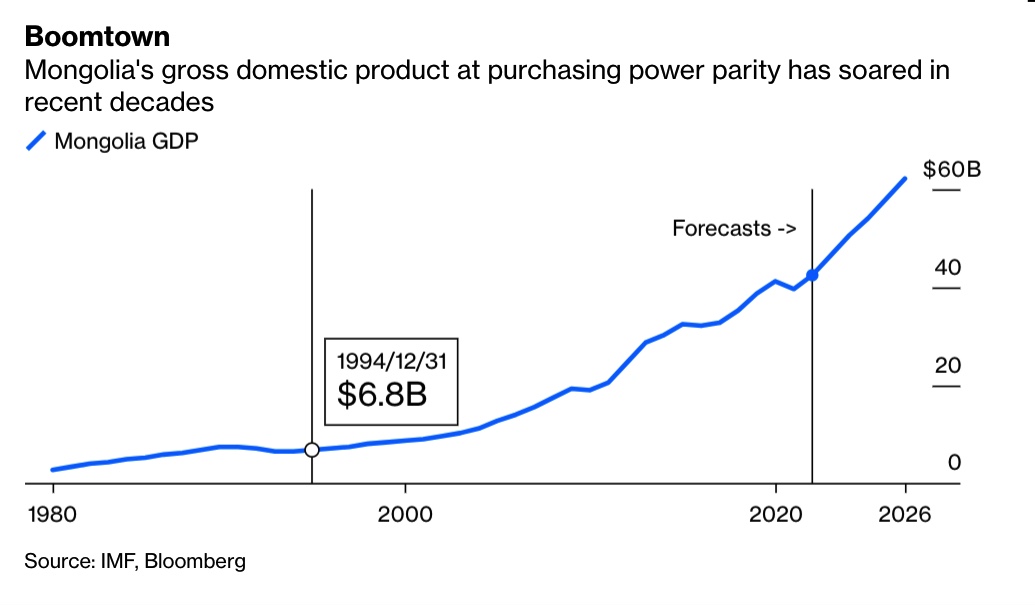
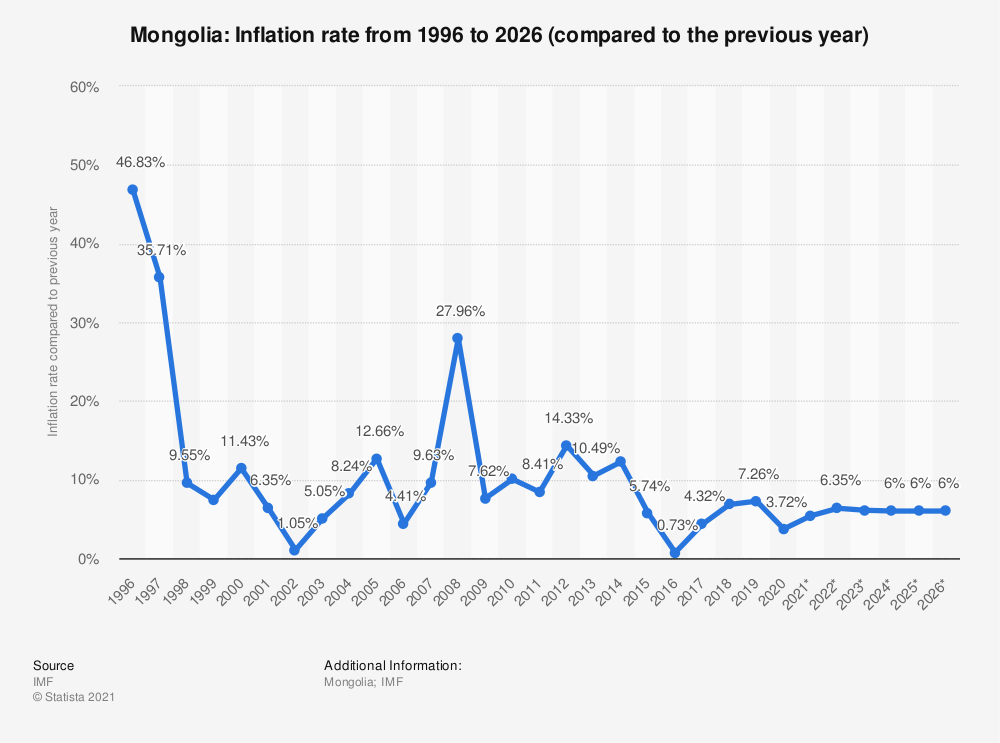
A resources “boomtown” throughout the 2000s. Source: Bloomberg. When I left in 1999, Mongolia’s PPP was US $8.8 bn; today (2021) it is US $42.4 bn.A dramatic decline in inflation paired with political and economic stabilisation allowed Mongolia to enjoy the fruits of the fast-growing economies of the 2000s. Source: Statista.It doesn’t hurt when your neighbour (China) is experiencing an economic boom as it drives down poverty rates.
“I highly recommend Mr. David South as a communications consultant who gets results.” Brian DaRin, Representative/Director, USAID Investment & Business Development Project, Global Technology Network/ International Executive Service Corps-Mongolia, 23 September 1999




 David South Consulting
You must be logged in to post a comment.