Tag: ubiquity

  • Indian ID Project is Foundation for Future Economic Progress

    Indian ID Project is Foundation for Future Economic Progress

    By David SouthDevelopment Challenges, South-South Solutions

    SOUTH-SOUTH CASE STUDY

    India is in the midst of the biggest national identification project in the country’s history. The aim is for every Indian to receive a voluntary electronic identification card containing his or her details and a unique number. Called an Aadhaar, it is a 12-digit unique number registered with the Unique Identification Authority of India (http://uidai.gov.in) (UIDAI). The project joins a growing trend across the global South to map populations in order to better achieve development goals.

    About one-third of the world’s urban dwellers live in slums, and the United Nations estimates that number will double by 2030 as a result of rapid urbanization in developing countries. How to improve slum-dwellers’ living conditions and raise their standard of living is the big challenge of the 21st century.

    With just four years to go until the 2015 deadline to meet the Millennium Development Goals (http://www.undp.org/mdg), and the current economic downturn reversing some gains, any tool that can make development decisions more precise has to be a benefit.

    Innovators are turning to the opportunities afforded by digital technologies to reach slums and poor areas. The approaches vary, from India’s national identification system to new ways of using mobile phones and Internet mapping technologies. With mobile phones now available across much of the global South, and plans underway to expand access to broadband internet even in poorly served Africa, it is becoming possible to develop a digital picture of a slum and poor areas and map population needs.

    Put to the right use, this powerful development tool can fast-track the delivery of aid and better connect people to markets and government services. In a country of severe regional disparities and caste (http://en.wikipedia.org/wiki/Caste) divisions, the national identification number has the advantage of not documenting people in a way that would bring prejudice.

    India’s Aadhaar is intended to serve a number of goals, from increasing national security to managing citizen identities, facilitating e-governance initiatives and tackling illegal immigration. While critics of ID schemes complain about the civil liberties implications of national identity card projects (www.bigbrotherwatch.org.uk), it is a fact that countries that want to increase the social benefits available to their citizens need to understand who those citizens are, where they live and what their social needs are. India’s problem to date has been a lack of knowledge of its citizens: many millions exist in a limbo world of not being known to local authorities.

    The unique number is stored in a database and contains details on the person’s demographics (name, age, etc.) and biometrics (http://en.wikipedia.org/wiki/Biometrics) – a photograph, 10 fingerprints and an iris scan. Residents in an area find out about the Aadhaar through various sources, from local media to local government agencies. An ‘Enrolment Camp’ is established in the area where people go to register, bringing anything they have that can prove their identity. The biometric scanning takes place here. ID cards are issued between 20 and 30 days later.

    On January 13, 2011 the project declared it had registered its millionth person, a 15-year-old named Sukrity from North Tripura. The goal is to register 600 million people in the next four years.

    One of the immediate advantages to many poor people is gaining access to banking services for the first time, because an Aadhaar number is accepted as sufficient ID to open a bank account. The identification authority says the scheme will be “pivotal in bringing financial services to the millions of unbanked people in the country, who have been excluded so far because of their lack of identification.”

    The Times of India reported in 2010 that Khaiver Hussain, a homeless man in an addiction treatment programme, was able to get a bank account after receiving the identification number. He was able to open an account with the Corporation Bank along with 27 other homeless people. Having a bank account has removed the fear he had of being robbed of his meagre savings while he slept.

    Another homeless day labourer, Tufail Ahmed from Uttar Pradesh, said “This passbook and the UID card have given people like me a new identity. It has empowered us.” He has been able to use the saved money to rent a room with four other day labourers.

    In countries where no national ID card schemes exist, people are turning to other methods to register and map populations in order to improve their living conditions.

    In Kenya and Brazil, digital mapping projects are underway using mobile phones to paint a picture of the population living in slum areas and shanty towns. An NGO called Map Kibera (www.mapkibera.org) began work on an ambitious project to digitally map Africa’s largest slum, Kibera in Nairobi, Kenya. The Map Kibera project uses an open-source software programme, OpenStreetMap (www.openstreetmap.org), to allow users to edit and add information as it is gathered.

    An NGO called Rede Jovem (www.redejovem.org.br) is deploying youths armed with GPS (global positioning system)-equipped (http://en.wikipedia.org/wiki/Global_Positioning_System)mobile phones to map the favelas of Rio de Janerio.

    Powerful tools now exist to aid digital mapping. Google Maps (www.maps.google.com) is one example.

    While the project is impressively ambitious – and it remains to be seen if it is completed as planned – the economic and development implications of this vast data collection and national identification are enormous. It will enable very accurate identification of markets and needs and also of development challenges and needs. This should lead to many business innovations in the country in coming years and also draw in more business from outside the country.

    Published: April 2011

    Resources

    1) Ushahidi is a website that was developed to map reports of violence in Kenya after the post-election fallout at the beginning of 2008. The new Ushahidi Engine has been created to use the lessons learned from Kenya to create a platform that allows anyone around the world to set up their own way to gather reports by mobile phone, email and the web – and map them. It is being built so that it can grow with the changing environment of the web, and to work with other websites and online tools. Website:http://blog.ushahidi.com/

    2) Google Android: Get inventing! This software enables anyone to start making applications for mobile phones. And it offers a platform for developers to then sell their applications (apps). Website: www.android.com

    https://davidsouthconsulting.org/2022/10/09/a-new-mobile-phone-aimed-at-the-poor/

    https://davidsouthconsulting.org/2022/09/29/cheap-indian-tablet-seeks-to-bridge-digital-divide/

    https://davidsouthconsulting.org/2022/02/17/digital-mapping-to-put-slums-on-the-map/

    https://davidsouthconsulting.org/2022/10/09/entrepreneurs-use-mobiles-and-it-to-tackle-indian-traffic-gridlock/

    https://davidsouthconsulting.org/2020/12/11/false-data-makes-border-screening-corruptible/

    https://davidsouthconsulting.org/2022/09/27/india-2-0-can-the-country-make-the-move-to-the-next-level/

    https://davidsouthconsulting.org/2022/11/01/indian-newspapers-thrive-with-economy/

    https://davidsouthconsulting.org/2022/10/18/indians-fighting-inflation-with-technology/

    https://davidsouthconsulting.org/2020/12/12/mobile-phone-shopping-to-create-efficient-markets-across-borders/

    “Unique Identity for All”: Biometric identity is being rolled out across the planet. HSB is one of the many players in this fast-growing data collection sector.

    Development Challenges, South-South Solutions was launched as an e-newsletter in 2006 by UNDP’s South-South Cooperation Unit (now the United Nations Office for South-South Cooperation) based in New York, USA. It led on profiling the rise of the global South as an economic powerhouse and was one of the first regular publications to champion the global South’s innovators, entrepreneurs, and pioneers. It tracked the key trends that are now so profoundly reshaping how development is seen and done. This includes the rapid take-up of mobile phones and information technology in the global South (as profiled in the first issue of magazine Southern Innovator), the move to becoming a majority urban world, a growing global innovator culture, and the plethora of solutions being developed in the global South to tackle its problems and improve living conditions and boost human development. The success of the e-newsletter led to the launch of the magazine Southern Innovator.
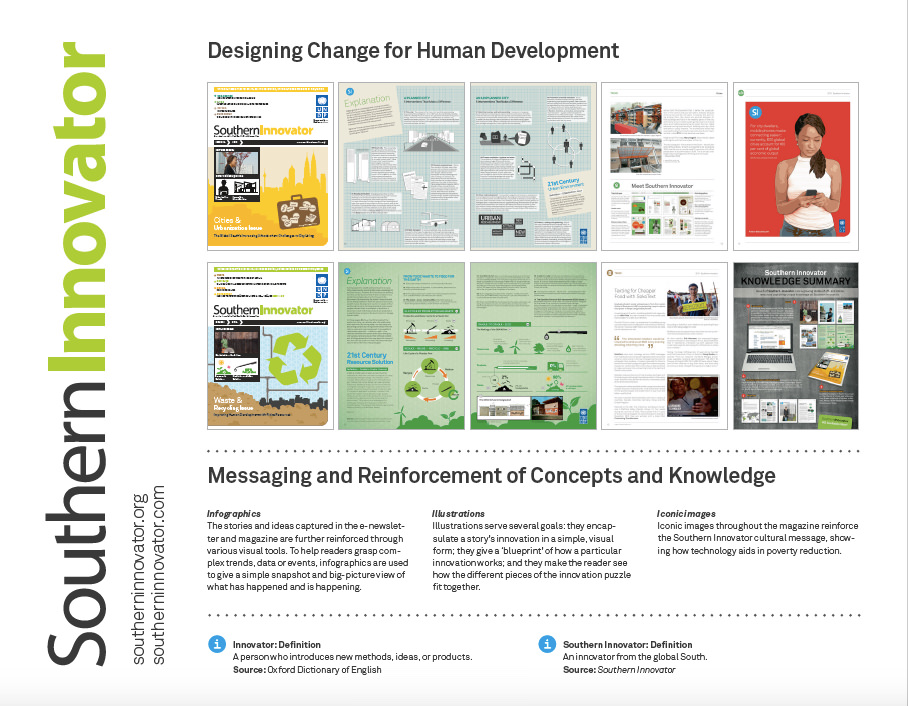
    By 2014, Southern Innovator had published five issues and become a recognised global innovation brand.

    https://davidsouthconsulting.org/2021/03/05/southern-innovator-issue-1/

    Creative Commons License

    This work is licensed under a
    Creative Commons Attribution-Noncommercial-No Derivative Works 3.0 License.

    ORCID iD: https://orcid.org/0000-0001-5311-1052.

    © David South Consulting 2023

  • New 3D Technology Makes Innovation Breakthrough and Puts Mind over Matter

    New 3D Technology Makes Innovation Breakthrough and Puts Mind over Matter

    By David SouthDevelopment Challenges, South-South Solutions

    SOUTH-SOUTH CASE STUDY

    Revolutions in technology are placing more and more power into the hands of the individual, and 3D printing and fabrication machines are opening a whole new chapter.

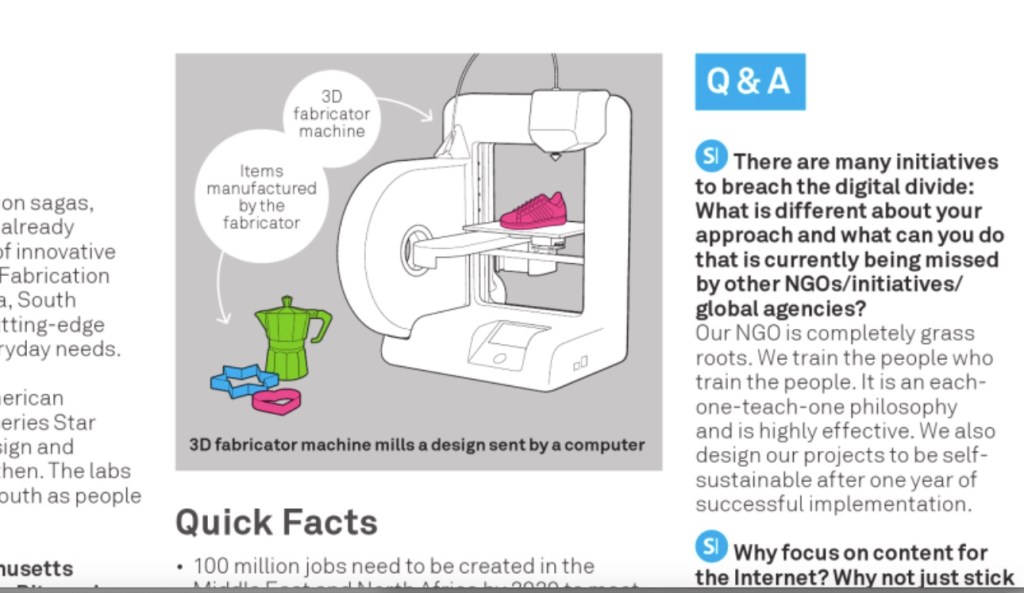
    These devices come in many forms, but they all do one thing: they can manufacture pretty well any three-dimensional object on the spot, from digital plans. These machines come in many sizes, from factory scale to smaller, home versions which are no bigger than personal computer printers, such as the well-known MakerBot Replicator 2 (makerbot.com).

    3D printers introduce sophisticated precision manufacturing to the individual much in the same way the personal computer and the Internet have empowered people to make their own software, build websites and start online businesses.

    A pioneering educational innovation in Chile is taking the technology even further, in a way that is truly mind-blowing. Thinker Thing (thinkerthing.com) promises to transform the way people interact with this new technology. “We have built a machine that will allow you to make real objects with your mind,” its website states.

    And, it wants to do more: “We want to use our invention to light a fire of inspiration throughout the remote and often disadvantaged schools of South America and we can do this with your help.”

    Thinker Thing allows the user to wear a headset and communicate through brain waves to the 3D printer. The printer then manufactures a three-dimensional model of the thoughts. These can be squiggly shapes or even, it is hoped, more sophisticated forms.

    Thinker Thing’s Chilean Chief Technology Officer is George Laskowsky. Laskowsky has a games console engineering background and was a research assistant in charge of high-energy particle experiments.

    The Chilean government is funding this experiment to help children to improve their creative skills. The idea is to use the technology to eliminate the technical side of creating objects and focus the effort on the creative thought process. Thinker Thing was selected from more than 1,400 applicants to participate in the prestigious global accelerator program, “Start Up Chile” (http://startupchile.org). Start-Up Chile is a program created by the Chilean government that seeks to attract early-stage high potential entrepreneurs to develop startups using Chile as a platform to go global, in line with the national goal of converting Chile into the innovation and entrepreneurship hub of Latin America.

    Based in Santiago, Chile, Laskowsky is seeking support for further development on IndieGoGo (http://www.indiegogo.com/projects/children-creating-real-objects-with-their-mind), an international crowdfunding platform for projects.

    The plan is to tour Thinker Thing all around Chile and use the science, art and engineering principles behind the invention to help very young children in remote rural regions to learn through understanding the project. Its creators also hope to take the exhibition – called the Monster Dreamer School Outreach Program and the Fantastical Mind Creatures of Chile Exhibition – on the road and show it in major global cities.

    The children are being asked to imagine fantastical creatures that will then be made into 3D forms with the machine. The idea is to then sell these 3D creatures to supporters of the project to help fund the initiative. As well, these creatures will go on display in an exhibition to help educate visitors about Chile’s children and their communities.

    To increase interest, exclusive photographic prints and limited edition figurines are available of the creatures the children create.

    The prototype uses what is called an EmotivEPOC, basically a wireless neuroheadset collecting signals from the user’s brain. In operation, the software allows users to make 3D models with the power of thought which are then made into a plastic model using a MakerBot Industries Replicator.

    This is experimental stuff and neurotechnology is in its early stages. It can detect simple emotions such as excitement or boredom and cognitive thoughts such as push and pull. Despite being in its early stages, the technology can evolve a 3D object over a number of steps by detecting the user’s emotional response to design changes.

    Thinker Thing has been working alongside neuroscientists to understand the workings of the brain. Amazingly, in one experiment they were able to get a person to control the leg of a cockroach using their own thoughts. Called the Salt Shaker (http://www.thinkerthing.com/about-2/salt-shaker/), it is an experimental kit for young students and hobbyists that allows them to take control of a biological limb quickly and simply.

    The 3D printing revolution is energizing for large and small-scale manufacturers alike. It means a business can now engage in precision manufacturing of products and spare parts quickly. It means it is possible to download from the Internet plans for new innovations and manufacture them within minutes. It also means communities off the mainstream supply line can make what they need and repair machinery without needing to wait weeks or months for items to be shipped from afar or spend vast sums on shipping costs.

    The Fab Labs project based at the Massachusetts Institute of Technology (MIT) has been at the forefront of pioneering and prototyping this technology, including running testing labs across the global South to prove the relevance of the technology to the world’s poorest communities.

    As of 2012, these include Fab Lab Afghanistan (http://www.fablab.af/), in Chile the FabLab Santiago (www.designlab.uai/fablab), Fab Lab Egypt (www.fablab-egypt.com), in Colombia the FabLab Medellin (http://www.fablabcolombia.com), in Ghana the Takoradi Technical Institute (http://ttifab.wikispaces.com/How+to+Use+the+TTI+Fab+Lab+Wiki), in India at various locations, Indonesia’s HONFablab (http://honfablab.org), ARO FabLab Kenya West (http://www.fablab.co.ke), and in Peru, South Africa, Suriname and many more are in the works (http://fab.cba.mit.edu/about/labs/).

    If Thinker Thing has its way, maybe people in the future will say “I think, therefore I print!”

    Published: August 2013

    Resources

    1) Stratasys: The company manufactures 3D printers and materials that create prototypes and manufactured goods directly from 3D CAD files or other 3D content. Stratasys systems are used by manufacturers to create models and prototypes to aid in the new product design process. And they are becoming widely used for production of finished goods in low-volume manufacturing. Systems range from affordable desktop 3D printers to large production systems for direct digital manufacturing. Website: http://www.stratasys.com/

    2) 3D Systems: 3D Systems is a leading provider of 3D content-to-print solutions including 3D printers, print materials and on-demand custom parts services for professionals and consumers alike. Website: http://www.3dsystems.com/

    ExOne: With decades of manufacturing experience and significant investment in research and product development, ExOne has pioneered the evolution of nontraditional manufacturing. This investment has yielded a new generation of rapid production technology in the field of additive manufacturing as well as advanced micromachining processes. Website: http://www.exone.com/

    FabCentral: This site supports a digital fabrication facility and global network of field fab labs managed by MIT’s Center for Bits and Atoms. Website: http://fab.cba.mit.edu

    Maker Shed: 3D Printing and Fabrication:  An outstanding resource for getting all you need to understand 3D printing and manufacturing, with 3D printers, supplies, Whether you want to print out physical objects or machine something from plastic, wood, or other materials, we have the tools and accessories you need. Website: http://www.makershed.com/3D_Printing_Fabrication_s/220.htm

    EMachineShop: The first and leading machine shop designed from the start for the Internet, eMachineShop’s mission is to provide easy, convenient and low-cost fabrication of custom parts via the web. Website: emachineshop.com/

    Development Challenges, South-South Solutions was launched as an e-newsletter in 2006 by UNDP’s South-South Cooperation Unit (now the United Nations Office for South-South Cooperation) based in New York, USA. It led on profiling the rise of the global South as an economic powerhouse and was one of the first regular publications to champion the global South’s innovators, entrepreneurs, and pioneers. It tracked the key trends that are now so profoundly reshaping how development is seen and done. This includes the rapid take-up of mobile phones and information technology in the global South (as profiled in the first issue of magazine Southern Innovator), the move to becoming a majority urban world, a growing global innovator culture, and the plethora of solutions being developed in the global South to tackle its problems and improve living conditions and boost human development. The success of the e-newsletter led to the launch of the magazine Southern Innovator.  

    Follow @SouthSouth1

    Google Books: https://books.google.co.uk/books?id=YfRcAwAAQBAJ&dq=development+challenges+august+2013&source=gbs_navlinks_s

    Slideshare: http://www.slideshare.net/DavidSouth1/development-challenges-august-2013-issue

    Southern Innovator Issue 1: https://books.google.co.uk/books?id=Q1O54YSE2BgC&dq=southern+innovator&source=gbs_navlinks_s

    Southern Innovator Issue 2: https://books.google.co.uk/books?id=Ty0N969dcssC&dq=southern+innovator&source=gbs_navlinks_s

    Southern Innovator Issue 3: https://books.google.co.uk/books?id=AQNt4YmhZagC&dq=southern+innovator&source=gbs_navlinks_s

    Southern Innovator Issue 4: https://books.google.co.uk/books?id=9T_n2tA7l4EC&dq=southern+innovator&source=gbs_navlinks_s

    Southern Innovator Issue 5: https://books.google.co.uk/books?id=6ILdAgAAQBAJ&dq=southern+innovator&source=gbs_navlinks_s

    Creative Commons License

    This work is licensed under a
    Creative Commons Attribution-Noncommercial-No Derivative Works 3.0 License.

    ORCID iD: https://orcid.org/0000-0001-5311-1052.

    © David South Consulting 2023

  • Data Surge across Global South Promises to Re-shape the Internet

    Data Surge across Global South Promises to Re-shape the Internet

    By David SouthDevelopment Challenges, South-South Solutions

    SOUTH-SOUTH CASE STUDY

    The deluge of data gathered by the digital revolution underway in the global South continues to offer a significant economic opportunity. How this data is harvested will forge the successful Internet business models of the future.

    As the Internet spreads its way further across the global South, many are forecasting this new surge in web users and the data they generate will radically reshape the way people engage with and use the Internet. Unlike previous generations of web users, most of these new users will be accessing the Internet primarily with mobile phones and other devices, rather than computers. Many will not be native English speakers.

    Argentinian philosopher and digital publisher Octavio Kulesz says “the digital experiences undertaken in the South suggest that new technologies represent a great opportunity for developing countries … but on the condition that local entrepreneurs seek out original models adapted to the concrete needs of their communities.”

    In a report for the International Alliance of Independent Publishers, Kulesz said we “must ask ourselves how useful it would be to reproduce the prototypes from the North in the South.”

    According to the Cisco Visual Networking Index Forecast (2010-2015), by 2015, there will be 3 billion Internet users in the world: 40 percent of the global population. Internet Protocol (IP) traffic is growing fastest in Latin America, where it is forecast to grow by 50 percent from 2010 to 2015. Next are the Middle East and Africa.

    There are already as many networked devices – tablets, mobile phones, connected appliances and smart machines – on the planet as people. By 2015 – the year of the Millennium Development Goals (http://www.un.org/millenniumgoals) – they’ll outnumber people by two to one.

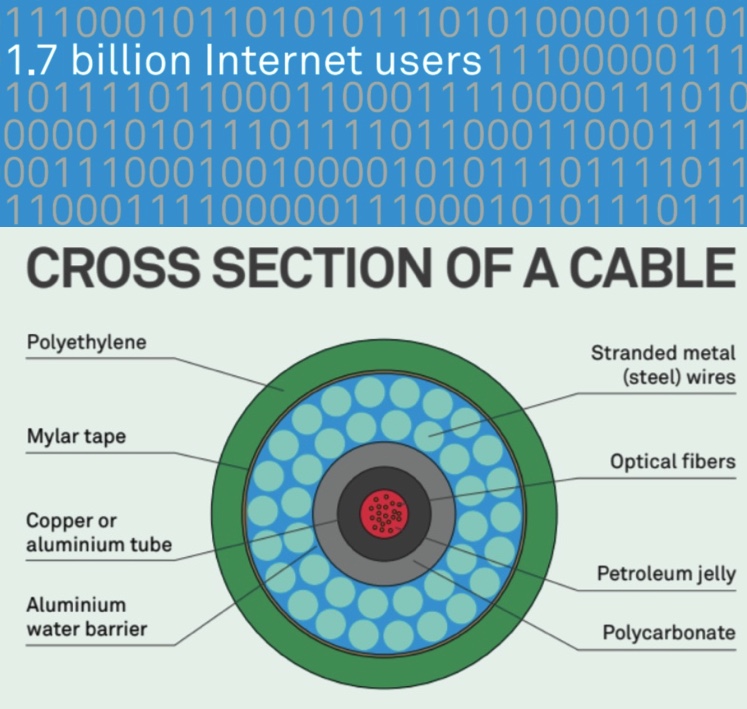
    The potential of the Internet revolution is especially compelling in Africa, a continent neglected for so long in the global communications revolution. The 10,000 kilometre-long East African Submarine Cable System (EASSy), connecting sub-Saharan Africa with Europe and Asia, has joined other cables from the continent. Gradually, the infrastructure is coming in to place to connect Africa properly to the world.

    The first batch of Internet users came from the United States, home of the Internet which grew out of the US military’s Arpanet system (http://en.wikipedia.org/wiki/ARPANET). This first wave of the Internet’s history was very much an American phenomenon. The priorities and content of the web were driven by the cultural and economic concerns of its American users. And the big brands of today’s web reflect this: Google, Facebook, eBay, Twitter, Yahoo, WordPress, to name a few.

    As the web expanded across wealthy, developed nations in Europe, users mostly mimicked the priorities of the American approach, using the web to express themselves, be entertained, share files, access government services and sell and market products and services.

    But the spread of the Internet across the global South is already showing itself to have a different character and set of priorities. One change is in the way people are accessing the web: through mobile phones and other devices, rather than through laptops and personal computers.

    In the future, the trend is towards a global mobile world, in which the communications medium will favour video and audio over text, according to Fast Company magazine (http://www.fastcompany.com). Information is being shared across boundaries on a vast scale for the first time. People around the world are gaining access to data and information never available before, and all of it is nearly instantaneous.

    Kulesz said countries of the South face a profound and difficult decision: follow the lead taken by the technology pioneers of the South, or try and replicate what was done in the North?

    “Sooner or later, these countries will have to ask themselves what kind of digital publishing highways they must build,” his report said, “and they will be faced with two very different options: a) financing the installation of platforms designed in the North; b) investing according to the concrete needs, expectations and potentialities of local authors, readers and entrepreneurs. Whatever the decision of each country may be, the long-term impact will be immense.”

    The costs of trying to replicate the technological infrastructure of the North makes little sense, when it is technologically possible to bypass this costly infrastructure with even newer work-arounds.

    “Of course, it would be extraordinary to obtain 80 percent Internet penetration in Africa or make huge investments in infrastructure throughout the developing regions,” continues Kulesz, “but that may never happen. And in the event that it does occur some day, by then the industrialized countries will no doubt have made another technological leap, meaning that the disparity in infrastructure would still persist. So the most effective option is to start working right now, with what is available.”

    New global magazine Southern Innovator (http://www.scribd.com/doc/57980406/Southern-Innovator-Issue-1), published by UNDP’s Special Unit for South-South Cooperation, captures how this process is happening, as the people of the global South re-shape the Internet to be their own and to meet their needs.

    Published: August 2011

    Resources

    1) Southern Innovator: New global magazine first issue gives a snapshot of the big changes across the global South in mobile phones and information technology. Website:http://www.scribd.com/doc/57980406/Southern-Innovator-Issue-1

    2) Cisco Visual Networking Index Forecast (2010-2015): The annual Cisco VNI Forecast was developed to estimate global Internet Protocol traffic growth and trends. Widely used by service providers, regulators, and industry influencers alike, the Cisco VNI Forecast is based on in-depth analysis and modelling of traffic, usage and device data from independent analyst forecasts. Website:http://newsroom.cisco.com/press-release-content?type=webcontent&articleId=324003

    3) Digital Publishing in Developing Countries: A report by the International Alliance of Independent Publishers. Website: http://alliance-lab.org/etude/archives/date/2010/01?lang=en

    https://davidsouthconsulting.org/2022/02/09/african-health-data-revolution/

    https://davidsouthconsulting.org/2020/12/04/big-data-can-transform-the-global-souths-growing-cities/

    https://davidsouthconsulting.org/2020/12/11/false-data-makes-border-screening-corruptible/

    https://davidsouthconsulting.org/2022/09/27/india-2-0-can-the-country-make-the-move-to-the-next-level/

    https://davidsouthconsulting.org/2022/10/31/mapping-beirut-brings-city-to-light/

    Development Challenges, South-South Solutions was launched as an e-newsletter in 2006 by UNDP’s South-South Cooperation Unit (now the United Nations Office for South-South Cooperation) based in New York, USA. It led on profiling the rise of the global South as an economic powerhouse and was one of the first regular publications to champion the global South’s innovators, entrepreneurs, and pioneers. It tracked the key trends that are now so profoundly reshaping how development is seen and done. This includes the rapid take-up of mobile phones and information technology in the global South (as profiled in the first issue of magazine Southern Innovator), the move to becoming a majority urban world, a growing global innovator culture, and the plethora of solutions being developed in the global South to tackle its problems and improve living conditions and boost human development. The success of the e-newsletter led to the launch of the magazine Southern Innovator.

    https://davidsouthconsulting.org/2021/03/05/southern-innovator-issue-1/

    Creative Commons License

    This work is licensed under a
    Creative Commons Attribution-Noncommercial-No Derivative Works 3.0 License.

    ORCID iD: https://orcid.org/0000-0001-5311-1052.

    © David South Consulting 2023
  • Big Data Can Transform the Global South’s Growing Cities

    Big Data Can Transform the Global South’s Growing Cities

    By David SouthDevelopment Challenges, South-South Solutions

    SOUTH-SOUTH CASE STUDY

    The coming years will see a major new force dominating development: Big Data. The term refers to the vast quantities of digital data being generated as a result of the proliferation of mobile phones, the Internet and social media across the global South – a so-called ‘data deluge’ (UN Global Pulse). It is an historically unprecedented surge in data, much of it coming from some of the poorest places on the planet and being gathered in real time.

    Big Data will have a profound impact on how the cities of the future develop, and will re-shape the way the challenges and problems of human development are handled.

    Estimates by Cisco (cisco.com) foresee 10 billion mobile Internet-enabled devices around the world by 2016. With the world population topping 7.3 billion by then, that will work out to 1.4 devices per person.

    Some estimates say 90 per cent of the digital data ever generated in the world has been produced in the past two years. It is also estimated that available digital data will increase by 40 per cent every year (UN Global Pulse). This digital transformation is being accompanied by another trend: the largest migration in human history from rural to semi-urban and urban areas.

    This presents an unprecedented opportunity to make this rapid urbanization and social change smarter and more responsive to human needs, and to avoid the failures of the past, from over-crowding to crime, disease, pollution, unemployment and poverty. Some believe data collection can radically alter development by flagging up problems quickly, giving cities the chance to respond and correct negative trends before they get out of control. In short, to build in resilience by way of digital technology.

    The latest region to see rapid industrialization and urbanization has been Asia – in particular China, a country that since the 1980s has simultaneously lifted the largest number of people in world history out of poverty and undertaken the biggest migration ever from rural to urban areas.

    And now Africa is beginning to follow in Asia’s wake.

    Unlike previous waves of industrialization and urbanization, Africa’s transformation is occurring in the age of the mobile phone, the Internet, personal computers and miniature electronic devices capable of more computing power than the computers used during the Apollo space programme (http://www.nasa.gov/audience/foreducators/diypodcast/rocket-evolution-index-diy.html). This changes the game significantly.

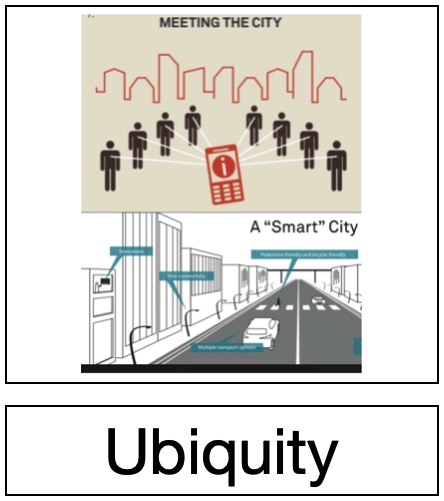
    This 21st-century approach to urban growth is at its most sophisticated, and utopian, in so-called “smart cities.” These are built-from-scratch cities that use the “Internet of Things”, where everything, from lamp posts to garbage bins to roads are embedded with microchips and radio frequency transmitters (RFID chips) (http://en.wikipedia.org/wiki/Radio-frequency_identification) to communicate data in real time. By analyzing this data, cities can be responsive to human needs and mitigate problems – improving waste collection and traffic management, reducing crime and pollution. Services can be customized to residents’ needs and liberate them to spend more time on things that matter such as their own health, family, work and hobbies. Examples of these cities include Tianjin Eco-city (tianjinecocity.gov.sg) in China, Masdar (masdar.ae) in Abu Dhabi in the United Arab Emirates and Songdo International Business District (songdo.com) in the Republic of Korea.

    These experimental smart cities are springing up in the East, and it will be the East – as well as Africa – that will see most of the action going forward. As the global management consulting firm McKinsey noted in its report Urban World: Mapping the Economic Power of Cities: “Over the next 15 years, the center of gravity of the urban world will move south and, even more decisively, east.”

    Cities in the global South will be generating the new prosperity of the 21st century. And it is widely accepted that people living in cities have the potential to become very efficient economically while rapidly driving prosperity higher.

    The McKinsey report says that “by 2025, developing-region cities of the City 600 (a list gathered by McKinsey) will be home to an estimated 235 million middle-class households earning more than (US) $20,000 a year at purchasing power parity (PPP).

    “Emerging-market mega-and middleweight cities together – 423 of them are included in the City 600 – are likely to contribute more than 45 percent of global growth from 2007 to 2025 (http://www.mckinsey.com/insights/urbanization/urban_world).”

    The world’s future prosperity is going to be found in the urban, the digitally connected, and the middle class.

    Tracking all this digital change is the UN Global Pulse. UN Global Pulse (unglobalpulse.org) was started by Secretary-General Ban Ki-moon in 2009 with a mandate to study these changes and build expertise in applying Big Data to global development. UN Global Pulse functions as a network of innovation labs where research on Big Data for development is conceived and coordinated. It partners with experts from UN agencies, governments, academia, and the private sector to research, develop, and mainstream approaches for applying real-time digital data to 21st-century development challenges.

    Unlike major technological trends of the past, this one is not restricted to the industrialized, developed world. Through the spread of mobile phone technology, billions of people are now using a device that constantly collects digital data, even in the poorest places on earth.

    From an international development perspective, Big Data has five characteristics, according to UN Global Pulse: it is digitally generated, passively produced by people interacting with digital services, automatically collected, can be geographically or temporally traced and can be continuously analyzed in real time.

    Sources of Big Data include chatter from social networks, web server logs, traffic flow sensors, satellite imagery, telemetry from vehicles and financial market data.

    The key to using Big Data is combining datasets and then contrasting them in lots of different ways and doing it very quickly. The purpose?  Better decision-making, based on an understanding of what is really happening on the ground.

    This data exceeds the capability of existing database software. It is either too much, or comes in too quickly, or can’t be handled using current software technology. Tackling this problem is creating a whole new wave of opportunities for those working in information technology.

    As technology and processing power continue to improve, the cost of wrestling with this data and putting it to use is coming down.

    The data can be analyzed for patterns and hidden information that before would have been too difficult to gather. This approach has been used by big companies such as WalMart (walmart.com), but it has cost them a large amount of money and time.

    Pioneers in Big Data include search engine Google, email and search provider Yahoo, online shopping service Amazon and social media service Facebook. Many supermarkets use Big Data to analyze the way customers behave when they are shopping, combining it with their social and geographical data.

    But new developments in hardware, cloud architecture, and open-source software mean Big Data processing is more accessible, including for small start-ups, who can just rent the capacity required on a cloud-based service (http://en.wikipedia.org/wiki/Cloud_computing).

    In the past, governments and planners had a ready excuse as to why they could not keep on top of ballooning urban populations and the chaos they brought. They could just throw up their hands and say “We do not know who these people are or what to do about them!”

    This excuse does not work in the age of the mobile phone. It is now relatively easy to deploy the power of the networked computing inside mobile phones to map urban slums and identify the needs of the people there. Parse that data, and you have an accurate account of what is happening in the slum – all in real-time.

    Making sense of all this information is creating its own new industries as innovators, entrepreneurs and companies step forward to chart this brave new world.

    Historically, significant improvements in human development have occurred only after large-scale gathering of data and information on the actual living conditions of the population. For example, prototypes of today’s infographics (http://en.wikipedia.org/wiki/Infographic) – informative visual representations of complex data – were created during the great attempts at tackling poverty and disease in Europe in the 19th century. Today’s masters of this technique include the Swedish doctor, academic and statistician Hans Rosling (gapminder.org), whose dynamic infographics are renowned for changing people’s perceptions of global problems.

    UN Global Pulse notes “much of the data used to track progress toward the Millennium Development Goals (MDGs) dates back to 2008 or earlier and doesn’t take into account the more recent economic crisis.

    “While this may feed a perception that there is a scarcity of information about the wellbeing of populations, the opposite is in fact true. Thanks to the digital revolution, there is an ocean of data, being continuously generated in both developed and developing nations, that did not exist even a few years ago.”

    UN Global Pulse believes Big Data can be used to protect social development gains when crises strike. Rather than undoing decades of good development work and human development achievements, Big Data can help to create agile responses to crisis as it happens.

    UN Global Pulse believes the same data, tools and analytics used by business can be turned to help the public sector understand “where people are losing the fight against hunger, poverty and disease, and to plan or evaluate a response.”

    Published: June 2014

    Resources

    1) Big Data: The Next Frontier for Innovation, Competition, and Productivity, Publisher: McKinsey Global Institute. Website: mckinsey.com

    2) United Nations Global Pulse: Global Pulse is an innovation initiative launched by the Executive Office of the United Nations Secretary-General, in response to the need for more timely information to track and monitor the impacts of global and local socio-economic crises. The Global Pulse initiative is exploring how new, digital data sources and real-time analytics technologies can help policymakers understand human well-being and emerging vulnerabilities in real-time, in order to better protect populations from shocks. Website: http://www.unglobalpulse.org/

    3) Business Models for the Data Economy by Q. Ethan McCallum and Ken Gleason. Website: http://www.oreilly.com/data/free/business-models-for-the-data-economy.csp?intcmp=il-strata-free-product-lgen_biz_models_for_data_economy_strata_right_rail

    4) Building Data Science Teams by D. J. Patil, Publisher: Radar. Website: http://www.oreilly.com/data/free/building-data-science-teams.csp

    5) Big Data for Development Primer, Publisher: UN Global Pulse. Website: http://www.slideshare.net/unglobalpulse/big-data-for-development-a-primer

    6) Mobile Phone Network Data for Development, Publisher: UN Global Pulse. Website: http://www.slideshare.net/unglobalpulse/mobile-data-for-development-primer-october-2013

    7) Big Data, Big Impact: New Possibilities for International Development, Publisher: World Economic Forum. Website: http://www.weforum.org/reports/big-data-big-impact-new-possibilities-international-development

    8) How numbers rule the world by Lorenzo Fioramonti, Publisher: Zed Books. Website: http://www.zedbooks.co.uk/node/16850

    9) Southern Innovator Issue 1: Mobile Phones and Information Technology: Considered a landmark work capturing this fast-changing field, Issue 1 comes packed with stories and contacts. Website: http://books.google.co.uk/books?id=Q1O54YSE2BgC&dq=southern+innovator+issue+1&source=gbs_navlinks_s

    10) Urban world: Mapping the economic power of cities published by McKinsey Global Institute. Website: http://www.mckinsey.com/insights/urbanization/urban_world

    11) Hadoop: Is open source software for handling of large data sets across clusters of computers using simple programming models. Website: http://hadoop.apache.org/

    12) Pivotal: Pivotal develops software applications for big data. A testimonial on the Pivotal website sums it up: “With the ability to load a day’s worth of data for a million meters in under fifty (50) seconds, we are able to keep up with the tremendous amount of data generated and start experimenting with many useful smart grid analytics.” Website: gopivotal.com

    13) TotallyDot: A way to centralize all the social media people use into a single page. Website: totallydot.com

    https://davidsouthconsulting.org/2022/02/09/african-health-data-revolution/

    https://davidsouthconsulting.org/2020/12/04/big-data-can-transform-the-global-souths-growing-cities/

    https://davidsouthconsulting.org/2020/04/27/computing-in-africa-is-set-to-get-a-big-boost/

    https://davidsouthconsulting.org/2020/12/04/data-surge-across-global-south-promises-to-re-shape-the-internet/

    https://davidsouthconsulting.org/2020/12/11/false-data-makes-border-screening-corruptible/

    https://davidsouthconsulting.org/2022/09/27/india-2-0-can-the-country-make-the-move-to-the-next-level/

    https://davidsouthconsulting.org/2021/03/04/indian-id-project-is-foundation-for-future-economic-progress/

    https://davidsouthconsulting.org/2020/04/26/starting-from-scratch-the-challenge-of-transition/

    Development Challenges, South-South Solutions was launched as an e-newsletter in 2006 by UNDP’s South-South Cooperation Unit (now the United Nations Office for South-South Cooperation) based in New York, USA. It led on profiling the rise of the global South as an economic powerhouse and was one of the first regular publications to champion the global South’s innovators, entrepreneurs, and pioneers. It tracked the key trends that are now so profoundly reshaping how development is seen and done. This includes the rapid take-up of mobile phones and information technology in the global South (as profiled in the first issue of magazine Southern Innovator), the move to becoming a majority urban world, a growing global innovator culture, and the plethora of solutions being developed in the global South to tackle its problems and improve living conditions and boost human development. The success of the e-newsletter led to the launch of the magazine Southern Innovator.

    https://davidsouthconsulting.org/2022/11/01/southern-innovator-magazine-2010-2014/

    Creative Commons License

    This work is licensed under a
    Creative Commons Attribution-Noncommercial-No Derivative Works 3.0 License.

    ORCID iD: https://orcid.org/0000-0001-5311-1052.

    © David South Consulting 2022