Categories
Archive data Development Challenges, South-South Solutions Newsletters

Arab World Domain Name Opportunity Huge Economic Help

By David SouthDevelopment Challenges, South-South Solutions

SOUTH-SOUTH CASE STUDY

With the so-called Arab Spring still unfolding across much of the Arabic-speaking world, it is easy to miss a rising new economic opportunity: The introduction of an Arabic domain name system for the Internet.

The explosion in mobile phones in the Arab world has dramatically increased the number of people who can now access the Internet. One Arabic financial website put the number of people who can now access the Internet in one way or another in the Arab world as 75 million (www.nuqudy.com). As highlighted in the 2003 Arab Human Development Report (AHDR), Arabic-speaking countries have been at a knowledge disadvantage for some time: more than 270 million citizens have access to fewer books than other languages, slower growth economies, and greater illiteracy than the faster-growing emerging economies. At the time, the AHDR found there were just 18 computers per 1,000 people compared to a global average of 78. And just 1.6 percent of Arabs had Internet access, one of the lowest ratios in the world (AHDR 2003).

Since the dawn of the Internet, Latin script has been used exclusively for top-level web domain names, the addresses that end .com, .org and so on. That has been a big obstacle for users of non-Latin script languages like Arabic. It is estimated just 10 percent of people in the Arab world speak English. Many of the resources on the Internet and its utility have been lost to these people. But by using Arabic domain names, there will be a consistency and no more guesswork.

A typical problem in Latin transliterations of Arabic is the conundrum as to either using El or Al as the prefix to a word. This problem is eliminated when Arabic is used.

The Arab world is also very mixed, including the resource-rich, cash-rich Gulf States – Kuwait, Qatar, United Arab Emirates, Saudi Arabia, Oman and Bahrain – and states with high rates of poverty such as Egypt, Djibouti and Yemen.

The protests and uprisings this year in Tunisia, Egypt and elsewhere – with their Facebook pages and Twitter streams – have shown that a growing group of highly Internet-savvy young people is emerging in the Arab world. But for many without the education or the resources, access to knowledge still remains weak. But armed with Internet-capable mobile phones and Arabic language domain names, rapid change is now possible.

The number of books published in Arabic is notoriously relatively low, and print runs are small. Arabic language books make up just 1.1 percent of world production.

The AHDR reports have called this knowledge deficit a direct obstacle to human development in Arab countries.

But things are changing and the rise of Arabic domain names offers the potential for an explosion in Arabic language Internet content.

In May 2010 ICANN, the world’s Internet domain authority, decided to allow top-level domains in non-Latin script. For Arabic speakers, it started this program in Egypt, Saudi Arabia and the United Arab Emirates.

As a sign of the importance of Arabic participation in future growth of the Internet, this year’s World Summit for the Information Society (WSIS) held in Geneva, Switzerland in May 2011 was sponsored by the United Arab Emirates (UAE).

A catchy domain name has many advantages. For Arabic speakers, this means they can type in Arabic domain names for websites and even do it right to left, as they do in print.

In 2009, the first Arabic domain name was grabbed by Egypt. As the Internet naming authority, the Internet Corporation for Assigned Names and Numbers (ICANN) (www.icann.org), started to allow the registering of non-Latin script names. The domain was for the Arabic word for Egypt or “.masr”.

As an early adopter, Egypt sees it as an important part of bringing more Arabic speakers online. George Victor, from the Egyptian National Telecom Regulatory Authority, told the BBC: “We believe that this is a great step that will open new horizons for many e-services in Egypt, and it will have its direct impact, enlarging the number of online users.”

Victor believes using Arabic builds trust.

“Having a domain name in your own language is a point of having a local identity,” he said.

“When talking about Arabic domain names, we are talking about having users which are not online now. People with languages disabilities – people who are having language as a barrier to connect online.”

From now on Internet address names will be able to end with almost any word in any language, offering organizations around the world the opportunity to market their brand, products, community or cause in new and innovative ways.

The advantages of registering an Arabic domain name are numerous. They include clear improvements to business and trade: an ability to protect a trademark, better communication with Arabic customers, better Arabic-language advertising opportunities, better memorability for Arabic domain names because they will be in the Arabic language, and greater access to Arabic customers.

But there are also significant improvements to how the Internet functions in the Arabic world. Search results on Arabic search engines will be more precise with Arabic domain names; catchy, memorable domain names will be a spur to the advertising and marketing industries; and a more Arab-friendly Internet will draw in more Arabic-speaking Internet users, helping them to enjoy the fruits of this great technological advance just as speakers of other languages have.

In March 2011, the Gulf state of Qatar enthusiastically started to offer Arabic domain names.

“The launch of Qatar’s Arabic top-level domain names is a major milestone as we work to build a more digitally inclusive society,” said Dr. Hessa Al Jaber, Secretary General of the Supreme Council of Information and Communication Technology, which will manage Qatar’s Internet domain names through the Qatar Domains Registry.

“As more organizations and individuals begin adopting Arabic domain names, the Internet will literally be opened up to broad new audiences. The Arab world represents a region with enormous potential for growth both in terms of usage and the creation of new digital content, especially Arabic content.”

ICANN’s President and Chief Executive, Rod Beckstrom, sees this as a new phase for the Internet: “ICANN has opened the Internet’s naming system to unleash the global human imagination. Today’s decision respects the rights of groups to create new Top Level Domains in any language or script. We hope this allows the domain system to better serve all of mankind.”

Published: July 2011

Resources

1) Watch the ICANN educational video “Get Ready for the Next Big Thing”, explaining how domain names work and what the changes mean. Website: http://www.icann.org

https://davidsouthconsulting.org/2022/10/26/africa-to-get-own-internet-domain/

https://davidsouthconsulting.org/2022/11/11/berber-hip-hop-helps-re-ignite-culture-and-economy/

https://davidsouthconsulting.org/2020/12/04/data-surge-across-global-south-promises-to-re-shape-the-internet/

https://davidsouthconsulting.org/2022/02/11/egyptian-youth-turns-plastic-waste-into-fuel/

https://davidsouthconsulting.org/2022/11/11/innovation-cairos-green-technology-pioneers/

https://davidsouthconsulting.org/2022/10/29/new-apps-make-driving-and-travelling-in-egypt-easier-safer/

https://davidsouthconsulting.org/2022/10/21/preserving-beekeeping-livelihoods-in-morocco/

https://davidsouthconsulting.org/2022/10/21/social-networking-websites-a-way-out-of-poverty/

Development Challenges, South-South Solutions was launched as an e-newsletter in 2006 by UNDP’s South-South Cooperation Unit (now the United Nations Office for South-South Cooperation) based in New York, USA. It led on profiling the rise of the global South as an economic powerhouse and was one of the first regular publications to champion the global South’s innovators, entrepreneurs, and pioneers. It tracked the key trends that are now so profoundly reshaping how development is seen and done. This includes the rapid take-up of mobile phones and information technology in the global South (as profiled in the first issue of magazine Southern Innovator), the move to becoming a majority urban world, a growing global innovator culture, and the plethora of solutions being developed in the global South to tackle its problems and improve living conditions and boost human development. The success of the e-newsletter led to the launch of the magazine Southern Innovator. 

Creative Commons License

This work is licensed under a
Creative Commons Attribution-Noncommercial-No Derivative Works 3.0 License.

ORCID iD: https://orcid.org/0000-0001-5311-1052.

© David South Consulting 2023
Categories
Archive Development Challenges, South-South Solutions Newsletters Southern Innovator magazine

Global South Eco-cities Show How the Future Can Be

By David SouthDevelopment Challenges, South-South Solutions

SOUTH-SOUTH CASE STUDY

The world is currently undergoing a high-stress transition on a scale not seen since the great industrial revolution that swept Europe in the 19th and 20th centuries. Today’s urban and industrial transition involves many more people and is taking place on a greater proportion of the planet. With rapid urbanization comes a demand for middle class lifestyles, with their high-energy usage and high consumption of raw materials.

This is stretching the planet’s resources to breaking point. And as many have pointed out, if the world’s population is to continue past today’s 7 billion to reach 9 billion and beyond, new ways of living are urgently required. Radical thinking will be necessary to match the contradictory goals of raising global living standards for the world’s poor with pressured resources and environmental conditions.

But there are innovative projects already under development to build a new generation of 21st-century cities that use less energy while offering their inhabitants a modern, high quality of life. Two examples are in China and the Middle East.

Both projects are seen as a way to earn income and establish viable business models to build the eco-cities of the future. Each project is seeking to develop the expertise and intellectual capacity to build functioning eco-cities elsewhere. In the case of the Masdar City project in the United Arab Emirates, international businesses are being encouraged to set up in Masdar City and to develop technologies that can be sold to other countries and cities – in short, to create a green technology hub akin to California’s hi-technology hub ‘Silicon Valley’. Masdar City is also being built in stages as investors are found to help with funding. Both projects hope to prove there is money to be made in being green and sustainable.

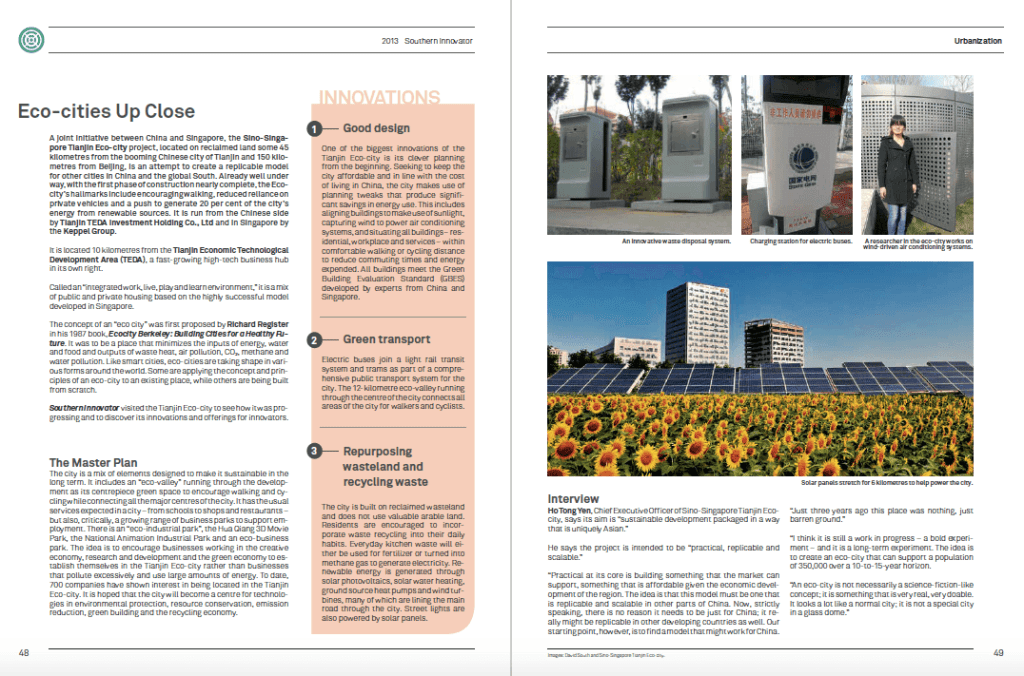
The Tianjin Eco-city (tianjinecocity.gov.sg) project is a joint venture between China and Singapore to build a 30 square kilometre city to house 350,000 residents.

Tianjin (http://en.wikipedia.org/wiki/Tianjin) is a large industrial city southeast of China’s capital, Beijing. It is a place that wears the effects of its industrial expansion on the outside. Air pollution is significant and the city has a grimy layer of soot on most outdoor infrastructure.

China has received a fair bit of criticism for its polluted cities as the country has rapidly modernized in the past two decades. This sprint to be one of the world’s top economic powers has come at a cost to the environment. In this respect, China is not unusual or alone. Industrialization can be brutal and polluting, as Europe found out during its earlier industrial revolution.

But China is recognizing this can’t go on forever and is already piloting many initiatives to forge a more sustainable future and bring development and high living standards back in line with what the environment can handle.

Sino-Singapore Tianjin Eco-city is the second large-scale collaboration between the Chinese government and Singapore. The first was the Suzhou Industrial Park (http://www.sipac.gov.cn/english/).The Tianjin project came up in 2007 as both countries contemplated the challenges of rapid urbanization and sustainable development.

The project’s vision, according to its website, is to be “a thriving city which is socially harmonious, environmentally-friendly and resource-efficient – a model for sustainable development.”

The philosophy behind the project is to find a way of living that is in harmony, with the environment, society and the economy. It is also about creating something that could be replicated elsewhere and be scaled up to a larger size.

The city is being built 40 kilometres from Tianjin centre and 150 kilometres from Beijing. It is located in the Tianjin Binhai New Area, considered one of the fastest growing places in China.

Construction is well underway and can be followed on the project’s website (http://www.tianjinecocity.gov.sg/gal.htm). It will be completed in 2020.

This year, the commercial street was completed and is ready for residents to move in.

Residents will be encouraged to avoid motorized transport and to either use public transport or people-powered transport such as bicycles and walking.

An eco-valley runs down the centre of the city and is meant to be a place for pedestrians and cyclists to enjoy.

The basic building block of the Eco-city – its version of a city block – is called the Eco Cell. Each Eco Cell measures 400 metres by 400 metres, a comfortable walking distance. Four Eco Cells make a neighbourhood. Several Eco Neighbourhoods make an Eco District and there are four Eco Districts in the Eco-city. It is a structure with two ideas in mind: to keep development always on a walkable, human scale and also to provide a formula for scaling up the size of the Eco-city as the number of residents increases.

It is a logical approach and seeks to address one of the most common problems with conventional cities: sprawling and unmanageable growth that quickly loses sight of human need.

Agreement was also reached on the standards that should be achieved for a wide variety of criteria, from air and water quality to vegetation, green building standards, and how much public space there should be per person.

An ambitious project in the United Arab Emirates is trying to become both the world’s top centre for eco cities and a living research centre for renewable energy. Masdar City (http://www.masdarcity.ae/en/)is planned to be a city for 40,000 people. It is billed as a high-density, pedestrian-friendly development where current and future renewable energy and clean technologies will be “marketed, researched, developed, tested and implemented.”

The city hopes to become home to hundreds of businesses, a research university and technology clusters.

This version of an eco-city is being built in three layers in the desert, 17 kilometres from the Emirati capital Abu Dhabi. The goal is to make a city with zero carbon emissions, powered entirely by renewable energy. It is an ambitious goal but there are examples in the world of cities that use significant renewable energy for their power, such as Reykjavik, Iceland in Northern Europe, which draws much of its energy from renewables and geothermal sources.

Masdar City is designed by world-famous British architect Norman Foster (fosterandpartners.com) and will be 6.5 square kilometres in size.

The design is highly innovative. The city will be erected on 6 metre high stilts to increase air circulation and reduce the heat coming from the desert floor. The city will be built on three levels or decks, to make a complete separation between transport and residential and public spaces.

The lowest deck will have a transportation system based on Personal Rapid Transport Pods. These look like insect eyes and are automated, controlled by touch screens, using magnetic sensors for propulsion. On top of this transport network will be the pedestrian streets, with businesses, shops and homes. No vehicles will be allowed there, and people will only be able to use bicycles or Segway (segway.com) people movers to get around. An overhead light railway system will run through the city centre, all the way to Abu Dhabi City.

“By layering the city, we can make the transport system super-efficient and the street level a much better experience,” Gerard Evenden, senior partner at Foster + Partners, told The Sunday Times. “There will be no car pollution, it will be safer and have more open spaces. Nobody has attempted anything like this.”

Masdar City is being built in stages as funding comes, with the goal of completion by 2016. It hopes to achieve its aspiration to be the most technologically advanced and environmentally friendly city in the world. As for water supplies in the desert, there is a plan: dew collected in the night and morning and a solar-powered desalination plant turning salt water into drinking water.

Electricity will come from a variety of sources. Solar panels will be on every roof and double as shade on alleyways. Non-organic waste will be recycled, while organic waste will be turned into fuel for power plants. Dirty water will be cleaned and then used to irrigate green spaces. Because of the design, the planners hope the city will just use a quarter of the energy of a conventional city.

To keep the city smart and the project on top of developments in renewable energy, the Masdar Institute of Science and Technology (http://www.masdar.ac.ae/) will specialize in renewable energy technology.

The cost for the city was pegged at US $22 billion in 2009.

The chief executive of Masdar – Abu Dhabi’s renewable-energy company – is Sultan Al Jaber. He sees the city as a beacon to show the way for the rest of the Emirate to convert from a highly inefficient consumer of energy to a pioneer in green technology.

“The problem with the renewable-energy industry is that it is too fragmented,” he told The Sunday Times. “This is where the idea for Masdar City came from. We said, ‘Let’s bring it all together within the same boundaries, like the Silicon Valley model (in California, USA).’”

The project needs to gather much of its funding as it progresses. The United Nations’ Clean Development Mechanism (http://cdm.unfccc.int/) is helping with financing. Companies can earn carbon credits if they help fund a low-carbon scheme in the global South. The sultan is ambitious and sees this as a “blueprint for the cities of the future.” It has been able to bring on board General Electric (GE) and the Massachusetts Institute of Technology (MIT) to sponsor the university.

It is possible to visit Masdar City and take a tour (http://www.masdarcity.ae/en/105/visit-masdar-city/) and it is also possible to view online what has been built so far (http://www.masdarcity.ae/en/32/built-environment/).

Published: June 2012

Resources

1) Center for Innovation, Testing and Evaluation (CITE): Located in Texas, USA, CITE is a fully functioning city with no residents to test new technologies before they are rolled out in real cities. Website: http://www.pegasusglobalholdings.com/test-center.html

2) Digital Cities of the Future: In Digital Cities, people will arrive just in time for their public transportation as exact information is provided to their device. The Citizen-Centric Cities (CCC) is a new paradigm, allowing governments and municipalities to introduce new policies. Website: http://eit.ictlabs.eu/action-lines/digital-cities-of-the-future/

3) Eco-city Administrative Committee: Website: http://www.eco-city.gov.cn/

4) Sino-Singapore Tianjin Eco-city, Investment and Development Co., Ltd. Website: tianjineco-city.com

5) ‘The Future Build’ initiative, a new green building materials portal from Masdar City. Website: thefuturebuild.com

6) UNHABITAT: The United Nations Human Settlements Programme is the UN agency mandated to promote socially and environmentally sustainable towns and cities with the goal of providing adequate shelter for all. Website: http://www.unhabitat.org

Creative Commons License

This work is licensed under a
Creative Commons Attribution-Noncommercial-No Derivative Works 3.0 License.

ORCID iD: https://orcid.org/0000-0001-5311-1052.

© David South Consulting 2022