Categories
Archive Blogroll Ger Magazine UNDP Mongolia 1997-1999 United Nations Development Programme

Mongolian Rock and Pop Book: Mongolia Sings its Own Song

Publisher: UNDP Mongolia Communications Office/Press Institute of Mongolia

Managing Editor: David South

Editorial Advisors: Ts. Enkhbat, Mustafa Eric, David South

Author and Researcher: Peter Marsh, Indiana University

Copy Editor: N. Oyuntungalag

Production Editor: B. Bayarma

Published: 1999

ISBN 99929-5-018-8

In the Mongolian language, the book explores how Mongolia’s vibrant rock and pop music scene led on business innovation and entrepreneurship in the country during the transition years (post-1989). Written by an ethnomusicologist, it details the key moments and events in this story, while splicing the narrative with first-person interviews with the major players.

https://davidsouthconsulting.org/2020/12/17/mongolias-musical-entrepreneurs-led-way-out-of-crisis-2018/

From Ger Magazine Issue 1

Published: September 9, 1998

Mongolia Sings its Own Song

MTV is available on cable television, bootleg CDs blare from kiosks and the latest news on the Spice Girls is available in one of dozens of entertainment newspapers. Despite the flood of foreign music it is local musicians who the youth turn to to voice their new-found freedoms, dreams and angst. Pop music researcher Peter Marsh swings to the new beat of the steppe…

It is something that would have horrified the old socialist leaders. Pop singer T. Ariunaa – Mongolia’s answer to Madonna – is doing what she does best: pushing the barriers of what a performer can and can’t do. Notorious in the local press as “Mongolia’s Queen of the Erotic,” she struts onto the stage of the Non-Stop – one of the newest and trendiest disco clubs in the Mongolian capital, Ulaanbaatar – wearing a black silk robe over black lingerie bikini underwear. Jumping into her hit song, “Telephone Number”, she sings the lines,

When you begin to take off your shirt, I am happy you’re staying;

When your hot breath is near me, the lights go out,

Cheekily writhing her torso, seductively opening and closing her robe, she teases her audience. And her audience, mostly Mongolian youth from the late teens to early thirties, take it all in with good humour, smiling and giggling. Whether they like her music or not, they appreciate what she’s doing and are having fun. The message of free expression is reflective of the enormous changes in attitudes over this decade. 

“I like Ariunaa very much,” says 30-year-old Sukhbaatar, a graphic designer. Wearing a dress shirt, slacks and noticebly shiny shoes, he’s sitting with his two friends, glasses of beer in hand, watching the show. “She has a powerful voice,” he says gesticulating towards the stage. “She has a peculiar style, and this kind of style should be developed in Mongolia. 

“But we don’t admire her as a singer,” he says with a wry laugh.

Not long ago, when this landlocked Northeast Asian nation was still subject to Soviet-backed socialist rule, pop-rock musicians like Ariunaa would never have been allowed to bring such explicit expressions of ‘the erotic’ anywhere near the public stage. Ariunaa’s boldness and charisma, which have made her one of Mongolia’s most well-known and controversial young pop stars, show something of the new openness and growing diversity that characterizes the emerging popular music industry in capitalist Mongolia. There are girl bands like Spike, boy bands like Nomiin Talst and Camerton and pop divas like Saraa.

A typical concert in Ulaanbaatar, like this one at the Non-Stop – a converted public gymnasium which opened earlier this year – consists of a succession of live Mongolian bands interspersed with breaks for dancing to Western pop, disco and techno music. The styles of music in these concerts fall into what the Mongolians call pop-rock, which ranges from rock ‘n’ roll, soft rock, and heavy metal rock to techno, hip-hop and rap. Mongolian music fans today now have a wide choice of styles to choose from.

Someone who would know about this well is the ‘elder statesman’ of rock, D. Jargalsaikhan. Wearing leather cowboy boots, sequined leather pants and a leather jacket, and with his black hair streaming down over his shoulders, Jargalsaikhan sees the new diversity of groups as a positive sign of the times, as he said in a recent newspaper interview. 

“In the stores today there are maybe 10 different varieties of sausage: salted, unsalted, spiced and so on. You can then look at them all and then choose the one you want, like spiced sausage. It’s the same thing with the music business in Mongolia today. In the era of the market economy many different bands and singers have come out, and the listeners can choose the recordings of those bands and music styles that they like. … The most important thing is that the other bands or styles of singers should not be ignored. All of them have a wish to do something. Usually, those who criticize different styles or forms of music are people with too much time on their hands.”

Although turning 40 this year, Jargalsaikhan is not a man with too much time on his hands. As head of the Mongolian Singer’s Association, his many responsibilities keep him on the run. In between numerous breaks to answer calls on his cell phone, Jargalsaikhan tells me about being a rocker in the 1970s and ’80s, which he terms the “Golden Era” of rock in Mongolia, and the difficulties they faced. “Because Mongolia was ruled by one party, the Revolutionary [Socialist] Party [from 1921 to 1990], there was little foreign influence allowed into the country. Rock and pop were not to be found on the [state-controlled] radio or TV, and aside from records and cassettes brought into the country by individuals coming from Europe and Russia, people here had very little experience with the music. … It was easier for the early rock-pop musicians to take examples from folk music, which was close to them, which they had been listening to since their childhood.” Much of the early music included settings of popular folk songs and melodies in the rock genre. And the youth, eager for alternatives to the state-sponsored cultural offerings, found the music to their liking.

The popularity of this early rock-pop, or so-called folk-pop groups soon drew the attention of the socialist party, which saw opportunities to use the music for the purpose of advancing its mission in Mongolia. In exchange for the state government’s granting of musical instruments, rehearsal and performance spaces, and concert and touring opportunities, the early bands were closely watched, their actions restricted by suspicious government officials. “Everything was planned by the government, and we had to do what it had planned,” says Jargalsaikhan. “For example, when we were abroad, we couldn’t go to the discos nor arrive at the hotel late. We couldn’t go where we wanted. There were conflicts between the singers and musicians and the government representatives [sent to oversee the tour]. If I spoke to foreigners, I would be considered a spy. Who I spoke with was also controlled. At that time, the social condition in Mongolia was like that of North Korea today.”

Considered by the government to be a “capitalist art,” the direct imitation of Western rock was not allowed. Mongolian bands instead had to create a unique Mongolian style of the music that drew from traditional folk or classical musical and literary traditions. Band members were often compelled to compose songs to lyrics written by members of the powerful Mongolian Union of Writers. “It was difficult for musicians to play their own compositions, and they were often forbidden to do so,” recalls Jargalsaikhan. “For the concert programmes, our songs had to include the topics of Mongolia and the Soviet Union, as well as the Mongolian love for Nature or for Father and Mother. … The topic of love between a man and woman was considered to be too personal for the public stage, and was almost forbidden.”

But rock and pop musicians gained more and more freedoms of expression as political and social reforms were introduced in Mongolia throughout the 1980s. “The rock-pop musicians of the 1970s became more skilled and their abilities improved,” says Jargalsaikahn. “They began to compose at the level of professional composers. Also, the older generations wanted to give more artistic freedoms to the youth at the same time as the Party controls were being lifted.” And the youth, in turn, were more intent on creating traditions of music of their own generation. “The young rock-pop musicians wanted to hand-down their own music to the next generation-their own pop-rock art.

Jargalsaikhan gained fame throughout Mongolia for his 1988 song “Chinggis Khan,” when he was lead singer of the band by the same name. Making use of traditional folk music instruments alongside of the group’s electric guitars, synthesizers and drums, the song praises the 13th century Mongolian leader as a great, if historically misunderstood, man who always had in mind the good of the Mongolian nation–and this at a time when expressing such sentiments could have landed him in prison. “I had to show my civil courage to sing this song. But many of my friends and fellow composers encouraged me to write and perform it.”

His was the voice of a new generation, one seeking more freedoms to express Mongolian identity in new ways. The efforts of many musicians of his generation contributed to the popular political movements and protests that eventually led, in 1990, to the downfall of the socialist government and the introduction of democratic and market economic reforms throughout the nation.

In the new social and cultural climate of the late-1980s and early ’90s, musicians saw it as their responsibility to introduce Western rock music and popular culture to Mongolia. Besides Jargalsaikhan’s Chinggis Khan (“soft rock”), other groups came onto the popular music scene, including bands like Haranga (“heavy-metal/grunge”) and Hurd (“metal rock”).

The leader and percussionist of the group Hurd (“Speed”), D. Ganbayar, saw it as a national service to his people to introduce his group’s unique form of Western-style rock. “The Mongolian people, and especially the youth, don’t want [their bands] to imitate Western rock art. They want a pop-rock with its own specific character, music that’s different from other types of Western rock-pop, music with its own national character.” Wearing a leather jacket and black hair down to his chest, Ganbayar, moves to the edge of his chair. “No one but us will introduce this kind of music to the Mongolian people. We serve our people. It’s our duty to introduce Western music to the Mongolian people through the Mongolian language and Mongolian melodies. We want to show that Mongolian rock-pop has its own unique character.”

Nearing a decade of life, Hurd continues to experiment with new sounds and performance styles. They recently softened their driving, heavy metal style in two “Unplugged” concerts given at another new disco club in Ulaanbaatar, Top Ten, a cavernous warehouse located in a former cultural centre. This was the first time any rock group had tried such a concert idea in Mongolia. Even on acoustic guitars, however, the group, consisting of a bass, two guitars, drums, percussion and keyboards, managed to fill the club with their sound and fury. Their fans packed the house, and the lead singer, Tumurtsog, needed little effort to get them to sing along with him on many songs.

Hurd and Haranga are still very popular groups in Mongolia, but in the past years few new heavy metal or hard rock groups have come onto the pop-rock scene here. Instead, a new generation of popular singers and music groups have been working their way up and into the limelight of the concert stages. These are youths that mostly eschew the long hair and leather jackets of the older groups in favor of short, styled hair and suits and ties. The music would be recognized in the West as techno, hip-hop, and pop along the lines of the Backstreet Boys, Celene Dion and the Spice Girls, and is almost always electronically produced in recording studios and then backgrounded to the singers and dancers themselves on stage with the use of a tape player.

Mostly in their late teens and early 20s, these performers appeal to Mongolian audiences with their singing, dancing and stage presence. One of the most popular of the current crop of bands is Har Sarnai (“Black Rose”), a “hip-hop techno” male duo, famous for their dancing, nationalistic song lyrics and sometimes outrageous clothes and hair styles.

In their concerts they often come out on stage wearing specially designed silken dels (traditional Mongolian robes worn by both men and women), with sunglasses and big bushy black and gray colored wigs on their heads. As the heavy techno beat of one of their most famous songs, “Alarm,” begins, they launch into their synchronized dance routines and lyrics, which exhort Mongolians to wake up from their dreaming and set to work producing a new society. Their audiences watch from their tables-as Mongolians hardly ever dance while the bands are performing-clearly enjoying the show.

“Har Sarnai is my favorite band,” says 19-year-old Buyanbaatar, a student at the Mongolian State University. “I like how different they are. Their clothes, their behavior on stage is different. And the songs that they sing, their dances and their clothes and style are all well suited together.”

Even older youth, like Sukhbaatar, age 30, mirror these sentiments. “I like Har Sarnai because I like their style and their dancing very much. I also like their unique styles of hair.” His friend Tsooj, age 31, adds, “In America you have rap bands, like New Kids [on the Block], and they dance really well. We like dancing very much. We are not too old for this!”

To both of them, the infectiousness of the new music pop scene transcends traditional age definitions. “I started to listen to music from the Beatles and other foreign bands. But now it’s become very nice in Mongolia. It’s just impossible not to be a fan because we are young people. We don’t think we are old. We are young enough, and we are here to support our favorite bands, and we will scream and whistle with everyone else!”

How audience members of different age groups can mix together at concerts and share such similar tastes in musical genres is perhaps unique to Mongolia. “One of the reasons why even the older generations like the new bands of the younger generations,” says Norov-Aragcha, a professional artist, aged 38, “is that in their youth, when they were 18 or 20, such bands didn’t exist here. We like new things like the younger people, and this music is new to Mongolia.”

But while he appreciates the new opportunities that the new bands have to perform their music in Mongolia, Norov-Aragcha adds that something is certainly missing from their music. “I like Ariunaa, and appreciate what she does. But all these bands and singers [of the young generation], although they have their own styles, they are generally on one level. None of them stands out from the rest. Maybe because of my profession, I prefer something new, something very different from the others. Haranga and Jargalsaikhan, they are our generation. They have feelings, they are making efforts with their music, and they are honest to their music. In their time [late-1980s and early 1990s] it was very difficult, but they did it. They have real talent, real feeling in their music.”

“Now I’m looking at all these new bands and singers, but still the one that I want hasn’t appeared. … That is, something which suits today’s conditions and atmosphere. … Something very powerful, very hard. Something like a Kurt Cobain.”

While not new to Mongolia, pop-rock’s growing diversity certainly is. The general feeling these days seems to be one of celebration of its freedoms and appreciation of its diversity, without the isolation of audiences into genres that is typical in the West. Given the difficulties Mongolia’s youth now face as they struggle to adapt to a society undergoing enormous change, a Mongolian “Kurt Cobain” may be just around the corner.

Creative Commons License

This work is licensed under a
Creative Commons Attribution-Noncommercial-No Derivative Works 3.0 License.

ORCID iD: https://orcid.org/0000-0001-5311-1052.

© David South Consulting 2024

Categories
Archive UNDP Mongolia 1997-1999 United Nations Development Programme

High Impact Communications In A Major Crisis: UNDP Mongolia 1997-1999 | 18 February 2016

I was head of communications for the United Nations mission in Mongolia from 1997 to 1999. The mission had to primarily tackle three major crises: the country’s turbulent transition from Communism to free markets and democracy, the social and economic crash this caused, and the Asian Financial Crisis (Pomfret 2000) (Quah 2003)*.

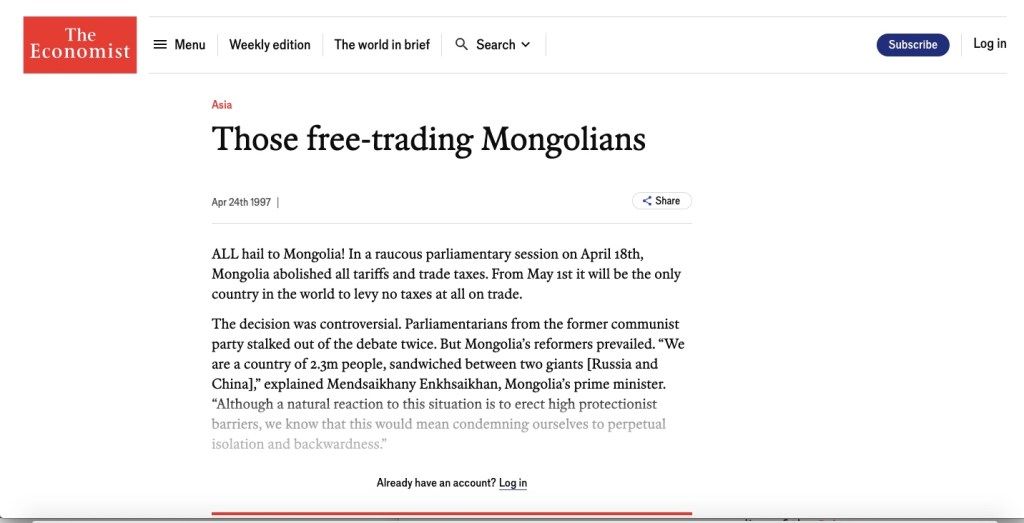
The Economist: “Those free-trading Mongolians” was published Apr 24th 1997. I arrived in May of 1997 to find a country on the cusp of great and turbulent change.

Richard Pomfret said in 1994 “In 1991 Mongolia suffered one of the biggest peacetime economic collapses ever (Mongolia’s Economic Reforms: Background, Content and Prospects, Richard Pomfret, University of Adelaide, 1994).”

From Curbing Corruption in Asia: A Comparative Study of Six Countries by Jon S. T. Quah: “The combined effect of these three shocks was devastating as ‘Mongolia suffered the most serious peacetime economic collapse any nation has faced during this century’. Indeed, Mongolia’s economic collapse ‘was possibly the greatest of all the (peaceful) formerly'” Communist countries. 

“The years 1998 and 1999 have been volatile ones for Mongolia, with revolving door governments, the assassination of a minister, emerging corruption, a banking scandal, in-fighting within the ruling Democratic Coalition, frequent paralysis within the Parliament, and disputes over the Constitution. Economically, the period was unstable and rife with controversies.” Mongolia in 1998 and 1999: Past, Present, and Future at the New Millennium by Sheldon R. Severinghaus, Asian Survey, Vol. 40, No. 1, A Survey of Asia in 1999 (Jan. – Feb., 2000), pp. 130-139 (Publisher: University of California)

Writing in 2018, author John West  found, in a chapter titled Mongolia’s Corruption Curse (Transparency International and the World Bank had found corruption worsened in Mongolia after 2001), “In many ways, Mongolia has everything going for it. After being a satellite state of the former Soviet Union for much of the twentieth century, Mongolia regained its independence with the end of the Cold War. A relatively peaceful political revolution in the early 1990s ushered in a multi-party democracy and open society which have remained in place. … And it is blessed with vast reserves of copper, gold, coal, molybdenum, fluorspar, uranium, tin and tungsten deposits. True, Mongolia experienced great upheavals as the breakup of the Soviet Union saw its trade decline by 80%. But Mongolia was also perfectly placed to benefit from the commodity super cycle driven by China, which is now the destination for the vast majority of its exports.

“However, despite much hype about the Mongolian “wolf economy”, this country of so much promise is being dragged down by massive corruption. …

“Mongolia’s corruption is greatly weakening its attractiveness as an investment destination, is fracturing society and weakening its fragile political institutions. Its culture of corruption has also fed its love-hate relationship with foreign investors, which has destabilized the economy.” Asian Century … on a Knife-edge: A 360 Degree Analysis of Asia’s Recent Economic Development by John West, Springer, 24 January 2018.  

In this role, I pioneered innovative use of the Internet and digital resources to communicate the UN’s work and Mongolia’s unfolding crises. The UN called this work a “role model” for the wider UN and country offices. A survey of United Nations country office websites in 2000 ranked the UN Mongolia website I launched in 1997 and oversaw for two years (1997-1999), third best in the world, saying: “A UN System site. A very nice, complete, professional site. Lots of information, easily accessible and well laid out. The information is comprehensive and up-to-date. This is a model of what a UNDP CO web site should be.” (https://www.scribd.com/document/35249986/United-Nations-2000-Survey-of-Country-Office-Websites)

As part of a strategic plan to raise awareness of Mongolia’s development challenges and to spur action on meeting them, a Communications Office was established for the UN mission in 1997. Acting as a strategic hub, the Communications Office and its dynamic and talented team, were able to leverage the existing budget to spur action on many fronts, including: 

Media

Working with journalists and media both within Mongolia and outside – including organising frequent cross-country media tours – the Communications Office was able to significantly raise awareness of Mongolia and its development challenges. This was reflected in a substantial increase in media coverage of the country and in the numerous books and other publications that emerged post-1997. The book In Their Own Words: Selected Writings by Journalists on Mongolia, 1997-1999 (ISBN 99929-5-043-9) archived the stories by theme.  

Top journalists covering Asia in the late 1990s contributed to the book.
The BBC’s Charu Shahane joined other journalists on a UNDP Mongolia media tour in 1998.

Ger Magazine

Ger Magazine (the Mongolian word for home and traditional tent dwelling) was published as the country’s first e-magazine in 1998. There were four issues in total from 1998 to 2000. The launch issue was on the theme of youth in the transition. Mongolia was transitioning from Communism to free markets and democracy and this had been both an exhilarating time and a wrenching time for young people. The magazine drew on talented journalists from Mongolia and the handful of international journalists based there to create a mix of content, from stories about life adapting to free markets to stories on various aspects of Mongolian culture and life. 

The second issue of the magazine proved particularly effective, with its modern life theme and cover story on a thriving Mongolian fashion scene.

Archived issues of the magazine can be found at the Wayback Machine here: https://archive.org/. Just type in the UN Mongolia website address for the years 1997 to 1999: http://www.un-mongolia.mn.


Blue Sky Bulletin

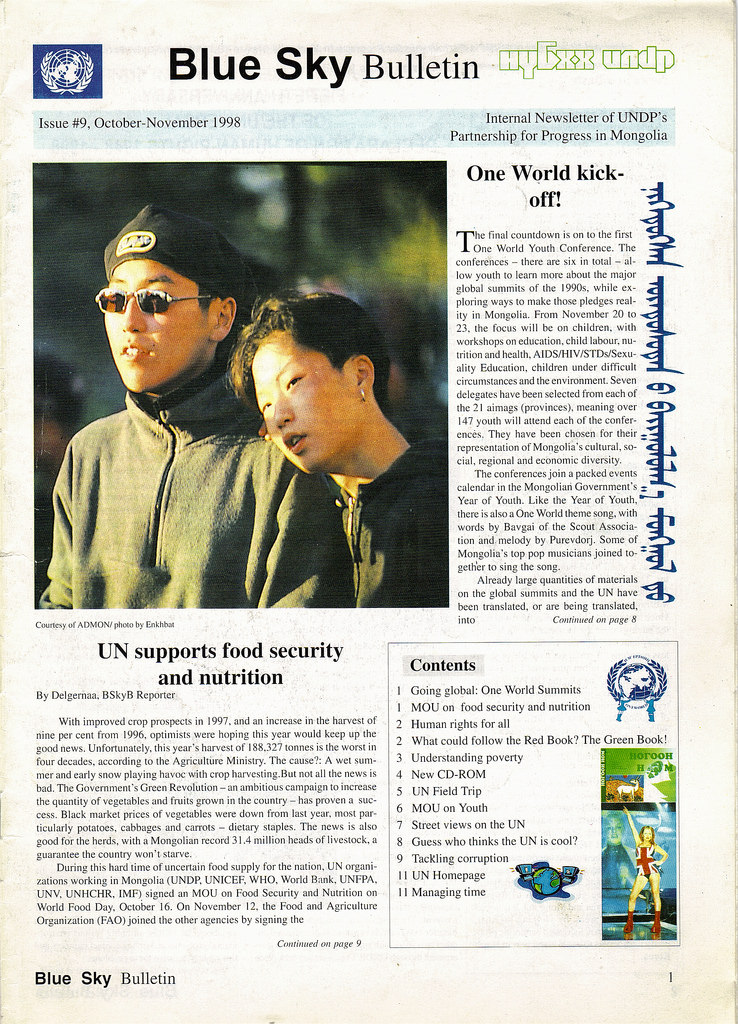
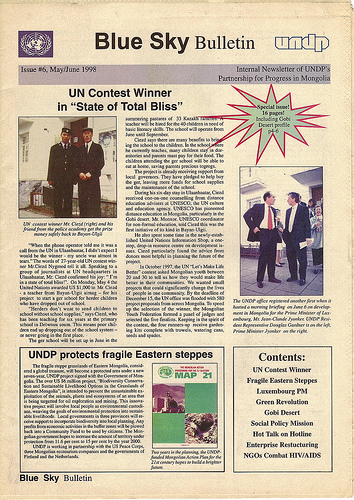
The Blue Sky Bulletin newsletter was launched in 1997 initially as a simple, photocopied handout. It quickly founds its purpose and its audience, becoming a key way to communicate what was happening in the country and a crucial resource for the global development community, scholars, the media and anyone trying to figure out what was happening in a crazy and chaotic time. Blue Sky Bulletin was distributed via email and by post and proved to be a popular and oft-cited resource on the country. The quality of its production also paralleled Mongolia’s growing capacity to publish to international standards, as desktop publishing software became available and printers switched to modern print technologies. Blue Sky Bulletin evolved from a rough, newsprint black and white publication to becoming a glossy, full-colour, bilingual newsletter distributed around Mongolia and the world.

Archived issues can be found online here:

Blue Sky Bulletin Issue 1

Blue Sky Bulletin Issue 2

Blue Sky Bulletin Issue 3

Blue Sky Bulletin Issue 4

Blue Sky Bulletin Issue 5

Blue Sky Bulletin Issue 6 

Blue Sky Bulletin Issue 7 

Blue Sky Bulletin Issue 8

Blue Sky Bulletin Issue 9

Blue Sky Bulletin Issue 10


Publishing

MHDR 1997

The Mongolian Human Development Report 1997 (MHDR), the country’s first, placed the story of the Mongolian people during the transition years (post-1989) at its heart, using photographs, stories and case studies to detail the bigger narrative at play.

This groundbreaking Mongolian Human Development Report went beyond just chronicling Mongolia’s state of development in statistics and graphs. Designed, laid out and published in Mongolia, the report broke with the practices of many other international organisations, who would publish outside of Mongolia – denying local companies much-needed work and the opportunity to develop their skills. The report’s costs helped to kick-start a publishing boom in the country and significantly raised standards in design and layout in the country. The foundations laid down by the project producing the report ushered in a new age in publishing for Mongolia.

The report’s launch was innovative, not only being distributed for free across the country, but also part of a multimedia campaign including television programming, public posters, town hall meetings and a ‘roadshow’ featuring the report’s researchers and writers.

The initial print run of 10,000 copies was doubled as demand for the report increased. To the surprise of many, once hearing about the free report, herders would travel to the capital, Ulaanbaatar, to pick up their copy. The report proved people cared passionately about the development of their country and that development concepts are not to be the secret domain of ‘development practitioners’. The report also became an English language learning tool as readers compared the Mongolian and English-language versions. 

You can read the report’s pdf here: http://www.mn.undp.org/content/mongolia/en/home/library/National-Human-Development-Reports/Mongolia-Human-Development-Report-1997.html

Mongolian AIDS Bulletin

Assembled by a team of health experts after the Fourth International Congress on AIDS in Asia and the Pacific, the Mongolian AIDS Bulletin was published in 1997 in the middle of an HIV/AIDS crisis. It provided timely information and health resources in the Mongolian language and was distributed across the country.
 
“Mongolia’s first AIDS Bulletin marked the beginning of the UNDP Response to HIV/AIDS/STDs Project back in the autumn of 1997. Over 5,000 copies of the magazine were distributed across the country, offering accurate information on the HIV/AIDS situation. The project has been pivotal in the formulation of a national information, education and communication (IEC) strategy, bringing together NGOs, donors, UN agencies and the government.”
 
Source: YouandAids: The HIV/AIDS Portal for Asia Pacific 

Green Book

In the Mongolian language, the Mongolian Green Book details effective ways to live in harmony with the environment while achieving development goals. Based on three years’ work in Mongolia – a Northeast Asian nation coping with desertification, mining, and climate change – the book presents tested strategies.  

EPAP Handbook

The Environmental Public Awareness Handbook was published in 1999 and features the case studies and lessons learned by UNDP’s Mongolian Environmental Public Awareness Programme (EPAP). The handbook draws on the close to 100 small environmental projects the Programme oversaw during a two-year period. These projects stretched across Mongolia, and operated in a time of great upheaval and social, economic and environmental distress. The handbook is intended for training purposes and the practice of public participation in environmental protection.

In its 2007 Needs Assessment, the Government of Mongolia found the EPAP projects “had a wide impact on limiting many environmental problems. Successful projects such as the Dutch/UNDP funded Environmental Awareness Project (EPAP), which was actually a multitude of small pilot projects (most costing less than $5,000 each) which taught local populations easily and efficiently different ways of living and working that are low-impact on the environment.”

Mongolia Updates 1997, 1998, 1999

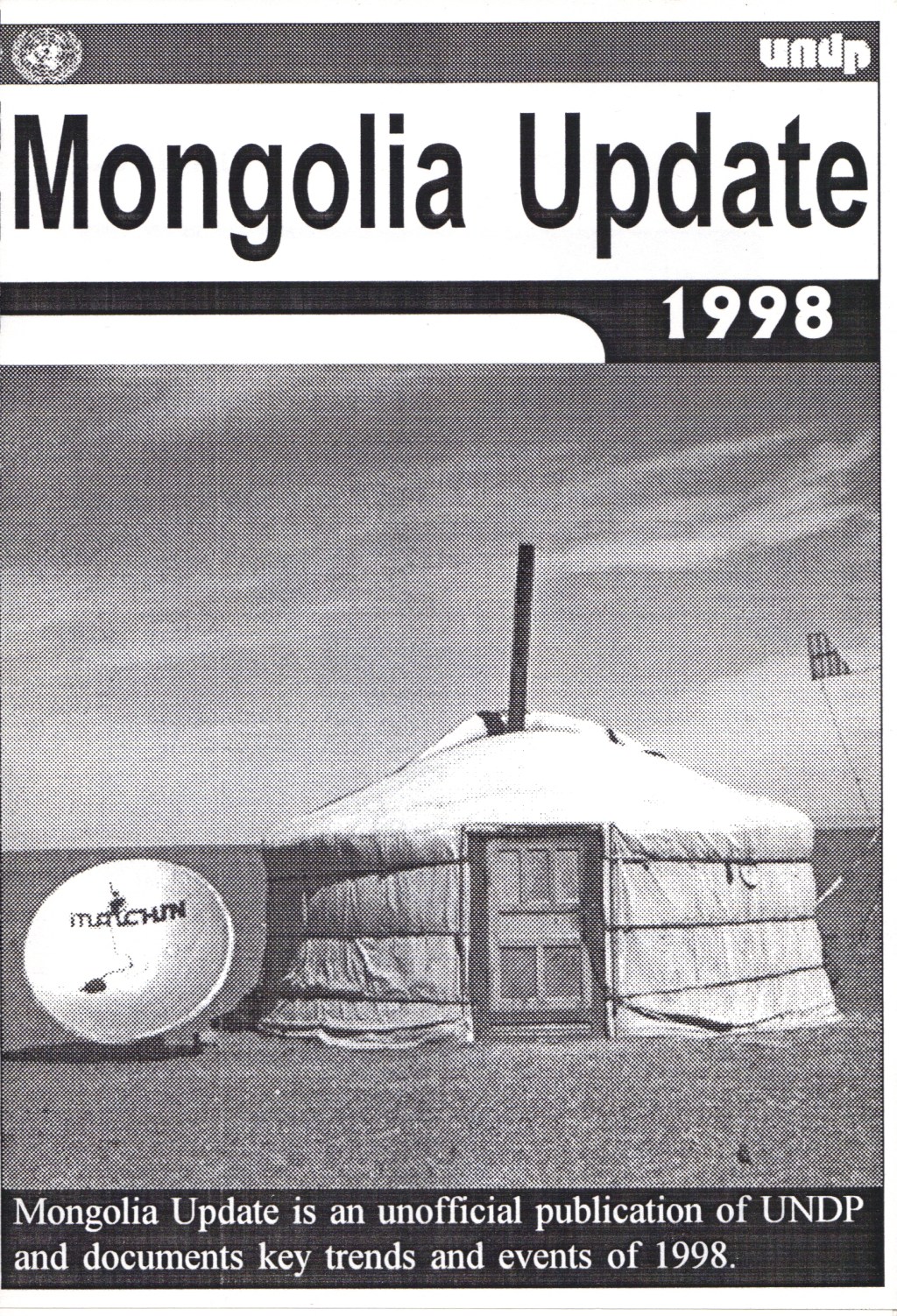
Mongolia Update 1998 detailed how the country was coping with its hyperinflation and the Asian economic crisis.

The mission simultaneously had to deal with the 1997 Asian Crisis (http://en.wikipedia.org/wiki/1997_Asian_Financial_Crisis) and the worst peacetime economic collapse in post-WWII history (http://www.jstor.org/pss/153756).  

Mongolia Update 1998 – Political Changes

1998 proved a tumultuous year for Mongolia. The country’s existing economic crisis caused by the transition from Communism to free markets was made worse by the wider Asian Crisis. The government was destabilised, leading to an often-confusing revolving door of political figures. In order to help readers better understand the political changes in the country, a special edition of Mongolia Update was published that year.  

UNDP Mongolia: The Guide

The Guide, first published in 1997, provided a rolling update on UNDP’s programmes and projects in Mongolia during a turbulent time (1997-1999). The mission simultaneously had to deal with the 1997 Asian Crisis (http://en.wikipedia.org/wiki/1997_Asian_financial_crisis) and the worst peacetime economic collapse in post-WWII history.

Each edition came with short project and context summaries, key staff contacts, and facts and figures on how the country was changing. For the first time, any member of the public could grasp what the UN was up to in the country and be able to contact the project staff. An unusual level of transparency at the time for a UN mission.

Memoranda of Understanding

Three Memoranda of Understanding were negotiated with the Mongolian Government to help focus efforts and aid the attainment of internationally-agreed resolutions. This was affirmed by a series of youth conferences, One World, held in 1998 and 1999.

Strategy and Leadership in a Crisis

The scale and gravity of the crisis that struck Mongolia in the early 1990s was only slowly shaken off by the late 1990s. The economic and social crisis brought on by the collapse of Communism and the ending of subsidies and supports from the Soviet Union, led to a sharp rise in job losses, poverty, hunger, and family and community breakdowns. 

The challenge was to find inspiring ways out of the crisis, while building confidence and hope. The sort of challenges confronted by the UNDP Mongolia Communications Office included: 

1) A food crisis: agricultural production was down sharply, and the traditional nomadic herding economy, while at peak herd, was failing to get the meat to markets and to a high enough standard to restore export levels to where they once were. As a result, a cross-border trading frenzy became the solution to falling domestic food production and availability.

2) HIV/AIDS/STDs crisis

3) A major banking crisis

4) Both the Asian Financial Crisis and the Russia Crisis.

5) An ongoing political crisis and an inability to form stable governments.

“Mongolia is not an easy country to live in and David [South] showed a keen ability to adapt in difficult circumstances. He was sensitive to the local habits and cultures and was highly respected by his Mongolian colleagues. … David’s journalism background served him well in his position as Director of the Communications Unit. … A major accomplishment … was the establishment of the UNDP web site. He had the artistic flare, solid writing talent and organizational skills that made this a success. … we greatly appreciated the talents and contributions of David South to the work of UNDP in Mongolia.” Douglas Gardner, UN Resident Coordinator and UNDP Resident Representative Mongolia

UNDP: Country Cooperation Frameworks and Related Matters – First Country Cooperation Framework for Mongolia (1997-2001).

Citations

The response by the Communications Office has been cited in numerous articles, stories, publications and books. It has also contributed to the development of the human development concept and understanding of human resilience in a crisis and innovation in a crisis. Book citations include: 

Modern Mongolia: From Khans to Commissars to Capitalists

Wild East: Travels in the New Mongolia

A more detailed list of citations can be found here: http://www.davidsouthconsulting.com/about/

For research purposes, key documents were compiled together and published online here: https://books.google.ca/books?id=K76jBgAAQBAJ&dq=undp+mongolia+key+documents&source=gbs_navlinks_s

In 2001, the UN won the Nobel Peace Prize for “their work for a better organized and more peaceful world” and its communications innovations, with work such as that in Mongolia being cited as a contributing factor to the awarding of the Prize

In 2000, the Millennium Development Goals (MDGs) were launched in a 15-year bid to use a focused approach to development centred around eight goals to accelerate improvements to human development. From 2000 to 2005, work was undertaken in various UN missions (Mongolia, South Africa, Turkmenistan, Ukraine) to communicate the goals and to reshape communications activities around the goals.

*Curbing Corruption in Asia: A Comparative Study of Six Countries by Jon S. T. Quah, Eastern Universities Press, 2003 

Transition and Democracy in Mongolia by Richard Pomfret, Europe-Asia Studies, Vol. 52, No. 1 (Jan., 2000), pp. 149-160, published by Taylor & Francis, Ltd. (http://www.jstor.org/stable/153756?seq=1#page_scan_tab_contents

UNDP Mongolia team photo in 1997. I am sitting front row centre left of the UN Resident Coordinator Douglas Gardner.
Creative Commons License

This work is licensed under a
Creative Commons Attribution-Noncommercial-No Derivative Works 3.0 License.

ORCID iD: https://orcid.org/0000-0001-5311-1052.

© David South Consulting 2023

Categories
Archive UNDP Mongolia 1997-1999 United Nations Development Programme

Mongolia Update – Coverage Of 1998 Political Changes | 1999

Editor and Writer: David South

Researcher: G. Enkhtungalug

Publisher: UNDP Mongolia Communications Office

Published: February 1999

Background: Mongolia Update – Coverage of 1998 Political Changes was a one-off special edition of Mongolia Update to help explain a politically turbulent year where three governments and three prime ministers came and went. At the time, Mongolia was in the grips of a severe crisis, called one of “the biggest peacetime economic collapses ever”. By 2012, Mongolia was called the “fastest growing economy in the world”. It is proof the foundations for Mongolia’s recovery from crisis were laid in the late 1990s. The success of the peaceful transition stands in stark contrast to many other international interventions post-2001. 

Mongolia Outlook 2012: World’s Fastest Growing Economy (Publisher: Eurasia Capital), 31 January 2012.

This is an unofficial publication of UNDP. Views presented in this document do not necessarily reflect those of UNDP. Mongolia Update is provided as a service to those who are interested in the rapid changes taking place in today’s Mongolia. A note about Mongolia Update: The Mongolia Update has proven to be one of the more popular documents produced by the UNDP Mongolia office. Since the autumn of 1997 UNDP has been able to offer two more frequently updated sources of information: the UNDP homepage and our monthly newsletter, the Blue Sky Bulletin (available from our office if you are not already receiving it). Please use the United Nations Homepage at http://www.un-mongolia.mn to keep abreast of the latest political, economic and social developments in Mongolia. Mongolia Update is an unofficial document of UNDP and is designed to periodically keep our partners outside of Ulaanbaatar apprised of issues in the country. 

A year of political divisionsWho is who in the cabinet
A government of technocrats

Background — a year of political divisions

Divisions in the ruling Democratic Coalition Government in 1998 led to the fall and rise of three governments and three prime ministers. From the beginning of 1998 cracks within the Coalition intensified. A number of Democrats were dissatisfied with the system whereby the Prime Minister and the Cabinet were not parliamentarians, but “experts” appointed from outside and perceived to be aloof from Parliament. On January 15, 1998, after several weeks of wrangling Parliament ruled that under the Mongolian constitution MPs could serve as Cabinet ministers. It was to prove a fateful decision for the year-and-a-half old M. Enkhsaikhan Government.

A faction within the Coalition Government became more vociferous, with its complaints that the Democrat’s election promises would not be fulfilled without better coordination between the Government and the Parliament. Things came to a head when the General Council of the Mongolian National Democratic Party (MNDP) called for the resignation of its own Government. The move was led by the 35-year-old Speaker of the Parliament and MNDP caucus leader Ts. Elbegdorj – a natural Prime Minister in a Government of MPs. After a joint meeting of the ruling councils of the Mongolian Social Democratic Party (MSDP) and the MNDP, Prime Minister Enkhsaikhan handed in his resignation to Mongolian People’s Revolutionary Party (MPRP) President Bagabandi. The new Prime Minister, Ts. Elbegdorj, was sworn into office on April 23, vowing to chart the same economic course as his predecessor. While trying to form his Cabinet, Elbegdorj quickly ran into trouble.

The opposition MPRP was emboldened, exploiting the fissures in the Democratic Coalition. They started to launch attacks against the new Government. Elbegdorj’s attempts at forming a Cabinet were delayed as one candidate after another was rejected.

The Cabinet was not composed until May 28, when 28-year-old CH. Saikhanbileg became Education Minister – the fifth nominee put forward for the post. The new Government faced an opposition boycott of Parliament by the beginning of June, in the wake of the merging of a state bank with a private bank amidst charges of conflict of interest. On July 25 Ts. Elbegdorj and his entire Cabinet resigned after losing a no-confidence vote in Parliament. The Elbegdorj cabinet continued to work as an acting Government. The murder of prominent democrat and minister of infrastructure S. Zorig shocked the nation October 2. Poised to become a candidate for Prime Minister, Zorig was axed to death in his apartment by two assailants. The crime remains unsolved and grabbed international headlines in what had been seen as the most peaceful country making the transition from communism to democracy. In November the Constitutional Court ruled MPs holding Cabinet posts as unconstitutional. This effectively reversed the aforementioned Parliament decision of January 15, 1998. Throughout the year opinion polls showed a growing weariness and disillusionment creeping into the body politic over the political indecision.

By December a compromise Prime Minister was found, in the form of the mayor of the capital city, Ulaanbaatar. On December 9 Prime Minister Narantsatsralt took office. As 1998 turned into 1999, Narantsatralt was still trying to have his Cabinet approved by both the Parliament and the President.

External economic turmoil started to have its affect on Mongolia in 1998. Many thought the country could ride out the Asian crisis unscathed, but Prime Minister Ts. Elbegdorj admitted in June it was unavoidable. Copper prices, Mongolia’s largest foreign currency earner continued to plummet to record lows. Prices for cashmere and gold, major exports for Mongolia, also declined. The picture for the domestic economy had some bright spots in 1998, with inflation under control and an expansion in the informal service sectors. The Government’s Green Revolution campaign was able to significantly boost the production of vegetables by encouraging home gardening. The economy was still supported by foreign aid, which totaled US $205 million in commitments for the year.

Instability in Russia has also had an impact on Mongolia. For example, in May Russian coal miners blocked the Trans-Siberian train that passes through the capital Ulaanbaatar on its way to China. In August a severe benzene shortage prompted the reintroduction of rationing. At its worst all gas supplies for the country were pulled back to the capital, leaving many stranded and unable to drive cars and run gas-powered electricity generators. The delays were due to job actions by Russian workers. Russia accounts for 30 per cent of Mongolia’s imports and 13.5 per cent of its exports. On the plus side, foodstuffs from Russia became cheaper with the decline of the rouble.

Who is who in the Cabinet

Prime Minister R.Amarjargal, 38 year old Moscow educated economist. He graduated from Economic Institute of Moscow as an economist and a teacher in 1982 and  earned a master’s degree at Bradford University in 1994-1995. 

1982-1983, he was an instructor in Mongolian Trade Union, 1983-1990, he worked as a teacher in Military Institute, 1991-1996 has served as Director of the Economics College. He was a popular Foreign Relations Minister before resigning with the entire cabinet on July 24, 1998. A member of MNDP, he speaks fluent Russian and English.

Finance Minister Yansangiin Ochirsukh. Born in Ulaanbaatar, economist Ochirsukh graduated from the Mongolian National University and did postgraduate work at Columbia University in the United States. He worked as a lecturer and researcher at the University before moving to the Mongol Bank, where since 1997 he has been in charge of foreign exchange and reserve policy. A member of the Mongolian Social Democratic Party, he speaks Russian, English and Chinese.

Minister of External Relations Nyamosoriin Tuya, 40, was born in 1958 in Ulaanbaatar. Studied in the Institute of External Relations in Moscow, Russia in international journalism. From 1984 to1985 she studied French culture and civilisation at the Sorbon University and did a Masters degree on the ” Theory of Democracy” at Leeds University, England. Ms.Tuya speaks English and French. Married with two sons and a girl, she worked as editor of the foreign programming service of Mongolian Radio. After 1996, she was working as Head of the Department for Common Policy at the Ministry of External Relations.

Minister of Environment Sonomtserengiin Mendsaikhan, 39, was born in Ulaanbaatar, and completed degrees at the Mongolian State University and the State University of Irkutsk, Russia in mathematics. S.Mendsaikhan speaks German and Russian. Married, he has a daughter. Started his career as a math teacher at an Ulaanbaatar school, he also worked as a lecturer at the Mongolian State University and later become general secretary of the Social-Democratic Party. From 1992 to1993 he worked as a manager in the Unuudur (Today) private newspaper. From1993 to 1997 he worked as a private company director, and in 1997 he was assigned as advisor to the Parliament’s Speaker.

Minister of Defence Sh.Tuvdendorj, 32, graduated from the Army Academy of Mongolia and the Otgontenger Language School. He worked as an army officer, technician and laboratory engineer at the State Telecommunications Utilisation Committee. He started a political career in 1994, working as secretary in charge of local affairs. In 1997, he was elected as general secretary of the Mongolian National Revolutionary party.

Minister of Agriculture Choinzongiin Sodnomtseren, 46, was born in Ulaanbaatar and is married with three children.After attending Mongolian State Agricultural University, he acquired a Ph.D. in Saint Petersburg, Russia. He also has a Ph.D. degree in veterinarian sciences.

While spending many years of his career on research studies, he worked as a lecturer at the State agricultural University. Sodnomtseren became later Principal and Rector of the State Agricultural University.

Minister of Health and Social Welfare Sodoviin Sonin. Born in Ulaanbaatar in 1956, S.Sonin graduated from the Medical University of Irkutsk and Mongolia’s State Administration and Management Development Institute. A doctor and professor of medicine, he has taught surgery at the Mongolian Medical University, worked at the Central Clinical Hospital and served as a department chair at the Ministry of Health and Social Welfare. Since 1991 he has headed the Asian Development Bank-backed Health Sector Development project. Sonin, who speaks Russian and English, does not belong to any political party.

Minister of Infrastructure, Gavaagiin Bathuu, 39, born in Hujirt county of Uvurhangai province. Married with two sons and a daughter, he graduated from the Economics Institute of Harikof, Russia as an auto engineer and economist. He speaks Russian and English. He started his career as a repairman and dispatcher at the state auto-engineering company.From 1986 to 1992, he worked at the Ministry of Infrastructure as an officer and senior officer and from 1992 to 1996 he worked as Director of Shunklai Company. Since1996 he was working as a head of the Department for Road and Transportation at the Ministry of Infrastructure.

Minister of Justice, Logiin Tsog, 47, was born in Ulaanbaatar. He graduated from the State University in Irkutsk, and from the Social Science Academy in Russia. A lawyer with high education in politics, he speaks Russian and English. He worked as the prosecutor for the department at the Ministry of Justice. From 1988 to 1989, he worked as inspector at the Mongolian Revolutionary Party’s Inspection Committee. From 1990 to 1991, he was assigned as the Head of the Standing Committee of the State Baga Hural (parliament of that time) on legal issues. From 1991 to 1996 he was general director of the “Golden Button” Co. Ltd and in 1996 he was elected as general secretary

Minister of Enlightenment A.Battur was born in 1965 in Hovd aimag. Battur is a career diplomat who graduated from Russia’s Institute for International Affairs and completed a postgraduate course at France’s Institute for International Affairs. He worked as an attaché in the Foreign Ministry between 1989 and 1992, and spent 1992 to 1996 as the cultural attaché at the Mongolian Embassy in France-where he also worked with UNESCO- before returning to senior administrative positions at the Ministry in 1996.

A member of the Mongolian National Democratic Party, he speaks English, French and Russian and is married with two children.

A government of technocrats

By January 15, 1999 Mongolia had its first complete Government in six months. All nine members of the Mongolian Cabinet have been approved and appointed. Like Prime Minister Narantsatsralt, they are not Members of Parliament. Since all nine Cabinet Ministers were chosen for their experience, many expect a more stable course to be charted for the remainder of the Democratic Coalition’s term in office (until 2000). However, the new Government might experience the same sort of complaints the Enkhsaikhan Government received, when Parliament accused those ministers of being aloof. It is also unclear if the MPRP will continue to offer a vigorous opposition. For the time being its seems the political forces have exhausted themselves and there is a genuine desire for stability in 1999. The new Government is expected to follow the same reform directions of the two previous Democratic Coalition Governments and details will emerge over the coming weeks.

Further explore this turbulent period in Mongolia’s history here: Wild East 17 Years Later | 2000 – 2017

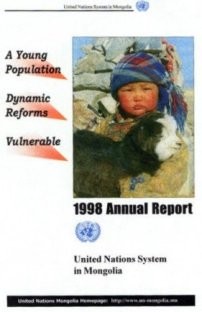
UN Mongolia Annual Report 1998
The UNDP Mongolia Communications Office oversaw a busy online and offline publishing programme from 1997 to 1999.

https://davidsouthconsulting.org/2023/01/09/mongolia-update-1998/

ORCID iD: https://orcid.org/0000-0001-5311-1052.

© David South Consulting 2018