Categories
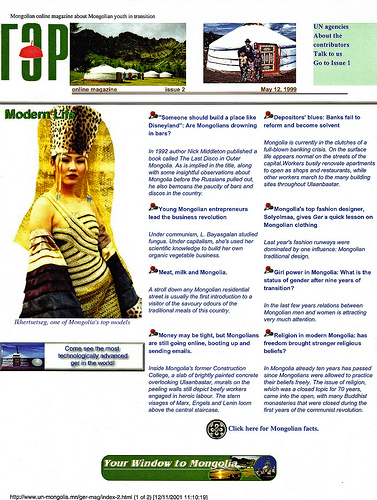
Ger Magazine UNDP Mongolia 1997-1999

Cashmere is king but Mongolia still struggles to reap the benefit

By A. Delgermaa, Ger Magazine, Modern Life, Issue 2, May 12, 1999

A Mongolian cashmere designer once opined that Mongolians are lucky that most goats in the country are capable of producing fine cashmere. And while Chinese cashmere dominates the marketplace, Mongolian cashmere is by far the purest and finest.

About 30 cashmere companies contributes tens of millions of dollars a year to the country’s wealth (though nobody is quite sure how much because most cashmere sales go unreported to the government). But the revenue isn’t what it used to be due to problems in the domestic industry and a drop in the world price. Z. Ayur, chief secretariat of the Gobi company, thinks it doesn’t have to be that way.

“Unfortunately we lose half of our raw cashmere to China,” he says.”

“The Chinese buy cashmere at a high price, not depending on the quality. This means national manufacturers lack raw cashmere to process into garments.”

He thinks raw cashmere exports should be banned or subject to a duty of 100 to 150 per cent. Mongolia’s weak infrastructure plays a part as well. It is cheaper for herders to travel to the Chinese border with cashmere than to bring it to the capital, Ulaanbaatar. Often when they are at the border with China, they are subjected to some hard bargaining by Chinese brokers, who exploit the fact herders can’t afford to walk away empty handed. 

Cashmere has always been considered a luxury and expensive. But in the past two years it has lost its fusty image as only for old people. Trendy designs have attracted a vast market of younger cashmere consumers. “I guess in the past it was dear and expensive and designs weren’t very appealing to the younger set,” thinks Gerelmaa, the chief designer of Gobi company. 

The Gobi company is one of the few state enterprises left over from the socialist period that still makes money (and is due for privatization this year – a prime pick for foreign investors). 

In 1972 the United Nations funded projects to experiment with starting a cashmere garment industry in Mongolia. This innovative thinking led to a joint Japanese-Mongolian venture in 1981 to start the first cashmere manufacturer, Gobi. These days it still produces one third of the country’s cashmere products. 

Mongolian Wool and Cashmere Federation head Tsendmaa is optimistic about the drop in the world market price.” It will soon go back up again,” she says with confidence. “The reserve of cashmere in the world will run out soon. What happened with the drop in prices is typical of any industry when it overproduces.” What worries her most is the flood of Mongolian cashmere going to China, where Chinese workers process and knit the garments and reap the job benefits.

While cashmere is still known for its use in classic turtle, crew and v-neck jumpers, things have changed. “Before we mostly exported classic styles in off-white, brown, grey, black, bark, blue or dark red to Japan or Germany,” continues Tsendmaa. “Now Americans order more fashionable cashmere for the young. The designs of short jumpers that expose bare chests and waists are cheap to produce (less material) and suitable for young fashions.” 

Italian, French or Belgian customers are fussier and demand greater variety in designs. These countries determine the vogue for cashmere wear and use the most high tech knitting technology.

Contemporary cashmere fashion in France or Italy can combine fur or silk. Colours have also been revamped, with the young going for light blue, light pink, snow white, off-white and light green. Italians and Americans like metal grey with rose or pink. Mixing up the colours in sporty stripes and lines is also popular.

Cashmere is very practical, warm and light. “It is not suitable for the office,” says Gerelmaa.” Cashmere wear is more suitable to wear for a night out or just for hanging out. But of course it is not for sport!” 

Fashionable Mongolian cashmere is becoming a strong competitor to Chinese, Italian, Scottish or American cashmere. “The raw material is pure and the design is more fashionable.”

And a happy Gerelmaa likes the sound the cash register makes in Japan: “In Japan classic Mongolian style is sold for more than US $1,200 in the Takashimaya Store, in GINZA.”

Now if more of that kind of hard cash found its way back to Mongolia, the country would definitely be better off. 

Creative Commons License

This work is licensed under a
Creative Commons Attribution-Noncommercial-No Derivative Works 3.0 License.

ORCID iD: https://orcid.org/0000-0001-5311-1052.

© David South Consulting 2024

Categories
Archive Development Challenges, South-South Solutions Newsletters

Ghana Wants to Tap Global Trendy Party Scene

By David SouthDevelopment Challenges, South-South Solutions

SOUTH-SOUTH CASE STUDY

Tourism is big business – and one of the most resilient parts of the global economy. Despite the international economic crisis that has wreaked havoc and increased unemployment and poverty in many countries since 2007, tourism is still going strong.

The UN’s World Tourism Organization (UNWTO) (http://www2.unwto.org/) found international tourist arrivals grew by 5 per cent during the first half of 2013 from the same period in 2012, reaching 500 million arrivals.

“The fact that international tourism grew above expectations confirms that traveling is now part of consumer patterns for an increasing number of people in both emerging and advanced economies,” said UNWTO Secretary-General Taleb Rifai. “This underlines the need to rightly place tourism as one of the key pillars of socio-economic development, being a leading contributor to economic growth, exports and jobs.”

One successful way to lure tourists, especially young tourists, is to nurture hubs of culture, outdoor activities, music and fashion around a holiday destination – generally one involving sun and sand. Such “party scenes” can be found in hotspots as far afield as Florida, the Spanish island of Ibiza and Koh Samui (http://www.kohsamui.com/) in Thailand. While at times annoying to local people, these groups of young tourists do bring significant wealth to smaller towns and seaside communities.

And now there are some in Africa who want to replicate this successful business formula in beach communities.

The Ghanaian fishing village of Kokrobrite (http://en.wikipedia.org/wiki/Kokrobite), located west of the capital, Accra, has become a nascent hub for a dance music scene and beach parties.

“We are organizing an all-day-long beach party with DJs, food and partying, inspired by the kind of summer jams that are held in Miami,” Basil Anthony, Chief Executive of Silky Entertainment (http://www.silkyentertainment.com/), told The Guardian newspaper. Silky Entertainment is organizer of Ghana Summer Beach Rave 2013.

“We are expecting partygoers in the thousands, and double the number we had last year. It’s going to be big.”

Other popular events include Tidal Rave (http://www.youtube.com/watch?v=8f5Wy3g9Y7w), aimed at university students, and an upmarket champagne party at Bella Roma beach which attracts expats and wealthy Ghanaians.

While these events have been very popular locally, ambitious entertainment entrepreneurs want to take the parties to the next level and make them truly global events, attracting tourists from around the world.

“The next Ibiza will be in Africa. It has already started,” said Andrew Tumi, also known as Won, a singer from the group Supafly.

“We are trying to recreate the good things about going to Ibiza, the music and the vibes. But more and more we are creating our own sound here, an Afro-house, reggae, African mashup… It’s really blending the African rhythm into a house scene.”

Dance music is hot right now, and is being refreshed with new trends in Afro-house and Afro-pop from across the continent. This in turn is creating a demand for parties to celebrate and enjoy the music.

The economic impact is considerable as the parties inspire other businesses to feed off the good vibrations. DJ MoBlack, who works in a nightclub in Accra, told The Guardian, “It’s not just the music, it’s a whole scene that’s on the rise – goods, fashion, jewelry – there is a style revolution happening around it. It’s a unique African vibe, but something that people everywhere can relate to.”

The impact on the tourism sector is already quantifiable. Tourist visits to Ghana grew from 400,000 a year in 2005 to 1 million in 2011.

Ben Ohene-Aryeh at the Ghana Tourism Authority (http://www.ghana.travel/) is optimistic bigger things are to come: “[The scene] is catching on well with the youth and now we hope that it will be done on a massive scale,” he said.

There is, however, a downside to this strategy: drug use is on the increase. According to the West Africa Commission on Drugs (wacommissionondrugs.org), marijuana use is on the rise as well as harder drugs such as cocaine.

It’s clear there are pitfalls to the youth-tourism strategy, but these can be managed with the right strategy – and the economic opportunities for small communities are substantial.

Published: November 2013

Resources

1) Information on drug tourism from DARA Thailand: DARA is Asia’s first and leading international destination for drug and alcohol rehabilitation. Website: http://alcoholrehab.com/alcohol-rehab/drug-tourism/

2) 3rd UNWTO International Conference on Tourism and the Media: How new media is shaping the news: With the rise of the new media, both the media landscape and the way stories are being told are changing. Millions of consumers now have the possibility to directly engage in the editorial process due to faster than ever evolving technology. More recently, mobile technology and a myriad of applications for smart phone devices are increasingly influencing communication flows. Website: http://www2.unwto.org/en/event/3rd-unwto-international-conference-tourism-and-media-how-new-media-shaping-news

3) The UNWTO World Tourism Barometer: A regular publication of the Tourism Trends and Marketing Strategies Programme of UNWTO aimed at monitoring the short-term evolution of tourism and providing the sector with relevant and timely information. Website: http://mkt.unwto.org/en/barometer

Tourism Investment and Business Forum for Africa: INVESTOUR is an annual tourism business and knowledge exchange platform in which representatives of African tourism and potential Spanish and Portuguese investors/partners meet to discuss about business and cooperation opportunities. Website: http://africa.unwto.org/en/event/v-tourism-investment-and-business-forum-africa-investour-edition-2014-madrid-spain

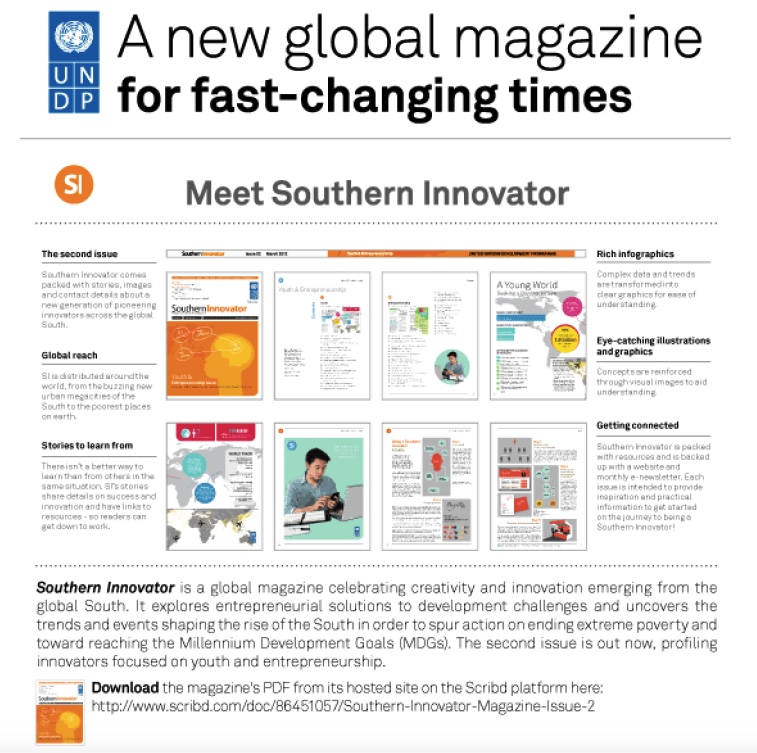
Development Challenges, South-South Solutions was launched as an e-newsletter in 2006 by UNDP’s South-South Cooperation Unit (now the United Nations Office for South-South Cooperation) based in New York, USA. It led on profiling the rise of the global South as an economic powerhouse and was one of the first regular publications to champion the global South’s innovators, entrepreneurs, and pioneers. It tracked the key trends that are now so profoundly reshaping how development is seen and done. This includes the rapid take-up of mobile phones and information technology in the global South (as profiled in the first issue of magazine Southern Innovator), the move to becoming a majority urban world, a growing global innovator culture, and the plethora of solutions being developed in the global South to tackle its problems and improve living conditions and boost human development. The success of the e-newsletter led to the launch of the magazine Southern Innovator. 

Creative Commons License

This work is licensed under a
Creative Commons Attribution-Noncommercial-No Derivative Works 3.0 License.

ORCID iD: https://orcid.org/0000-0001-5311-1052.

© David South Consulting 2023