Tag: trends

  • Indian Newspapers Thrive with Economy

    Indian Newspapers Thrive with Economy

    By David SouthDevelopment Challenges, South-South Solutions

    SOUTH-SOUTH CASE STUDY

    The onslaught of digital media in the developed countries of the world regularly brings pronouncements of the death of the traditional newspaper. But this assumption of digital triumph misses out on the reality in countries across the global South.

    As incomes rise and literacy levels go up, so does the desire to consume news and information. And while many are jumping straight to online and mobile phone sources, just as many are enjoying more traditional print media offerings like magazines and newspapers.

    India boasts both a fast-growing economy and the largest number of paid-for newspapers in the world. The print media industry in India has seen phenomenal growth since 2005, with the number newspaper titles increasing by 40 percent to 2,700 (World Association of Newspapers). The two factors driving this growth in newspapers are rising literacy and a booming economy

    The World Association of Newspapers found China leads the world for newspaper subscribers, with 93.5 million readers a day. India is second. It is estimated the Indian newspaper industry will generate US $3.8 billion in revenues in 2010, a 13 percent growth rate over the last five years.

    Estimates place growth in the newspaper industry in the next four years at 9 percent a year, to US $5.9 billion (KPMG).

    Part of the reason India is defying the decline in newspaper numbers and readership seen in developed countries is poor internet penetration across the country. Because of this, only 7 percent of the population uses the web for information. And the country’s high number of illiterates (just 65 percent of the population can read) means even if many could afford a newspaper, they couldn’t use it.

    According to Amar Ambani, head of research at India Infoline Group, “Unlike the West where the internet publishing and advertising has significantly hit the print media, the Internet threat to print media is still in its nascent stage in India, given the low penetration of computers and adequate bandwidth across the country.”

    Newspapers are also growing in a highly competitive market exploding with new television channels on cable and satellite and other media distractions like mobile phone applications.

    The newspapers (http://www.world-newspapers.com/india.html) are a strong reflection of how much the economy has changed in the past decade. They contain advertisements for property, mobile phones, cars and dating services.

    Cost is also a critical element in their success: at only four rupees each (US $0.09 cents), many Indians buy several newspapers at a time for their home. The publications are able to charge so little because of the health of the advertising revenue coming in. Newspaper advertising in India increased by 30 percent between January and Match 2010 alone, the quickest jump in ads for the Asia-Pacific region (Nielsen India).

    There is a hierarchy in the newspaper industry: English-language newspapers attract wealthier readers and can charge the most for advertising. But rising literacy rates combined with increasing personal wealth is fuelling growth in regional papers written in local languages. India has 22 official languages and English as an associate language. The country as a whole has about 33 different languages and over 2,000 local dialects. Hindi newspaper circulation rose from 8 million in the early 1990s to over 25 million in 2009.

    The Times of India (http://timesofindia.indiatimes.com) is now the world’s largest circulation English-language newspaper, with 4 million readers. It uses this success to charge 10 times what regional papers can for advertising. At present, the regional newspapers’ bread-and-butter is mostly government-paid advertising.

    But if trends continue as they are, then the tables will turn on big beasts like the Times of India. Regional papers will grow as people look for an opportunity to read in their own local language.

    Flush with cash and confidence, Indian newspapers are also innovating new ways to advertise untried in other countries. Talking ads attached to the actual newspaper’s back pages caused a great stir when they were trialled in India recently (http://www.guardian.co.uk/media/greenslade/2010/sep/28/newspapers-advertising). The talking ads for a car company delivered a sales pitch but also alarmed and annoyed many people because the talking ad wouldn’t stop talking.

    Ambani puts the success of the Indian newspaper industry down to five factors: the economic boom in semi-urban and rural India; growing local content; more opportunity to grow the number of readers; rising advertising spending; and rising literacy as a result of rising secondary school enrolment. He believes students aged between 10 and 15 are getting the newspaper habit and they represent huge future growth in newspaper readers.

    Published: October 2010

    Resources

    https://davidsouthconsulting.org/2022/11/17/book-boom-rides-growing-economies-and-cities/

    https://davidsouthconsulting.org/2022/09/29/cheap-indian-tablet-seeks-to-bridge-digital-divide/

    https://davidsouthconsulting.org/2022/10/20/the-e-reader-battle-reaches-india/

    https://davidsouthconsulting.org/2022/10/12/free-magazine-boosts-income-for-rickshaw-drivers/

    https://davidsouthconsulting.org/2022/05/26/kenyan-book-company-brings-online-sales-to-east-africa/

    https://davidsouthconsulting.org/2022/10/12/rickshaw-drivers-prosper-with-new-services/

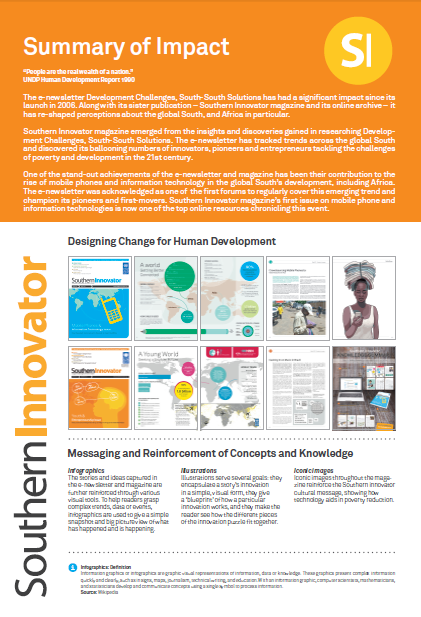
    Development Challenges, South-South Solutions was launched as an e-newsletter in 2006 by UNDP’s South-South Cooperation Unit (now the United Nations Office for South-South Cooperation) based in New York, USA. It led on profiling the rise of the global South as an economic powerhouse and was one of the first regular publications to champion the global South’s innovators, entrepreneurs, and pioneers. It tracked the key trends that are now so profoundly reshaping how development is seen and done. This includes the rapid take-up of mobile phones and information technology in the global South (as profiled in the first issue of magazine Southern Innovator), the move to becoming a majority urban world, a growing global innovator culture, and the plethora of solutions being developed in the global South to tackle its problems and improve living conditions and boost human development. The success of the e-newsletter led to the launch of the magazine Southern Innovator. 

    https://davidsouthconsulting.org/2021/03/05/southern-innovator-issue-1/

    Creative Commons License

    This work is licensed under a
    Creative Commons Attribution-Noncommercial-No Derivative Works 3.0 License.

    ORCID iD: https://orcid.org/0000-0001-5311-1052.

    © David South Consulting 2024

  • Many Positive Trends for Africa in 2010

    Many Positive Trends for Africa in 2010

    By David SouthDevelopment Challenges, South-South Solutions

    SOUTH-SOUTH CASE STUDY

    While 2009 saw the global economic crisis spread around the world, the story is more complex and more hopeful than many believe. For Africa, various trends are pointing to positive economic development in 2010, despite the continent’s numerous political, social and environmental challenges. Pragmatism is driving stronger economic ties between Africa and the rest of the world, while long-running trends are delivering opportunity to millions despite setbacks.

    The Standard Chartered bank (http://research.standardchartered.com/Pages/home.aspx) believes sub-Saharan Africa will jolt itself out from the 1 percent growth it had in 2009, to reach 4.7 percent growth in 2010 and 5.7 percent in 2011 (http://research.standardchartered.com/researchdocuments/Pages/ResearchArticle.aspx?&R=66952). The reason? The world’s strong appetite for commodities and food, which will continue to draw in business. And much of this business will be done by that powerhouse of the global South, China.

    The fact that China is trading better infrastructure – roads, rail and ports – for commodities means other businesses can also benefit from the improving environment. Throughout the downturn in 2009, China actually increased its investments in Africa.

    The United States is also trying to increase its economic relationship with Africa. It wants a third of its oil imports to come from West Africa by 2015.

    And the competition for food in the world, as countries address the global food crisis, has seen companies from the Middle East to Asia to Britain purchasing land in Africa to grow more food.

    The Annansi Chronicles blog on African business and culture trends (www.annansi.com) has come up with a list of the big trends to watch out for on the continent in 2010. They build upon many of the patterns that have emerged in the past few years in Africa.

    The blog predicts that Africa will increasingly be an innovation incubator. Concepts like the bottom of the pyramid – where the poor are seen as an unserved marketplace of needs – will draw more private companies in to innovate new products and services. Already, products and services trialled in Africa are then launched in other places in the world. One example has been mobile phone banking. The blog sees the challenge for Africa as finding ways to increase innovation and harness its economic benefits within the continent, and to direct resources to the African pioneers out there who need money and infrastructure support to grow their ideas.

    Mobile phones will continue to be the source of opportunity in Africa in 2010. Get ready for more businesses to take advantage of the move from analog to digital in Africa, as fibre optic cables continue to expand. Just as the introduction of broadband internet in developed countries gave birth to new businesses like You Tube (www.youtube.com), so it will create new opportunities in Africa. The key to growing the prosperity from this is to see governments and the private sector better connect with African technology pioneers, as can be found in hot spot countries like Ghana.

    Along with technology comes content. And the people to make the content interesting and attractive will be Africa’s so-called ‘creative class’: savvy young African entrepreneurs and thinkers. They have drawn on the rising urbanization of the continent and greater international travel to explore new ways of representing African culture. This has come forward in the explosion in media, fashion, music and design. The blog believes the 2010 FIFA World Cup in South Africa (http://www.fifa.com/worldcup) is going to thrust the world’s attention on to Africa’s creative class: a global media burst that will be an opportunity not to be missed.

    And this will also challenge global perceptions of “brand Africa.” Already, the world’s tourists flow to Africa in greater numbers, defying decades of negative media publicity. Brand Africa will be up for grabs in 2010.

    And finally, while China has been the big story in terms of economic investment in Africa, India will start to make more moves to catch up by flexing its information technology muscles. Look for more joint partnerships between African countries and Indian technology companies.

    In short, Africa has as many positive trends for 2010 as negative ones. It is just a matter of focusing on the good so the negative will not have a fighting chance in 2010.

    Published: January 2010

    Resources

    1) Design Indaba: See the latest on the catwalks in all-day fashion shows; attend short films, talks and product launches; be enticed to buy from more than 260 exhibitors and hobnob with the designers in person. Above all, be awed by the creative spirit of innovative South Africans. Website: http://www.mobileactive.org

    2) Maker Faire Africa: African pioneers in grassroots innovation offer inspiring inventions. Website: http://makerfaireafrica.com/

    3) Arise Africa Fashion Week: The place to be seen and to see. Website: http://www.africanfashioninternational.com/africaFashionWeek/

    https://davidsouthconsulting.org/2020/12/15/development-challenges-south-south-solutions-newsletter-2007-2010-2/

    https://davidsouthconsulting.org/2022/11/29/new-magazine-13-october-2010/

    https://davidsouthconsulting.org/2022/11/28/new-website-on-the-way-16-september-2010/

    https://davidsouthconsulting.org/2022/12/01/off-to-the-printers-with-a-new-name-southern-innovator-14-may-2010/

    https://davidsouthconsulting.org/2022/11/01/southern-innovator-magazine-2010-2014/

    https://davidsouthconsulting.org/2021/02/22/team-southern-innovator-phase-1-development-2010-2015/

    https://davidsouthconsulting.org/2021/10/28/2010-development-challenges-south-south-solutions/

    https://davidsouthconsulting.org/2022/10/25/2011-trends-for-the-south/

    Development Challenges, South-South Solutions was launched as an e-newsletter in 2006 by UNDP’s South-South Cooperation Unit (now the United Nations Office for South-South Cooperation) based in New York, USA. It led on profiling the rise of the global South as an economic powerhouse and was one of the first regular publications to champion the global South’s innovators, entrepreneurs, and pioneers. It tracked the key trends that are now so profoundly reshaping how development is seen and done. This includes the rapid take-up of mobile phones and information technology in the global South (as profiled in the first issue of magazine Southern Innovator), the move to becoming a majority urban world, a growing global innovator culture, and the plethora of solutions being developed in the global South to tackle its problems and improve living conditions and boost human development. The success of the e-newsletter led to the launch of the magazine Southern Innovator. 

    Creative Commons License

    This work is licensed under a
    Creative Commons Attribution-Noncommercial-No Derivative Works 3.0 License.

    ORCID iD: https://orcid.org/0000-0001-5311-1052.

    © David South Consulting 2023

  • African Fashion’s Growing Global Marketplace Profile

    African Fashion’s Growing Global Marketplace Profile

    By David SouthDevelopment Challenges, South-South Solutions

    SOUTH-SOUTH CASE STUDY

    Tales of African global fashion successes have multiplied in the last few years. African fashion is seeing its profile rise as more and more shows and festivals boost awareness of the continent’s designs, designers and models. In turn, African fashion and design is being taken more seriously as an income and job generator, and as a sector able to weather the ups and downs of the global economy: people always need to wear clothes.

    If the global fashion industry were a country, it would rank 7th in global GDP (gross domestic product) (Fashion Performance Network).

    In 2011, the apparel retail industry was worth an estimated US $1.1 trillion, and that could grow to US $1.3 trillion by 2016. And the sector is expanding in the global South. It is forecast that India and China combined will be as big a fashion market as the United States by 2015.

    One visible aspect of this is the plethora of African fashion weeks that have sprung up.

    Launched in 2011, African Fashion Week in London (africafashionweeklondon.com), or AFWL, is a reflection of how far things have come and how much higher the profile of African fashion now is.

    The mission behind AFWL is “to promote emerging and established African designers and African-inspired designers from across the globe.” The number of attendees grew from 4,700 in the first year to 20,000 in 2012.

    In 2012 it partnered with Côte d’Ivoire Fashion Week (https://www.facebook.com/pages/Cote-dIvoire-Fashion-Week/364950310210789), which will hold its third annual event in December 2013. This partnership has meant fashion designers from Côte d’Ivoire can benefit from the higher international profile of appearing at African Fashion Week in London. The theme in 2012 was “Ivorian Textile Products on the American Market.”

    “London is one of the most important fashion capitals around the world,” said Côte d’Ivoire Fashion Week’s founder and CEO, Coulibaly Severin on the AFWL website. “It is a great honour for us and the African continent to have a professional international platform to promote African Fashion industry actors, African heritage, African values, African textiles through Africa Fashion Week London.”

    The idea is to use the fashion week as a bridge to access the European market.

    With the right support, African fashion businesses have huge potential for growth.

    A distinctive “Afropolitan” aesthetic (http://afropolitanaesthetic.tumblr.com/) has grown as a phenomenon since 2005, influencing global urban design trends. It can be characterized as urban, sophisticated, tailored and boldly African in its use of colours and patterns. British designer Paul Smith (http://www.paulsmith.co.uk/uk-en/shop/) has been one of many designers to be inspired by the afropolitan look.

    While African fashion trends have always influenced the global fashion business, the challenge has been to create viable global African fashion brands that can compete in the global marketplace and in turn create sustainable jobs in Africa.

    Pioneers are showing that it can be done.

    Featured at Africa Fashion Week in London in 2011, the Nigerian fashion brand Mmabon (mmabon.com) is now looking to pioneer new ways to buy and sell clothing in Africa. The company, which sells affordable casual and custom apparel, is launching a mobile phone app for all devices and is building its own Internet e-commerce website as well. Mmabon had been engaging with customers through Facebook and the BlackBerry smartphone, but realized it could offer a much better experience for customers through an app and an e-commerce website. This shows the future for fashion in Africa is going mobile and going online.

    Founded by Elizabeth Idem-Ido, Mmabon is capitalizing on the fact Internet access is improving in Nigeria and is turning to online advertising to drum up customers. The fashion brand is trying to reach 16 to 34 year olds, of which 8 million are believed to be currently on Facebook in Nigeria, according to Idem-Ido.

    There is a cultural change underway in the country: people are increasingly feeling comfortable doing commerce online and on mobile phones.

    “Nigerian youths are now more willing to buy products over the Internet, unlike five years ago, with the likes of konga.com and jumia.com revolutionizing the online retail scene in Nigeria,” Idem-Ido, who is also a trained lawyer, told VC4Africa (https://vc4africa.biz/).

    Konga (Konga.com) is Nigeria’s largest online mall. Opened in 2012, it offers a wide range of products for order across Nigeria. Jumia.com calls itself the “the biggest online shopping mall in Africa”, operating in Morocco, Egypt, Ivory Coast, Nigeria and Kenya. Another player is Ecwid (ecwid.com), which bills itself as an e-commerce solution for small businesses that “is a revolutionary shopping cart that seamlessly integrates with your existing website. It can also be added to your page on social media networks, such as Facebook or mySpace”.

    Idem-Ido’s experience with Mmabon over the past two years shows how online marketing can be an effective – and cost-effective – way to broaden a company’s customer base.

    “As a business, we have not physically met with 80 per cent of our current customers,” she said. “Orders have been achieved from referrals, BlackBerry Messenger contacts and our official Facebook page. Online marketing improves our visibility without owning a prime-location store and reminds, assures our already existing customers on why we are their preferred brand.”

    Her fashion business began humbly as a part-time t-shirt printing hobby for her friends. Then people started ordering custom-designed t-shirts, and so she began a journey exploring fabrics in local and foreign markets.

    Mmabon is now the official merchandiser for the Calabar Festival 2013-2015 (calabarfestival.com), the biggest street carnival in West Africa. Taking place in Calabar, Cross River State, Nigeria, it attracts a million people.

    Mmabon is receiving help from Venture Capital for Africa, or VC4Africa (https://vc4africa.biz/), a community of entrepreneurs and investors helping to build companies in Africa, to raise further investment to grow the brand and the business.

    Another success benefiting from international exposure is Malian designer Boubacar Doumbia (http://www.ndomo.net/english/index.html), who is currently making fabrics for design-savvy British furniture and home furnishings store Habitat. The prints with African themes have proven a hit with Habitat customers.

    Working from a new studio in Burkina Faso’s capital, Ouagadougou, Doumbia (https://www.ashoka.org/fellow/boubacar-doumbia) is a leading advocate of bogolan (http://www.malimali.org/what-is-bogolan/), a Malian traditional textile dyeing process using mud.

    He uses locally grown cotton, which is first dyed using plant-based dyes. A chemical reaction occurs when the iron in the mud is applied to the fabric and turns the existing plant dye black after three applications, or grey after two applications. The mud is washed off and the fabrics are placed in the sun to dry. It is a sustainable and chemical-free approach to dyeing fabrics and also creates vibrant patterns that have caught the attention of people in Europe and elsewhere.

    Other outlets who have become enamored with African patterns and themes in Britain include Darkroom Boutique, House of Fraser and the V&A Museum, The Guardian newspaper reported.

    As an Ashoka fellow (ashoka.org) – Ashoka is the largest network of social entrepreneurs worldwide – Boubacar is using the craft as a way to boost skills and opportunities for youth in Mali. He has “overhauled the traditional model of youth apprenticeship in Mali by putting young people in a central, entrepreneurial role from the outset. Rather than simply train students in the methods of textile production, he teaches professional, people and life skills, and encourages his apprentices to become self-sufficient, creative, and innovative”, according to the Ashoka website.

    Elsewhere, African fashion style pioneer Gilles Belinga (https://www.facebook.com/GillesBelinga) has become a fashion phenomenon in China. The former communications engineering student had a deeply personal conversion to fashion and style upon arriving in Beijing; the buzzing and vibrant Chinese capital captured his heart.

    “I discovered my talent and passion for fashion in China,” he told China Daily.

    “I’ve also been given many opportunities here, so I want to pursue my fashion dream in China.”

    The Cameroon native has a distinctly afropolitan take on fashion – elegant, tailored suits, strong colours, and a gentleman’s manner – and this fashionable posture landed him modeling work in fashion shows.

    He arrived in China in 2008 after his parents divorced and he went from being in a wealthy family back home to having to do any job he could get to survive. He started out in Tianjin, China – an industrial city with a large high-technology sector – and then moved to Beijing to study.

    It was there that he fell in love with the city’s fashion scene and hasn’t looked back.

    “I never attended fashion school in Africa, but in Beijing, in this fashionable environment I realized that I like drawing clothes, matching colors and mixing fabrics,” he said.

    “There are so many fabrics here, which has given me the chance to try out different things. Sometimes you might have a talent in you, but you might not discover that talent if you’re not in a place where it can come out.”

    He now designs clothes and has them made by local tailors.

    “When I design clothes for clients, I look at the whole person and what kind of message they want to deliver to people,” he said. “Then I check their skin color and think about style and fabric.”

    He defies the elitist take on fashion that can be promulgated by fashion magazines and thinks good fashion is for everyone.

    “I believe the way you dress sends a message to people about how you want them to think about you.”

    He finds Beijing is full of opportunities and he is regularly stopped in the city’s trendy Sanlitun (http://en.wikipedia.org/wiki/Sanlitun) neighbourhood and asked to be in fashion shows.

    “In China, you don’t know who you are going to meet. You could be anywhere and meet someone who can change your life.”

    And he plans to perfect his skills and designs in China and then take them back to Cameroon one day.

    And maybe, in time, Belinga will be the next big fashion thing.

    Published: October 2013

    Resources

    1) African Fashion Week London: AFWL celebrates London’s unique and diverse cultural heritage, topped with the flamboyant mixing of Western and African culture through fashion at the same time promoting Africa’s rich ethnic culture and interpreting it into contemporary designs. Website: africafashionweeklondon.com

    2) Gentlemen of Bacongo by Daniele Tamagni, Paul Smith and Paul Goodwin, Publisher: Trolley. Website: amazon.com

    The Afropolitan: A magazine and website from South Africa packed with content from an afropolitan perspective. Website: afropolitan.co.za/

    Association of African Designers in Diaspora: The Association of African Designers in the Diaspora is the non-profit social enterprise arm of Africa Fashion Week London that supports emerging designers with the aim to make a positive contribution to society through fashion and creativity. Website: http://africafashionweeklondon.com/africafashionweek/association-of-african-designers-in-diaspora/

    The Creative Economy: How People Make Money From Ideas by John Howkins, Publisher: Penguin. Website: creativeeconomy.com/book.htm

    Creative Economy Report Website: This annual report offers a snapshot of the state of the global creative economy and its key trends. Website: http://unctad.org/en/Pages/Publications/Creative-Economy-Report-%28Series%29.aspx

    7) Copyright + Creativity = Jobs and Economic Growth: WIPO Studies on the Economic Contribution of the Copyright Industries (WIPO 2012). Website: http://www.ip-watch.org/weblog/wp-content/uploads/2012/02/WIPO-Copyright-Economic-Contribution-Analysis-2012-FINAL-230-2.pdf

    8) The Afropolitan Shop: The Afropolitan Shop is an online boutique founded by Beverly Lwenya, that desires to tell an African Design Story. It began as a blog in 2007 called The Afropolitan Network, which highlighted stories and images of the African Diaspora. The Afropolitan Shop is now a growing global brand, specializing in handmade and designer accessories such as jewelry, bags and shoes. Website: theafropolitanshop.com/

    Creative Commons License

    This work is licensed under a
    Creative Commons Attribution-Noncommercial-No Derivative Works 3.0 License.

    ORCID iD: https://orcid.org/0000-0001-5311-1052.

    © David South Consulting 2023