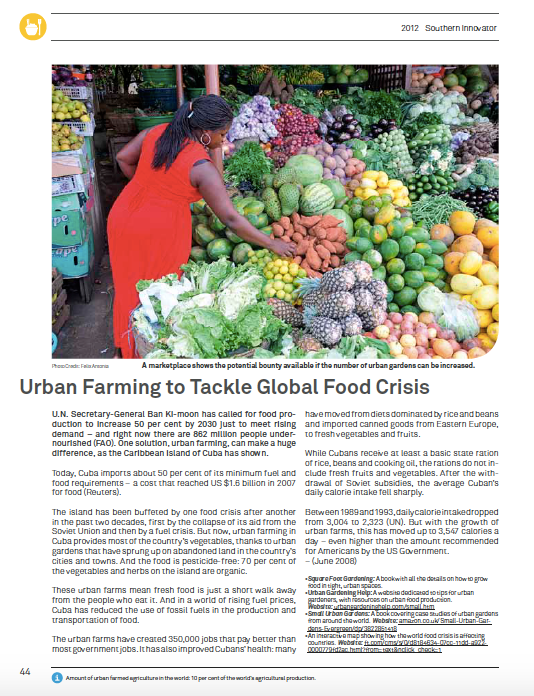
Market trading is a vital lifeline for most people in the South. Plenty of delights usually await people in the market, where live animals, herbs and spices, fresh fruits and vegetables, and life’s necessities compete for customers’ money. The formal and informal food sector plays a crucial role in empowering women and providing food to the poor. Women are often those mostly responsible for selling fresh products and street food, and running small catering operations. By being a vendor and getting food at a lower cost, they are able to contribute to their families’ food security.
Trading and selling in the marketplace can be one of the best options for poor women. By trading, women gain economic independence, learn vital business skills and enjoy the social benefits of interacting with others. But the highly individualistic nature of market trading has its downside: traders must do everything themselves and a day not spent at market is a day’s income lost. They also can only buy in small quantities, and usually pay a higher price. Or don’t know what the competitive price is, so are in a weaker bargaining position with wholesalers.
Making market trading more efficient has huge advantages, the primary one being more money for the trader.
Women market traders in Nigeria are improving their efficiency and income with mobile phones. Rural women market traders in the Obiaruku market are using mobile phones to call their suppliers, access information like commodity prices, and contact customers. A survey of the traders found 95 per cent thought mobile phones had a big impact on their business. This has included fewer trips to suppliers, a quicker way to get help when they have been robbed, and opportunities to top-up incomes by selling airtime, handsets or mobile phone accessories.
In Nigeria, mobile phone use has shot up at a rate of 25 per cent a year. A recent study found that out of a population of 140 million, 12.1 million now have mobile phones and 64 million use mobile phones through street-side phone centres. Phones are also helping women market traders to keep tabs on price fluctuations – giving them an advantage when bargaining with crafty – mostly male – suppliers. A weak bargaining position is a common problem: In Ghana, for example, product producers are forced to sell through “market queens” who take advantage of the lack of price transparency and do not always pay producers fairly (De Lardemelle, 1995).
In the Madurai region in southern India, women market traders are using a system called CAM. It allows them to record all their business transactions. CAM uses a Nokia 6600 mobile phone to record daily transactions. This includes small loans, buying livestock, or operating tiny retail businesses. The phone’s camera takes pictures of bookkeeping forms to identify and track all documents. The phone then asks the user to input numbers to the data fields. At the last key, the data is sent via text message to a central server. According to Tapan Parikh, a professor at the University of California at Berkeley School of Information in the United States, the most successful technological solutions work because they include village leaders, customers, NGOs, and others in the design process. “This is the only way to ensure long-term sustainability and benefit,” he said.
In Soweto, South Africa a simple solution to a chronic problem for women market traders has emerged. After seeing hundreds and sometimes thousands of women selling their goods in the marketplace, it became clear they all had one thing in common: they closed on Mondays. They did this because they needed to go to the wholesaler to buy their goods. And they mostly did this by piling into taxis to get there. It hurt the profitability of their businesses in many ways: there was the cost of the taxi, the fact they could only buy small amounts to squeeze in the taxi, a day’s business was lost, and the lack of a discounted, bulk price.
But the solution to this problem is a bright one: the women place a bulk, wholesale order with a go-between who works with a computer out of a former shipping container. He logs the orders into his computer and sends one big order. The wholesaler is happy with the big order, and delivers it and gives him a 15 per cent discount. This is his profit. The women pay the same price as before, but do not have to pay for the taxi and the goods are delivered directly to them. On top of this, the women can stay open on Monday and make more money!
Published: May 2008
Resources
Book on how mobile phones are empowering women in Nigeria – Mobile Telephony: Leveraging Strengths and Opportunities for Socio-Economic Transformation in Nigeria. Website:http://mobileactive.org/book-review-nigeria-goes-mobile
Business Action for Africa: This is a network of businesses and business organisations working collectively to accelerate growth and poverty reduction in Africa. Blog:http://www.businessactionforafrica.blogspot.com/ Website:
Trade hubs can prove to be decisive in boosting regional growth. Trade hubs are places where commerce congregates, for a mix of geographical, cultural and economic reasons. Like a bicycle wheel, a trade hub sits at the centre as the spokes of trade routes travel towards it. Throughout history, trade hubs have emerged, from the outposts of the Silk Route running through Asia and Central Asia to the Hanseatic League cities of Northern Europe in the Middle Ages.
Trade is critical to increasing prosperity, and the more efficient trade becomes – and the greater the variety of goods and affordable prices – the higher the standard of living for the nations doing the trading.
With South-South trade the great economic success story of the past decade, new trade hubs are emerging. World Trade Organization (WTO) (www.wto.org) figures show South-South trade accounted for 16.4 percent of the US $14 trillion in total world exports in 2007, up from 11.5 percent in 2000. While the global economic crisis has slowed things down, the overall trend is firmly established.
One country hoping to become a key 21st century trade hub is the tiny African nation of Djibouti, which sits strategically between the Red Sea and the Gulf of Aden. It is surrounded by the nations of Eritrea, Ethiopia and Somalia and is across the Bab al Mandab Strait from Yemen.
It is at the nexus of Africa and Asia. Some of the busiest shipping lanes in the world float by the country’s coastline. Much of the oil shipped to Europe and the United States passes by.
“Djibouti is perfectly positioned to become a services and logistics hub,” said Jerome Martins Oliveira, chief executive officer of Djibouti port, operated by a subsidiary of Dubai World.
PwC (PriceWaterhouseCoopers) (http://www.pwc.co.uk), which recently published its third Transportation & Logistics 2030 Report, predicts that global trade hubs and routes will shift to emerging markets within the next 20 years.
“Trade volumes will move towards emerging markets such as Africa or Asia and competition for future large transport contracts will be determined within the next few years,” said Akhter Moosa, PwC’s South African Transport and Logistics Leader.
This underscores the growing importance of emerging markets. The majority of global trade is forecast to shift to emerging markets by 2030. As the trade shifts, so new trade routes emerge. PwC sees strong links between Asia and Africa and Asia and South America, as well as trade within Asia, transforming global supply chains.
Hot spots for trade are showing impressive growth. Trade between Asia and the former Soviet states grows at 42 percent a year. The volume of trade between South America and Africa is growing by double digits.
“China already owns seven of the world’s twenty largest ports,” said Christopher Siewierski, associate director in Corporate Finance at PwC. “India, Russia and South Africa are also expected to play a significant role as logistics giants.”
Respondents to the Transportation & Logistics 2030 Report (http://www.pwc.com/gx/en/transportation-logistics/tl2030/tl2030-pub.jhtml ) believe it is unlikely that companies from emerging countries will seek further growth in the developed European and North American markets. Instead, they will concentrate on domestic markets and the strong growing neighbouring countries.
All of this is good news for Djibouti. At present, the population of Djibouti (http://en.wikipedia.org/wiki/Djibouti) is small at around 864,202 people (2009 World Bank).
Ancient Djibouti traded hides and skins for the perfumes of Egypt, India and China: a classic South-South trade heritage. Djibouti became a French colony and gained its independence from France in 1977.
The geography is harsh: a rocky semi desert of plateaus and highlands. Djibouti has few resources, apart from its large salt reserves – the country has a long history of salt mining. Djibouti must depend on foreign assistance – or innovative trade.
Djibouti has to be clever in increasing income opportunities: the country has an estimated unemployment rate of between 40 and 50 percent. The country is heavily dependent on imports for food and fuel, and over the past decade has experienced recession – in the wake of a 1991 to 1994 civil war – and a growing population.
For years, the tiny state was overlooked and development had proceeded at a slow pace. But now investment from Dubai is pouring in to upgrade the port to make it a regional gateway.
The Djibouti Free Zone (http://www.djiboutifz.com/) was set up in the wake of the country being designated a free-export processing zone in 1995. In practice, this means a company or business working to export products can be designated as an Export Processing Company (EPC).
It was created to re-shape the landscape in Africa when it comes to trade. Push out the red tape, and bring efficiency and plenty of services: the prime habitat for business to flourish free of restrictions. Prospective businesses can find modern offices, distribution, storage and light manufacturing facilities.
Djibouti provides services as both a transit port for the region and an international trans shipment and refuelling center.
And even more ambitious plans are afoot: a multi-billion dollar, 29-kilometre bridge across the Red Sea has been proposed. The Bridge of the Horns (http://en.wikipedia.org/wiki/Bridge_of_the_Horns) will link Djibouti with Yemen and two new cities will be built on either side of the bridge. The new Noor City on the Djibouti side will become the “financial, educational, and medical hub of Africa” according to its developers.
Elsewhere, the United States is funding and operating four regional trade and competiveness hubs in sub-Saharan Africa. They aim to assist, enhance and broaden the flow of trade between the United States and the region, both inside and outside the terms of the historic African Growth and Opportunity Act (AGOA) (http://www.agoa.gov/). The four trade hubs — located in Ghana, Senegal, Botswana and Kenya — provide information and technical expertise to enhance and expand bilateral trade between the United States and Africa.
Published: December 2010
Resources
Port Management Association of Eastern and Southern Africa: Is a regional organisation for the ports and maritime sector in Eastern and Southern Africa. It seeks to promote and nurture best practices among member ports by creating an enabling environment for exchange of information and capacity building to contribute to the economic development of the region. Website:http://www.pmaesa.org/welcome.htm
Dubai World: Global holding company Dubai World “focuses on the strategic growth areas of Transport & Logistics, Drydocks & Maritime, Urban Development, Investment & Financial Services. Our portfolio contains some of the world’s leading companies in their industries, including Drydocks World, Economic Zones World, Istithmar World, Nakheel and majority ownership of DP World.” Website: http://www.dubaiworld.ae/
West Africa Trade Hub: The USAID West Africa Trade Hub uses a market-driven approach to increase exports from the region – making West Africa competitive in world markets. The Trade Hub provides direct assistance to hundreds of companies in six value chains. That work is complemented by teams tackling problems in transportation, telecommunications, access to finance and business environment that make it difficult for West African companies to compete. Website:http://www.watradehub.com/
Biz Community.com: Africa’s Leading Daily Retail News: Where the action is on Africa’s fast-growing retail markets. Website: http://www.bizcommunity.com/196/160.html
It was announced in January 2014 that China has surpassed the United States to become the world’s number one trading nation, as measured by the total value of exports and imports. This new economic behemoth also continued to grow its trade relationships with Africa.
US exports and imports of goods totaled US $3.82 trillion in 2013, according to the U.S. Commerce Department. China’s annual trade in goods passed US $4 trillion for the first time in 2013 (Guardian).
Zheng Yuesheng, a spokesman for China’s customs administration, told The Guardian that becoming the world’s number one trading nation was “a landmark milestone for our nation’s foreign trade development.”
Significantly for Africa, 2012 was also a record year for China-Africa trade, which reached 5 per cent of China’s total foreign trade and made up 16 per cent of all of Africa’s international trade, according to a new report from South Africa.
Consultancy Africa Intelligence (consultancyafrica.com), a South African-based organization with more than 200 consultants focused on “expert research and analysis on Africa” highlights the achievements of this strong trade relationship – and also some of its threats and weaknesses – in its report.
Trade between China and Africa has surged during the decade since China joined the World Trade Organization (WTO) (wto.org) in 2001, rising from around US $10 billion in 2000 to US $198.49 billion in 2012, according to China’s Ministry of Commerce. Ambitiously, it could reach US $300 billion by 2015, announced Cheng Zhigang, secretary-general of the China-Africa Industrial Cooperation and Development Forum (www.zfhz.org) (China Daily).
China’s trade and poverty reduction.
The World Bank reported South-South trade now surpasses South-North trade, meaning exports from developing countries to other developing countries exceed exports to wealthy developed countries. South-South trade experienced rapid growth in the 2000s, accounting for 32 per cent of world trade by 2011 (World Bank).
South-South trade and investment between Africa and lower-income and middle-income developing countries rose from 5 per cent in the 1990s to almost 25 per cent in 2010 (Consultancy Africa Intelligence). Before the 1990s, over 90 per cent of trade for Africa was with high-income or developed countries.
China is attractive as a trade partner for many reasons. One of them is the strong admiration for its success in lifting millions out of poverty through an aggressive growth strategy and rapid urbanization with big investments in education, science, technology, infrastructure – modern airports, ports, roads and rail – and research and development.
Since 1978, it is believed China has lifted 500 million people out of poverty, out of a population of 1.3 billion people (World Bank). Incomes have doubled every 10 years with average GDP growth of 10 per cent a year, meaning the country has almost reached all the Millennium Development Goals.
Building a trade relationship with China has led to Zambia’s copper mines running again, Gabon’s oil fields being re-explored, and Sudan becoming a major oil exporter to China. Angola, Democratic Republic of Congo (DRC), Equatorial Guinea, Republic of Congo and South Africa are all benefiting from exporting commodities to China.
The relationship has not been entirely beneficial, according to the Consultancy Africa Intelligence report. Some African industries, such as textiles, have suffered from competition with cheaper Chinese imports, leading to factory closures and job loses.
Non-commodity exports from Africa to China amounted to just 10 per cent of the trade total. Many of the contracts signed for projects also go to Chinese companies, the report found.
Renewed concern has also emerged over rising debt levels in Africa.
In summary, the report finds a growing trade relationship with China has brought to Africa commodity booms, growing GDP (gross domestic product), and lots of foreign investment. On the negative side of the ledger, there have been job loses due to cheaper imports, rising personal and government debt levels and an over-dependence on minerals for economic growth.
Across Africa, new infrastructure has emerged where it probably would not have come about under the continuing debt burdens from the 1970s and 1980s. The continent has received a shot of energy, but it remains to be seen whether governments can sustain this economic jolt and make the wise choices that create African jobs and build liveable cities for the 21st century.
Published: March 2014
Resources
1) Global South-South Development Expo: The Global South-South Development Expo (GSSD Expo) is the only Expo solely from the South and for the South. It showcases successful Southern-grown development solutions (SDSs) addressing the need to meet the Millennium Development Goals (MDGs). Website: southsouthexpo.org
2) World Trade Organization (WTO): There are a number of ways of looking at the World Trade Organization. It is an organization for trade opening. It is a forum for governments to negotiate trade agreements. It is a place for them to settle trade disputes. It operates a system of trade rules. Essentially, the WTO is a place where member governments try to sort out the trade problems they face with each other. Website: http://www.wto.org
3) Djibouti Free Zone: Djibouti Free Zone was created with one primary goal in mind – to bring about a sea-change in the way Africa thinks and does business. No red tape, ruthless efficiency and genuinely exhaustive services – in essence, it offers the ideal conditions for trade and commerce to flourish. Website: djiboutifz.com/
4) Forum on China-Africa Cooperation: Keep up with the busy diplomatic and trade contacts between China and African countries. Website: http://www.focac.org/eng/
5) China-Africa Cooperation Net: China-Africa Industrial Forum (CAIF) is the collective dialogue and cooperation mechanism that was set up by both China and friendly African countries in the year 2000. Website: http://www.zfhz.org/html/en_gywm.html
China has been a member of the WTO (World Trade Organization) since 11 December 2001. The World Trade Organization deals with the global rules of trade between nations. Its main function is to ensure that trade flows as smoothly, predictably and freely as possible.
Weathering the global economic crisis is testing the stability of countries across the global South. But many countries are finding South-South trade and catering to their domestic middle classes can lift incomes and maintain growth rates despite the global turmoil.
A decade of boom in global markets as they became more integrated has brought rising incomes and created growing economies in the so-called emerging markets of the global South. Finance and investment from developed countries flowed into the global South and helped bolster growing economies, boosting incomes and bringing millions of people into the middle classes. But since the start of the global economic crisis in 2008, more and more countries in the global South have experienced turmoil, chaos and crisis.
The export-driven model that had served many Asian countries well – creating products for developed Western markets – is being tested by high unemployment in developed economies and declining purchasing power for the Western middle classes. Two trends that have grown in the past 10 years may offer a solution to this economic crisis. One is to build on the growth in South-South trade, and the other is to tap the growing middle classes of the global South by expanding the products and services available to them and further improving their quality of life.
It is well established that one of the key elements to securing sustainable prosperity is a thriving middle class. Middle classes in many countries in the global South are still classified as vulnerable – at risk of returning to poverty if the economy experiences a short-term crisis. Their resilience to an economic downturn needs to be strengthened, and this can be done by improving the quality of products and services available to them.
Building this market can also strengthen domestic job growth and help reduce a country’s dependence on imports.
One country facing up to this challenge is Indonesia. The New York Times recently reported that ports in Indonesia and other resource-exporting countries are quiet, as China’s demand for resources slows.
But while export markets are experiencing a slowdown, investment is going into Indonesia’s agricultural food-processing industry. Agricultural multinational Cargill (cargill.com) is building a cocoa-bean processing plant in the country, and the PT. Suprama (suprama.co.id/en/) instant-noodle factory is running at full capacity to meet the needs of the country’s growing middle class.
Many countries have experienced significant inflows of investment money as a result of stimulus measures led by the United States Federal Reserve (http://www.federalreserve.gov/faqs/about_12594.htm) to counter the economic contraction caused by the global economic crisis. This money, however, is uncertain and can just as easily disappear as it leaves to chase the next opportunity. Wise countries take measures to avoid being dependent on this fickle and fast investment funding.
Unlike in the Asian Crisis of 1997-1998 (http://en.wikipedia.org/wiki/1997_Asian_financial_crisis), many emerging-market countries now have large foreign currency reserves and robust stock markets. They have also built up their middle classes and increased consumption. Trade links with other countries in the global South have grown enormously since the late 1990s. For example, the trade between China and Africa, as announced by Chinese President Xi Jinping (http://en.wikipedia.org/wiki/Xi_Jinping) in early 2014, has surpassed US $200 billion for the first time, turning China into Africa’s largest trading partner
The relationship between trade and poverty reduction, the case of China.
Despite a raging global crisis, in many emerging economies domestic spending is holding up and, in some cases, has never been stronger.
China now plays a key role in maintaining global economic demand. According to the global bank HSBC, Chinese growth adds “twice as many dollars to annual global demand as growth in the United States economy and far more than the economies of the European Union.”
China is also in the process of altering its economy, from being the low-wage workshop of the world to an increasingly high-tech, high-value economy with growing science, technology and innovation sectors buoyed by heavy investment in research and development, for example China’s Xi’an Hi-tech Industries Development Zone (xdz.com). As China changes, other countries can step in and replace the industries that no longer find China an affordable place to manufacture their goods.
As an example, the Indonesian vice minister of trade, Bayu Krisnamurthi, announced that the Foxconn Technology Group of Taiwan (foxconn.com), which makes components and assembles devices for the popular Apple (apple.com) computer brand, is looking to set up a large factory in Indonesia.
“The other brands will come in their footsteps,” Krisnamurthi told The New York Times.
Other countries are bucking the crisis trend and using greater freedom to boost economic growth.
Cuba has been able to bounce back with free-market reforms. The Caribbean island has had its ups and downs economically since its revolution in the late 1950s. After the revolution, the country had several decades of impressive human development gains and built up enviable education and health care systems. But with the collapse of the Soviet Union in the early 1990s, the country lost its trade relationships and subsidies and was pitched into a major economic crisis.
During the Cold War, the USSR hoovered up almost all of Cuba’s exports of sugar, nickel and citrus fruit, and sold Cuba two-thirds of its food and 98 per cent of its fuel.
What was termed the “special period” after the collapse of the Soviet Union saw petrol become scarce. Many had to turn to cycling and walking to get around. Factories closed and food production declined.
One estimate by Hal Klepak of the Royal Military College of Canada, reported in The Observer newspaper, found the economy collapsed by 50 per cent in the five years to 1993.
Since then, Cuba has endured significant austerity and has struggled to regain its trade relationships and restore economic growth. Tourism has played a key role in keeping the country going.
And since 2008, various economic reforms have started to shift the economy away from over-dependence on the state and towards a more mixed market model.
Its capital, Havana, is a UNESCO world heritage site and is a popular tourist destination with one of the best-preserved former Spanish colonial architecture in the Caribbean.
When President Raul Castro took over from his brother Fidel, he began to slowly experiment with reforms to test how much market freedom could boost the economy and increase incomes. This has included allowing paladares, or privately-run restaurants, which are now flourishing and benefiting from the steady flow of tourists to the island.
The state now allows people to set up as independent traders in 200 occupations. Some have established entertainment businesses such as paint balling, others are running bars, or bookshops. It is now possible to easily change money in Havana and to find accommodation in private homes. Cash machines are spreading throughout the capital and more and more businesses will accept credit cards.
Registered businesspeople rose from 157,000 in October 2011 to more than 442,000 in 2013.
By being flexible, it is possible to discover new ways to grow economies and increase incomes, even in hard times. And increasing South-South trade is the way to go.
1) The China Africa Project: The China Africa Project is a multimedia resource dedicated to exploring every aspect of China’s growing engagement with Africa. Website: chinaafricaproject.com
2) China’s trade and investment in Africa: Resources to contribute to more informed investment and trade policies and decision making in sectors and locations where China is emerging as a major player. Website: http://www.cifor.org/china-africa/home.html
Made-in-China.com: With the continuous and explosive growth of Chinese exports, trade and the number of internet users, Focus Technology launched its online trade platform, Made-in-China.com. Made-in-China.com provides the most complete, accurate and up-to-date information on Chinese products and Chinese suppliers available anywhere on the web. Nowadays, Made-in-China.com is a world-leading B2B portal, specializing in bridging the gap between global buyers and quality Chinese suppliers. Website: made-in-china.com
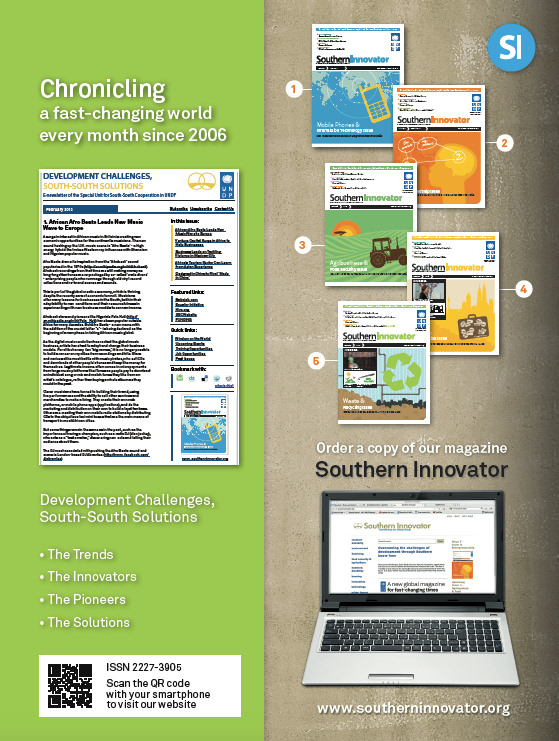
Development Challenges, South-South Solutions was launched as an e-newsletter in 2006 by UNDP’s South-South Cooperation Unit (now the United Nations Office for South-South Cooperation) based in New York, USA. It led on profiling the rise of the global South as an economic powerhouse and was one of the first regular publications to champion the global South’s innovators, entrepreneurs, and pioneers. It tracked the key trends that are now so profoundly reshaping how development is seen and done. This includes the rapid take-up of mobile phones and information technology in the global South (as profiled in the first issue of magazine Southern Innovator), the move to becoming a majority urban world, a growing global innovator culture, and the plethora of solutions being developed in the global South to tackle its problems and improve living conditions and boost human development. The success of the e-newsletter led to the launch of the magazine Southern Innovator.




 David South Consulting

You must be logged in to post a comment.