Tag: Toronto

  • Changing Health Care Careers A Sign Of The Times

    Changing Health Care Careers A Sign Of The Times

    By David South

    Hospital News (Canada), June 1992

    Ontario’s health care system is in the midst of a big change. But where are the new jobs going to be and how can health care workers prepare for the coming crunch?

    “Anybody who thought they could progress through the health care system until retirement is in for a shock,” said Ruth Robinson, a national health care consultant for Peat Marwick Stevenson and Kellogg management consultants. 

    Radical changes are taking place in the health care system and it looks like traditionally safe occupations are in for a shake-up. 

    “Hospitals are being pressured to change fundamentally,” said Ms. Robinson. “The net effect is fewer jobs. A lot of people will have to think about new careers.”

    In the Ministry of Health working document entitled Goals and Strategic Priorities, released in January, the fundamental shift from treatment to disease prevention and health promotion is laid out in generalities. 

    The goals range from health equity for aboriginals, women, children and AIDS patients to better management of costs to development of a stronger health care industry that will jump start the economy. And they range from the reorganization of professional responsibilities to promotion of services outside institutions with the goal of keeping people out of hospitals. 

    One thing is clear, the talk is about big changes. But talk is cheap to laid-off health care workers looking for new jobs. 

    The provincial government’s recently passed, but yet to be proclaimed, Regulated Health Professions Act will have serious repercusions for all health care providers. 

    “Traditionally, doctors have an exclusive domain over a wide area,” said Charlie Bigenwald, executive director of health human resources planning at the Ministry of Health. “Even though other people could do things, they had to be delegated by a doctor. With the legislation, we have pushed back what doctors can do. This means there will be more opportunity for a wider variety of health care workers to get into those areas.”

    Midwifery is one of the benefactors of changes in regulations. The Ministry of Health is looking into having a university-based program for midwives. 

    Ms. Robinson predicted nurses and middle management will suffer the most in the change to community-based health care. 

    “Nurses will need to get a bachelor degree if they hope to compete for jobs,” she said. 

    As for middle managers, who often have clinical skills, they will have to reconsider staying in health care, she said. “They will disappear significantly. They can advance themselves by getting back to clinical skills or consider management positions in non-health care areas.

    “There is nothing to be ashamed of about career changes these days,” she added. 

    In the shift towards community-based care, opportunities will arise for health care workers who can offer creative solutions to improve service delivery. 

    “For nurses, we currently have something called the Nursing Innovation Fund where individuals can apply for a wide variety of developmental things like attending workshops, conferences and training programs. We process 2,500 applications a year,” said Mr. Bigenwald. 

    The Ministry of Health hopes the future sees a health care system that adds to the province’s economy rather than drains it. 

    “We spend $17 billion a year on health care. We never looked at the health care system as an economic motor in the past. The question we are asking right now is ‘why can’t an Ontario firm make the carpets, beds, sutures etc?’, said Mr. Bigenwald. 

    Ms. Robinson said “Governments are running out of money and can’t increase funding. They will be looking for more partnerships in the private sector. In this climate, creative solutions to health care delivery have a great opportunity.” 

    Creative Commons License

    This work is licensed under a
    Creative Commons Attribution-Noncommercial-No Derivative Works 3.0 License.

    ORCID iD: https://orcid.org/0000-0001-5311-1052.

    © David South Consulting 2023

  • US Health Care Businesses Chasing Profits Into Canada

    US Health Care Businesses Chasing Profits Into Canada

    Some fear corporate health care will kill equality of treatment

    By David South

    Now Magazine (Toronto, Canada), April 8-14, 1993

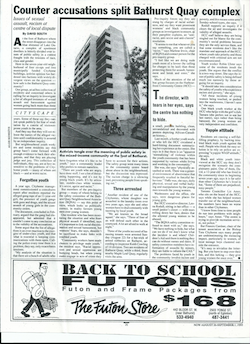
    American-style private health care is slipping across the Canadian border under the noses of three provincial NDP governments, say researchers representing an association of health care workers.

    Jackie Henwood and Colleen Fuller of the 7,500-member Health Sciences Association of British Columbia charge in a recent report that a combination of free trade and tightfisted government spending is undermining the universality of medicare and ushering in the beginnings of a two-tier system.

    While the health care industry created more jobs than any other sector of the economy between 1984 and 1991, they point out, things have changed dramatically since the Canada-US free trade agreement came into effect in 1989. Now much of this growth is clustering in the private sector.

    And they expect that this trend will continue under the forthcoming North American free trade agreement.

    “NAFTA will accelerate trends towards a privatized, nonunion and corporate dominated system of health care in Canada,” says the report.

    Binding provisions

    Chapter 14 of the Canada-US free trade agreement opened competition for health-care facilities management services to US companies. Certain NAFTA provisions will bind all levels of government to consider for-profit health care companies on equal footing with public providers when bidding for services, and entitles them to compensation if they can prove to an arbitration board that they’ve been wronged.

    “That represents a substantial encroachment on the democratic right of local, provincial and federal governments to make decisions,” says Cathleen Connors, who chairs the Canadian Health Coalition, which includes labour activists, nurses, doctors and other health-care workers.

    This, in combination with health care cutbacks – both federal and provincial – is resulting in service and job cuts, bed closures, increased drug costs and an increase in privatization, the report says.

    In the area of home care, for example – visiting nurses, physiotherapists, homemakers and other services – private firms now take in close to half of all OHIP billings. Many of their clients pay out of their own pockets for services.

    The Ontario ministry of health doesn’t keep statistics on the private home health care sector in the province, but the Ontario Home Health Care Providers’ Association, a trade group, estimates that private firms in the industry now employ 20,000 people.

    The industry is dominated by a small number of large firms, including Paramed, Comcare and Med+Care.

    “It’s a market situation,” says Henwood. “If the services aren’t available to people within the public sector, they will go outside of it.

    “We’ve seen this in other countries like England, where they had a public system and now have a parallel private system. If you erode a system enough that people get pissed off, they are going to start to look for alternatives, and the people with the greatest liberty are those with money.”

    Connors says that because the Canada Health Act only covers the provision of hospital and physician services, the prinicples of universality and comprehensiveness don’t extend down to community-based services like home care.

    The study also found that giant US private health insurers are positioning themselves to reap profits in the fertile Canadian market.

    Last week, Wisconsin-based American Medical Security Inc. announced it will begin offering American hospital insurance to Ontario residents this month, citing a demand in Canada to bypass lengthening waiting lists for medical treatment.

    Giant US west-coast insurer Kaiser Permanente declared in the March 1992 issue of Fortune magazine that they have targeted Canada as the next growth market. And American Express membership now offers the privilege of health insurance.

    With private health care services sprouting up like spring weeds, says Henwood, provinces are placing yearly limits on the number of private services covered under provincial health plans, thus preventing people shopping around for services, no matter what their income.

    Sheila Corriveau, corporate relations coordinator at Toronto-based Dynacare, Canada’s largest full-range private health care company – which operates labs, retirement homes, homecare services and consulting services – is enthusiastic about expansion plans, and says that removing patients from hospitals into their homes has been a boon for private health-care services.

    “I think the health system will benefit, because what you are really doing is off-loading the cost from the public sector and from the treasury to private enterprise,” says Harry Shapiro of Dynacare. “Private enterprise depends on its own ingenuity for survival and its own levels of efficiency.”

    But advocates of the public system say the free-market option now looming is being ushered in by the very parties that Canadians have come to rely on to defend medicare.

    Medicare stance

    Ontario’s new health minister, Ruth Grier, however, denies her government is jeopardizing medicare.

    “I want to disagree with that as profoundly as I can,” she says, fidgeting with an ashtray during a recent interview. “Our government has reaffirmed its commitment to medicare. Over the last decade, under conservative and liberal governments, health care costs have increased in double-digit figures. The system would have collapsed at that rate of growth.

    “I guess I haven’t found a way of blaming free trade for failures of the health care system at this point,” she says.

    But critics say in the last year alone, Ontario’s ministry of health has capped health coverage for travellers abroad, removed coverage for physical exams requested by employers, chopped hospital beds and cut back the number of drugs covered on the provincial drug plan.

    Grier says that the government’s vision relies on a new view of medical care seekers as consumers who are going to take more responsibility for their own health care

    “Government can’t do it all,” she says.

    Now Magazine (Toronto, Canada), April 8-14, 1993.

    More investigative journalism by David South for Toronto’s Now Magazine:

    Now Magazine (Toronto, Canada), November 12-18, 1992.

    More healthcare reporting by David South from Canada’s Today’s Seniors

    Feds Call For AIDS, Blood System Inquiry: Some Seniors Infected

    Government Urged To Limit Free Drugs For Seniors

    Health Care On The Cutting Block: Ministry Hopes For Efficiency With Search And Destroy Tactics

    New Seniors’ Group Boosts ‘Grey Power’: Grey Panthers Chapter Opens With A Canadian Touch

    Seniors Falling Through The Health Care Cost Cracks

    ORCID iD: https://orcid.org/0000-0001-5311-1052.

    © David South Consulting 2021

    Like our content? Help contribute to the costs of keeping it online.

    Scan code with your phone and help us out.
    Creative Commons License

    This work is licensed under a
    Creative Commons Attribution-Noncommercial-No Derivative Works 3.0 License.

    ORCID iD: https://orcid.org/0000-0001-5311-1052.

    © David South Consulting 2022

  • Cut Services To Elderly, Says Doctors’ Survey… But Leave Our Salaries Alone!

    Cut Services To Elderly, Says Doctors’ Survey… But Leave Our Salaries Alone!

    “With a guaranteed income and job security, I don’t know one doctor who has suffered in the recession…”

    By David South

    Today’s Seniors (Canada), January 1993

    If the results of a nation-wide survey of doctors are right, Canadian physicians love medicare but abhor government attempts to make them accountable for its costs. It also suggests that doctors are more willing to talk about cutting services to seniors and people with “unhealthy lifestyles” than to discuss cutting their own wages to save money. 

    However, according to some doctors, physicians’s anger with the provincial government is founded on ignorance and poor analysis of the larger forces affecting health care. 

    The survey, Breaking the Wall of Silence: Doctors’ Voices Heard at Last, was commissioned by The Medical Post, a national newspaper for doctors. It sent questionnaires to 12,000 doctors, receiving 3,087 responses. The Post also conducted in-person interviews to better gauge the mood of doctors. 

    The survey’s title is somewhat misleading, considering that doctors have been making noise over a number of issues this year; targets included proposed right-to-treatment legislation, cuts to the Drug Benefit Plan, capping of yearly billings at $450,000, and inquiries into charges of sexual abuse by doctors. And most significantly, the last conference of the Canadian Medical Association passed a resolution calling for a two-tier health system in which those with money can hop the queue. 

    Post editor Diana Swift says the poll shows fairly strong support for limiting services to the elderly, although the survey question is short on details: “I feel it is reasonable that access to high-cost services such as transplants should be rationed according to such parameters as the patient’s age and/or unhealthy habits.”

    Yet just under 70 per cent of doctors opposed any capping of their salaries, despite 56 per cent of the public supporting this measure according to a 1991 Globe and Mail-CBC poll. 

    When questioned, Health Minister Francis Lankin expressed surprise that doctors felt so strongly, and denied the government is considering rationing services to seniors. Lankin feels the volatile mood of doctors is a reaction to the rapid changes taking place in health care. 

    Dr. Michael Rachlis, health care critic and author of the book Second Opinion, says the survey’s low response rate means that the answers reflect “redneck physicians, who are more likely to respond.” Swift admits to a high response rate from young male physicians, who since the 1986 doctors’s strike in Ontario, have been considered the profession’s most militant. 

    One response which some may find alarming was towards the “Oregon model.” In that American state, medical procedures are rationed to seniors and individuals covered by medicare. Anybody needing uncovered emegency treatment has to pay for it themselves. A disturbing 65 per cent of survey respondents supported such a move. 

    Dr. Gerry Gold, associate registrar at the College of Physicians and Surgeons of Ontario, feels that some doctors lack perspective. “The complaints are a reflection of frustration with increasing involvement of government. But if physicians understood the role of the government in the U.S., they would realize they, along with insurance companies, intervene far more.”

    Gold says doctors have had the same complaints ever since the beginnings of medicare. “Many front-line doctors lack the information to make informed comment,” he says. “They aren’t being consulted or informed by the government.”

    Rachlis says many doctors fail to realize how privileged they are. “Canadian physicians don’t realize medicare has protected their autonomy more than in the U.S.,” he says. “Doctors are always angry because they have large chips on their shoulders from being brutalized in their training. They don’t realize the government has given them a privileged monopoly over health services. With a guaranteed income with job security, I don’t know one doctor who has suffered in this recession.”

    Gold doesn’t foresee strikes or job actions by doctors, but predicts further government cuts, and more services being de-insured by OHIP. A recent example involved removing coverage for third-party medical exams such as those requested by employers or insurance companies. As medical procedures end up outside of OHIP, Gold foresees physicians charging whatever they like. 

    A perennial idea is the user fee. This is one of the few ideas that gathers support from a majority of doctors and the general population alike. But Rachlis feels these measures are meanspirited and avoid the real problems plaguing health care. “When Saskatchewan introduced user fees for physician and hospital care in 1968,” he says, “health costs remained the same and it discouraged the elderly, the poor and people with large families from seeking service. 

    “When providers are allowed to charge users for care, as in the United States, where more than 20 per cent of health care costs are paid our of pocket, overall costs go up.” 

    More from Canada’s Today’s Seniors

    Feds Call For AIDS, Blood System Inquiry: Some Seniors Infected

    Government Urged To Limit Free Drugs For Seniors

    Health Care On The Cutting Block: Ministry Hopes For Efficiency With Search And Destroy Tactics

    New Seniors’ Group Boosts ‘Grey Power’: Grey Panthers Chapter Opens With A Canadian Touch

    Seniors Falling Through The Health Care Cost Cracks

    ORCID iD: https://orcid.org/0000-0001-5311-1052.

    © David South Consulting 2021

  • Swing Shift: Sexual liberation is back in style

    Swing Shift: Sexual liberation is back in style

    By David South

    Id Magazine (Canada), October 3-16, 1996

    Deep in the bedrooms (and living rooms) of the home-owning classes, the sexual liberation movement marches on: swingers’ parties are back. Those libidinous libertines many thought were lost in a 70s disco haze, according to a Toronto swinger, are back in greater numbers than in those polyester days. 

    In contrast to the many people (mostly men) looking for the anonymous and on-demand buzz of escort agencies, porn videos and sex toys, it seems to me swinging is the most idealistic camp in the army of sexual liberation. There isn’t any sneaking around behind your spouse’s back – in fact, you bring them along for the good times. 

    Swingers were usually the subject of the porn movies I watched at the base cinema during my army days. They weren’t real people, but some sort of myth from more electric times. 

    Ron Michaels, 41, is an unabashed proselytizer for swinging. A strip-club DJ and erotic and commerical photographer, he’s also co-owner, along with his wife, of swingers’ club Eros. A confident and articulate spokesperson, he has been swinging since he was 17. 

    “We believe honesty is the cornerstone of our lifestyle – that makes it work,” he says. “The people engaging in back-alley sex are being dishonest. It’s the same with having an affair – wanting your cake but not being able to share it with the rest of us. 

    “Swinging is a moral alternative to having affairs.” 

    The divorce rate among swingers, Michaels maintains, is only five per cent, compared to 51 per cent for the general population. The one wrinkle in this impressive “fact” is Michaels’ other admission that many swingers are on their second “married relationship”.

    Interviewing Michaels, I feel like I’m talking to a Rotary Club member or a boy scout leader, not a swinger. The talk is about clubs, memberships ($69 a year per couple), trips. It’s a hobby, sport and lifestyle to many swingers, claims Michaels. 

    “We have regular weekly functions throughout the year. Some of them are organized by the members. We organize trips and holidays. Weekends in the Caribbean. Like any other social club.”

    That can’t be wife/husband swapping he’s talking about, can it?

    Michaels’ Toronto Beaches home leaves no doubt as to its occupant’s lifestyle choices: “If you don’t swing, don’t ring,” says a brass plaque nailed to the door. 

    Michaels is very proud of swinging’s growth in the 90s. His group has grown from 300 member-couples 14 years ago to 1,800 today. Michaels ambitiously estimates that between 100,000 and 200,000 Southern Ontarians are into swinging, between 20 and 25 million across North America. 

    So, how does swinging in the 90s work?

    Michaels says most clubs operate more as matchmaking parties than full-out orgies. Couples get to know each other and make the arrangements to meet away from the club’s party. Michaels is quick to disassociate his club from drop-in style swingers parties. 

    “Canadians are much more conservative than Americans. In New York they are more hardcore, less selective of their partners. When they get there they are more like, ‘let’s find the first available body and get to it,’ whereas people at social clubs want to get to know you. We are talking about four-way compatability here.”

    According to Michaels, the big victory for Canadian swingers took place in 1992. “Our Mississauga club was raided back in ’92 and we took it through the courts for a year. We were acquitted and set a legal precedent, making swingers’ clubs legal.”

    To many men, the whole swinging thing seems like the best of both worlds: you keep your wife and get to taste the fruits of other trees at the same time. But Michaels says this male teenage fantasy doesn’t pan out in reality. 

    “That wears off pretty quickly. Let’s face it, men have a much lower capacity for sex than women do. Men need a longer recovery period and don’t have as many orgasms in a night. Women can just go and go. Guys can’t compete with that. After a while the fantasy wears thin, and it’s the guy that wants to drop out of the lifestyle.” 

    And what about that other most-asked-question: what’s it like to see your spouse having the time of their life with your neighbour?

    “They don’t get into those kinds of comparisons. How can I describe this? It’s not a competitive thing where you try to outperform each other. Most swingers appreciate each other as being unique and different, rather than this is bigger, this is harder, this is faster, this is better. Each new experience is taken at face value, ‘Hey, it’s a good time’. You move on to the next one or you go back to your regular partner.”

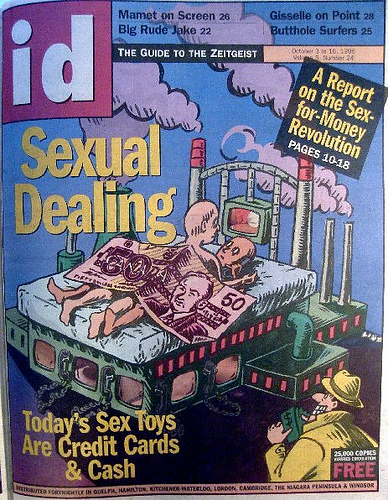
    Read more on the 1990s sex economy here: From Special Report: Sexual Dealing: Today’s Sex Toys Are Credit Cards & Cash: A Report On The Sex-For-Money Revolution

    Special Report: Sexual Dealing: Today’s Sex Toys Are Credit Cards & Cash: A Report On The Sex-For-Money Revolution.

    Read more on the 1990s sex economy here: From Special Report: NMM (New Media Markets) Spotlight On The Emergence Of Satellite Porn Channels In The UK

    Update: It is over 20 years since this Special Report was published. It forecast the significant role the Internet was to play in the growth of sex content and the sex industry and vice versa. Here is an interesting overview of the situation in 2020. The Internet is for Porn – It always was, it always will be.

    “One of the biggest and most interesting things happening in the consumer web right now is running almost completely under the radar. It has virtually zero Silicon Valley involvement. There are no boastful VCs getting rich. It is utterly absent from tech’s plethora of twitters, fora and media (at least, as they say, “on main”). Indeed, the true extent of its incredible success has gone almost completely unnoticed, even by its many, many, many customers.

    I’m talking, of course, about OnlyFans.”

    ORCID iD: https://orcid.org/0000-0001-5311-1052.

    © David South Consulting 2021