Check your prejudices at the door, look beyond your self-interest, and open your mind, because the Grey Panthers are here in Canada.
Joe Moniz, the 26-year-old founder of the Canadian Grey Panthers, is confident that his ambitious plans for a new national seniors’ organization are just what Canadian seniors need.
That’s right: 26-years-old. Modelled on the U.S. Grey Panthers, the Canadian Grey Panthers believe in harnessing the power of all age groups, making the connection that everybody will eventually be a senior and that seniors benefit from a better society for everyone.
“The major difference between us and any other organization is our slogan, “Age and Youth Working Together,” he says. “Look at our pension fund. It’s depleting. I’m concerned about my future as a senior citizen – will there be a pension fund? We want to act now, to bring youth and age together to improve the situation of seniors today and improve our situation in the future.
“Membership is open to all age groups. We want to bring seniors into day care to interact with children. We want to deal with the universities, give people the opportunity to discuss and unite. It’s a different approach, but it can make a huge difference.”
Moniz has already organized the group’s first chapter, in Hamilton, complete with a board of retired university professors and doctors. The group has put together insurance packages that will “blow the others out of the water.”
“All seniors’ attempts at lobbying in the past have been short term,” says a blunt Moniz. “We are the organization that will make the difference. We will lobby provincially, federally, and municipally, and we are non-partisan.
“The reason I’m introducing the Grey Panthers is to keep grey power alive in Canada, and to provide the necessary channels to do so through lobbying efforts. If anyone has problems with local politicians, they can call us, and we in turn let them know the channels they should use. There are a lot of seniors out there being cheated, and it is up to us to help them.”
The Canadian Grey Panthers (which uses the British spelling, as opposed to its American counterpart) will initially concentrate on four issues: pensions, drug plans, affordable housing and long-term care, and will communicate information through newsletters, surveys and meetings.
Moniz promises to make the Panthers accessible to all, no matter what their income. He plans to hit the streets and visit institutions to inform seniors of the group’s presence. As if to prove the group’s potential for excitement, an enthusiastic gentleman from a local retirement home interrupts Moniz during a coffee shop interview. “That’s the best thing I’ve heard from a young person in Toronto,” he says.
The U.S. Panthers were formed by political activist Maggie Kuhn and five friends in 1970. Back then, their name wasn’t as exciting. It was the convoluted and unsexy “Consultation of Older and Younger Adults for Social Change.” In 1972, they adopted the media’s pet name – a grey twist on radical African-American rights organization the Black Panthers.
The radical milieu of political activism was contagious – and the Panthers symbolized its jump from the youth of America to other generations.
“When we formed, we were an intergenerational group,” says Panthers’ U.S. national chair, Charlotte Flynn. “The first issue the group addressed was mandatory retirement. We combat the stigma of ageism, which is making decisions about people based on chronological age. Ageism isn’t just confined to the elderly – ageism exists for young people as well.”
The agenda of the Panthers is just as radical today. Flynn, who is candid about the group’s failures as well as its successes, admits that it isn’t the easiest route to popularity. With membership at about 45,000, the U.S. Panthers have spoken out on now-popular issues like health care, the environment, affordable housing – and taken brave stands against mainstream opinion when it came to the Gulf War and the invasion of Panama.
And they think big. Not content with just influencing the American political scene, the Panthers have taken on the world, gaining official advisor status at the United Nations.
Although involved in a broad range of issues, Flynn says the Panthers are primarily seen as a strong voice for the rights of American seniors.
“We have tried very hard to let people know we are not a special interest group for the elderly,” says Flynn. “But we are always getting called upon to highlight what any legislation is doing to older people.”
With Panther groups sprouting in Europe and now in Canada, the important issue of maintaining the integrity of the Panther name has arisen, says Flynn. She points to the flip side of having a reputation for action: people want to start branches without being interested in the full agenda of the Panthers, using the name for shock value. At the last convention in November 1992, the Panthers formed a committee to act as quality control monitors for the name.
One thing is clear from the ambitious agenda of the Grey Panthers – they aren’t for everyone.
But Moniz’s pragmatic approach seems distinct from the American Panthers. He shies away from some of the American group’s positions, emphasizing a balance between insurance policies and political policies.
“If you read the American Panthers’ position sheet, it’s anti-this and anti-that,” he says. “We aren’t going to take that approach. It would be suicide.”
But he is quick in his praise of the group and its founder Maggie Kuhn. “People may consider her actions to be radical, but they’re not. Look at the achievements. She is one of the top 25 active women in the U.S.
“The Gray Panthers are achievers. They have proven the effectiveness of intergenerational attempts at social justice.”
A quick call to seniors’ groups drew many surpised faces.
“I can’t say anything about them – I don’t know who they are,” responded Murray Morgenthau, executive director of the Canadian Association of Retired Persons (CARP).
Jane Leitch at the United Senior Citizens of Ontario had heard something was happening but wonders why a new group is forming “with so many groups out there.”
One Voice spokesperson Andrew Aitkens says his group is closer to the American Association of Retired Persons than the Panthers in their approach, and that they “have found that there are much more effective ways for advocacy. We don’t march on the Hill at the drop of the hat.”
But Flynn says the Panthers embody a philosophy distinct from all other seniors’ groups. “As Maggie Kuhn said, ‘those of us who are older are the elders of the tribe and should be concerned about survival.’ We look at all issues that deny people the ability to realize their full potential, whether young or old. We are really interested in empowering people rather than being a special interest for the elderly.”
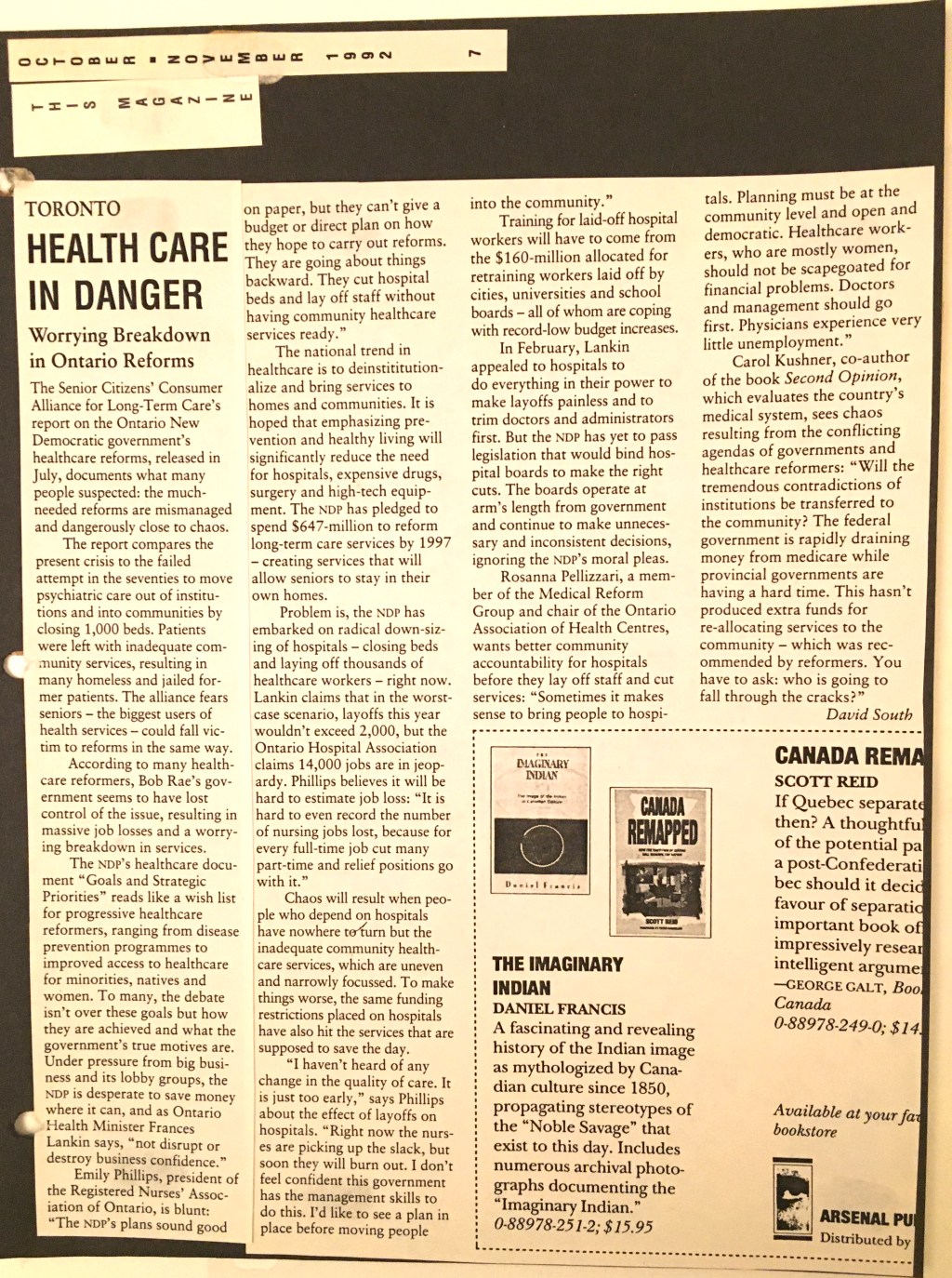
The Senior Citizens’ Consumer Alliance for Long-Term Care’s report on the Ontario New Democratic government’s health care reforms, released in July, documents what many people suspected: the much-needed reforms are mismanaged and dangerously close to chaos.
The report compares the present crisis to the failed attempt in the seventies to move psychiatric care out of institutions and into communities by closing 1,000 beds. Patients were left with inadequate community services, resulting in many homeless and jailed former patients. The alliance fears seniors – the biggest users of health services – could fall victim to reforms in the same way.
According to many health care reformers, Bob Rae’s government seems to have lost control of the issue, resulting in massive job losses and a worrying breakdown in services.
The NDP’s health care document “Goals and Strategic Priorities” reads like a wish list for progressive health care reformers, ranging from disease prevention programmes to improved access to health care for minorities, natives and women. To many, the debate isn’t over these goals but how they are achieved and what the government’s true motives are. Under pressure from big business and its lobby groups, the NDP is desperate to save money where it can, and as Ontario Health Minister Francis Lankin says, “not disrupt or destroy business confidence.”
Emily Phillips, president of the Registered Nurses’ Association of Ontario, is blunt: “The NDP’s plans sound good on paper, but they can’t give a budget or direct plan on how they hope to carry out reforms. They are going about things backward. They cut hospital beds and lay off staff without having community health care services ready.”
The national trend in health care is to deinstitutionalize and bring services to homes and communities. It is hoped that emphasizing prevention and healthy living will significantly reduce the need for hospitals, expensive drugs, surgery and high-tech equipment. The NDP has pledged to spend $647 million to reform long-term care services by 1997 – creating services that will allow seniors to stay in their own homes.
Problem is, the NDP has embarked on radical down-sizing of hospitals – closing beds and laying off thousands of health care workers – right now. Lankin claims that in the worst-case scenario, layoffs this year wouldn’t exceed 2,000, but the Ontario Hospital Association claims 14,000 jobs are in jeopardy. Phillips believes it will be hard to estimate job loss: “It is hard to even record the number of nursing jobs lost, because for every full-time job cut many part-time and relief positions go with it.”
Chaos will result when people who depend on hospitals have nowhere to turn but the inadequate community health care services, which are uneven and narrowly focussed. To make things worse, the same funding restrictions placed on hospitals have also hit the services that are supposed to save the day.
“I haven’t heard of any change in the quality of care. It is just too early,” says Phillips about the effect of layoffs on hospitals. “Right now the nurses are picking up the slack, but soon they will burn out. I don’t feel confident this government has the management skills to do this. I’d like to see a plan in place before moving people into the community.”
Training for laid-off hospital workers will have to come from the $160-million allocated for retraining workers laid off by cities, universities and school boards – all of whom are coping with record-low budget increases.
In February, Lankin appealed to hospitals to do everything in their power to make layoffs painless and to trim doctors and administrators first. But the NDP has yet to pass legislation that would bind hospital boards to make the right cuts. The boards operate at arm’s length from government and continue to make unnecessary decisions, ignoring the NDP’s moral pleas.
Rosana Pellizzari, a member of the Medical Reform Group and chair of the Ontario Association of Health Centres, wants better community accountability for hospitals before they lay off staff and cut services: “Sometimes it makes sense to bring people to hospitals. Planning must be at the community level and open and democratic. Health care workers, who are mostly women, should not be scapegoated for financial problems. Doctors and management should go first. Physicians experience very little unemployment.”
Carol Kushner, co-author of the book Second Opinion, which evaluates the country’s medical system, sees chaos resulting from the conflicting agendas of governments and health care reformers: “Will the tremendous contradictions of institutions be transferred to the community? The federal government is rapidly draining money from medicare while provincial governments are having a hard time. This hasn’t produced extra funds for re-allocating services to the community – which was recommended by reformers. You have to ask: who is going to fall through the cracks?”
Two historical works I am cited in as a resource both share a connection to austerity crises. The first, Modern Mongolia: From Khans to Commissars to Capitalists by Morris Rossabi(University of California Press), draws on my work for UNDP Mongolia (1997-1999) to show the impact of austerity policies on the country as it peacefully transitioned from Communism to free markets and democracy in the 1990s.
Modern Mongolia: From Khans to Commissars to Capitalists.Modern Mongolia on Google Books.
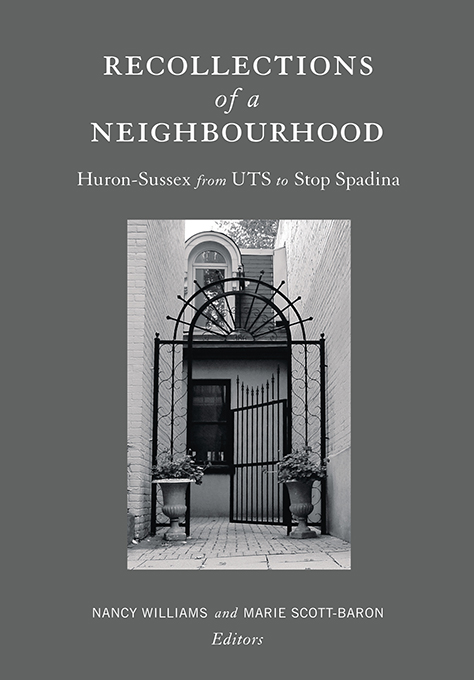
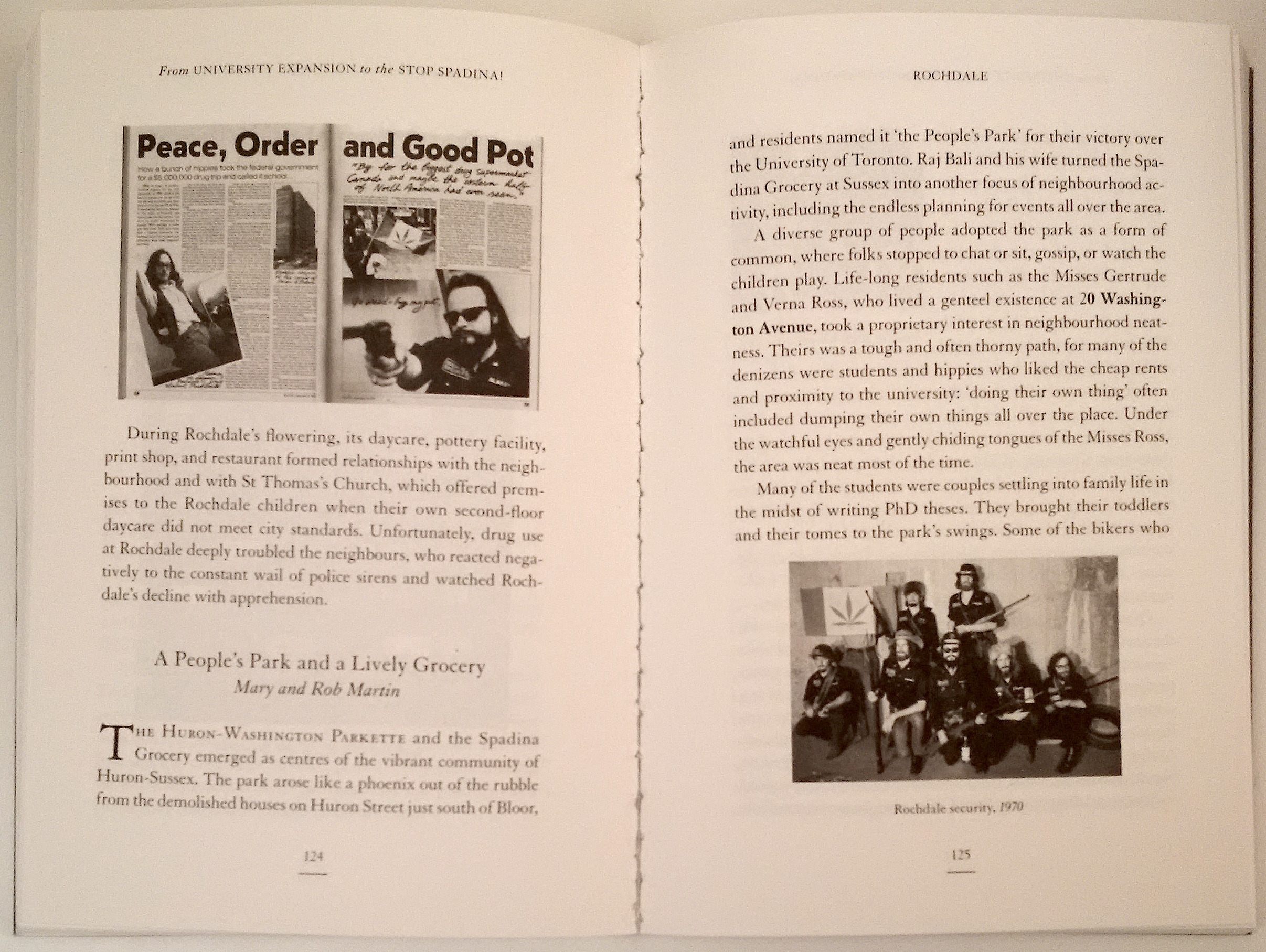
The second, Recollections of a Neighbourhood: Huron-Sussex from UTS to Stop Spadina by Nancy Williams and Marie Scott-Baron (editors) (Words Indeed Publishing), details the evolution of a remarkable – and bohemian – Toronto, Canada neighbourhood in which I lived in the 1980s and 1990s. It uses an image from Watch Magazine, a youth culture biweekly I edited in 1994 and 1996. The magazine was launched during the depths of Canada’s austerity crisis. Despite the economic gloom, the magazine fizzed with youthful vitality and edge and contributed to Toronto’s resurgence. The particular piece cited is a feature on Rochdale College, a late 1960s experimental college associated with the University of Toronto that lit up the neighbourhood with hippie and alternative cultures, until it went into meltdown as drug gangs took control. It was a bold experiment and a reflection of the counter culture vibe of the time.
Recollections of a Neighbourhood: Huron-Sussex from UTS to Stop Spadina.“Peace, Order and Good Pot” by Bill White.List of Illustrations: Sandwiched between Prime Minister Pierre Elliott Trudeau and urbanist Jane Jacobs.





















 David South Consulting
You must be logged in to post a comment.