Tag: toilets

  • Pay for Pee Keeps Indian Town Clean

    Pay for Pee Keeps Indian Town Clean

    By David SouthDevelopment Challenges, South-South Solutions

    SOUTH-SOUTH CASE STUDY

    The task is huge: 2.6 billion people, or 41 percent of the world’s population, is without access to basic sanitation. As a result, most have to make do and defecate or urinate wherever they can. In crowded urban areas, the result is an unpleasant source of disease and filth that fouls living spaces and sickens or kills many people.

    In Indian cities, between one-quarter and one-half of the population, mostly slum-dwellers, has inadequate or no provision for sanitation.

    Many government-built communal toilet blocks are in a sad state. They are overburdened by queues of people that can stretch a mile-long in the mornings. They can also be too expensive for many slum dwellers. Often government-built toilet blocks are in disrepair after just three months, and people return to defecating in the streets.

    In 2008, the International Year of Sanitation (http://esa.un.org/iys/), more than 330 million people in India do not have access to proper sanitation facilities. And in the case of the remote town of Musiri in Tamil Nadu state, many residents relieve themselves on river banks, leading to infectious diseases like diarrhoea.

    But an ingenious scheme is keeping streets clean and people relieved. Rather than viewing human waste as an expensive problem and annoyance, poor residents are being paid up to a dollar a month to use public toilets. By paying people to use the toilets, the government avoids having to run campaigns to get people to change their habits.

    “In fact, many of us started using toilets for urination only after the ecosan (ecological sanitation) toilets were constructed in the area,” S. Rajasekaran, a truck cleaner, to The Times of India.

    The urine is being collected to be used as a crop fertilizer by the state’s agricultural university (http://www.tnau.ac.in/ ). About 150 residents use the eco-sanitation toilet daily. It is designed to collect faeces as well: it too is used as fertilizer.

    “We’re motivating people to know the value of their urine,” Marathi Subburaman, who came up with the novel idea, told CNN. “The urine that is collected goes into fields for paddy crops, and of course the faeces becomes good compost in a matter of months.”

    Subburaman’s non-profit Society for Community Organization and People’s Education (SCOPE) has teamed up with Tamil Nadui Agricultural University and are studying how much urine is needed to fertilize a field.

    “Next year, we can install urine banks so we can sell the urine to farmers,” he said.

    The locals are given cards and each trip is recorded. At the end of the month, the cards are handed in and the money collected.

    The average amount paid out is based on the assumption most people need to go twice a day.

    If some get cheeky and try to make more money from pretending they need to go to the toilet, there is a solution: “If they ask to go three, four times a day, then something’s wrong,” Subburaman said. “We ask them to go to a doctor.”

    Another successful model is the Indian NGO SPARC (Society for Promotion of Area Resource Centres) (http://www.sparcindia.org/). SPARC is an Indian NGO established in Mumbai in 1984 that began working with women pavement dwellers.

    It has been designing and building toilet blocks in Indian cities, bringing access to toilets and washing facilities to hundreds of thousands of poor urban Indians. It has built toilet blocks for 400,000 people in eight Indian cities. It trains community groups to build, manage and maintain the toilet blocks. It has also proven that local groups can take on the management and costs of providing toilet facilities.

    Resources

    • World Toilet Organization: The global non-profit organization committed to improving toilet and sanitation conditions. Website: http://www.worldtoilet.org
    • World Toilet College: Established in 2005, the World Toilet College (WTC) started as a social enterprise, with the belief that there is a need for an independent world body to ensure the best practices and standards in toilet design, cleanliness, and sanitation technologies are adopted and disseminated through training. Website: http://www.worldtoilet.org/ourwork3.asp
    • Official website for the 2008 International Year of Sanitation. Website: http://esa.un.org/iys/
    • Waste has expert knowledge on domestic solid and liquid waste management and sanitation issues. Its website offers a comparison of designs and methods for toilets. Website: http://www.ecosan.nl/page/353

    Development Challenges, South-South Solutions was launched as an e-newsletter in 2006 by UNDP’s South-South Cooperation Unit (now the United Nations Office for South-South Cooperation) based in New York, USA. It led on profiling the rise of the global South as an economic powerhouse and was one of the first regular publications to champion the global South’s innovators, entrepreneurs, and pioneers. It tracked the key trends that are now so profoundly reshaping how development is seen and done. This includes the rapid take-up of mobile phones and information technology in the global South (as profiled in the first issue of magazine Southern Innovator), the move to becoming a majority urban world, a growing global innovator culture, and the plethora of solutions being developed in the global South to tackle its problems and improve living conditions and boost human development. The success of the e-newsletter led to the launch of the magazine Southern Innovator.  

    Follow @SouthSouth1

    Google Books: https://books.google.co.uk/books?id=m5GYBgAAQBAJ&dq=development+challenges+may+2012&source=gbs_navlinks_s

    Slideshare: http://www.slideshare.net/DavidSouth1/development-challengessouthsouthsolutionsmay2012issue

    Southern Innovator Issue 1: https://books.google.co.uk/books?id=Q1O54YSE2BgC&dq=southern+innovator&source=gbs_navlinks_s

    Southern Innovator Issue 2: https://books.google.co.uk/books?id=Ty0N969dcssC&dq=southern+innovator&source=gbs_navlinks_s

    Southern Innovator Issue 3: https://books.google.co.uk/books?id=AQNt4YmhZagC&dq=southern+innovator&source=gbs_navlinks_s

    Southern Innovator Issue 4: https://books.google.co.uk/books?id=9T_n2tA7l4EC&dq=southern+innovator&source=gbs_navlinks_s

    Southern Innovator Issue 5: https://books.google.co.uk/books?id=6ILdAgAAQBAJ&dq=southern+innovator&source=gbs_navlinks_s
    https://davidsouthconsulting.org/2022/10/18/indian-initiatives-to-make-travel-safer-for-women/

    https://davidsouthconsulting.org/2022/10/25/indian-toilet-pioneer-champions-good-ideas/

    https://davidsouthconsulting.org/2022/10/18/indians-fighting-inflation-with-technology/

    https://davidsouthconsulting.org/2022/11/18/toilet-malls-make-going-better/

    Creative Commons License

    This work is licensed under a
    Creative Commons Attribution-Noncommercial-No Derivative Works 3.0 License.

    ORCID iD: https://orcid.org/0000-0001-5311-1052.

    © David South Consulting 2023

  • Saving Water to Make Money

    Saving Water to Make Money

    By David SouthDevelopment Challenges, South-South Solutions

    SOUTH-SOUTH CASE STUDY

    The world’s water supplies are running low, and according to the World Health Organisation (WHO), four out of every 10 people are already affected. But despite the gloomy reality of this problem, entrepreneurs in the South are rising to the challenge to save water.

    “The situation is getting worse due to population growth, urbanisation and increased domestic and industrial water use,” said WHO’s Director-General, Dr Margaret Chan. While the WHO has adopted the theme ‘Coping with Water Scarcity’ for this year, every year more than 1.6 million people die from lack of access to safe water and sanitation. Ninety percent of these deaths are children under the age of five.

    The health consequences of water scarcity include diarrhoeal diseases such as cholera, typhoid fever, salmonellosis, other gastrointestinal viruses, and dysentery.

    One unnecessary waste of water is car washing. The number of cars in developing countries is growing fast, with a 27 per cent increase in sales in China this year, and South America overtaking Asia as the world’s fastest-growing regional vehicle market (Global Auto Report). And all these cars will be washed, wasting this precious resource.

    The large informal car washing market in Brazil has long been known for paying low wages and avoiding taxes. On top of this they also waste water. Lots and lots of water. In Brazil, 28.5 per cent of the population (41.8 million people) do not have access to public water or wastewater services. And 60 per cent do not have adequate sanitation (Brazilian Institute of Applied Economic Research).

    Started in 1994, Drywash uses a locally available Brazilian organic carnauba wax to clean cars without using water. Drywash has also developed a line of cleaning products that cleans every part of a car without the need for water. They estimate they have saved 450 million litres of water in their first 10 years of operation. From the start, they set out to change the status quo and run a business that “thinks like a big corporation,” said its international partner, Tiago Aguiar.

    To do this, Drywash’s management team focused on operating an efficient and professional business. When Brazil’s government passed strict laws against informal selling of products, Drywash was well positioned to benefit, with companies preferring to work with a legal business. Customers have also been attracted to Drywash because they know the service is consistent and to a high standard. Drywash made US $2.7 million in 2005.

    Drywash prides itself on operating “on the books”, and paying taxes. They are also ambitious, and have expanded outside Brazil and into other services.

    And they don’t just do private cars: they also clean private jets, with Drywash Air. They have also expanded into Mexico, Portugal and Australia, on top of 50 Brazilian franchises. They also want to enter the US market.

    In China, Landwasher toilets is tackling the growing problem of providing flush toilets to the country’s 1.32 billion people. As its founder Wu Hao told the World Resources Institute (www.nextbillion.net), “Assuming all of our country uses water-flushing toilets, not even the Changjiang and the Yellow Rive will be enough.”

    Formed six years ago, it has patented a process using a special agent and sterilisation to dispose of human waste without using water, and very little electricity.

    Hao graduated from Beijing University’s Physics Department and developed management experience working in manufacturing, securities investment and corporate management.

    “On a personal level, I love the natural environment… I can’t endure the large scale waste and damage to the environment caused by the process of construction in China.”

    Landwasher has seen its sales grow to 40 million Yuan (US $5.2 million), and has six sales offices covering 27 provinces.

    Landwasher has just been awarded a contract to provide portable toilets to the 2008 Olympics in Beijing.

    Published: September 2007

    Resources

    • World Water Council: Established in 1996, the World Water Council promotes awareness and builds political commitment to trigger action on critical water issues.
    • Water Supply and Sanitation Collaborative Council: Works on sustainable sanitation, hygiene and water services to all people, with special attention to the underserved poor.
    • The Stratus Group is a Brazilian fund looking for sustainable SMEs in Brazil’s high-growth green sectors.

    Development Challenges, South-South Solutions was launched as an e-newsletter in 2006 by UNDP’s South-South Cooperation Unit (now the United Nations Office for South-South Cooperation) based in New York, USA. It led on profiling the rise of the global South as an economic powerhouse and was one of the first regular publications to champion the global South’s innovators, entrepreneurs, and pioneers. It tracked the key trends that are now so profoundly reshaping how development is seen and done. This includes the rapid take-up of mobile phones and information technology in the global South (as profiled in the first issue of magazine Southern Innovator), the move to becoming a majority urban world, a growing global innovator culture, and the plethora of solutions being developed in the global South to tackle its problems and improve living conditions and boost human development. The success of the e-newsletter led to the launch of the magazine Southern Innovator.

    Creative Commons License

    This work is licensed under a
    Creative Commons Attribution-Noncommercial-No Derivative Works 3.0 License.

    ORCID iD: https://orcid.org/0000-0001-5311-1052.

    © David South Consulting 2022

  • Toilet Malls Make Going Better

    Toilet Malls Make Going Better

    By David SouthDevelopment Challenges, South-South Solutions

    SOUTH-SOUTH CASE STUDY

    Across the global South, clever entrepreneurs are transforming services that were bare-bones, grim and out-of-date into modern facilities packed with features that help to pay for their operation. In Kenya, an entrepreneur has used this approach to transform the poor quality of public toilets.

    Public sanitation is essential for good health and a high quality of life. Around the world, more than 2.6 billion people, or 41 percent of the world’s population, are without access to basic sanitation. As a result, most have to make do and defecate or urinate wherever they can. In crowded urban areas, the result is an unpleasant source of disease and filth that fouls living spaces and sickens or kills many people.

    Nairobi’s slums are notorious for so-called ‘flying toilets’ or ‘scud missiles’: plastic bags filled with excrement that act as the only toilet available for many. Half the population also has no access to clean water. It has been estimated these appalling conditions contribute to up to 50 percent of health problems for slum dwellers.

    The Iko Toilet started by David Kuria first came to life in Nairobi’s central business district.

    “What we saw in the last 10 years, the few public toilets that existed were in very poor shape,” he told CNN. “In fact they had been taken over by the street boys, and they were a point for mugging and drug trafficking. With that background we needed some sort of social transformation. For people to gain the confidence that you could have a public toilet which is clean which is safe and you can go in and come out the same way.”

    The solution was “toilet malls,” complete with a range of on-site micro businesses to make going to the public toilet attractive. Apart from music and radio to listen to, there is a shoe shining service, snack bars selling fruit and water, and even banking services. The idea is that the micro businesses pay for the upkeep and cleaning of the toilet. And their presence also keeps the toilets safe because there is always somebody around.

    While the concept was pioneered in the business district, it is now moving out into Nairobi’s slums. So far, Kuria has completed 12 toilets in Nairobi and has another 18 under development. He is also rolling out the toilets to other parts of the country. He receives the plots of land from local municipalities and his company, Ecotact, builds the toilets.

    It costs five Kenyan shillings (US .07 cents) to use the toilets.

    Kuria had become frustrated with the city council’s inability to provide clean and safe public toilets.

    “I thought for some time before coming up with the idea,” he told The Nation. “People had nowhere to go and thugs were holding them to ransom in the few facilities then run by the council.”

    Kuria said people are leaving good comments about the toilets and say it makes them proud to be Kenyan.

    The cost to build a toilet is Sh 2 million (US $26,000) and the toilet is managed by Kuria for five years. At the end of the contract, he will hand them over to the local council.

    “We are getting support from UNDP and other partners like East African Breweries, the Global Water International and the Rotary International,” he said.

    An architect by training, Kuria is hoping to employ more than 1,000 people by the end of this year. So far 120 people work for the Iko Toilets. Like so many others, he is also affected by chronic water shortages.

    “We are worried because when there is scarcity of water, we are forced to buy it at an additional cost,” he said.

    Private vendors currently provide the water for the toilet malls.

    Iko Toilets are so successful they have made it into the ‘Hall of Fame’ at the World Toilet Organization (http://www.worldtoilet.org/). Kuria was also winner of the World Economic Forum’s Africa Entrepreneur of the Year award earlier this year.

    And his ambitions extend beyond Kenya.

    “We also want to go to other countries. Uganda, Rwanda and South Africa have already approached me for Iko Toilets,” he said.

    Published: August 2009

    Resources

    1) World Toilet Organization: The global non-profit organization committed to improving toilet and sanitation conditions. Website: http://www.worldtoilet.org

    2) World Toilet College: Established in 2005, the World Toilet College (WTC) started as a social enterprise, with the belief that there is a need for an independent world body to ensure the best practices and standards in toilet design, cleanliness, and sanitation technologies are adopted and disseminated through training. Website: http://www.worldtoilet.org/ourwork3.asp

    3) Official website for the 2008 International Year of Sanitation. Website: http://esa.un.org/iys/

    4) Waste has expert knowledge on domestic solid and liquid waste management and sanitation issues. Its website offers a comparison of designs and methods for toilets. Website: http://www.ecosan.nl/page/353

    5) A set of photos on Flickr of the Iko toilets. Website: http://www.flickr.com/photos/wateradvocates/3306962447/

    Development Challenges, South-South Solutions was launched as an e-newsletter in 2006 by UNDP’s South-South Cooperation Unit (now the United Nations Office for South-South Cooperation) based in New York, USA. It led on profiling the rise of the global South as an economic powerhouse and was one of the first regular publications to champion the global South’s innovators, entrepreneurs, and pioneers. It tracked the key trends that are now so profoundly reshaping how development is seen and done. This includes the rapid take-up of mobile phones and information technology in the global South (as profiled in the first issue of magazine Southern Innovator), the move to becoming a majority urban world, a growing global innovator culture, and the plethora of solutions being developed in the global South to tackle its problems and improve living conditions and boost human development. The success of the e-newsletter led to the launch of the magazine Southern Innovator. 

    Creative Commons License

    This work is licensed under a
    Creative Commons Attribution-Noncommercial-No Derivative Works 3.0 License.

    ORCID iD: https://orcid.org/0000-0001-5311-1052.

    © David South Consulting 2023

  • Indian Toilet Pioneer Champions Good Ideas

    Indian Toilet Pioneer Champions Good Ideas

    By David SouthDevelopment Challenges, South-South Solutions

    SOUTH-SOUTH CASE STUDY

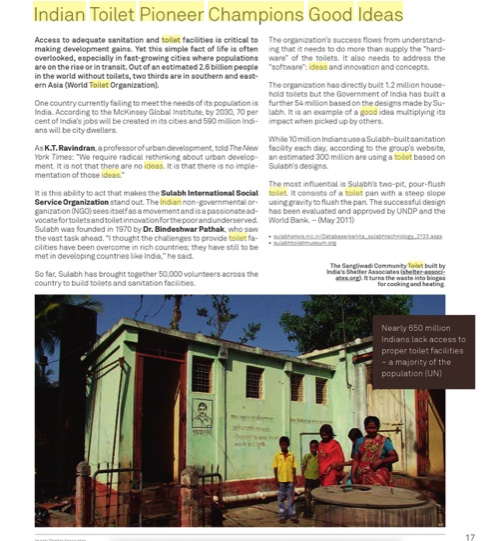
    Access to adequate sanitation and toilet facilities is critical to making development gains. Yet this simple fact of life often gets overlooked, especially in fast-growing cities where populations are on the rise or in transit. Out of an estimated 2.6 billion people in the world without toilets, two-thirds are in southern and eastern Asia (World Toilet Organization).

    It is easy to take toilet technology for granted in developed countries, but in the fast-growing urban world of the global South, increasing access will be the dividing line between a future of good human health and dignity, or misery and poor health. The biggest gains in human health always come about once people have access to clean water and sanitation. Yet this proven fact gets lost in many places for a wide variety of reasons.

    One country currently failing to meet the needs of its population is India. According to the McKinsey Global Institute, by 2030, 70 percent of India’s jobs will be created in its cities, and 590 million Indians will be city-dwellers. An enormous infrastructure task lies ahead for India: a city the size of Chicago needs to be built every year. But so far this challenge is not being met, leaving the country with the largest number of urban slum dwellers anywhere in the world. Housing is just not keeping up with populations’ needs.

    As K.T. Ravindran, a professor of urban development, told the New York Times: “We require radical rethinking about urban development. It is not that there are no ideas. It is that there is no implementation of those ideas.”

    It is this ability to act that makes the Sulabh International Social Service Organization stand out. The Indian non-governmental organization (NGO) sees itself as a movement and is a passionate advocate for toilets and toilet innovation for the poor and underserved.

    Sulabh was founded in 1970 by Dr. Bindeshwar Pathak, who saw the vast task ahead. “I thought the challenges to provide toilet facilities have been overcome in rich countries; it has still to be met in developing countries like India,” he said.

    So far, Sulabh has brought together 50,000 volunteers across the country to build toilets and sanitation facilities.

    The organization’s success flows from understanding that it needs to do more than supply the ‘hardware’ of the toilets; it also needs to address the ‘software’: ideas and innovation and concepts.

    The organization has directly built 1.2 million household toilets – but the government of India has built a further 54 million toilets based on the designs made by Sulabh. It’s an example of a good idea multiplying its impact when picked up by others.

    While 10 million Indians use a Sulabh-built sanitation facility each day, according to the group’s website, an estimated 300 million are using a toilet based on Sulabh’s designs.

    Most influential is Sulabh’s two-pit, pour-flush toilet (www.sulabhenvis.nic.in/Sulabhtechnology.htm). It consists of a toilet pan with a steep slope using gravity to flush the pan. Water is poured in to the pan to flush the toilet and the waste goes into either one of two pits. As one pit fills up with waste, waste is diverted to the second pit. After around 18 months, the first, filled pit’s waste becomes a safe, organic fertiliser suitable for agriculture and the fertiliser’s value covers the cost of emptying the pit. The successful design has been evaluated and approved by UNDP and the World Bank.

    Sulabh has also been designing ways to get power and energy from toilets, building 200 biogas plants that turn the gas generated from the human excrement deposited in the toilets into a source of energy. Biogas (http://en.wikipedia.org/wiki/Biogas) is a clean-burning gas that can be made from animal, plant and human waste with the right technology and is a green solution to the need for gas to cook and run electricity generators.

    Pride of place for the NGO is its vast toilet and bath complex at the holy shrine of Shri Sai Baba in Shirdi, Maharashtra (http://en.wikipedia.org/wiki/Maharashtra). Millions flock to the shrine every year, but it lacked proper sanitation facilities. To solve this problem Sulabh’s local branch has built a vast complex occupying two acres. The brightly coloured and palace-like facility has 120 toilets, 108 bathing cubicles, six dressing rooms, and urinals and can serve 30,000 people a day. There are telephones and 5,000 lockers for tourists to keep possessions safe.

    There are also three biogas plants connected to the facility, generating electricity and hot water for bathing used by the toilet and bath complex. This solves the puzzle of how to fund the utilities. Water discharged from the facility is used to irrigate the surrounding green spaces.

    Sulabh has also built a museum dedicated to toilets and toilet technology (http://www.sulabhtoiletmuseum.org). The museum places the toilet as a critical part of human civilisation and shows how it fits in with the cultural context of India. Toilets and toilet designs from around the world and throughout history are gathered together and make a fascinating journey through this essential human need.

    Published: May 2011

    Resources

    1) World Toilet Organization: World Toilet Organization (WTO) is a global non- profit organization committed to improving toilet and sanitation conditions worldwide. Website: http://www.worldtoilet.org

    2) World Toilet Day: On November 19 every year, this event draws attention to the lack of access for 2.6 billion people. Website: http://www.worldtoilet.org

    3) Dirt: The Filthy Reality of Everyday Life: An exhibit by the prestigious Wellcome Collection on the human relationship with dirt and hygiene in history. Website:http://www.wellcomecollection.org/whats-on/exhibitions/dirt.aspx

    4) World Toilet College: Established in 2005, the World Toilet College (WTC) started as a social enterprise, with the belief that there is need for an independent world body to ensure the best practices and standards in Toilet Design, Cleanliness, and Sanitation Technologies are adopted and disseminated through training. Website:http://worldtoilet.org/ourwork3.asp

    Development Challenges, South-South Solutions was launched as an e-newsletter in 2006 by UNDP’s South-South Cooperation Unit (now the United Nations Office for South-South Cooperation) based in New York, USA. It led on profiling the rise of the global South as an economic powerhouse and was one of the first regular publications to champion the global South’s innovators, entrepreneurs, and pioneers. It tracked the key trends that are now so profoundly reshaping how development is seen and done. This includes the rapid take-up of mobile phones and information technology in the global South (as profiled in the first issue of magazine Southern Innovator), the move to becoming a majority urban world, a growing global innovator culture, and the plethora of solutions being developed in the global South to tackle its problems and improve living conditions and boost human development. The success of the e-newsletter led to the launch of the magazine Southern Innovator. 

    Creative Commons License

    This work is licensed under a
    Creative Commons Attribution-Noncommercial-No Derivative Works 3.0 License.

    ORCID iD: https://orcid.org/0000-0001-5311-1052.

    © David South Consulting 2023