Categories
Archive

CASE STUDY 1: Investigative Journalism | 1991 – 1997

Expertise: Investigative journalism, editing, start-ups, content and magazine design, digital content, digital strategy.

Locations: Toronto and Guelph, Ontario, Canada and London, UK 1991 to 1997

Investigative Journalist, Editor, Reporter, Writer: David South

Abstract

I worked as a journalist for magazines and newspapers from 1991 to 1997 in Canada and the United Kingdom and as a radio host for a weekly spoken word interview programme, Word of Mouth (CKLN-FM). 

CKLN-FM’s “Word of Mouth 6 pm-6:55 pm Hosts: David South, Jill Lawless This show goes well behind the headlines for the real story behind the events.”

This included working as an investigative journalist for Now Magazine, “Toronto’s alternative news and entertainment source”, as a Medical and Health Correspondent for Today’s Seniors, and as an investigative journalist and reporter for two Financial Times newsletters, New Media Markets and Screen Finance.  

Samples of published stories can be found here (below) and on the Muck Rack platform here: https://muckrack.com/david-south

About

Could it be possible to do high-quality investigative journalism in the context of a shrinking economy undergoing austerity, and where the media sector is contracting and consolidating around a small number of media companies? Is it possible to launch new media products in the face of a contracting economy and reach new audiences and create new markets?

In Canada, the early to mid 1990s were the years of government austerity and economic crisis. After the crash of 1989/1990*, institutions came under great stress. Health care, for example, was pitched into a period of turmoil and change. Drawing on my experience working in the health sector (Princess Margaret Hospital/Ontario Cancer Institute), I covered this crisis in many stories for various publications, in particular Today’s Seniors.

The Canadian economy severely contracted and unemployment was at 11.4 per cent by 1993 (Statistics Canada), and as Statistics Canada says, “Because employment recovered at a snail’s pace after the recession of the early 1990s, the decline in the unemployment rate was delayed until 1994”. 

The media in general could not avoid the wider economic crisis. According to the book The Missing News: Filters and Blind Spots in Canada’s Press (Robert A. Hackett and Richard S. Garneau, Canadian Centre for Policy Alternatives, University of Toronto Press 2000), Canada’s media was also in a crisis throughout the 1990s, as declining resources, staff layoffs and media closures reduced the breadth and depth of news coverage. Canadian media as a whole also has a “great dependence on advertising, which accounts for more than 70% of daily newspaper revenues, about 64% of magazine revenues,” which means there is enormous pressure to only publish stories that do not upset advertisers. And monopolies exert great control over news content in Canada: “In the United States, ten companies control 43.7% of total daily newspaper circulation. By contrast, in Canada since 1996, one single company controls a comparable share of the media pie.”

The impact of this crisis was summed up by Jeffrey Simpson in the book The Missing News, where he said newspapers are “shrinking in size, personnel, ambition and, as a consequence, in their curiosity,” …. “I believe the result has been a diminution in quality.” (p64)

This is the context in which, ironically, it was possible to flourish as a much-sought-after investigative journalist who could get the story and get the quotes and as an editor. And it was also a time for opportunity, in particular as new media rose in importance, from cable and satellite television, to the rise of the Internet.

I broke original stories for Now Magazine as a member of their investigative reporting team, for Today’s Seniors as its Medical and Health Correspondent, and as a reporter for two Financial Times newsletters in London, UK. I also broke original stories as a freelancer for many other magazines and newspapers, including Hospital News, The Toronto Star, This Magazine, The Annex Gleaner, Flare, The Financial Post Magazine, Canadian Living, and others. I drew on strong contacts in health care, media, politics, international relations and the military. 

I was an editor for magazines, newspapers and newsletters as well, gaining invaluable experience and contacts. This included as Editor-in-Chief for start-up youth publication, Watch Magazine (see Case Study 2), and as Features Editor for Id Magazine (see Case Study 3). 

Themes covered included the uses – and abuses – of data, the impact of military engagements to uphold international law, how to re-structure health care when budgets are tight, with populations ageing, and technology and scientific advances quickly expanding options, the emerging new media world of cable and satellite television and the Internet, the sexual revolution 2.0, urbanization and how it re-shapes politics and community, international development, and youth culture. 

Story highlights include covering data concerns over Canada’s border screening measures, questions about the air quality of aircraft cabins, the debate over airstrikes in Bosnia, scandals involving peacekeepers in Somalia and reporting on the UN peacekeeping mission in Haiti, reforms to medical education in Canada, innovators in health care, the tug of war over health care spending during austerity measures, London, UK designers, the growing role of Nordic countries in cable and satellite television, the film financing scene in Europe and the UK, the new sexual revolution and its impact on cable and satellite television and the rising Internet, changes to Canada’s media industry, and Toronto’s embracing of the megacity concept and the political battles it sparked. 

I edited newsletters and newspapers aimed at specific communities, from Canada’s medical history community to part-time students. And had the privilege of helming a start-up youth magazine as its Editor-in-Chief to its commercial success (see Case Study 2). 

It was an exciting time of great change, best reflected by the fact in 1997 Id Magazine (Features Editor: see Case Study 3) was one of the first Canadian publications to regularly publish an online version (https://web-beta.archive.org/web/19970207103121/www.idmagazine.com).  

* “The last two recessions in Canada occurred in 1982 and 1990. … The most recent Canadian recession began in the second quarter of 1990 and over the next 12 months GDP fell by 3.2%. … The recovery from this recession was unusually slow; there was almost no growth between mid-1991 and mid-1992. This slow recovery was export driven.” (The Canadian Encyclopedia)

 “In early 1994, Canada’s economic situation was not that favourable—our economy was facing some rather serious problems.

 “… the recession here was more severe than in the United States.

“Working their way out of these difficulties was disruptive and painful for Canadian businesses. Defaults, restructurings, and downsizings became the order of the day. With all this, unemployment took a long time to recover from the 1990–91 recession and, in many instances, wages and salaries were frozen or reduced (Bank of Canada: Canada’s Economic Future: What Have We Learned from the 1990s?)

A small sample of published stories with links is below:  

Investigative Journalism 

An Abuse of Privilege?

Aid Organization Gives Overseas Hungry Diet Food

Artists Fear Indifference From Megacity

Casino Calamity: One Gambling Guru Thinks The Province Is Going Too Far

Counter Accusations Split Bathurst Quay Complex: Issues of Sexual Assault, Racism at Centre of Local Dispute

False Data Makes Border Screening Corruptible

New Student Group Seeks 30 Percent Tuition Hike

Peaceniks Questioning Air-raid Strategy in Bosnia

Safety at Stake

Somali Killings Reveal Ugly Side of Elite Regiment

Study Says Jetliner Air Quality Poses Health Risks: CUPE Takes on Airline Industry with Findings on Survey

Top Reporters Offer Military Media Handling Tips

Will the Megacity Mean Mega-privatization?

Will Niagara Falls Become the Northern Vegas?

Health and Medical

Changing Health Care Careers a Sign of the Times

Critics Blast Government Long-Term Care Reforms

Cut Services to Elderly, Says Doctors’ Survey … But Leave Our Salaries Alone!

Feds Call for AIDS, Blood System Inquiry: Some Seniors Infected

Government Urged to Limit Free Drugs for Seniors

Health Care on the Cutting Block: Ministry Hopes for Efficiency with Search and Destroy Tactics

Health Care in Danger

Lamas Against AIDS

New Legislation Will Allow Control of Medical Treatment

New Seniors’ Group Boosts ‘Grey Power’: Grey Panthers Chapter Opens with a Canadian Touch

Philippine Conference Tackles Asia’s AIDS Crisis

Private Firms Thrive as NDP ‘Reinvents’ Medicare

Psychiatric Care Lacking for Institutionalised Seniors

Seniors Falling Through the Health Care Cost Cracks

Specialists Want Cancer Treatments Universally Available

Take Two Big Doses of Humanity and Call Me in the Morning

Taking Medicine to the People: Four Innovators In Community Health

US Health Care Businesses Chasing Profits into Canada

Magazines

The Ethics of Soup: Grading Supermarket Shelves – For Profit

Freaky – The 70s Meant Something

Land of the Free, Home of the Bored

Man Out Of Time: The World Once Turned On the Ideas of this Guelph Grad, But Does the Economist John Kenneth Galbraith Know the Way Forward?

Oasis Has Arrogance, A Pile of Attitude and the Best Album of 1994

From Special Report: Sexual Dealing: Today’s Sex Toys Are Credit Cards & Cash: A Report On The Sex-For-Money Revolution

Redneck Renaissance: A Coterie of Journalists Turn Cracker Culture into a Leisure Lifestyle

Safety at Stake

Swing Shift: Sexual Liberation is Back in Style

Time Machines

Too Black

Media 

The Big Dump: CP’s New Operational Plan Leaves Critics with Questions Aplenty

Channel Regulation: Swedes will Fight Children’s Advertising all the Way

Do TV Porn Channels Degrade and Humiliate?

Is the UK Rushing to Watch TV Porn? 

Playboy ‘is not for sad and lonely single men’

TV’s Moral Guide in Question – Again

UK Laws on Satellite Porn Among Toughest in Europe

Undercurrents: A Cancellation at CBC TV Raises a Host of Issues for the Future

Special Reports

From Special Report: NMM (New Media Markets) Spotlight on the Emergence of Satellite Porn Channels in the UK

From Special Report: Sexual Dealing: Today’s Sex Toys Are Credit Cards & Cash: A Report on the Sex-for-Money Revolution

United Nations

Freedom of Expression: Introducing Investigative Journalism to Local Media in Mongolia

Starting from Scratch: The Challenge of Transition

State of Decay: Haiti Turns to Free-market Economics and the UN to Save Itself

Traffic Signs Bring Safety to the Streets

Magazines

Watch Magazine

Id Magazine

Newsletters

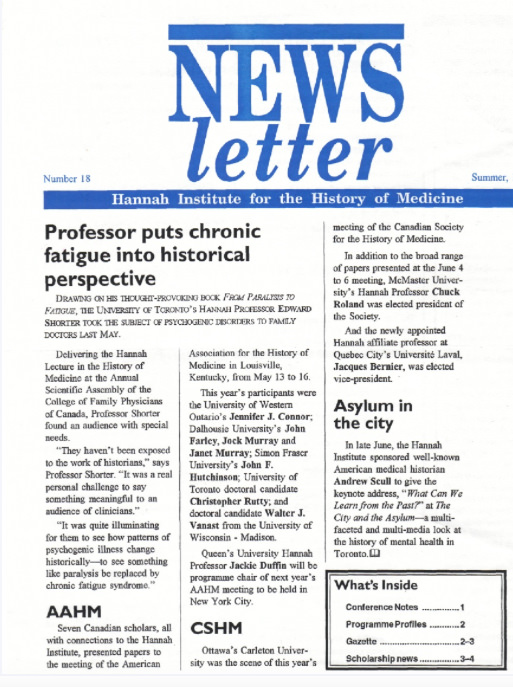
Hannah Institute for the History of Medicine

New Media Markets

Screen Finance

Blue Sky Bulletin

Other Resources

Ger Magazine: Issue 1

Ger Magazine: Issue 2

In Their Own Words: Selected Writings by Journalists on Mongolia, 1997-1999 (ISBN 99929-5-043-9) 

Mongolian Rock and Pop Book (ISBN 99929-5-018-8) 

Wild East: Travels in the New Mongolia (ISBN 1-55022-434-4)

Timeline 

1991: Begin career as investigative journalist and editor.

1992: Work as a Medical and Health Reporter for Today’s Seniors and as an Investigative Journalist for Now Magazine. Work as Editor and Writer for the Hannah Institute for the History of Medicine’s newsletter. 

1993: Published in many publications, including The Toronto Star, Canadian Living and This Magazine.

1994: Work on re-launch of Watch Magazine 2.0 and its expansion (see Case Study 2). 

1995: Work as reporter for two Financial Times newsletters in London, UK.

1996: Work on re-launch of Watch Magazine 3.0 and its expansion. Begin work at Id Magazine as its Features Editor (see Case Study 3).

1997: Begin two-year assignment with the United Nations mission in Mongolia (see Case Study 4). 

Testimonials 

David South … proved himself to be a penetrating, thorough and hard-working journalist. He produced a lot of very good stories …” Neil McCartney, Editor, Screen Finance, Telecom Markets and Mobile Communications, London, UK

This work is licensed under a Creative Commons Attribution 4.0 International License.

ORCID iD: https://orcid.org/0000-0001-5311-1052.

© David South Consulting 2025

Categories
Archive Blogroll Today's Seniors

New Legislation Will Allow Control Of Medical Treatment

By David South

Today’s Seniors (Canada), December 1993

It isn’t the nicest thing to think about, but if accident or illness strikes, you could end up receiving unwanted treatment. 

But in 1994 things will change. The living will or advance directive – a document clearly stating a patient’s wishes about how they want to be treated – will become part of the doctor-patient relationship. 

A trio of acts passed last December – the Advocacy Act, the Substitute Decisions Act and the Consent to Treatment Act – allow, albeit in rather vague language, for Ontarians to set out in advance which medical procedures they would or wouldn’t accept and let’s them name a proxy in case they are incapable of expressing their wishes. 

This vague language – intended to allow patients to customize their wishes – means that writing a living will can prove to be a troubling and confusing experience. 

To aid decision-making, the University of Toronto Centre for Bioethics is offering advice through a “model” living will. 

The centre’s Dr. Peter Singer has geared the “model” to meet Ontario legislation and to offer a guide for anybody who doesn’t know where to begin. 

“We put a lot of detail in the advance directive about states of incompetence people get into, and also the sorts of procedures providers might recommend in those health states.”

Singer sees living wills as an effective tool aiding patients to control their own health care.

“Unless the doctor is a longstanding friend it’s hard to know what patients want. As a practicing doctor, I have run into an incompetent person where their family member has no idea what sort of wishes the person would have wanted. The goal of a living will is to provide the personal care the patient would want.”

But there is a danger. Dr. Singer urges the need for informed and detailed language in a living will. 

“If I have a couple minutes to make a decision I need a document that gives me a lot of confidence that this person wouldn’t want this treatment.”

In an emergency, the doctor might not even know of the living will’s existence. Dr. Singer advises giving a copy to your family doctor, lawyer, or proxy, and keep one with you at all times. When so-called “smart” health cards come along, Dr. Singer would like to see the living will recorded on the magnetic strip along with other health information. 

Read more health and medical journalism here: Taking Medicine To The People: Four Innovators In Community Health

Read more about transforming medical history scholarship in Canada here: Hannah Institute For The History Of Medicine | 1992 – 1994

More from Canada’s Today’s Seniors

Feds Call For AIDS, Blood System Inquiry: Some Seniors Infected

Government Urged To Limit Free Drugs For Seniors

Health Care On The Cutting Block: Ministry Hopes For Efficiency With Search And Destroy Tactics

New Seniors’ Group Boosts ‘Grey Power’: Grey Panthers Chapter Opens With A Canadian Touch

Seniors Falling Through The Health Care Cost Cracks

Like our content? Help contribute to the costs of keeping it online. 

Scan code with your phone and help us out.

ORCID iD: https://orcid.org/0000-0001-5311-1052.

© David South Consulting 2021

Categories
Archive Blogroll Today's Seniors

Private Firms Thrive As NDP ‘Reinvents’ Medicare

By David South

Today’s Seniors (Canada), August 1993

Many of today’s seniors fought for Canada’s internationally-admired public health system. But more and more people are becoming worried that the combination of health care reform, funding cutbacks and free trade is fuelling the growth of a second tier of private medical services serving the well off. 

The provincial government sees things differently, arguing Ontarians no longer expect government to pay for everything and rather than eroding medicare, the NDP is reinventing it. 

Whichever way one looks at it, private insurance companies, homecare providers, labs and other services designed to make money are becoming more and more involved in the health care business. 

Operating in the territory outside the guidelines of the 1984 Canada Health Act – which sets out the principles of medicare for the federal government to enforce – the private sector has room to expand, at the same time as OHIP coverage is scaled back from more and more services. 

Janet Maher, whose Ontario Health Coaltion (OHC) represents doctors, nurses and other health care workers, worries for the future of medicare. 

“A number of things like accommodation services – laundry, food services – are in the grey area of the Canada Health Act,” says Maher. “So with all these fees that are being introduced, by the strict letter of the law, there is no way to stop them. But as far as we are concerned the spirit of the Act isn’t being observed.”

In its current reforms, the government of Ontario is emphasizing paramedical professions like midwives who fall outside the CHA and aren’t covered by OHIP. The turn to community-based services means that people have to rely more on services and providers that aren’t covered under the CHA. 

Maher says privatizing accommodation services is a recent phenomenon, the result of hospitals finding creative ways to trim their budgets. 

“It’s a new area that hospitals are taking bids on,” she says. “The other thing around the accommodation services is that because they are not categorized, strictly speaking, as health care services, none of this is exempted in the Free Trade Agreement from U.S. competition.”

A recent report by two British Columbia researchers tries to put together this complex puzzle. Jackie Henwood and Colleen Fuller of the 7,500-member Health Sciences Association of British Columbia recently charged that a combination of free trade and budget-slashing governments is eroding the universality of medicare and ushering in a two-tier system. 

Fuller and Henwood identify the Free Trade Agreement as the culprit. While the health care industry created more jobs than any other sector of the Canadian economy between 1984 and 1991, they point out the job growth has been concentrated in the private sector since free trade was implemented in 1989. And they expect worse under the proposed North American Free Trade Agreement (NAFTA). 

“NAFTA will accelerate trends towards a privatized, non-union and corporate-dominated system of health care in Canada.”

One provision of the Free Trade Agreement has also made it possible for U.S. companies to compete against Canadian firms in health care. Chapter 14, “health-care facilities management services”, allows wide-open competition. 

Under NAFTA, provisions will bind all levels of government to consider for-profit health care companies on both sides of the border on equal footing with public providers when bidding for services, and entitles them to compensation if they can prove to an arbitration board they’ve been wronged. 

“That represents a substantial encroachment on the democratic right of local, provincial and federal governments to make decisions,” says Cathleen Connors, who chairs the national wing of OHC, the Canadian Health Coalition. 

It’s this plus health care cutbacks – federal and provincial – that’s resulting in service and job cuts and bed closures in the public sector and an increase in privatization, say Henwood and Fuller. These opportunities have not gone unnoticed by private companies south of the border. 

One such company is American Medical Security Inc. (AMS) of Green Bay Wisconsin. After hiring Canadian pollsters Angus Reid to do a survey, AMS saw a profitable market in offering American hospital insurance to frustrated Canadians awaiting surgery. Sixteen per cent of those polled said they wanted this service; that was enough for AMS. 

“One thing that comes across loud and clear is that Canadians for the most part are happy,” says spokesperson Carrie Galbraith. “They know they are taken care of during an emergency. But they are willing to pay a little extra if they need care.”

So far, AMS offers its plan to Ontario, B.C. and Manitoba, with Toronto its best market. Galbraith says plans are in the works to expand to all of Canada except the territories. 

Unfortunately, like most private health plans, AMS cuts its losses by avoiding what Galbraith calls “adverse selection” – anybody with a known serious health problem need not apply. 

Here in Ontario, private for-profit home care services take in close to half of all OHIP billings. Many clients pay out of their own pockets for additional services. 

The Ontario health ministry doesn’t keep statistics on the extent of the private home health care sector, says spokesperson Layne Verbeek. But the Ontario Home Health Care Providers’ Association, a trade group, estimates private homecare companies now employ 20,000 and serve more than 100,000. 

“It’s a market situation,” says Henwood. “If the services aren’t available to people within the public sector, they will go outside of it. We’ve seen this in other countries like England, where they had a public system and now have a parallel private system. If you erode a system enough that people get angry, they are going to start to look for alternatives, and the people with the greatest liberty are those with money.”

But in a recent interview, health minister Ruth Grier was adamant this scenario wouldn’t be allowed to take place in Ontario. She strongly disagreed that medicare is being weakened due to recent changes, and said the government has actually “reaffirmed its commitment to medicare.”  

More from Canada’s Today’s Seniors

Feds Call For AIDS, Blood System Inquiry: Some Seniors Infected

Government Urged To Limit Free Drugs For Seniors

Health Care On The Cutting Block: Ministry Hopes For Efficiency With Search And Destroy Tactics

New Seniors’ Group Boosts ‘Grey Power’: Grey Panthers Chapter Opens With A Canadian Touch

Seniors Falling Through The Health Care Cost Cracks

My background: 

CASE STUDY 7: UNOSSC + UNDP | 2007 – 2016

CASE STUDY 5: GOSH/ICH Child Health Portal | 2001 – 2003

CASE STUDY 4: UN + UNDP Mongolia | 1997 – 1999

Hannah Institute For The History Of Medicine | 1992 – 1994

Taking Medicine To The People: Four Innovators In Community Health

Take Two Big Doses Of Humanity And Call Me In The Morning

Like our content? Help contribute to the costs of keeping it online.

Scan code with your phone and help us out.

ORCID iD: https://orcid.org/0000-0001-5311-1052.

© David South Consulting 2021

Categories
Archive Blogroll Today's Seniors

Cut Services To Elderly, Says Doctors’ Survey… But Leave Our Salaries Alone!

“With a guaranteed income and job security, I don’t know one doctor who has suffered in the recession…”

By David South

Today’s Seniors (Canada), January 1993

If the results of a nation-wide survey of doctors are right, Canadian physicians love medicare but abhor government attempts to make them accountable for its costs. It also suggests that doctors are more willing to talk about cutting services to seniors and people with “unhealthy lifestyles” than to discuss cutting their own wages to save money. 

However, according to some doctors, physicians’s anger with the provincial government is founded on ignorance and poor analysis of the larger forces affecting health care. 

The survey, Breaking the Wall of Silence: Doctors’ Voices Heard at Last, was commissioned by The Medical Post, a national newspaper for doctors. It sent questionnaires to 12,000 doctors, receiving 3,087 responses. The Post also conducted in-person interviews to better gauge the mood of doctors. 

The survey’s title is somewhat misleading, considering that doctors have been making noise over a number of issues this year; targets included proposed right-to-treatment legislation, cuts to the Drug Benefit Plan, capping of yearly billings at $450,000, and inquiries into charges of sexual abuse by doctors. And most significantly, the last conference of the Canadian Medical Association passed a resolution calling for a two-tier health system in which those with money can hop the queue. 

Post editor Diana Swift says the poll shows fairly strong support for limiting services to the elderly, although the survey question is short on details: “I feel it is reasonable that access to high-cost services such as transplants should be rationed according to such parameters as the patient’s age and/or unhealthy habits.”

Yet just under 70 per cent of doctors opposed any capping of their salaries, despite 56 per cent of the public supporting this measure according to a 1991 Globe and Mail-CBC poll. 

When questioned, Health Minister Francis Lankin expressed surprise that doctors felt so strongly, and denied the government is considering rationing services to seniors. Lankin feels the volatile mood of doctors is a reaction to the rapid changes taking place in health care. 

Dr. Michael Rachlis, health care critic and author of the book Second Opinion, says the survey’s low response rate means that the answers reflect “redneck physicians, who are more likely to respond.” Swift admits to a high response rate from young male physicians, who since the 1986 doctors’s strike in Ontario, have been considered the profession’s most militant. 

One response which some may find alarming was towards the “Oregon model.” In that American state, medical procedures are rationed to seniors and individuals covered by medicare. Anybody needing uncovered emegency treatment has to pay for it themselves. A disturbing 65 per cent of survey respondents supported such a move. 

Dr. Gerry Gold, associate registrar at the College of Physicians and Surgeons of Ontario, feels that some doctors lack perspective. “The complaints are a reflection of frustration with increasing involvement of government. But if physicians understood the role of the government in the U.S., they would realize they, along with insurance companies, intervene far more.”

Gold says doctors have had the same complaints ever since the beginnings of medicare. “Many front-line doctors lack the information to make informed comment,” he says. “They aren’t being consulted or informed by the government.”

Rachlis says many doctors fail to realize how privileged they are. “Canadian physicians don’t realize medicare has protected their autonomy more than in the U.S.,” he says. “Doctors are always angry because they have large chips on their shoulders from being brutalized in their training. They don’t realize the government has given them a privileged monopoly over health services. With a guaranteed income with job security, I don’t know one doctor who has suffered in this recession.”

Gold doesn’t foresee strikes or job actions by doctors, but predicts further government cuts, and more services being de-insured by OHIP. A recent example involved removing coverage for third-party medical exams such as those requested by employers or insurance companies. As medical procedures end up outside of OHIP, Gold foresees physicians charging whatever they like. 

A perennial idea is the user fee. This is one of the few ideas that gathers support from a majority of doctors and the general population alike. But Rachlis feels these measures are meanspirited and avoid the real problems plaguing health care. “When Saskatchewan introduced user fees for physician and hospital care in 1968,” he says, “health costs remained the same and it discouraged the elderly, the poor and people with large families from seeking service. 

“When providers are allowed to charge users for care, as in the United States, where more than 20 per cent of health care costs are paid our of pocket, overall costs go up.” 

More from Canada’s Today’s Seniors

Feds Call For AIDS, Blood System Inquiry: Some Seniors Infected

Government Urged To Limit Free Drugs For Seniors

Health Care On The Cutting Block: Ministry Hopes For Efficiency With Search And Destroy Tactics

New Seniors’ Group Boosts ‘Grey Power’: Grey Panthers Chapter Opens With A Canadian Touch

Seniors Falling Through The Health Care Cost Cracks

ORCID iD: https://orcid.org/0000-0001-5311-1052.

© David South Consulting 2021