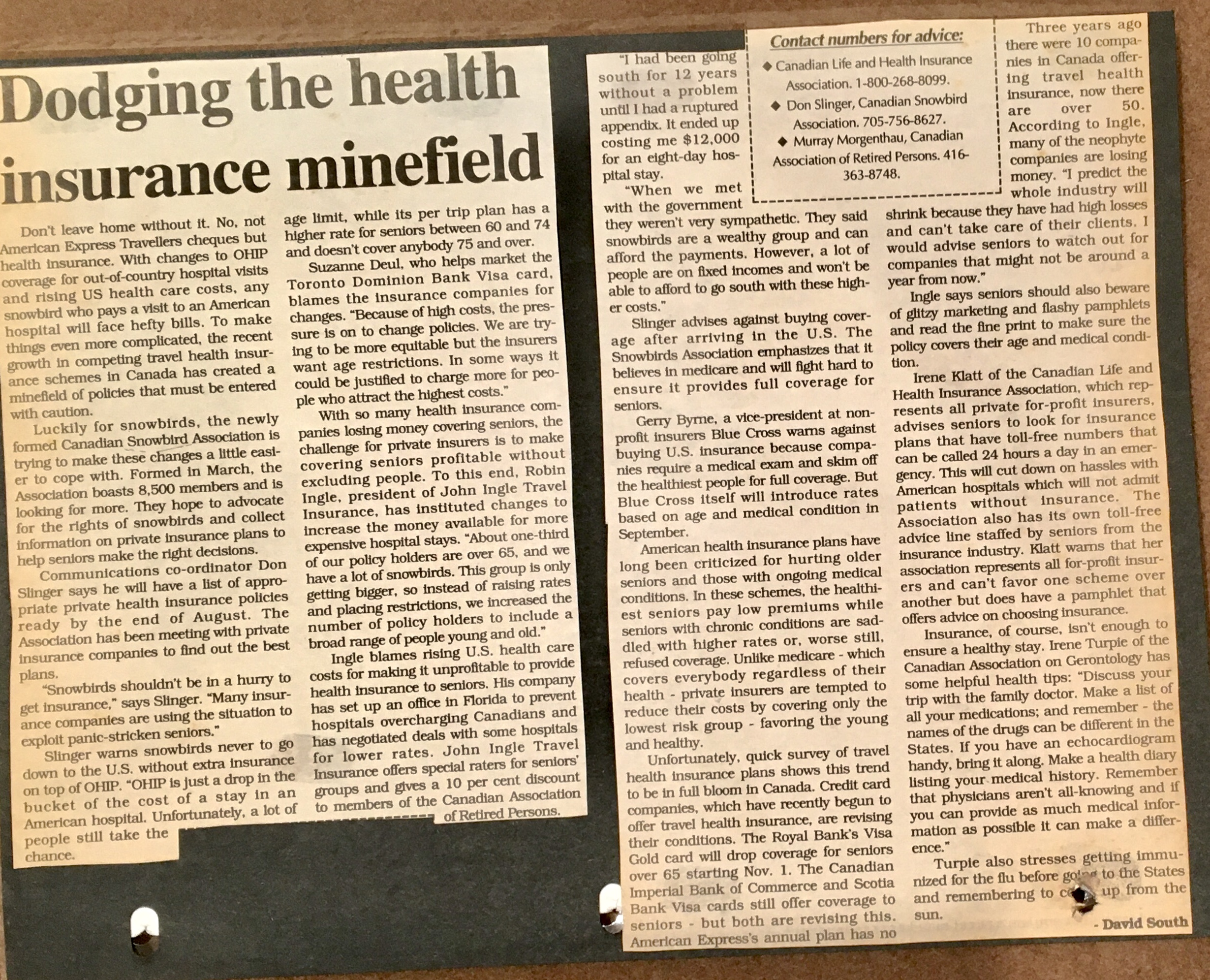
Don’t leave home without it. No, not American Express Travellers cheques but health insurance. With changes to OHIP coverage for out-of-country hospital visits and rising U.S. health care costs, any snowbird who pays a visit to an American hospital will face hefty bills. To make things even more complicated, the recent growth in competing travel health insurance schemes in Canada has created a minefield of policies that must be entered with caution.
Luckily for snowbirds, the newly formed Canadian Snowbird Association is trying to make these changes a little easier to cope with. Formed in March, the Association boasts 8,500 members and is looking for more. They hope to advocate for the rights of snowbirds and collect information on private insurance plans to help seniors make the right decisions.
Communications co-ordinator Don Slinger says he will have a list of appropriate private health insurance policies ready by the end of August. The Association has been meeting with private insurance companies to find out the best plans.
“Snowbirds shouldn’t be in a hurry to get insurance,” says Slinger. “Many insurance companies are using the situation to exploit panic-stricken seniors.”
Slinger warns snowbirds never to go down to the U.S. without extra insurance on top of OHIP. “OHIP is just a drop in the bucket of the cost of a stay in an American hospital. Unfortunately, a lot of people still take the chance.
“I had been going south for 12 years without a problem until a ruptured appendix. It ended up costing me $12,000 for an eight-day hospital stay.
“When we met with the government they weren’t sympathetic. They said snowbirds are a wealthy group and can afford the payments. However, a lot of people are on fixed incomes and won’t be able to afford to go south with these higher costs.”
Slinger advises against buying coverage after arriving in the U.S. The Snowbirds Association emphasizes that it believes in medicare and will fight hard to ensure it provides full coverage for seniors.
Gerry Byrne, a vice-president at non-profit insurers Blue Cross warns against buying U.S. insurance because companies require a medical exam and skim off the healthiest people for full coverage. But Blue Cross itself will introduce rates based on age and medical conditions in September.
American health insurance plans have long been criticized for hurting older seniors and those with ongoing medical conditions. In these schemes, the healthiest seniors pay low premiums while seniors with chronic conditions are saddled with higher rates or, worse still, refused coverage. Unlike medicare – which covers everybody regardless of their health – private insurers are tempted to reduce their costs by covering only the lowest risk group – favouring the young and healthy.
Unfortunately, a quick survey of travel health insurance plans shows this trend to be in full bloom in Canada. Credit card companies, which have recently begun to offer travel health insurance, are revising their conditions. The Royal Bank’s Visa Gold card will drop coverage for seniors over 65 starting Nov. 1. The Canadian Imperial Bank of Commerce and Scotia Bank Visa cards still offer coverage to seniors – but both are revising this. American Express’s annual plan has no age limit, while its per trip plan has a higher rate for seniors between 60 and 74 and doesn’t cover anybody 75 and over.
Suzanne Deul, who helps market the Toronto Dominion Bank Visa card, blames the insurance companies for changes. “Because of high costs, the pressure is on to change policies. We are trying to be more equitable but the insurers want age restrictions. In some ways it could be justified to charge more for people who attract higher costs.”
With so many health insurance companies losing money covering seniors, the challenge for private insurers is to make covering seniors profitable without excluding people. To this end, Robin Ingle, president of John Ingle Travel Insurance, has instituted changes to increase the money available for more expensive hospital stays.
“About one-third of our policy holders are over 65, and we have a lot of snowbirds. This group is only getting bigger, so instead of raising rates and placing restrictions, we increased the number of policy holders to include a broad range of people young and old.”
Ingle blames rising U.S. health care costs for making it unprofitable to provide health insurance to seniors. His company has set up an office in Florida to prevent hospitals overcharging Canadians and has negotiated deals with some hospitals for lower rates. John Ingle Travel Insurance offers special rates for seniors’ groups and gives a 10 per cent discount to members of the Canadian Association of Retired Persons.
Three years ago there were 10 companies in Canada offering travel insurance; now there are over 50.
According to Ingle, many of the neophyte companies are losing money. “I predict the whole industry will shrink because they have had high losses and can’t take care of their clients. I would advise seniors to watch out for companies that might not be around a year from now.”
Ingle says seniors should also beware of glitzy marketing and flashy pamphlets and read the fine print to make sure the policy covers their age and medical condition.
Irene Klatt of the Canadian Life and Health Insurance Association, which represents all private for-profit insurers, advises seniors to look for insurance plans that have toll-free numbers that can be called 24 hours a day in an emergency. This will cut down on hassles with American hospitals which will not admit patients without insurance. The Association also has its own toll-free advice line staffed by seniors from the insurance industry. Klatt warns that her association represents all for-profit insurers and can’t favor one scheme over another but does have a pamphlet that offers advice on choosing insurance.
Insurance, of course, isn’t enough to ensure a healthy stay. Irene Turple of the Canadian Association on Gerontology has some helpful health tips: “Discuss your trip with the family doctor. Make a list of all your medications; and remember – the names of the drugs can be different in the States. If you have an echocardiogram handy, bring it along. Make a health diary listing your medical history. Remember that physicians aren’t all-knowing and if you can provide as much medical information as possible it can make a difference.”
Turple also stresses getting immunized for the flu before going to the States and remembering to cover up from the sun.
Check your prejudices at the door, look beyond your self-interest, and open your mind, because the Grey Panthers are here in Canada.
Joe Moniz, the 26-year-old founder of the Canadian Grey Panthers, is confident that his ambitious plans for a new national seniors’ organization are just what Canadian seniors need.
That’s right: 26-years-old. Modelled on the U.S. Grey Panthers, the Canadian Grey Panthers believe in harnessing the power of all age groups, making the connection that everybody will eventually be a senior and that seniors benefit from a better society for everyone.
“The major difference between us and any other organization is our slogan, “Age and Youth Working Together,” he says. “Look at our pension fund. It’s depleting. I’m concerned about my future as a senior citizen – will there be a pension fund? We want to act now, to bring youth and age together to improve the situation of seniors today and improve our situation in the future.
“Membership is open to all age groups. We want to bring seniors into day care to interact with children. We want to deal with the universities, give people the opportunity to discuss and unite. It’s a different approach, but it can make a huge difference.”
Moniz has already organized the group’s first chapter, in Hamilton, complete with a board of retired university professors and doctors. The group has put together insurance packages that will “blow the others out of the water.”
“All seniors’ attempts at lobbying in the past have been short term,” says a blunt Moniz. “We are the organization that will make the difference. We will lobby provincially, federally, and municipally, and we are non-partisan.
“The reason I’m introducing the Grey Panthers is to keep grey power alive in Canada, and to provide the necessary channels to do so through lobbying efforts. If anyone has problems with local politicians, they can call us, and we in turn let them know the channels they should use. There are a lot of seniors out there being cheated, and it is up to us to help them.”
The Canadian Grey Panthers (which uses the British spelling, as opposed to its American counterpart) will initially concentrate on four issues: pensions, drug plans, affordable housing and long-term care, and will communicate information through newsletters, surveys and meetings.
Moniz promises to make the Panthers accessible to all, no matter what their income. He plans to hit the streets and visit institutions to inform seniors of the group’s presence. As if to prove the group’s potential for excitement, an enthusiastic gentleman from a local retirement home interrupts Moniz during a coffee shop interview. “That’s the best thing I’ve heard from a young person in Toronto,” he says.
The U.S. Panthers were formed by political activist Maggie Kuhn and five friends in 1970. Back then, their name wasn’t as exciting. It was the convoluted and unsexy “Consultation of Older and Younger Adults for Social Change.” In 1972, they adopted the media’s pet name – a grey twist on radical African-American rights organization the Black Panthers.
The radical milieu of political activism was contagious – and the Panthers symbolized its jump from the youth of America to other generations.
“When we formed, we were an intergenerational group,” says Panthers’ U.S. national chair, Charlotte Flynn. “The first issue the group addressed was mandatory retirement. We combat the stigma of ageism, which is making decisions about people based on chronological age. Ageism isn’t just confined to the elderly – ageism exists for young people as well.”
The agenda of the Panthers is just as radical today. Flynn, who is candid about the group’s failures as well as its successes, admits that it isn’t the easiest route to popularity. With membership at about 45,000, the U.S. Panthers have spoken out on now-popular issues like health care, the environment, affordable housing – and taken brave stands against mainstream opinion when it came to the Gulf War and the invasion of Panama.
And they think big. Not content with just influencing the American political scene, the Panthers have taken on the world, gaining official advisor status at the United Nations.
Although involved in a broad range of issues, Flynn says the Panthers are primarily seen as a strong voice for the rights of American seniors.
“We have tried very hard to let people know we are not a special interest group for the elderly,” says Flynn. “But we are always getting called upon to highlight what any legislation is doing to older people.”
With Panther groups sprouting in Europe and now in Canada, the important issue of maintaining the integrity of the Panther name has arisen, says Flynn. She points to the flip side of having a reputation for action: people want to start branches without being interested in the full agenda of the Panthers, using the name for shock value. At the last convention in November 1992, the Panthers formed a committee to act as quality control monitors for the name.
One thing is clear from the ambitious agenda of the Grey Panthers – they aren’t for everyone.
But Moniz’s pragmatic approach seems distinct from the American Panthers. He shies away from some of the American group’s positions, emphasizing a balance between insurance policies and political policies.
“If you read the American Panthers’ position sheet, it’s anti-this and anti-that,” he says. “We aren’t going to take that approach. It would be suicide.”
But he is quick in his praise of the group and its founder Maggie Kuhn. “People may consider her actions to be radical, but they’re not. Look at the achievements. She is one of the top 25 active women in the U.S.
“The Gray Panthers are achievers. They have proven the effectiveness of intergenerational attempts at social justice.”
A quick call to seniors’ groups drew many surpised faces.
“I can’t say anything about them – I don’t know who they are,” responded Murray Morgenthau, executive director of the Canadian Association of Retired Persons (CARP).
Jane Leitch at the United Senior Citizens of Ontario had heard something was happening but wonders why a new group is forming “with so many groups out there.”
One Voice spokesperson Andrew Aitkens says his group is closer to the American Association of Retired Persons than the Panthers in their approach, and that they “have found that there are much more effective ways for advocacy. We don’t march on the Hill at the drop of the hat.”
But Flynn says the Panthers embody a philosophy distinct from all other seniors’ groups. “As Maggie Kuhn said, ‘those of us who are older are the elders of the tribe and should be concerned about survival.’ We look at all issues that deny people the ability to realize their full potential, whether young or old. We are really interested in empowering people rather than being a special interest for the elderly.”
27 Years Contributing as a Health and Human Development Communicator | 1991 – 2017
Preface
Out of the army and off to the University of Toronto in the 1980s.
Whilst studying at the University of Toronto in the 1980s, the seeds were sown for much of the work that followed in the 1990s and 2000s. And what came together was the ability to undertake innovative communications initiatives using media and the latest digital tools. I had a strong interest in what constituted a modern, healthy society, and this eventually led my studies from psychology to sociology to history and eventually medical history. Along the way, I further developed my keen interest in communicating, writing for student media and broadcasting on student radio. I also organised various student organisations, from Erindale College’s first Peace Club, to its Amnesty International chapter, and eventually ran on a reforming ticket for the Students Adminstrative Council (SAC) at U of T. I undertook primary research for a history professor (Sidney Aster) working on a book, looking into the British Government’s efforts to organise food supply shipments during World War II (the biography of Lord Salter, Power, Policy and Personality: the Life and Times of Lord Salter, 1881-1975), and catalogued the CIA (Central Intelligence Agency) collection for the University of Toronto (Robarts Library). Being U of T, I also had the privilege of making amazing contacts and meeting some of the brightest Canadian minds of the time (for example, Professor Edward Shorter, co-author of Shock Therapy: A History of Electroconvulsive Treatment in Mental Illness).
The 1990s were an exciting time because it was possible to blaze new trails with emerging digital technologies. And this led to highly influential work with the United Nations and the UK’s National Health Service (NHS). This included an opportunity to head up the communications office for the UN in Mongolia just at the moment in the late 1990s when the Internet was coming online, and undertaking an influential role heading the launch of a child health portal for the prestigious Great Ormond Street Children’s Hospital (GOSH)/Institute of Child Health (ICH), just as the NHS was undertaking its Modernisation Plan in the early 2000s.
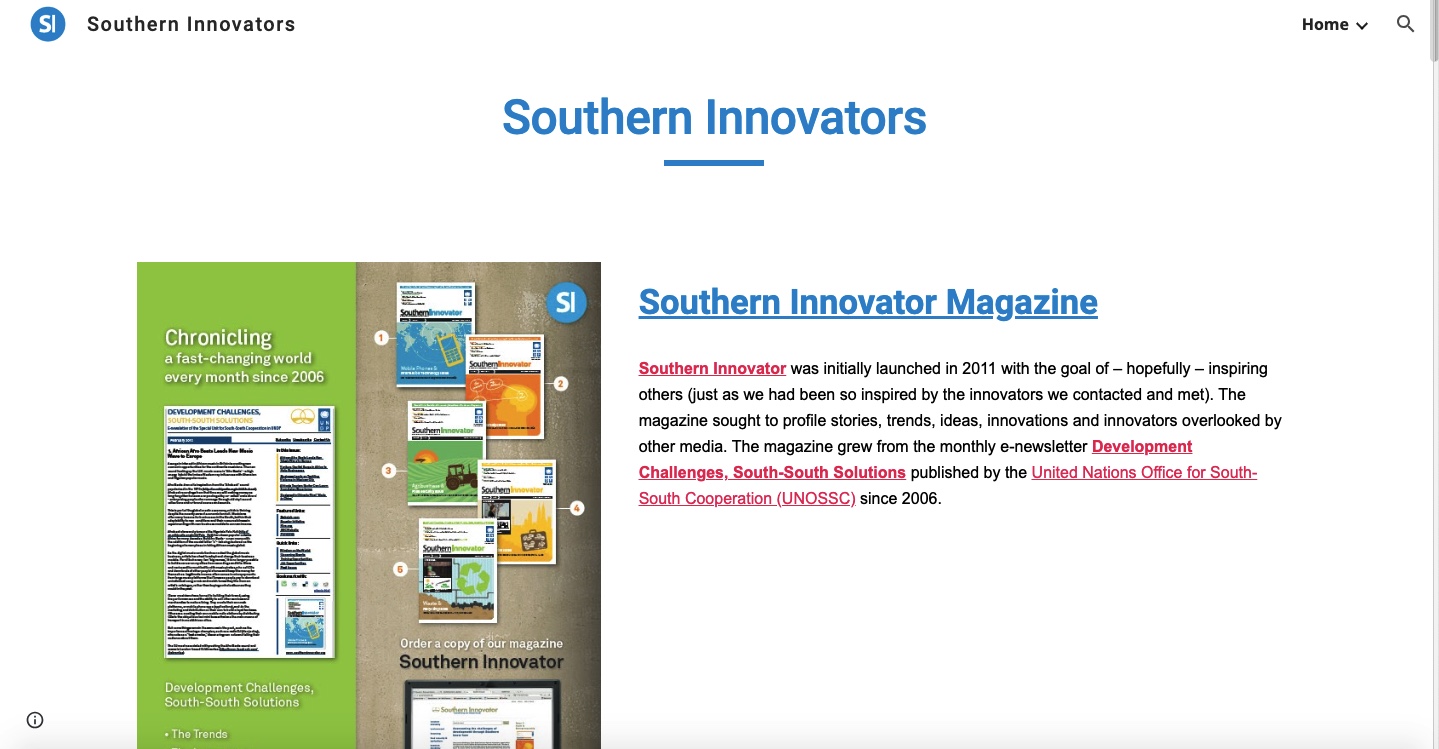
By the mid-2000s, whilst consulting for the United Nations in Africa, Asia and Central Asia, I was offered a new opportunity in 2006/2007 to work with the then-Special Unit for South-South Cooperation (SSC) based in New York. It became clear there was a disconnect between what was happening within the United Nations and what was happening on the ground in the global South. The rapid take-up of mobile phones was transforming how people communicated and led their lives. Elsewhere, the wider mobile and information technologies space was generating new business models and creative ways to use communications tools to do things and make a living. All this was very stimulating and chronicled in the e-newsletter Development Challenges, South-South Solutions and Southern Innovator Magazine for the United Nations Office for South-South Cooperation (UNOSSC).
Timeline
1985/1989: Graduate from the University of Toronto with a BA Honours in History (including medical history) and Political Science. One of my final year papers addressed medical quackery involving the drug laetrile as a cancer cure and how the medical establishment and regulatory authorities, in their attempts to prevent its use, in fact played into the prevailing anti-establishment political climate and distrust of institutions and the government.
1989/1991: Begin work as a Unit Coordinator for a chemotherapy ward of the Princess Margaret Cancer Centre (previously Princess Margaret Hospital/Ontario Cancer Institute) in Toronto. First training in health informatics and witness first-hand new computer initiatives to quantify workload on the ward to better allocate resources.
Report from Miami and Fort Lauderdale for Today’s Seniors in the wake of Hurricane Andrew on medical evacuation coordination measures for Canadian ‘Snowbirds’.
1994/1996: Editor-in-Chief for Watch Magazine, an innovative youth culture and media start-up partly funded by the Government of Canada. Watch Magazine played an important role in Toronto’s recovery from the economic collapse brought about by the combination of the late 1980s crash and government austerity policies. By engaging youth (high school-aged writers, editors and creatives), Watch Magazine showed their energy and perspective could jolt the city back to life, despite the negative media portrayal of youth at the time.
“As one of those high school kids and the guy who wrote (most of) this article, I’d like to say thanks to David [South] for all his hard work on Watch magazine! I learned a lot from him and it was a great experience.” William White
In 1995 I worked as a Senior Media Reporter for the Financial Times‘ newsletters New Media Markets and Screen Finance. I covered the rise of new media, including the Internet and cable and satellite television channels. Also covered new film-financing schemes funded by the European Union and the rise of new media in the Nordic countries. Stories included:
1997/1999: Communcations Coordinator and head of communications for the UN Mongolia mission in Ulaanbaatar, Mongolia (1997-1999) under the Partnership for Progress.
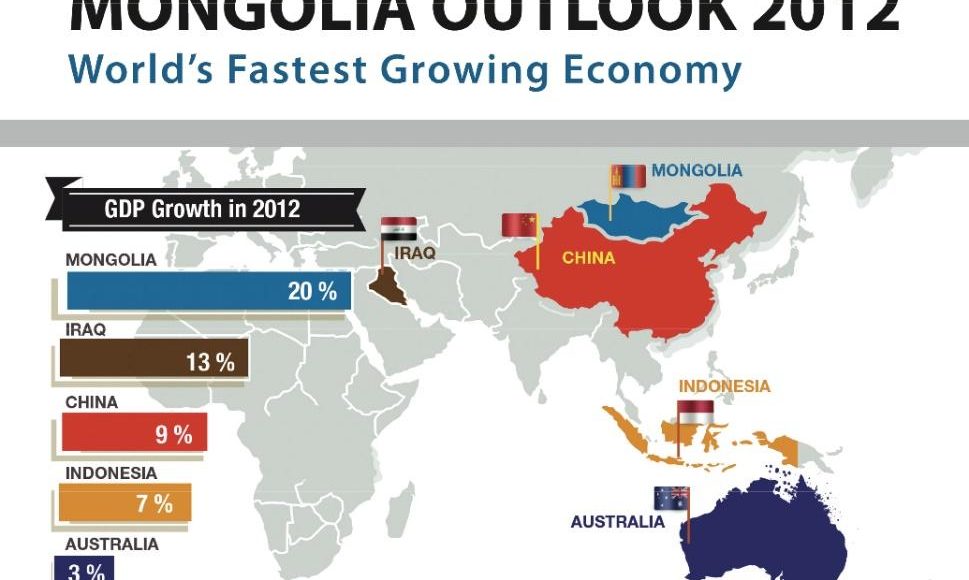
1997: Begin a two-year assignment as head of communications for the UN/UNDP Mongolia mission (1997-1999). Called “one of the biggest peacetime economic collapses ever”, I was thrown into the deep end as part of the UN’s efforts to rescue Mongolia from this severe crisis. I established the award-winning UN/UNDP Mongolia Communications Office (a high-profile and lively hub staffed by media professionals) and quickly developed and launched the award-winning UN Mongolia Development Portal (www.un-mongolia.mn) (called a “role model” for the United Nations). I developed and launched the mission’s first newsletter, Blue Sky Bulletin(distributed by post, online and by email to subscribers), as well as the first Mongolian Human Development Report, the Mongolian AIDS Bulletin(after attending the Fourth International Congress on AIDS in Asia and the Pacificin 1997, and meeting and being inspired by UNAIDS head Dr. Peter Piot, the Bulletin was used to kick-start Mongolia’s response to an unfolding STDs/HIV/AIDS crisis), the UN’s and Mongolia’s first online magazine, Ger, while also overseeing the country’s largest bilingual online and offline publishing operation. In Starting from Scratch: The Challenge of Transition, I document the challenge to re-start Mongolia’s data and statistics collection after it was wiped off the mainframe computers that once stored it during the Communist period (a cautionary tale for our times if there ever was one!). InFreedom of Expression: Introducing Investigative Journalism to Local Media in Mongolia, I give an account of a workshop for Mongolian journalists keen to learn more about the discipline of investigative journalism and how important it is in a democracy. In Partnership for Progress: UNDP in Mongolia, I painted a picture of Mongolia’s country conditions in 1997, what was at stake, and how the UN was responding. Stabilized, by 2012 Mongolia was being called the fastest growing economy in the world, and was contributing troops to UN peacekeeping missions.
Whilst working for a UK-based international development consultancy, I prepared papers for the American Foundation for AIDS Research (AMFAR), the Global Fund to Fight AIDS, Tuberculosis and Malaria, the Harvard Institute for International Development (HIID), for various UN agencies including UNCTAD and UNAIDS, and coordinated the preparation of the report and launch strategy for the World Bank’s Task Force on Higher Education and Society (2000).
2001/2003: Project Manager in charge of Web Strategy for the GOSH Child Health Portal at Great Ormond Street Hospital for Children NHS Trust/Institute of Child Health.
2001: Begin work on the development of the award-winning GOSH Child Health Portal for the National Health Service (NHS). As part of the NHS’ Modernisation Plan, it was called a “role model” for the NHS and one of the “three most admired websites in the UK public and voluntary sectors,” and was developed and launched under heavy public and media scrutiny. Each stage of the Portal’s development would coincide with a high-profile media launch. For example, the Hospital’s 150th birthday celebrations included Her Majesty Queen Elizabeth II and pop star Madonna.
“The GOSH/ICH web site to date has been a notable success. Not only has it met a majority of its objectives … and achieved recognition as ‘exemplary’ among NHS resources, but it has also generated a number of spin-off projects, including Children First (as a successor to GOSHKids) and The Virtual Children’s Hospital. …
“In a context in which less than 25% of all projects realise even 50% of their benefits, the satisfaction of 75% of the original objectives .. must rank as a significant achievement.” Consultant’s evaluation of the GOSH Child Health Portal in 2003.
2003/2004: Live and work in Jerusalem, Israel. Travel extensively around the country during the hudna.
2007/2017: Consultant and Editor and Writer for the United Nations Office for South-South Cooperation (UNOSSC) (formerly the Special Unit for South-South Cooperation). Both an e-newsletter (Development Challenges, South-South Solutions) and a magazine (Southern Innovator) are produced chronicling the impact of mobile and information technologies on the global South, and the rise of a 21st-century innovator culture as a result. Both media substantially raise the profile of the global South, Southern Solutions, and the 21st-century global innovation culture, while also being cited as an influential resource in the UN’s adoption of an innovation and South-South Cooperation agenda for its programming and priorities.
The thinking behind this work can be found in two sources:
1) Innovation: Applying Knowledge in Development by The UN Millennium Project, “commissioned by United Nations Secretary-General Kofi Annan to develop a practical plan of action to meet the Millennium Development Goals. As an independent advisory body directed by Professor Jeffrey D. Sachs, the UN Millennium Project submitted its recommendations to the UN Secretary General in January 2005. The core of the UN Millennium Project’s work has been carried out by 10 thematic Task Forces comprising more than 250 experts from around the world, including scientists, development practitioners, parliamentarians, policymakers, and representatives from civil society, UN agencies, the World Bank, the IMF, and the private sector” (Innovation: Applying Knowledge in Development, UN Millennium Development Library, Taylor & Francis, 17 June 2013).
2) Two editors for the e-newsletter and magazine, Cosmas Gitta and Audette Bruce, authored a paper jointly with Professor Calestous Juma (a well-known scholar and leading figure in the study of innovation at the Belfer Center) in 2005 for the Harvard Kennedy School’s Belfer Center for Science and International Affairs titled, Forging New Technology Alliances: The Role of South-South Cooperation.
2007: David South Consulting begins work on the e-newsletter Development Challenges, South-South Solutions for the then-Special Unit for South-South Cooperation (SSC) at the United Nations. The e-newsletter is distributed by email to an influential global subscriber audience working in international development and the United Nations, as well as distributed online via various platforms.
2008: Reader response experiment begins with crowd-powered news website NowPublic. Initial proposal for the development of book or magazine on innovation. Awarded grant for Cuba study tour by BSHF.
2009: Adjust e-newsletter content based on reader responses. Begin posting content on Twitter platform.
2010: Begin development of the new global magazine Southern Innovator with the then-Special Unit for South-South Cooperation (SSC) at the United Nations and a design team in Iceland led by Solveig Rolfsdottir, one of Iceland’s top graphic designers and illustrators.
The magazine was produced to the UN’s design standards, as well as abiding by the UN’s Global Compact. With production in Iceland, the magazine could be designed and laid out using 100 per cent renewable energy sources.
Launch David South Consulting as Senior Partner working with talented global professionals.
It is called “a terrific tour de force of what is interesting, cutting edge and relevant in the global mobile/ICT space…”. Launch www.southerninnovator.org website (now www.southerninnovator.com) and social media including Twitter account @SouthSouth1.
To avoid censorship and interference, Southern Innovator‘s editorial operations were based in London, UK and its design studio was based in Reykjavik, Iceland (a high-ranking country in the World Press Freedom rankings and a former top place holder in the UNDP Human Development Index). Using a women-led design studio, it developed a design vision that could communicate across borders using clear graphic design and high-quality images. For example, when it launched in 2011, infographics were rare in development publications and at the UN; now they are commonplace. It also tried to be as ‘green’ as possible. The studio was powered on 100 per cent renewable energy (in particular, geothermal energy); the hard copy of the magazine is printed on paper from sustainable forests.
2012: Launch second and third issues of Southern Innovator Magazine at the GSSD Expo in Vienna, Austria.
Called a “Beautiful, inspiring magazine from UNDP on South-South innovation.”
With 201 Development Challenges, South-South Solutions stories posted on the NowPublic platform, a total of 336,289 views by 2012 had occurred, according to the NowPublic counter (Closed in December 2013, the stories published on NowPublic were able to reach a large, global audience, receiving 201,109 views as of 27 June 2010, and reaching 420,151 views by 31 July 2013. The stories were cited in many other media resources and also in books. This includes Export Now: Five Keys to Entering New Markets by Frank Lavin and Peter Cohan (2011) and The Canadian).
2013: Launch fourth issue of Southern Innovator Magazine at the GSSD Expo in Nairobi, Kenya.
Called “fantastic, great content and a beautiful design!” and “Always inspiring.”.
2014: Launch fifth issue of Southern Innovator Magazine at the GSSD Expo in Washington, D.C. U.S.A. The Twitter account @SouthSouth1 called “ one of the best sources out there for news and info on #solutions to #SouthSouth challenges.” Final issues of e-newsletter Development Challenges, South-South Solutions published.
The two publications proved influential on a number of fronts, being early to draw attention to the following: the rising use of mobile phones and information technology in development, the world becoming an urban place, innovative food solutions including the nascent insect food sector (now a big thing), altering perspectives on what is possible in Africa, the use of data science to innovate development, and tracking the growing number of technology hubs and the fast-growing start-up culture in the global South. The publications were cited for shaping the new strategic direction adopted by the United Nations Development Programme (UNDP) (the UN’s leading development organisation) and its first youth strategy, and the development of the Sustainable Development Goals (SDGs). As the world’s first global innovator magazine, Southern Innovator’s design had to be appropriate for a diverse audience. It has drawn praise for being both “beautiful” and “inspiring”, while its use of sharp, modern graphic design and infographics inspired others in the UN to up their game when it comes to design.
Senior Partner David South outside the White House in 2014.
2015: Develop scale-up plan for Southern Innovator Magazine. The UNOSSC was promoted from being a Special Unit to an Office. It also had its budget increased.
South-South cooperation and innovation have now become the key methodology for the UN’s delivery of its programmes and projects. In 2015, China pledged US $2 billion to “support South-South cooperation” and called for the international community to “deepen South-South and tripartite cooperation”. In development parlance, they have been “Mainstreaming South-South and Triangular Cooperation” in their plans.
The current policy vogue for innovation in developing and developed countries can trace its roots back to some of the early work done by these two publications (and which was further amplified by the annual Global South-South Development Expo (GSSD Expo), which often would feature innovators from the two publications, spreading the innovation message around the world). Both publications had set out to inspire and “champion a global 21st century innovator culture”. And they have done this, as can be seen from concrete evidence and anecdotal responses from individuals and organizations alike.
Agribusiness strategy and rural development: A case study of Ihunga Sub County, Ntungamo District by Denis, Simpson Singahache, 2018
Financing Renewable Energy in Developing Countries: Analysis of Business Models and Best Practices, Resources Future Publication, Pakistan Office, July 2018
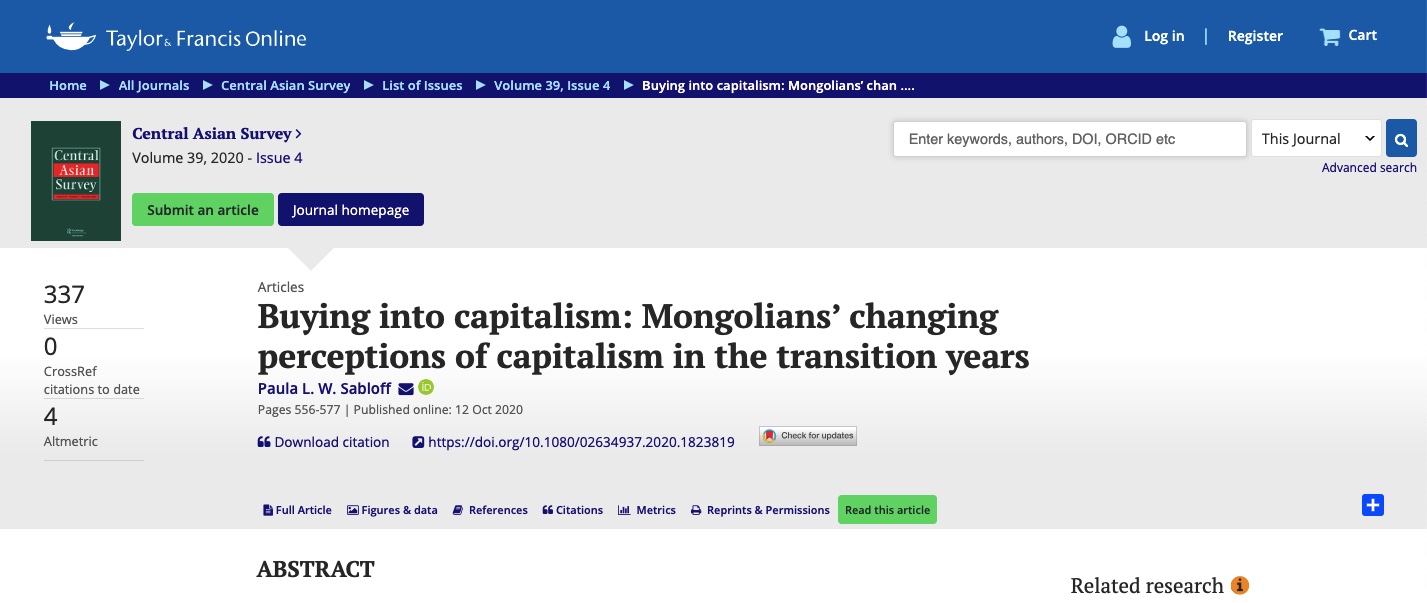
“A political anthropologist, she uses complex-systems tools to analyze three different databases: Mongolians’ changing ideas on democracy and capitalism, the emergence of early states all over the world, and 19-20th century Cozumel.”
The Santa Fe Institute “is the world’s leading research center for complex systems science.”











 David South Consulting
You must be logged in to post a comment.