
Tag: The Simpsons

  • Popular Characters Re-invent Traditional Carving

    Popular Characters Re-invent Traditional Carving

    By David SouthDevelopment Challenges, South-South Solutions

    SOUTH-SOUTH CASE STUDY

    The popular cartoon characters from the long-running series The Simpsons are breathing new life into traditional African stone carvings.

    A traditional craft in many cultures, carving adds value to local resources and provides an excellent source of income for local artisans and entrepreneurs. While wood or stone carvings are a popular tourist souvenir throughout Africa, Asia and Latin America, most carvers stick to traditional subjects.

    However, a group of villagers in western Kenya have transformed their economy by swapping carvings of elephants and Cleopatra for Homer, Marge and Sideshow Bob.

    According to the book Carving out a Future by the Centre for International Forestry Research (CIFOR), carving exports from the island of Bali in Indonesia total US $100 million per year. India’s industry is worth US $65 million. In Oaxaca, Mexico, carvings earn US $2,500 per household, increasing access to education and health. In Kenya, carving involves more than 60,000 people and provides household income for more than 300,000. In some communities in South Africa, households can earn between US $500 and US $2,000 per year from carvings – 80 per cent of a household income.

    Research into carving has identified several factors that are critical to maximising profits: quality is critical, and the best woods and stone must be used. Diversity is an important element: too much of the same thing being made available damages the market. And sustainability: the wood and stone resources must not be used up.

    It is this novelty and diversity that The Simpsons carvings address. By tapping into the global market for official licensed merchandise, the Tabaka carvers of the Abagusi tribe – well-known carvers in western Kenya – have significantly increased their income. And they are cashing in on the global popularity of the first Simpsons movie released this year.

    Tabaka is a village three hours by bus from Kenya’s capital, Nairobi. In Nairobi, the carvers would sell their soap stone carvings to middlemen, often for a pittance compared to what they would in turn charge tourists. Negotiations with these vendors could take days and waste the precious income of the carvers as they waited around for the deal to come through.

    Craft Village UK has organised the carvers to produce Simpsons statuettes for the worldwide market. The carvers were able to win the official merchandise license from The Simpsons’ owners, Twentieth Century Fox, after its vice-president saw a video of the carvers. They were initially awarded the license to craft 12 of the show’s characters for the US and UK markets, but last month they gained the worldwide license.

    Craft Village’s founder, UK-based Paul Young, had the idea three years ago when his sister returned from living in Uganda with soap stone carvings. Impressed by the quality of the workmanship, he thought they would sell better in a western market if they reproduced popular images from films and TV. In 2005, he made contact with the carvers through a crafts company in Nairobi. He sent initial plastic figurine models and photos to help the carvers get the statues right. He flew to Kenya in 2005 to meet the carvers for the first time and video the carving process.

    Initial prototypes were too heavy and some would break. And it took 12 months of trial and error to get the quality high enough to approach Twentieth Century Fox.

    “Familiarizing the carvers with The Simpsons was difficult,” said Young. “Making the carvers understand the importance of quality control and the need for benchmark standards and uniform carvings was – and still is – a challenge.”

    “I don’t know who they are,” said Pauline Kemunto, who helps her husband with the carvings. “But I like them because I earn from them.”

    In a community known for growing bananas, David Atang’a, master carver and former soldier, supports five children. “If this Simpsons project succeeds, I hope to educate my children in university,” he said.

    Two groups of 15 members each are divided between Tabaka Master Carvers and Tabaka Classic Carvers. Women take over and wash, polish and shine the pieces. Each piece is numbered and signed (Craft Village UK products).

    The carvers now make 450 Kenyan shillings per statue (UK £3) – between four and six times what they would have got for a traditional carving. Where work before was sporadic, it is now regular and employs 80 people. The extra income means the carvers can now send their children to secondary school.

    Enosh Onsombi grew up with no electricity and no television. But since the community started carving the Simpsons characters, “Life has changed so much,” he told The Independent newspaper. “The Simpsons has changed everything.”

    Published: October 2007

    Resources

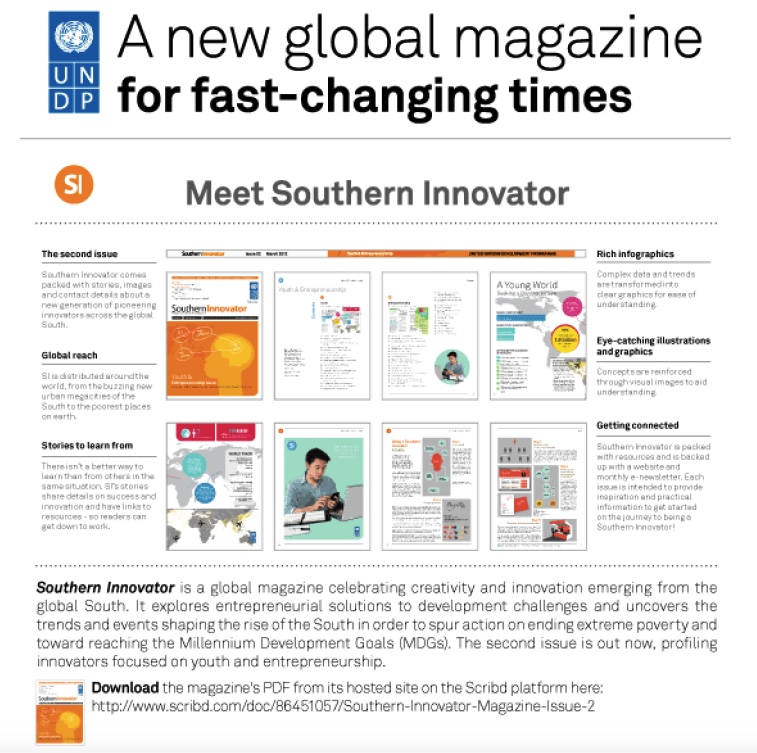
    Development Challenges, South-South Solutions was launched as an e-newsletter in 2006 by UNDP’s South-South Cooperation Unit (now the United Nations Office for South-South Cooperation) based in New York, USA. It led on profiling the rise of the global South as an economic powerhouse and was one of the first regular publications to champion the global South’s innovators, entrepreneurs, and pioneers. It tracked the key trends that are now so profoundly reshaping how development is seen and done. This includes the rapid take-up of mobile phones and information technology in the global South (as profiled in the first issue of magazine Southern Innovator), the move to becoming a majority urban world, a growing global innovator culture, and the plethora of solutions being developed in the global South to tackle its problems and improve living conditions and boost human development. The success of the e-newsletter led to the launch of the magazine Southern Innovator.
    Creative Commons License

    This work is licensed under a
    Creative Commons Attribution-Noncommercial-No Derivative Works 3.0 License.

    ORCID iD: https://orcid.org/0000-0001-5311-1052.

    © David South Consulting 2022

  • TV’s Moral Guide In Question – Again

    TV’s Moral Guide In Question – Again

    By David South

    Id Magazine (Canada), November 28-December 11, 1996

    Television programmers are under attack once again. Thanks to Guelph activist Patricia Herdman’s Coalition for Responsible Televsion (CORT), two violent television shows – Poltergeist (CTV) and Millennium (Fox/Global) – have lost several advertisers in recent weeks due to pressure from CORT. It’s just another wave in a new assault on the immorality of television.

    Positive Entertainment Alternatives for Children Everywhere (PEACE), a Montreal group founded after the murder of 14 young women in that city in 1989, staged a press conference last week, complete with sweet-faced children, to announce its “Toxic TV” list. Who is toxic? Old favourites like Bugs Bunny, Batman and Robin and The Simpsons. PEACE also produced a list of “Positive” TV shows. It included a wrist-slashing selection of insipid programming, such as Barney and Friends, Fresh Prince of Bel-Air and Kratt’s Creature.

    But critics of television overlook the strong and often simplistic moral messages that infuse most programming. Some even argue the mostly Judeo-Christian morality comes at the expense of atheistic and agnostic perspectives.

    University of Guelph philosophy professor Jay Newman argues that religious moralists are making television the scapegoat for all of society’s ills.

    He argues television, rather than being a moral vacuum, is heavily influenced by Judeo-Christain values – often in shows many people don’t suspect.

    Newman sharply criticizes religious moralists, who he says, neglect to observe the same contradictions in their own beliefs that they see in television.

    In Newman’s view, religion shares many sins with television. Religion promotes passivity (“The meek shall inherit the earth”), disrupts family life (who needs to talk to that “immoral” gay brother/sister?), does a questionable job of moral education, invents celebrities (the saints), sacrifices spiritual wisdom for meaningless ritual and entertainment (the Mass), and promotes violent behaviour (who can forget the Crusades or the Spanish Inquisition?).

    Leaning back in his chair at his University of Guelph office, the irascible New York-born Newman enthusiastically defends television.

    “When we assess TV as bad,” he says, “I’m not convinced religion is the only moral teacher, and it has not been the best moral teacher. Religion has been a very important force of hatred, whereas Star Trek teaches us to respect other cultures.

    “TV has been of great value in promoting pluralism and an increase in tolerance.”

    Newman isn’t talking about gore-soaked TV like Poltergeist and Millennium, shows he says speak more about their producers than about the medium of television. “Wanton slaughter can’t be blamed on TV. But I do agree with psychologists that some television inures us to violence.”

    He sees Star Trek as a moral force for both pluralism and tolerance, strong values that are essential to democracies with many ethnic, cultural and racial groups. “This show promotes tolerance towards people who appear different. It shows aliens have aspirations and desires just like us.”

    Newman does take offence to one race of aliens on the popular series: the Ferengi. While the Ferengi are supposed to be the equivalent of used car dealers in Star Trek’s universe, they draw criticism from Newman for their anti-semitic undertones. But even here, says Newman, TV can’t beat the pantheon of Christain anti-semites.

    As for the bumbling antics of Bart Simpson and his dad Homer, Newman says The Simpsons also contain positive morals. “The Simpsons teaches us to accept the foibles of others and empathize. It does it in a gentle way without passing a very austere judgement.”

    Newman even sees hope in the dreamy world of daytime soap operas. They teach people to develop empathy. They also use negative role models to show that hatred and contempt backfire on people; that promiscuity and adultry don’t come without a cost.”

    As for Seinfeld, a sitcom about a group of friends who seem to never do anything, Newman says, “I’m a New Yorker and I can’t sit through it.”

    Newman, an expert on religious fanaticism and hypocrisy, has responded to religious critics of television in his new book, appropriately titled Religion vs. Television. Newman sees religious critics of television as at best hypocrites, at worst specious claimants to higher moral ground.

    “[Religious leaders] make judgements to show the usefulness of their institutions in an attempt to restore the lustre of religious authority.”

    Newman believes the debate surrounding violence on TV is misguided. He believes the root causes of violence should be dealt with first.

    “Television is a convenient scapegoat. Its criticism parallels religious bigotry. They don’t focus on the individual, just the medium. And this is accepted by people who call themselves liberal!”

    TV immoral?

    But critics of TV say any decent moral messages that slip through are undermined by television’s subservience to a higher God: consumerism. For Rose Anne Dyson of Canadians Concerned About Violence in Television (C-CAVE), this corrupted morality can’t be ignored. “There is only one over-riding religion today: consumerism. Its main purveyor is TV.

    “Television is a major socializer today. Parents and teachers are key to modifying that influence. But most of television is very bad and just teaches consumer-driven values. There isn’t a single children’s programme that isn’t infused with commercial values.”

    Dyson believes the negative effects aren’t just psychological. “Watching too much TV is bad – it causes obesity and hyperactivity.”

    Dyson’s claims were recently backed up by a new study showing unhealthy minds may lead to unhealthy bodies. A study conducted by Columbia University claimed the more that children watched TV, the fatter they got. Researcher Dr Barbara Dennison found children who watched 14 hours of television a week had diets with 35 per cent of their calories from fat. The study blamed the high representation of junk food in television ads and the fact they promoted couch potato dining. Canadian children on average watch 18 hours a week of television.

    Dyson does agree with Newman’s criticism of organized religions’ spurious claims to higher ground. “Judeo-Christian religions have gotten us into a lot of trouble!”

    To control this morally wayward TV, Dyson looks forward to more entertainment conglomerates self-regulating their programming. “The cornerstone of democracy is to obey rules.

    “A lot of cultural studies people tend to underestimate the impact of TV – there is too much of a value-free approach.”

    Id was published in Guelph, Ontario, Canada in the 1990s.

    Further Reading:

    Channel Regulation: Swedes Will Fight Children’s Advertising All The Way

    From Special Report: NMM (New Media Markets) Spotlight On The Emergence Of Satellite Porn Channels In The UK

    Undercurrents: A Cancellation At CBC TV Raises A Host Of Issues For The Future

    https://davidsouthconsulting.org/2021/02/05/channel-regulation-swedes-will-fight-childrens-advertising-all-the-way/

    https://davidsouthconsulting.org/2021/02/03/do-tv-porn-channels-degrade-and-humiliate/

    https://davidsouthconsulting.org/2021/03/03/kommunikation-total-der-siebte-kontinent/

    https://davidsouthconsulting.org/2021/12/08/new-media-markets-and-screen-finance/

    https://davidsouthconsulting.org/2022/04/21/nsd-partners-in-bitter-row-over-choice-of-satellite-as-brussels-deadline-nears/

    https://davidsouthconsulting.org/2021/02/01/playboy-is-not-for-sad-and-lonely-single-men/

    https://davidsouthconsulting.org/2022/11/22/popular-characters-re-invent-traditional-carving/

    https://davidsouthconsulting.org/2022/10/27/reality-television-teaches-business-skills-in-sudan/

    https://davidsouthconsulting.org/2021/01/14/from-special-report-nmm-new-media-markets-spotlight-on-the-emergence-of-satellite-porn-channels-in-the-uk/

    https://davidsouthconsulting.org/2021/02/01/uk-laws-on-satellite-porn-among-toughest-in-europe/

    https://davidsouthconsulting.org/2020/12/11/undercurrents-a-cancellation-at-cbc-tv-raises-a-host-of-issues-for-the-future/

    Creative Commons License

    This work is licensed under a
    Creative Commons Attribution-Noncommercial-No Derivative Works 3.0 License.

    ORCID iD: https://orcid.org/0000-0001-5311-1052.

    © David South Consulting 2023