Categories
Archive Blogroll id magazine

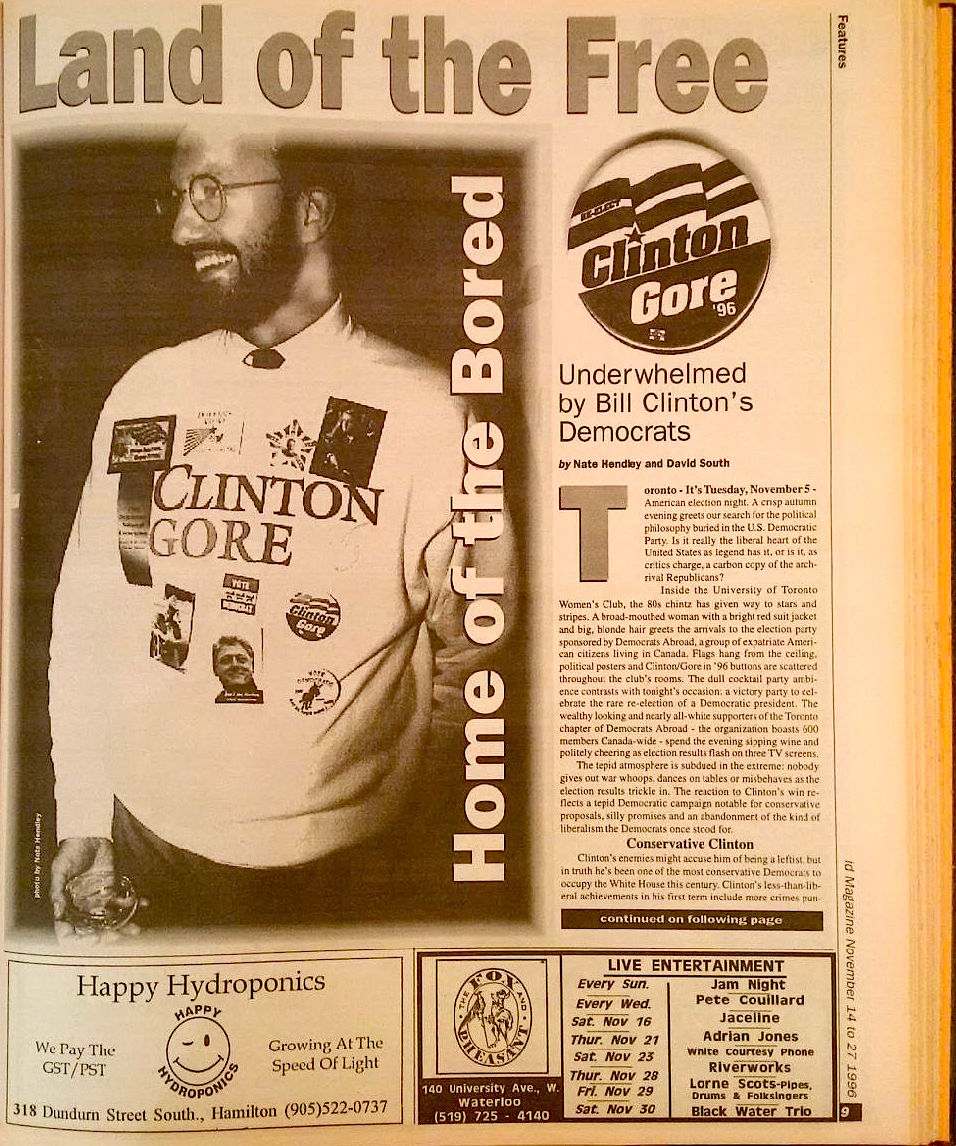
Land Of The Free, Home Of The Bored

Underwhelmed by Bill Clinton’s Democrats

By Nate Hendley and David South

Id Magazine (Canada), November 14 – 27, 1996

Toronto – It’s Tuesday, November 5 – American election night. A crisp autumn evening greets our search for the political philosophy buried in the US Democratic Party. Is it really the liberal heart of the United States as legend has it, or is it, as critics charge, a carbon copy of the arch-rival Republicans?

Inside the University of Toronto Women’s Club, the 80s chintz has given way to stars and stripes. A broad-mouthed woman with a bright red suit jacket and big, blonde hair greets the arrivals to the election party sponsored by Democrats Abroad, a group of expatriate American citizens living in Canada. Flags hang from the ceiling, political posters and Clinton/Gore in ’96 buttons are scattered throughout the club’s rooms. The dull cocktail party ambience contrasts with tonight’s occasion: a victory party to celebrate the rare re-election of a Democratic president. The wealthy looking and nearly all-white supporters of the Toronto chapter of Democrats Abroad – the organization boasts 600 members Canada-wide – spend the evening sipping wine and politely cheering as election results flash on three TV screens.

The tepid atmosphere is subdued in the extreme: nobody gives out war whoops, dances on tables or misbehaves as the election results trickle in. The reaction to Clinton’s win reflects a tepid Democratic campaign notable for conservative proposals, silly promises and an abandonment of the kind of liberalism the Democrats once stood for.

Conservative Clinton

Clinton’s enemies might accuse him of being a leftist, but in truth he’s been one of the most conservative Democrats to occupy the White House this century. Clinton’s less-than-liberal achievements in his first term include more crimes punishable by the death penalty, a promised additional 100,000 police on the streets, “V-Chip” technology in television sets, an intensification of the war on drugs and an abandonment of federal responsibility for welfare. Clinton’s re-election campaign featured promises to encourage school kids to wear uniforms, a vow to get even tougher on drug use by such measures as forcing teenagers to pass urine tests before issuing them driver’s licenses, and a recommitment to eliminating the US federal deficit.

The mostly monied professionals at the party are well aware of Clinton’s rightward turn since taking office in 1992, but put the president’s conservative leanings down to pragmatic politics.

“Am I disappointed in Clinton?” asks Bill Cronau, the past chair of Democrats Abroad and self-professed liberal. “Sure, but I’m not surprised that Clinton became more conservative. He is a Southerner after all.”

Arkansas-born Clinton used law and order issues “to chop GOP off,” adds Cronau, an insurance manager for Manulife, on the president’s theft of the Republican’s thunder.

The closest thing at the party to an actual living American politician is Tom Ward. Ward, with a detached air and the glow of a politician, soon attracted an audience when he entered the room. Ward twice ran unsuccessfully to become a Democratic congressman for Indiana, and agrees that overall Clinton has been “a disappointment as a liberal.”

He also agrees the president has moved far more to the right than previous Democratic presidents such as Jimmy Carter or Lyndon Johnson. Still, Ward, who has lived in East York since 1989, gives Clinton liberal kudos for his attempted passage of health care reforms. Yet Clinton’s proposed health care plan fell apart in 1994 following intense debate and criticism from the Republicans. Ward says he would try to introduce Canadian political ideas such as universal health care and stricter gun control were he to return to Indiana for a third run at Congress.

Canada or Clinton?

Joan Sumner, a psychologist originally from New York City, says she was initially impressed by Canada’s health care system, and by Clinton’s attempt at passing similar legislation in the US. But now she’s having second thoughts.

The Republicans, under Ronald Reagan and George Bush “decimated the health care system in the United States,” she says. “To run a medical practice became like running a business. It became difficult to collect from the insurance companies, who were reluctant to pay for psychiatric care.”

Sumner, who works with people who have “closed-head injuries,” has lived in Canada for 11 years. At the time she arrived, she found Canada’s health care system in good shape. “Now it’s a disaster and going from bad to worse. Truth be told, I am thinking of looking back across the border, especially with Clinton’s second term. The federal Liberals and the provincial government have no commitment to the people of Ontario.”

She complains about the extent of America’s influence on the Canadian political system.

Mike Harris, she fears, is borrowing his ideas from conservative Republican governor Christine Todd Williams in New Jersey. She would prefer Harris to look to liberals like former New York governor Mario Cuomo for inspiration. Unfortunately, Cuomo’s version of liberalism is out of fashion in both Canada and the United States these days.

While nearly everyone at the party expresses displeasure with Clinton’s turn to the right, few can explain why they supported him over his Republican challenger, Bob Dole.

In one corner is a bearded man in a white sweatshirt littered with Clinton/Gore campaign buttons. This super-supporter is Tim Wilkins, a Toronto social worker originally from Florida. When asked what policies attracted him to support the Democrats, Wilkins becomes flustered and unable to give any specifics.

“Been with the Democrats since 1988,” says Wilkins. “I could not identify with the Republicans at all. I think Bush was a very poor selection, and when he selected Dan Quale as his running mate, I thought ‘my Lord, you’ve just blown that ticket.’ The Republicans are just too right-wing, completely out of touch with Americans. And that’s an example of what’s happening tonight. Bob Dole and (running mate) Jack Kemp are completely out of touch. They have no agenda, no economic plan.”

Clinton and Chretien

Byron Toben, a Montreal Democrat, thinks a Clinton win will cement the close personal relationship between Clinton and prime minister Jean Chretien.

“Clinton and Chretien have something of a mutual admiration society going,” says Toben, who does immigration work, helping US citizens to move to Canada. “Clinton and Chretien are both on the same wavelength.”

Anne Kerr, the Canadian-born wife of Tom Ward, also agrees. She says Clinton’s victory is important to Canada because Liberals have more in common with the Democrats than the Republicans.

True enough, both Chretien and Clinton represent parties traditionally viewed as left-of-centre. Both men ran on vaguely liberal platforms for election, and both turned sharply conservative after deciding that deficit-reduction was more important than social spending or government activism. The federal Liberals in Canada and the Democrats in the United States now support conservative agendas that aren’t too much different than the platforms of their right-wing rivals. The biggest difference between the two nations, as Ward points out, is that the United States now lacks any major left-wing party such as the New Democrats. The Greens, running as a left-wing alternative to the Democrats, with consumer crusader Ralph Nader as their candidate, pulled in slightly more than a half-million votes on November 5. That is more than other minor parties such as the Libertarians or US Taxpayers Party, but hardly enough to convince Clinton to turn sharply leftwards in his second term.

Disappointment with Clinton’s first term aside, the Democrats Abroad party briefly jolts awake towards the end of the evening when Clinton’s re-election is confirmed. Champagne corks are popped by the club’s wait staff, but nobody is in a hurry to grab a glass. The mood becomes slightly effervescent as tipsy Democrats grow more animated, only to be hit with some mind-numbing post-victory speeches by the group’s executive. After a few toasts, the moment passes and a steady stream of Democrats slips out, thankful their man had won over Bob Dole, becoming the first Democratic president to win a second consecutive term in office since Franklin Roosevelt in 1936.
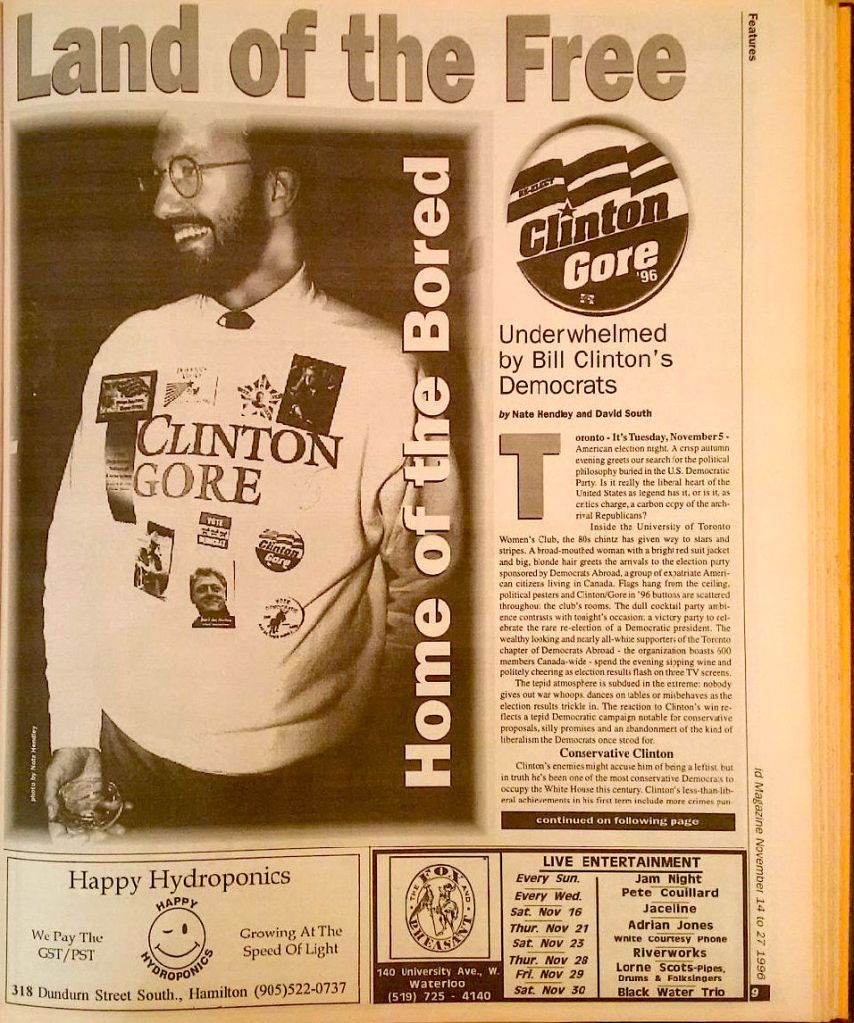
Id Magazine was published in Guelph, Canada in the 1990s.

https://davidsouthconsulting.org/2021/07/20/case-study-3-id-magazine-1996-1997-2/

https://davidsouthconsulting.org/2020/06/16/casino-calamity-one-gambling-guru-thinks-the-province-is-going-too-far/

https://davidsouthconsulting.org/2021/02/07/cock-tales-too-much-for-hamilton/

https://davidsouthconsulting.org/2020/12/22/man-out-of-time-the-world-once-turned-on-the-ideas-of-this-guelph-grad-but-does-the-economist-john-kenneth-galbraith-know-the-way-forward/

https://davidsouthconsulting.org/2022/09/23/opinion-canada-is-allowing-u-s-to-dictate-haitis-renewal-more-news-and-opinion-on-what-the-un-soldiers-call-the-haitian-vacation/

https://davidsouthconsulting.org/2021/03/17/province-for-sale-step-right-up-for-an-opportunity-to-buy-what-you-already-paid-for/

https://davidsouthconsulting.org/2021/01/20/pulling-the-plug-on-hate-rock-1996/

https://davidsouthconsulting.org/2021/01/16/redneck-renaissance-a-coterie-of-journalists-turn-cracker-culture-into-a-leisure-lifestyle/

https://davidsouthconsulting.org/2021/01/14/from-special-report-sexual-dealing-todays-sex-toys-are-credit-cards-cash-a-report-on-the-sex-for-money-revolution/

https://davidsouthconsulting.org/2020/04/22/state-of-decay-haiti-turns-to-free-market-economics-and-the-un-to-save-itself/

https://davidsouthconsulting.org/2021/02/03/swing-shift-sexual-liberation-is-back-in-style/

https://davidsouthconsulting.org/2022/08/13/truckus-maximus-the-big-boys-with-the-big-toys-do-some-hardcore-pogo-at-monster-truck-show/

https://davidsouthconsulting.org/2020/12/11/tvs-moral-guide-in-question-again/

https://davidsouthconsulting.org/2021/01/26/u-s-elections-update-clinton-is-using-canada-to-keep-control-of-haiti/

https://davidsouthconsulting.org/2021/09/13/will-niagara-falls-become-the-northern-vegas/

Books by Nate Hendley: 

Al Capone: Chicago’s King of Crime, Five Rivers Chapmanry, 2010

American Gangsters, Then and Now: An Encyclopedia, ABC-CLIO, 23 Dec. 2009 

The Big Con: Great Hoaxes, Frauds, Grifts, and Swindles in American History, ABC-CLIO, 2016

Black Donnellys: The Outrageous tale of Canada’s deadiest feud, James Lorimer & Company, 2018

Bonnie and Clyde: A Biography, Greenwood Publishing Group, 2007

The Boy on the Bicycle: A Case of Wrongful Conviction in Toronto, Five Rivers Publishing, 2018

Crystal Death: North America’s Most Dangerous Drug, Five Rivers Chapmanry, 2011

Dutch Schultz: The Brazen Beer Baron of New York, Five Rivers Chapmanry, 2011

Edwin Alonzo Boyd: Life and Crimes of Canada’s Master Bank Robber, James Lorimer & Company, 2013

Motivate to Create: A Guide for Writers, Five Rivers Chapmanry, 2010

Publications by David South: 

Southern Innovator Magazine Issue 1: Mobile Phones and Information Technology 

Southern Innovator Magazine Issue 2: Youth and Entrepreneurship

Southern Innovator Magazine Issue 3: Agribusiness and Food Security

Southern Innovator Magazine Issue 4: Cities and Urbanization

Southern Innovator Magazine Issue 5: Waste and Recycling 

Creative Commons License

This work is licensed under a
Creative Commons Attribution-Noncommercial-No Derivative Works 3.0 License.

ORCID iD: https://orcid.org/0000-0001-5311-1052.

© David South Consulting 2023

Categories
Archive Blogroll id magazine

Casino Calamity: One Gambling Guru Thinks The Province Is Going Too Far

By David South

Id Magazine (Canada), May 16-29, 1996

Will Ontario become saturated with gambling? It is a question being asked more and more as the provincial government moves to allow unprecedented choice for gamblers.

Bars and hotels will soon have video one-armed bandits (known as video lottery terminals and slammed by the Addiction Research Foundation as video crack) and permanent charity casinos will be set up throughout the province.

Finance minister Ernie Eves’ budget may have brought joy to the hearts of the province’s gambling fanatics, but whether this is sound economic policy is less certain. Eves hopes to reap $60 million this year from the VLTs, or fruit machines.

Speaking to id under anonymity due to the sensitivity of his work, a private gambling consultant to the provincial government says the extended gambling could monkey-wrench the government’s on-going plans to build casinos to attract American tourists.

He says, “There is a maximum to any market area, to the number of people who will come. In Ontario, the idea was to have monopoly markets to create jobs and revenue for government. Spreading casinos out on the border areas would maximize jobs. But the introduction of VLT machines and permanent charity casinos means there will be a narrowing of the market. As soon as you set up the VLTs, there will be a permanent impact.”

He believes littering the province with casinos – both large and small – and VLTs, will be the equivalent of pissing in the wind for the government, arguing tourists will only be attracted to Ontario casinos if they consist of only a few, flashy must-see attractions based on the Las Vegas model.

Tourist temptation

The focus on tourists is key. Research has shown that gambling aimed at residents living near casinos can actually harm other local businesses like restaurants and movie theatres, as people spend more of their entertainment budgets on gambling. Add to this equation the fact that most of the profits go out of the community to Queen’s Park, and a casino can hurt local economies.

Knowing this, the government has instead focused on attracting tourists. In the case of the Windsor casino, it has worked – 80 per cent of gamblers there come from the US. The economic equation is simple: every dollar sucked in by the casino is a net gain for Canada that doesn’t hurt any other Canadian businesses (as for Detroit, that is anther story).

If the government keeps on its current course, Ontario could have 10 working government-owned casinos in the near future. By year’s end, the Windsor casino will be joined by Niagara Falls and the Rama First Nations casino near Orillia.

According to Anne Rappe of the government-owned Ontario Casino Corporation public outrage could change plans. “The government has been clear in its commitment to letting voters voice their view on casinos for other sites.”

Just a fad

Governments, like people, follow fads. The trend towards harder forms of gambling, like casinos and VLTs, as opposed to softer gambling like lotteries, represents a desperate move by local governments to hang on to tax revenues.

Even more than flashy schemes to build theme parks, art galleries and museums, casinos are seen as a sure-fire way to revive ailing communities by attracting tourists. Throughout North America, consultants and casino companies are telling government to turn to gambling if they hope to boost public treasuries and generate jobs. The pitch in these hard economic times goes down a treat with governments beseiged by voters to, on the one hand, reduce debt and deficits, and on the other be seen to be creating economic opportunity in the age of downsizing.

Casinos also serve another purpose. While taxes seem punitive, making money off of gamblers appears on the surface to be a win-win situation. The government gets the money it wants,while gamblers get the adrenaline rush they crave, and maybe some cash. The whole arrangement seems to be victimless – if you want to gamble, you pay the price.

For their part, gambling advocates envision Ontario as a Mecca for American gamblers chasing our low dollar, low crime, no tax casinos. They say we can have it both ways: a safe, low-crime Ontario in which islands of gambling fever suck in much-needed American dollars to prop up the provincial government treasury.

Gambling has been legal in Canada since 1969 (though the oldest casino is the gold rush-era Diamond Gerties in Dawson City, Yukon), but it wasn’t until the New Democrat government of Bob Rae that the idea of government-run or sanctioned permanent casinos became an option in Ontario.

The gambling consultant says the appeal of casinos is that they offer a sure-fire anchor to a local economy. He criticizes other developments like theme parks for being “too risky.” To make the most money, he says, casinos should avoid any pretensions to be slick, high-society affairs and instead go after the folks with “the family restaurant-style dress code.”

While the casino in Windsor is a lucrative success for the government – taking in a “win” of $500 million – local businesses have yet to report any of that money coming their way. Gambling experts say that isn’t about to change. With $400 million going directly to the government, and the rest covering expenses and the management fee paid to an American consortium running the casino, there will be little left for anyone else.

The Windsor casino is also drawing criticism for being a social parasite on Detroit, which supplies 80 per cent of the casino users. The influx of $1 million into Windsor means between 2,000 and 3,000 jobs are lost in Detroit, according to gambling expert William Thompson of the University of Nevada. Because of this, it is believed Detroit will soon set up a casino if voters say so.

A 1993 Coopers and Lybrand study commissioned by the government estimated Windsor’s win would be reduced by 60 per cent if Detroit were to open a casino.

That same study strangely found comfort in its findings that the average “pathological gambler” is male, under 30, non-Caucasian, unmarried and without a high school diploma.

It then goes on to say, “The typical US casino gaming patron earns thirty per cent more than the average of the US population, is between the ages of 40-64, is college educated and lives in a household of two or more members.” Just the kind of market that sends corporations into ecstasy.

Quebec example

The Quebec experience offers some valuable lessons for Ontario. Quebec’s three casinos were also looking to be a success until recently. The Quebec government and gambling advocates maintained the casinos (located in Montreal, Pointe-au-Pic and Ottawa’s sin-bin, Hull) were squeaky clean. Just like in Ontario, they remarked upon the impressive revenues – $1 million a day – and the huge influx of tourists. But closer scrutiny reveals the three casinos have not come without a cost.

Both Montreal and Pointe-au-Pic casinos have been criticized for preying on poor locals who spend the pittance out of their entertainment budgets on gambling. The casinos have also been involved in high-profile drug busts, money laundering scams and even murders committed by gambling addicts trying to extort money from relatives. At the Montreal casino, enterprising youth gangs targeted winners as they left the casino when it closed at three am. The robberies worked like this: A confidant would spot winners in the casino and then use a cellphone to tell accomplices waiting outside to mug the unsuspecting “lucky” ones still intoxicated by their good fortune.

All the rosy projections about casinos reviving the Ontario economy are based on several key assumptions: Americans will be the main users of the casinos, casinos in Ontario will not compete with each other or other sectors of the economy (restaurants, movie theatres, etc.), the social costs will be low and crime will not increase significantly, and most importantly, American casinos won’t lure away gamblers.

As for the gambling consultant, he doesn’t think the casinos slated to open later this year in Niagara Falls will drag the city down any farther. “Niagara Falls isn’t the nicest place now. The casino will finally give an economic reason to upgrade these places (hotels, motels and restaurants).”

And while the Niagara Falls casino will most certainly be popular, it will not be able to operate free of competition for long. Across the Rainbow Bridge at Niagara Falls, New York, preparations are being made to open a casino by 1997.

Windsor will also face competition from the American side. Voters in the state of Michigan will be asked to vote on whether to allow casinos at the next state elections. Several groups, including a local Indian band, have been pushing for a casino to be located in downtown Detroit. Canadian casinos must also compete with river boats from Illinois and Indiana.

The government has reached a watershed in its gambling policy, leaving it with few choices. It can either allow unfettered growth in casinos as more and more communities scramble to find any means necessary to generate jobs and tax revenues, or it can recognize there is a limit to gambling as a solution to economic woes.

As the source says, “The government is in a quandry: they like the revenue but hate the way it is raised.”

Id Magazine was published in the mid to late 1990s in Canada.

https://davidsouthconsulting.org/2021/07/20/case-study-3-id-magazine-1996-1997-2/

Citations

Story cited in Schizophrenia: A Patient’s Perspective by Abu Sayed Zahiduzzaman (Author House), 2013. 

https://davidsouthconsulting.org/2020/11/17/land-of-the-free-home-of-the-bored/

https://davidsouthconsulting.org/2020/12/22/man-out-of-time-the-world-once-turned-on-the-ideas-of-this-guelph-grad-but-does-the-economist-john-kenneth-galbraith-know-the-way-forward/

https://davidsouthconsulting.org/2022/06/24/professor-puts-chronic-fatigue-into-historical-perspective/

https://davidsouthconsulting.org/2021/03/17/province-for-sale-step-right-up-for-an-opportunity-to-buy-what-you-already-paid-for/

https://davidsouthconsulting.org/2020/06/14/psychiatric-care-lacking-for-institutionalised-seniors/

https://davidsouthconsulting.org/2021/01/20/pulling-the-plug-on-hate-rock-1996/

https://davidsouthconsulting.org/2021/01/16/redneck-renaissance-a-coterie-of-journalists-turn-cracker-culture-into-a-leisure-lifestyle/

https://davidsouthconsulting.org/2021/01/14/from-special-report-sexual-dealing-todays-sex-toys-are-credit-cards-cash-a-report-on-the-sex-for-money-revolution/

https://davidsouthconsulting.org/2020/04/22/state-of-decay-haiti-turns-to-free-market-economics-and-the-un-to-save-itself/

https://davidsouthconsulting.org/2021/02/03/swing-shift-sexual-liberation-is-back-in-style/

https://davidsouthconsulting.org/2022/08/13/truckus-maximus-the-big-boys-with-the-big-toys-do-some-hardcore-pogo-at-monster-truck-show/

https://davidsouthconsulting.org/2020/12/11/tvs-moral-guide-in-question-again/

https://davidsouthconsulting.org/2021/09/13/will-niagara-falls-become-the-northern-vegas/

Creative Commons License

This work is licensed under a
Creative Commons Attribution-Noncommercial-No Derivative Works 3.0 License.

ORCID iD: https://orcid.org/0000-0001-5311-1052.

© David South Consulting 2023
Categories
Archive Blogroll id magazine

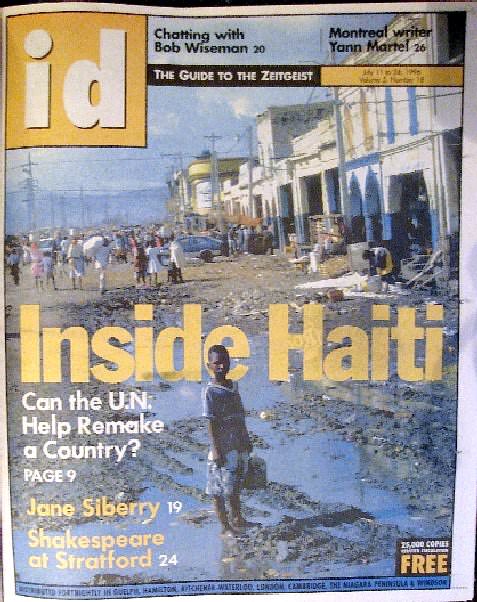
State Of Decay: Haiti Turns To Free-Market Economics And The UN To Save Itself

By David South

Id Magazine (Canada), July 11-25, 1996

Port-au-Prince – Brand-new four-by-four jeeps in various shapes and sizes bounce over the moon-like craters of Port-au-Prince’s roads. The presence of so many expensive vehicles in a country unable to feed all its citizens is hard to take, but it is not one of the worst paradoxes of Haiti.

The appalling state of the roads – more like occassional stretches of asphalt to break up the monotony of potholes – is an apt symbol of Haiti, a reminder with every jar of the tailbone of the public squalor of the many and the private wealth of the few. The shiny new jeeps are not a sign of recent good times, but reveal who has all the money in this nation of almost seven million: the tiny Haitian elite, thieves, the United Nations and the multitude of non-governmental aid agencies.

When democratically-elected president Jean-Bertrand Artistide, deposed in a 1991 coup, returned to complete his term in office in 1994, many Haitians hoped that this country would at last begin to shake off centuries of exploitation at the hands of a selfish elite backed by American corporate masters and begin to build a democratic future.

The United Nations mission in Haiti, which includes 700 Canadian troops, is intended to support the country’s fledgling democracy. But Haiti’s future remains uncertain – as does the role the UN will play in shaping it.

Despite negotiating a peaceful and democratic transition last February 7 from Aristide – a firebrand former priest and passionate advocate of Haiti’s poor – to successor Rene Garcia Preval, Haiti hasn’t stopped its economic freefall. Economists predict the country won’t match 1991 earning levels until the next century. Political unrest resulting from opposition to the government’s privatization plans could also spell trouble ahead.

The United Nations presence, due to end June 30, has been extended another five months at the request of the Haitian government. The newly-minted UN Support Mission in Haiti, a military force of 600 UN troops supported by 700 soldiers paid through voluntary contributions, is being assembled. It will replace the current force of 1900.

Lousy loans

Meanwhile, the government of Rene Preval is negotiating with the International Monetary Fund (IMF), the World Bank and the United States to get much-needed loans to help balance the budget. Critics say the world’s banks are trying to lock the poorest country in the Western hemisphere further into crippling debt. The Haitian budget is US $750 million, 60 per cent of which the government hopes to raise from loans.

But there is a condition. Haiti must embark on a structural adjustment programme: widespread firings of the public service, privatization of most of the public sector, loosening of controls over foreign capital, adherance to the ethos of global trading blocks espoused by the North American Free Trade Agreement (NAFTA). Some call this neo-liberalism, others neo-conservatism. Either way, it forces this impoverished country to limit how it can address rebuilding a crumbling infrastructure.

The government’s hands are tied, though, as the conditions were part of the deal to return Aristide to power.

A Canadian public relations company, Gervais-Gagnon-Covington Associates, has been paid US $800,000 by the American government to sell the idea of privatization of Haiti’s handful of idle and near-bankrupt state enterprises.

In order to plunge deep into this Haitian quagmire, I pitch up at the legendary Hotel Oloffson – made famous by novelist Graham Greene in The Comedians – and begin interviewing in the languid atmosphere by the pool.

“Aristide has put Haitians in a giant trap with the IMF plan,” says Jane Regan, who runs an independent news service based in Port-au-Prince. “The US $1 billion in loans will double the national debt.

“Haiti used to be self-sufficient in rice – last year they bought US $56 billion in US rice. The roads are worse now than a year ago. Right now the UN mission is of questionable worth and Canadians are getting taken advantage of.  They have been sent to clean up after the Americans. These are the same neo-liberal economic policies that hurt Canadian workers – just imagine what Haitians are feeling!”

Regan thinks that, so far, the only people to make any money out of this arrangement are businesses and the more than 800 NGOs operating in Haiti. And on that note, the feisty Regan disrobes and plunges into the Hotel’s pool.

According to Kim Ives, a reporter with the Haitian newspaper Haiti Progres, there are a few cracks in the solidarity between Preval and Aristide: “Aristide is hitting out against privatizations. In a two-hour TV interview, he drew a line between himself and Preval.”

One of the few visible signs of change in Haiti is the dusty Octobre 15 road leading from the airport past former president Aristide’s palatial home on its way to the wealthy suburb of Petionville. It is bordered on one side by Camp Maple Leaf, and on the other by dilapidated shanty towns and desperate street vendors.

Cynics point out the road conveniently serves the interests of the elite once again. It offers a direct and more or less pothole-free route from the secluded mansions of Petionville to the airport – a crucial escape route in a politically volatile developing country. In fact, a development of monster homes that would make a Canadian suburbanite blush is going up near the airport to capitalise on this.

Canadian troops

Caught between the Haitian government and its people is the United Nations, including Canada’s troops. Canadian troops form the first line of defence – along with Preval’s personal secuity guards – to defend the National Palace. They accompany the president wherever he goes, 24 hours a day.

Some fear growing resentment among Haitians for government policies will pitch the population against the soldiers.

At Camp Maple Leaf, the home base of Canada’s military contingent in Haiti, the troops are scrambling to adjust to a new mission sanctioned by the United Nations. As of June 30, they must take a back seat to the troubled Haitian police force as it tries to prove that the intensive training provided by police from around the world has paid off.

In the first week of July, the Canadian soldiers of the Royal 22nd Regiment – the famous Vandoos  – receive confusing news about a change in their firing orders or Rules of Engagement. ROEs dictate the tone and behaviour of peacekeepers on a UN mission and, as the experience of Somalia demonstrates, they can be the difference between success and disaster.

As the new mandate starts, the Canadians are first told they will be only able to use deadly force to defend themselves and not Haitians. If a member of the government is assassinated, they must stand by. If a Haitian is clubbed to death before their eyes, they must stand back. It is a qualitative change from their ROEs prior to June 30.

Ottawa military spokesman Captain Conrad Bellehumour says the change is indicative of an evolving mandate. But a military spokesman in Haiti says the old ROEs are now back in force, and Canadians can intervene to save a Haitian’s life.

“Maybe somebody’s been listening to Jean-Luc Picard too much,” quips retired Brigadier-General Jim Hanson, in a reference to TV show Star Trek’s prime directive of non-interference in a culture.

Preval’s police

A large banner hangs over a Port-au-Prince street: “Police + Population = Securite + Paix”. The UN has placed its greatest emphasis on reforming Haiti’s policing and justice system. The Police Nationale d’Haiti (PNH) was formed, and the RCMP and the American Federal Bureau of Investigation (FBI) were asked to provide training. The idea is to break from the past – when the military used policing as an opportunity to terrorize the population – and establish a police force to serve and protect.

But the efforts of the Haitians and their international police advisers have had a mixed success. According to Canadian soldiers, the Haitian police need to be coaxed into conducting routine patrols and have not given up patrolling in large numbers in the back of a pick up truck with rifles at the ready. To be fair, seven police officers have been killed since January, in what many believe is an organized campaign of terror orchestrated by sympathizers of the old dictatorship and drug gangs.

According to Sergeant Serge Martin of the Vandoos, “The PNH use 15 police officers to patrol and don’t talk to anybody.”

“You don’t depend on police to protect you,” claims Regan. “The Haitian government has no control over them. You don’t know if there is going to be a coup tomorrow.”

Jean-Yves Urfie, editor of the pro-democracy Libete newspaper in Port-au-Prince, believes the campaign to kill police goes back to the United States. “I am convinced the coup d’etat was financed by the Republican administration. I believe the Republicans want to destroy things here to show (President) Clinton wasted his time bringing Aristide back.

“The government was forced to incorporate former members of the military into the police force. And it would be terrible if the population develops the impression all cops are bad.”

“They are 10 years away from a viable police force,” concludes Hanson.

A stop at the fourth precinct police station shows just how far things still need to go. At the counter is a lone police officer, sharply turned out in his beige shirt and yellow-striped navy pants, courtesy of the Royal Canadian Mounted Police. But this proves to be a veneer of change. Canadian soldiers ask if everything is alright. They then ask to see tonight’s prisoners. The officer sheepishly leads the troops down a narrow corridor to 9 ‘ by 12 ‘ foot cell stuffed with nine prisoners. It is very hot and the stench from an open drain overflowing with sewage is nauseating.

Outside the Penitencier National in downtown Port-au-Prince, a yellow concrete structure with peeling pain, Haitians lined up to feed the inmates, talk about their frustrations with a justice system that has collapsed. Many complain that only the rich, who can hire lawyers, can enjoy the fruits of democracy. While state-directed beatings and killings have been dramatically reduced, most prisoners rot on remand until they are charged with a crime. Heiner Rosentdahl, the UN representative in Haiti in charge of prison reform, tries to be upbeat. “There have been no changes in conditions in Haiti’s prisons. Treatment of the prisoners is better, though there have been some abuses. We have developed a nation-wide register book of prisoners to help keep track of who is in prison.”

Another mixed blessing, according to Rosendahl, is the new requirement that all prisoners be fed two meal a day. The food is so poor, prisoners have been getting sick.

He is frustrated with the pace of penal reform. “The Haitian prison system hasn’t had a budget since October 1995, because of battles within the parliament,” he says. “The Haitian government didn’t ask for a plan to change this situation despite the minister of justice visiting the prison for the first time.”

According to Rosendahl, it is not the routine killing of thieves by mobs that worries the elite. Nor is it the assassination of police officers, or the untold thousands dying of disease and hunger. The only thing that is beginning to rock their world is a new phenomenon for Haiti: kidnapping and extortion.

Voodoo economics

For such a seriously depressed economy, there is an astonishingly large number of lottery booths – or Borlettes – on Haitian streets. They are so plentiful, they join gas stations as the main landmarks of the streets.

The industrial park which is now home to the remaining American troops stationed in Port-au-Prince, is a good monument to Haiti’s economic problems. Dilapidated and only barely functioning, this facility once supported, directly and indirectly, a large portion of the city’s population. As crummy as the sweatshop jobs were, they provided valuable income for the capital’s poor.

The Haitian economy under Francois Duvalier and his son, Jean-Claude, before the chaos of the late 1980s and 1990s, was based on assembling manufactured goods for the US market. Haiti was the world’s largest producer of baseballs, and ranked as “top three in the assembly of such diverse products as stuffed toys, dolls and apparel, especially brassieres. All told, the impact of international subcontracting was considerable,” according to author Paul Farmer in his book, The Uses of Haiti.

Today, Pierre Joseph, a Haitian-American from New York City, has a new job: he screens the ID cards of Haitian workers as they enter the park. He says there were once over 50 factories operating here; now there are 30.

Evidence of Haiti’s economic collapse is everywhere. On the walls outside the National Palace is scrawled Aba Preval Granhanje – Preval is a liar. Across the wide boulevard in a square are around 75 homeless children. They joke with the Canadian soldiers, especially boyish 2nd Lt. Marc Verret, who looks like a baby in soldiers clothes. The kids beg him for water and money.

In the market area, the piles of garbage, rotting meat and excrement make a muddy devil’s stew. Homeless children sleep on top of the abandoned crates. One small child is curled up in an American flag, asleep.

Desecrating dead

The dead also suffer the indignities of economic ruin. Outside the gates of the Hopital Generale, a man lies dead on a broken trolley in the yard. Others still alive, with limbs missing, are sprawled out on the ground. Chickens and goats roam the grounds. In the back is the main morgue for Port-au-Prince. The odour just 25 feet from the entrance to the morgue is normal for this city strewn with rotting garbage and stewed by a hot sun.

Inside, an overpowering odour like rotten chicken meat is the product of 450 human cadavers. Like rag dolls laid out in a ghoulish toy store, row upon row of children dead from starvation and disease – Haiti’s infant mortality rate is 127 per 1,000 babies born – are stacked almost to the ceiling. There are also adults. Old women, young men badly mutilated for stealing, are strewn out on the dirty concrete floor and on shelves.

There is no refrigeration, and according to military doctor Major Tim Cook, “something really nasty is going to come out of there if they don’t do something.”

Proving peacekeeping

More is at stake in Haiti than the re-building of a politically and economically devastated nation. For Canada’s armed forces, shaken and little stirred by the Somalia scandal, it is an opportunity to make amends. This time around, the peacekeepers are keeping the needs of the local population foremost in their gun sights. When the Vandoos head out on another one of their 24-hour patrols, the atmosphere is friendly and filled with gentle ribbing with the locals. They have the advantage of being able to speak French, a language understood to varying degrees by most of the population.

The approach of the individual soldiers varies widely. On a routine patrol, Alpha Company engaged in good-natured kidding around, with splashing the locals the worst offence. But a day out with Charlie Company, led by Sergeant Serge Martin, proved another story. The two privates assigned to accompany a group of journalists were a couple of operators. The day included a visit to a perfume shop, a trip through the wharf area looking for prostitutes and constant propositioning of the local women.

One Canadian corporal with the Vandoos, Eric Charbonneau, has been trying to make a small difference to the lives of the 400 people living in the community of Cazeau, a shanty town near the international airport. He has started literacy and hygiene lessons and raised money to help the residents build concrete houses to replace the mud dwellings they currently inhabit.

“I was walking along the fence and started to build a relationship with the kids,” he explains. “Some guy approached me and needed some help. It took three weeks to build a relationship. They are too used to white people giving away things for doing nothing. They were surprised when they had to work for it.”

At the gates to Camp Maple Leaf is a spray-painted sign. In Creole, French and English beside a Canadian flag, it says “No More Jobs.” While it could look at home back in Canada, it illustrates how important the presence of soldiers, the United Nations and charities are right now to the economy.

Some observers see the UN presence as part of a slide back into dependency on foreign money, restricting Haiti’s ability to assert itself. But others believe the turn to the international community is Haiti’s last hope of breaking with a past littered with dictatorships and poverty.

According to Captain Roberto Blizzard – an erudite and wise observer of the situation – the base has been stampeded with desperate Haitians looking for work. Blizzard has tried to find work for as many Haitians as he can, even helping them to form a laundry co-operative he hopes will survive long past the Canadians’ stay.

“There is a danger of the Haitian people turning into full-time beggars,” he says with sadness.

Further reading:

Failed States and Institutional Decay: Understanding Instability and Poverty in the Developing World by Natasha M. Ezrow and Erica Frantz, Bloomsbury Academic, 18 July 2013.

Towards a taxonomy of failed states in the New World Order: decaying Somalia, Liberia, Rwanda and Haiti by Jean-Germain Gros, Third World Quarterly, Vol. 17 No. 3 September 1996 Section 5 Page 455

https://davidsouthconsulting.org/2021/10/28/ending-gang-violence-while-cleaning-the-streets-in-haiti/

https://davidsouthconsulting.org/2021/09/01/haiti-earthquake-prompts-tech-aid/

https://davidsouthconsulting.org/2021/01/08/haitian-coffee-becoming-a-hit-with-american-connoisseurs/

https://davidsouthconsulting.org/2021/10/28/milk-co-operatives-help-hungry-haiti/

https://davidsouthconsulting.org/2022/09/23/opinion-canada-is-allowing-u-s-to-dictate-haitis-renewal-more-news-and-opinion-on-what-the-un-soldiers-call-the-haitian-vacation/

https://davidsouthconsulting.org/2021/01/26/u-s-elections-update-clinton-is-using-canada-to-keep-control-of-haiti/

Creative Commons License

This work is licensed under a
Creative Commons Attribution-Noncommercial-No Derivative Works 3.0 License.

ORCID iD: https://orcid.org/0000-0001-5311-1052.

© David South Consulting 2025