Categories
Archive Development Challenges, South-South Solutions Newsletters Southern Innovator magazine

Filipino Architect wants to Transform Slum with New Plan

By David SouthDevelopment Challenges, South-South Solutions

SOUTH-SOUTH CASE STUDY

A clash is occurring across the global South over the future of urban planning and the ever-growing slums of the world’s megacities. This will be a decisive clash of visions: should cities flatten slums and relocate their residents, or work with slum dwellers, acknowledge the role they play in city economies and improve their lives with better dwellings?

As the world turned into a majority urban place in the 2000s, cities grew at a phenomenal rate. The cities of Africa and Asia are growing by a million people a week, according to some estimates. Megacities and sprawling slums will be the hallmarks of this new urban world, it seems. In sub-Saharan Africa, 72 percent of the population already lives in slum conditions.

The danger of building unsafe or makeshift homes can be seen in 2010’s devastating earthquake in Haiti, where many buildings collapsed, killing thousands.

One of the Philippines’ leading architects and urban planners,
Felino A. Palafox Jr. of Palafox Associates (www.palafoxassociates.com), is passionate about re-making the slums in his country’s capital, Manila. The city is prone to devastating and sometimes deadly flooding. Palafox believes the vulnerability of slum dwellings and poor urban planning are placing lives at risk.

“We can’t wait for another tragedy,” Palafox told the Philippine Daily Inquirer in 2010. “We have seen how an unprecedented volume of rainfall like what (storm) Ondoy had brought could prove too much for Metro Manila’s river and drainage system. We have also seen what a massive earthquake could do to an unprepared city like Haiti.

“While there is nothing that we could do to control the destructive power of these natural phenomena, there are steps that we could take to limit the amount of damage.”

If the rapid growth in urban populations is to be safe and sustainable, then new dwellings will need to be built that meet high standards of durability.

The UN Challenge of Slums report from 2003 (www.unhabitat.org/pmss/listItemDetails.aspx?publicationID=1156) broke with past orthodoxy that slums must be cleared, arguing that slums should be seen as positive economic forces, incubators for budding entrepreneurs that offer a gateway to better things for new migrants.

Muhammad Khadim of UN-Habitat summed up the new thinking:

“Ten years ago, we used to dream that cities would become slum-free,” he said. But “the approach has changed. People see the positives. The approach now is not to clear them but to improve them gradually (and) regularise land tenure.”

The arguments behind embracing slums come from the economic changes across developing countries since the 1970s. Growing informal economies combined with fewer social provisions and the shift to urban from rural communities have all contributed to the explosion in slums and informal housing.

Manila is a city of stark and startling contrasts: there are glitzy shopping malls and high-rise office buildings, but also large slums and hungry people begging and selling trinkets on the city’s roads.

It’s a place where the slum clearance-vs-renovation debate is hot and current. The Philippines is currently in the midst of a campaign to clear slums in Manila and move people back to the countryside.

“Many of our people are no longer interested in agriculture, so we need to give them incentives to go back,” Cecilia Alba, head of the national Housing and Urban Development Co-ordinating Council, told the New Statesman magazine. “If we had to rehouse the slum-dwellers inside Manila in medium-rise housing, it would cost a third of the national budget.”

Palafox has a different vision – rebuilding a slum community from top to bottom.

An architect, environmental planner, urban planner and development consultant, Palafox runs one of the top architecture firms in the Philippines, employing more than 100 staff and consultants.

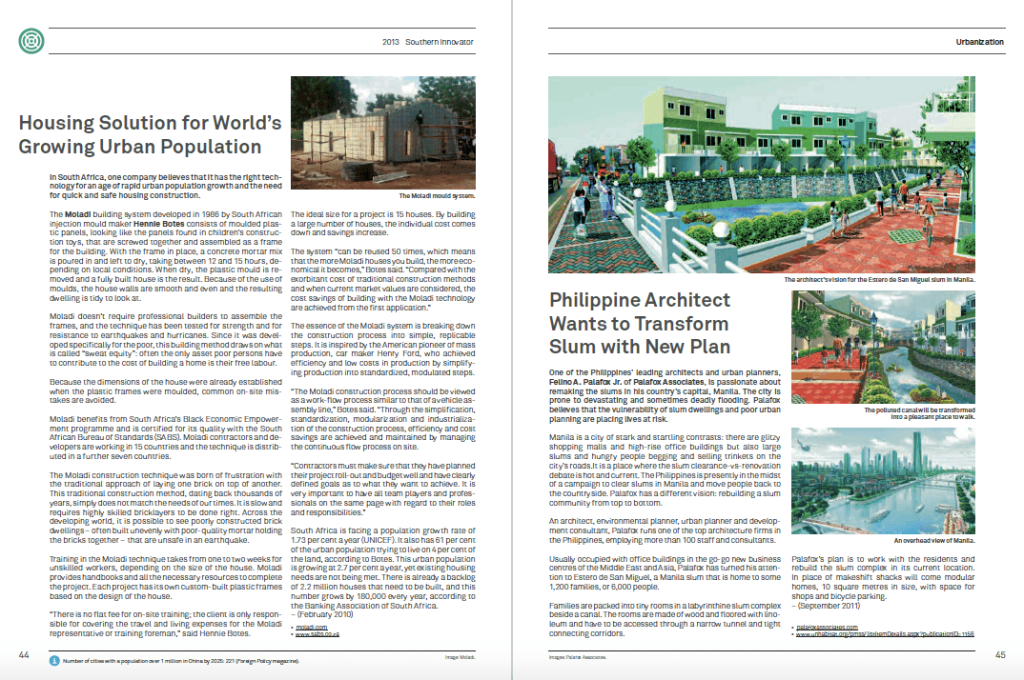
Usually occupied with office buildings in the go-go new business centres of the Middle East and Asia, Palafox has turned his attention to Estero de San Miguel, a Manila slum that is home to some 1,200 families, or 6,000 people.

Families are packed into tiny rooms in a labyrinthine slum complex beside a canal. The rooms are made of wood and floored with linoleum and have to be accessed through a narrow tunnel and tight connecting corridors.

Palafox’s plan is to work with the residents and rebuild it in its current location. In place of makeshift shacks will come modular homes, 10 square metres in size with space for shops and bicycle parking.

The design has the homes extend above a walkway, imitating the way the original slum structures were built.

Palafox is applying innovative thinking to the problem: taking his design direction from the dwellings slum residents build:  “The slum-dwellers,” he explained to the New Statesman, “are experts at live-work space design. They spontaneously do mixed-use! We just have to learn from them.”

Re-housing the residents on site means they can continue to play their role in the city’s economy, and do not have to make a long commute to jobs and opportunities.

Palafox also rebuts complaints about the cost of his plan, arguing the scale of corruption in the Philippines costs just as much.

“OK, the total cost of rehousing slum-dwellers in situ is 30 per cent of GDP (but) I calculate we lose about 30 per cent of the country’s wealth through corruption. If we didn’t have corruption, we wouldn’t need to tolerate slums.”

Another passionate advocate of working with slum dwellers is Father Norberto Carcellar from the Homeless People’s Federation (http://sdinet.org/countries/philippines.htm).

“We have to recognize the value of slum-dwellers to the city,” he said. “These are the ones who drive your car, clean your house and run your store. If these people were cleared from the city, the city would die. Slum-dwellers add social, political and economic value to the city.”

Even in its current form, Estero de San Miguel is a vibrant place, with an Internet café and a volunteer police force.

A BBC report found it lively and economically viable because it has educational and communication technologies that improve living conditions. The residents make their living working as cheap labour for the city.

Oliver Baldera, a carpenter, lives with his wife and four children:

“We’ve been here more than 10 years,” he told the New Statesman. “There’s no choice.

“It’s easier to get a job here and I can earn 400 pesos a day. I can send the kids to school and they eat three times a day – but it’s not enough. I need more space.”

Published: September 2011

Resources

1) More Urban, Less Poor: The first textbook to explore urban development and management and challenge the notion unplanned shanty towns without basic services are the inevitable consequence of urbanization. Website:http://www.earthscan.co.uk/?tabid=649
2) Slum Populations in the Developing World: See a breakdown of the urban/slum population in developing nations. Website: http://news.bbc.co.uk/1/hi/5078654.stm
3) Architecture for Humanity: An NGO to promote architectural and design solutions to global, social and humanitarian crises. Website:http://architectureforhumanity.org/
5) Building and Social Housing Foundation: The Building and Social Housing Foundation (BSHF) is an independent research organisation that promotes sustainable development and innovation in housing through collaborative research and knowledge transfer. Website:http://www.bshf.org
6) NGO called Map Kibera began work on an ambitious project to digitally map Africa’s largest slum, Kibera in Nairobi, Kenya. Website: http://www.mapkibera.org
7) ArrivalCity: The Final Migration and Our Next World by Doug Saunders. Website: http://www.arrivalcity.net
8) Slum TV: Based deep inside Nairobi’s largest slum, Mathare, they have been seeking out the stories of hope where international media only see violence and gloom. Website: http://www.slum-tv.org
9) A Kenyan eco-village is helping slum dwellers to start new lives and increase their wealth. The community, Kaputei, is being built by former slum residents – some of whom used to beg to survive – and is providing new homes with electricity, running water and services like schools and parks. By building their own homes, with the help of affordable mortgage loans, the residents are able to make a big upgrade to their quality of life while acquiring real wealth. Website: http://www.jamiibora.org
8) Cities for All shows how the world’s poor are building ties across the global South. Website:http://globalurbanist.com/2010/08/24/cities-for-all-shows-how-the-worlds-poor-are-building-ties-across-the-global-south.aspx

https://davidsouthconsulting.org/2021/10/21/cities-for-all-shows-how-the-worlds-poor-are-building-ties-across-the-global-south/

https://davidsouthconsulting.org/2022/05/23/debt-free-homes-for-the-poor/

https://davidsouthconsulting.org/2021/11/11/decent-and-affordable-housing-for-the-poor/

https://davidsouthconsulting.org/2022/02/17/digital-mapping-to-put-slums-on-the-map/

https://davidsouthconsulting.org/2022/04/28/envisioning-better-slums/

https://davidsouthconsulting.org/2022/11/16/favela-fashion-brings-women-work/

https://davidsouthconsulting.org/2022/10/25/indian-city-slum-areas-become-newly-desirable-places-to-live/

https://davidsouthconsulting.org/2022/10/25/indian-toilet-pioneer-champions-good-ideas/

https://davidsouthconsulting.org/2022/04/28/innovation-in-the-slums-can-bring-peace-and-prosperity/

https://davidsouthconsulting.org/2020/12/14/innovation-in-growing-cities-to-prevent-social-exclusion/

https://davidsouthconsulting.org/2021/11/22/kenyan-eco-village-being-built-by-slum-dwellers/

https://davidsouthconsulting.org/2021/10/03/a-new-house-kit-for-slum-dwellers-that-is-safe-and-easy-to-build/

https://davidsouthconsulting.org/2022/11/19/securing-land-rights-for-the-poor-now-reaping-rewards/

https://davidsouthconsulting.org/2022/10/24/solar-power-bringing-light-and-opportunity-to-the-poor/
https://davidsouthconsulting.org/2021/03/05/southern-innovator-issue-4/

https://davidsouthconsulting.org/southern-innovator-scale-up-fundraiser/

Creative Commons License

This work is licensed under a
Creative Commons Attribution-Noncommercial-No Derivative Works 3.0 License.

ORCID iD: https://orcid.org/0000-0001-5311-1052.

© David South Consulting 2023

Categories
Archive Blogroll Development Challenges, South-South Solutions Newsletters The Global Urbanist

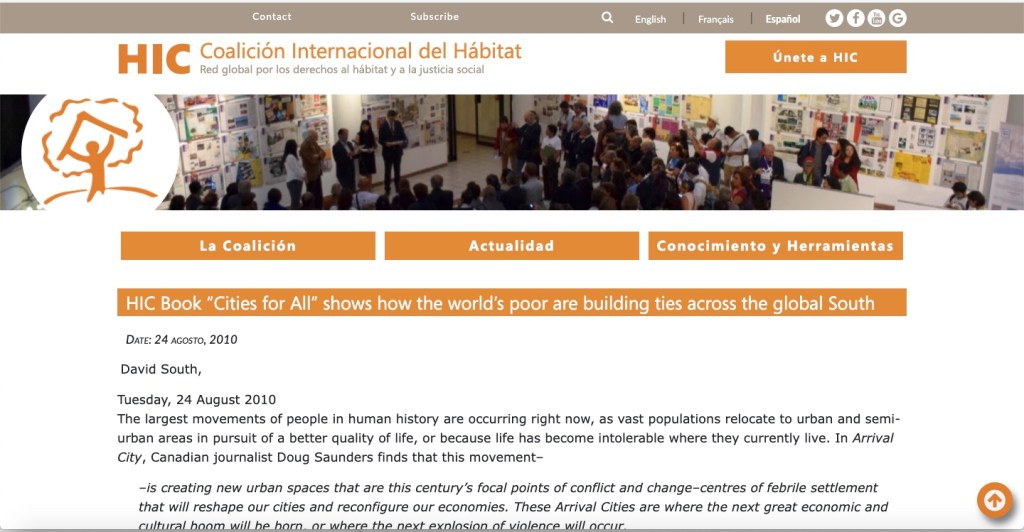
Cities For All Shows How The World’s Poor Are Building Ties Across The Global South

By David SouthDevelopment Challenges, South-South Solutions

SOUTH-SOUTH CASE STUDY

Cities for All, recently published by Habitat International Coalition, draws together thinkers and innovators in a compilation of case studies addressing the challenges of inclusive cities in the global South. The book seeks to articulate experiences of South-South cooperation and enhance the links between different regions. David South interviews the co-editor, Charlotte Mathivet.

Published: 24 August 2010

Global Urbanist (http://globalurbanist.com/2010/08/24/cities-for-all-shows-how-the-worlds-poor-are-building-ties-across-the-global-south)

The largest movements of people in human history are occurring right now, as vast populations relocate to urban and semi-urban areas in pursuit of a better quality of life, or because life has become intolerable where they currently live. In Arrival City, Canadian journalist Doug Saunders finds that this movement —

— is creating new urban spaces that are this century’s focal points of conflict and change — centres of febrile settlement that will reshape our cities and reconfigure our economies. These Arrival Cities are where the next great economic and cultural boom will be born, or where the next explosion of violence will occur.

For most, this process is chaotic, unplanned, and fraught with risk, hardship, poverty and stress; yet, because so many are also able to dramatically improve their life chances, many millions will continue to follow this path.

The speed of urbanisation makes the question of how to build liveable cities increasingly urgent. A new book hopes to help people get closer to solutions to these vexing problems.

Cities for All: proposals and experiences towards the right to the city, published by Habitat International Coalition (HIC) in Santiago, Chile, and co-edited by HIC’s Ana Sugranyes and Charlotte Mathivet, was launched during this year’s World Urban Forum in Rio de Janeiro, and highlights ways in which urban residents across the South are defining how they would like their cities to evolve, refusing to accept social exclusion and demanding a “right to the city”.

The book is published in three languages — EnglishSpanish and Portuguese.

“A lot of social initiatives based on the right to the city are coming from these ‘new cities of the South'”, says Mathivet. “The book highlights original social initiatives: protests and organising of the urban poor, such as the pavement dwellers’ movements in Mumbai where people with nothing, living on the pavements of a very big city, organise themselves to struggle for their collective rights, just as the park dwellers did in Osaka.”

“Another innovative experience came from the children’s workshops in Santiago, aimed at including children in urban planning in order to make a children-friendly city.”

The cities of Africa and Asia are growing by a million peole a week. If current trends continue, mega-cities and sprawling slums will be the hallmarks of this majority urban world. In sub-Saharan Africa, 72 per cent of the population lives in slum conditions. And by 2015, there will be 332 million slum-dwellers in Africa, with slums growing at twice the speed of cities.

“The consequences have produced a deeper gap between the city and countryside, and also within the city between the rich and poor,” said Mathivet.

Cities for All details African experiences from Nigeria, Cameroon, Ghana and South Africa. Mathivet believes “one common topic affecting these countries is the problem of forced evictions, due to the rural exodus and growing urbanisation. It is therefore very important for the right to the city to include a perspective of linking the struggle between rural and urban movements, because problems in cities and the countryside are closely connected, especially in Africa.”

And the current surge to cities in Africa raises the issue of what type of development will occur. The book argues that cities aren’t automatically a solution to the plight of the poor. Cities need to be worked on, and many of the problems faced by the South’s fast-growing cities stem from a power imbalance.

“A very important thing to realise is that a city life is not a synonym for a better life or a miracle solution for poor people, nor for the ‘capitalist’ way of life,” says Mathivet. “African nations and their people have to find effective solutions on their own to overcome poverty — which they are doing — without copying development models from the North.”

“In my understanding, urban growth is not haphazard or poorly planned in ‘developing’ countries. Rather, I think that urban ‘planning’ or lack of planning is done with a goal of generating more benefits for powerful interests and fewer benefits for poor people.”

The book argues for a two-way relationship with the people who make up the majority of these fast-growing cities. And it says each city will have to customise its solutions.

“It is very difficult to apply social innovations to other countries without understanding the history and the social, economic, cultural and political context,” says Mathivet.

“Hope comes from learning of different experiences. For example, if a social movement in South Africa succsesfully avoided an eviction from a slum, it may help another social movement in Brazil to strengthen its own strategy. One of the book’s goals was to articulate the various South-South experiences and enhance the links between different regions.”

In one chapter, contributor David Harvey argues that “the right to the city is not simply the right to what already exists in the city; it is also the right to transform the city into something radically different.”

“The right to the city itself will not stop the over-whelming phenomenon of urban growth,” believes Mathivet. “The consequences produced by implementing this collective right would rather change people’s daily lives by achieving more equality in cities as well as in the relationship between the city and coutnryside in regards to growing urban populations.”

Cities for All highlights the existence of ‘cities without citizens’: the vast numbers of slum dwellers and the poor who live mostly ignored by authorities (unless they are in the way of commercial development).

“The expression ‘cities without citizens’ means the exact opposite of the right to the city proposal,” Mathivet says. “This alternative to the present global paradigm proposes to allow people to participate in the process of creating the city in terms of urban planning, decision-making, budget, public policies, etc. It is possible for people to influence their own lives and the community.”

“There is no miracle solution, and the right to the city is a banner around which people can organise themselves to articulate their struggles and demand social justice.”

The book concludes by arguing for the advantages of a ‘slow city’ approach. But how does this work in fast-growing urban areas where people are looking to quickly escape poverty, or are seeking rapid improvements to their quality oflife? Would they not find a slow city approach frustrating?

Mathivet believes a leap of imagination is required: “Cities for All is not intended to be a recipe book. The slow city experience was chosen as a conclusion to the book in order to present a different approach, but not to propose a clear solution to follow. Concluding with the slow city experience, which is radically different and difficult to apply in African and Asian cities, where the spread of urbanisation is uncontrollable and leads to major problems, emphasises that the fight for the right to the city involves imagination and the desire for another possible city …

“Moreover, slow city experiences have been developed otuside of wealthy European countries, for example in some small Argentine and South Korean cities.”

And with the coming decade unfolding, what will cities in the South be like? Are we on the cusp of a new, dark age akin to the misery of Europe’s cities during the industrial revolution?

Mathivet acknowledges that “we can see a dark future where the interests of the most vulnerable will not be the priority. However, looking at the experiences by and for the people, we cannot consider them poor, but rich of knowledge, cognitive capital, and with courage to change their lives and their communities, through self-management and autonomy.

Cities for All aimed to show this richness … the challenges are for civil society to deepen links between different movements to build a stronger global strategy, during events like the next World Social Forum in Dakar, February 2011.”

David South is an international development consultant and writer. He writes the Development Challenges: South-South solutions e-newsletter for UNDP’s Special Unit for South-South Cooperation. He led the Communications Office for the UN in Ulaanbaatar from 1997 to 1999 and has worked for the UN in South Africa, Turkmenistan and Ukraine.

The Special Unit for South-South Cooperation is mandated to promote, coordinate and support South-South and triangular cooperation on a global and UN-systemwide basis.

This story is adapted from a piece in the July 2010 edition of Development Challenges.

http://globalurbanist.com/2010/08/24/cities-for-all-shows-how-the-worlds-poor-are-building-ties-across-the-global-south

https://www.hic-net.org/es/hic-book-cities-for-all-shows-how-the-worlds-poor-are-building-ties-across-the-global-south/

Development Challenges, South-South Solutions was launched as an e-newsletter in 2006 by UNDP’s South-South Cooperation Unit (now the United Nations Office for South-South Cooperation) based in New York, USA. It led on profiling the rise of the global South as an economic powerhouse and was one of the first regular publications to champion the global South’s innovators, entrepreneurs, and pioneers. It tracked the key trends that are now so profoundly reshaping how development is seen and done. This includes the rapid take-up of mobile phones and information technology in the global South (as profiled in the first issue of magazine Southern Innovator), the move to becoming a majority urban world, a growing global innovator culture, and the plethora of solutions being developed in the global South to tackle its problems and improve living conditions and boost human development. The success of the e-newsletter led to the launch of the magazine Southern Innovator. 

Creative Commons License

This work is licensed under a
Creative Commons Attribution-Noncommercial-No Derivative Works 3.0 License.

ORCID iD: https://orcid.org/0000-0001-5311-1052.

© David South Consulting 2021