Categories
Archive Development Challenges, South-South Solutions Newsletters

Reality Television Teaches Business Skills in Sudan

By David SouthDevelopment Challenges, South-South Solutions

SOUTH-SOUTH CASE STUDY

Learning how to thrive in a market economy does not necessarily come naturally. But for young people who have grown up under a different economic system or known nothing but economic chaos, learning business skills can give them the tools to get on in life.

With youth unemployment rates high around the world, it is clear many young people may never get the jobs they expect unless they start businesses themselves.

In 2013, 73.4 million young people were out of work, an increase of 3.5 million from 2007. A report by the International Labour Organization (ilo.org) found persistent unemployment around the world in the wake of the global economic crisis, a proliferation of temporary jobs and growing youth discouragement in advanced economies; and poor quality, informal, subsistence jobs in developing countries. School-to-work transition surveys of developing countries showed that youth are far more likely to land low-quality jobs in the informal economy than jobs paying decent wages and offering benefits.

High youth unemployment often has nothing to do with poor educational achievement (many unemployed youth have high school educations or university degrees), but is often caused by other factors, including lack of access to capital, rigid labour markets, skills mismatched to demand in the economy (for example construction and building trades), or a gap between personal aspirations and the true state of the country’s economic development.

But rather than despair, it is possible to show youth how to turn things around and use business skills to re-shape economies in their favor. Youth tend to bring to the economy energy and drive combined with new ideas and experiences calibrated to the demands of the 21st century. By harnessing this, youth can find a unique space in the marketplace. In turn, young people can lead in reviving damaged economies and making their countries wealthier and healthier. Many youth have grown up around the emerging digital economy and the use of mobile phones. Being comfortable with the 21st century digital economy will unleash many economic opportunities that favor youth.

The British Council says that “creative entrepreneurship is considered the most efficient model for youth in the developing world who are facing huge difficulties in finding employment”. The entrepreneurship or creative investment industry is one of the fastest-growing sectors in the world.

Understanding what works for youth business entrepreneurship has become a specialty in its own right. Using the media to teach skills and inspire youth to action is one proven approach.

One recent example is a successful television programme from the Republic of the Sudan. Called Mashrouy (mashrouy.com), it is modeled on reality TV programmes such as The Apprentice, which features serial U.S. entrepreneur Donald Trump (http://www.bbc.co.uk/programmes/b00q3fkq) and the BBC’s Dragon’s Den (http://www.bbc.co.uk/programmes/b006vq92), where contestants pitch their ideas to a panel of judges to see if they can get funding for their business idea.

In Mashrouy, 12 contestants battled it out to see who had the best business idea. They undertook various challenges and the original 12 were whittled down to three contestants. Live on air in December 2013, viewers voted for their favorite contestant and the winner (https://www.facebook.com/Mashrouy) received a prize of 200,000 SDG (US $35,211), while the second prize winner received 150,000 SDG (US $26,408) and the third prize winner received 100,000 SDG (US $17,605). All three were then taken to London in the United Kingdom to meet other creative entrepreneurs and receive valuable business advice.

The Sudanese show (http://sudan.britishcouncil.org/our-work/mashrouy) is supported by the British Embassy and the British Council, and is working with the Sudanese Young Businessmen Association and major Sudanese companies to spread the idea of entrepreneurship among the youth of Sudan.

Sudan suffered a brutal civil war on and off throughout the 2000s, leading to the partition of the original country into the Republic of the Sudan and the new nation of South Sudan in 2011.

Faced with Sudan’s serious youth unemployment – as high as 34 per cent – and a fragile economy, the TV show’s producers wanted to encourage youth to start businesses.

The contest was aimed at youth between 18 and 40 and appeared on the Blue Nile (http://bnile.tv/blue.html) channel.

“At a time of national economic hardship, it has kindled the imagination of Sudanese youth,” wrote journalist Isma’il Kushkush (https://twitter.com/ikushkush) in The New York Times.

For the show, a panel of experts picked 12 projects out of 2,500 applications. Each of the 12 finalists was given a chance to do a “pitch,” giving a quick summary of their business idea and trying to get the panel excited about the idea and its potential. The idea that generated the most excitement won.
The 12 pitches included an idea for an ostrich farm and a plan to export spicy peanut butter. The winner, 32-year-old Samah al-Gadi, wants to use a locally available weed-like river plant to make bags and furniture. She said she got up the courage to be on the show from a supportive mother.

“Amid ululations, screams and clapping, a jubilant Ms. Gadi raised both hands above her scarf-covered head, flashing victory signs,” The New York Times said. “Her mother, sitting at a dinner table, was brought to tears.”

The women-owned social enterprise Making Cents International (makingcents.com), based in Washington, D.C., USA, has been gathering resources on youth entrepreneurship since 1999. It has put together a custom “curricula to develop the mindset, skillset, and toolset that enable entrepreneurs and enterprises to participate in profitable markets; financial institutions to serve new populations; and individuals to obtain meaningful work”.  This is available in 25 languages. It also hosts the Global Youth Economic Opportunities Conference in Washington, DC, held this year from 6 to 8 October 2014 (http://youtheconomicopportunities.org/conference).

Published: April 2014

Resources

1) Khartoum Teaching Centre: The British Council is a world leader in English language training and teaching. It offers general English courses for adult learners of all levels, totaling 60 hours of tuition over 10 weeks. Website: http://sudan.britishcouncil.org/learn-english/courses

2) Start-up Chile innovation fund: Start-Up Chile is a program created by the Chilean Government, executed by Corfo via InnovaChile, that seeks to attract early stage, high-potential entrepreneurs to bootstrap their startups in Chile, using it as a platform to go global. Website: startupchile.org

3) Global Youth Economic Opportunities Conference 2014: From 6 to 8 October Youth entrepreneurship conference in Washington, D.C., USA. Website: youtheconomicopportunities.org/conference

4) Making Cents International: The Youth Economic Opportunities learning platform is the first community of practice and knowledge exchange portal developed by and for the youth economic opportunities sector. Website: youtheconomicopportunities.org

5) Mongolian Rock Pop book: A book published by UNDP in the Mongolian language on how the country’s rock and pop musicians led on business innovation using creative marketing and publicity during the country’s turbulent transition during the 1990s. Website: http://tinyurl.com/p25scqq

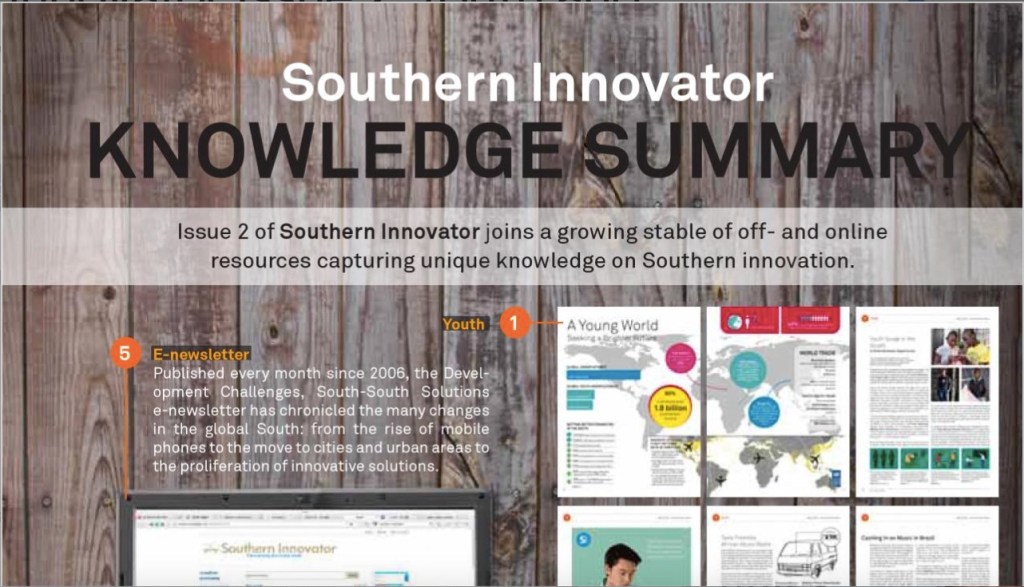
Development Challenges, South-South Solutions was launched as an e-newsletter in 2006 by UNDP’s South-South Cooperation Unit (now the United Nations Office for South-South Cooperation) based in New York, USA. It led on profiling the rise of the global South as an economic powerhouse and was one of the first regular publications to champion the global South’s innovators, entrepreneurs, and pioneers. It tracked the key trends that are now so profoundly reshaping how development is seen and done. This includes the rapid take-up of mobile phones and information technology in the global South (as profiled in the first issue of magazine Southern Innovator), the move to becoming a majority urban world, a growing global innovator culture, and the plethora of solutions being developed in the global South to tackle its problems and improve living conditions and boost human development. The success of the e-newsletter led to the launch of the magazine Southern Innovator. 

https://davidsouthconsulting.org/2021/03/05/southern-innovator-issue-2/

Creative Commons License

This work is licensed under a
Creative Commons Attribution-Noncommercial-No Derivative Works 3.0 License.

ORCID iD: https://orcid.org/0000-0001-5311-1052.

© David South Consulting 2023

Categories
Archive New Media Markets

NSD partners in bitter row over choice of satellite as Brussels deadline nears

DTH Scandinavia

By David South

Financial Times New Media Markets (London, UK), September 21, 1995

ISSN: 02654717

OCLC Number / Unique Identifier: 1266447669

The controversial Nordic Satellite Distribution consortium is in danger of collapsing because of a row between two of its three big shareholders.

The row, between Swedish programmer Kinnevik and Norwegian telephone company Telenor, threatens the chances of the consortium coming up with a restructuring that will win acceptance from European Commission competition officials.

NSD has been trying to turn the 1 degree West orbital position – home to the Thor and TV Sat-2 satellites – into Scandinavia’s “hot bird” position. But Kinnevik also plans to take a substantial slice of capacity on the Swedish Space Corporation’s planned digital satellite Sirius-2, at 5 degrees East. Telenor is furious.

It is demanding that Kinnevik drop the plan and also give up its existing transponders at the 5 degrees East position, on the Tele-X and Sirius-1 satellites. Kinnevik already plans to give up its Astra transponders, to the relief of Telenor.

Kinnevik is buying capacity on the rival system simply as a way of hedging its bets. Sirius-2, with 16 transponders offering a mix of digital and analogue channels for the Scandinavian market, could become a powerful satellite and Kinnevik is worried that a strong rival service might be developed on it. The company is thought to be negotiating for six of the 16 transponders (another 16 transponders are aimed at the rest of Europe).

Per Bendix, chairman of the NSD, said that the group could continue without Kinnevik, although it would be difficult to find another company with such large pockets.

He downplayed the rows between the shareholders: “Of course, there are tensions between Kinnevik and Telenor. You can’t imagine a process like this, a complicated business deal, without some frictions which create some warmth. None of the partners can stop this initiative, it has gained too much momentum.”

TeleDanmark, the third member of NSD, has tried to play a mediating role between Telenor and Kinnevik.

One source close to the consortium said: “Kinnevik is definitely interested in investigating other satellite operators for the digital future. The company is known for doing exactly as it pleases, which clashes with Telenor which is trying to get 1 degree West into shape.”

Kinnevik and Telenor have clashed repeatedly over Kinnevik’s refusal to give up the 5 degrees East position, where it transmits five channels on Sirius. The issue has been exacerbated for Telenor by the fact that the mostly unencrypted Sirius/Tele-X package has achieved a better penetration than the encrypted Thor package.

The two companies have also been at loggerheads over the restructuring of the consortium, forced upon it by the European Commission.

Last July, competition commissioner Karel Van Miert ruled that NSD, which was planned as a vertically-integrated company providing programming, subscriber management and satellite capacity, was anti-competitive.

He ruled that NSD would “create or strengthen a permanent dominant position as a result of which effective competition would be significantly impeded” in the Nordic market for satellite broadcasting. It would dominate the provision of satellite transponders in Scandinavia, cable television in Denmark and direct-to-home pay-television distribution.

Bendix, with the backing of Telenor, has been trying to broaden the shareholder base by bringing in other Scandinavian programmers. But Kinnevik opposes the move because it does not think that it will meet Brussels’ concerns. It also does not want to play second fiddle to other programmers.

The shareholders have looked at other options, including one of splitting NSD into separate companies covering transponder-leasing, subscriber management and programming. The companies could have different ownership. Pele Tornberg, Kinnevik’s deputy managing director, would not say what alternative plan Kinnevik is proposing.

NSD has until next month to present Brussels with a revised shareholding structure.

Helsinki Media, the Finnish broadcaster, has rejected an approach to rejoin NSD, which it left in 1994 in a row over Kinnevik’s influence. President Tabio Kallioja said that the company maintained its view that NSD gave Kinnevik a stranglehold on the allocation of satellite capacity to other programmers. He added that Helsinki Media was interested in the plans for digital satellite television being developed by NetHold and by Telia Media, owned by the Swedish PTT, Telia.

More from New Media Markets and Screen Finance:

New Media Markets and Screen Finance

New Media Markets and Screen Finance were published by the Financial Times in the 1990s.

https://davidsouthconsulting.org/2021/12/08/new-media-markets-and-screen-finance/

From Special Report: NMM (New Media Markets) Spotlight On The Emergence Of Satellite Porn Channels In The UK

https://davidsouthconsulting.org/2020/12/21/affordable-space-programmes-becoming-part-of-souths-development/

https://davidsouthconsulting.org/2021/02/05/channel-regulation-swedes-will-fight-childrens-advertising-all-the-way/

https://davidsouthconsulting.org/2021/02/03/do-tv-porn-channels-degrade-and-humiliate/

https://davidsouthconsulting.org/2021/03/03/kommunikation-total-der-siebte-kontinent/

https://davidsouthconsulting.org/2021/02/01/playboy-is-not-for-sad-and-lonely-single-men/

https://davidsouthconsulting.org/2021/01/14/from-special-report-nmm-new-media-markets-spotlight-on-the-emergence-of-satellite-porn-channels-in-the-uk/

https://davidsouthconsulting.org/2021/02/01/uk-laws-on-satellite-porn-among-toughest-in-europe/

Creative Commons License

This work is licensed under a
Creative Commons Attribution-Noncommercial-No Derivative Works 3.0 License.

ORCID iD: https://orcid.org/0000-0001-5311-1052.

© David South Consulting 2023

Categories
Archive Blogroll id magazine

TV’s Moral Guide In Question – Again

By David South

Id Magazine (Canada), November 28-December 11, 1996

Television programmers are under attack once again. Thanks to Guelph activist Patricia Herdman’s Coalition for Responsible Televsion (CORT), two violent television shows – Poltergeist (CTV) and Millennium (Fox/Global) – have lost several advertisers in recent weeks due to pressure from CORT. It’s just another wave in a new assault on the immorality of television.

Positive Entertainment Alternatives for Children Everywhere (PEACE), a Montreal group founded after the murder of 14 young women in that city in 1989, staged a press conference last week, complete with sweet-faced children, to announce its “Toxic TV” list. Who is toxic? Old favourites like Bugs Bunny, Batman and Robin and The Simpsons. PEACE also produced a list of “Positive” TV shows. It included a wrist-slashing selection of insipid programming, such as Barney and Friends, Fresh Prince of Bel-Air and Kratt’s Creature.

But critics of television overlook the strong and often simplistic moral messages that infuse most programming. Some even argue the mostly Judeo-Christian morality comes at the expense of atheistic and agnostic perspectives.

University of Guelph philosophy professor Jay Newman argues that religious moralists are making television the scapegoat for all of society’s ills.

He argues television, rather than being a moral vacuum, is heavily influenced by Judeo-Christain values – often in shows many people don’t suspect.

Newman sharply criticizes religious moralists, who he says, neglect to observe the same contradictions in their own beliefs that they see in television.

In Newman’s view, religion shares many sins with television. Religion promotes passivity (“The meek shall inherit the earth”), disrupts family life (who needs to talk to that “immoral” gay brother/sister?), does a questionable job of moral education, invents celebrities (the saints), sacrifices spiritual wisdom for meaningless ritual and entertainment (the Mass), and promotes violent behaviour (who can forget the Crusades or the Spanish Inquisition?).

Leaning back in his chair at his University of Guelph office, the irascible New York-born Newman enthusiastically defends television.

“When we assess TV as bad,” he says, “I’m not convinced religion is the only moral teacher, and it has not been the best moral teacher. Religion has been a very important force of hatred, whereas Star Trek teaches us to respect other cultures.

“TV has been of great value in promoting pluralism and an increase in tolerance.”

Newman isn’t talking about gore-soaked TV like Poltergeist and Millennium, shows he says speak more about their producers than about the medium of television. “Wanton slaughter can’t be blamed on TV. But I do agree with psychologists that some television inures us to violence.”

He sees Star Trek as a moral force for both pluralism and tolerance, strong values that are essential to democracies with many ethnic, cultural and racial groups. “This show promotes tolerance towards people who appear different. It shows aliens have aspirations and desires just like us.”

Newman does take offence to one race of aliens on the popular series: the Ferengi. While the Ferengi are supposed to be the equivalent of used car dealers in Star Trek’s universe, they draw criticism from Newman for their anti-semitic undertones. But even here, says Newman, TV can’t beat the pantheon of Christain anti-semites.

As for the bumbling antics of Bart Simpson and his dad Homer, Newman says The Simpsons also contain positive morals. “The Simpsons teaches us to accept the foibles of others and empathize. It does it in a gentle way without passing a very austere judgement.”

Newman even sees hope in the dreamy world of daytime soap operas. They teach people to develop empathy. They also use negative role models to show that hatred and contempt backfire on people; that promiscuity and adultry don’t come without a cost.”

As for Seinfeld, a sitcom about a group of friends who seem to never do anything, Newman says, “I’m a New Yorker and I can’t sit through it.”

Newman, an expert on religious fanaticism and hypocrisy, has responded to religious critics of television in his new book, appropriately titled Religion vs. Television. Newman sees religious critics of television as at best hypocrites, at worst specious claimants to higher moral ground.

“[Religious leaders] make judgements to show the usefulness of their institutions in an attempt to restore the lustre of religious authority.”

Newman believes the debate surrounding violence on TV is misguided. He believes the root causes of violence should be dealt with first.

“Television is a convenient scapegoat. Its criticism parallels religious bigotry. They don’t focus on the individual, just the medium. And this is accepted by people who call themselves liberal!”

TV immoral?

But critics of TV say any decent moral messages that slip through are undermined by television’s subservience to a higher God: consumerism. For Rose Anne Dyson of Canadians Concerned About Violence in Television (C-CAVE), this corrupted morality can’t be ignored. “There is only one over-riding religion today: consumerism. Its main purveyor is TV.

“Television is a major socializer today. Parents and teachers are key to modifying that influence. But most of television is very bad and just teaches consumer-driven values. There isn’t a single children’s programme that isn’t infused with commercial values.”

Dyson believes the negative effects aren’t just psychological. “Watching too much TV is bad – it causes obesity and hyperactivity.”

Dyson’s claims were recently backed up by a new study showing unhealthy minds may lead to unhealthy bodies. A study conducted by Columbia University claimed the more that children watched TV, the fatter they got. Researcher Dr Barbara Dennison found children who watched 14 hours of television a week had diets with 35 per cent of their calories from fat. The study blamed the high representation of junk food in television ads and the fact they promoted couch potato dining. Canadian children on average watch 18 hours a week of television.

Dyson does agree with Newman’s criticism of organized religions’ spurious claims to higher ground. “Judeo-Christian religions have gotten us into a lot of trouble!”

To control this morally wayward TV, Dyson looks forward to more entertainment conglomerates self-regulating their programming. “The cornerstone of democracy is to obey rules.

“A lot of cultural studies people tend to underestimate the impact of TV – there is too much of a value-free approach.”

Id was published in Guelph, Ontario, Canada in the 1990s.

Further Reading:

Channel Regulation: Swedes Will Fight Children’s Advertising All The Way

From Special Report: NMM (New Media Markets) Spotlight On The Emergence Of Satellite Porn Channels In The UK

Undercurrents: A Cancellation At CBC TV Raises A Host Of Issues For The Future

https://davidsouthconsulting.org/2021/02/05/channel-regulation-swedes-will-fight-childrens-advertising-all-the-way/

https://davidsouthconsulting.org/2021/02/03/do-tv-porn-channels-degrade-and-humiliate/

https://davidsouthconsulting.org/2021/03/03/kommunikation-total-der-siebte-kontinent/

https://davidsouthconsulting.org/2021/12/08/new-media-markets-and-screen-finance/

https://davidsouthconsulting.org/2022/04/21/nsd-partners-in-bitter-row-over-choice-of-satellite-as-brussels-deadline-nears/

https://davidsouthconsulting.org/2021/02/01/playboy-is-not-for-sad-and-lonely-single-men/

https://davidsouthconsulting.org/2022/11/22/popular-characters-re-invent-traditional-carving/

https://davidsouthconsulting.org/2022/10/27/reality-television-teaches-business-skills-in-sudan/

https://davidsouthconsulting.org/2021/01/14/from-special-report-nmm-new-media-markets-spotlight-on-the-emergence-of-satellite-porn-channels-in-the-uk/

https://davidsouthconsulting.org/2021/02/01/uk-laws-on-satellite-porn-among-toughest-in-europe/

https://davidsouthconsulting.org/2020/12/11/undercurrents-a-cancellation-at-cbc-tv-raises-a-host-of-issues-for-the-future/

Creative Commons License

This work is licensed under a
Creative Commons Attribution-Noncommercial-No Derivative Works 3.0 License.

ORCID iD: https://orcid.org/0000-0001-5311-1052.

© David South Consulting 2023