Categories
Archive Blogroll Development Challenges, South-South Solutions Newsletters Southern Innovator magazine

New 3D Technology Makes Innovation Breakthrough and Puts Mind over Matter

By David SouthDevelopment Challenges, South-South Solutions

SOUTH-SOUTH CASE STUDY

Revolutions in technology are placing more and more power into the hands of the individual, and 3D printing and fabrication machines are opening a whole new chapter.

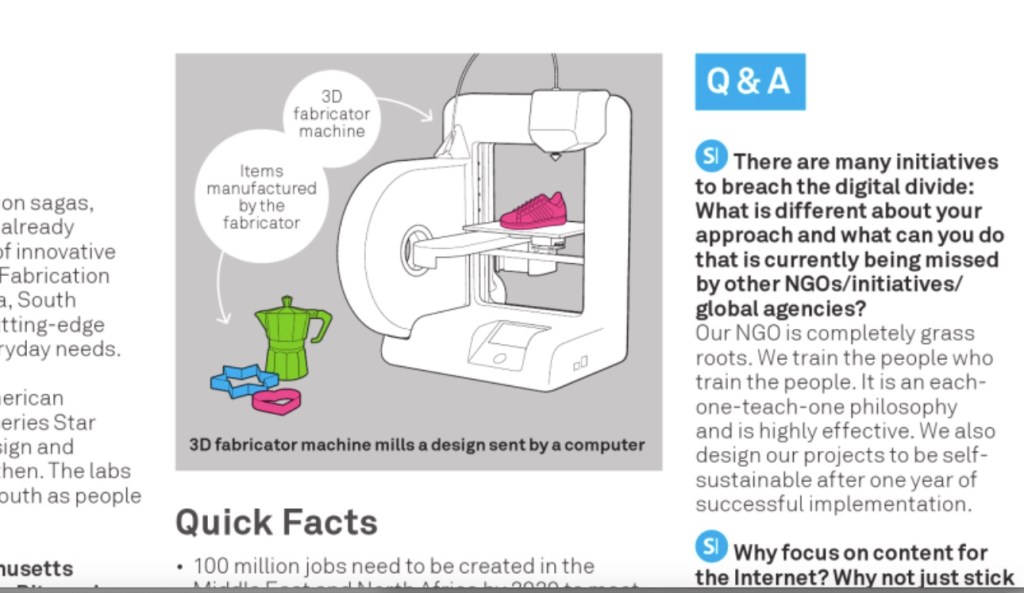
These devices come in many forms, but they all do one thing: they can manufacture pretty well any three-dimensional object on the spot, from digital plans. These machines come in many sizes, from factory scale to smaller, home versions which are no bigger than personal computer printers, such as the well-known MakerBot Replicator 2 (makerbot.com).

3D printers introduce sophisticated precision manufacturing to the individual much in the same way the personal computer and the Internet have empowered people to make their own software, build websites and start online businesses.

A pioneering educational innovation in Chile is taking the technology even further, in a way that is truly mind-blowing. Thinker Thing (thinkerthing.com) promises to transform the way people interact with this new technology. “We have built a machine that will allow you to make real objects with your mind,” its website states.

And, it wants to do more: “We want to use our invention to light a fire of inspiration throughout the remote and often disadvantaged schools of South America and we can do this with your help.”

Thinker Thing allows the user to wear a headset and communicate through brain waves to the 3D printer. The printer then manufactures a three-dimensional model of the thoughts. These can be squiggly shapes or even, it is hoped, more sophisticated forms.

Thinker Thing’s Chilean Chief Technology Officer is George Laskowsky. Laskowsky has a games console engineering background and was a research assistant in charge of high-energy particle experiments.

The Chilean government is funding this experiment to help children to improve their creative skills. The idea is to use the technology to eliminate the technical side of creating objects and focus the effort on the creative thought process. Thinker Thing was selected from more than 1,400 applicants to participate in the prestigious global accelerator program, “Start Up Chile” (http://startupchile.org). Start-Up Chile is a program created by the Chilean government that seeks to attract early-stage high potential entrepreneurs to develop startups using Chile as a platform to go global, in line with the national goal of converting Chile into the innovation and entrepreneurship hub of Latin America.

Based in Santiago, Chile, Laskowsky is seeking support for further development on IndieGoGo (http://www.indiegogo.com/projects/children-creating-real-objects-with-their-mind), an international crowdfunding platform for projects.

The plan is to tour Thinker Thing all around Chile and use the science, art and engineering principles behind the invention to help very young children in remote rural regions to learn through understanding the project. Its creators also hope to take the exhibition – called the Monster Dreamer School Outreach Program and the Fantastical Mind Creatures of Chile Exhibition – on the road and show it in major global cities.

The children are being asked to imagine fantastical creatures that will then be made into 3D forms with the machine. The idea is to then sell these 3D creatures to supporters of the project to help fund the initiative. As well, these creatures will go on display in an exhibition to help educate visitors about Chile’s children and their communities.

To increase interest, exclusive photographic prints and limited edition figurines are available of the creatures the children create.

The prototype uses what is called an EmotivEPOC, basically a wireless neuroheadset collecting signals from the user’s brain. In operation, the software allows users to make 3D models with the power of thought which are then made into a plastic model using a MakerBot Industries Replicator.

This is experimental stuff and neurotechnology is in its early stages. It can detect simple emotions such as excitement or boredom and cognitive thoughts such as push and pull. Despite being in its early stages, the technology can evolve a 3D object over a number of steps by detecting the user’s emotional response to design changes.

Thinker Thing has been working alongside neuroscientists to understand the workings of the brain. Amazingly, in one experiment they were able to get a person to control the leg of a cockroach using their own thoughts. Called the Salt Shaker (http://www.thinkerthing.com/about-2/salt-shaker/), it is an experimental kit for young students and hobbyists that allows them to take control of a biological limb quickly and simply.

The 3D printing revolution is energizing for large and small-scale manufacturers alike. It means a business can now engage in precision manufacturing of products and spare parts quickly. It means it is possible to download from the Internet plans for new innovations and manufacture them within minutes. It also means communities off the mainstream supply line can make what they need and repair machinery without needing to wait weeks or months for items to be shipped from afar or spend vast sums on shipping costs.

The Fab Labs project based at the Massachusetts Institute of Technology (MIT) has been at the forefront of pioneering and prototyping this technology, including running testing labs across the global South to prove the relevance of the technology to the world’s poorest communities.

As of 2012, these include Fab Lab Afghanistan (http://www.fablab.af/), in Chile the FabLab Santiago (www.designlab.uai/fablab), Fab Lab Egypt (www.fablab-egypt.com), in Colombia the FabLab Medellin (http://www.fablabcolombia.com), in Ghana the Takoradi Technical Institute (http://ttifab.wikispaces.com/How+to+Use+the+TTI+Fab+Lab+Wiki), in India at various locations, Indonesia’s HONFablab (http://honfablab.org), ARO FabLab Kenya West (http://www.fablab.co.ke), and in Peru, South Africa, Suriname and many more are in the works (http://fab.cba.mit.edu/about/labs/).

If Thinker Thing has its way, maybe people in the future will say “I think, therefore I print!”

Published: August 2013

Resources

1) Stratasys: The company manufactures 3D printers and materials that create prototypes and manufactured goods directly from 3D CAD files or other 3D content. Stratasys systems are used by manufacturers to create models and prototypes to aid in the new product design process. And they are becoming widely used for production of finished goods in low-volume manufacturing. Systems range from affordable desktop 3D printers to large production systems for direct digital manufacturing. Website: http://www.stratasys.com/

2) 3D Systems: 3D Systems is a leading provider of 3D content-to-print solutions including 3D printers, print materials and on-demand custom parts services for professionals and consumers alike. Website: http://www.3dsystems.com/

ExOne: With decades of manufacturing experience and significant investment in research and product development, ExOne has pioneered the evolution of nontraditional manufacturing. This investment has yielded a new generation of rapid production technology in the field of additive manufacturing as well as advanced micromachining processes. Website: http://www.exone.com/

FabCentral: This site supports a digital fabrication facility and global network of field fab labs managed by MIT’s Center for Bits and Atoms. Website: http://fab.cba.mit.edu

Maker Shed: 3D Printing and Fabrication:  An outstanding resource for getting all you need to understand 3D printing and manufacturing, with 3D printers, supplies, Whether you want to print out physical objects or machine something from plastic, wood, or other materials, we have the tools and accessories you need. Website: http://www.makershed.com/3D_Printing_Fabrication_s/220.htm

EMachineShop: The first and leading machine shop designed from the start for the Internet, eMachineShop’s mission is to provide easy, convenient and low-cost fabrication of custom parts via the web. Website: emachineshop.com/

Development Challenges, South-South Solutions was launched as an e-newsletter in 2006 by UNDP’s South-South Cooperation Unit (now the United Nations Office for South-South Cooperation) based in New York, USA. It led on profiling the rise of the global South as an economic powerhouse and was one of the first regular publications to champion the global South’s innovators, entrepreneurs, and pioneers. It tracked the key trends that are now so profoundly reshaping how development is seen and done. This includes the rapid take-up of mobile phones and information technology in the global South (as profiled in the first issue of magazine Southern Innovator), the move to becoming a majority urban world, a growing global innovator culture, and the plethora of solutions being developed in the global South to tackle its problems and improve living conditions and boost human development. The success of the e-newsletter led to the launch of the magazine Southern Innovator.  

Follow @SouthSouth1

Google Books: https://books.google.co.uk/books?id=YfRcAwAAQBAJ&dq=development+challenges+august+2013&source=gbs_navlinks_s

Slideshare: http://www.slideshare.net/DavidSouth1/development-challenges-august-2013-issue

Southern Innovator Issue 1: https://books.google.co.uk/books?id=Q1O54YSE2BgC&dq=southern+innovator&source=gbs_navlinks_s

Southern Innovator Issue 2: https://books.google.co.uk/books?id=Ty0N969dcssC&dq=southern+innovator&source=gbs_navlinks_s

Southern Innovator Issue 3: https://books.google.co.uk/books?id=AQNt4YmhZagC&dq=southern+innovator&source=gbs_navlinks_s

Southern Innovator Issue 4: https://books.google.co.uk/books?id=9T_n2tA7l4EC&dq=southern+innovator&source=gbs_navlinks_s

Southern Innovator Issue 5: https://books.google.co.uk/books?id=6ILdAgAAQBAJ&dq=southern+innovator&source=gbs_navlinks_s

Creative Commons License

This work is licensed under a
Creative Commons Attribution-Noncommercial-No Derivative Works 3.0 License.

ORCID iD: https://orcid.org/0000-0001-5311-1052.

© David South Consulting 2023

Categories
Archive Blogroll Southern Innovator magazine Special Unit for South-South Cooperation United Nations Development Programme United Nations Office for South-South Cooperation

Team | Southern Innovator Phase 1 Development (2010 – 2015)

Work began in 2010 to develop what became the United Nations magazine Southern Innovator. A highly talented global team of international development and design professionals based in New York and London collaborated with an Icelandic studio to create an innovation media brand showcasing global South innovators inspired by the mobile and information technology revolutions. It was launched in 2011 at the UN General Assembly in New York.

Cosmas Gitta

Editor-in-Chief

“Dr. Cosmas Gitta is a senior UN consultant and the former Assistant Director for Policy and UN Affairs at the UN Office for South-South Cooperation, where he oversaw the convening of various intergovernmental and interagency forums as well as the preparation of related reports and studies, including the biennial reports of the Secretary-General on the state of South-South cooperation. He was Editor-in-Chief of the magazine Southern Innovator and an e-newsletter, Development Challenges, South-South Solutions, both of which are media to share information on development related innovations with partners around the world. He was for many years Managing Editor of Cooperation South, a print and electronic development journal promoting collaboration among developing countries. Mr. Gitta holds a PhD in international and comparative education from Columbia University and he has lectured on human rights education at his alma mater, and on a range of other subjects at various campuses of the City University of New York.” (From Integral Leadership Review)

David South

Editor and Writer

David South is the founder and senior partner for David South International and David South Consulting. He has worked around the world for the United Nations and has led a number of groundbreaking projects for major institutions. Clients have included the United Nations Office for South-South Cooperation (UNOSSC), the United Nations Development Programme (UNDP), the Great Ormond Street Hospital for Children (GOSH)/Institute of Child Health (ICH)/National Health Service (NHS), Harvard Institute for International Development, UNICEF, World Bank, USAID, and the Hannah Institute for the History of Medicine, among others.

He has worked for, or side-by-side, with many high-level senior professionals and executives. These experienced professionals had roles under close public scrutiny and needed to show the impact of their work to a tight deadline.

He has been the editor for the United Nations magazine Southern Innovator since 2010. He also researched and wrote the influential United Nations e-newsletter Development Challenges, South-South Solutions (2007-2014). He has over two decades’ experience in media and journalism (developing strong relationships with many top journalists and media professionals), health and human development, and the role innovation plays in transforming major organisations while getting the most from people tackling complex problems in challenging environments.

Email me: davidsouthconsulting@gmail.com

Audette Bruce

Managing Editor

 Sólveig Rolfsdóttir

Graphic Designer and Ilustrator

Eva Hrönn Guðnadóttir

Graphic Designer and Illustrator


Launched in May 2011, the new global magazine Southern Innovator (ISSN 2222-9280) is about the people across the global South shaping our new world, eradicating poverty and working towards the achievement of the Millennium Development Goals (MDGs).

They are the innovators.

Follow the magazine on Twitter @SouthSouth1.

Southern Innovator Issue 1

Southern Innovator Issue 2

Southern Innovator Issue 3

Southern Innovator Issue 4

Southern Innovator Issue 5

If you would like hard copies of the magazine for distribution, then please contact the United Nations Office for South-South Cooperation (UNOSSC) (https://www.unsouthsouth.org/2014/12/25/southern-innovator-magazine/).

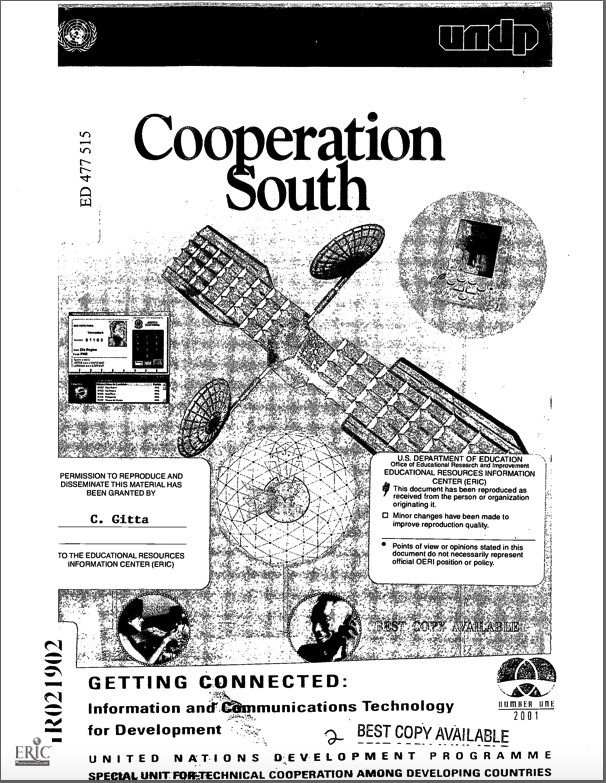
Read more of Dr. Gitta’s work here: Cooperation South, Getting Connected: Information and Communications Technology for Development, Number 1, 2001, United Nations Development Programme, ISSN-0259-3882.

Cooperation South, Getting Connected: Information and Communications Technology for Development, Number 1, 2001, United Nations Development Programme, ISSN-0259-3882. The team behind Cooperation South joined up with a team from Canada/UK/Iceland to create Southern Innovator Magazine (ISSN 2222-9280). Both publications highlighted the innovators behind the global South’s connectivity revolution.

This work is licensed under a Creative Commons Attribution 4.0 International License.

ORCID iD: https://orcid.org/0000-0001-5311-1052.

© David South Consulting 2021

Categories
Archive Blogroll Development Challenges, South-South Solutions Newsletters Southern Innovator magazine

Baker Cookstoves – Designing for the African Customer

By David SouthDevelopment Challenges, South-South Solutions

SOUTH-SOUTH CASE STUDY

An innovative social enterprise is using design to create an energy-efficient cookstove for Kenya. By turning to an experienced Swedish architecture and design firm, the people behind the Baker cookstove wanted to make sure the stove’s design was as efficient as possible and relevant to the customers’ needs, while also making sure it is visually appealing and something a person would proudly want in their home.

The Baker cookstove (bakerproduct.com) has been designed to be a high-quality and desirable product that also accomplishes the goal of saving money for the user. This unique product is being developed and made at the company’s factory in Nairobi, Kenya.

Baker’s owner is Top Third Ventures Global (topthirdventures.com), a social-impact company registered in Kenya and founded in 2011 by American Lucas Belenky and Björn Hammar, a Swedish/Finnish entrepreneur. Their goal is to make sure that everyone in the developing world has access to an affordable, high-quality efficient cookstove.

While cooking is a daily necessity for billions of people, it is also costly and polluting. By switching to energy-efficient cookstoves, families can reduce the cost of cooking daily meals and, if the stove is designed right, cut the amount of pollution generated. One of the great obstacles to the take-up of energy-efficient cookstoves to date has been the absence of sustainable business models to sell and distribute them.

The Baker cookstove, designed as an aspirational product and backed up with a seven-year guarantee, hopes to change this dynamic. If things go to plan, the company hopes to significantly scale up its production based on customers wanting to have a Baker cookstove proudly on display in their home.

The Baker cookstove is the product of a deliberate attempt to use design and a well-thought-out production life cycle to create an item that is eye-catching, effective, and manufactured consistently to a high standard.

Designed by Claesson Koivisto Rune (http://www.ckr.se/), a Swedish architecture and design firm, the Baker cookstove is a sleek, round, modern stove and comes in eye-catching colors such as orange. It could easily fit in with other kitchen products in a high-end design shop. And that is the point: they want people to want the Baker cookstove.

Quality is key, and engineering and design teams constantly monitor the product and make adjustments to the cookstove as they receive feedback from customers.

The Baker cookstove is benefiting from new financing being made available through carbon credits, which its founders believe will bring big changes to the energy-efficient cookstove market over the next 10 years.

Baker’s chief executive, Lucas Belenky, told Southern Innovator magazine – this newsletter’s sister publication – about the thinking behind the Baker cookstove.

SI: What role does design play in the Baker cookstove social enterprise? At what stage did Top Third Ventures start to think through the production life cycle for the Baker cookstove? What did you feel was missing in the other cookstove models currently available on the market?

The Baker cookstove is the cornerstone of the social enterprise. Top Third Ventures is at its core a product company. There are different aspects to the business model to make it work (i.e. carbon credits and big data) but everything depends on the success of the Baker product. We started thinking through the production life cycle from the day the company was founded in late 2011. The Baker is designed for usability, aspirational value, and performance, prioritized in that order. The most important thing is that the Baker is easy to use and does not require its users to change their daily routines or cooking habits. Cooking cultures vary greatly across the developing world so it is important to understand exactly who your customer is and focus on meeting their requirements. When you have a product that is easy to use it needs to be desirable as well. Beyond the service provided, the product should make the customer feel good about themselves. Finally, the Baker cooks the same food with half the fuel and much less smoke.

The priorities seem reversed for other cookstove models on the market. Efficiency comes first, then the aesthetic design, and cultural conformity is last. Hyper-efficient cookstoves are great for health and the environment on paper but the benefits are not realized because widespread adoption isn’t achieved. Most products are imposed through a top-down approach instead of starting with the customer and designing the stove around them.

SI: Why did you choose to have the Baker cookstove designed by Claesson Koivisto Rune, a Swedish architecture and design firm? What were some of the challenges encountered when designing the product and the production life cycle? What advice do you have for other social enterprises looking to offer an appealing product to low-income households?

We wanted the Baker cookstove to be an aspirational product that you use as much because of the performance (less fuel and less smoke) as because it is beautiful. Claesson Koivisto Rune believed in our vision at a very early stage and I doubt we could have gotten where we are today without them. Challenges around the design mainly involve keeping the costs down. Our customers do not have a lot of disposable income so balancing affordability with performance and world-class design is tough.

For other entrepreneurs selling to low-income households my advice is identify your customer, listen to them, and never stop listening. This is obvious to most businesses but for social enterprises sometimes the grant organizations or other dispersers of donor funding become the customer without you noticing.

Finally, often just because the consumer is in a developing country, enterprises neglect aesthetic appeal and branding. Do not do this. Your consumer behaves for the most part like their counterpart in the developed world. They want products that look nice and make them feel good.

SI: What role is information technology playing in the Baker cookstove’s development? How do mobile phones help with reaching customers in Africa? How does offering software products such as Top3Tracker help Baker cookstoves?

Information technology has a huge impact in decentralized areas because it enables cheap flow of information. For Top Third Ventures it allows us to track our sales in real-time, communicate with current and future customers instantly, and gain valuable insights about how to improve the sales pitch and marketing strategy. The Baker cookstoves also depends on carbon finance, which requires a dialogue with current customers to ensure the usage of the cookstove is accurately measured. Information technology such as our Top3 Tracker significantly reduces the cost of accessing carbon finance.

SI: It is said an innovator is somebody who disrupts existing products and ways of doing things. How is Top Third Ventures innovating and disrupting the current approach to energy-efficient cookstove distribution?

We hope to change the way products for low-income households are designed, marketed, and sold. Top Third Ventures’ Baker cookstove embodies our conviction that these products should be customer-centric, have aspirational value, and conform to local cultures. The success of our product will show that consumers in the developing world want the same thing as their counterparts in developed countries.

Top Third is a partner of the Global Alliance for Clean Cookstoves (cleancookstoves.org).

Published: December 2013

Resources

1) Baker cookstove: The website details how the cookstove was developed. Website: bakerproduct.com

2) Top Third Ventures: The company designs, manufactures, and sells its own unique efficient cookstoves made to fit the local cultures and traditions of their customers, supported by a strong brand and world-class customer communication. In addition, Top Third Ventures works with existing manufacturers and distributors to secure carbon financing for their activities through their programmatic CDM activity and electronic data management system. Website: topthirdventures.com

3) Global Alliance for Clean Cookstoves: The Global Alliance for Clean Cookstoves calls for 100 million homes to adopt clean and efficient stoves and fuels by 2020. Website: cleancookstoves.org

Like our content? Help contribute to the costs of keeping it online. 

Scan code with your phone and help us out.

This work is licensed under a Creative Commons Attribution 4.0 International License.

ORCID iD: https://orcid.org/0000-0001-5311-1052.

© David South Consulting 2021

Categories
Archive Birkbeck University of London Blogroll

A Steppe Back?: Economic Liberalisation And Poverty Reduction In Mongolia

Paper delivered to the School of Politics and Government, Birkbeck College, University of London, London, UK, 2000

“… the neo-liberal claim that transition is most successful in situations where state organs wither away is highly problematic. The state, it seems, is required as a fundamental regulatory formation in transition (Pickles and Smith 1998: 15).”

By David South

This paper will explore the profound weaknesses of economic liberalisation as a tool of poverty reduction in the developing world. I have chosen to explore the experience of the Northeast Asian nation of Mongolia; a country sandwiched between Russia and China which has been held up as an example of how economic liberalisation policies and strong personal freedoms can help a country make the transition from a command-based Communist country to free markets and democracy (UNDP Mongolia: The Guide 1997-1999). I argue that the slate of policies that constitute economic liberalisation (or “shock therapy”) in the 1990s – privatisation, price liberalisation and a free-floating currency – are, by themselves, poor mechanisms for the alleviation of poverty; that in fact they increase poverty rates and leave a legacy of weak institutions that are either unwilling to, or incapable of, helping the poor. The author will also draw on firsthand evidence gained while working in the United Nations mission in Mongolia for two years.

Economic liberalisation policies have been inhibited from alleviating poverty by the cultural legacy of Mongolia’s economic development, which has de-emphasised private property and a money-based economy and placed a high emphasis on wealth being held in herds of animals and goods exchanged by barter.

Mongolia, with its relative isolation and small population of 2.4 million (Human Development Report Mongolia 2000: 55), has been seen as a self-contained petri dish by economic liberalisers hoping to incubate a robust transition to free markets and democracy that can serve as an example to other post-Communist states.

Mongolia’s journey towards neo-liberal ideas is unique. Unlike many other developing nations, Mongolia’s lively democratic movement that emerged at the end of the 1980s actively sought out these policies, and has enjoyed strong and widespread public support for them (though this has ebbed and flowed with the economic fortunes of the country). The 1996 election was fought and won by the Democratic Coalition based on these policies; the Coalition won 50 of the 76 seats in Mongolia’s parliament, and voter turnout was more than 90 per cent (Far Eastern Economic Review 1997: March 27). Thus, this is not a case of international institutions forcing upon a country policies against its wishes: the door was opened and the economic liberalisers were effectively invited in for a big bowl of fermented mare’s milk.

However, it is also a country in which economic liberalisation has failed to deliver anticipated reductions in poverty for the majority of the population, and a strong case exists that it has made things worse.

As the Human Development Report Mongolia 2000 states:

In recent years however, the predominant vision has been neo-liberal. Backed by some international donors, reformers have argued that the best thing the state can do is to largely withdraw from the economy – by rapidly privatising state enterprises, and dismantling as many regulations and controls as possible, and allowing market forces to determine the production and allocation of goods and services. (Human Development Report Mongolia 2000: 13)

Liberalisation policies in Mongolia: A potted history

With the fall of the Soviet Union at the beginning of the 1990s, Mongolia woke up to find itself without its financial benefactor for most of the 20th century, Russia, and in the grip of a severe economic decline (Rossabi 2000: 9).

But a new “big brother” was at hand. In 1991, economic liberaliser Jeffrey Sachs arrived in Mongolia (Fortune 1998: December 7). The arrival of Sachs and his ideas were to have a profound impact on the lives of Mongolians. He gathered a group of well-educated Mongolian economists to test economic liberalisation theories.

Smith and Swain neatly summerise the source of economic ideas for the transition states:

The roles played by Francis Fukuyama (1992), formerly of the US State Department, and Jeffrey Sachs (1990), as policy adviser … translated this agenda into the all too familiar programme of so-called ‘shock therapy’. Shock therapy has been based on the view that capitalism could be … imposed by fiat and that the unleashing of the power of capital will inevitably allow the institutions, regulations, habits and practices associated with the ‘normal’ functioning of a capitalist market economy to emerge (Smith and Swain 1998)

The economic liberalisation project in Mongolia can be split into two distinct phases. The first more tentative phase under the Communist government extended from 1990 to 1992 and included privatisation of some state firms, the issuing of stock-market vouchers to most of the population and a failed attempt to enter the foreign currency markets (as a result of which 80 per cent of the country’s reserves were lost). This phase coincided with a new constitution, democratic elections and significant improvements in personal freedoms.

The economic liberalisation project encountered serious difficulties from the start, and when all aid and subsidies from the Soviet Union were removed, the economy collapsed, with inflation spiralling to 320 per cent (Human Development Report Mongolia 2000: 13). Pro-economic liberalisation factions in the Communist government lost influence and the reforms stalled from 1992 until 1996, when they were re-started with a vengeance with the election of the Democratic Coalition. The Coalition was assembled from a hitherto fragmented opposition by the Washington-based International Republican Institute and mimicked the policies of the American Republican Party, including distributing a Newt Gingrich-style “Contract with the Mongolian Voter.”

The second phase of reforms, under Democratic Coalition Prime Minister M. Enkhsaikhan, was launched with the removal of price controls on fuel and electricity, increasing prices by 50 per cent (Rossabi 2000: 11). This phase of economic liberalisation also ran into difficulties, but its most successful policy achievements have been the privatisation of public housing, the removal of trade tariffs and the reining in of inflation.

Poverty and economic liberalisation

Prior to the introduction of economic liberalisation, there was no extreme poverty in Mongolia, though it is difficult to gauge relative poverty since this information was not gathered. Rossabi notes, however, an extensive public welfare system was spread throughout the country:

The Mongol economy required substantial subsidies from the Soviet Union. This command economy produced inefficient industries, few consumer goods, and scant increases in the size of the Mongol herds. The one-party system limited dissent and contributed to human rights abuses. On the other hand, the government provided extensive medical, educational, and welfare benefits to the young, women, the elderly, and indeed much of society. A growth in population, a longer life span, and high rate of literacy were byproducts of such state policies. (Rossabi 2000: 6)

All research data has shown an increase in poverty levels for a large portion of the population after 1990. Estimates vary wildly, but the United Nations Development Programme reports that 38.4 per cent of urban dwellers – and 32.6 per cent of rural residents – were poor in 1998 (Human Development Report Mongolia 2000: 23). School attendance is down, regional disparities have become more extreme, with the capital experiencing a boom fuelled by international aid (this totalled US $180 million in 1998 (Mongolia Update 1999: 27) and an expanding service sector. Provincial towns and smaller communities have seen local state-run businesses collapse, communications weaken, and a leaching of the population, either to the countryside to herd animals or to the capital to seek work.

To cite one graphic anecdotal example of the process, a consulant for the Asian Development Bank told a 1998 donor agencies meeting of the irony of going into former factory towns, and telling the well-educated residents to turn to small crafts and itinerant vegetable growing rather than restarting the existing factory.

Mongolia’s transition: theoretical dilemmas

As Pickles and Smith note in their work of political economy Theorising Transition: the Political Economy of Post-Communist Transformations, it is a profound mistake to ignore the distinctive evolution of each of the former Communist states. Mongolia’s attempts at transition to a market economy have been deeply marked by its cultural legacy, in spite of attempts to transcend this. While Ohmae may assert that “This movement up the ladder of development has nothing to do with culture and everything to do with the region’s ability to put the right policies, institutions, and infrastructure in place at the right time (Ohmae 1994: 21),” culture is crucial. It is simplistic to depend on a “stock set of policies to enable the supposed transition to capitalism at the end of the twentieth century to be achieved (Pickles and Smith 1998: 10).”

As Pickles and Smith add about post-Communist Eastern Europe:

Treating post-communist Eastern Europe as a whole fails to recognise the ever-present diversity of some 27 states and 270 million people. Even at the end of the nineteenth century, such political-economic diversity was central to what was unfolding in the region … The diversity of historical experiences was replicated under state socialism, and while we would not argue for some form of historical determination, the state socialist economy in part relied upon these spatial divisions of labour and forms of social organization and institutionalised practices, albeit that large-scale attempts at forced industrialisation were made to eradicate the legacies of ‘peasant societies’ and uneven capitalist development. (Pickles and Smith 1998: 12)

Historically, Mongolia had never experienced capitalism, even in its most basic and embryonic form. Prior to the 1921 revolution which made Mongolia the world’s second Communist country, the vast majority of its citizens were divided between two occupations: nomadic herding, and the herding of souls as Buddhist monks. There was a small trading community, including a tiny community of Jewish traders – a legacy of the long-gone silk route that once plied its way through the Mongol Empire. But modern, urban, industrial capitalism as was present at this time in Europe was nonexistent in Mongolia. Concepts of capitalism, market economics and private property were introduced anew after 1990.

Urbanisation, modernisation and industrialisation were wholly communist concepts in Mongolia prior to 1990. The traditional nomadic way of life measures wealth in terms of the size of the herd and places a high value on the ability to roam unencumbered by private property divisions and the ability to trade animals for other goods (though these needs are simple since a nomadic herder can only carry around a limited quantity of possessions).

Economic liberalisation policies have, ironically, only exacerbated this trend, driving more of the economy into barter relations and actually pushing a portion of the population out of urban areas and into subsistance herding in order to survive (Partnership for Progress 1998: 2-3).

Mongolia also offers some anomalies to theories of economic and democratic liberalisation. Lewis contends that democracy gives a nation a distinct economic advantage. “Average wealth, the degree of industrialisation and urbanisation and level of education are perceived to be much higher for countries which are democratic, education being of particular importance in this respect (Lewis: 1997).”

Yet as Fortune magazine noted, “No other Asian country enjoys more political freedom today than Mongolia. And no other Asian country has shown greater commitment to open markets. But Mongolia has received little reward for its efforts (Fortune 1998: December 7).”

The role of the state

Broad, Cavanagh and Bello see a strong argument for clear state direction in underdeveloped economies in the beginning stages, before allowing market mechanisms to dominate:

The South Korean economy’s resumption of growth after a brief period of stagnation at the onset of the 1980s and Eastern Europe’s slowdown after rapid growth in the 1960s confirm a more complex truth than the purveyed by free-market ideologues. Communist economies may propel societies through the first stages of development, but further growth into a more sophisticated economy necessitates a greater role for market mechanisms. (Broad/Bello/Cavanagh 2000: 392)

Strong state direction in economic development has been abandoned in Mongolia (it remains to be seen whether the re-election of the former Communist party in the summer of 2000 will alter this), and it can be argued that the over-dependence on market mechanisms has been premature.

In fact, “the neo-liberal claim that transition is most successful in situations where state organs wither away is highly problematic. The state, it seems, is required as a fundamental regulatory formation in transition (Pickles and Smith 1998: 15).”

The absence of this regulation in Mongolia means that where once economic transactions were transparent, they have now gone underground. The example of cashmere exports (one of the country’s major foreign-currency earners) is particularly interesting. In 1998 the Mongolian government, faced with ever-dwindling tax revenues, introduced a tax on cashmere exports, ostensibly to protect the domestic cashmere-manufacturing industry. Whatever the true intention, the result was catastrophic for government revenues. Recorded exports fell by more than 98 per cent, to US $306,000 in 1998 from US $16 million in 1997 (Far Eastern Economic Review: 1999). The trade went underground and a handful of customs officials could not make a dent in a border as vast as Mongolia’s. It is a graphic example of how weak the central government had become, unable to raise revenues when necessary.

Economic liberalisation also tends to pull economic activity into the capital, as has been witnessed across the transition states. Centrifugal forces leave great swathes of poverty in rural areas and drain marginal urban centres of their skilled workers (Pickles and Smith 1998: 17). Mongolia is no exception to this pattern (Rossabi 2000: 10).

Forces outside the market

After investigating the role economic liberalisers in non-communist developing nations, Robert Bates found that market-oriented economists routinely overlook the role politics and political power plays in wealth distribution:

One reason that market-oriented economists tend to deny the centrality of politics to the development process is that they tend to discount problems of distribution. Those who adhere to the efficiency-and-growth position counter that if development produces a maldistribution of income, those who are losers in the short run could become winners in the longer run … From this viewpoint, governments are not just irrelevant to the development process, the actually impede it. (Bates 1988: 239-240)

There is scant contemporary research into the role of clan or family elites in modern Mongolia, but Rossabi, a Mongolia historian, believes they wield significant influence to this day, and have glided from communism to capitalism with ease (Rossabi 2000: 12). He asks, “Has there been sufficient turnover in the political elite, or does it represent the same consitutency as in the past? Has it expanded sufficiently to make itself more broadly representative of the Mongol population, including the herders and the countryside in general?”

In search of a purpose

Mongolia today is undergoing a basic economic dilemma familiar to Ricardo. It is at once transforming political and economic relations while also exploring what advantages it has to offer to the world markets, that old chestnut of absolute and comparative advantage. To date, its absolute advantage has been to be the source of raw materials, the two key foreign currency earners being copper and cashmere wool (Human Development Report Mongolia 2000: 30).

Its large herds of animals (some 34 million) are under-utilised as foreign-currency earners, and for the most part provide food for domestic consumption. One of the main reasons for this has been the rudimentary livestock techniques that exclude these vast meat and dairy resources from foreign markets (while the herds are raised without any use of chemicals, there is no quality control – a service once provided by the state before 1990). The distortions to the economy caused by these policies are highlighted in the Gross Domestic Product (GDP). In 1985, agriculture accounted for 14.3 per cent of GDP, and industry was 31.8 per cent. By 1998, agriculture (now mostly nomadic herding) accounted for 32.8 per cent of GDP and industry shrank to 24.1 per cent (Human Development Report Mongolia 2000: 56). The economy had contracted and was more focused on meeting basic domestic food needs.

Mongolia has a number of strengths it can draw on, however, with its impressive steps at building democracy and personal freedom chief among them. Lewis categorises former communist states into two groups, with group two taking an undemocratic route. Mongolia would rank in group one, since these countries have: “relatively rapidly established a reasonably viable constitutional order and multiparty system, having held free elections, seen unequivocal changes of government and generally established civil liberties (Lewis: 1997).”

The economic model used by the Democratic Coalition was the United States; Mongolia’s new leaders, dismissed other Asian nations – with their stoic, thrifty populations taking direction from the state – as poor examples for Mongolia. Like the US, Mongolia’s nomadic heritage values freedom and individual effort over the state, assert government advisers such as Tserenpuntsag Batbold, an economic adviser to the Mongolian prime minister’s office.

Batbold is sanguine about finding a purpose for the country’s economy: “I’m always thinking about this, but I can’t give you an answer. This is exactly why we have to create a nondistortive economic environment, one which will show us the true comparative advantages of this nation (Asian Wall Street Journal 1997: May 27).”

Yet the process has been a difficult one. At a June 1998 international investors’ conference in Ulaanbaatar, the World Bank variously called Mongolia the “gateway to Russia”, the “gateway to China”, and the “gateway to Central Asia” (UB Post: 1998), giving the impression that both the global institutions and the Mongolian government would try anything in a desperate search for a purpose for the country’s economy. In fact, efforts in the 1990s to attract foreign direct investment (FDI) have not been fruitful. In 1999, FDI stood at US $70 million; it was US $200 million for all of the 1990s (Human Development Report Mongolia 2000). The belief that foreign private companies would pay for the country’s infrastructure improvements has run up against a wall: most foreign companies find it hard to see the benefits in investing in a country that only has a market of 2.4 million people and very high start-up costs.

By 1998, even Sachs was striking a pessimistic note. He told Fortune magazine he disagreed with the pace of reforms and insisted infrastructure improvements – more roads, improved livestock breeding, investment in information technology – were the only things that would improve the country’s economy (Fortune 1998: December 7).

Conclusion

Political power in Mongolia has switched from the hegemonic control of the Communist Party (and its overlords in Moscow) to be dispersed amongst a plethora of actors, including international aid organizations. Economic liberalisation has destroyed the state’s ability to guarantee a minimum standard of living. However, it has also expanded the number of small businesses in the country, and the GNP generated from the private sector has grown from 10 per cent of the total in 1990 to 64 per cent in 1999 (Human Development Report Mongolia 2000: 31). In spite of this, poverty rates remain stubbornly high, undermining assertions that free markets alone will generate wealth for the disadvantaged.

Unfortunately, Mongolia has significantly misdiagnosed the origins of prosperity in its current role model, the United States. Economic liberalisation policies cling to simplistic notions of the evolution of capitalist markets in the US, ignoring the complex relationship between state-funded or regulated infrastructure development and economic growth. Post-communist countries have been ill-advised on what policies will actually reduce poverty rates. These societies do not fit into conventional ideas of underdevelopment; on the whole their populations are highly literate and skilled. While products produced by these countries may not be able to compete head-on with more technologically sophisticated equivalents in Western markets, there is little evidence that wholesale destruction of these industries will spurn economic growth and reduce poverty.

Pax Chaotica: A Re-evaluation of Post-WWII Economic and Political Order

In The Interests Of The Exploited?: The Role Of Development Pressure Groups In The UK

The Sweet Smell Of Failure: The World Bank And The Persistence Of Poverty

ORCID iD: https://orcid.org/0000-0001-5311-1052.

© David South Consulting 2017