Categories
Archive Blogroll Today's Seniors

Feds Call For AIDS, Blood System Inquiry: Some Seniors Infected

By David South

Today’s Seniors (Canada), July 1993

HIV-tainted blood transfusions given in the early 1980s have left some seniors with AIDS, but it is feared many are unaware of their HIV-positive status. 

Between 1979 and 1985 – before testing of blood products for HIV became mandatory – 266 transfusion recipients and over 677 hemophiliacs are known to have been infected in Canada, according to the Centre for AIDS Statistics. 

But the final numbers are unkown – estimates range from 400 to 1,000 cases of HIV transmission among the 1.5 million Canadians given blood products during this time. 

This uncertainty is fueling public concern. With such a serious public health danger, many are shocked by the confusing messages being sent by governments, the Canadian Red Cross Society and hospitals. 

But it took the report of an all-party Parliamentary subcommittee on health, released at the end of May, to shock the federal government into calling for a public inquiry into the blood system. The report is highly critical of the decision-making process involved in blood collection and distribution. 

“We have members of our group who are seniors,” says Jerry Freise, spokesperson for advocacy organization HIV-BT (Blood Transfusion) Group, whose wife was infected with HIV due to a blood transfusion. “And many of them went for years being misdiagnosed and treated for something other than HIV. Others have gotten sick, and one died without knowing it because nobody told him. 

“A classic case is Kenneth Pittman who was infected in 1984. The Red Cross found out in 1985 and they allegedly took two years to tell The Toronto Hospital. The hospital took two years to tell his doctor, and his doctor decided not to tell anybody. 

Infected

“Another couple, a lady of 59 and a man of 64, called us April 1. She found she was infected, and the reason she took a test is because her husband turned out to be HIV-positive three weeks before a transfusion in 1983. He had gone for years without a diagnosis from doctors.” 

This runs counter to the Red Cross’s story. 

“Whenever a blood donor tests positive for HIV antibodies, we go back and trace the prior donations,” says spokesperson Angela Prokoptak at the Society’s national office. “The Red Cross supplies blood to hospitals, so we know which units went to which hospital. But the hospital must go through their records to find who they transfused. 

“After identifying the recipient, the hospital contacts the recipient’s physician, and then they have them tested. There are of course limitations.

“Since 1987, the Red Cross has been advising people who may be concerned to consult their physician for counselling and advice.”

But subcommitte member Chris Axworthy, an NDP MP, found that hospitals and the Red Cross hesitated to notify former patients for fear of lawsuits. He says the federal government should show some leadership and stop passing the buck to other agencies and departments. 

Only two hospitals in Ontario – Toronto’s Hospital for Sick Children and Princess Margaret Hospital – have tried systematically to contact former patients. 

Ontario health ministry spokesperson Layne Verbeek says it is a laborious and costly task for hospitals to notify former patients. “We’ve always informed people if they are thought to be at risk, but many hospitals aren’t in the position to trace. If people are at risk or have doubts, they should be tested.”

Verbeek says recent media coverage has caused an increase in the number of people seeking HIV blood tests – requests for the test doubled after the Sick Kids hospital went public. The provincial government’s lab went from 700 tests per day to 1,300, but Verbeek says that has started to taper off. 

The ministry of health is happy with the number of people coming forward to be tested, says Verbeek. 

But Friese says the different players are more concerned about lawsuits than informing the public. He is especially upset at the Red Cross for not taking a leadership role in disseminating information. 

“The Red Cross and the medical system have failed miserably to contact people. Even today they are reticent to tell people they were part of a risk group and should get treated.” Friese feels the various governments and the Red Cross are leaving the job of informing the public to his group and the Canadian Hemophiliacs Society. 

Beat the drums

“It’s my job to beat the drums for the media while I’m dealing with my wife being infected? That’s my job, when these are the ministers of health?”, Friese says with anger.

The effect of AIDS on seniors isn’t new to US-based National Institute on Aging researcher Marcia Ory. She and colleagues helped sound the alarm back in 1989 with the book “AIDS In An Aging Society: What We Need To Know.” In the US, over 10 per cent of AIDS cases have occurred in people over 50. 

“Surprisingly, people have ignored older people and the AIDS issue,” says Ory. “You had older people in hospitals who might have complained about fatigue which was thought to be age-related. Older people aren’t as likely to be diagnosed as early because of the assumption that they are not at risk from AIDS.

“We don’t want older people in general to be overly fearful, but we want them to acknowledge the possibility, and to engage in good preventative practices if they are at risk.” 

Ron deBurger, director of AIDS prevention for the Canadian Public Health Association, would like assurances that the security of the blood supply has improved. 

“The subcommittee came to the right conclusion asking for a public inquiry,” says deBurger. “I would hope the terms of reference are broad enough to take a look at the whole issue of the safety of the blood supply, not only in terms of what happened in the past, but, more importantly, what’s happening today.”

Other than hemophiliacs, who require large quantities of blood, deBurger believes anybody who received one transfusion has a small risk. “If you had blood once, I think the odds are pretty long that you are going to end up with tainted blood. But AIDS does take eight to 10 years to manifest itself, and we might still be picking up pieces for the next four to five years that we don’t know about yet.” 

Friese recommends that anybody who received blood or blood products between 1979 and 1985 get an HIV test. If their doctor says it isn’t necessary, they should call the AIDS Hotline about anonymous testing. 

Anybody who has tested positive for HIV and would like support and counselling can call Robert St-Pierre of the Canadian Hemophilia Society at 1-800-668-2686.

For information on anonymous testing call the Ontario government’s AIDS Hotline in Toronto at 416-392-2437. For support write HIV-BT Group, 257 Eglinton Avenue W., Suite 206, Toronto, Ont., M4R 1B1. 

Read more of David South’s 1990s health and medical journalism here: 

https://davidsouthconsulting.org/2022/06/24/can-we-talk-hannah-promotes-communication-between-medical-schools/

https://davidsouthconsulting.org/2021/02/05/changing-health-care-careers-a-sign-of-the-times/

https://davidsouthconsulting.org/2017/10/18/hannah-institute-for-the-history-of-medicine-1992-1994/

https://davidsouthconsulting.org/2022/04/28/health-care-in-danger/

https://davidsouthconsulting.org/2020/12/17/lamas-against-aids/

https://davidsouthconsulting.org/2017/08/15/mongolian-aids-bulletin/

https://davidsouthconsulting.org/2020/12/17/philippine-conference-tackles-asias-aids-crisis/

https://davidsouthconsulting.org/2022/06/24/professor-puts-chronic-fatigue-into-historical-perspective/

https://davidsouthconsulting.org/2021/02/05/study-says-jetliner-air-quality-poses-health-risks-cupe-takes-on-airline-industry-with-findings-of-survey/

https://davidsouthconsulting.org/2020/04/20/take-two-big-doses-of-humanity-and-call-me-in-the-morning/

Taking Medicine To The People: Four Innovators In Community Health

https://davidsouthconsulting.org/2021/02/05/us-health-care-businesses-chasing-profits-into-canada/

More from Canada’s Today’s Seniors

https://davidsouthconsulting.org/2021/02/05/critics-blast-government-long-term-care-reforms/

https://davidsouthconsulting.org/2022/10/08/dodging-the-health-insurance-minefield/

https://davidsouthconsulting.org/2020/06/14/government-urged-to-limit-free-drugs-for-seniors/

Health Care On The Cutting Block: Ministry Hopes For Efficiency With Search And Destroy Tactics

https://davidsouthconsulting.org/2021/02/05/health-care-on-the-cutting-block-ministry-hopes-for-efficiency-with-search-and-destroy-tactics/

New Seniors’ Group Boosts ‘Grey Power’: Grey Panthers Chapter Opens With A Canadian Touch

https://davidsouthconsulting.org/2021/02/20/private-firms-thrive-as-ndp-reinvents-medicare/

https://davidsouthconsulting.org/2020/06/14/psychiatric-care-lacking-for-institutionalised-seniors/

Seniors Falling Through The Health Care Cost Cracks

https://davidsouthconsulting.org/2020/06/14/specialists-want-cancer-treatments-universally-available/

ORCID iD: https://orcid.org/0000-0001-5311-1052.

© David South Consulting 2023
Categories
Archive Blogroll Canadian Living

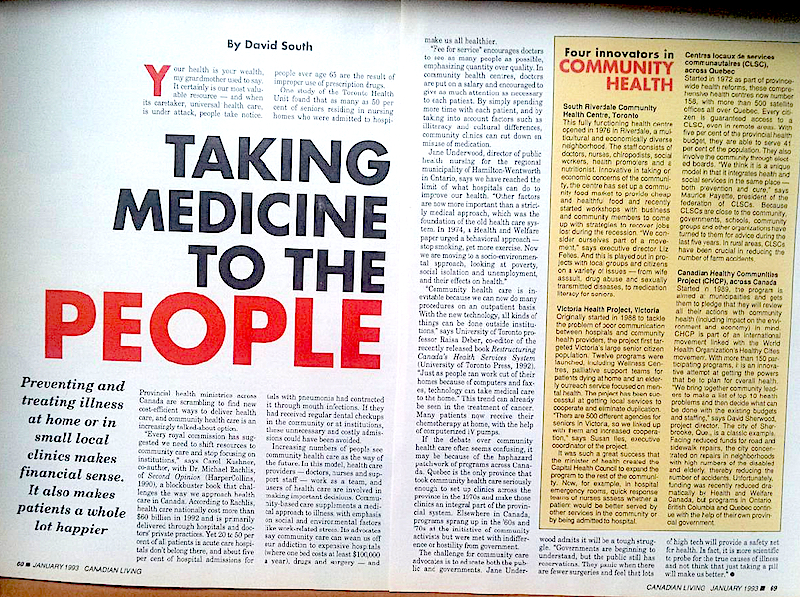
Taking Medicine To The People: Four Innovators In Community Health

Preventing and treating illness at home or in small local clinics makes financial sense. It also makes patients a whole lot happier.

By David South

Canadian Living (Canada), January 1993

Your health is your wealth, my grandmother used to say. It certainly is our most valuable resource – and when its caretaker, universal health care, is under attack, people take notice.

Provincial health ministries across Canada are scrambling to find new cost-efficient ways to deliver health care, and community health care is an increasingly talked-about option.

“Every royal commission has suggested we need to shift resources to community care and stop focusing on institutions,” says Carol Kushner, co-author, with Dr. Michael Rachlis, of Second Opinion (HarperCollins, 1990), a blockbuster book that challenges the way we approach health care in Canada. According to Rachlis, health care nationally cost more than $60 billion in 1992 and is primarily delivered through hospitals and doctors’ private practices. Yet 20 per cent of all patients in acute care hospitals don’t belong there, and about five per cent of hospital admissions for people over age 65 are the result of improper use of prescription drugs.

One study of the Toronto Health Unit found that as many as 50 per cent of seniors residing in nursing homes who were admitted to hospitals with pneumonia had contracted it through mouth infections. If they had received regular dental check-ups in the community or at institutions, these unnecessary and costly admissions could have been avoided.

Increasing numbers of people see community health care as the way of the future. In this model, health care providers – doctors, nurses and support staff – work as a team, and users of health care are involved in making important decisions. Community-based care supplements a medical approach to illness, with emphasis on social and environmental factors like work-related stress. Its advocates say community care can wean us off our addication to expensive hospitals (where one bed costs at least $100,000 a year), drugs and surgery – and make us all healthier.

“Fee for service” encourages doctors to see as many people as possible, emphasizing quantity over quality. In community health centres, doctors are put on a salary and encouraged to give as much attention as necessary to each patient. By simply spending more time with each patient, and by taking into account factors such as illiteracy and cultural differences, community clinics can cut down on misuse of medication.

Jane Underwood, director of public health nursing for the regional municipality of Hamilton-Wentworth in Ontario, says we have reached the limit of what hospitals can do to improve health. “Other factors are now more important than a strictly medical approach, which was the foundation of the old health care system. In 1974, a Health and Welfare paper urged a behavioral approach – stop smoking, get more exercise. Now we are moving to a socio-environmental approach, looking at poverty, social isolation, and unemployment, and their effects on health.”

“Community health care is inevitable because we can now do many procedures on an outpatient basis. With the new technology, all kinds of things can be done outside institutions,” says University of Toronto professor Raisa Deber, co-editor of the recently released book Restructuring Canada’s Health Services System (University of Toronto Press, 1992).

“Just as people can work out of their homes because of computers and faxes, technology can take medical care to the home.” This trend can already be seen in the treatment of cancer. Many patients now receive their chemotherapy at home, with the help of computerized IV pumps.”

If the debate over community health care often seems confusing, it may be because of the haphazard patchwork of programs across Canada. Quebec is the only province that took community health care seriously enough to set up clinics across the province in the 1970s and make those clinics an integral part of the provincial system. Elsewhere in Canada, programs sprang up in the ’60s and ’70s at the initiative of community activists but were met with indifference or hostility from government.

The challenge for community care advocates is to educate both the public and governments. Jane Underwood admits it will be a tough struggle. “Governments are beginning to understand, but the public still has reservations. They panic when there are fewer surgeries and feel that lots of high tech will provide a safety net for health. In fact, it is more scientific to probe for the true causes of illness and not think that just taking a pill will make us better.”

Four Innovators in Community Health

South Riverdale Community Health Centre, Toronto

This fully functioning health centre opened in 1976 in Riverdale, a multicultural and economically diverse neighborhood. The staff consists of doctors, nurses, chiropodists, social workers, health promoters and a nutritionist. Innovative in taking on economic concerns of the community, the centre has set up a community food market to provide cheap and healthful food and recently started workshops with business and community members to come up with strategies to recover jobs lost during the recession. “We consider ourselves part of a movement,” says executive director Liz Feltes. And this is played out in projects with local groups and citizens on a variety of issues – from wife assault, drug abuse and sexually transmitted diseases, to medication literacy for seniors. 

Victoria Health Project, Victoria

Originally started in 1988 to tackle the problem of poor communication between hospitals and community health providers, the project first targeted Victoria’s large senior citizen population. Twelve programs were launched, including Wellness Centres, palliative support teams for patients dying at home and elderly outreach service focused on mental health. The project has been successful at getting local services to cooperate and eliminate duplication. “There are 500 different agencies for seniors in Victoria, so we linked up with them and increased cooperation,” says Susan Lles, excutive coordinator of the project.

It was such a great success that the minister of health created the Capital Health Council to expand the program to the rest of the community. Now, for example, in hospital emergency rooms, quick response teams of nurses assess whether a patient would be better served by other services in the community or by being admitted to hospital. 

Centres locaux de services communautaires (CLSC), across Quebec

Started in 1972 as part of province-wide health reforms, these comprehensive health centres now number 158, with more than 500 satellite offices all over Quebec. Every citizen is guaranteed access to a CLSC, even in remote areas. With five per cent of the provincial health budget, they are able to serve 41 pr cent of the population. They also involve the community through elected boards. “We think it is a unique model in that it integrates health and social services in the same place – both prevention and cure,” says Maurice Payette, president of the federation of CLSCs. Because CLSCs are close to the community, governments, schools, community groups and other organizations have turned to them for advice during the last five years. In rural areas, CLSCs have been crucial in reducing the number of farm accidents. 

Canadian Healthy Communities Project (CHCP), across Canada

Started in 1989, the program is aimed at municipalities and gets them to pledge that they will review all their actions with community health (including impact on the environment and economy) in mind. CHCP is part of an international movement linked with the World Health Organization’s Healthy Cities movement. With more than 150 participating programs, it is an innovative attempt at getting the powers that be to plan for overall health. “We bring together community leaders to make a list of top 10 health problems and then decide what can be done with the existing budgets and staffing,” says David Sherwood, project director. The city of Sherbrooke, Que., is a classic example. Facing reduced funds for road and sidewalk repairs, the city concentrated on repairs in neighborhoods with hig numbers of the disabled and elderly, thereby reducing the number of accidents. Unfortunately, funding was recently reduced dramatically by Health and Welfare Canada, but programs in Ontario, British Columbia and Quebec continue with the help of their own provincial government. 

This work is licensed under a Creative Commons Attribution 4.0 International License.

“… in recent years it has become a pursuit for a growing number of researchers. … Behind much of this growth has been the Hannah Institute for the History of Medicine …” 

Read more about Canadian innovation in healthcare and medical education here: Take Two Big Doses Of Humanity And Call Me In The Morning

Read more on my work promoting Canadian medical history scholarship here: Hannah Institute For The History Of Medicine | 1992 – 1994

Read more on my work leading on innovation and modernisation in the UK’s NHS here: CASE STUDY 5: GOSH/ICH Child Health Portal | 2001 – 2003

https://davidsouthconsulting.org/2021/02/05/changing-health-care-careers-a-sign-of-the-times/

https://davidsouthconsulting.org/2021/02/05/critics-blast-government-long-term-care-reforms/

https://davidsouthconsulting.org/2022/10/08/dodging-the-health-insurance-minefield/

https://davidsouthconsulting.org/2020/12/18/feds-call-for-aids-blood-system-inquiry-some-seniors-infected/

https://davidsouthconsulting.org/2022/04/28/health-care-in-danger/

https://davidsouthconsulting.org/2021/02/05/health-care-on-the-cutting-block-ministry-hopes-for-efficiency-with-search-and-destroy-tactics/

https://davidsouthconsulting.org/2021/02/20/new-legislation-will-allow-control-of-medical-treatment/

https://davidsouthconsulting.org/2021/02/20/private-firms-thrive-as-ndp-reinvents-medicare/

https://davidsouthconsulting.org/2020/06/14/psychiatric-care-lacking-for-institutionalised-seniors/

https://davidsouthconsulting.org/2020/06/14/seniors-falling-through-the-health-care-cost-cracks/

https://davidsouthconsulting.org/2020/06/14/specialists-want-cancer-treatments-universally-available/

https://davidsouthconsulting.org/2020/04/20/take-two-big-doses-of-humanity-and-call-me-in-the-morning/

https://davidsouthconsulting.org/2021/02/05/us-health-care-businesses-chasing-profits-into-canada/

Creative Commons License

This work is licensed under a
Creative Commons Attribution-Noncommercial-No Derivative Works 3.0 License.

ORCID iD: https://orcid.org/0000-0001-5311-1052.

© David South Consulting 2023