Categories
Archive Blogroll Development Challenges, South-South Solutions Newsletters Southern Innovator magazine

Creating Green Fashion in China

By David SouthDevelopment Challenges, South-South Solutions

SOUTH-SOUTH CASE STUDY

China is the world’s largest manufacturer (Euromonitor) and the largest clothing maker, producing a quarter of all textiles and clothing. It is a global fashion production hub, and many major global clothing brands have their products made there – whether they admit it or not.

Although most people probably do not give it a second thought, the fashion and clothing industries can be highly polluting and exploitive. The use of toxic fertilizers to boost cotton yields leaves behind a legacy of contaminated soil and water tables. Dyes used to colour clothing also can be toxic and pollute water. For people working in this industry – many of whom are women – conditions can vary widely and include low pay and high stress.

According to the Ethical Fashion Forum, “it is difficult for companies sourcing from China to be sure of fair working practices. There have been many reports of low wages, long hours, and unfair working conditions in factories in China.”

But one innovative fashion brand is out to transform the way the garment business works in China and to develop a template that could be used in other places such as Africa.

The design duo of Hans Martin Galliker and Amihan Zemp has set up their clothing brand’s studio in one of Beijing’s historic hutong (alley) neighbourhoods – narrow streets of low-rise buildings that were the traditional urban dwelling environments for generations of Chinese people. The NEEMIC (neemic.com) brand, founded in 2011, makes sustainable fashions and champions green production methods in China.

The business’s belief is that the world has enough fabric already to meet the clothing needs of the population. In response, NEEMIC makes its clothing from a mix of recycled natural materials and new organic materials. According to its website, NEEMIC collaborates “with young designers from London to Tokyo to create a particular metropolitan aesthetic.”

“We use the finest natural fabrics for a perfectly comfortable feel,” Galliker said. “We pick the finest natural materials from leftovers of the industry, recycle used clothes, and strive to order new fabrics only from certified organic producers.”

Hans Martin Galliker began as a farming apprentice in his native Switzerland, and brings a practical bent to his approach to fashion. He draws on his knowledge of farming and agriculture to create a unique eco-conscious fashion product in China.

Galliker got his start in fashion working for a brand in Shenzhen, southern China. He worked with the organic farms there, and this inspired him to explore sustainability in fashion design and ways of introducing the principles of fair trade to the fashion and textile industries in China.

Galliker is passionate about taking a different attitude to fashion: “There are many fashion brands and many of them are … meaningless,” he told the China Daily newspaper. “They do fashion which looks more or less … the same, which has no creativity and does a lot of harm to the environment.

“Growing cotton is highly chemicals and labour-intensive, which degrades the soil and pays people very low salaries. And the dyeing and colouring processes pollute rivers and people receive low salaries but have to work long hours. The whole textile industry is really bad for the environment.”

NEEMIC has completed three collections of clothing since it was founded in 2011.

“We started selling some of our designs at a boutique in Beijing that focuses on upcycling fashion. People like it and want to buy more,” said Galliker.

Upcycling is the process of converting waste material into new products (http://en.wikipedia.org/wiki/Upcycling).

And to counter any negative perceptions that organic cotton clothing can only ever be unfashionable, Galliker is out to prove it is possible to create stylish organic clothing.

On top of building the brand, Galliker also works to educate the industry and change ways. He is also setting up a branch in China of the Hong Kong Organic Textile Association (http://neemic.asia/organic), which encourages fashion designers to jointly buy organic materials. He also publishes a website on sustainable agricultural practices in China, with details on current policies on organic farming.

“It is very normal for Chinese farmers to use many fertilizers, but the environment is going bad and consumers do not like this kind of farming,” Galliker points out. “For farmers, it’s not meaningful to produce only to make money to live a decent life. It should be more than that.”

The NEEMIC operation is lean: the Beijing studio does all the designing of the clothes, programming of the multilingual websites and runs the online shopping and payment sites.

For now, the goal is to not only increase the use of organically grown materials but also to introduce the fair trade concept into China.

“In two years we want to do fair trade production,” Galliker said.

And he has Africa in his sights with his green fashion template.

“In the long term we will have many successful projects here or non-profit companies … a lot of creative force and investment so that we can help rural regions in Africa to do sustainable agriculture projects.”

Published: December 2012

Resources

1) Ethical Fashion Forum: The Ethical Fashion Forum is the industry body dedicated to a sustainable future for fashion. A not for profit organisation, EFF aims to make it easy for fashion professionals to integrate sustainability at the heart of what they do. Website: http://www.ethicalfashionforum.com/

2) Hong Kong Organic Textile Association: Its mission is to promote organic textiles in Hong Kong Website: http://www.facebook.com/HKOrganicTextileAssociation

3) Tips on how to upcycle. Website: http://www.independent.co.uk/property/interiors/the-insider–how-to-upcycle-without-much-effort-2343100.html

4) How to create a Lookbook for a fashion brand. Website: http://noisetteacademy.com/2011/05/creating-a-lookbook/
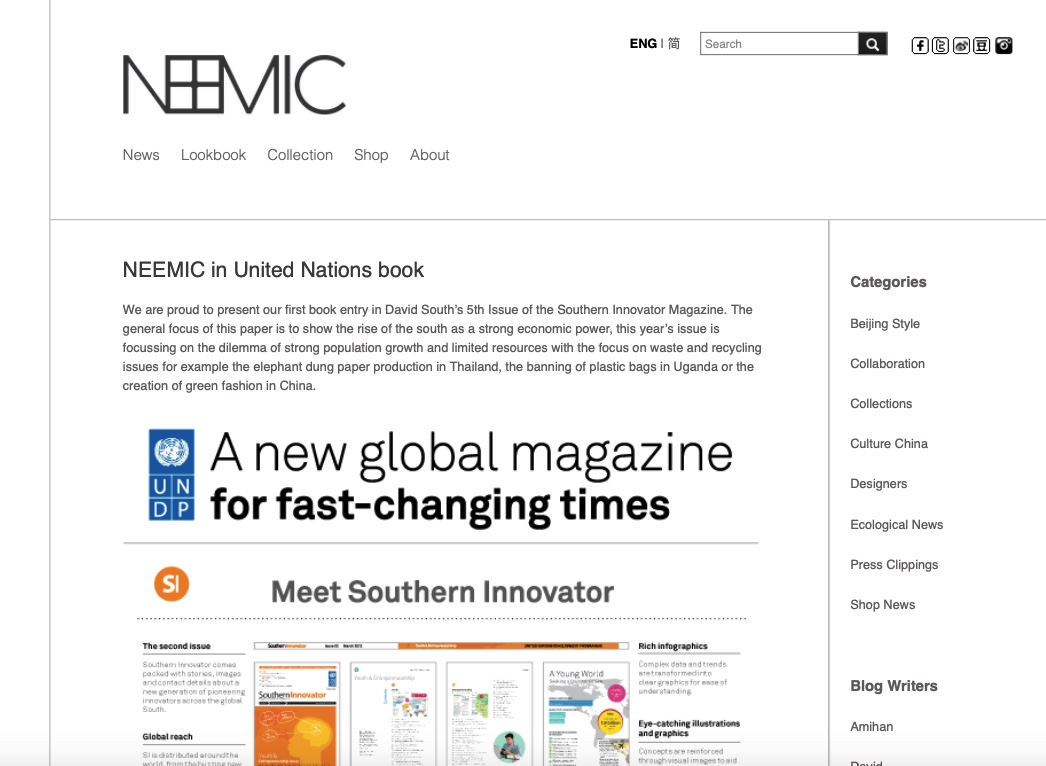
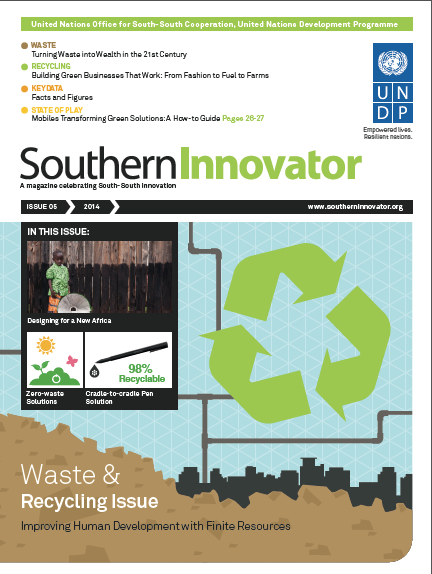
“We are proud to present our first book entry in David South’s 5th Issue of the Southern Innovator Magazine. The general focus of this paper is to show the rise of the south as a strong economic power, this year’s issue is focussing on the dilemma of strong population growth and limited resources with the focus on waste and recycling issues for example the elephant dung paper production in Thailand, the banning of plastic bags in Uganda or the creation of green fashion in China.” https://neemic.asia/ecological-news/neemic-southern-innovator-book

https://davidsouthconsulting.org/2021/02/09/african-fashions-growing-global-marketplace-profile/

https://davidsouthconsulting.org/2021/01/05/afropolitan-african-fashion-scene-bursting-with-energy/

https://davidsouthconsulting.org/2022/10/09/fashion-closes-gap-between-catwalk-and-crafts/

https://davidsouthconsulting.org/2022/11/17/fashion-recycling-how-southern-designers-are-re-using-and-making-money/

https://davidsouthconsulting.org/2022/11/16/favela-fashion-brings-women-work/

https://davidsouthconsulting.org/2020/04/30/local-fashions-pay-off-for-southern-designers/

https://davidsouthconsulting.org/2022/10/24/made-in-africa-fashion-brand-pioneers-aim-for-global-success/

https://davidsouthconsulting.org/2021/10/04/putting-quality-and-design-at-the-centre-of-chinese-fashion/

https://davidsouthconsulting.org/2021/03/05/southern-innovator-issue-5/

Development Challenges, South-South Solutions was launched as an e-newsletter in 2006 by UNDP’s South-South Cooperation Unit (now the United Nations Office for South-South Cooperation) based in New York, USA. It led on profiling the rise of the global South as an economic powerhouse and was one of the first regular publications to champion the global South’s innovators, entrepreneurs, and pioneers. It tracked the key trends that are now so profoundly reshaping how development is seen and done. This includes the rapid take-up of mobile phones and information technology in the global South (as profiled in the first issue of magazine Southern Innovator), the move to becoming a majority urban world, a growing global innovator culture, and the plethora of solutions being developed in the global South to tackle its problems and improve living conditions and boost human development. The success of the e-newsletter led to the launch of the magazine Southern Innovator.  

Follow @SouthSouth1

Google Books: https://books.google.co.uk/books?id=q1KeBgAAQBAJ&dq=development+challenges+december+2012&source=gbs_navlinks_s

Slideshare: http://www.slideshare.net/DavidSouth1/development-challengessouthsouthsolutionsdecember2012issue

Southern Innovator Issue 1: https://books.google.co.uk/books?id=Q1O54YSE2BgC&dq=southern+innovator&source=gbs_navlinks_s

Southern Innovator Issue 2: https://books.google.co.uk/books?id=Ty0N969dcssC&dq=southern+innovator&source=gbs_navlinks_s

Southern Innovator Issue 3: https://books.google.co.uk/books?id=AQNt4YmhZagC&dq=southern+innovator&source=gbs_navlinks_s

Southern Innovator Issue 4: https://books.google.co.uk/books?id=9T_n2tA7l4EC&dq=southern+innovator&source=gbs_navlinks_s

Southern Innovator Issue 5: https://books.google.co.uk/books?id=6ILdAgAAQBAJ&dq=southern+innovator&source=gbs_navlinks_s

Creative Commons License

This work is licensed under a
Creative Commons Attribution-Noncommercial-No Derivative Works 3.0 License.

ORCID iD: https://orcid.org/0000-0001-5311-1052.

© David South Consulting 2023

Categories
Archive Blogroll UNDP Mongolia 1997-1999 UNDP News United Nations Development Programme

A UNDP Success Story: Grassroots Environmental Campaign Mobilizes Thousands In Mongolia | 1999

I had read the other day the following headline from Bloomberg: World’s Worst Air Has Mongolians Seeing Red, Planning Action. As far back as 1999, such a health and environmental tragedy was foreseen by a highly successful UNDP environment project. As its Canadian adviser Robert Ferguson said to UNDP News at the time, “Mongolia’s environment is endangered by a range of problems that are on the brink of exploding.”

He knew what he was talking about: Ferguson and his Mongolian colleagues had spent two years mobilizing Mongolians across the country to take practical steps to address the country’s environmental problems as part of the Environmental Public Awareness Programme (EPAP). Few people had as much first-hand knowledge of the country and its environmental challenges as they did.

In its 2007 Needs Assessment, the Government of Mongolia found the EPAP projects “had a wide impact on limiting many environmental problems. Successful projects such as the Dutch/UNDP funded Environmental Awareness Project (EPAP), which was actually a multitude of small pilot projects (most costing less than [US] $5,000 each) which taught local populations easily and efficiently different ways of living and working that are low-impact on the environment.” 

UNDP News: Networking Publication of UNDP Staff Worldwide April/May 1999

A UNDP Success Story 

By David South, Communications Coordinator, UNDP Mongolia 

Grassroots environmental campaign mobilizes thousands in Mongolia 

A countrywide environmental education campaign in Mongolia has drawn praise from around the world, most especially for its ability to mobilize thousands of people and produce hundreds of advocacy materials.  

Robert Ferguson, a UNV Information Specialist from Canada, has just finished a two-year assignment advising on the Environmental Public Awareness Programme. The project, implemented by UNDP, proved that civil society is alive and very well in Mongolia, despite 70 years of Communism and the hardships of transition to a free-market economy.  

For the first-time visitor to Mongolia, it is easy to be dazzled by the view: the expansive steppe, the sparse population with a sprinkling of nomadic tents, the enormous herds of sheep, goats and cows. First impressions tend toward the belief that Mongolia is an unspoiled paradise where nomads have roamed for thousands of years. The reality is considerably different. The 600,000-plus capital of Ulaanbaatar, or Red Hero, is densely populated, urban and home to the country’s remaining factories and electrical power plants. In winter, pollution from power plants and coal stoves in the traditional tents, or gers, where half of the city’s population still lives, chokes the population and causes numerous respiratory problems. 

While Mongolia has space to spare – the population is 2.4 million, plus 32 million head of livestock, in a territory the size of Western Europe – a long list of threats are taking their toll on this harsh but beautiful country.  

“Mongolia’s environment is endangered by a range of problems that are on the brink of exploding,” says Robert Ferguson. “As these  problems are not yet out of control, this country is in a very good position for grassroots initiatives that can help communities to realize their environmental problems and understand possible ways to keep them under control … 

… On one cold autumn day, Ferguson and his colleagues are visiting a project in the shantytown of Chingeltei in the north of the capital. A majority of Ulannbaatar’s population live in neighbourhoods like this, where the mix of traditional gers, wooden cottages and newly built Mongolian monster homes gives a vivid example of the transition years. The population has exploded as more and more Mongolians seek out their dreams in the capital.  

The Environmental Public Awareness Programme, or EPAP, uses small grants of between $1,000 and $2,000 to start awareness projects with local NGOs. After two years, nearly 100 small projects have been implemented – yet the original project document had only proposed 15 projects.  According to Ferguson, the project team, which includes Sumiya and Davaasuren, were struck by the wellspring of enthusiasm they were tapping.

… Garbage is strewn liberally on the dusty streets. Inspired by recycling campaigns in his native Canada, Ferguson encouraged local women to start the Blue Bag Project. Local women proudly show off their streets – garbage-free – as they collect pop and beer bottles and animal bones to turn in for cash at the local recycler. This is just one EPAP project that has galvanized grassroots action. Back in the EPAP at the Stalinesque Ministry of Nature and Environment, Ferguson continues … 

…. were all weak. What was needed was a means to take the right to public participation and an understanding of these laws to community organizations and let them develop public awareness campaigns that get the information out.”  

The Programme has exceeded expectations … 

…. “The response we got to our initial call for interested environmental groups was unexpected,” says Ferguson. “NGOs came from nowhere. And they embraced the idea …

… In October last year, EPAP launched the Mongolian Green Book, a pocket-sized environmental awareness handbook for NGOs. More recently Ferguson completed a Handbook on Environmental Public Awareness to share Mongolia’s experiences with others who care about the environment…

… The workshop is an immediate follow-up to the launching of the network through a workshop attended by 12 members in December 1998…

… with such enthusiasm that we pursued more money and nearly doubled the funding for small public awareness problems.”

Note: This is just an excerpt from the story. This issue of UNDP News featured contributions from UN Secretary-General Kofi Annan, Danny Glover, Nadine Gordimer and Amartya Sen.

The highly successful EPAP project was profiled in UNDP News in April/May 1999. This issue of UNDP News featured contributions from then UN Secretary-General Kofi Annan, Danny Glover, Nadine Gordimer and Amartya Sen.

The highly successful EPAP project was profiled in UNDP News in April/May 1999. This issue of UNDP News featured contributions from then UN Secretary-General Kofi Annan, Danny Glover, Nadine Gordimer and Amartya Sen.
Many resources are available online to explore Mongolia’s 1990s transition experience.
The Environmental Public Awareness Handbook: Case Studies and Lessons Learned in Mongolia, published in 1999 by the UNDP Mongolia Communications Office.
The Mongolian Green Book was published in 1999 by the UNDP Mongolia Communications Office.
The EPAP Handbook and the Mongolian Green Book were published by the UNDP Mongolia Communications Office and funded by the European Union’s TACIS programme.
European Union. europa.eu

Read Robert Ferguson’s The Devil and the Disappearing Sea: Or, How I Tried to Stop the World’s Worst Ecological Catastrophe (Publisher: Raincoast Books, 2004) to learn more about the toxic mix of politics and the environment. The book has been widely cited since and can be purchased online here: The Devil and the Disappearing Sea: A True Story about the Aral Sea Catastrophe: Amazon.co.uk: Ferguson, Robert, Ferguson, Rob: 9781551925998: Books

Robert Ferguson’s The Devil and the Disappearing Sea: Or, How I Tried to Stop the World’s Worst Ecological Catastrophe (Publisher: Raincoast Books, 2004).

Further reading on the plight of the Mongolian steppe in China: Life sentence for former Party chief who killed the Mongolian steppe: For 8 years Liu Zhouzhi pocketed bribes favoring mines exploitation, destroying the landscape, polluting land and drying up the pastures’ water sources. 

“The former head of the Communist Party in Inner Mongolia has been sentenced to life imprisonment for taking bribes that have led to pollution of the Mongolian steppe and the oppression of Mongolian herders. According to the judgment, published yesterday, by Beijing News, Liu Zhozhi, who had been expelled from the party before trial, used his eight years in power to pocket up to 8.17 million Yuan (over one million euros).”

Read more on the connection between corruption and air pollution levels here: 

The effect of corruption on carbon emissions in developed and developing countries: empirical investigation of a claim 

UN agency hit with corruption allegations at climate projects – United Nations Development Programme internal audit describes signs of fraud and collusion

Document of the Week: Aid Donors Blast UNDP for Resisting Appeals to Fight Corruption – A dozen wealthy donor states press the United Nations Development Program to investigate allegations that funds were misappropriated from a Russia climate program it managed.

Greed and Graft at U.N. Climate Program – Whistleblowers and experts allege corruption at a United Nations Development Program project for reducing greenhouse gas emissions in Russia, according to a Foreign Policy investigation.

And it hasn’t got better, according to UNICEF, as reported in The New York Times:

Mongolian Air Pollution Causing Health Crisis-UNICEF

The story reports on a child health crisis in the country’s capital, Ulaanbaatar, because “Many ger households burn coal or even trash to keep warm and the smog they produce has led to a surge in respiratory and heart disease and stoked anger and protests.”

And “Pollution levels in Ulaanbaatar” have “become worse than that in cities such as Beijing and New Delhi”, according to the UNICEF report. 

In 2018, Time published a story titled “Life in the Most Polluted Capital in the World”. This consequence of poor development policy stands in stark contrast to just a few years earlier, when the Mongolian President was awarded the 2012 Champions of the Earth award for “leadership that had a positive impact on the environment” and in 2013 was named as Global Host for World Environment Day 2013 because Mongolia “is prioritizing a Green Economy shift across its big economic sectors such as mining and promoting environmental awareness among youth”. Awards and meetings are clearly not enough. Update on Tuesday, August 28, 2018 at 3:35AM by David South

The importance of reducing exposure to urban air pollution is being backed up with more studies and evidence. What we have seen in the past 20 years of globalization has been a big push to encourage urbanization and denser urban living conditions. But, unfortunately for human health and well-being, this has not been connected to a strategy to reduce urban air pollution. In fact the opposite has been happening in many cities.

Urban air pollution has increased from various sources, in developed countries from vehicles, in particular those burning diesel fuel, and in developing countries, from not only vehicles but also households burning fuel for heating and cooking.

The tragedy unfolding in Mongolia’s capital, Ulaanbaatar, is a classic case of this public health problem. But it is also a crisis in developed world cities, as more vehicles clog streets (many people have been encouraged to buy these vehicles as a boost to the economy during the Global Financial Crisis). Bizarrely, highly polluting diesel engines were marketed as a ‘green’ solution, in particular in the UK!   

Some stories that highlight the harm done, especially to children, can be read below:

Air Pollution Linked To Increased Mental Illness In Children

Air Pollution Causes ‘Huge’ Reduction In Intelligence, Study Reveals

A new book to be launched in April 2019 by journalist Beth Gardiner (@Gardiner_Beth), “Choked: The Age of Air Pollution and the Fight for a Cleaner Future” (Granta) (University of Chicago Press), explores today’s global air pollution crisis in the world’s cities. Gardiner is an environmental journalist who writes for The New York Times, The Guardian and other publications (bethgardiner.com).  

The UK cover for Choked: The Age of Air Pollution and the Fight for a Cleaner Future (Granta, 2019). 

A story by Beth Gardiner on the air pollution crisis in Mongolia from National Geographic. Kids suffer most in one of Earth’s most polluted cities – In winter, coal stoves and power plants choke Mongolia’s capital, Ulaanbaatar, with smoke—and lung disease.

“An urgent, essential read” Arnold Schwarzenegger

Listed in the Financial Times’ “What we’ll be reading in 2019”

“A compelling book about a critical subject” Elizabeth Kolbert, Pulitzer Prize-winning author of The Sixth Extinction

“Air pollution kills seven million people every year, causing heart attacks, strokes, cancer, dementia and more. In Choked, Beth Gardiner travels the world to tell the story of this modern-day plague, exposing the political decisions and economic forces that have kept so many of us breathing dirty air.” 

ORCID iD: https://orcid.org/0000-0001-5311-1052.

© David South Consulting 2020

Categories
Archive Development Challenges, South-South Solutions Newsletters Southern Innovator magazine

Local Fashions Pay Off For Southern Designers

By David SouthDevelopment Challenges, South-South Solutions

SOUTH-SOUTH CASE STUDY

Fashion earns big money around the world: The global clothing industry is estimated to be worth US $900 billion a year. For many decades, strong American brands have been the desired commodity for those looking to be cool and contemporary. People were willing to pay high premium prices to get the cache of American cool that the brands conveyed.

But the decline in popularity suffered by American brands in recent years has become a boost for local brands. And this is creating a whole new opportunity for canny Southern entrepreneurs. It is being called ‘fashionalism’ or fashion nationalism – a pop culture trend blending patriotism with fashion.

One of fashionalism’s pioneers is Italian-educated Filipino designer Rhett Eala. He is credited with coming up with the snappy name fashionalism, after launching his My Pilipinas clothing line. Its signature logo is the Philippine archipelago on collared shirts and cotton polo shirts. An experienced designer who has worked in Hong Kong and for a major department store, Eala joined Collezione C2 as creative director two years ago.

He started with just three styles sporting the map. But now he has expanded the design to cover almost his entire range of clothing.

“It’s a fun way to show your pride in being Filipino, without a lot of words. Filipinos have today become global citizens,” said Eala.

Eala’s design talent stretches to pop art paintings as well, with an art exhibit called My Pilipinas Series, 18 Filipino pop art paintings that transcend flag-waving notions of nationalism.

But Eala is no parochialist: he is very much inspired by global artists and trends. His work is a blend of foreign concepts and patriotic ideals. Common Filipino iconography gets the high-design treatment, as Eala draws inspiration from Damien Hirst, David Hockney and Andy Warhol. He tries to challenge his customers, taking the complicated and oblique Rorschach Test patterns, and blending them with other designs.

The fashionalist logoed clothing not only sells well domestically, but also amongst the large diaspora of Filipino expatriates around the world.

“Fashionalism has a very positive impact on our business,” said Joey Qua, the Managing Director of Collezione C2. “We’ve always wanted to highlight the ingenuity of Philippine artistry and what it feels like to be proud to be a Filipino.”

“More importantly, we want to make Filipinos proud to wear our brand here and abroad, since the Filipinos of today are more global in nature, we have so many Filipinos who are more exposed globally.”

“We want to make nationalism hip and relevant to today’s generation,” said Eala.

Supporters of fashionalism say it is about restoring pride in the country’s development and achievements, not in stirring up negative xenophobia and other negative aspects of nationalism.

Another group of Manila fashion designers, Team Manila and Analog Soul, are marking the 25th anniversary of the death of Filipino nationalist hero, Ninoy Aquino – who was assassinated at the airport after returning to the Philippines from his self-imposed exile in the United States on August 21, 1983. Their t-shirts include sayings like: “I am Ninoy.”

The clever designers have turned Aquino’s signature old-school eye glass frames into an iconic logo.

“Ever since our humble beginnings as a Design Studio in 2001, we’ve made it a point to celebrate the Philippines and the Filipino people in our designs,” said Team Manila’s chief operating officer, Nico Bacani. “It was only natural that when we established our clothing and apparel line in 2005, the messages would remain the same – positive messages about the country, the culture and the people, be it explicitly or through subtle means in design.”

Underground t-shirt designers had been selling yellow Ninoy t-shirts to the young and trendy urbanites. But it is the professional design flair that has taken the trend to the next level and created an industry in its own right, with the fashionalism branding spreading beyond clothes to coffee mugs and other everyday items.

“We started as a design studio working from our Macs (Macintosh Computers) at home,” said Bacani. “and when we did start selling merchandise, this would be done literally in our garage and obscure spaces throughout the apartment we were renting. We then participated in bazaars, until such time as we raised enough capital and loyal clientele to expand into a stand-alone store.

“So the obstacles we faced were more towards asset capitalization and recruiting people well-versed in the retail industry. We were, however, luckier than most, as the media would frequently feature our products, which was a big boost.”

And Bacani hopes for a big payoff for the Phillippines as a whole.

“We really wouldn’t say there’s anything negative about it, but we would say that it would be quite disappointing if it ended up just being that – wearing the clothes and not living the message. We would be quite pleased if Fashionalism were a trigger, a catalyst for something bigger, such as a more active participation in the development of the country as a whole. And we see that people starting to think and feel proud of being Filipino and representing the Filipino well, whether it be at the workplace here or abroad, or in everyday living around the world.”

As for other fashion designers thinking of going down the fashionalism path, Eala said: “My advice is being honest with your design. Try to design from your heart and your mind. Be inspired with what’s around you. Design for your environment and if you have a chance, travel to places that you haven’t been to. ”

More on Andy Warhol at Artsy here: https://www.artsy.net/artist/andy-warhol

Published: October 2008

Development Challenges, South-South Solutions was launched as an e-newsletter in 2006 by UNDP’s South-South Cooperation Unit (now the United Nations Office for South-South Cooperation) based in New York, USA. It led on profiling the rise of the global South as an economic powerhouse and was one of the first regular publications to champion the global South’s innovators, entrepreneurs, and pioneers. It tracked the key trends that are now so profoundly reshaping how development is seen and done. This includes the rapid take-up of mobile phones and information technology in the global South (as profiled in the first issue of magazine Southern Innovator), the move to becoming a majority urban world, a growing global innovator culture, and the plethora of solutions being developed in the global South to tackle its problems and improve living conditions and boost human development. The success of the e-newsletter led to the launch of the magazine Southern Innovator.  

Follow @SouthSouth1

Slideshare: http://www.slideshare.net/DavidSouth1/development-challengessouthsouthsolutionsoctober2008issue 

Southern Innovator Issue 1: https://books.google.co.uk/books?id=Q1O54YSE2BgC&dq=southern+innovator&source=gbs_navlinks_s

Southern Innovator Issue 2: https://books.google.co.uk/books?id=Ty0N969dcssC&dq=southern+innovator&source=gbs_navlinks_s

Southern Innovator Issue 3: https://books.google.co.uk/books?id=AQNt4YmhZagC&dq=southern+innovator&source=gbs_navlinks_s

Southern Innovator Issue 4: https://books.google.co.uk/books?id=9T_n2tA7l4EC&dq=southern+innovator&source=gbs_navlinks_s

Southern Innovator Issue 5: https://books.google.co.uk/books?id=6ILdAgAAQBAJ&dq=southern+innovator&source=gbs_navlinks_s

Creative Commons License

This work is licensed under a
Creative Commons Attribution-Noncommercial-No Derivative Works 3.0 License.

ORCID iD: https://orcid.org/0000-0001-5311-1052.

© David South Consulting 2023