Tag: Sustainable Development Goals

  • Solar Bottle Bulbs Light Up Dark Homes

    Solar Bottle Bulbs Light Up Dark Homes

    By David SouthDevelopment Challenges, South-South Solutions

    SOUTH-SOUTH CASE STUDY

    Finding ways to generate low-cost or free light has captured the imagination of innovators across the global South. The desire for light is strong: Light gives an immediate boost to income-making opportunities and quality of life when the sun goes down or in dark homes with few windows.

    More than 1.7 billion people around the world have no domestic electricity supply, of whom more than 500 million live in sub-Saharan Africa (World Bank). Without a source of electricity, it is difficult to use conventional technology to switch the lights on.

    While it is possible to run lights using batteries or diesel generators, these are expensive options that are not possible for many poor people. The more of a slim income that is spent on light, heat or cooking fuel, the less there is left for better-quality food, clothing, transport or education and skills development.

    Low-cost light is great, but free light is even better – and one Brazilian solution is offering this.

    Brazilian innovator and mechanic Alfredo Moser has taken the common plastic water bottle and created a low-cost lighting solution for dark spaces. Often makeshift homes lack decent lighting or a good design that lets the light in during the day. This means it may be a bright, sunny day outside, but inside the home or workplace, it is very dark and reading or working is difficult.

    Moser came upon the idea during regular blackouts in his home city of Uberaba (http://www.uberaba.mg.gov.br/portal/principal) in southern Brazil during 2002. During the blackouts, only factories were able to get electricity, leaving the rest of the population in the dark.

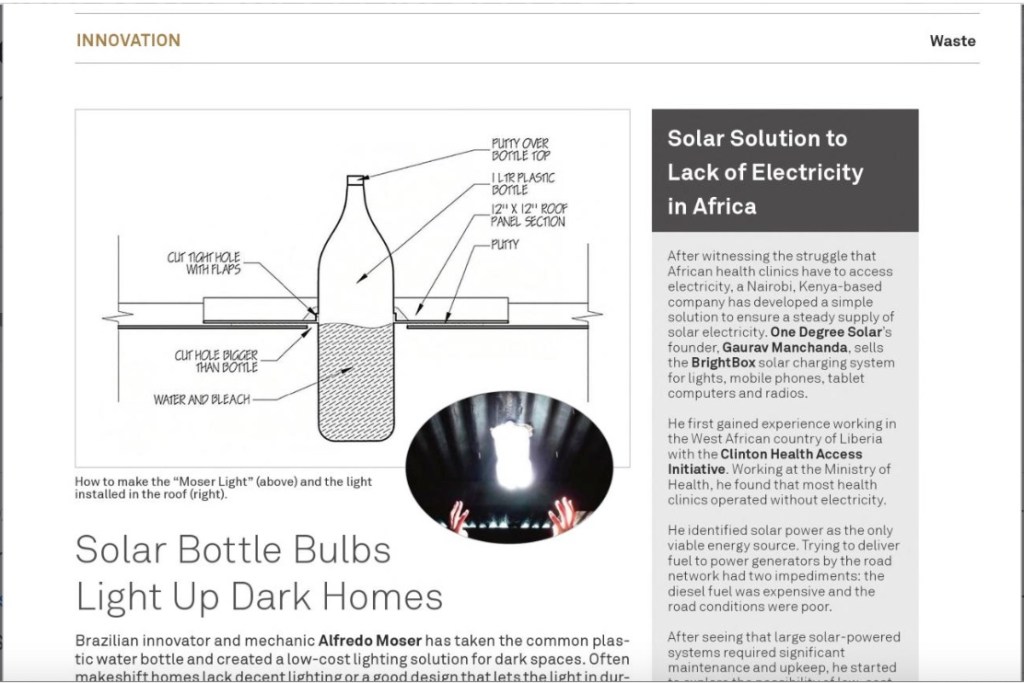
    The “Moser Light” involves taking plastic bottles, which are usually just thrown away or recycled, and filling them with water and bleach to draw on a basic physical phenomenon: the refraction of sunlight when it passes through a water-based medium.

    It is a simple idea: Holes are drilled in the ceiling of a room and the bottles placed in the holes. The liquid-filled bottle amplifies the existing sunlight (or even moonlight) and projects it into the dark room. This turns the plastic bottle into a very bright lightbulb that does not require any electricity.

    Moser uses a solution of two capfuls of bleach added to the water to prevent anything growing in the water such as algae because of the exposure to sunlight.

    “The cleaner the bottle, the better,” he said.

    Polyester resin is used to seal the hole around the plastic bottle and make it watertight from rain.

    Moser claims his bottle innovation can produce between 40 and 60 watts of light.

    Moser uses recycled plastic bottles, so the carbon footprint is minimal compared to the manufacture of one incandescent bulb, which takes 0.45 kilograms of CO2 (UN). Running a 50 Watt incandescent light bulb for 14 hours a day for a year, around the same light as produced by the bottle bulb, produces a carbon footprint of nearly 200 kilograms of CO2.

    “There was one man who installed the lights and within a month he had saved enough to pay for the essential things for his child, who was about to be born. Can you imagine?” Moser told the BBC.

    The plan is to try and get as many as a million homes fitted with the lighting system by the end of 2013.

    In many poor areas, it is common to live in makeshift or rudimentary dwellings. These are often built to crude designs and, in order to keep costs down and boost security, will have few or no windows. These dwellings will consequently be very dark inside, even on the brightest days. This leaves people having to turn to a source of artificial light if they want to do something indoors like read or work. And this costs money. Be it electricity from a mains, or battery-powered lamps or gas-powered lanterns, the cost will eat into a person’s tight income. This is where Moser’s simple solution saves the day and saves pennies: it is free light once the bottle lamp system is installed.

    Placing the bottle lights in the ceiling transforms the ceiling into something akin to the night sky, with many points of light shining down into the room like stars. It also means the occupant of the room does not just have to strain to see with the use of a single light but now has many lights illuminating the room from all angles.

    “It’s a divine light,” Moser told the BBC World Service. “God gave the sun to everyone, and light is for everyone. Whoever wants it saves money. You can’t get an electric shock from it, and it doesn’t cost a penny.”

    It has not been a road to riches for Moser. He has made some money installing the system in a local supermarket and nearby homes, and he has inspired a charity to install the lighting system and to train people to do the installation and make an income from it.

    The MyShelter Foundation in the Philippines was inspired by Moser’s invention and has installed the system in some 140,000 homes there, the BBC reported.

    “We want him to know that there are a great number of people who admire what he is doing,” MyShelter Executive Director Illac Angelo Diaz said of Moser.

    Using bottle bulbs instead of electricity or generators means families can save US $6 per month, according to Diaz (CNN). The Philippines is reported to have the most expensive electricity in Asia and slum homes usually do not have electricity.

    It is estimated 15 other countries also have homes using the Moser system. The MyShelter Foundation believes 1 million homes worldwide have used the Moser system as of 2013.

    Liter of Light (http://aliteroflight.org), run by the MyShelter Foundation, offers instructions on how to install the lighting system on its website.

    Published: September 2013

    Resources

    1) D-Lab: MIT: Development through Dialogue, Design and Dissemination: D-Lab is building a global network of innovators to design and disseminate technologies that meaningfully improve the lives of people living in poverty. The program’s mission is pursued through interdisciplinary courses, technology development, and community initiatives, all of which emphasize experiential learning, real-world projects, community-led development, and scalability. Website: http://d-lab.mit.edu/

    2) d.light Solar: d.light is a for-profit social enterprise whose purpose is to create new freedoms for customers without access to reliable power so they can enjoy a brighter future. d.light design manufacture and distribute solar light and power products throughout the developing world. Website: http://www.dlightdesign.com/

    3) Liter of Light:  It brings the eco-friendly bottle light to communities living without electricity. Website: http://aliteroflight.org

    4) Solar Sister: Solar Sister eradicates energy poverty by empowering women with economic opportunity.  They combine the breakthrough potential of solar technology with a deliberately woman-centered direct sales network to bring light, hope and opportunity to even the most remote communities in rural Africa. Website: http://www.solarsister.org/

    Creative Commons License

    This work is licensed under a
    Creative Commons Attribution-Noncommercial-No Derivative Works 3.0 License.

    ORCID iD: https://orcid.org/0000-0001-5311-1052.

    © David South Consulting 2023
  • Social Franchising Models Proving Poor Bring Profits

    Social Franchising Models Proving Poor Bring Profits

    By David SouthDevelopment Challenges, South-South Solutions

    SOUTH-SOUTH CASE STUDY

    The four billion people in the world who live on less than US $2 a day have been described as the bottom of the economic pyramid, or BOP for short. In his book The Fortune at the Bottom of the Pyramid, Indian business consultant and professor CK Prahalad argues that this attitude must be turned on its head: rather than seeing the world’s poor as a burden, only worthy of charity, Prahalad sees nothing but opportunity and unmet needs that business can address. In short, he argues, profits can be married with the goal of eradicating poverty.

    Prahalad has gone so far as to claim this is a market potentially worth US $13 trillion, while the World Resources Institute puts it at US $5 trillion in its latest report, The Next 4 Billion.

    One of the tools business is turning to reach the world’s poor is known as social franchising. The concept borrows from the business world and the highly successful franchise models that are more commonly associated with fast-food restaurants and computer and clothing retailers – wherever rapid expansion and scale are required to reach the biggest market possible. And there is no bigger market, social franchising advocates claim, than the world’s four billion poorest people.

    In the past, most formal business in developing countries chased the small middle class or the even smaller elite or foreign expatriate communities. Traditional poverty eradication strategies have also been criticized for being too narrow, focused on a very small group, or for wasting time and resources replicating what has already been achieved elsewhere, and for ballooning and shrinking depending on aid grants or success at fundraising. Social franchising aims to bypass these weaknesses by finding models that work, making sure they are self-financing, and then quickly scaling them up to reach as many people as possible. It’s a model that is gaining more followers and the serious interest of big and small businesses.

    One example is the Scojo Foundation in India, established to tackle the common problem of blurry vision as people age (presbyopia). Not a disease, the first symptoms occur between the ages of 40 and 50. Low vision affects 124 million people in the world according to the World Health Organization’s Vision 2020 campaign, organizers of World Sight Day 2007 on October 11.

    Blurry vision is a serious disability for weavers, mechanics, goldsmiths and others whose livelihoods depend on near vision. As vision deteriorates, these people are unable to provide for their families. Yet it is easily treatable with a pair of eyeglasses.

    Since, 2002, the Scojo Foundation (the social franchising wing of eyeglasses manufacturer Scojo New York, has launched operations in Bangladesh, Mexico, Guatemala, El Salvador and Ghana. Its largest and fastest growing operation is in India, where it employs more than 560 entrepreneurs in rural villages, and selling more than 50,000 pairs of glasses since 2001.

    It has grown quickly because the business model has been replicated by local staff who work as franchisees. It has followed the franchise model by building a network of “vision entrepreneurs” – low-income men and women, who in turn sell reading glasses directly to rural villagers throughout India. The franchise model enables the “vision entrepreneurs” to earn a good income, and gain respect from other community members.

    Nico Clemminck, co-author of a case study on Scojo, found the price was very competitive with other options in India, and that the higher quality of the glasses made them attractive to villagers.

    “The franchisees, or Vision Entrepreneurs as Scojo calls them, that we met were very involved with Scojo – some of them shifting away their focus from previous occupations to spend the majority of their time on conducting vision screenings and selling glasses. The main reason is that the business is quite profitable to them – they make a US $1 margin per glasses sold, which is very high compared to other retail products. A trend we did notice is that commitment decreases over time, as the entrepreneurs exhaust their immediate circle of relatives or target village populations, and the incremental sale becomes tougher to make.”

    According to Clemminck, Scojo has been able to quickly and successfully expand to other countries by forming partnerships with existing networks that reach into villages.

    The profit hierarchy works like this: the manufacturer charges US $1 for the reading glasses, Scojo charges another US $1, the franchisee a further US $1, and the customer pays US $3 for the glasses. By creating profit at each stage, the model ensures the financial incentives are there to keep the distribution network active.

    Prior to Scojo, it was believed developing infrastructure in rural Indian communities is too high to sustain a franchising model for low-cost products. Scojo found it was possible to succeed with this model, by focusing on profitability and sustainability right from the start, pursuing aggressive growth through partnerships to build economies of scale, blocking competitors by having a strong brand and first-mover advantage, constantly refining the model across regions, and delivering a tangible social benefit, both economic and health.

    On average, franchisees work 20-30 hours per month and earn US $15 to US $20 per month. Considering most franchisees were living on US $1 a day, the extra income is very welcome, Clemminck said.

    “This project gave me insight into the large, untapped market opportunity that exists,” says case study co-author Sachin Kadakia, “and how the concept of ‘Bottom of the Pyramid’ provides a tangible and significant improvement to the quality of life of people in these communities.”

    Another social franchise gaining ground in India is Medicine Shoppe. As a chain of pharmacies, Medicine Shoppe targets underserved communities by offering entrepreneurs franchises. It is an offshoot of the largest franchiser of independent community pharmacies in the US, Medicine Shoppe International Inc.. It can draw on its strong brand and identity to appeal to potential franchises.

    Acumen Fund fellow Nadaa Taiyab, who is working with Medicine Shoppe’s expansion to help the rural and urban poor, found it was important to learn lessons and adapt the model.

    “When I arrived in December (2006),” she said, “we opened the first Sehat Clinic. Last weekend we opened the seventh, with an eighth shortly underway. The model has undergone a tremendous evolution in the past six months. We shifted our site selection strategy from relatively affluent areas with a slum nearby, to locating the clinics right inside slums. We redesigned the process through which we recruit doctors and created an employment package that allows us to hire experienced doctors at a salary we can afford.

    “We also implemented an entirely new concept for Medicine Shoppe called community marketing outreach. Through this program, we hire local women in each area to make daily home visits, refer patients to the clinic, spread health education and awareness, and promote our free health camps and health clinics. In the past four months we have held over 35 health-plus-vision-testing camps, serving over 4,000 people.

    “We have also made some changes to the look and feel of the clinics and shops and put all our marketing materials in the local language, to make our services more appealing to low-income markets.”

    There are critics of the BOP approach, however. Aneel Karnani from the Ross School of Business at the University of Michigan, argues from a for-profit perspective, business would be much better off targeting the needs of the growing middle classes, especially in countries like India and China. He, however, does acknowledge that social franchising businesses like above, where social responsibility is key, are relevant to meeting the needs of the poor.

    Published: August 2007

    Resources

    • A detailed and thorough case study of how the Scojo Foundation model works is found here
    • An excellent set of decision matrices to help budding social entrepreneurs and existing businesses to decide if social franchising is the right solution: www.createproject.org
    • The Social Enterprise Alliance has built a knowledge network and extensive range of resources (including 160 case studies) on social enterprise.

    Creative Commons License

    This work is licensed under a
    Creative Commons Attribution-Noncommercial-No Derivative Works 3.0 License.

    ORCID iD: https://orcid.org/0000-0001-5311-1052.

    © David South Consulting 2023

  • Cooking Bag Helps Poor Households Save Time, Money

    Cooking Bag Helps Poor Households Save Time, Money

    By David SouthDevelopment Challenges, South-South Solutions

    SOUTH-SOUTH CASE STUDY

    For millions of poor people around the world, life is lived on the economic margins and household and personal budgets are tight. There were 1.29 billion people in the world living on less than US $1.25 a day as of 2008 (World Bank), and 1.18 billion living on US $1.25 to US $2 per day. There was only a modest drop in the number of people living below US $2 per day – the average poverty line for developing countries – between 1981 and 2008, from 2.59 to 2.47 billion.

    Since the global economic crisis erupted in 2008, the world’s poor have seen prices fluctuate wildly as the international financial system fights the effects of the turmoil. In 2008, this led to the Food and Agriculture Organization sounding the alarm about the harmful effects of rising food inflation.

    Increasing hunger led to civil unrest and rioting that year.

    Anything poor people can do to make their slim daily budgets go a little bit further means more money left over for better quality food and other expenses, like clothing, shelter, fuel and education. One clever invention from South Africa is trying to tackle household cooking costs and shave the cost of fuel required to prepare the family meal. The Wonderbag (http://nbwonderbag.com/) is a brightly coloured, puffy cooking bag that slow cooks a meal in a pot – be it a stew, curry, rice, soups – to save energy.

    “The cost and savings per household are significant,” according to the Wonderbag’s inventor, Sarah Collins.

    It has many other advantages, too: it is a time-saver, allowing people to spend the time doing something other than just tending the cooking pot. It can also reduce cooking accidents because less time is spent around the stove or fire.

    It is an efficient cooking method that uses less water to cook meals. And it even avoids the risk of burning – and wasting – food.

    “20 per cent of all staple food in Africa is burned, due to pots being placed on open fires and unregulated stove tops. With the Wonderbag, no burning happens,” confirms Collins.

    To date, the Wonderbag has created 1,000 jobs and is looking to increase this to 7,000 jobs in the next five years.

    Wonderbag bills itself as “eco-cooking that’s changing lives.”

    Eco-cooking seeks to use every joule (http://en.wikipedia.org/wiki/Joule) of energy from the cooking fire or heat source to maximum effect. A pot is placed on the stove and brought to the temperature required for cooking the dish. Then the pot is placed in the Wonderbag. Since the bag is heavily insulated, it reflects back the existing heat in the dish and allows it to continue cooking for up to 12 hours. It can cook rice in one hour and lamb in two to three hours.

    It works in four easy steps, summed up on the Wonderbag website: “boil it, bag it, stand it, serve it”.

    The Wonderbag claims to use 30 per cent less energy than other cooking methods. According to cost breakdowns on the Wonderbag website, someone with a Wonderbag would use 2.4 litres a week of paraffin – a common fuel for cook stoves – compared to 4 litres without. This works out to a cost of US $2.40 a week with a Wonderbag and US $4.00 a week without.

    The trade-off with the savings in money and energy is time – Wonderbag is not suitable for those looking for a quick meal. According to Wonderbag, meat that cooks in 20 minutes on the stove will take five hours in the Wonderbag.

    Chicken that takes 15 minutes on the stove takes three hours in the Wonderbag. Vegetables that take five minutes on the stove will cook in an hour in the Wonderbag.

    South African entrepreneur and inventor Collins originally developed the Wonderbag for people living in the townships of Durban (http://en.wikipedia.org/wiki/Durban). She found many of the residents spent up to a third of their income on fuel for cooking. They would either use paraffin or spend many hours gathering wood or dung.

    These common fuel sources for cooking give off toxic fumes and are a health hazard if used for long periods. The Wonderbag means households spend less time inhaling fumes from a stove.

    “The Wonderbag will always be a work in progress for me as I look to adapt the bag in line with my consumers’ feedback,” confirms Collins. “For example, we are now about to launch Wonderbag 2, which has an even more efficient insulator than polystyrene and is more readily available and easier to recycle following feedback earlier in the year.”

    In South Africa, the bags sell for R170 (US $22) and there are discounts for the very poor. Collins estimates that a family of four could save US $80 a year if they used the Wonderbag two or three times a week.

    Collins has used clever marketing strategies to get the Wonderbags out to the public, and 150,000 have been sold so far. One promotion gave away a Wonderbag with every purchase of boxes of curry powder.

    Wonderbag has also partnered with local communities. Swartland Municipality (swartland.org.za) purchased 5,000 Wonderbags and distributed them to 4,700 of “the most indigent and deserving households – the poorest of the poor.”

    It is also running a promotion in the United Kingdom where, for every Wonderbag bought, one is given to a family in the developing world.

    The popularity and success of the Wonderbag prompted the multinational food company, Unilever – one of the world’s leading suppliers of fast-moving consumer goods – to purchase 5 million bags for distribution. According to the Wonderbag website, this could lead to savings of US $1.35 billion on fuel for the users.

    “The partnership has also enabled us to scale up and test the Wonderbag in different markets,” explains Collins.

    Wonderbag hope to expand to 12 or 15 developing countries in Africa in 2012.

    The company says it plans to target developing countries with high poverty, fuel supply shortages, high incidence of health problems from air pollution, and high incidence of injuries from fuel fires.

    And for Wonderbag’s success so far, Collins has this advice: “Immerse yourself in your product and the way of life of your consumers. Understand it and them inside out so you can be your best advert. Word of mouth is by far the best form of advertising and the truth out of your own mouth is a great start.”

    Published: April 2012

    Resources 

    1) Haybox: Haybox is another variation on the concept of heat retention for efficient cooking. Website: http://haybox.co.uk/

    2) How to build a clay oven. Website: http://clayoven.wordpress.com/2008/08/29/1-building-a-clay-oven-the-basics/

    3) Solar ovens and cookers are another way to cut costs when making meals.This website has many designs and plans on how to build a solar cooker. Website: http://solarcooking.org/plans/

    Follow @SouthSouth1

    Slideshare: http://www.slideshare.net/DavidSouth1/development-challengessouthsouthsolutionsnovember2010issue

    Southern Innovator Issue 1: https://books.google.co.uk/books?id=Q1O54YSE2BgC&dq=southern+innovator&source=gbs_navlinks_s

    Southern Innovator Issue 2: https://books.google.co.uk/books?id=Ty0N969dcssC&dq=southern+innovator&source=gbs_navlinks_s

    Southern Innovator Issue 3: https://books.google.co.uk/books?id=AQNt4YmhZagC&dq=southern+innovator&source=gbs_navlinks_s

    Southern Innovator Issue 4: https://books.google.co.uk/books?id=9T_n2tA7l4EC&dq=southern+innovator&source=gbs_navlinks_s

    Southern Innovator Issue 5: https://books.google.co.uk/books?id=6ILdAgAAQBAJ&dq=southern+innovator&source=gbs_navlinks_s

    Creative Commons License

    This work is licensed under a
    Creative Commons Attribution-Noncommercial-No Derivative Works 3.0 License.

    ORCID iD: https://orcid.org/0000-0001-5311-1052.

    © David South Consulting 2024