Categories
Archive Blogroll Development Challenges, South-South Solutions Newsletters Southern Innovator magazine

Rickshaw Drivers Prosper with New Services

By David SouthDevelopment Challenges, South-South Solutions

SOUTH-SOUTH CASE STUDY

The rickshaw is the world’s oldest form of wheeled transportation and forms a significant part of India’s transport infrastructure. In large cities across Asia, 1 million three-wheeled auto-rickshaws form an important means of daily transportation and a vital source of income for their drivers. There are 8 million cycle rickshaws on the streets of India, the government says. They perform many tasks: as taxis, as couriers, as goods movers. And the Indian government promotes cycle rickshaws as a non-polluting alternative.

But rickshaw drivers in India struggle with a bad image despite being a critical component of the transport infrastructure. They work 12 to 18 hour days, are paid poorly, and are subject to frequent abuse from passengers and other drivers in the crowded and stressful streets.

Many of the men working as rickshaw drivers have left behind families in villages. Because their main home is elsewhere, many just eat, sleep and live next to the roadside.

An innovative company is taking this important service into the 21st century, and in turn boosting income and benefits for the drivers and restoring their dignity. Based in Delhi, Sammaan (www.sammaan.org), meaning dignity, has developed a sophisticated business model that offers a wide range of services to rickshaw passengers – drinks for sale, mobile phone chargers, courier collections, music, magazines/newspapers, first aid and outdoor advertising and marketing – along with professional treatment of the drivers, providing them with a uniform, identity card, bank accounts, profit sharing and insurance. The drivers pay a small maintenance fee of 10 rupees a day (US 20 cents) for renting the rickshaws. It is common in the rickshaw industry in India for drivers to rent their vehicles on a daily basis – 95 percent do so.

Drivers get the full fare from a ride, while they share the profits from the sales of goods with Sammaan (http://uk.youtube.com/watch?v=yUuP16fyTjM).

Sammaan’s founder, 27-year-old Irfan Alam, from the Indian state of Bihar, had the inspiration for his business idea when he was thirsty and riding in a rickshaw. He knew the rickshaw driver made very little money after he paid his rent for the rickshaw. And so he thought about how drivers could increase their income. Why couldn’t they sell drinks, or newspapers or mobile phone cards, he thought?

As well, since they travel more than 6 miles a day on average, why not deliver things and host advertisements on the rickshaws?

Sammaan’s idea is to fully modernize the rickshaw business: an important goal considering it makes up 30 percent of urban transport in India. By turning rickshaws into mobile advertising and marketing vehicles, income is substantially increased, while offering services builds loyalty from passengers.

In order to improve the quality of life for drivers, Sammaan also offers free evening classes for the drivers and their children.

Sammaan’s rickshaws are custom designed to allow for ample space to display the paid-for advertisements. This has proved a highly competitive way to do outdoor advertisements: it is 90 percent cheaper than advertising billboards and other campaigns. The fact the rickshaws go everywhere – from urban back streets to rural areas – makes it an effective way to reach all corners of India.

The rickshaws for the passengers are no more expensive than rickshaws with no services. And passengers are even covered by insurance if there is an accident.

Sammaan currently has hundreds of rickshaws running in Noida, Ghaziabad , Patna , Agra , Meerut , Gurgaon and Chandigarh .

The company also is planning to offer phone services in the rickshaws and the ability to pay utility bills while riding inside.

“We are also in advanced talks with Zandu Pharmaceuticals, Coca Cola and Dabur, and are hopeful of getting advertising contracts from them,” Alam told The Economist magazine. Sammaan expects to make Rs 10,000 to 15,000 (US $204 to US $307) a year from a single rickshaw.
Alam is part of a new breed in India: he is not from an established business family, but is nonetheless well educated. Many educated Indians are turning to entrepreneurship instead of becoming a corporate drone in a big company. This is being called a revolution in middle-class aspirations.

India has long-standing entrepreneurial traditions: merchant community the Marwari baniyas (http://en.wikipedia.org/wiki/Marwaris) are famed for their business acumen. But the new entrepreneurs have different aspirations and inspirations. They look to technology pioneers like Infosys (http://www.infosys.com/) and hire people based on merit and professionalism, not family connections.

The hot areas for this new breed of entrepreneur are technology, entertainment, human resources and education.

Alam’s rickshaws are made out of fiberglass for tourist towns with paved roads, and a rugged version out of iron for places with poor road conditions.

Another initiative to modernize the rickshaw business has come from India’s Centre for Scientific and Industrial Research (CSIR) (http://www.csir.res.in/), which has developed a state-of-the-art, solar powered version of the humble cycle-rickshaw.

The “soleckshaw” is a motorized cycle rickshaw that can be pedalled normally or run on a 36-volt solar battery.

The makeover includes FM radios and power points for charging mobile phones during rides.

The “soleckshaw,” which has a top speed of 15 kilometres (9.3 miles) per hour, has a sturdier frame and foam seats for up to three people.

The fully-charged solar battery will power the rickshaw for 50 to 70 kilometres (30 to 42 miles). Used batteries can be deposited at a centralized solar-powered charging station and replaced for a nominal fee.

Published: January 2009

Resources

  • India’s National Entrepreneurship Network (NEN) promotes the spirit of enterprise on the country’s campuses and has a contest to pick the top 30 Indian hot start-ups. Website: http://www.nenonline.org/
  • Indian venture capital firm Helion Ventures invests in start-ups. Website: www.helionvc.com
  • TATA NEN Hottest Startups — India’s first ever people’s choice awards. Hottest Startups will identify, showcase and support the highest-potential young companies in India. Websitehttp://www.hotteststartups.in/http://www.hotteststartups.in/shortlistedStartupsHome.do?        method=fetch&businessFn=shortlistedStartupsHome
  • Tukshop is a website selling auto rickshaws and tuk-tuks. Website: http://www.tukshop.biz/
  • A wide range of auto rickshaws for sale. Website: http://www.auto-rickshaw.com/
  • The Hybrid Tuk Tuk Battle is a competition to come up with less polluting auto rickshaws, clean up the air in Asian cities, and improve the economic conditions for auto rickshaw drivers. Website: http://hybridtuktuk.com/

Citations:

As cited in A Sociological Approach to Health Determinants by Toni Schofield (2015).

https://davidsouthconsulting.org/2022/11/21/asia/

https://davidsouthconsulting.org/2022/09/29/cheap-indian-tablet-seeks-to-bridge-digital-divide/

https://davidsouthconsulting.org/2022/02/17/digital-mapping-to-put-slums-on-the-map/

https://davidsouthconsulting.org/2022/10/20/the-e-reader-battle-reaches-india/

https://davidsouthconsulting.org/2022/10/09/entrepreneurs-use-mobiles-and-it-to-tackle-indian-traffic-gridlock/

https://davidsouthconsulting.org/2022/10/12/free-magazine-boosts-income-for-rickshaw-drivers/

https://davidsouthconsulting.org/2022/06/10/illiterate-get-internet-at-touch-of-a-button/

https://davidsouthconsulting.org/2022/09/27/india-2-0-can-the-country-make-the-move-to-the-next-level/

https://davidsouthconsulting.org/2022/10/25/indian-city-slum-areas-become-newly-desirable-places-to-live/

https://davidsouthconsulting.org/2021/03/04/indian-id-project-is-foundation-for-future-economic-progress/

https://davidsouthconsulting.org/2022/06/15/indian-mobile-phone-application-innovators-empower-citizens/

https://davidsouthconsulting.org/2022/11/01/indian-newspapers-thrive-with-economy/

https://davidsouthconsulting.org/2022/10/06/indian-solar-power-pack-powers-villages/

https://davidsouthconsulting.org/2022/10/18/indians-fighting-inflation-with-technology/

https://davidsouthconsulting.org/2022/06/10/info-ladies-and-question-boxes-reaching-out-to-the-poor/

https://davidsouthconsulting.org/2022/03/29/model-city-to-test-the-new-urbanism-concept-in-india/

https://davidsouthconsulting.org/2022/10/09/a-new-mobile-phone-aimed-at-the-poor/

https://davidsouthconsulting.org/2021/03/31/new-weapon-against-crime-in-the-south/

Development Challenges, South-South Solutions was launched as an e-newsletter in 2006 by UNDP’s South-South Cooperation Unit (now the United Nations Office for South-South Cooperation) based in New York, USA. It led on profiling the rise of the global South as an economic powerhouse and was one of the first regular publications to champion the global South’s innovators, entrepreneurs, and pioneers. It tracked the key trends that are now so profoundly reshaping how development is seen and done. This includes the rapid take-up of mobile phones and information technology in the global South (as profiled in the first issue of magazine Southern Innovator), the move to becoming a majority urban world, a growing global innovator culture, and the plethora of solutions being developed in the global South to tackle its problems and improve living conditions and boost human development. The success of the e-newsletter led to the launch of the magazine Southern Innovator. 

Creative Commons License

This work is licensed under a
Creative Commons Attribution-Noncommercial-No Derivative Works 3.0 License.

ORCID iD: https://orcid.org/0000-0001-5311-1052.

© David South Consulting 2023

Categories
Archive

Indian Solar Economy Brings New Vocation for Women

By David SouthDevelopment Challenges, South-South Solutions

SOUTH-SOUTH CASE STUDY

India has started to make significant advances in developing solar power technologies for the poor. There are now whole villages using solar energy and improving their standard of living. Various companies and projects are selling inexpensive solar appliances – from cooking stoves to lanterns and power generators – across the country. This new solar power ‘grid’ is also bringing further economic opportunities: jobs for people to repair and maintain the new equipment.

An interesting initiative is turning the need to repair and maintain solar-powered equipment into a job opportunity for poor women.

More than 1.7 billion people around the world have no domestic electricity supply, of whom more than 500 million live in sub-Saharan Africa, and 400 million in India (World Bank). Some 600,000 Indian villages lack an electrical supply. India’s Prime Minister Manmohan Singh has pledged “power for all” by 2012. An ambitious goal, and one that acknowledges that without electricity, many development goals remain dreams that will never be achieved.

Being able to see at night, for example, unleashes a vast range of possibilities – such as being able to work or study later – but for the very poor, lighting is often the most expensive household expense, soaking up 10 to 15 percent of income.

The power of the sun can help transform this situation. According to Greenpeace (http://www.greenpeace.org/international), India could generate 10 percent of its electricity from solar power by 2030.

In the Indian State of Rajasthan, more than 30,000 homes in 800 villages have turned to solar power for lighting and cooking needs. It is this increasing solar power grid that the Barefoot College (http://www.barefootcollege.org) based in Tilonia – where it was founded over 30 years ago – has turned to as a new economic opportunity. The College is training women to be solar engineers, developing both useful skills and a new income source. So far, Barefoot College itself has solar electrified some 350 villages across India and dozens more in sub-Saharan Africa and even war-torn Afghanistan.

The College prides itself on stripping out academic jargon while inspiring confidence in students’ innate talents and skills so they can take on new vocations.

The solar engineers – many of whom are illiterate – are taught by their peers. Given a box of tools and hardware, the students undertake practical projects to learn-by-doing how the solar devices work and can be repaired. They are introduced to technical terms and concepts and learn how to wire circuits and do daily repairs.

“It is only, we have found, an illiterate woman who is a teacher who can actually train an illiterate women who is a trainer,” the college’s founder, Bunker Roy, told the BBC. “They have the patience, tolerance and improvisation.”

Roy says the training teaches more knowledge of the technical aspects of solar power than a typical student would glean from an undergraduate university degree.

The Barefoot College takes its inspiration from former Indian leader Mahatma Ghandi (http://en.wikipedia.org/wiki/Mohandas_Karamchand_Gandhi), who felt the wisdom, knowledge and skills already existing in rural villages should be the basis for any development. He also believed deploying sophisticated technology in poor communities should be done on their terms to avoid exploitation.

The College is a passionate believer in the inherent skills and abilities of the poor to improve their conditions. It eschews formal qualifications, believing these can be as much a hindrance as a help, trapping people in rigid methodologies.

The Barefoot College has been working on solar electrification in poor and rural villages since 1989. It has used similar techniques to train teachers and teach medical skills.

The course has successfully attracted sponsored students from as far away as Africa. Sarka Mussara, a 56-year-old widowed grandmother from the West African nation of Mauritania, had never attended school or even left her village before coming to India on a UN sponsorship.

“We started little by little learning the solar energy system,” she told PBS. “Day by day and little by little we were able to put things together.”

The solar engineers become highly skilled and can even fabricate complex components like a charge controller (http://en.wikipedia.org/wiki/Charge_controller) when they are back in the village.

One of the additional benefits of training skilled solar engineers is the more confident role these women play in their communities when they return. They often take the lead on other projects in the village.

The College also picks the tough cases: only villages that are inaccessible, remote or non-electrified get help.

Its approach is to have a meeting to introduce the benefits of solar lighting to the community. If the community wants it, then a village committee is formed. Any household that wants solar power has to pay a small fee, no matter how poor. This is to ensure they feel a sense of ownership of the new technology.

Some members of the community are then selected to be trained as “Barefoot Solar Engineers,” or BSEs. They will install, repair and maintain the solar lighting units for at least five years. A workshop is set up to carry out repairs fully equipped with tools and replacement parts. The solar engineers attend a six-month course at the College, leading to work for at least five years.

The Barefoot College encourages middle-aged women and widows and single mothers to become engineers. Experience has shown them to be the most reliable and less prone to moving to the city after training.

Published: May 2010

Resources

1) D.light Design is dedicated to bringing modern lighting and power to more than 1.6 billion people globally currently living without electricity. They aim to be the number one player in off-grid lighting and power solutions worldwide. Website: http://www.dlightdesign.com

2) Solar Power Answers is a one-stop-shop for everything to do with solar power. It has a design manual and guides to the complex world of solar power equipment. Website: http://www.solar-power-answers.co.uk/index.php

3) Sun King solar lantern: The lantern provides 16 hours of light for a day’s charge. Website: http://www.greenlightplanet.com/ourusers.html

Development Challenges, South-South Solutions was launched as an e-newsletter in 2006 by UNDP’s South-South Cooperation Unit (now the United Nations Office for South-South Cooperation) based in New York, USA. It led on profiling the rise of the global South as an economic powerhouse and was one of the first regular publications to champion the global South’s innovators, entrepreneurs, and pioneers. It tracked the key trends that are now so profoundly reshaping how development is seen and done. This includes the rapid take-up of mobile phones and information technology in the global South (as profiled in the first issue of magazine Southern Innovator), the move to becoming a majority urban world, a growing global innovator culture, and the plethora of solutions being developed in the global South to tackle its problems and improve living conditions and boost human development. The success of the e-newsletter led to the launch of the magazine Southern Innovator.  

Creative Commons License

This work is licensed under a
Creative Commons Attribution-Noncommercial-No Derivative Works 3.0 License.

ORCID iD: https://orcid.org/0000-0001-5311-1052.

© David South Consulting 2022

Categories
Archive Development Challenges, South-South Solutions Newsletters Southern Innovator magazine

Solar Sisters Doing it for Themselves: Tackling African Light Famine

By David SouthDevelopment Challenges, South-South Solutions

SOUTH-SOUTH CASE STUDY

A social enterprise is seeking to capture the power of the sun to bring light and economic opportunity to women in Africa. Using a direct-marketing distribution system, it sells solar lamps and lanterns to some of Africa’s remotest communities. Solar Sister (www.solarsister.org), launched in Uganda in 2010, is hoping to do for power generation what mobile phones have done for communication in Africa: make a technological leap to a model of grassroots power generation, rather than waiting for large-scale power schemes to eventually reach the poor and rural.

More than 1.7 billion people around the world have no domestic electricity supply, of which more than 500 million live in sub-Saharan Africa (World Bank).

Solar power is being creatively used in many countries to tackle energy poverty and give women, in particular, viable sources of income. In India, whole villages are already using solar energy and improving their standard of living. Various companies and projects are selling inexpensive solar appliances – from cooking stoves to lanterns and power generators – across the country.

A billion Africans use just four percent of the world’s electricity (The Economist). Energy poverty is already harming further economic growth and development gains. With Africa’s population expected to double to 2 billion by 2050, the gap between people’s needs and the power available is stark: in Nigeria, out of 79 power stations, only 17 are working (The Economist).

A report by the International Finance Corporation called the sub-Saharan solar market the largest in the world – a market of 65 million would-be customers, who could access off-grid lighting over the next five years (IFC). The report anticipated high growth rates of 40 to 50 percent for anyone entering the market, with less than one percent of the market currently being served.

Being able to see at night unleashes a vast range of possibilities, such as being able to work or study later. But for the very poor, lighting is often the most expensive household expense.

As Solar Sister founder Katherine Lucey points out, households “rely on kerosene lanterns and candles for light. They spend up to 40 percent of their family income on energy that is inefficient, insufficient and hazardous. Widespread use of kerosene has an adverse impact on local air quality as well as on global climate change.

“Poor lighting, smoke and rudimentary lanterns are responsible for a large number of infections and burn injuries. Within the household, women are responsible for kerosene purchases and use – in order for new clean energy technology to be adopted at the household level, women have to ‘buy in’ to the technology.”

And this is the challenge: to find an affordable – and sustainable – way to bring electricity and energy to people living in remote and rural areas. These are places that face stark options: to remain off-grid and energy poor, or to abandon their communities and join the many millions across the global South on the march to urban and semi-urban areas in search of income and opportunity.

Lucey says that could be “a recipe for disaster”.

“In a country like Uganda, with a population of 32 million people, it is not possible to have them all move to Kampala to access electricity,” she said. “It would overburden already stretched infrastructure and services and disrupt the social and economic structures of an entire population. In the end, it can challenge the stability of entire nations.”

The Solar Sister direct-marketing model works like this: micro-investment capital of US $500 is invested in one Solar Sister Entrepreneur and she receives a ‘business in a bag’: a start-up kit of inventory, training and marketing resources. As her own boss, she has a strong incentive to succeed. She uses the money to purchase a consignment of lamps or lanterns, which she then sells, encouraging people to replace kerosene lamps with solar lamps: healthier, safer and better for the environment. She is encouraged to use her existing networks of family, friends and neighbours to reach rural and hard-to-reach customers.

The Solar Sister, after succeeding in selling the first consignment of lamps, then receives training in marketing and inventory and business skills. She can then move on to be a team leader and recruit other Solar Sisters. She earns a commission from the lamp sales, which help to improve her ability to pay for healthcare, education and food for her family. She then repays the cash for the lamps and the cycle starts all over again with a new consignment.

The model will sound familiar to many: it is what has built successful marketing machines like the famous all-women’s make-up and beauty products seller Avon (www.avon.com). Or the other famous direct marketing behemoth, Amway (www.amway.co.uk).

The Solar Sister model is heavily dependent on the success of word-of-mouth to grow:

“What we have found is that the women are the best distribution system for bringing new technology to rural households since they sell through their trusted networks of family, friends and neighbours,” Lucey said. “They use the lamps themselves, and then talk passionately about the benefits: the better light, the money they save by not having to buy kerosene, the amount of time their children are able to study, the cleaner air and safer environment for their kids.”

According to Lucey, the business model “brings solar technology right to the women’s doorstep. The Solar Sister business model developed as a grass-roots solution to the gender-based technology gap. Women make up 70 percent of the rural poor, but are often left out ‘in the dark’ when it comes to technology solutions.”

It is still early days for Solar Sister, which has been in operation for just over a year and now has 107 Solar Sister Entrepreneurs working in 10 teams reaching 34 communities in three countries – Uganda, Rwanda and Sudan. Lucey says the goal is to build a network of 1,500 female entrepreneurs in Africa over the next two years, benefiting over 1 million people.

Apart from the business model and the new technology, there is a radical concept at the heart of Solar Sister: to replicate for electricity generation the distributed and rapid growth that has been seen with mobile phones. In just five years, the availability of mobile phones in Africa increased by 550 percent.

“Distributed energy, such as solar, puts the investment in energy generation rather than transmission, and breaks the problem into smaller, achievable, components that do not have to wait for political processes for implementation,” explains Lucey. “It allows for the possibility that people can solve their own problems rather than wait for government or NGOs to come solve their energy problems for them. Distributed solar has the potential to leap-frog the 20th century grid-based solution, much like mobile phones have done in the telecom industry.”

One of the solar lanterns for sale is manufactured by D.Light Design. Their newest lantern model is called Kiran (http://www.dlightdesign.com/products_kiran_global.php). It sells for US $10 and provides up to eight hours of light on a full battery, its manufacturers say. D.Light Design calls it the “$10 Kerosene Killer” because it believes it has the right mix of price and technology to trump the need to use kerosene lanterns. The lantern gives off a white light powerful enough so people can read, study or do domestic tasks. A solar panel sits on top of the lantern, which is shaped like a drinking thermos with a large carry handle on top.

Other solar lamps/lanterns have been burdened by cost, ranging in price from US $15 to US $30: a prohibitive price for many poor people.

The ubiquity of mobile phone payments in Africa has made it much easier to transfer funds back and forth between the entrepreneurs and Solar Sister. And since its launch, Solar Sister has learned how to change and adapt to local conditions.

“These women are the experts in their local communities of what works and what doesn’t,” Lucey said. “Solar Sister Voila (http://www.solarsister.org/voila-uganda) decided to visit the roadside market stalls at night when shopkeepers were burning kerosene lamps for light. She got their instant attention with the high brightness of her solar powered lamps.

“Solar Sister’s mission is to bring more and more women from the veils of smoke, darkness and anonymity to the forefront of a clean energy revolution.”

Published: April 2011

Resources

1) D.light Design: Their lights use LEDs (light emitting diodes) (http://en.wikipedia.org/wiki/LED_lamp) and are four times brighter than a kerosene lantern according to D.Light Design. Website: www.dlightdesign.com

2) Lighting Africa: Lighting Africa, a joint IFC and World Bank program, is helping develop commercial off-grid lighting markets in Sub-Saharan Africa as part of the World Bank Group’s wider efforts to improve access to energy. Lighting Africa is mobilizing the private sector to build sustainable markets to provide safe, affordable, and modern off-grid lighting to 2.5 million people in Africa by 2012 and to 250 million people by 2030. Website: www.lightingafrica.org

3) Solar Lighting for the Base of the Pyramid – Overview of an Emerging Market, a report by the International Finance Corporation finding Africa will be the world’s largest market for solar portable lights by 2015. The report addresses market trends and statistics at a global level with more detailed analysis for the African market. Website: www.lightingafrica.org/market-intelligence/market-trends-assessment.html

4) How We Made It Africa: A website detailing success stories on businesses investing in Africa and how people are making the most of opportunities on the continent. Website: www.howwemadeitinafrica.com

5) Barefoot College: The College is training women to be solar engineers, developing both useful skills and a new income source. So far, Barefoot College itself has solar electrified some 350 villages across India and dozens more in sub-Saharan Africa and even war-torn Afghanistan. Website: www.barefootcollege.org

6) Solar Power Answers is a one-stop-shop for everything to do with solar power. It has a design manual and guides to the complex world of solar power equipment. Website: www.solar-power-answers.co.uk/index.php

7) Sun King solar lantern: The lantern provides 16 hours of light for a day’s charge. Website: www.greenlightplanet.com/ourusers.html

8) ToughStuff has developed a modular range of affordable solar powered energy solutions to the three main power needs of poor consumers in the developing world – lighting, mobile phones and radios. Website: www.toughstuffonline.com

Development Challenges, South-South Solutions was launched as an e-newsletter in 2006 by UNDP’s South-South Cooperation Unit (now the United Nations Office for South-South Cooperation) based in New York, USA. It led on profiling the rise of the global South as an economic powerhouse and was one of the first regular publications to champion the global South’s innovators, entrepreneurs, and pioneers. It tracked the key trends that are now so profoundly reshaping how development is seen and done. This includes the rapid take-up of mobile phones and information technology in the global South (as profiled in the first issue of magazine Southern Innovator), the move to becoming a majority urban world, a growing global innovator culture, and the plethora of solutions being developed in the global South to tackle its problems and improve living conditions and boost human development. The success of the e-newsletter led to the launch of the magazine Southern Innovator.  
Creative Commons License

This work is licensed under a
Creative Commons Attribution-Noncommercial-No Derivative Works 3.0 License.

ORCID iD: https://orcid.org/0000-0001-5311-1052.

© David South Consulting 2023

Categories
Archive Development Challenges, South-South Solutions Newsletters

Battery Business Brings Tanzanians Cheap Electricity

By David SouthDevelopment Challenges, South-South Solutions

SOUTH-SOUTH CASE STUDY

Access to electricity is critical for making substantial development gains. With steady supplies of electricity, it is possible to read and study at night, to run modern appliances, to better use the latest information technologies and to work using time- and labour-saving devices. A home with electricity literally switches the light on modern life and gives a family huge advantages compared to those without electricity.

But there are two potential obstacles to providing electricity for the poor: one is just getting access to a steady supply; the other is paying for it.

In Africa, much of the population suffers from an electricity famine. The situation is worse than on any other continent: the proportion of people in Africa still without electricity is higher – and the rate of urban electrification is lower – than anywhere else. Four out of five rural residents in Africa live without electricity. The rate of rural electrification is also lower than on any other continent and the proportion of Africans who depend on inefficient traditional energy sources is higher than elsewhere (Desertec-Africa).

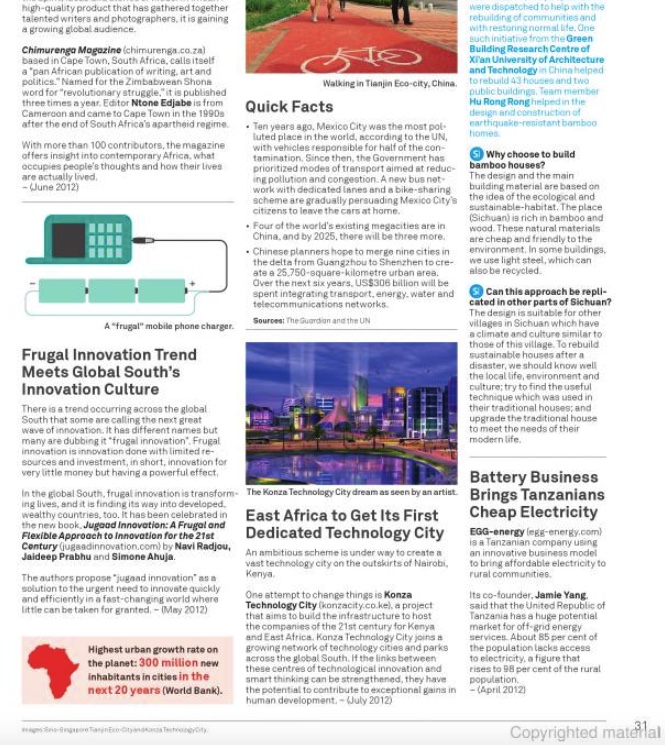
EGG-energy (http://egg-energy.com) is a Tanzanian company using an innovative business model to bring affordable electricity to rural communities.

Its co-founder, Jamie Yang, said Tanzania has a huge potential market for offgrid energy services. About 85 per cent of the population lacks access to electricity, a figure that rises to 98 per cent of the rural population.

EGG-energy says it is “dedicated to helping low-income consumers in sub-Saharan Africa gain access to clean, affordable energy, using a unique strategy based around portable rechargeable batteries.” The company has eight full-time staff based in their Makumbusho office, 6 kilometres north of Dar es Salaam, the capital.

It calls its system the “portable grid,” and it works like this: customers have a power system installed in their home that runs on brick-sized, re-chargeable batteries. The batteries are re-charged at a central charging station using power from the Tanzanian power grid, and sent to local distribution centres where customers can pick them up. Customers rent the batteries for a subscription fee, and they last about five nights in a home. When the battery is empty, the customer returns it, swaps for a fresh battery and pays a small swapping fee.

It is a brilliant solution to the problem of getting power from the main Tanzanian power grid to people’s homes. According to EGG-energy, most Tanzanians live within 5 kilometres from a power grid line. Yet the majority of the population lack access to electricity.

“After researching the energy situation in Tanzania and other countries with similar electricity access problems, it became clear that one of the primary problems was a lack of last-mile distribution,” explained Yang. “The only way to get power from the source into homes and businesses were power lines, and for the vast majority of rural Tanzanians, this was very much out of reach.

We saw situations in which power lines would pass right over large populations that were still using kerosene for lighting. We also saw that distributed generation like solar was finding only very limited markets because there was no share or sell power from that source without an affordable way to distribute the electricity.”

While EGG-energy is based in Tanzania, it hopes hope to expand across the developing world.

In order to develop an effective distribution network, EGG-energy partners with local store owners and delivery businesses to help with distributing the batteries. The batteries are based on those used in the airline industry and are light enough to be held in one hand.

Yang believes marketing is critical to the success of the technology.

“Don’t underestimate the cost of sales, marketing, and distribution,” he said.

“Many companies focus on the technology and in lowering the cost of the technology, while not paying enough attention to the gaps in the distribution channels.

“We have a sales team that communicates what we do through a variety of methods, including door-to-door sales, road shows and village meetings. We also make contact with the local political leaders and offer referral awards to our existing customers. Potential customers come to our charging stations to purchase the system and to connect to EGG.”

When a customer signs up with EGG-energy, a technician is dispatched to their home to make sure the electricity system is sound and effective. The company also sells energy-efficient lights, radios and mobile phone chargers to complement the electricity system. It’s a wise business model, since having a steady and reliable supply of electricity is a great motivator for customers to purchase other electric-powered appliances.

“We have technicians that have received vocational training through the Tanzanian system and technicians that we train ourselves,” Yang said. “We have very standardized electricity installations that are easy to teach, and have more experienced technicians that we rely on for troubleshooting and support.”

EGG-energy also makes the claim it can reduce a household’s energy expenses by 50 per cent as they make the switch from traditional batteries for radios and kerosene lamps for light.

EGG-energy calls itself a “for-profit company with a social mission.” It sees the provision of affordable electricity and energy as a spur for small entrepreneurs to build their businesses, boost educational opportunities through longer study time, and help with connecting families with the outside world.

It uses regular feedback with customers to make sure their service is actually cheaper than other options – a good habit for any business looking to build a lasting customer relationship.

“One of the key deficiencies in the energy supply chain is customer support,” said Yang. “We have seen multiple solar installations given by NGOs to community organizations that are no longer functioning because the user doesn’t have someone reliable to call or hasn’t allotted a budget to maintain the system.

“Customer support is a key component of last mile distribution, and something that EGG-energy is focusing on as an energy services company with a local, physical presence.”

Published: April 2012

Resources

1) ANSOLE (the African Network for Solar Energy) is a research-oriented network of 200 scientists from 22 African and 10 non-African countries. It believes, according to Mammo Muchie, founding editor of the African Journal of Science, Technology, Innovation, and Development, “solar power will become the major renewable energy source on the continent only by organized research, training, design, and engineering.” Website: ansole.org

2) The Kenya-based non-governmental organization (NGO) Access: energy is tackling the problem of 84 per cent of Kenyans – 32 million people – lacking access to electricity at home. It is doing this by teaching people how to make and assemble wind turbines out of scrap metal and car parts and other materials found within communities. Their turbine design is called the Night Heron Turbine. Website: http://access-collective.com/energy/

4) TANESCO: Tanzania Electric Supply Company: Website: http://www.tanesco.co.tz

https://davidsouthconsulting.org/2022/10/24/brazilian-solar-powered-wifi-for-poor-schools/

https://davidsouthconsulting.org/2022/10/06/indian-solar-power-pack-powers-villages/

https://davidsouthconsulting.org/2022/11/20/new-battery-back-up-technology-targeting-developing-countries-and-remote-regions/

https://davidsouthconsulting.org/2022/10/02/powerful-solar-light-spurring-income-making-opportunities/

https://davidsouthconsulting.org/2022/10/24/solar-power-bringing-light-and-opportunity-to-the-poor/

https://davidsouthconsulting.org/2021/03/24/solar-powered-mobile-clinics-to-boost-rural-healthcare-in-africa/

https://davidsouthconsulting.org/2021/03/30/solar-powered-village-kick-starts-development-goals/

https://davidsouthconsulting.org/2022/10/06/solar-sisters-doing-it-for-themselves-tackling-african-light-famine/

Development Challenges, South-South Solutions was launched as an e-newsletter in 2006 by UNDP’s South-South Cooperation Unit (now the United Nations Office for South-South Cooperation) based in New York, USA. It led on profiling the rise of the global South as an economic powerhouse and was one of the first regular publications to champion the global South’s innovators, entrepreneurs, and pioneers. It tracked the key trends that are now so profoundly reshaping how development is seen and done. This includes the rapid take-up of mobile phones and information technology in the global South (as profiled in the first issue of magazine Southern Innovator), the move to becoming a majority urban world, a growing global innovator culture, and the plethora of solutions being developed in the global South to tackle its problems and improve living conditions and boost human development. The success of the e-newsletter led to the launch of the magazine Southern Innovator.  

https://davidsouthconsulting.org/2021/03/05/southern-innovator-issue-4/

Creative Commons License

This work is licensed under a
Creative Commons Attribution-Noncommercial-No Derivative Works 3.0 License.

ORCID iD: https://orcid.org/0000-0001-5311-1052.

© David South Consulting 2023