Categories
Archive Development Challenges, South-South Solutions Newsletters

Cooking up a Recipe to End Poverty

By David SouthDevelopment Challenges, South-South Solutions

SOUTH-SOUTH CASE STUDY

Like music, food has a powerful ability to jump across cultural and regional barriers and unite people in the sheer pleasure of the meal. Tapping the rich vein of regional culinary heritages is also a great way to make money. Promoting local recipes and foods has other benefits: as the global obesity (or globesity as WHO calls it) epidemic reaches into the urban areas of cities in the developing world, anything that pulls people away from fast food and high-fat foods is a good thing. Doctors have found home cooking keeps people thin and is better for them.

The trend across the developing world towards eating away from home is another factor in the growing obesity crisis. While cooking at home allows for control of ingredients and portion sizes, eating out usually means more high energy and fatty foods. The global obesity crisis is threatening to reverse many essential health gains brought about by development. As communities prosper, diets become more reliant on junk food and fast food.

The International Obesity Task Force found 1.7 billion people in the world need to lose weight. There are now more overweight people in the world than hungry people. Neville Rigby, the policy director of the task force, told The Associated Press, “What’s clear is that the developing world in particular is going to bear the enormous brunt of this weight gain. It’s rapidly accelerating. We’re even seeing obesity in adolescents in India now. It’s universal. It has become a fully global epidemic – indeed, pandemic.”

According to Dr Susan Jebb, Medical Research Council Director of Studies, Human Nutrition Centre, University of Cambridge, “getting back to a bit of home cooking could be a good start” to tackling the obesity crisis.

Increasing awareness of traditional and local recipes can generate income in many ways. From publishing cookbooks to inspiring restaurant and food vendor menus to sparking up supermarket product lines, whole industries can be built up from the humble recipe. Supermarkets in Africa are a growing sector. Executives from South Africa’s Shoprite supermarket chain recently announced a doubling of their supermarkets in Uganda, and called supermarkets one of the fastest growing businesses in East Africa. UK supermarket chain Sainsbury’s has already started to dispatch Fairtrade Ambassadors to Africa to trawl the continent for new products to stock their shelves.

So, the time is right for entrepreneurs to target the African food market and raise its profile. Seizing this opportunity is an ambitious project to digitally archive the vast and often hard-to-find treasure trove of African cookbooks. Announced at a conference in Tanzania this summer, the African Cookbook Project is seeking to gather together in one place all the past and present African cookbooks, effectively creating the most comprehensive resource of African recipes.

Published: August 2007

Resources

  • Africooks: Culinary Literature by Jessica B. Harris: This established African cookbook writer offers an excellent role model for budding cookbook authors: www.africooks.com
  • A success story about a Senagalese restaurant in the US: NYTimes article
  • BetumiBlog and Betumi.com (www.betumi.com): Betumi is the African Culinary Network and “connects anyone who delights in African cuisine, foodways and food history.” View photos.
  • An extensive list of African cookbooks available for sale: here
  • Africa’s Big Seven: held every year, it is the main event that brings together food retailers and producers and is a perfect place to bring a new product looking to be launched.

https://davidsouthconsulting.org/2022/11/21/agribusiness-food-security/

https://davidsouthconsulting.org/2022/11/10/brazilian-restaurant-serves-amazonian-treats/

https://davidsouthconsulting.org/2022/06/24/dabbawallahs-use-web-and-text-to-make-lunch-on-time/

https://davidsouthconsulting.org/2022/11/11/havanas-restaurant-boom-augers-in-new-age-of-entrepreneurs/

https://davidsouthconsulting.org/2022/10/14/indias-modernizing-food-economy-unleashing-new-opportunities/

https://davidsouthconsulting.org/2022/05/04/insects-can-help-in-food-crisis/

https://davidsouthconsulting.org/2022/10/24/latin-american-food-renaissance-excites-diners/

https://davidsouthconsulting.org/2022/10/20/new-appetite-for-nutritious-traditional-vegetables/

https://davidsouthconsulting.org/2023/03/27/rats-a-solution-in-food-crisis/

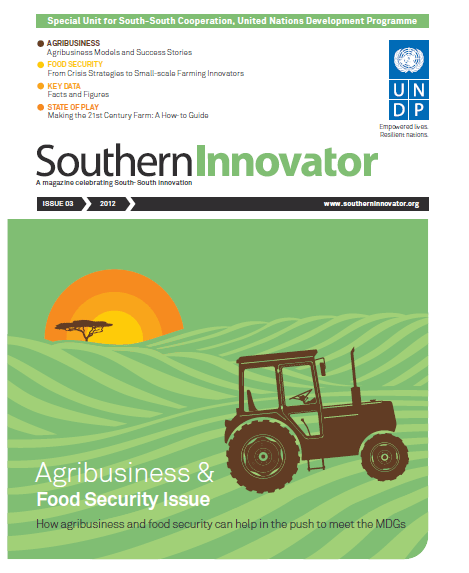
https://davidsouthconsulting.org/2021/03/05/southern-innovator-issue-3/

https://davidsouthconsulting.org/2022/11/16/thai-organic-supermarkets-seek-to-improve-health/

https://davidsouthconsulting.org/2022/11/11/woman-restaurant-entrepreneur-embraces-brand-driven-growth/

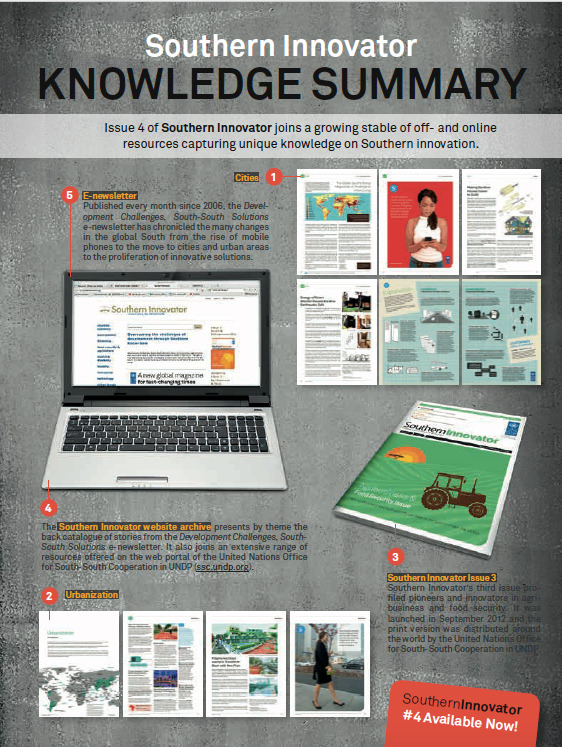
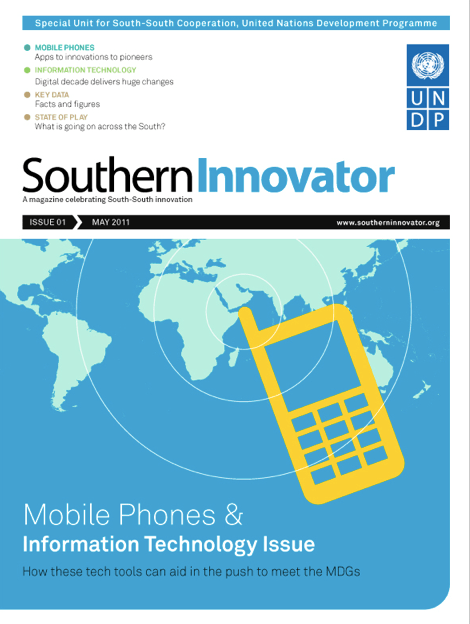
Development Challenges, South-South Solutions was launched as an e-newsletter in 2006 by UNDP’s South-South Cooperation Unit (now the United Nations Office for South-South Cooperation) based in New York, USA. It led on profiling the rise of the global South as an economic powerhouse and was one of the first regular publications to champion the global South’s innovators, entrepreneurs, and pioneers. It tracked the key trends that are now so profoundly reshaping how development is seen and done. This includes the rapid take-up of mobile phones and information technology in the global South (as profiled in the first issue of magazine Southern Innovator), the move to becoming a majority urban world, a growing global innovator culture, and the plethora of solutions being developed in the global South to tackle its problems and improve living conditions and boost human development. The success of the e-newsletter led to the launch of the magazine Southern Innovator.

Creative Commons License

This work is licensed under a
Creative Commons Attribution-Noncommercial-No Derivative Works 3.0 License.

ORCID iD: https://orcid.org/0000-0001-5311-1052.

© David South Consulting 2023

Categories
Archive Development Challenges, South-South Solutions Newsletters

SOS Shops Keep Food Affordable for Poor, Unemployed

By David SouthDevelopment Challenges, South-South Solutions

SOUTH-SOUTH CASE STUDY

As the global downturn bears down on country after country, governments around the world are introducing austerity measures to try to keep their economies going. Many countries are now facing financial crisis and the need for loans and support from the International Monetary Fund (IMF).

Formerly comfortable people are going from regular employment to unemployment or erratic employment, and growing numbers of people are finding it hard even to afford basics such as food.

In Balkan nation Serbia, trade unions have come up with a solution: they are called SOS Shops and they feature food and other products priced at as much as 70 percent less than regular shops. By cutting back on the profit margin for the products, the store can make drastic cuts in prices.

In the capital, Belgrade, the shops are run by trade unions in partnership with a local retail chain, Jabuka. The Association of Free and Independent Trade Unions uses Jabuka to run the stores. Anyone with an income below 20,000 dinars (US $280) a month can receive a special card to shop at the SOS stores.

In Jabuka’s other stores, the profit margin is 20 percent, and in rival stores it can be over 30 percent. Jabuka also makes savings by sourcing locally and suppliers offering discounts of between 15 percent and 25 percent.

“The prices there are 30 to 50 percent lower than in major supermarkets,” Jabuka manager Milorad Miskovic told IPS. “It’s a hard time for many people, so we decided to lower our margin of profit to only five percent at the SOS shops.

“SOS shops are intended for the socially handicapped. SOS shops offer goods at lower prices to Serbian citizens earning minimum wages or pensions lower than RSD 20,000, to the unemployed, to the displaced from Kosovo and the citizens on the dole (welfare).”

Hard hit by the global downturn, Serbia has seen its recent boom times disappear quickly. The country had enjoyed average yearly growth since 2000 of 6.7 percent.

The country is currently negotiating bridging loans with the IMF (www.imf.org). The conditions for the loan mean severe cuts to public sector wages and tax rises.

According to the Serbian Statistical Office, Serbia has lost 10,000 jobs a month since the beginning of 2009. The official unemployment rate is 14 percent, and the government believes half a million people now live below the official poverty line, out of a population of 10 million.

“Many people have lost their jobs and the main problem is that the middle class is now poor. That is the real problem,” Nebojsa Rajkovic of the Association of Independent Trade Unions told the BBC. “The government prepared a social programme to deal with the economic crisis in Serbia, but it was not enough and that is the reason the union devised this project.”

This month, the Jabuka trade company opened its third SOS shop in Belgrade. The shop, the largest SOS shop so far, will be opened in the Mirijevo neighbourhood of Belgrade, and it will offer a wider range of products.

The unions plan to open 100 social supermarkets this year. Basic staples like bread, milk and potatoes are the cheapest goods. Unlike other supermarkets, the stores feature local brands and products made in Serbia: a boost to local producers in the economic downturn.

In order to stop hoarding of the cheap food or people buying a lot and then selling it for a profit, the amount that can be bought on one shopping trip is limited. For example, just three bottles of cooking oil are allowed each time.

“Most people in Serbia are finding things difficult financially. We only have maybe five or 10 percent of the population who don’t have financial problems,” continued Rajkovic.

One customer, 26-year-old Milica Marjanovic , found the shops provided much-needed support to her unemployed family. “My mother, my sister and I are unemployed. We don’t get any social benefits,” she said to the BBC.

“There are a lot of unemployed people in Serbia, life is hard for a lot of people and they can hardly manage.

“Many families don’t even have what is basic for living. So, these shops are welcome.”

Published: May 2010

Resources

The Co-operative Food: This pioneering network of supermarkets offers both affordable food prices for customers and good prices and terms for suppliers. They are a founding member of the Ethical Trading Initiative (ETI). This is an alliance of companies, trade unions and non-governmental organisations (NGOs) working together to improving working conditions in supply chains.
Website: http://www.co-operative.coop/food/

Development Challenges, South-South Solutions was launched as an e-newsletter in 2006 by UNDP’s South-South Cooperation Unit (now the United Nations Office for South-South Cooperation) based in New York, USA. It led on profiling the rise of the global South as an economic powerhouse and was one of the first regular publications to champion the global South’s innovators, entrepreneurs, and pioneers. It tracked the key trends that are now so profoundly reshaping how development is seen and done. This includes the rapid take-up of mobile phones and information technology in the global South (as profiled in the first issue of magazine Southern Innovator), the move to becoming a majority urban world, a growing global innovator culture, and the plethora of solutions being developed in the global South to tackle its problems and improve living conditions and boost human development. The success of the e-newsletter led to the launch of the magazine Southern Innovator. 

https://davidsouthconsulting.org/2021/03/05/southern-innovator-issue-3/

Creative Commons License

This work is licensed under a
Creative Commons Attribution-Noncommercial-No Derivative Works 3.0 License.

ORCID iD: https://orcid.org/0000-0001-5311-1052.

© David South Consulting 2022

Categories
Archive Development Challenges, South-South Solutions Newsletters

Thai Organic Supermarkets Seek to Improve Health

By David SouthDevelopment Challenges, South-South Solutions

SOUTH-SOUTH CASE STUDY

A Thai business is working hard to expand access to organic food in the country. It sees this as part of a wider campaign to improve health in the country – and its success has caught the attention of the government, which wants to turn Thailand into a global health destination.

The Lemon Farm chain run by Suwanna Langnamsank (http://www.lemonfarm.com/lmf/) was started 13 years ago and has grown to nine organic supermarkets in the capital, Bangkok. Lemon Farm works with 200 organic farms in Thailand and employs 160 people.

Organic food (http://en.wikipedia.org/wiki/Organic_food) – grown without chemicals and artificial fertilizers and not irradiated or subjected to other tampering – is believed by many to be healthier because it avoids the harmful effects of accumulating chemicals. It is also thought to be richer in vitamins and minerals because of the use of non-chemical fertilizers on the soil.

Lemon Farm sells made-in-Thailand organic vegetables and fruit, natural gift sets, soap and tea. There are also macrobiotic cafes in the supermarkets called Be Organic.  A macrobiotic diet avoids foods containing toxins (http://www.cancerresearchuk.org/cancer-help/about-cancer/treatment/complementary-alternative/therapies/macrobiotic-diet).

The supermarkets use eye-pleasing modern design to set themselves apart from more conventional supermarkets.

According to Lemon Farm’s website, it is a social enterprise and practices fair trade. It is using market-driven solutions to increase the availability of healthy food in the country. It seeks to support small-scale farmers and champion change in farming methods, encouraging a move away from dependence on harmful chemicals that damage human health and the environment and promoting “agricultural and economic self-sufficiency”.

The macrobiotic restaurant operates to six values, among them using fresh vegetables and only using produce from associated farms. The restaurants do not use added sugar, they cook using a pressure cooker, and use natural ingredients such as sea salt, ginger, fermented soy sauce and natural miso. They do not use any artificial preservatives or flavour enhancers such as monosodium glutamate (MSG), a common practice in Asian cooking.

Lemon Farm’s success as an organic food pioneer has caught the attention of the Thai government. The Ministry of Commerce (http://www2.moc.go.th/main.php?filename=index_design4_en) has contracted Lemon Farm to join its campaign to offer organic food in schools and hospitals.

By promoting organic food, the government is hoping to boost farmers’ incomes while improving health in the country and bolstering the country’s thriving medical services industry serving foreign patients.

“We need to promote healthy food and a healthy environment,” Piramol Charoenpao, deputy permanent secretary at the Ministry of Commerce, told Monocle magazine. “Thailand is a medical hub. The idea is to have retreat-style hospitals serving organic food. We’re increasing organic food production and educating people about it.”

Thailand has already built a good reputation with its medical and health services. More than 1.6 million non-Thais are treated in Thai hospitals annually, with an estimated 500,000 travelling specifically for medical treatment (The Guardian).

Former Thai Prime Minister Thaksin Shinawatra mooted the idea of making the country an international leader in medical tourism in 2003. It is expected providing medical services to overseas patients will make the country US $3.3 billion by 2015 (The Guardian).
 
It is hoped that offering organic food in hospitals and health facilities will boost the attractiveness and effectiveness of using health services in Thailand.

Medical tourism is considered one of the fastest-growing sectors in the world. Estimates place it as a market worth US $100 billion. Three countries that compete in this market by offering medical services in the English language include India, Singapore and Thailand. They compete by offering services comparable to wealthier countries but at considerably less cost.

Lemon Farm says it is on a mission to develop the marketplace for organic food in Thailand by educating consumers and producing “innovative natural food”.  It looks like it has already made a big impact.

Published: February 2013

Resources

1) Whole Foods Market: The world’s leader in natural and organic foods, with more than 340 stores in North America and the United Kingdom. Website: wholefoodsmarket.com

2) Conscious Capitalism: A book by Co-CEO of Whole Foods Market, John Mackey. Website:http://consciouscapitalism.org/resources/538

3) Live Plan: A step-by-step online resource for creating a business plan for an organic supermarket. Website:http://www.bplans.com/organic_food_store_business_plan/company_summary_fc.php

4) Start your own: Health food store: Advice and business tips on starting a health food store. Website:http://www.startups.co.uk/health-food-store.html

Southern Innovator logo

London Edit

31 July 2013

Google Books: https://books.google.co.uk/books?id=hvRcAwAAQBAJ&dq=development+challenges+february+2013&source=gbs_navlinks_s

Slideshare: http://www.slideshare.net/DavidSouth1/development-challenges-february-2013-issue

Southern Innovator Issue 1: https://books.google.co.uk/books?id=Q1O54YSE2BgC&dq=southern+innovator&source=gbs_navlinks_s

Southern Innovator Issue 2:https://books.google.co.uk/books?id=Ty0N969dcssC&dq=southern+innovator&source=gbs_navlinks_s

Southern Innovator Issue 3:https://books.google.co.uk/books?id=AQNt4YmhZagC&dq=southern+innovator&source=gbs_navlinks_s

Southern Innovator Issue 4: https://books.google.co.uk/books?id=9T_n2tA7l4EC&dq=southern+innovator&source=gbs_navlinks_s

Southern Innovator Issue 5:https://books.google.co.uk/books?id=6ILdAgAAQBAJ&dq=southern+innovator&source=gbs_navlinks_s

Development Challenges, South-South Solutions was launched as an e-newsletter in 2006 by UNDP’s South-South Cooperation Unit (now the United Nations Office for South-South Cooperation) based in New York, USA. It led on profiling the rise of the global South as an economic powerhouse and was one of the first regular publications to champion the global South’s innovators, entrepreneurs, and pioneers. It tracked the key trends that are now so profoundly reshaping how development is seen and done. This includes the rapid take-up of mobile phones and information technology in the global South (as profiled in the first issue of magazine Southern Innovator), the move to becoming a majority urban world, a growing global innovator culture, and the plethora of solutions being developed in the global South to tackle its problems and improve living conditions and boost human development. The success of the e-newsletter led to the launch of the magazine Southern Innovator. 

Creative Commons License

This work is licensed under a
Creative Commons Attribution-Noncommercial-No Derivative Works 3.0 License.

ORCID iD: https://orcid.org/0000-0001-5311-1052.

© David South Consulting 2022