In November/December 2000 I worked in Kyiv/Kiev, Ukraine for the United Nations mission on the strategic re-launch of the mission website as a portal, whilst also advising the UN Resident Coordinator/UNDP Resident Representative Douglas Gardner on communications strategy. It was an extraordinary experience on many levels. It was a time when the Internet was fast evolving and required quick thinking and an ability to innovate; it was also a key moment in Ukraine’s history.
According to Olena Nikolayenko in Youth Movements and Elections in Eastern Europe (Cambridge University Press, 2017), “Gongadze’s murder in September 2000 engendered the Ukraine without Kuchma Movement. The website Maidan (http://maidanua .org) was initially set up by civic activists to provide extensive coverage of the movement’s activities.”
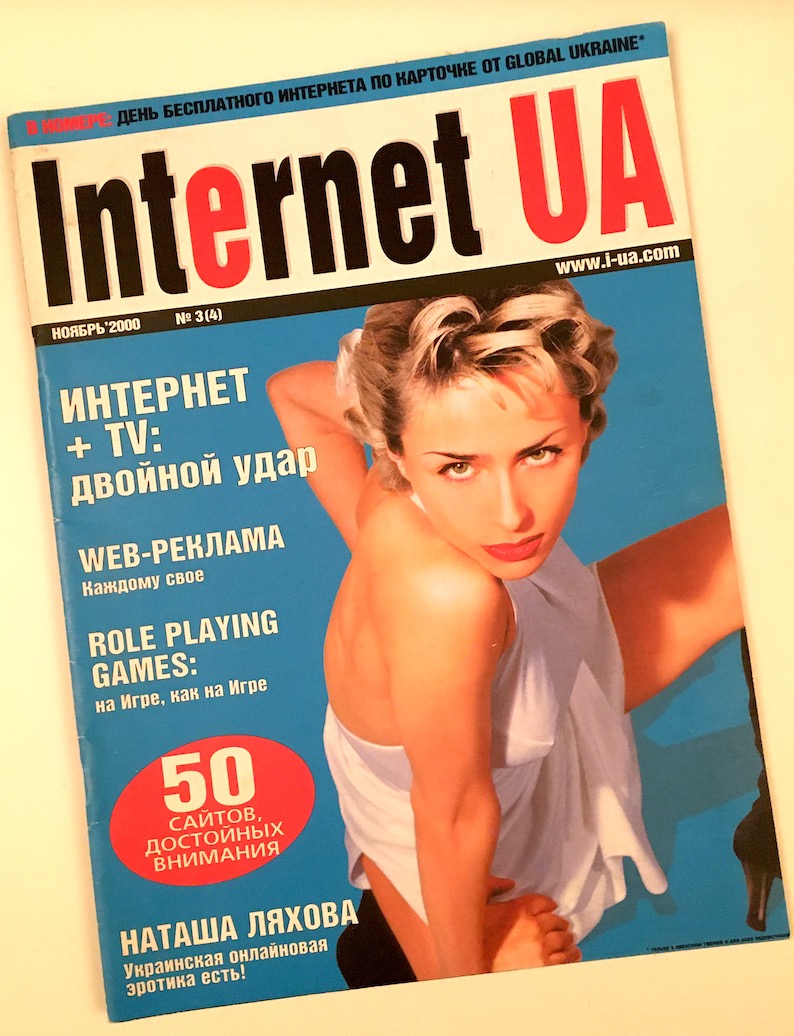
But despite those dangers and clear threats from the government of the time, there was a flourishing and inventive Internet and digital economy. The magazine Internet UA (whose editor I enjoyed meeting) gave a great overview of the scene in Ukraine and its creativity. Just as now, the creation of Internet stars who can exploit the medium (in this case sexy videos: a very large online market today) was driving viewers and subscribers. But there was also a vibrant online news media, blogging, commerce and gaming presence as well.
Internet UA magazine: Sex sells and the sex industry has always had pioneers seeking new ways to get eyeballs for their content. The Internet from its early days has been driven by the search for nude pictures and sex videos. In this cover feature, “Internet + TV: Double Impact”. That content mix has become the foundation of websites such as Pornhub etc.
According to ain.ua, the Ukrainian digital economy today is ” … ‘local’ only just figuratively speaking. Ukrainian startups are initially focused on international markets. Product companies are included into international industry ratings. Outsourcing works with clients from all over the world. Global players enter Ukrainian market, opening R&D offices, acquiring and investing into local companies. There are no boundaries.”
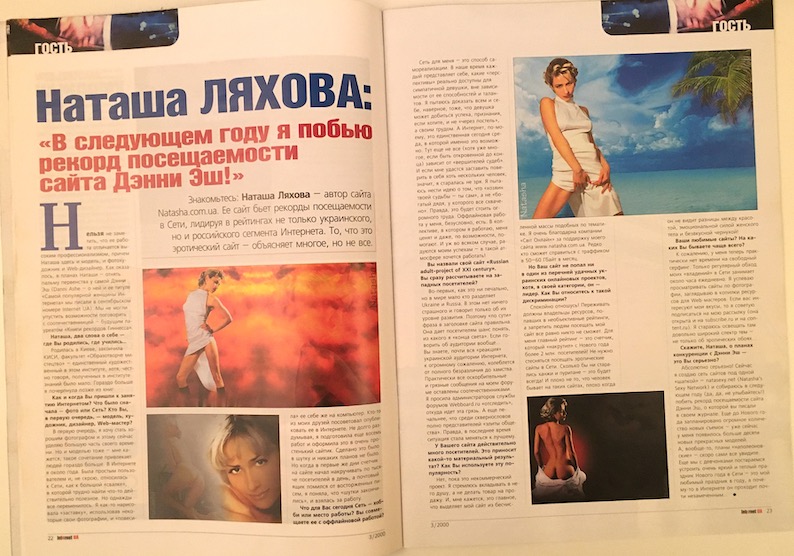
A magazine feature on ‘Natasha’s’ Internet content offering.
It is easy to take digital freedoms for granted now but there was great resistance at the time and, unlike today, many governments were openly hostile to digital technology, online communications and e-commerce.
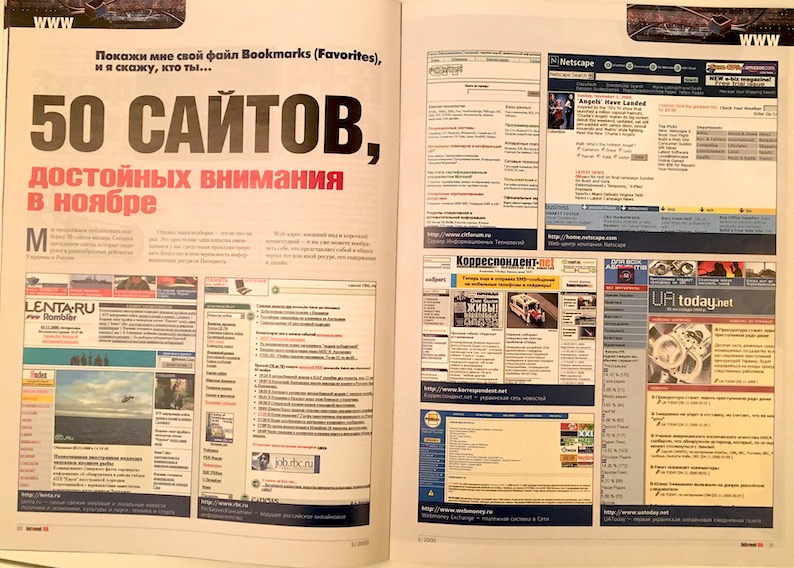
50 websites to bookmark in 2000.
The UN itself was evolving and embracing the communications and design revolution being driven by digital change. This was the first “dot.com” boom, which had begun in 1997. I had played a key role in pioneering online content for Mongolia (1997-1999) and could bring this experience to Ukraine. In particular, I launched an award-winning web portal for the UN Mongolia mission in 1997 (www.un-mongolia.mn) and also the country’s first web magazine, Ger.
The UN Ukraine brief involved creating content that was accessible to users with low bandwidth, dial-up connections (few had mobile phones in 2000). I had been building new media experience throughout the 1990s, tracking the cable and satellite TV and mobile/Internet revolutions for the Financial Times as a journalist, as well as launching websites for various media clients.
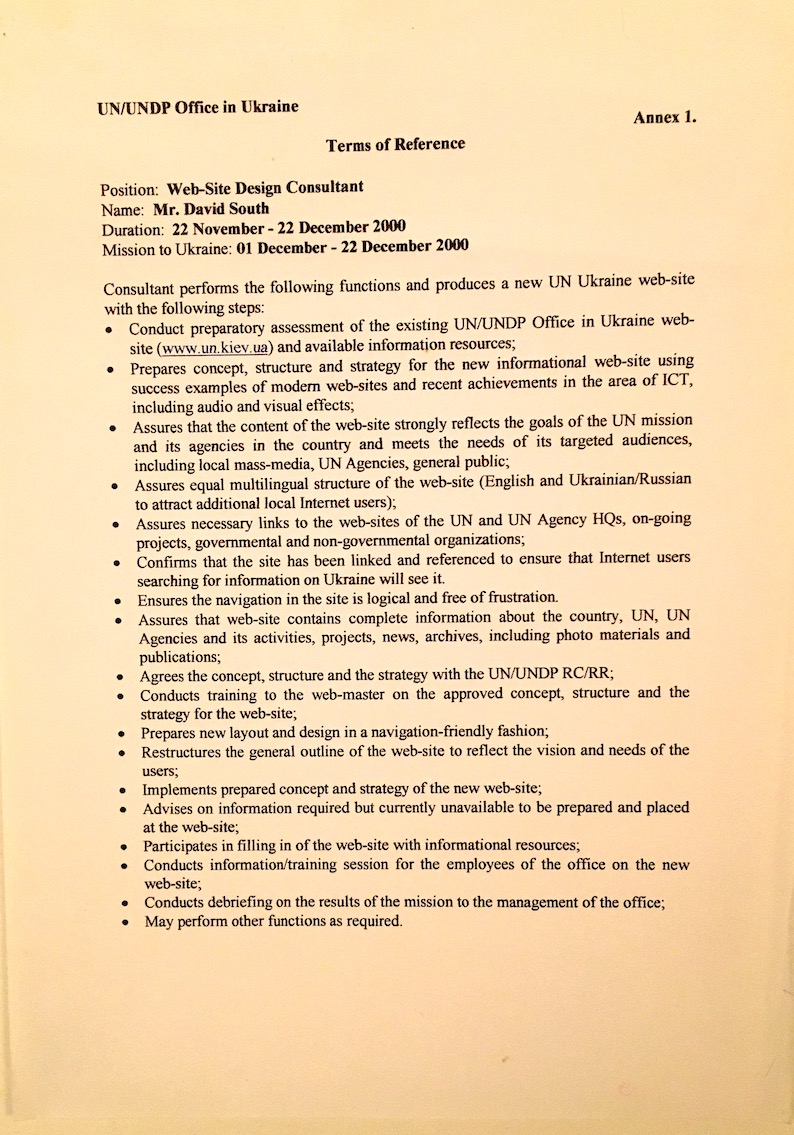
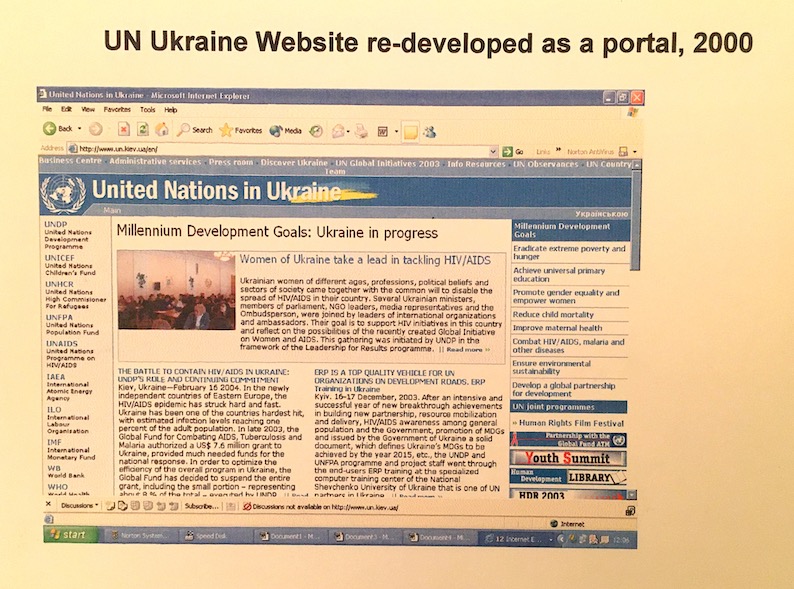
The Terms of Reference for the UN/UNDP Ukraine assignment.The assignment business card.The UN/UNDP Ukraine website before launch as a portal.The first iteration of the new UN Ukraine portal.
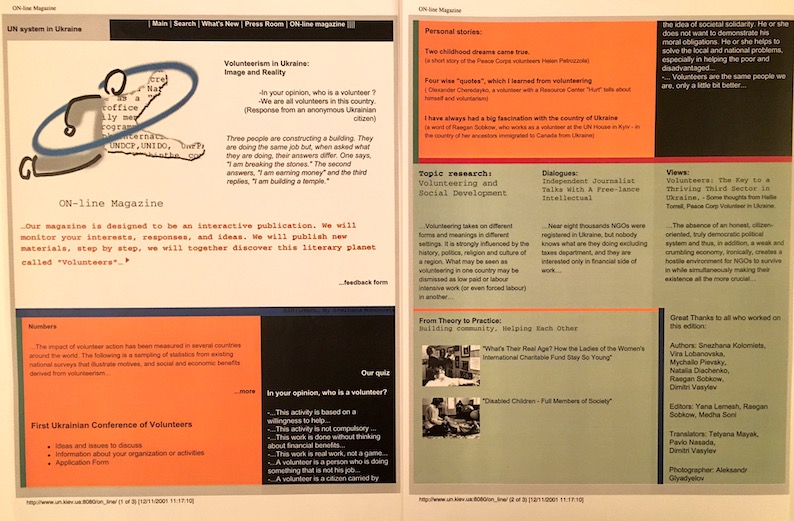
Key content created and launched on the UN Ukraine portal included critical information on the HIV/AIDS crisis in Ukraine, UN Ukraine’s first online magazine to explore perceptions of volunteering and NGOs in the post-communist period, and content preparing for the visit of the UN Secretary-General Kofi Annan, by showing how Ukraine was engaging with global development priorities, for example the eight Millennium Development Goals (MDGs), and bringing together UN agencies and entities into a cohesive web and “One UN” experience.
The first UN Ukraine online magazine.Bringing together UN agencies and entities into a cohesive web and “One UN” experience.
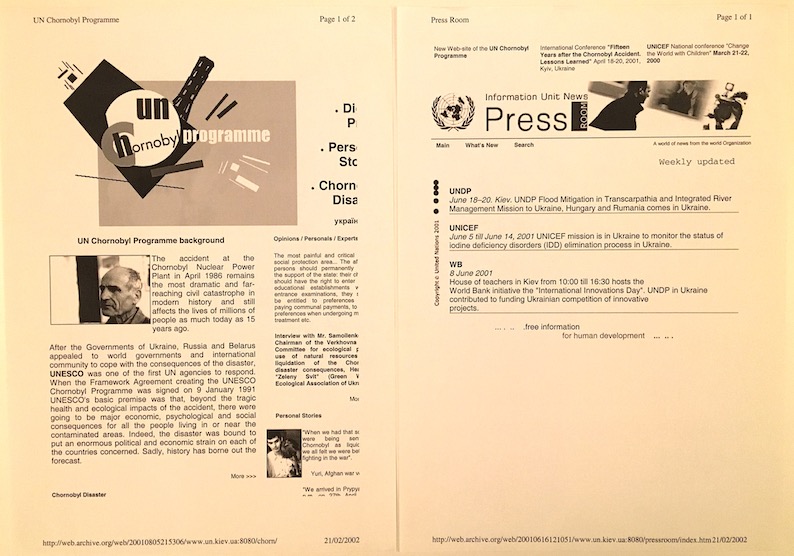
One highlight of this assignment was working with the “UN Chornobyl Programme” to develop its web content. This included visiting Pripyat (https://en.wikipedia.org/wiki/Pripyat),an abandoned city because of the Chernobyl Nuclear Power Plant disaster in 1986. I have visited many abandoned and “secret” cities and towns in the course of working with the United Nations but this particular visit had the added dimension of an environmental and human health disaster hanging over it (and as a former healthcare worker at Canada’s top cancer hospital and research institute, I couldn’t forget the impact of high radiation levels on the body).
UN Chornobyl Programme website in development, 2000.UN agencies in Ukraine. UNDP in Ukraine.
The power of the Internet and the digital economy to engage people, especially the young, despite living in a country with significant political repression of free speech and even physical intimidation and murder, stuck with me. This work also contributed to laying the foundations for Ukraine’s growing freedoms and greater engagement with Europe.
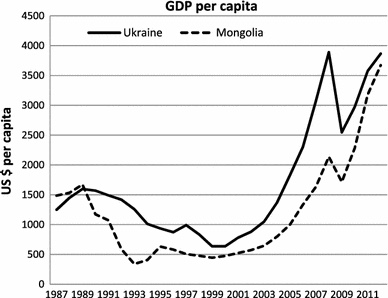
As this chart shows, increasing connectivity had a profound impact on living standards in Ukraine and Mongolia post-2000. The extreme turbulence Mongolia experienced in the 1990s – after the collapse of support mechanisms from the Soviet Union – calmed down as Mongolia integrated with the global economy, especially a booming China.
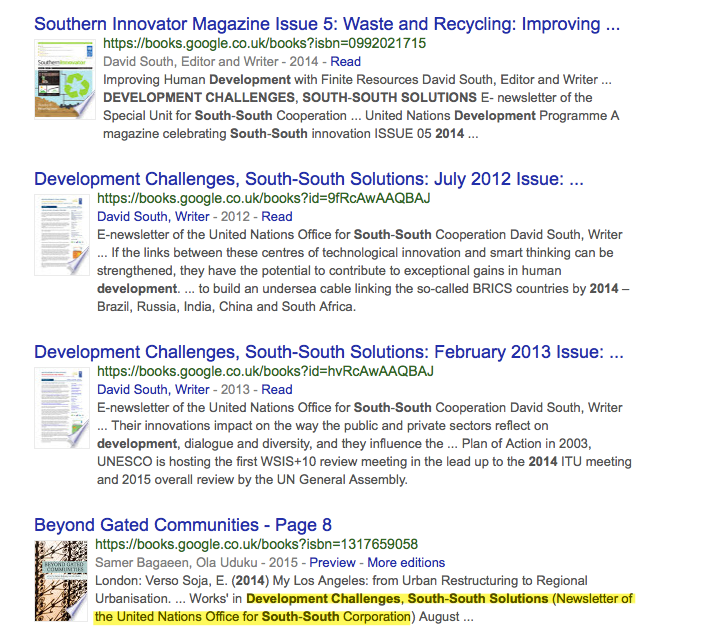
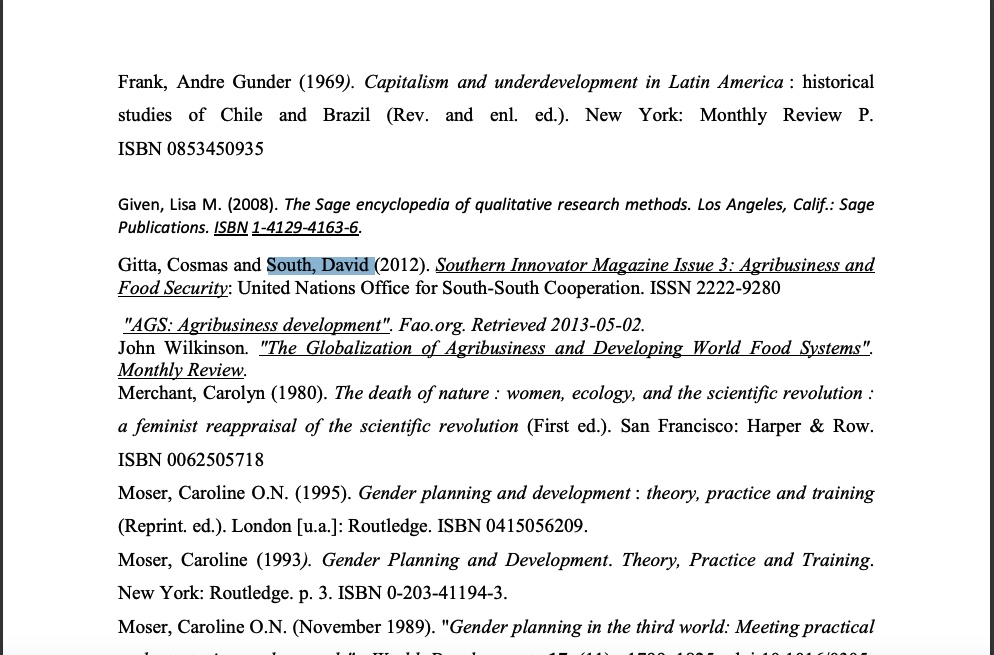
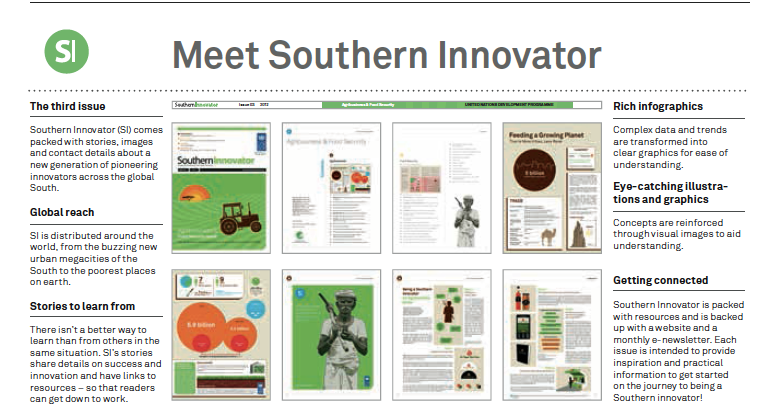
Southern Innovator was initially launched in 2011 with the goal of – hopefully – inspiring others (just as we had been so inspired by the innovators we contacted and met). The magazine seeks to profile stories, trends, ideas, innovations and innovators overlooked by other media. The magazine grew from the monthly e-newsletter Development Challenges, South-South Solutions published by the United Nations Office for South-South Cooperation (UNOSSC) since 2006. A selection of books and papers citing stories from the magazine are featured below to aid researchers, in particular those interested in health and human development and the role of innovators in international development.
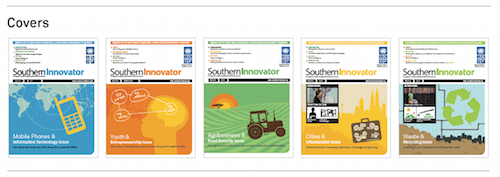
The first five issues of Southern Innovator from 2011 to 2014. Called a “Beautiful, inspiring magazine from UNDP on South-South innovation.”
“Innovation is critical to growth and development in Africa. In the context of a continent characterized by fast growing economies as well as an array of socioeconomic challenges, such as high levels of poverty and inequality, innovation in Africa must be understood in an encompassing manner. Africa needs to support the emergence of its own Silicon Valleys, but it must also foster the invention and adoption of cleaner technologies that limit respiratory illnesses, deforestation and combat climate change. This book contains a number of analytical case studies that examine the nature and origins of emerging high-end innovation hubs in Africa. These “hubs” or ecosystems are both understudied and little known inside and outside the continent. With this analysis, the book highlights and draws lessons from some of the most promising and successful innovation cases in Africa today, exploring the key factors driving their successful emergence, growth and future prospects. Relevant for scholars, policymakers, and business leaders, the book provides both inspiration and useful policy advice that can inform strategies and concrete measures to speed up the pace of innovation in Africa today.”
“Research on gated communities is moving away from the hard concept of a ‘gated community’ to the more fluid one of urban gating. The latter allows communities to be viewed through a new lens of soft boundaries, modern communication and networks of influence.
The book, written by an international team of experts, builds on the research of Bagaeen and Uduku’s previous edited publication, Gated Communities (Routledge 2010) and relates recent events to trends in urban research, showing how the discussion has moved from privatised to newly collectivised spaces, which have been the focal point for events such as the Occupy London movement and the Arab Spring.
Communities are now more mobilised and connected than ever, and Beyond Gated Communities shows how neighbourhoods can become part of a global network beyond their own gates. With chapters on Australia, Canada, Europe, South America, Asia, Africa and the Middle East, this is a truly international resource for scholars and students of urban studies interested in this dynamic, growing area of research.”
“The economic, political and social situation in Chile shows a country in transition. Some observers anticipate a broad “reboot” of the nation. While Chile is still seen by many as an example of progress in South America and of developmental potential in the global South, it faces a complex political constellation, particularly in the aftermath of the re-election of Michelle Bachelet. Many wonder how social and institutional innovations can be incepted without interrupting the country’s remarkable success over the past decades.
This book provides an interdisciplinary analysis of Chile’s situation and perspectives. In particular, it addresses the questions:
What is Chile’s real socio-political situation behind the curtains, irrespective of simplifications?
What are the nation’s main opportunities and problems?
What future strategies will be concretely applicable to improve social balance and mitigate ideological divisions?
The result is a provocative examination of a nation in search of identity and its role on the global stage.
Roland Benedikter, Dr., is Research Scholar at the Orfalea Center for Global and International Studies, University of California, Santa Barbara, Senior Research Scholar of the Council on Hemispheric Affairs Washington D.C., Trustee of the Toynbee Prize Foundation Boston and Full Member of the Club of Rome.
Katja Siepmann, MA, is Senior Research Fellow of the Council on Hemispheric Affairs Washington D.C., Member of the German Council on Foreign Relations, and Lecturer at the Faculty of Interdisciplinary Cultural Sciences of the European University Frankfurt/Oder.
The volume features a Foreword by Ned Strong, Executive Director of the David Rockefeller Center for Latin American Studies, Harvard University, and a Preface by Larry Birns, Director of the Council on Hemispheric Affairs, Washington D.C., and Former Senior Public Affairs Officer of the United Nations’ Economic Commission for Latin America (Santiago, Chile).”
“A Sociological Approach to Health Determinants investigates how the social works in determining health and health inequity. Taking a global perspective, the book shines a light on how experiences of health, illness and health care are shaped by a variety of complex social dynamics. Informed primarily by sociology, the book engages with the WHO’s social determinants of health approach and draws on contributions from history, political economy and policy analysis to examine issues such as class, gender, ethnicity and indigeneity, and the impact they have on health. A Sociological Approach to Health Determinants is a comprehensive resource that provides a new perspective on the influence of social structures on health, and how our understanding of the social can ensure improved health outcomes for people all over the globe. Toni Schofield is Associate Professor at the University of Sydney. She specialises in research and teaching in sociology, and public policy and administration.”
New Directions in Children’s and Adolescents’ Information Behavior Research edited by Dania Bilal and Jamshid Beheshti (Emerald Group Publishing: 2014)”This book comprises innovative research on the information behavior of various age groups. It also looks at special populations such as ethnic minorities, indigenous peoples, and users with disabilities. The book presents research and reflections on designing systems that help the new generation cope with a complex knowledge society.
Economy Reports for APEC Economies on demographics, policies & ICT applications for people with Special Needs (Seniors and People with Disabilities), Asia-Pacific Economic Cooperation, APEC Telecommunications and Information Working Group, January 2013
Taming the Tide: Stories from India by Claire Bentley, Vanessa Brombosz, Sofianne Gabrielli, Ga Eun Lee, Vaidehi Nafade, Lindsay Steele and Muhammad Wali, Global Health Case Studies: A Compilation from PPHS 511 Fundamentals of Global Health, McGill Global Health Programs, Case studies – Fall 2015, pages 23 to 32
If you would like to either sponsor an issue of Southern Innovator or place an advertisement in the magazine, then please contact southerninnovator@yahoo.co.uk.
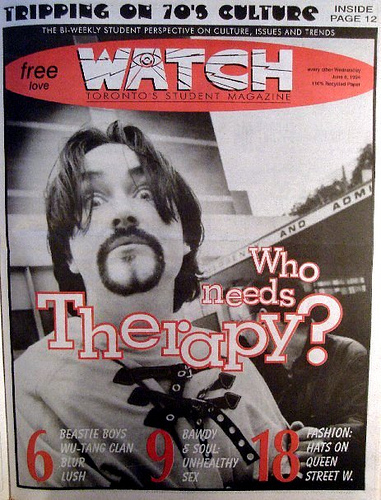
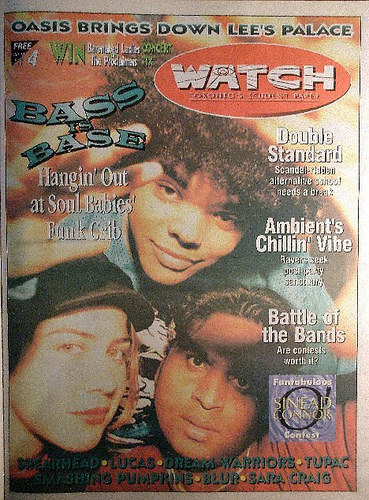
Watch Magazine (Toronto, Canada), October 12, 1994
Preparing to invade Lee’s Palace October 19, supersonically hyped English pop fivesome Oasis have a lot to live up to. The Manchester-based band have experienced a tsunami of media hype reminiscent of The Sex Pistols or The Beatles.
A triple slam of three hit singles in three months – Supersonic, Shakermaker, Live Forevever – and four sold out UK tours preceded their first album, Definitely Maybe. But this clever English pop formula faces its biggest challenge: North America.
The band has developed in less than a year, a reputation for being a ferry-disturbing, hotel-trashing, media-slagging, earth-shattering, shit-disturbing, ego-boosting, self-absorbed, tune-churning, attention-grabbing machine.
And what does an Oasis album sound like?
After you’ve heard all the hype and b.s., approaching 11-track Definitely Maybe should be a disappointing experience. It’s not. The album is craftily tight, with every song great. These guys left the crap at home – a lesson for other bands.
Singer Liam Gallagher’s voice isn’t polished, posh or slick. He drags words out, lets his voice crack, he whines. But this is the charm. Brother Noel Gallagher’s lyrics are cheeky, deliberately oblique at times, pragmatic and just simply entertaining. Gone are the 12-point manifestos of other bands, into the trash goes the primary-school poetry.
Noel writes songs that deliberately pay homage to their influences: The Stone Roses, The Jam, The Beatles, The Rolling Stones, The Sex Pistols. But listen closely. Each one is manipulative – you can’t help feeling the rhythm flow. There’s straight chord-bashing, multi-layered jangle guitar, and a lager-laden freight train ripping through the entire album.
Though it is worth mentioning there are five in Oasis – 22-year-old Liam, 27-year-old songwriter and guitarist Noel, guitarist Paul Arthurs, bassist Paul McGuigan, drummer Tony McCarroll – the band has deliberately served up brothers Liam and Noel as willing fodder for the press.
Hailing from the much-maligned north of England – Burnage, South Manchester to be exact – has meant the band has taken buckets of regional bigotry over their Mancunian accents. It seems the London style gestapo will still let good old fashioned English class and regional prejudices get in the way of a solid analysis of Oasis.
Calling up from Austin, Texas, lead singer Liam’s thick Mancunian accent rips through the telephone line in a firestorm of profanity – it’s refreshing.
The band is on a mission to devour all the “crap bands.” And through a little of Liam and Noel’s own version of the power of positive thinking, or to some, bold-faced arrogance, Oasis are going to give the music business an enema like they’ve never seen before.
“Crap bands. That motivates us to be big,” says Liam confidently. “We were pissed off listening to all the daft bands – blagging the kids that this is what it is all about when it’s not. We are there to prove them all wrong. No bullshit, no strings attached – just simple rock n’ roll.”
Are they the vanguard of a new English invasion, or just another crew of hyped-up, trainer traipsing tossers? North America represents a walled fortress that has buffeted repeated attempts to resurrect the Brit-pack musical and cultural invasion of the 60s. The times have changed in the land where hip-hop, country music and heavy metal rule.
The classic British art-school pop formula of acquiring a very cool one-word name, a pile of trendy clothes, some mega-cool posters – and these days a video – falls flat amongst a population more comfortable in sweatpants and a baseball cap.
But Liam disagrees, and points to their appearance at the New Music Conference in New York.
“Packed-out – the crowd was havin’ it. The gigs have been like at home. Because we’re from England they don’t know much about us – they just come and listen to the music, go home and have a good night.
“We are fucking slick, a big machine! But we’ve not been trained. We know our songs are fucking good. We know we’ve got the best songs on the fucking planet. It ain’t just England – we know our kid (Noel) write the best songs in a long, long time. Since the days of Lennon and McCartney. And he’s doing it on his own.”
Liam’s antics, much to the disappointment of Noel, have gotten some major print in England’s tabloid music press, and has lead to a sleazy prose slug-fest between rivals the New Musicial Express and Melody Maker.
There was the ferry fracas, with Liam san Noel being tossed off for fighting and public drunkenness. Or how about being arrested for some serious hotel trashing with Primal Scream and the Verve while on tour in Sweden.
With the media hyping the scrapper reputation, an ugly element has been attracted to their concerts. During an August 9 concert, a fan punched Noel in the eye during Bring it Down, resulting in a mob of 300 stoning the tour bus.
But the band has never been sedate. They got their first record contract by storming a concert and demanding to be allowed to play or they will tear the place down.
“We’re not hype – I laugh at the English press. They’re stupid. They don’t even understand our music. They like it, that’s about it. Then they’ve got to write about me and our kid fighting, bits about trashing the hotel.”
Talking to Oasis, forget about the nice-boys-next-door routine. In fact, forget about every false face pop musicians had to put on in the puritanical 80s, and the politically correct 90s. Oasis not only admit to using drugs, shock of shock, they like it.
“Our mums know about it. I was doing drugs since I was 13. Sniffing gas, sniffing glue, drinking cider, getting off my face.”
They don’t labour themselves with the soul-consuming indie band angst of worry that if they get big they have somehow sold out.
Depending on the day of the week and who you talk to, the brothers either enjoy a healthy creative conflict, or bloody well hate each other. Certainly, the evidence points to the latter, while Liam says otherwise.
There was the time at a South England gig where Noel punched Liam in the face and chased him off stage. But there is the Noel who returned from being a roadie for the Inspiral Carpets and approached the band in 1992 telling them their songs are “shite” and they should let him write the songs and take over.
“Our kid, he’s a bit of a singer, but he knows he can’t sing. He says I can’t write a song. We are both kind of jealous of each other. That’s how I see it anyway. I don’t know. He thinks he’s the only one who really loves music, and his own brother don’t understand it. And I ant to prove to him I mean it a little more than he does – and it freaks him out. He sings totally different – then I get a grip of it and I bite the head off of it.”
It has been Noel’s discipline and raw talent, Liam admits, that pulled Oasis together.
They believe in total commitment to the cause of being the best band in the world.
“There’s a day when you turn around and say, right “Do you want this to be every Tuesday, Thursday night, like a fucking scout club meeting, or do you want it to be real?” If you want it to be real, you’ve got to be here every Monday, Tuesday, Wednesday, Thursday, Friday, Saturday, Sunday – you can’t go out drinkingwith your mates or doing this with your bird. You can’t have a bird if you want to be the biggest band in the world – this is what it’s about. If you don’t like it, piss off, tell us now.”
They gotten a reputation for being a juicy interview for jaded journalists tired of earnest musicians telling of their next charity album, or wanking on about how their music is deep.
The British press have gorged themselves on a love-hate feast of large portions of Oasis.
For Oasis watchers, the landmark article was the April 23 issue this year of NME. Titled The Bruise Brothers, this was the true beginning of the hype machine. The article immediately focuses in on the duelling brothers, barely touching the fact they are a band.
The stage was set for a punch and judy comedy involving the nasty yet lovable Gallagher brothers. Shakespeare couldn’t have written a better play for the press gang to report.
While Liam denies it, there has been talk of a full-blown conspiracy involving Oasis record label Creation and their buddies within the press – an Oasis hype mafia some have called it.
“If someone likes you and your on their label, they are going to talk about you. We’ve done all the shit gigs man. The reason why we are bigis because we are fucking crafty. We’ve done four sell-out tours within the space of four months. What other band does that? – none. We’ve had a single out every month. People are just tripping. There’s no big mafia working us up. If there is, I don’t fucking know it. No one’s told me.
“They just want to build us up as hype and then see if they can knock us down. But they won’t be able to – ’cause we are writing the best songs – we can rip their papers up and wipe our bums with it and throw it in the fucking bin, they can’t do it with us. They can do it with Suede, ’cause Suede let em. If someone stitches me in the paper and I meet them in London or wherever, they get it, I tell them.
“A couple weeks ago we were on the front cover of the NME, Melody Maker – we didn’t even do an interview with the NME. They just sneaked over and got a picture, the picture that was on the cover of the NME was going to be for VOX.
“They got (freelance photographer) Keving Cummings to sell the VOX picture to the NME. Now Kevin Cummings don’t come near us, if he does I’ll slap him, and I’ve told him. He says this is for VOX, and the next fucking day it’s on the front cover of the NME without even an interview with us.
“They can try and have a backlash – we will release Whatever at xmas with proper Beatles styling, which will sell thousands and thousands of fucking copies and put us in the charts.”
When former Jam powerhouse and English pop icon Paul Weller dropped by an Oasis gig, the meeting was blown into the clash of titan egos by the press.
“He comes to the gig because he likes the music. We chilled out with him. You know how the press works, they just build it up. They made out as if Paul Weller walked in our dressing room and our kid fucking snaps at him. He loves Paul Weller. This is bullshit, I’m not having the NME or the Melody Maker deciding what we are. No way, I’m not having it.”
In fact Liam sees Weller on holy ground. “The other two guys in the band were dicks, I don’t care for them at all. Paul Weller was a diamond. He wrote some mega songs. They are bloody selling groceries, trying to get it together.
“Everyone is going they should form the Jam again – no way man. They look like 50-year-old men, them two now. Paul Weller looks like a young lad now. He’s kept it together, why should he go back, go jamming with them again. He’s still young.”
It took just one tour with Primal Scream for Oasis to determine who is the greatest rock n’ roll band alive. Lead singer Bobby Gillespie’s degenerate 70s roadshow follies didn’t impress Liam.
“They ain’t the rock n’ roll band everybody makes them out to be. There’s only three in Primal Scream – the rest are all hiding. A rock n’ roll band to me is about five people who know each other very well, they are all friends. They ain’t the last rock n’ roll band, we are! Fucking idiots, we are! Well we aren’t the last, but we are the rock n’ roll band to date if there is one about – not Primal Scream.
“Plus he (Gillespie) smells and they don’t wash their clothes. They are too rock n’ roll cliche, you know what I mean. I know for a fact lot of these rock n’ roll types look at us and say we aren’t rock n’ roll because we have trainers. So fucking what! It’s not all about winkle pickers, skin-tight pants and long greasy hair. That’s Guns n’ Roses material!”
Note:This was the first article about Oasis in North America. In October, 2007 Liam Gallagher was named one of the ten wittiest Englishmen in history.
A sample of Watch magazine covers from 1994 (Toronto, Canada).
Sloan’s 1994 release, Twice Removed, was called by Chart magazine one of the “Top 50 Canadian Albums of All Time”.
In 1999 I published the first book on Mongolia’s contemporary music scene. Freshly opened up to the wider world, Mongolia’s musicians were leading the way for this youthful, new Asian democracy. By 2020, Mongolian musicians had become a global Internet sensation.
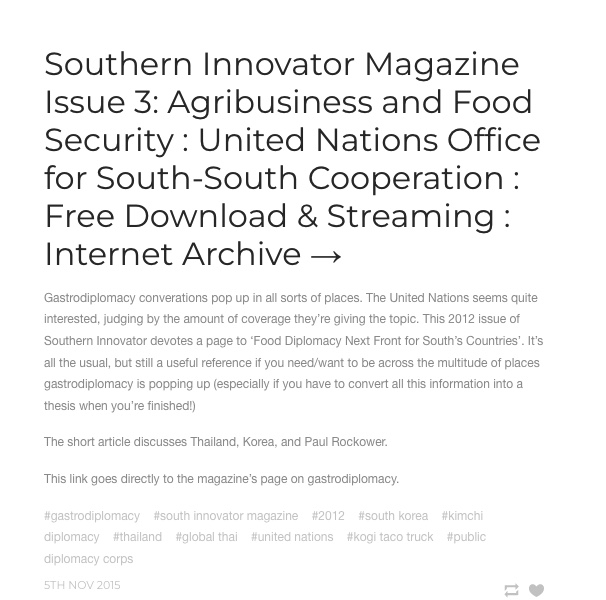
Launched in 2011, Southern Innovator’s first issue on mobile phones and information technology proved highly influential, profiling the work of a new generation of innovators. It has been cited in books, papers and strategic plans. The third issue focused on agribusiness and food security, including the phenomenon of ‘gastrodiplomacy’.
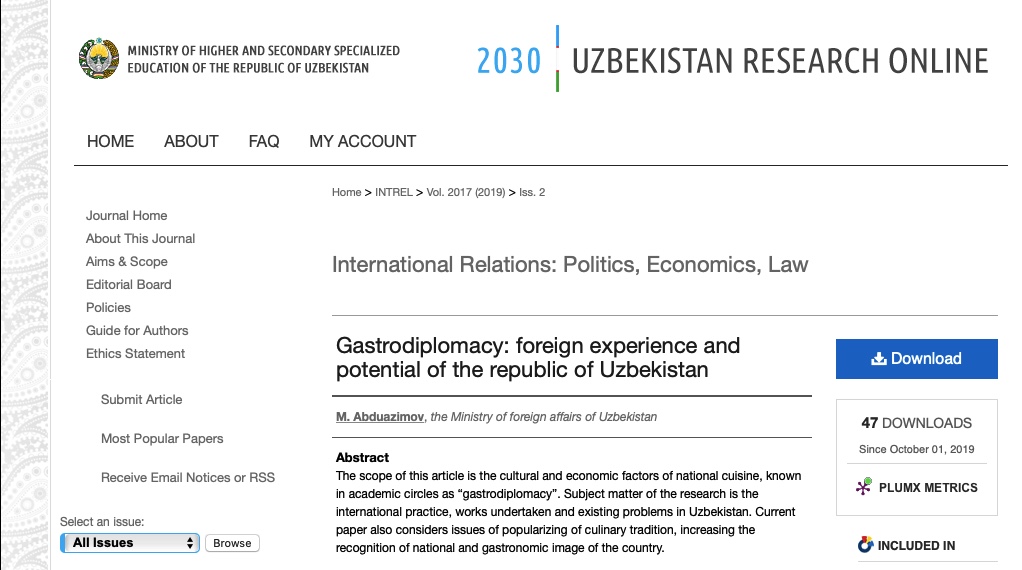
Abduazimov, M. (2017) “Gastrodiplomacy: foreign experience and potential of the republic of Uzbekistan,” International Relations: Politics, Economics, Law: Vol. 2017 : Iss. 2 , Article 2. Available at: https://uzjournals.edu.uz/intrel/vol2017/iss2/2.







































 David South Consulting
You must be logged in to post a comment.