There is no better indicator of significant economic progress than the rise and rise of book festivals across the South. These symbols of intellectually curious and globally aware middle classes are also boosting economies and contributing to a bigger, more sophisticated creative economy – something that will drive future growth across many sectors.
The trend is most advanced in Asia, where according to the OECD, “large numbers of Asians are expected to become middle class in the next 10 years” (OECD Working Paper No. 285). But the rising middle class can also be found across the South – and so can the new book festivals.
According to Sanjoy Roy, managing director of New Delhi-based festival producer Teamwork Productions (www.teamworkfilms.com) ,” India’s rising economic growth has ensured that the great middle class is happy to travel and to spend.”
“More and more Indians are taking to tourism both local and international. India’s large middle-aged upper middle class and wealthy sector feeds occasions like the literature festival, ensuring attendance, making it a word of mouth must-be-seen, must-attend occasion on the social season calendar.”
Recognition of the importance of this trend can be seen in the recent growth in book festivals associated with the Hay Festival (www.hayfestival.com) based in Hay-on-Wye, Wales. There are now Hay festivals in Beirut, Lebanon; Bogota and Cartagena, Colombia; Zacatecas, Mexico; Nairobi, Kenya; the Maldives; and the Indian state of Kerala.
The festivals are part of the powerful global creative economy, which is seen as the “interface between creativity, culture, economics and technology in a contemporary world dominated by images, sounds, texts and symbols” (UNCTAD). The cultural sector has been shown to be an effective way for emerging economies to leapfrog into high-growth areas in the 21st century world economy.
Roy also confirms the economic impact of book festivals. He produces India’s Jaipur Literature Festival (www.jaipurliteraturefestival.org) , which attracted over 32,000 visitors this year. The hard numbers show the economic impact of the event: “Approximately 3,000 room nights were booked by visitors during this period at an average of US $100 per night,” Roy said. “Our own spend in Jaipur during this period was approximately US $500,000. Shopping, meals and transport spend I would peg at between US $200,000 and US $300,000.”
The OECD defines the global middle class as those living in households with daily per capita incomes of between US$10 and US$100. It calculates that Asia accounts for less than one-quarter of today’s middle class, but says that share could double by 2020. Within a decade, “more than half of the world’s middle class could be in Asia and Asian consumers could account for over 40 per cent of global middle class consumption.”
The World Bank takes an even more optimistic view, seeing this burgeoning middle class’ spending power as being triggered once people get out of the desperation of a subsistence existence. This means the “developing world’s middle class is defined as those who are not poor when judged by the median poverty line of developing countries, but are still poor by US standards. The “Western middle class” is defined as those who are not poor by US standards.” Although barely 80 million people in the developing world entered the Western middle class over 1990-2002, it found an extra 1.2 billion people joined the developing world’s middle class. Four-fifths came from Asia, and half from China (World Bank).
With the rise of the creative sector, significant innovation will come from the global South, according to the director of the Hay Festival, Peter Florence.
“The digital revolution will be absolutely essential to developing countries,” he told the Associated Press. “They are going to skip two levels of publishing industry tradition. The mobile phone is more important for writers in those societies than pen and paper is. That is a very interesting continuation of oral culture. At the same time the West has decided to start moving from audio editions to digital downloads, oral culture is just moving straight into digital culture in many places around the world.”
The impact of a growing middle class can be seen in fast-growing India, which is forecast to become the largest market for English language books within a decade.
A survey by Tehelka (www.tehelka.com) found Indians favour stories about local conditions and set in the places where they live.
India’s most popular current writer is Chetan Bhagat, a former investment banker. He has sold more than 3 million books in the last five years. His latest, Two States, sold a million copies in four months.
Bhagat writes about the country’s aspiring middle class. His publisher, Rupa (www.rupapublications.com/Client/home.aspx) , believes he appeals to a “pan-Indian, pan-age group.”
For Roy, it is still too early to tell how the new Hay Kerala festival in the state capital, Thiruvananthapuram, will affect the economy of the area (the first one is from November 12 to 14, 2010).
“In the long term we hope this too becomes like Jaipur, attracting an international and national audience from outside the state,” he said. “Kerala has a robust economy. What it may do is increase the total tourist influx into the city and divert some of the annual Goa traffic to its own benefit.”
Roy says the Hay Festival Kerala will follow the programming pattern of other Hay festivals, combining international authors with a strong local flavour.
“India is celebrating its golden age in the creative arts and literature not just in English but across all official and subsidiary Indian languages,” he said. “The depth, scope, extent and range of writing in both fiction and non-fiction is incredible.”
Drawing on his success with the festival in Jaipur, Roy has advice for others in the South looking for creative economy success.
“It’s all about location, location, location,” he said. “A festival city like that of Cannes, Venice, Edinburgh, Avignon, Hay are special. Choose the right location, be inclusive and bring the local community on board and have the power to sustain – and in due course with a strong programming base, the festival will grow.
“Every festival will have its own learning (curve) and those who take these on board will find it easier to be successful.”
Published: June 2010
Resources
Thirsty-Fish: Story and Strategy: A consultancy that helps businesses build their brands based on age-old practices of storytelling. Website: www.thirsty-fish.com
Operating since 2006, the Singapore International Story Telling Festival has competitions, readings and seminars. Website:http://www.bookcouncil.sg/sisf/
The basics of story telling are answered in this webpage. Website:www.timsheppard.co.uk
Creative Economy Report 2008. An economic and statistical assessment of creative industries world-wide as well as an overview of how developing countries can benefit from trade in creative products and services, produced by UNCTAD and the Special Unit for South-South Cooperation in UNDP. Website:http://www.unctad.org/en/docs/ditc20082cer_en.pdf
Campaign for Education: Since the campaign started in 1999, 40 million more children have been able to access school. Website:http://www.campaignforeducation.org/
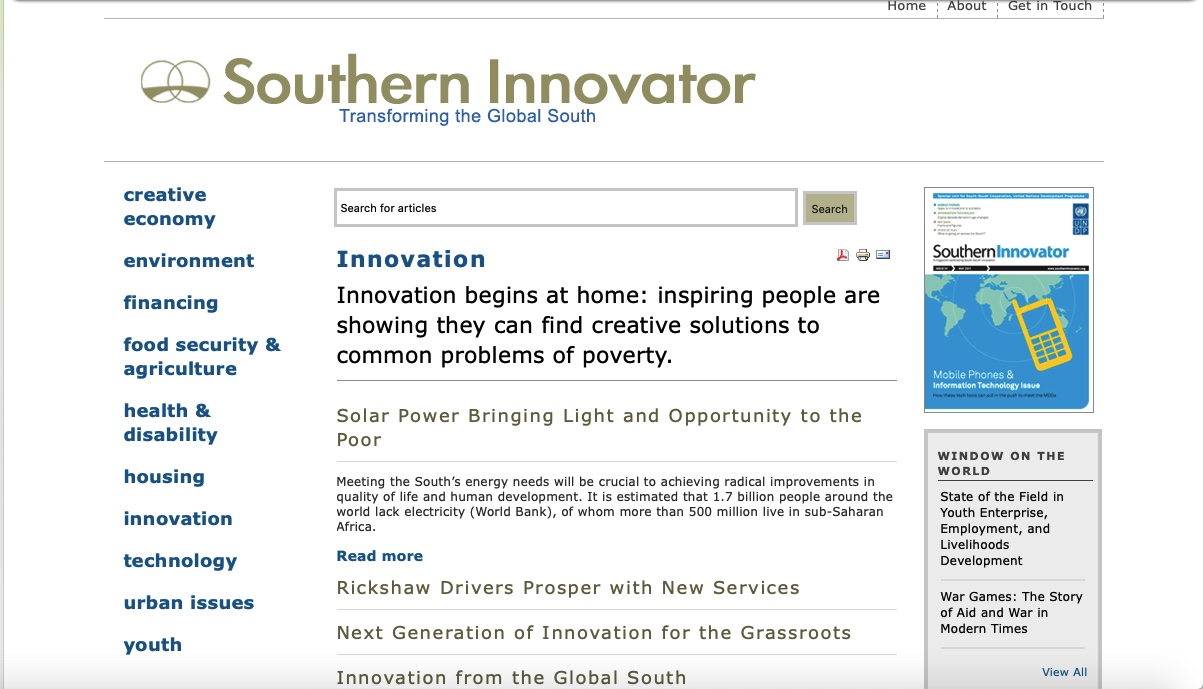
Development Challenges, South-South Solutions was launched as an e-newsletter in 2006 by UNDP’s South-South Cooperation Unit (now the United Nations Office for South-South Cooperation) based in New York, USA. It led on profiling the rise of the global South as an economic powerhouse and was one of the first regular publications to champion the global South’s innovators, entrepreneurs, and pioneers. It tracked the key trends that are now so profoundly reshaping how development is seen and done. This includes the rapid take-up of mobile phones and information technology in the global South (as profiled in the first issue of magazine Southern Innovator), the move to becoming a majority urban world, a growing global innovator culture, and the plethora of solutions being developed in the global South to tackle its problems and improve living conditions and boost human development. The success of the e-newsletter led to the launch of the magazine Southern Innovator.
The fast-changing modern world is raising the living standards of billions in the South – China alone has lifted 400 million people out of poverty since the 1980s – but it is also risking the loss of many rich cultural traditions. One of them is storytelling.
Oral storytelling is a critical tool for passing on history, while teaching morals and ethics, especially in societies with low rates of literacy and little formal education. But with the rise of modern media and advertising, few traditional storytellers – many of whom are old – stand a chance. Populations are on the move like never before. As more and more people end up in sprawling cities, many are becoming disconnected from their roots.
Yet across the South, people are finding ways to re-invent story telling — and also to make money, preserve cultural pride and feed the appetite for novelty in hungry, modern media and business.
In 1997, storytelling was acknowledged by UNESCO, which pledged to back humanity’s oral and immaterial heritage, and to protect a vast number of oral and musical traditions, crafts and knowledge – plus the “living human treasures” who possess them. It backed this up in 2003 with the Convention for the Safeguarding of Intangible Cultural Heritage. It supports storytelling through its International Programme for the Development of Communication.
But what about the young – the most important generation for storytelling to have a future? In Bogota, Colombia, students have started a movement of urban storytellers. Aged between 17 and 35, they draw on the things they have learned in university. They eschew linear narration and instead adopt the popular language of films and advertising. Inspired by one television commercial, a story revolves around a drop of tomato sauce falling from a high-rise building, sparking a gun battle. The staccato narrative takes inspiration from post-modern authors like Italo Calvino. It is also the perfect narrative to capture modern, urban audiences who live in a world saturated with media.
By blending together ancestral and post-modern tales, these student storytellers are luring Latin Americans back to listening to stories. Live storytelling, when done well, has an ability to connect with other people like no other medium. This new generation also is helping make Colombia a gathering place for storytellers in Latin America, expressed in events like the Hay Festival Cartegena, a literary event that draws authors from around the world.
But is there any money in storytelling? Tale-spinners like Argentinian Juan Moreno say yes. Moreno quit teaching 17 years ago to tell stories for money in theatres, bars, universities and libraries, tapping into a contemporary marketplace for storytelling.
In fact, it is better paid than acting in the theatre, he claims, and if you are good, it comes with lots of travel. There is a global round of congresses, festivals and seminars to keep storytellers connected, inspired – and paid.
Moreno now makes money teaching many professions how to use stories to be more powerful communicators. He told the UNESCO Courier, “the value of the spoken word, words that heal and restore, that can give life but also take it away,” are key to many fields, like law and social work.
The world centres of storytelling are very much focused on the South. The International Congress of Oral Storytelling, part of the Buenos Aires Book Fair, has been running every year since 1995. At the Congress, tips are exchanged over the subtle tricks of timing and voice, gestures and facial expressions. Other Southern cities with storytelling events, include Bucaramanga, Colombia, Monterrey, Mexico and Agüimes, in the Canary Islands.
While young people are breathing new life into storytelling, Morocco’s legendary storytellers have been facing a common dilemma seen across the developing and developed world: how can they compete with flashier and more distracting pastimes like computer games and TV?
Illiteracy in Morocco affects 40 per cent of the population, so telling stories is an excellent way to reach this non-reading group. Stories and parables have long been seen as a great way to convey ideas, values and philosophies.
But Morocco’s storytelling sages, or halakis, are using their heads and turning to computers to get their stories told, and prevent their thousand-year tradition from dying out. With the help of UNESCO, the halakis have created a digital archive of their stories in audio and video.
Based in Marrakesh’s famous main square, Jemaa al-Fna, they compete in a hury burly of street entertainers and aromatic foods; it is a place where men with monkeys vie with snake charmers for your attention. Morocco’s storytellers would set up in the public squares of the cities of Fes, Meknes and Marrakesh to entertain crowds and educate about morality. These would include the ethical values of kindness, honour and chivalry. But Marrakesh is now the only place where a half dozen old men (there used to be 20 in Marrakesh) still practice this ancient art form.
UNESCO declared the square in 2001 part of the world’s “Oral and Intangible Heritage of Humanity.” Video recorders have been documenting the storytellers and chronicling them on the internet.
Spanish writer Juan Goytisolo, who spends part of his year in Marrakesh, has championed the halakis in his book, Marrakesh Tales, and in bringing UNESCO in to help them. He has defended their corner against the plans of city planners and developers.
Seventy-one-year-old Moulay Mohammed is blunt about the current state of storytelling: “Young Moroccans would rather watch TV soap operas than listen to a storyteller, much less become one themselves,” he told the BBC. Mohammed’s stock-in-trade is the Old Testament and all of A Thousand and One Nights: both tales of sultans, thieves, wise men and fools, mystics, genies, viziers and belly dancers. And he has been telling these tales for 45 years.
In South Africa, digital technology is also breathing new life into storytelling – and infusing the stories with urgent, contemporary issues like HIV, and domestic and sexual violence. South African women are using digital technology to preserve traditional storytelling: A collection of 15 digital stories – called “I Have Listened, I Have Heard” – made in 2006 are being distributed along with books. They assembled the stories using audio recorders and made movies of the readings with digital cameras. It was funded by the Foundation for Human Rights and made at the Women’s Net Computer Training Centre in Johannesburg.
The storytellers worked together on each script, taking a day. They would tell the group a story focusing on particular experiences or meaningful moments in their lives. The group would comment and draw out the best bits of the story. The whole process helps the story teller to flesh out the story with metaphors, narrative techniques and milestones.
International Congress of Oral Storytelling: Held from 2-4 May 2008 in Buenos Aires, Argentina. Website: www.el-libro.org.ar
Folk Tales: Online project where Pakistani students and their teachers share folklore and fables with students around the world. Website:www.edutopia.org
Thirsty-Fish: Story and Strategy: A consultancy that helps businesses build their brands based on age-old practices of storytelling. Website:www.thirsty-fish.com
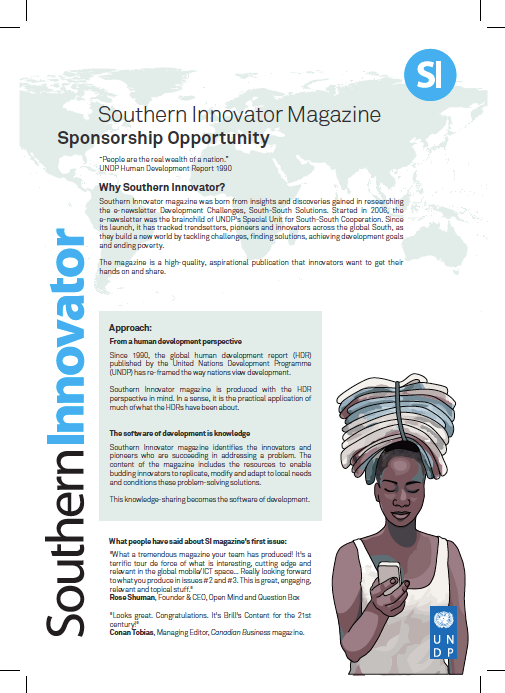
“I think you [David South] and the designer [Solveig Rolfsdottir] do great work and I enjoy Southern Innovator very much!” Ines Tofalo, Programme Specialist, United Nations Office for South-South Cooperation
NEW: A new design template has been launched for the e-newsletter (see below). The Southern Innovator website archive of Development Challenges stories is also now online: southerninnovator.org
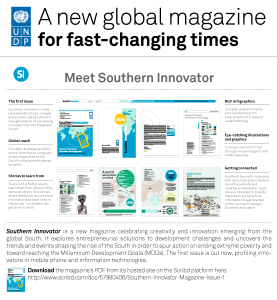
New magazine Southern Innovator has launched: Read and download the magazine here: Southern Innovator Issue 1
December
Mapping to Protect Kenya’s Environment: the eMazingira SolutionDevelopment Challenges: Powerful new grassroots crowd-mapping tools have sprung up in the past few years across the global South, from Brazil’s Wikicrimes (www.wikicrimes.org) real-time crime mapping technology to the now famous Ushahidi (http://ushahidi.com) – a non-profit company making the free and open source Ushahidi software for information collection, visualization and interactive mapping – from its base in Kenya. They share some common features. All draw on the widespread use of mobile phones in the global South combined with growing access to the Internet, either through 3G mobile phone services, WiFi wireless connections, Internet centres or increasingly available broadband Internet services.
Building an Interactive Radio Network for Farmers in NigeriaDevelopment Challenges: As solar power technology has improved, new pioneers have emerged to exploit this innovation. Several decades ago, solar power was seen as too expensive for wide-scale roll out in poor countries and communities. But today, an army of solar technology pioneers has fanned out across the world to show the new wave of innovations and how they make solar power affordable.
African Manufacturing Pioneers Proving it is Possible to ThriveDevelopment Challenges: Africa’s paradox is that it is home to the greatest share of the world’s unexploited resources, yet has some of the world’s lowest per capita incomes. History has shown that exploiting the continent’s resources alone for export markets does little to improve incomes and living conditions in Africa, which in turn does nothing to improve human development. The key to resolving this paradox is made-in-Africa jobs, in particular high-value jobs that make products.
Indian City Slum Areas Become Newly Desirable Places to LiveDevelopment Challenges: With India’s urban economy experiencing rapid growth, its slums – once seen as the most undesirable places to live in the country, if not on Earth – are attracting the attention of affluent residents and developers in India’s rapidly expanding cities. The prosperity in India’s cities has made these areas’ proximity to business and entertainment zones highly desirable. In turn, this has led to slum dwellers either upgrading their homes and in the process boosting their value, or being offered the opportunity to sell their rudimentary dwellings to real estate agents and property developers.
November
New African Film Proving Power of Creative EconomyDevelopment Challenges: A new movie is generating excitement around life in the war-torn, chaotic and impoverished Democratic Republic of the Congo (http://en.wikipedia.org/wiki/Democratic_Republic_of_the_Congo) – the central African nation – and proving how versatile and resilient a creative economy can be in a crisis.
Recycling Waste to Boost Incomes and Opportunities Development Challenges: We all know that green is good, but often the best way to encourage recycling and other environment-improving activities is to put in place economic incentives. It is one thing to admonish people and tell them something is the right thing to do; it is another to make keeping a clean environment pay.
Virtual Supermarket Shopping Takes off in China Development Challenges: An ingenious use of technological innovation and savvy trend-spotting is radically transforming the way people do their grocery shopping in China. Busy urban dwellers with time-poor lifestyles can now do their grocery shopping as they pass through Shanghai’s subway system and have their weekly shopping delivered to their home.
Bolivia Grabs World Media Attention with Salt Hotel Development Challenges: Tourism is a great way to attract foreign currency to a country and build local economies, especially in remote or isolated places. But the catch is finding a way to get people to go the distance and come and visit and spend their money.
October
Indian Mobile Phone Application Innovators Empower Citizens Development Challenges: With mobile phones becoming ubiquitous across the global South, the opportunity to make money – and possible fortunes – by providing ‘apps’ for these devices is now a reality.
Mapping Beirut Brings City to LightDevelopment Challenges: As cities in the global South grow ever larger, their often-chaotic evolution can create sprawling urban mazes that would confuse even the brightest brains.
Putting Quality and Design at the Centre of Chinese FashionDevelopment Challenges: Awareness of the sourcing of materials for fashion has been on the rise in the past decade. Concerns about how the global fashion industry functions and its impact on the environment have given rise to savvy retailers who take care over the sourcing of their materials and the working conditions of their employees.
Cheap Indian Tablet Seeks to Bridge Digital Divide Development Challenges:India has had many false starts in innovating in information technology. While the country and its talented army of software engineers have a global reputation for innovation, the fits and starts that have accompanied attempts to create new hardware and devices have drawn a range of emotions, from amusement to frustration.
September
Filipino Architect wants to Transform Slum with New PlanDevelopment Challenges: A clash is occurring across the global South over the future of urban planning and the ever-growing slums of the world’s megacities. This will be a decisive clash of visions: should cities flatten slums and relocate their residents, or work with slum dwellers, acknowledge the role they play in city economies and improve their lives with better dwellings?
Model City to Test the New Urbanism Concept in IndiaDevelopment Challenges: India’s phenomenal economic growth rate – forecast to be 7.9 percent this year by the Asian Development Bank, after averaging 7.7 percent per year over the past decade – has been the force behind an expanding middle class population, now estimated at 50 million people (McKinsey). Forecasts see it swelling from 5 percent of the population to 40 percent by 2025.
Pulque: Aztec Drink Ferments New EconomyDevelopment Challenges:Reviving traditional foods and drinks can be an income-boosting source of new economic activity. Many cultures can benefit from looking again at their rich traditions to find new ways to increase enterprise. This can be difficult at first. Big global brands have many initial advantages: they are backed by wealthy and experienced international companies and can deploy aggressive marketing and distribution power to get products into the hands of consumers. The power of Coca Cola to reach all corners of the earth is legendary.
Ghana: Oil-rich City Sparks Entrepreneurs and DebateDevelopment Challenges: Commodity booms can seem like the answer to a poor nation’s prayers, a way to fulfil all their development dreams and goals. The reality, however, is far more complex. More often than not, the discovery of resources sparks a mad scramble for profits and patronage, as politicians and politically connected elites carve out their slice of the new resource boom before anyone else.
August
Anti-bribery Website in India Inspires Others Development Challenges: An Indian website tackling corruption has been so successful it has inspired a wave of followers in China. The I Paid a Bribe website – motto: “Uncover the Market Price of Corruption” – was set up by the Janaagraha Centre for Citizenship and Democracy (www.janaagraha.org), a non-profit organisation based in Bangalore, India.
Turning African Youth on to TechnologyDevelopment Challenges: An African NGO believes the Internet is the single biggest key to rapid development in Africa – and it is working to connect youth, women and rural populations to the web, and in turn, switch them on to the vast resources stored across the world’s Internet sites.
Pakistan Simplifies Job-matching ServicesDevelopment Challenges: An innovative job-matching service from Pakistan is trying to bring together people who normally live separate lives. It is eliminating the middlemen who gouge both employers and employees for job-seeking fees and opening up a new world of opportunities for the poor.
Data Surge across Global South Promises to Re-shape the Internet Development Challenges: The deluge of data gathered by the digital revolution underway in the global South continues to offer a significant economic opportunity. How this data is harvested will forge the successful Internet business models of the future.
July
Bringing the Invention and Innovation Mindset to Young Kenyans Development Challenges: A highly innovative new way to teach the basics of electronics, computing and technological innovation is being pioneered in the slums of Nairobi, Kenya. Driven by the desire to counter perceptions of apathy among young people, NGO Kuweni Serious is running a training course for girls aged over 8 years in some of the poorest parts of the city to turn on a new generation to the power of technology to make change.
Arab World Domain Name Opportunity Huge Economic HelpDevelopment Challenges: With the so-called Arab Spring still unfolding across much of the Arabic-speaking world, it is easy to miss a rising new economic opportunity: The introduction of an Arabic domain name system for the Internet.
African Youth Want to do Business in Fast-growing Economy Development Challenges: Africa’s growing economy is meeting head-on an optimistic young population keen to start businesses. At least that is what a new poll of African youth says, finding that one in five Africans between the ages of 15 and 24 without a current business wants to start one in the next 12 months.
Kenyan Safari Begins Minutes from AirportDevelopment Challenges: Many people find the prospect of staying in airport hotels dreary at best. They tend to be located in industrial parts of cities or far from city centres. They can be surrounded by roads and highways and are built to move lots of people, not to look nice. The surrounding areas can be very common to all nations – warehouses, office parks, nondescript restaurants and hotels – and give few clues to where you are apart from the weather and the languages on the sign boards.
June
Brazilian Restaurant Serves Amazonian TreatsDevelopment Challenges: The vast Amazon rainforest has inspired a cuisine pioneer in Brazil. Combining the sensual pleasures of fine dining and the joy of tasting new flavours with a pursuit of sustainable and profitable local farming, a chef is inventing a new Brazilian cuisine and showing the way to create sustainable incomes.
Civet Cat Coffee Brews Filipino OpportunityDevelopment Challenges: In the Philippines, one animal’s call of nature has become a business opportunity.The civet cat, a member of the mongoose family, ingests the fruit of coffee plants, and expels the beans. This has created an unexpected by-product – a prized beverage for the world’s savvy coffee drinkers seeking the next taste sensation. The partially digested coffee beans are gathered from the faeces of the cat and used to make a much-coveted, smooth-flavoured cup of coffee.
Indonesia Best for EntrepreneursDevelopment Challenges: A global survey has unearthed hotspots across the global South for start-up businesses and private enterprise. It shows there are now many places in the South where people are actively encouraged to start businesses and engage in innovation and enterprise. The top place in the world for entrepreneurship, according to the survey for the British Broadcasting Corporation (BBC), is Indonesia.
The e-Reader Battle Reaches IndiaDevelopment Challenges: The rise and rise of e-books and electronic publishing has prompted the development of e-readers: handy, portable devices that try to mimic the reading experience of paper books while offering the storage and navigation capability of computers.
May
African Botanicals to be used to Boost Fight against Parasites Development Challenges: More than 1 billion people in the developing world currently suffer from tropical diseases, which leave a trail of disfigurement, disability and even death. Yet only 16 out of 1,393 – 0.01 percent – of new medicines marketed between 1975 and 1999 targeted tropical diseases (International Journal of Public Health).
Floating Bank Floats New Dreams for Brazilian Middle Class Development Challenges: Brazil’s booming economy has seen a dramatic increase in the size of its middle class. More and more people have been lifted out of poverty as a growing, stable economy overcomes years of political and economic instability. In 2010, Brazil’s economy grew by a record 7.5 percent, surpassing a previous peak in 1986 (Brazilian Institute of Geography and Statistics) (IBGE) (www.ibge.gov.br/english). The country’s gross domestic product (GDP) reached 3.67 trillion reais (US $2.21 trillion) in 2010, making it Latin America’s largest economy.
Indonesian Food Company Helps Itself by Making Farmers More Efficient Development Challenges: The current global economic crisis is taking place at the same time as a global food crisis. Food inflation took off at the beginning of 2011. This is having a devastating affect on countries dependent on food imports and experiencing decreasing domestic production capabilities. The least developed countries (LDCs) saw food imports rise from US $9 billion in 2002, to US $23 billion by 2008 (UNCTAD), prompting Supachai Panitchpakdi, secretary general of UNCTAD, to say “the import dependence has become quite devastating.”
Indian Toilet Pioneer Champions Good Ideas Development Challenges:Access to adequate sanitation and toilet facilities is critical to making development gains. Yet this simple fact of life often gets overlooked, especially in fast-growing cities where populations are on the rise or in transit. Out of an estimated 2.6 billion people in the world without toilets, two-thirds are in southern and eastern Asia (World Toilet Organization).
April
Solar Sisters Doing it for Themselves: Tackling African Light Famine Development Challenges: A social enterprise is seeking to capture the power of the sun to bring light and economic opportunity to women in Africa. Using a direct-marketing distribution system, it sells solar lamps and lanterns to some of Africa’s remotest communities. Solar Sister (www.solarsister.org), launched in Uganda in 2010, is hoping to do for power generation what mobile phones have done for communication in Africa: make a technological leap to a model of grassroots power generation, rather than waiting for large-scale power schemes to eventually reach the poor and rural.
South Africa Innovates Healthcare with Prepay Phone Vouchers Development Challenges: Pioneers in Africa are experimenting with new ways to fund the delivery of healthcare that is affordable and sustainable and not dependent on foreign aid and donations. A South African company is prototyping the selling of pre-payment healthcare services through mobile phones with a range of vouchers that can be bought and downloaded at the tap of a keypad.
Indian ID Project is Foundation for Future Economic Progress Development Challenges: India is in the midst of the biggest national identification project in the country’s history. The aim is for every Indian to receive a voluntaryelectronic identification card containing his or her details and a unique number. Called an Aadhaar, it is a 12-digit unique number registered with the Unique Identification Authority of India (http://uidai.gov.in) (UIDAI). The project joins a growing trend across the global South to map populations in order to better achieve development goals.
Ghana’s Funeral Economy Innovates and Exports Development Challenges: The West African nation of Ghana’s funeral economy is attracting innovation and grabbing attention outside the country. The nation’s elaborate – but expensive – funeral rituals provide craftsmen with a good income. And new products are being introduced to handle the financial consequences of this unavoidable fact of life.
March
Bolivian Film School’s Film Scene Paying Off Development Challenges: A film school in Bolivia shows how a creative hub can become the start of something much bigger. The school is inspiring a new generation of young people to get into filmmaking. And one of its lecturers is already experiencing global success acting in an award-winning new Spanish film.
Happy Nigeria: West African Nation Has Good Attitude Development Challenges: In the last 10 years, an increasing amount of attention has been paid to the concept of national happiness. The notion was first developed in the tiny Asian Kingdom of Bhutan (http://en.wikipedia.org/wiki/Bhutan), whose advocacy of ‘gross national happiness’ (http://www.grossnationalhappiness.com/) as a measure of national achievement just as important as Gross National Product (GNP), has been met with equal parts ridicule, respect and research.
Cambodian Bloggers Champion New, Open Ways Development Challenges: The Southeast Asian nation of Cambodia has had a very difficult history over the past few decades. In the 1950s and 1960s, it was seen as a glamorous and vibrant place. Dynamic, ambitious and newly independent from French colonial rule, Cambodia embarked on an extensive programme of building that is now called “New Khmer Architecture.” It is the most visible legacy of this modernizing time.
China Consumer Market: Asian Perspective HelpsDevelopment Challenges:The rise of China since 1989 has been the most remarkable development story of our times. The number of people lifted out of poverty is historically unprecedented: 65 percent of Chinese people lived below the poverty line in 1981; in 2007 it was 4 percent (World Bank).
February
Disaster Recovery, Ten Years After: The Gujarat, India Experience Development Challenges: In the past decade, there have been many devastating natural disasters, from Iran’s 2003 Bam earthquake and the Asian tsunami of 2004 to Hurricane Katrina in the United States in 2005 and the earthquakes in Chile and Haiti in 2010. All of these events received extensive media attention and drew a large aid response. Those who track natural disasters have noticed a serious increase in frequency over the past decade (http://www.marketoracle.co.uk/Article26290.html).
Chilean Eco-Buildings Pioneering Construction MethodsDevelopment Challenges: Across the global South, the search is on for new ways to build without extracting a high price from local environments.More and more people are recognizing the advantages of energy-saving methods like prefabrication. Prefab building techniques involve assembling a structure from pre-assembled parts or modules made in a factory, or transporting a completed, factory-made structure to a site (http://en.wikipedia.org/wiki/Prefabricated_building).
Model Cities Across the South Challenge Old WaysDevelopment Challenges: Pioneering thinking about how resources are used and how people live their lives is taking place in the dynamic economies of the global South. Facing a vast population surge to urban areas, these include attempts to build “green” cities and low-waste, smart and digital communities.
Indian Newspapers Thrive with Economy Development Challenges: The onslaught of digital media in the developed countries of the world regularly brings pronouncements of the death of the traditional newspaper. But this assumption of digital triumph misses out on the reality in countries across the global South.
Extra story: 2011 Trends for the South Development Challenges: The world has been through a dramatic and fascinating period since the global economic crisis erupted in 2008. While the wealthy, developed nations of the North have been pitched into one crisis after another, the countries of the global South (many of whom are well accustomed to crises) have been part of a powerful new economic phenomenon: the rapid growth of South-South trade, investment and exchange. Its effects include stronger ties between Asia and South America and between China and Africa.
Africa’s Consumer Market in Spotlight for 2011Development Challenges:While other parts of the world will spend 2011 worrying about their debt levels and how to spur economic growth, many factors are pointing to Africa potentially following a different story. A frenzy of activity has been building around Africa’s market opportunities and its growing middle class consumer population.
China’s Booming Wine Market Can Boost SouthDevelopment Challenges: A great South-South opportunity has emerged with the recent boom in wine drinking in China and the pursuit of quality tastes. Matching high-quality wine producers from the global South – including South Africa, Chile, Morocco, and Lebanon – with China’s thirsty wine drinkers could deliver a major income boost.
Food Inflation: Ways to Fight ItDevelopment Challenges: Food inflation has taken off at the beginning of 2011. As the global economic crisis enters its next phase, both developed and developing countries are experiencing inflation. There are many factors fuelling the rise in prices – inefficient distribution and storage systems, lack of investment in agriculture, devaluing currencies, high demand, natural and man-made disasters, use of food products like corn to make biofuels – but there are also ways to counter the effects of food inflation that have been tried and tested across the South.
Turning Animal Waste Into PaperDevelopment Challenges: Animal waste is a messy fact of daily life in rural communities across the global South. This byproduct of life has many uses – but an ingredient for making writing paper is probably not the first that springs to mind.
Development Challenges, South-South Solutions was launched as an e-newsletter in 2006 by UNDP’s South-South Cooperation Unit (now the United Nations Office for South-South Cooperation) based in New York, USA. It led on profiling the rise of the global South as an economic powerhouse and was one of the first regular publications to champion the global South’s innovators, entrepreneurs, and pioneers. It tracked the key trends that are now so profoundly reshaping how development is seen and done. This includes the rapid take-up of mobile phones and information technology in the global South (as profiled in the first issue of magazine Southern Innovator), the move to becoming a majority urban world, a growing global innovator culture, and the plethora of solutions being developed in the global South to tackle its problems and improve living conditions and boost human development. The success of the e-newsletter led to the launch of the magazine Southern Innovator.







 David South Consulting

You must be logged in to post a comment.