Tag: start-ups

  • Oasis Has Arrogance, A Pile Of Attitude And The Best Album Of 1994

    Oasis Has Arrogance, A Pile Of Attitude And The Best Album Of 1994

    “You Can’t Have A Bird If You Want To Be The Biggest Band In The World”

    By David South

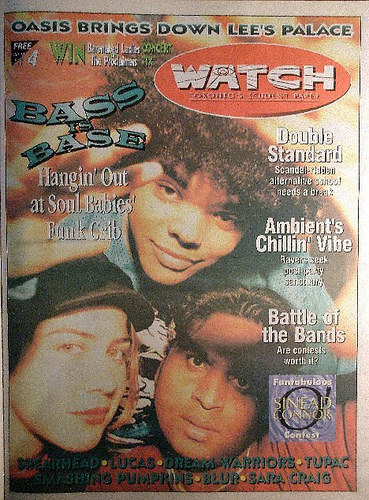
    Watch Magazine (Toronto, Canada), October 12, 1994

    Preparing to invade Lee’s Palace October 19, supersonically hyped English pop fivesome Oasis have a lot to live up to. The Manchester-based band have experienced a tsunami of media hype reminiscent of The Sex Pistols or The Beatles.

    A triple slam of three hit singles in three months – Supersonic, Shakermaker, Live Forevever – and four sold out UK tours preceded their first album, Definitely Maybe. But this clever English pop formula faces its biggest challenge: North America.

    The band has developed in less than a year, a reputation for being a ferry-disturbing, hotel-trashing, media-slagging, earth-shattering, shit-disturbing, ego-boosting, self-absorbed, tune-churning, attention-grabbing machine.

    And what does an Oasis album sound like?

    After you’ve heard all the hype and b.s., approaching 11-track Definitely Maybe should be a disappointing experience. It’s not. The album is craftily tight, with every song great. These guys left the crap at home – a lesson for other bands.

    Singer Liam Gallagher’s voice isn’t polished, posh or slick. He drags words out, lets his voice crack, he whines. But this is the charm. Brother Noel Gallagher’s lyrics are cheeky, deliberately oblique at times, pragmatic and just simply entertaining. Gone are the 12-point manifestos of other bands, into the trash goes the primary-school poetry.

    Noel writes songs that deliberately pay homage to their influences: The Stone Roses, The Jam, The Beatles, The Rolling Stones, The Sex Pistols. But listen closely. Each one is manipulative – you can’t help feeling the rhythm flow. There’s straight chord-bashing, multi-layered jangle guitar, and a lager-laden freight train ripping through the entire album.

    Though it is worth mentioning there are five in Oasis – 22-year-old Liam, 27-year-old songwriter and guitarist Noel, guitarist Paul Arthurs, bassist Paul McGuigan, drummer Tony McCarroll – the band has deliberately served up brothers Liam and Noel as willing fodder for the press.

    Hailing from the much-maligned north of England – Burnage, South Manchester to be exact – has meant the band has taken buckets of regional bigotry over their Mancunian accents. It seems the London style gestapo will still let good old fashioned English class and regional prejudices get in the way of a solid analysis of Oasis.

    Calling up from Austin, Texas, lead singer Liam’s thick Mancunian accent rips through the telephone line in a firestorm of profanity – it’s refreshing.

    The band is on a mission to devour all the “crap bands.” And through a little of Liam and Noel’s own version of the power of positive thinking, or to some, bold-faced arrogance, Oasis are going to give the music business an enema like they’ve never seen before.

    “Crap bands. That motivates us to be big,” says Liam confidently. “We were pissed off listening to all the daft bands – blagging the kids that this is what it is all about when it’s not. We are there to prove them all wrong. No bullshit, no strings attached – just simple rock n’ roll.”

    Are they the vanguard of a new English invasion, or just another crew of hyped-up, trainer traipsing tossers? North America represents a walled fortress that has buffeted repeated attempts to resurrect the Brit-pack musical and cultural invasion of the 60s. The times have changed in the land where hip-hop, country music and heavy metal rule.

    The classic British art-school pop formula of acquiring a very cool one-word name, a pile of trendy clothes, some mega-cool posters – and these days a video – falls flat amongst a population more comfortable in sweatpants and a baseball cap.

    But Liam disagrees, and points to their appearance at the New Music Conference in New York.

    “Packed-out – the crowd was havin’ it. The gigs have been like at home. Because we’re from England they don’t know much about us – they just come and listen to the music, go home and have a good night.

    “We are fucking slick, a big machine! But we’ve not been trained. We know our songs are fucking good. We know we’ve got the best songs on the fucking planet. It ain’t just England – we know our kid (Noel) write the best songs in a long, long time. Since the days of Lennon and McCartney. And he’s doing it on his own.”

    Liam’s antics, much to the disappointment of Noel, have gotten some major print in England’s tabloid music press, and has lead to a sleazy prose slug-fest between rivals the New Musicial Express and Melody Maker.

    There was the ferry fracas, with Liam san Noel being tossed off for fighting and public drunkenness. Or how about being arrested for some serious hotel trashing with Primal Scream and the Verve while on tour in Sweden.

    With the media hyping the scrapper reputation, an ugly element has been attracted to their concerts. During an August 9 concert, a fan punched Noel in the eye during Bring it Down, resulting in a mob of 300 stoning the tour bus.

    But the band has never been sedate. They got their first record contract by storming a concert and demanding to be allowed to play or they will tear the place down.

    “We’re not hype – I laugh at the English press. They’re stupid. They don’t even understand our music. They like it, that’s about it. Then they’ve got to write about me and our kid fighting, bits about trashing the hotel.”

    Talking to Oasis, forget about the nice-boys-next-door routine. In fact, forget about every false face pop musicians had to put on in the puritanical 80s, and the politically correct 90s. Oasis not only admit to using drugs, shock of shock, they like it.

    “Our mums know about it. I was doing drugs since I was 13. Sniffing gas, sniffing glue, drinking cider, getting off my face.”

    They don’t labour themselves with the soul-consuming indie band angst of worry that if they get big they have somehow sold out.

    Depending on the day of the week and who you talk to, the brothers either enjoy a healthy creative conflict, or bloody well hate each other. Certainly, the evidence points to the latter, while Liam says otherwise.

    There was the time at a South England gig where Noel punched Liam in the face and chased him off stage. But there is the Noel who returned from being a roadie for the Inspiral Carpets and approached the band in 1992 telling them their songs are “shite” and they should let him write the songs and take over.

    “Our kid, he’s a bit of a singer, but he knows he can’t sing. He says I can’t write a song. We are both kind of jealous of each other. That’s how I see it anyway. I don’t know. He thinks he’s the only one who really loves music, and his own brother don’t understand it. And I ant to prove to him I mean it a little more than he does – and it freaks him out. He sings totally different – then I get a grip of it and I bite the head off of it.”

    It has been Noel’s discipline and raw talent, Liam admits, that pulled Oasis together.

    They believe in total commitment to the cause of being the best band in the world.

    “There’s a day when you turn around and say, right “Do you want this to be every Tuesday, Thursday night, like a fucking scout club meeting, or do you want it to be real?” If you want it to be real, you’ve got to be here every Monday, Tuesday, Wednesday, Thursday, Friday, Saturday, Sunday – you can’t go out drinkingwith your mates or doing this with your bird. You can’t have a bird if you want to be the biggest band in the world – this is what it’s about. If you don’t like it, piss off, tell us now.”

    They gotten a reputation for being a juicy interview for jaded journalists tired of earnest musicians telling of their next charity album, or wanking on about how their music is deep.

    The British press have gorged themselves on a love-hate feast of large portions of Oasis.

    For Oasis watchers, the landmark article was the April 23 issue this year of NME. Titled The Bruise Brothers, this was the true beginning of the hype machine. The article immediately focuses in on the duelling brothers, barely touching the fact they are a band.

    The stage was set for a punch and judy comedy involving the nasty yet lovable Gallagher brothers. Shakespeare couldn’t have written a better play for the press gang to report.

    While Liam denies it, there has been talk of a full-blown conspiracy involving Oasis record label Creation and their buddies within the press – an Oasis hype mafia some have called it.

    “If someone likes you and your on their label, they are going to talk about you. We’ve done all the shit gigs man. The reason why we are bigis because we are fucking crafty. We’ve done four sell-out tours within the space of four months. What other band does that? – none. We’ve had a single out every month. People are just tripping. There’s no big mafia working us up. If there is, I don’t fucking know it. No one’s told me.

    “They just want to build us up as hype and then see if they can knock us down. But they won’t be able to – ’cause we are writing the best songs – we can rip their papers up and wipe our bums with it and throw it in the fucking bin, they can’t do it with us. They can do it with Suede, ’cause Suede let em. If someone stitches me in the paper and I meet them in London or wherever, they get it, I tell them.

    “A couple weeks ago we were on the front cover of the NME, Melody Maker – we didn’t even do an interview with the NME. They just sneaked over and got a picture, the picture that was on the cover of the NME was going to be for VOX.

    “They got (freelance photographer) Keving Cummings to sell the VOX picture to the NME. Now Kevin Cummings don’t come near us, if he does I’ll slap him, and I’ve told him. He says this is for VOX, and the next fucking day it’s on the front cover of the NME without even an interview with us.

    “They can try and have a backlash – we will release Whatever at xmas with proper Beatles styling, which will sell thousands and thousands of fucking copies and put us in the charts.”

    When former Jam powerhouse and English pop icon Paul Weller dropped by an Oasis gig, the meeting was blown into the clash of titan egos by the press.

    “He comes to the gig because he likes the music. We chilled out with him. You know how the press works, they just build it up. They made out as if Paul Weller walked in our dressing room and our kid fucking snaps at him. He loves Paul Weller. This is bullshit, I’m not having the NME or the Melody Maker deciding what we are. No way, I’m not having it.”

    In fact Liam sees Weller on holy ground. “The other two guys in the band were dicks, I don’t care for them at all. Paul Weller was a diamond. He wrote some mega songs. They are bloody selling groceries, trying to get it together.

    “Everyone is going they should form the Jam again – no way man. They look like 50-year-old men, them two now. Paul Weller looks like a young lad now. He’s kept it together, why should he go back, go jamming with them again. He’s still young.”

    It took just one tour with Primal Scream for Oasis to determine who is the greatest rock n’ roll band alive. Lead singer Bobby Gillespie’s degenerate 70s roadshow follies didn’t impress Liam.

    “They ain’t the rock n’ roll band everybody makes them out to be. There’s only three in Primal Scream – the rest are all hiding. A rock n’ roll band to me is about five people who know each other very well, they are all friends. They ain’t the last rock n’ roll band, we are! Fucking idiots, we are! Well we aren’t the last, but we are the rock n’ roll band to date if there is one about – not Primal Scream.

    “Plus he (Gillespie) smells and they don’t wash their clothes. They are too rock n’ roll cliche, you know what I mean. I know for a fact lot of these rock n’ roll types look at us and say we aren’t rock n’ roll because we have trainers. So fucking what! It’s not all about winkle pickers, skin-tight pants and long greasy hair. That’s Guns n’ Roses material!”

    Note: This was the first article about Oasis in North America. In October, 2007 Liam Gallagher was named one of the ten wittiest Englishmen in history.

    Watch Magazine: Sloan Cover
    Sloan’s 1994 release, Twice Removed, was called by Chart magazine one of the “Top 50 Canadian Albums of All Time”.
    Mongolian Rock Pop Front Cover
    In 1999 I published the first book on Mongolia’s contemporary music scene. Freshly opened up to the wider world, Mongolia’s musicians were leading the way for this youthful, new Asian democracy. By 2020, Mongolian musicians had become a global Internet sensation.
    Creative Commons License

    This work is licensed under a
    Creative Commons Attribution-Noncommercial-No Derivative Works 3.0 License.

    ORCID iD: https://orcid.org/0000-0001-5311-1052.

    © David South Consulting 2021

  • Texting For Cheaper Marketplace Food With SokoText

    Texting For Cheaper Marketplace Food With SokoText

    By David SouthDevelopment Challenges, South-South Solutions

    SOUTH-SOUTH CASE STUDY

    An international group of graduate-social entrepreneurs from the London School of Economics (LSE) is pioneering a way to reduce food prices in Kenya using mobile phones.

    Answering a call to action to address global food insecurity by the Hult Prize (hultprize.org), the team members looked at how they could make food cheaper for urban slum dwellers.

    The Hult Prize, funded by Swedish educational entrepreneur and billionaire, Bertil Hult, is a start-up accelerator for budding young social entrepreneurs emerging from the world’s universities. The winner receives US $1 million and mentorship to make their idea become real.

    SokoText (sokotext.com) (soko means market in Swahili) uses SMS (short message service) messages from mobile phones to empower vegetable sellers and kiosk owners in slums when it comes to bargaining the price for wholesale fresh produce. SokoText makes it possible for them to benefit from bulk prices by pooling their orders together every day. Usually vendors lack the funds to buy in bulk and have to make numerous time-consuming trips to the centre of Nairobi to buy stock.

    SokoText reduces the price of fresh produce by 20 per cent for kiosk owners by buying the produce earlier in the supply chain. SokoText then delivers the food to a wholesale outlet at the entrance to the slum.

    This approach makes available a wider range of produce and reduces the price. And best of all, it will knock down prices for the poorest people and enable them to buy more food and better quality food.

    The team behind SokoText come from a variety of countries – Colombia, Canada, Kenya, Britain and Germany.

    Hatched at the LSE, the enterprise prototyped its service in Mathare Valley, Nairobi, Kenya for four weeks during the summer of 2013 with 27 users and began the second phase of testing in November 2013, working with a local NGO, Community Transformers (https://www.facebook.com/pages/Community-Transformers-kenya/119937408165671).

    According to SokoText, slum dwellers spend on average 60 per cent of their daily budget on food.

    Mobile phones can be transformative since they are now a common communications tool, even in slums.

    On the SokoText website, respected blogger and commentator on technology in Africa, Erik Hersman (http://whiteafrican.com/about/), calls it “a fantastic low-tech approach that could really scale for decreasing the inefficiencies in urban slum markets.”

    SokoText’s 21-year-old co-founder and chief executive, Suraj Gudka, explained the genesis of the project to news and technology in Africa website, 140Friday.com.

    “From our research, the Mama Mboga (small-scale vegetable retailers) spend between 150 and 200 Kenyan shillings (US $1.70 and US $2.3) daily, about 25 per cent of her revenue, to buy her stock, and since they do not buy in bulk they [she] get their goods at a higher price.”

    Getting the market traders to cooperate is very difficult, Gudka found, because competition is fierce and trust is low. SokoText sees itself as a solution to this situation. By encouraging bulk buying by way of the SMS text service, there is no need to build trust between the traders before the produce is purchased.

    “To use our service, the interested retailers would be required to send us an SMS every evening detailing what they need,” said Gudka, “and then we will source the produce and they come pick it up from us the next morning. In this way they do not have to incur the additional costs of transporting their goods and it also saves them time.”

    SokoText is being incubated at the Nailab (nailab.co.ke) in Nairobi, a startup accelerator that offers a three to 12 month entrepreneurship program, with a focus on growing innovative technology-driven ideas.

    SokoText’s summer pilot test confirmed taking the orders can work but found getting the product to the market in time was difficult.

    The next step will be to set up a presence in the Mathare slum.

    “We will be selling about seven to 10 different kinds of produce, and from our calculations, according to our projections for how much the Mama Mbogas buy every day, we hope to get  40-50 customers within three months,” Gudka said.

    Published: December 2013

    Resources

    1) SokoText: The website explains further how the service works. Website: sokotext.com

    2) Hult Prize: The Hult Prize Foundation is a not-for-profit organization dedicated to launching the world’s next wave of social entrepreneurs. It encourages the world’s brightest business minds to compete in teams to solve the planet’s biggest challenges with innovative ideas for sustainable start-up enterprises. Annual Hult Prize winners can make their ideas reality with the help of US $1 million in seed funding. Website: hultprize.org

    3) White African: Where Africa and Technology Collide! Website: http://whiteafrican.com/about/

    4) Nailab: Nailab (Nairobi Incubation Lab) is a startup accelerator that offers an entrepreneurship program focusing on growing innovative technology driven ideas. This is done through providing business advice, technical training and support, professional mentoring and coaching, giving access to market and fostering strategic partnerships as well as linking them to investors. Website: nailab.co.ke

    https://davidsouthconsulting.org/2020/04/30/crowdsourcing-mobile-phones-to-make-the-poor-money/

    https://davidsouthconsulting.org/2022/06/24/dabbawallahs-use-web-and-text-to-make-lunch-on-time/

    https://davidsouthconsulting.org/2022/11/01/innovative-mobile-phone-applications-storm-south/

    https://davidsouthconsulting.org/2022/10/27/kenyan-mobile-phone-innovations/

    https://davidsouthconsulting.org/2021/09/06/microwork-pioneer-transforms-prospects-for-poor-vulnerable/

    https://davidsouthconsulting.org/2020/12/20/mobile-phones-engineering-souths-next-generation-of-entrepreneurs/

    https://davidsouthconsulting.org/2020/12/12/mobile-phones-new-market-tools-for-the-poor/

    https://davidsouthconsulting.org/2022/06/16/web-2-0-to-the-rescue-using-web-and-text-to-beat-shortages-in-africa/

    Development Challenges, South-South Solutions was launched as an e-newsletter in 2006 by UNDP’s South-South Cooperation Unit (now the United Nations Office for South-South Cooperation) based in New York, USA. It led on profiling the rise of the global South as an economic powerhouse and was one of the first regular publications to champion the global South’s innovators, entrepreneurs, and pioneers. It tracked the key trends that are now so profoundly reshaping how development is seen and done. This includes the rapid take-up of mobile phones and information technology in the global South (as profiled in the first issue of magazine Southern Innovator), the move to becoming a majority urban world, a growing global innovator culture, and the plethora of solutions being developed in the global South to tackle its problems and improve living conditions and boost human development. The success of the e-newsletter led to the launch of the magazine Southern Innovator.  

    Follow @SouthSouth1

    Google Books: https://books.google.co.uk/books?id=hPNcAwAAQBAJ&dq=development+challenges+december+2013&source=gbs_navlinks_s

    Slideshare: http://www.slideshare.net/DavidSouth1/development-challenges-december-2013-issue

    Southern Innovator Issue 1: https://books.google.co.uk/books?id=Q1O54YSE2BgC&dq=southern+innovator&source=gbs_navlinks_s

    Southern Innovator Issue 2: https://books.google.co.uk/books?id=Ty0N969dcssC&dq=southern+innovator&source=gbs_navlinks_s

    Southern Innovator Issue 3: https://books.google.co.uk/books?id=AQNt4YmhZagC&dq=southern+innovator&source=gbs_navlinks_s

    Southern Innovator Issue 4: https://books.google.co.uk/books?id=9T_n2tA7l4EC&dq=southern+innovator&source=gbs_navlinks_s

    Southern Innovator Issue 5: https://books.google.co.uk/books?id=6ILdAgAAQBAJ&dq=southern+innovator&source=gbs_navlinks_s

    SokoText co-founder Sofia Zab (left). She oversees SokoText’s marketing strategy and manages SokoText’s technology products.

    Development Challenges, South-South Solutions was launched as an e-newsletter in 2006 by UNDP’s South-South Cooperation Unit (now the United Nations Office for South-South Cooperation) based in New York, USA. It led on profiling the rise of the global South as an economic powerhouse and was one of the first regular publications to champion the global South’s innovators, entrepreneurs, and pioneers. It tracked the key trends that are now so profoundly reshaping how development is seen and done. This includes the rapid take-up of mobile phones and information technology in the global South (as profiled in the first issue of magazine Southern Innovator), the move to becoming a majority urban world, a growing global innovator culture, and the plethora of solutions being developed in the global South to tackle its problems and improve living conditions and boost human development. The success of the e-newsletter led to the launch of the magazine Southern Innovator.

    https://davidsouthconsulting.org/2021/03/05/southern-innovator-issue-1/

    https://davidsouthconsulting.org/2021/03/05/southern-innovator-issue-5/

    Creative Commons License

    This work is licensed under a
    Creative Commons Attribution-Noncommercial-No Derivative Works 3.0 License.

    ORCID iD: https://orcid.org/0000-0001-5311-1052.

    © David South Consulting 2023

  • Southern Innovator Issue 2

    Southern Innovator Issue 2

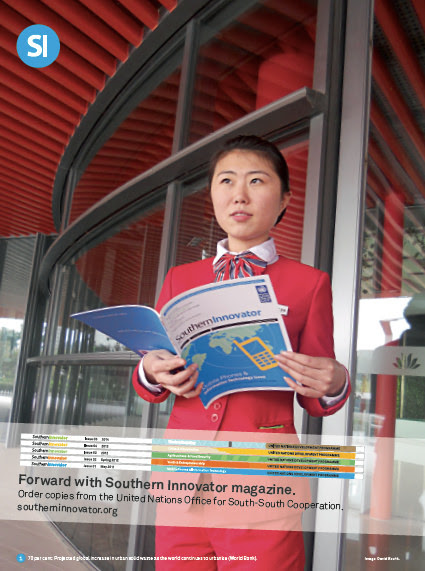
    Launched in May 2011, the new global magazine Southern Innovator (ISSN 2222-9280) is about the people across the global South shaping our new world, eradicating poverty and working towards the achievement of the Millennium Development Goals (MDGs). 

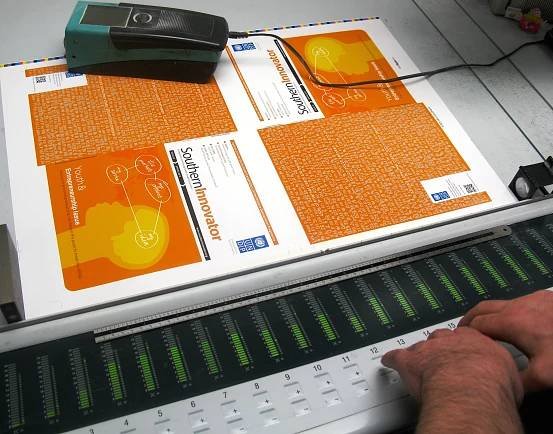
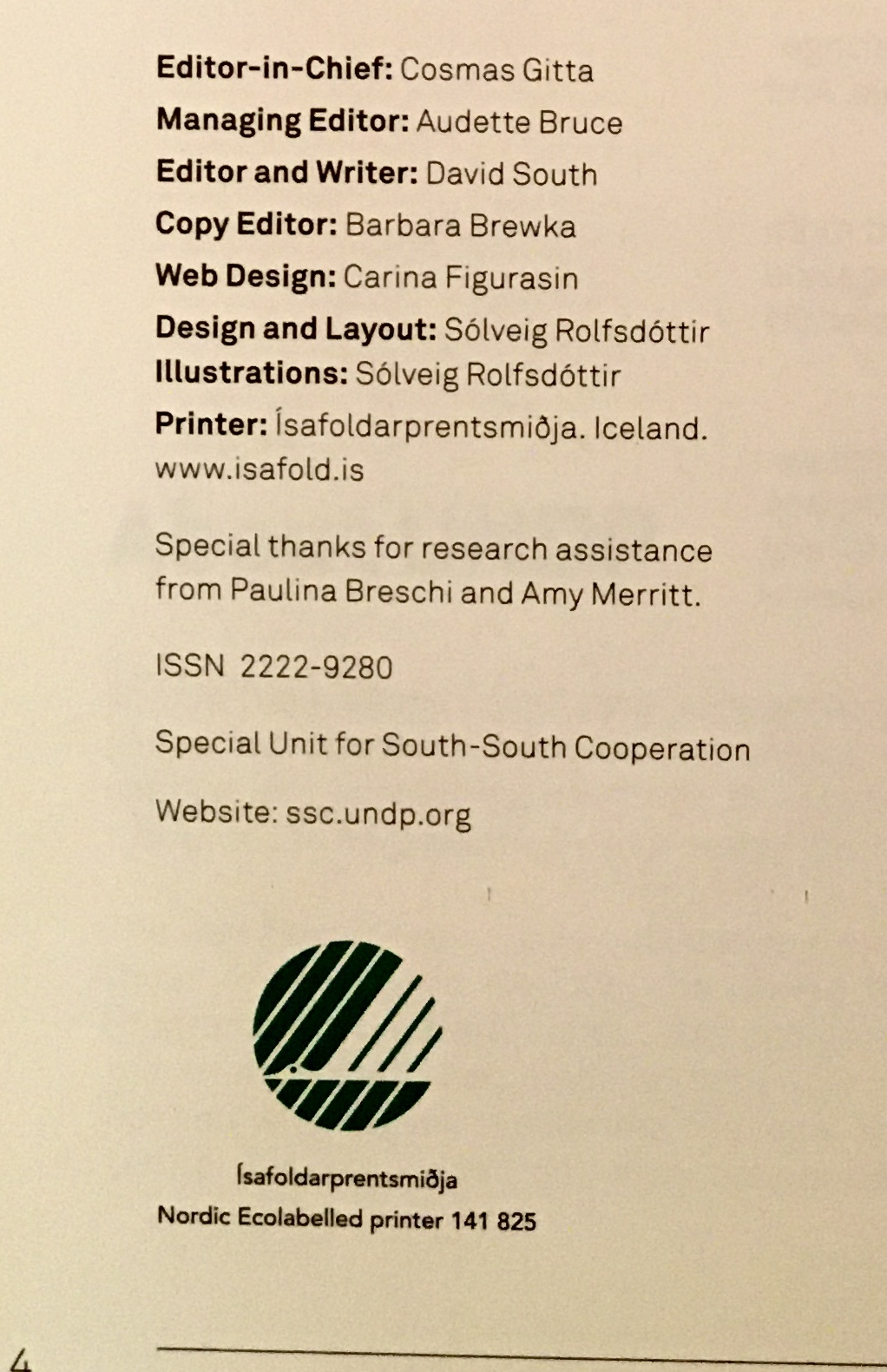
    The second issue of Southern Innovator was printed in 2012 in Iceland by Ísafoldarprentsmiðja, a Nordic Ecolabelled printer (ISSN 2227-0523/2222-9280).

    https://www.nordic-ecolabel.org

    Team | Southern Innovator Phase 1 Development (2010 – 2015)

    They are the innovators.

    Follow the magazine on Twitter @SouthSouth1. 

    Southern Innovator Issue 1

    Southern Innovator Issue 2

    Southern Innovator Issue 3

    Southern Innovator Issue 4

    Southern Innovator Issue 5

    If you would like hard copies of the magazine for distribution, then please contact the United Nations Office for South-South Cooperation (UNOSSC)(https://www.unsouthsouth.org/2014/12/25/southern-innovator-magazine/).

    Copies of Southern Innovator can be viewed at the UN Library Geneva.

    https://davidsouthconsulting.org/southern-innovator-scale-up-fundraiser/

    ORCID iD: https://orcid.org/0000-0001-5311-1052.

    © David South Consulting 2021

  • New 3D Technology Makes Innovation Breakthrough and Puts Mind over Matter

    New 3D Technology Makes Innovation Breakthrough and Puts Mind over Matter

    By David SouthDevelopment Challenges, South-South Solutions

    SOUTH-SOUTH CASE STUDY

    Revolutions in technology are placing more and more power into the hands of the individual, and 3D printing and fabrication machines are opening a whole new chapter.

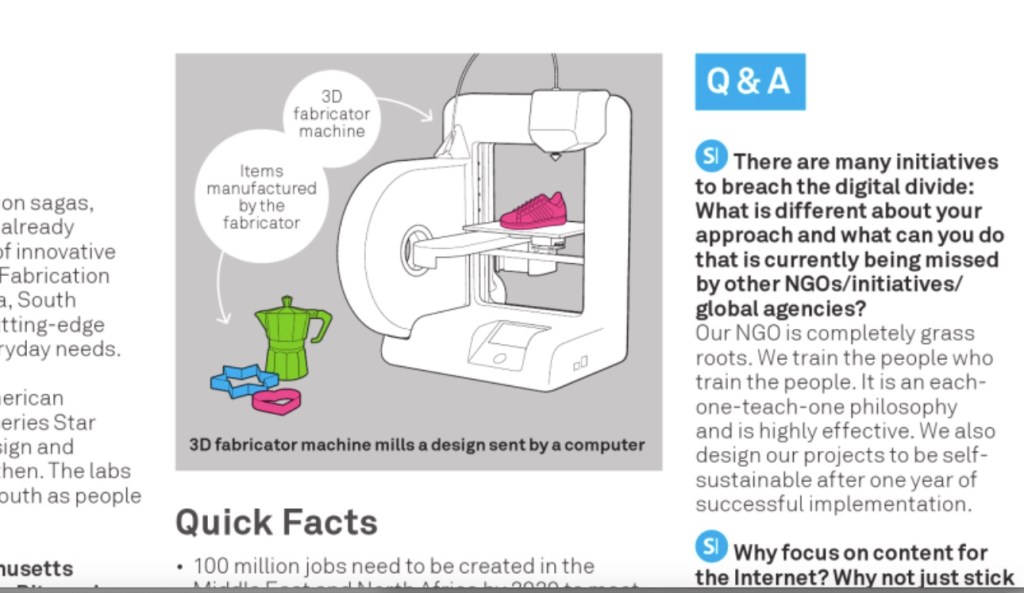
    These devices come in many forms, but they all do one thing: they can manufacture pretty well any three-dimensional object on the spot, from digital plans. These machines come in many sizes, from factory scale to smaller, home versions which are no bigger than personal computer printers, such as the well-known MakerBot Replicator 2 (makerbot.com).

    3D printers introduce sophisticated precision manufacturing to the individual much in the same way the personal computer and the Internet have empowered people to make their own software, build websites and start online businesses.

    A pioneering educational innovation in Chile is taking the technology even further, in a way that is truly mind-blowing. Thinker Thing (thinkerthing.com) promises to transform the way people interact with this new technology. “We have built a machine that will allow you to make real objects with your mind,” its website states.

    And, it wants to do more: “We want to use our invention to light a fire of inspiration throughout the remote and often disadvantaged schools of South America and we can do this with your help.”

    Thinker Thing allows the user to wear a headset and communicate through brain waves to the 3D printer. The printer then manufactures a three-dimensional model of the thoughts. These can be squiggly shapes or even, it is hoped, more sophisticated forms.

    Thinker Thing’s Chilean Chief Technology Officer is George Laskowsky. Laskowsky has a games console engineering background and was a research assistant in charge of high-energy particle experiments.

    The Chilean government is funding this experiment to help children to improve their creative skills. The idea is to use the technology to eliminate the technical side of creating objects and focus the effort on the creative thought process. Thinker Thing was selected from more than 1,400 applicants to participate in the prestigious global accelerator program, “Start Up Chile” (http://startupchile.org). Start-Up Chile is a program created by the Chilean government that seeks to attract early-stage high potential entrepreneurs to develop startups using Chile as a platform to go global, in line with the national goal of converting Chile into the innovation and entrepreneurship hub of Latin America.

    Based in Santiago, Chile, Laskowsky is seeking support for further development on IndieGoGo (http://www.indiegogo.com/projects/children-creating-real-objects-with-their-mind), an international crowdfunding platform for projects.

    The plan is to tour Thinker Thing all around Chile and use the science, art and engineering principles behind the invention to help very young children in remote rural regions to learn through understanding the project. Its creators also hope to take the exhibition – called the Monster Dreamer School Outreach Program and the Fantastical Mind Creatures of Chile Exhibition – on the road and show it in major global cities.

    The children are being asked to imagine fantastical creatures that will then be made into 3D forms with the machine. The idea is to then sell these 3D creatures to supporters of the project to help fund the initiative. As well, these creatures will go on display in an exhibition to help educate visitors about Chile’s children and their communities.

    To increase interest, exclusive photographic prints and limited edition figurines are available of the creatures the children create.

    The prototype uses what is called an EmotivEPOC, basically a wireless neuroheadset collecting signals from the user’s brain. In operation, the software allows users to make 3D models with the power of thought which are then made into a plastic model using a MakerBot Industries Replicator.

    This is experimental stuff and neurotechnology is in its early stages. It can detect simple emotions such as excitement or boredom and cognitive thoughts such as push and pull. Despite being in its early stages, the technology can evolve a 3D object over a number of steps by detecting the user’s emotional response to design changes.

    Thinker Thing has been working alongside neuroscientists to understand the workings of the brain. Amazingly, in one experiment they were able to get a person to control the leg of a cockroach using their own thoughts. Called the Salt Shaker (http://www.thinkerthing.com/about-2/salt-shaker/), it is an experimental kit for young students and hobbyists that allows them to take control of a biological limb quickly and simply.

    The 3D printing revolution is energizing for large and small-scale manufacturers alike. It means a business can now engage in precision manufacturing of products and spare parts quickly. It means it is possible to download from the Internet plans for new innovations and manufacture them within minutes. It also means communities off the mainstream supply line can make what they need and repair machinery without needing to wait weeks or months for items to be shipped from afar or spend vast sums on shipping costs.

    The Fab Labs project based at the Massachusetts Institute of Technology (MIT) has been at the forefront of pioneering and prototyping this technology, including running testing labs across the global South to prove the relevance of the technology to the world’s poorest communities.

    As of 2012, these include Fab Lab Afghanistan (http://www.fablab.af/), in Chile the FabLab Santiago (www.designlab.uai/fablab), Fab Lab Egypt (www.fablab-egypt.com), in Colombia the FabLab Medellin (http://www.fablabcolombia.com), in Ghana the Takoradi Technical Institute (http://ttifab.wikispaces.com/How+to+Use+the+TTI+Fab+Lab+Wiki), in India at various locations, Indonesia’s HONFablab (http://honfablab.org), ARO FabLab Kenya West (http://www.fablab.co.ke), and in Peru, South Africa, Suriname and many more are in the works (http://fab.cba.mit.edu/about/labs/).

    If Thinker Thing has its way, maybe people in the future will say “I think, therefore I print!”

    Published: August 2013

    Resources

    1) Stratasys: The company manufactures 3D printers and materials that create prototypes and manufactured goods directly from 3D CAD files or other 3D content. Stratasys systems are used by manufacturers to create models and prototypes to aid in the new product design process. And they are becoming widely used for production of finished goods in low-volume manufacturing. Systems range from affordable desktop 3D printers to large production systems for direct digital manufacturing. Website: http://www.stratasys.com/

    2) 3D Systems: 3D Systems is a leading provider of 3D content-to-print solutions including 3D printers, print materials and on-demand custom parts services for professionals and consumers alike. Website: http://www.3dsystems.com/

    ExOne: With decades of manufacturing experience and significant investment in research and product development, ExOne has pioneered the evolution of nontraditional manufacturing. This investment has yielded a new generation of rapid production technology in the field of additive manufacturing as well as advanced micromachining processes. Website: http://www.exone.com/

    FabCentral: This site supports a digital fabrication facility and global network of field fab labs managed by MIT’s Center for Bits and Atoms. Website: http://fab.cba.mit.edu

    Maker Shed: 3D Printing and Fabrication:  An outstanding resource for getting all you need to understand 3D printing and manufacturing, with 3D printers, supplies, Whether you want to print out physical objects or machine something from plastic, wood, or other materials, we have the tools and accessories you need. Website: http://www.makershed.com/3D_Printing_Fabrication_s/220.htm

    EMachineShop: The first and leading machine shop designed from the start for the Internet, eMachineShop’s mission is to provide easy, convenient and low-cost fabrication of custom parts via the web. Website: emachineshop.com/

    Development Challenges, South-South Solutions was launched as an e-newsletter in 2006 by UNDP’s South-South Cooperation Unit (now the United Nations Office for South-South Cooperation) based in New York, USA. It led on profiling the rise of the global South as an economic powerhouse and was one of the first regular publications to champion the global South’s innovators, entrepreneurs, and pioneers. It tracked the key trends that are now so profoundly reshaping how development is seen and done. This includes the rapid take-up of mobile phones and information technology in the global South (as profiled in the first issue of magazine Southern Innovator), the move to becoming a majority urban world, a growing global innovator culture, and the plethora of solutions being developed in the global South to tackle its problems and improve living conditions and boost human development. The success of the e-newsletter led to the launch of the magazine Southern Innovator.  

    Follow @SouthSouth1

    Google Books: https://books.google.co.uk/books?id=YfRcAwAAQBAJ&dq=development+challenges+august+2013&source=gbs_navlinks_s

    Slideshare: http://www.slideshare.net/DavidSouth1/development-challenges-august-2013-issue

    Southern Innovator Issue 1: https://books.google.co.uk/books?id=Q1O54YSE2BgC&dq=southern+innovator&source=gbs_navlinks_s

    Southern Innovator Issue 2: https://books.google.co.uk/books?id=Ty0N969dcssC&dq=southern+innovator&source=gbs_navlinks_s

    Southern Innovator Issue 3: https://books.google.co.uk/books?id=AQNt4YmhZagC&dq=southern+innovator&source=gbs_navlinks_s

    Southern Innovator Issue 4: https://books.google.co.uk/books?id=9T_n2tA7l4EC&dq=southern+innovator&source=gbs_navlinks_s

    Southern Innovator Issue 5: https://books.google.co.uk/books?id=6ILdAgAAQBAJ&dq=southern+innovator&source=gbs_navlinks_s

    Creative Commons License

    This work is licensed under a
    Creative Commons Attribution-Noncommercial-No Derivative Works 3.0 License.

    ORCID iD: https://orcid.org/0000-0001-5311-1052.

    © David South Consulting 2023