Tag: southerninnovators

  • Cleaner Stoves To Reduce Global Warming

    Cleaner Stoves To Reduce Global Warming

    By David SouthDevelopment Challenges, South-South Solutions

    SOUTH-SOUTH CASE STUDY

    The use of polluting fuel-burning stoves by half the world’s population – including 80 percent of rural households – is a documented contributor to a host of health problems. Poor households not only have to contend with the ill health effects of dirty water and poor sanitation, the fumes from burning dung, wood, coal or crop leftovers lead to the deaths of more than 1.6 million people a year from breathing toxic indoor air (WHO).

    The polluting stoves have also been identified as major contributors to climate change. The soot from the fires produces black carbon, now considered a significant contributor to global warming. While carbon dioxide is the number one contributor to rising global temperatures, black carbon is second, causing 18 percent of warming.

    Getting black carbon levels down is being seen as a relatively inexpensive way to reduce global warming while gaining another good: cleaner air for poor households. The soot only hangs around in the atmosphere for a few weeks while carbon dioxide lingers for years, so the impact can be seen quickly.

    A flurry of initiatives across the South are now designing, developing and testing clean-burning stoves to tackle this problem. The number of initiatives is impressive (see list of clean-burning stove initiatives by country: http://www.bioenergylists.org/en/country), but the test will be who can develop stoves that poor households will actually use and find the right model to distribute them to half the world’s population.

    In India, the Surya cookstove project is test marketing six prototypes of clean burning stoves with poor households. Developed by the Energy and Resources Institute (TERI) in New Delhi, the six stoves are still undergoing field testing. Initial criticisms from users have focused on the stoves’ durability and overly clinical appearance.

    Cost will be critical to success no matter what the stove’s final design: “I’m sure they’d look nice, but I’d have to see them, to try them,” Chetram Jatrav in Kohlua, central India, told the New York Times. As her three children coughed, she continued that she would like a stove that “made less smoke and used less fuel” but she cannot afford one.

    Envirofit India – founded in 2007 as a branch of the US-based Envirofit International – is at a more advanced stage, already selling clean-burning stoves across India and the Philippines. It claims to have already sold over 10,000 stoves to poor households.

    They have developed high-quality stoves in four models: the B-110 Value Single Pot (a simple stove for one pot), S-2100 Deluxe Single Pot (a sturdier design), S-4150 Deluxe Double Pot (two burning surfaces), S-4150 Deluxe Double Pot with Chimney. They have been designed to be visually appealing for households – in tasteful colours like blue and green – and using high quality engineering for durability.

    They have been tested by engineers at the Colorado State University’s Engines and Energy Conversion Laboratory and are certified for design and environmental standards.

    The stoves are on sale in 1,000 villages in Karnataka, Tamil Nadu, Kerala, and Andhra Pradesh. The stoves have already successfully undergone pilot testing in Chitradurga and Dharmapuri. The manufacturer uses a network of dealers, distributors, village entrepreneurs and not-for-profit organizations to make the stoves commercially available for purchase. They hope to have 1,500 dealer outlets by the end of 2009.

    “Envirofit clean cookstoves have received an overwhelming reception in India,” said Ron Bills, chairman and chief executive officer at Envirofit. “Our cookstoves are not only meticulously engineered to reduce toxic emissions and fuel use; they are also aesthetically designed and durable. Envirofit takes great pride in offering high-quality, affordable products to typically underserved global markets.”

    But once again price comes up as a major issue: Envirofit’s stoves are designed to last five years, and thus they cost more than other stoves for sale in India. An Envirofit stove costs between 500 rupees (US $10) to 2,000 rupees (US $40): existing stoves sell for between 250 rupees (US $5) and 1,000 rupees (US $20), and last a year at most.

    As one blogger complained: “The envirofit stoves … are way beyond the capacity of the low income households who form 65% of the Indian population. Only the 10% of the middle to higher income segment can go for them… perhaps the price can be brought down by reducing the showy part of the stove to help the poorest.”

    Envirofit is part of the Shell Foundation’s Breathing Space program, established to tackle indoor air pollution from cooking fires in homes and hopes to sell and place 10 million clean-burning stoves in five countries over the next five years.

    Published: May 2009

    Resources

    A video shows the installation of clean-burning stoves in Peru, South America. It also has links to many other videos of clean-burning stoves and how to build and install them.
    Website: http://www.youtube.com/watch?v=neZZvvnL8Lg

    Designing a clean-burning dung fuel stove.
    Website: www.bioenergylists.org

    Follow @SouthSouth1

    Slideshare: http://www.slideshare.net/DavidSouth1/development-challengessouthsouthsolutionsnovember2010issue

    Southern Innovator Issue 1: https://books.google.co.uk/books?id=Q1O54YSE2BgC&dq=southern+innovator&source=gbs_navlinks_s

    Southern Innovator Issue 2: https://books.google.co.uk/books?id=Ty0N969dcssC&dq=southern+innovator&source=gbs_navlinks_s

    Southern Innovator Issue 3: https://books.google.co.uk/books?id=AQNt4YmhZagC&dq=southern+innovator&source=gbs_navlinks_s

    Southern Innovator Issue 4: https://books.google.co.uk/books?id=9T_n2tA7l4EC&dq=southern+innovator&source=gbs_navlinks_s

    Southern Innovator Issue 5: https://books.google.co.uk/books?id=6ILdAgAAQBAJ&dq=southern+innovator&source=gbs_navlinks_s

    Creative Commons License

    This work is licensed under a
    Creative Commons Attribution-Noncommercial-No Derivative Works 3.0 License.

    ORCID iD: https://orcid.org/0000-0001-5311-1052.

    © David South Consulting 2023

  • Egyptian Youth Turns Plastic Waste into Fuel

    Egyptian Youth Turns Plastic Waste into Fuel

    By David SouthDevelopment Challenges, South-South Solutions

    SOUTH-SOUTH CASE STUDY

    The challenge of finding alternate fuel sources is capturing the imagination of innovators across the global South. As the world’s population increases – it recently reached 7 billion (UN) – and the number of people seeking a better life grows in turn, the energy demands on the planet are pushing up competition for existing conventional fuel sources.

    The modern lifestyle that many aspire to requires energy, whether it’s using electronic products which consume large quantities of electricity, driving personal vehicles or living in homes that are artificially heated and cooled.

    This energy hunger has opened up a whole new market demand that needs to be met. The scale of this market is enormous, but the solutions are ultimately limited only by people’s imaginations. An award-winning Egyptian teenage scientist is capturing attention for the imaginative solution of turning waste plastic into biofuel, sparking interest in the creation of a whole new source of wealth for her country.

    Sixteen-year-old Azza Abdel Hamid Faiad (http://tinyurl.com/dysemjg) has found a new way to take waste plastic and break it down into fuel. She has discovered aluminosilicate minerals (http://en.wikipedia.org/wiki/Aluminosilicate) – which contain aluminium, silicon and oxygen and are found in clays – can break down the polymers that make up plastic (http://en.wikipedia.org/wiki/Polymer) to produce the gases methane, propane and ethane, all of which can be turned into ethanol (http://en.wikipedia.org/wiki/Ethanol), which is useful as a biofuel.

    According to Inhabitat (inhabitat.com), a website dedicated to “green design, innovation, and the future of clean technology,” her solution could turn the country’s annual consumption of 1 million tonnes of plastic into a year’s supply of biofuel worth US $78 million.

    Clever innovators are sitting on a goldmine if they can come up with renewable energy solutions. The U.S. Army alone is looking to spend US $7 billion on renewable energy sources and is accepting bids from the private sector to meet its needs (http://www.forbes.com/sites/toddwoody/2012/08/08/u-s-army-opens-bids-to-buy-7-billionin-renewable-energy/). The army is looking to sign contracts stretching up to 30 years for buying electricity generated by solar, wind, geothermal and biomass projects.

    The options are numerous for renewable energy – from solar power to wind power to algae as a source of biofuels (http://en.wikipedia.org/wiki/Biofuel). The challenge is to find a fuel source that is plentiful, renewable, and crucially, doesn’t harm other needs.

    Using biofuel as a replacement for conventional petroleum-based fuels like gasoline and diesel appears to be an attractive solution, but it can lead to other problems. Some people are using used cooking oils to convert into biodiesels, but sometimes there is not enough used cooking oil to meet demand. In short, a constant supply source is required to meet ever-increasing energy demand.

    A famous example of where the use of renewable plant-based fuel sources can go wrong is the case of corn. The widespread use of corn as a source for biofuels – rather than for animal feed or human food – has led to accusations this is contributing to the global food crisis. The current drought in the United States is damaging corn crops and only making this problem more acute. The U.S. is the world’s largest producer of corn (US Department of Agriculture) and much of it is used as livestock feed around the world.

    Faiad’s solution is appealing because the fuel does not come from biomass – derived from plant matter – but turns waste plastic into the raw material for biofuel.

    Plastic waste is a common byproduct of modern life. Plastic is used extensively in packaging, bottles, bags and electronic products. It fills up landfill sites and is a blight on the landscape in many countries. It is also a product made from petrochemicals (http://en.wikipedia.org/wiki/Plastic), the very source of conventional fuel used by most of the world’s vehicles.

    Breaking down waste plastic from bottles, packaging and other products into what is called ‘biofuel feedstock’ – the substance necessary to start the creation of biofuel – requires a means to turn the plastic into fuel.

    According to Green Prophet (greenprophet.com), Faiad believes her technological breakthrough “can provide an economically efficient method for production of hydrocarbon fuel namely: cracked naphtha (http://en.wikipedia.org/wiki/Petroleum_naphtha) of about 40,000 tons per year and hydrocarbon gases of about 138,000 tons per year equivalent to US $78 million.”

    This could be a big economic boost to Egypt’s economy, simultaneously reducing dependence on petroleum-based fuels and creating a new source of income. Egypt’s economy has been hit hard since the start of the Arab Spring (http://en.wikipedia.org/wiki/Arab_Spring). The number of tourists fell 33 per cent in 2011 and revenue dropped by US $3.7 billion from 2010 (Egyptian Tourism Minister). In 2009 about 12.5 million tourists visited Egypt, bringing revenue of US $10.8 billion. The tourism sector is one of the country’s top sources of foreign revenue, accounting for more than 11 per cent of GDP, and offers jobs in a country beset by high unemployment – for Egypt, tourism makes up 11 per cent of its GDP (gross domestic product) (Reuters).

    Faiad’s innovation has not gone unnoticed. She received the European Fusion Development Agreement award (http://www.efda.org/) at the 2011 23rd European Union Contest for Young Scientists (http://ec.europa.eu/research/youngscientists/index_en.cfm). She is also receiving interest from the Egyptian Petroleum Research Institute (http://www.epri.sci.eg/), according to Inhabitat.

    Ambitious Faiad is also seeking to take ownership of her innovation by getting a patent from the Egyptian Patent Office (http://www.egypo.gov.eg/english/default.htm).

    Published: August 2012

    Resources

    1) Biofuel: A website with a good overview of biofuel options and directions on how to make biofuel. Website: http://biofuel.org.uk/

    2) Biogasmax: Biogas Highway – waste to energy concept, 18-19 September in Gothenburg, Sweden. Participate in an intensive two-day programme with complete focus on biogas at the Water and Wastewater Fair. Meet with exhibiting Swedish biogas companies and companies within the water and wastewater sectors. Participate at the “International biogas business opportunities” seminar and learn more about biogas concepts and strategies. Website: http://www.biogasmax.eu/

    3) New Techniques Create Butanol, A Superior Biofuel: A story from Science Daily about new techniques to produce a biofuel superior to ethanol. Website: http://www.sciencedaily.com/releases/2008/01/080123153142.htm

    4) Biofuels Digest: The Digest covers producer news, research, policy, policymakers, conferences, fleets and financial news. Website: http://www.biofuelsdigest.com/bdigest/

    Follow @SouthSouth1

    Slideshare: http://www.slideshare.net/DavidSouth1/development-challengessouthsouthsolutionsnovember2010issue

    Southern Innovator Issue 1: https://books.google.co.uk/books?id=Q1O54YSE2BgC&dq=southern+innovator&source=gbs_navlinks_s

    Southern Innovator Issue 2: https://books.google.co.uk/books?id=Ty0N969dcssC&dq=southern+innovator&source=gbs_navlinks_s

    Southern Innovator Issue 3: https://books.google.co.uk/books?id=AQNt4YmhZagC&dq=southern+innovator&source=gbs_navlinks_s

    Southern Innovator Issue 4: https://books.google.co.uk/books?id=9T_n2tA7l4EC&dq=southern+innovator&source=gbs_navlinks_s

    Southern Innovator Issue 5: https://books.google.co.uk/books?id=6ILdAgAAQBAJ&dq=southern+innovator&source=gbs_navlinks_s

    Creative Commons License

    This work is licensed under a
    Creative Commons Attribution-Noncommercial-No Derivative Works 3.0 License.

    ORCID iD: https://orcid.org/0000-0001-5311-1052.

    © David South Consulting 2023

  • Press Release 3 | Southern Innovator

    Press Release 3 | Southern Innovator

    Press Release for General Distribution

    Southern Innovator’s Fifth Issue Profiles Innovators in Waste and Recycling

    United Nations, New York, USA, 28 April 2014

    • Fifth issue of Southern Innovator tackles ways to improve human development in a world with finite resources
    • 60-page color magazine offers a snapshot of our fast-changing world

    The fifth issue of Southern Innovator (SI) magazine is out now. It explores how innovation can tackle the challenges of improving human development on a planet with finite resources.

    SI researchers identified innovative, low-polluting options to the world’s energy needs. They found that it is possible to alter the way that things are made to reduce or eliminate waste and toxic pollutants harming human health and damaging the environment. And not only that: they also discovered that there are sustainable incomes to be made from the economy of waste reduction and recycling – an opportunity that has yet to be fully realized. The innovations shared here demonstrate that raising living standards in the global South and responsible use of the world’s resources are not necessarily incompatible.

    Some innovators are transforming attitudes towards fashion, proving that it does not have to be a wasteful industry. Others are turning commonly found waste – food waste, or human or animal excrement – into fuel for heating. The link between good design and the efficient use of resources is apparent in many of the innovators’ solutions. If a new, green economy is to work, then it must appeal to people’s aspirations and be something that they want in their lives and are willing to work to achieve.

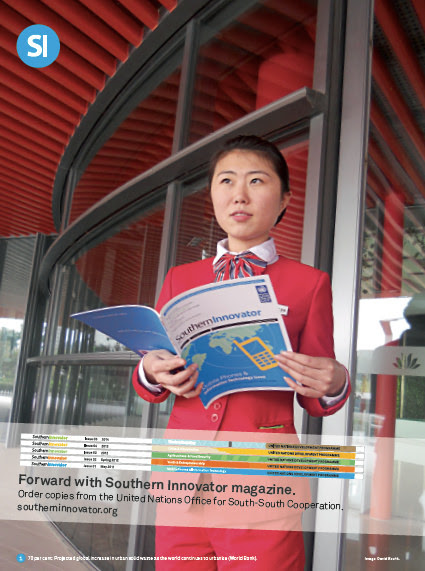
    Southern Innovator (southerninnovator.org) champions a 21st-century global innovator culture. It is based on intensive research and produced by the United Nations Office for South-South Cooperation in (UNOSSC) in UNDP. UNOSSC also organizes the annual Global South-South Development Expo (southsouthexpo.org), a traveling celebration bringing together Southern innovators, with previous venues in New York, Washington, D.C., Geneva, Rome,Vienna, Nairobi and Doha.

    We hope that you enjoy the magazine and find its content interesting and illuminating, a snapshot of a fast-changing world awash with innovators, creators and doers making their world a better place.

    For information on sponsoring issues of the magazine, either through helping to fund its print run, or through an insert relating to an issue’s theme with pertinent content for our readers, contact Cosmas Gitta at cosmas.gitta@undp.org.

    Online archives: southerninnovator.org; http://www.scribd.com/SouthernInnovator. Follow us @SouthSouth1

    Press Release 2

    Press Release 1

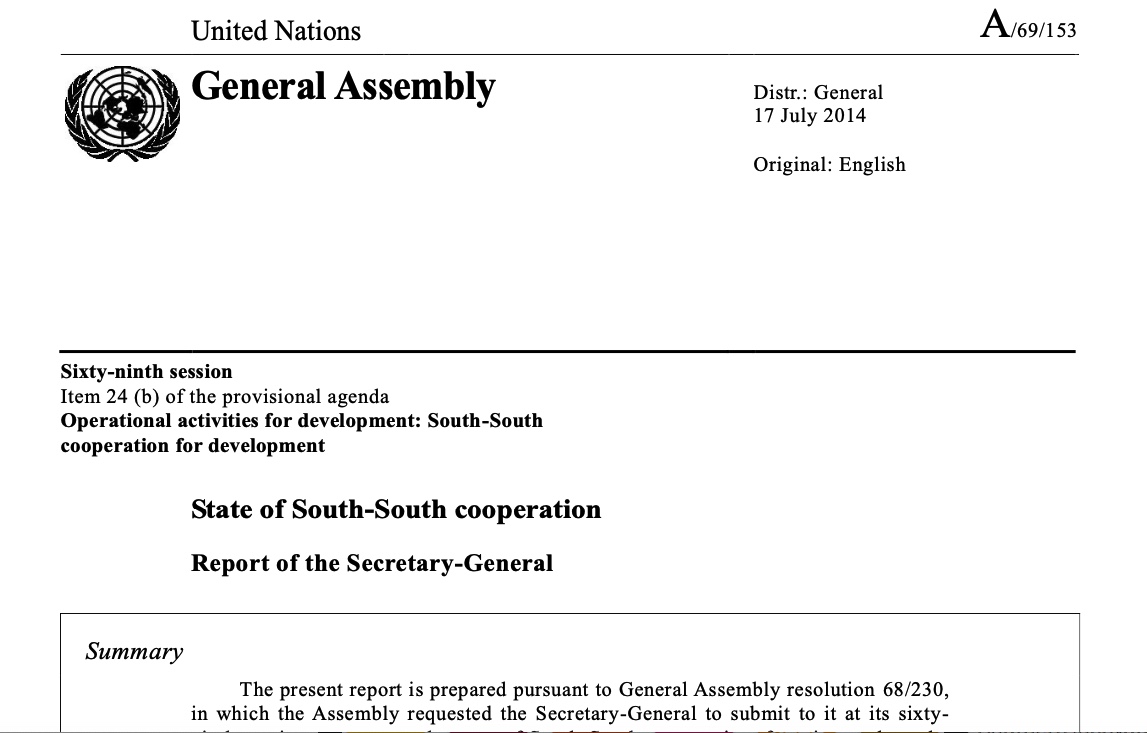
    United Nations General Assembly: Sixty-ninth session, Item 24 (b) of the provisional agenda, Operational activities for development: South-South cooperation for development, 17 July 2014.
    The research informing Southern Innovator Magazine played a part in the formulation of the UN’s post-2015 development agenda, including the Sustainable Development Goals (SDGs).

    https://davidsouthconsulting.org/southern-innovator-scale-up-fundraiser/

    ORCID iD: https://orcid.org/0000-0001-5311-1052.

    © David South Consulting 2022

  • Press Release 2 | Southern Innovator

    Press Release 2 | Southern Innovator

    Press Release for General Distribution

    Fourth Issue of UNDP Magazine Southern Innovator Launches at Expo

    United Nations, Nairobi, Kenya, 31 October 2013

    • Fourth issue of Southern Innovator launched at Global South-South Development Expo 2013 in Nairobi, Kenya
    • 60-page color magazine gives snapshot of fast-changing world

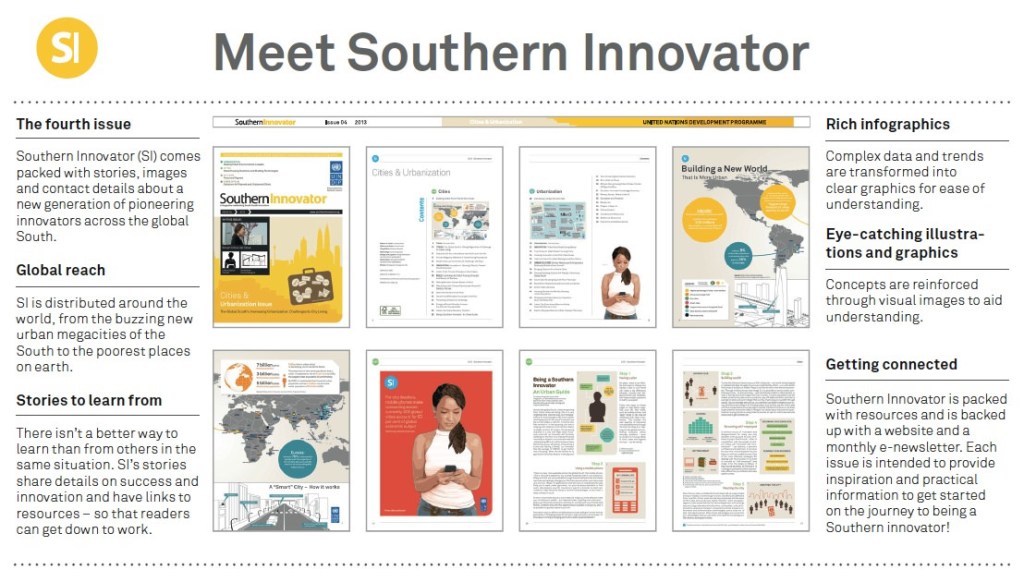
    The fourth issue of Southern Innovator magazine has launched at the Global South-South Development Expo 2013 in Nairobi, Kenya. Southern Innovator Issue 4 visits the new cities being built to tackle the challenges of a rapidly urbanizing 21st-century world. The magazine also highlights some of the solutions being devised to the challenges people face as the world becomes a majority urban place.

    Some innovators are building new cities from scratch, applying the latest thinking and hard-wiring in cutting-edge information technologies and innovative environmental measures to create ‘smart’ cities and eco-cities. Architects are designing and refining homes that are beautiful and functional, easy to build, affordable and conserve energy. Social entrepreneurs are innovating ways to create liveable and socially inclusive urban areas, often in places where planning has been scant and where incomes are very low. All those featured in the magazine were chosen for their focus on improving human development and their ingenuity and fresh thinking.

    Southern Innovator champions a 21st-century global innovator culture. The magazine profiles and celebrates the innovators across the global South finding new ways to tackle poverty, create wealth and improve human development and achieve the Millennium Development Goals (MDGs). In its first issue in September 2011, Southern Innovator featured the people who are re-shaping new information technologies – from mobile phone apps to Internet technologies. Many of the innovators profiled in that first issue came from Kenya.

    SI (southerninnovator.org) is based on intensive research and produced by the United Nations Office for South-South Cooperation in UNDP (UNOSSC) (formerly the Special Unit for South-South Cooperation in UNDP). UNOSSC organizes an annual Global South-South Development Expo (southsouthexpo.org), a roaming celebration and gathering of Southern innovators previously held in New York, Washington, D.C., Geneva, Rome and Vienna. This year’s Expo is being held in Nairobi, Kenya (28 October to 1 November 2013) and is hosted by the UN Environment Programme (unep.org).

    SI is being distributed through the United Nations’ network and partners and reaches some of the world’s poorest and remotest places, as well as the vibrant but stressed growing global megacities. It is hoped the magazine will inspire budding innovators with its mix of stories, essential information, facts and figures, images and graphics.

    We hope you enjoy the magazine and find its content interesting and illuminating: a snapshot of a fast-changing world awash, as we found out, with
    innovators, creators and do-ers making their world a better place. It is possible to sponsor issues of the magazine, either through helping to fund its print run, or through sponsored inserts covering that issue’s theme with relevant content for our readers.

    For more information on Southern Innovator, contact Cosmas Gitta at
    cosmas.gitta@undp.org.

    Press Release 1

    Press Release 3

    Online archives: southerninnovator.orghttp://www.scribd.com/SouthernInnovator. Follow @SouthSouth1

    United Nations General Assembly: Sixty-ninth session, Item 24 (b) of the provisional agenda, Operational activities for development: South-South cooperation for development, 17 July 2014.
    The research informing Southern Innovator Magazine played a part in the formulation of the UN’s post-2015 development agenda, including the Sustainable Development Goals (SDGs).

    https://davidsouthconsulting.org/southern-innovator-scale-up-fundraiser/

    ORCID iD: https://orcid.org/0000-0001-5311-1052.

    © David South Consulting 2022