Categories
Archive Development Challenges, South-South Solutions Newsletters

Carbon Credits Can Benefit African Farmers Thanks to New System

By David SouthDevelopment Challenges, South-South Solutions

SOUTH-SOUTH CASE STUDY

The global carbon credit trading schemes emanating from the Kyoto Protocol are now creating a multi-billion dollar market – the European carbon market was worth €14.6 billion in 2006 – and represents one of the fastest growing business opportunities in the world. Being green has finally come of age. Yet all the benefits of this are largely bypassing Africa despite more than 70 percent of the continent’s inhabitants earning a living off the land.

The World Agroforestry Centre – whose mission is to advance the science and practice of agroforestry to transform the lives and landscapes of the rural poor in developing countries – in partnership with Michigan State University has developed a method using satellite imagery and infrared sensing that measures carbon storage in African farmland. They have completed a pilot programme in western Kenya and are ready to encourage poor farmers to plant trees as soon as the European Union allows carbon credits under the Kyoto Protocol to be awarded for this kind of scheme. Further pilot projects will be rolled out in 2007 in partnership with CARE International and the WWF.

But European Union policies on carbon credits are holding back this significant opportunity to enhance African livelihoods. Europe’s Emissions Trading Scheme (ETS) is at present not willing to recognize the new method of verifying carbon storage in farmland. The ETS is the largest multi-country, multi-sector greenhouse gas emission trading scheme in the world. The issue of carbon storage, or carbon “sinks” as they are known, is very controversial in the world of Kyoto agreement implementation. Non-government organizations that advocate for forests and indigenous people have worked hard to exclude the use of forestry credits to offset fossil fuel burning, arguing that forestry offsets to date have been for big monoculture plantations of fast-growing eucalyptus or pine trees. It is claimed they are net carbon emitters over their lifetimes and also cause additional environmental and social problems.

But the World Agroforestry Centre’s approach is very different from a monoculture plantation. Their scheme is to help rural Africans to integrate more trees into their agricultural production systems, with benefits besides storing carbon. They argue that the right kinds of trees can increase the productivity and resilience of the land. Trees provide food, fuel, fertilizer, and medicine – medicinal trees are the main source of medication for 80 percent of Africa’s population.

Louis Verchon, the lead scientist for climate change at the World Agroforestry Centre, believes that if the EU would put in place a new scheme to credit farmers who capture carbon in their land, “millions of dollars in carbon credits could begin flowing to the world’s rural poor.” At present, Verchon says two-thirds of the carbon credit business is being captured by Asian countries who are mostly offering industrial solutions. “Africa has something to offer on this – it can’t compete with the likes of South Korea on industrial solutions, but it has plenty of land.”

In order to make the scheme work, two things will need to be improved: Africa’s institutional weakness and the paucity of qualified carbon credit verifiers. A network of verifiers would be required to inspect farm sites and make the calculations required to allocate carbon credits to poor farmers. At present, there are no qualified African-born verifiers in Africa according to Verchon.

The WAC are working with WWF and CARE to build up NGO capacity and start demonstration projects to prove it can work – two pilot projects are already up and running in Kenya. They are also automating much of the process by building a web portal.

Verchon says the WAC “are in it for the long-haul and we will see this grow over the next ten years.”

Published: January 2007

Resources

  • More on emissions trading: Click here
  • Kenya’s Greenbelt Movement: Founded by Nobel Peace Prize winner Wangari Maathai, it provides income and sustenance to millions of people in Kenya through the planting of trees.
Creative Commons License


This work is licensed under a
Creative Commons Attribution-Noncommercial-No Derivative Works 3.0 License.

ORCID iD: https://orcid.org/0000-0001-5311-1052.

© David South Consulting 2023
Categories
Archive Development Challenges, South-South Solutions Newsletters Southern Innovator magazine

Insects Can Help in Food Crisis

By David SouthDevelopment Challenges, South-South Solutions

SOUTH-SOUTH CASE STUDY

For many years it was a given that the world’s problem was not a lack of food, but that it was unfairly shared. But as the switch to biofuels gathers pace, farmland is being diverted away from growing food for people, to food for fuel. On top of this, growing prosperity in many countries in the South has boosted demand for better quality food, including grain-devouring meat diets – it takes 10 kilograms of grain to get one kilogram of meat from a cow. The crisis has deeply alarmed the UN’s World Food Programme and the World Bank. In the economic battle for food, the poor are the most vulnerable.

So-called agflation (agricultural inflation) has seen spiraling food prices, which in turn are causing food shortages, hunger and malnutrition around the world. For example, rice in Thailand has jumped from US $400 per 100 kilograms in January, to US $760. World grain stocks are at their lowest level in four decades.

But where can new sources of food be found? And what would be a more efficient use of the world’s resources to feed the growing population? One answer, surprisingly, is insects.

In February this year the UN’s Food and Agriculture Organization held a conference in Chiang Mai, Thailand to devour the dietary value of insects as food and discuss how to harvest more of them. The working group of three dozen scientists from 15 countries probed the role of edible forest insects in food security. They explored insect protein as a contributor to better nutrition, the economics of collecting edible forest insects, methods of harvesting, processing and marketing edible forest insects, and ways of promoting insect eating with snacks, dishes, condiments — even recipes.

The range of insects that can be tapped for food is huge: beetles, ants, bees, crickets, silk worms, moths, termites, larvae, spiders, tarantulas and scorpions. More than 1,400 insect species are eaten in 90 countries in the South. Known as entomophagy, insect eating is a growing industry. Entrepreneurs in the South are making insects both palatable and marketable – and in turn profitable. These innovations are adding another income source for farmers and the poor, and supplying another weapon to the battle for global food security.

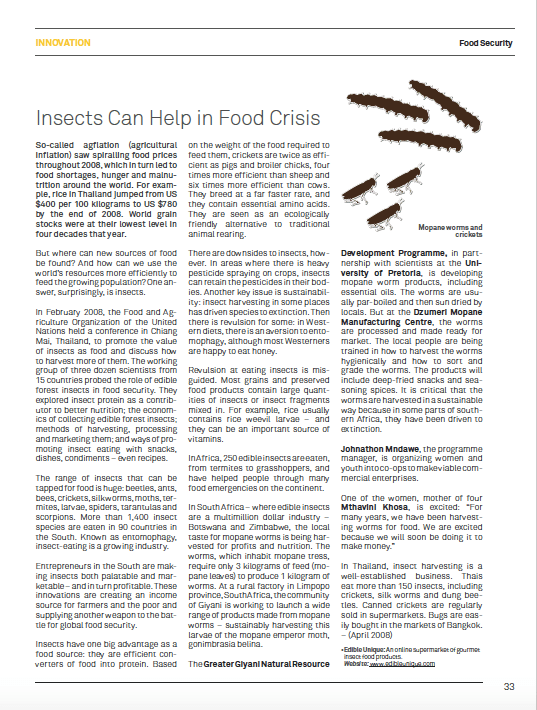
Insects have one big advantage as a food source: they are efficient converters of food into protein. Based on the weight of the food required to feed them, crickets are twice as efficient as pigs and broiler chicks, four times more efficient than sheep and six times more efficient than cows. They breed at a far faster rate, and they contain essential amino acids. They are seen as an ecologically friendly alternative to traditional animal rearing.

There are downsides to insects, however. In areas where there is heavy pesticide spraying on crops, insects can retain the pesticides in their bodies. Another key issue is sustainability: insect harvesting in some places has driven species to extinction. Then there is revulsion for some: in Western diets, there is an aversion to entomophagy, although most Westerners are happy to eat honey.

Revulsion at eating of insects is misguided. Most grains and preserved food products contain large quantities of insects or insect fragments mixed in. For example, rice usually contains rice weevil larvae – and they can be an important source of vitamins.

In Africa, 250 edible insects are eaten, from termites to grasshoppers, and have helped people through many food emergencies on the continent.

In South Africa — where edible insects are a multimillion dollar industry — Botswana and Zimbabwe, the local taste for mopane worms is being harvested for profits and nutrition. The worms, which inhabit mopane tress, require only three kilograms of feed (mopane leaves) to produce one kilogram of worms. At a rural factory in Limpopo province, South Africa, the community of Giyani is working to launch a wide range of products made from mopane worms – sustainably harvesting this larvae of the mopane emperor moth, gonimbrasia belina.

The Greater Giyani Natural Resources Development Programme in partnership with scientists at the University of Pretoria, is developing mopane worm products, including essential oils. The worms are usually par-boiled and then sun dried by locals. But at the Dzumeri Mopane Manufacturing Centre, the worms are processed and made ready for market. The local people are being trained in how to harvest the worms hygienically, and how to sort and grade the worms. The products will include deep-fried snacks and seasoning spices. It is critical the worms are harvested in a sustainable way, because in some parts of southern Africa, they have been driven to extinction.

Johnathon Mndawe, the programme manager, is organizing women and youth into co-ops to make viable commercial enterprises. “We expect the product to hit supermarket shelves in 2009,” said Morewane Mampuru, coordinator for the Centre for Scientific and Industrial Research, another partner.

One of the women, mother of four Mthavini Khosa, is excited: “For many years, we have been harvesting worms for food. We are excited because we will soon be doing it to make money.”

In Thailand, insect harvesting is a well-established business. Thais eat more than 150 insects, including crickets, silk worms and dung beetles. Canned crickets are regularly sold in supermarkets. Bugs are easily bought in the markets of Bangkok.

Online vendor Thailand Unique, based in Udon Thani, sells and markets a wide range of edible insects. They include edible scorpions, preserved giant water bugs, roasted grasshoppers, edible big crickets, bamboo worms, crushed giant bug paste, and introducing this year, Bug Snackz and Scorpion Thai Green Curry. There is even a ‘Bug Sample Pack’, containing a mix of seven edible insects and arachnids, all slow roasted for easy snacking.

Another important centre for insect harvesting is Latin America. In Venezuala, the Pemon Indians eat fire ants during the rainy season.

In Colombia, so-called “fatass ant” or “hormiga culona” is eaten like popcorn in movie theatres. Some believe it is a defence against cancer, or a natural aphrodisiac. Eating the ants or culona, has been happening right back to the ancient Guane Indians.

In Santander province, farmers are exporting the ants for sale, some being dipped in Belgian chocolate and sold as a luxury food in London’s Harrods and Fortnum and Mason department stores. The abundant ant population brings in US $11 a pound (kilogram conversion) for the farmers, a doubling in price since 2000.

Farmers in the artist colony of Barichara harvest the ants – though concerns have been raised that they have been over-harvesting the population. Restaurants in the area offer ant-based spreads for bread and an ant-flavored lamb sauce.

“It’s an age-old dilemma for the farmer — should I kill it or eat it?” said Andres Santamaria to CBS News, who was given a $40,000 grant from Santander’s government to develop an environmentally sustainable, export-oriented programme for breeding the ants.

In Tijuana, Mexico, ancient Aztec, pre-Colombian insect meals are on offer at this restaurant, joining a global trend. Cien Anios (“100 Years”), specialises in pre-Colombian, Aztec insect recipes. It is proof there is money in preparing insects for food. Typical dishes include garlicky ant eggs and cactus worms in butter.

Published: April 2008

Resources

  • A network for insect collectors: Website: www.insect.net
  • Sunrise Land Shrimp: A do-it-yourself guide to raising and harvesting insects for food, with important information on health and hygiene: Website: www.slshrimp.com
  • Edible Unique: An online supermarket of gourmet insect food products. Website: www.edibleunique.com

https://davidsouthconsulting.org/2022/11/18/farmers-weather-fertilizer-crisis-by-going-organic/

https://davidsouthconsulting.org/2022/11/11/urban-farming-to-tackle-global-food-crisis/

Tijuana‘s Cien Años was the original inspiration for this story. As one of the first stories to draw attention to the insects-for-food market, it contributed to a growing awareness of this exciting food source. I had a delicious all-insect meal there in 2002.

https://davidsouthconsulting.org/2021/03/05/southern-innovator-issue-3/

Creative Commons License

This work is licensed under a
Creative Commons Attribution-Noncommercial-No Derivative Works 3.0 License.

ORCID iD: https://orcid.org/0000-0001-5311-1052.

© David South Consulting 2022

Categories
Archive Development Challenges, South-South Solutions Newsletters Southern Innovator magazine

Social Franchising Models Proving Poor Bring Profits

By David SouthDevelopment Challenges, South-South Solutions

SOUTH-SOUTH CASE STUDY

The four billion people in the world who live on less than US $2 a day have been described as the bottom of the economic pyramid, or BOP for short. In his book The Fortune at the Bottom of the Pyramid, Indian business consultant and professor CK Prahalad argues that this attitude must be turned on its head: rather than seeing the world’s poor as a burden, only worthy of charity, Prahalad sees nothing but opportunity and unmet needs that business can address. In short, he argues, profits can be married with the goal of eradicating poverty.

Prahalad has gone so far as to claim this is a market potentially worth US $13 trillion, while the World Resources Institute puts it at US $5 trillion in its latest report, The Next 4 Billion.

One of the tools business is turning to reach the world’s poor is known as social franchising. The concept borrows from the business world and the highly successful franchise models that are more commonly associated with fast-food restaurants and computer and clothing retailers – wherever rapid expansion and scale are required to reach the biggest market possible. And there is no bigger market, social franchising advocates claim, than the world’s four billion poorest people.

In the past, most formal business in developing countries chased the small middle class or the even smaller elite or foreign expatriate communities. Traditional poverty eradication strategies have also been criticized for being too narrow, focused on a very small group, or for wasting time and resources replicating what has already been achieved elsewhere, and for ballooning and shrinking depending on aid grants or success at fundraising. Social franchising aims to bypass these weaknesses by finding models that work, making sure they are self-financing, and then quickly scaling them up to reach as many people as possible. It’s a model that is gaining more followers and the serious interest of big and small businesses.

One example is the Scojo Foundation in India, established to tackle the common problem of blurry vision as people age (presbyopia). Not a disease, the first symptoms occur between the ages of 40 and 50. Low vision affects 124 million people in the world according to the World Health Organization’s Vision 2020 campaign, organizers of World Sight Day 2007 on October 11.

Blurry vision is a serious disability for weavers, mechanics, goldsmiths and others whose livelihoods depend on near vision. As vision deteriorates, these people are unable to provide for their families. Yet it is easily treatable with a pair of eyeglasses.

Since, 2002, the Scojo Foundation (the social franchising wing of eyeglasses manufacturer Scojo New York, has launched operations in Bangladesh, Mexico, Guatemala, El Salvador and Ghana. Its largest and fastest growing operation is in India, where it employs more than 560 entrepreneurs in rural villages, and selling more than 50,000 pairs of glasses since 2001.

It has grown quickly because the business model has been replicated by local staff who work as franchisees. It has followed the franchise model by building a network of “vision entrepreneurs” – low-income men and women, who in turn sell reading glasses directly to rural villagers throughout India. The franchise model enables the “vision entrepreneurs” to earn a good income, and gain respect from other community members.

Nico Clemminck, co-author of a case study on Scojo, found the price was very competitive with other options in India, and that the higher quality of the glasses made them attractive to villagers.

“The franchisees, or Vision Entrepreneurs as Scojo calls them, that we met were very involved with Scojo – some of them shifting away their focus from previous occupations to spend the majority of their time on conducting vision screenings and selling glasses. The main reason is that the business is quite profitable to them – they make a US $1 margin per glasses sold, which is very high compared to other retail products. A trend we did notice is that commitment decreases over time, as the entrepreneurs exhaust their immediate circle of relatives or target village populations, and the incremental sale becomes tougher to make.”

According to Clemminck, Scojo has been able to quickly and successfully expand to other countries by forming partnerships with existing networks that reach into villages.

The profit hierarchy works like this: the manufacturer charges US $1 for the reading glasses, Scojo charges another US $1, the franchisee a further US $1, and the customer pays US $3 for the glasses. By creating profit at each stage, the model ensures the financial incentives are there to keep the distribution network active.

Prior to Scojo, it was believed developing infrastructure in rural Indian communities is too high to sustain a franchising model for low-cost products. Scojo found it was possible to succeed with this model, by focusing on profitability and sustainability right from the start, pursuing aggressive growth through partnerships to build economies of scale, blocking competitors by having a strong brand and first-mover advantage, constantly refining the model across regions, and delivering a tangible social benefit, both economic and health.

On average, franchisees work 20-30 hours per month and earn US $15 to US $20 per month. Considering most franchisees were living on US $1 a day, the extra income is very welcome, Clemminck said.

“This project gave me insight into the large, untapped market opportunity that exists,” says case study co-author Sachin Kadakia, “and how the concept of ‘Bottom of the Pyramid’ provides a tangible and significant improvement to the quality of life of people in these communities.”

Another social franchise gaining ground in India is Medicine Shoppe. As a chain of pharmacies, Medicine Shoppe targets underserved communities by offering entrepreneurs franchises. It is an offshoot of the largest franchiser of independent community pharmacies in the US, Medicine Shoppe International Inc.. It can draw on its strong brand and identity to appeal to potential franchises.

Acumen Fund fellow Nadaa Taiyab, who is working with Medicine Shoppe’s expansion to help the rural and urban poor, found it was important to learn lessons and adapt the model.

“When I arrived in December (2006),” she said, “we opened the first Sehat Clinic. Last weekend we opened the seventh, with an eighth shortly underway. The model has undergone a tremendous evolution in the past six months. We shifted our site selection strategy from relatively affluent areas with a slum nearby, to locating the clinics right inside slums. We redesigned the process through which we recruit doctors and created an employment package that allows us to hire experienced doctors at a salary we can afford.

“We also implemented an entirely new concept for Medicine Shoppe called community marketing outreach. Through this program, we hire local women in each area to make daily home visits, refer patients to the clinic, spread health education and awareness, and promote our free health camps and health clinics. In the past four months we have held over 35 health-plus-vision-testing camps, serving over 4,000 people.

“We have also made some changes to the look and feel of the clinics and shops and put all our marketing materials in the local language, to make our services more appealing to low-income markets.”

There are critics of the BOP approach, however. Aneel Karnani from the Ross School of Business at the University of Michigan, argues from a for-profit perspective, business would be much better off targeting the needs of the growing middle classes, especially in countries like India and China. He, however, does acknowledge that social franchising businesses like above, where social responsibility is key, are relevant to meeting the needs of the poor.

Published: August 2007

Resources

  • A detailed and thorough case study of how the Scojo Foundation model works is found here
  • An excellent set of decision matrices to help budding social entrepreneurs and existing businesses to decide if social franchising is the right solution: www.createproject.org
  • The Social Enterprise Alliance has built a knowledge network and extensive range of resources (including 160 case studies) on social enterprise.

Creative Commons License

This work is licensed under a
Creative Commons Attribution-Noncommercial-No Derivative Works 3.0 License.

ORCID iD: https://orcid.org/0000-0001-5311-1052.

© David South Consulting 2023

Categories
Archive Development Challenges, South-South Solutions Newsletters Southern Innovator magazine

Urban Youth: A Great Source of Untapped Growth

By David SouthDevelopment Challenges, South-South Solutions

SOUTH-SOUTH CASE STUDY

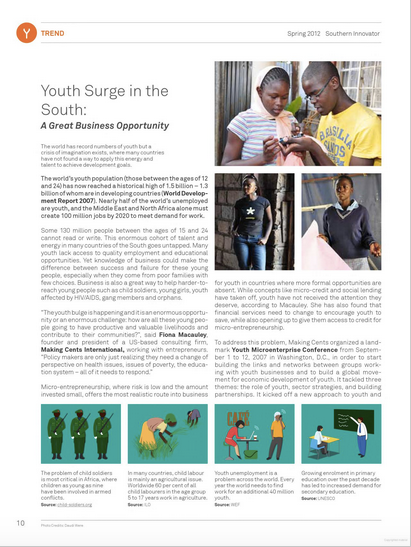
The world’s growing urbanization means that a whole generation of youth will have a dramatically different life than their parents. The world’s 3.3 billion urbanites now outnumber rural residents for the first time (UNFPA’s State of the World Population 2007 Report). And the vast majority live in slums or periurban areas, places of sprawl, where public services are poor and housing conditions unhealthy. Most young people working in the urban informal sector live in slum areas: for example, 75 per cent in Benin in Africa, and 90 per cent in Burkina Faso, the Central African Republic, Chad and Ethiopia. Most of this work is just bare survival work: according to the International Labour Organization, approximately 85 per cent of all new employment falls into this category.

Getting youth into quality work and earning more than enough simply to survive is critical to building a healthy society. Young people are bombarded every day with good and bad influences, and as UNFPA found in its Youth Supplement: Growing Up Urban, “the interactions with the urban environment can have an intense impact on the socialization of young people, exposing them to a multitude of influences as they develop, experiment, question, and assume roles in their societies.”

It is predicted that over the next 10 years, 1.2 billion youths will enter the working-age population (UNFPA). But youth unemployment is a huge problem around the world. Unemployed young people make up almost half (43.7 per cent) of the world’s total unemployed (UNFPA). Young people aged 15 to 19 are more than three times as likely to be unemployed as adults. Young people are the future, a resource no society can afford to waste. If their innate energy and enthusiasm is tapped, countries can see significant economic growth.

There are youth entrepreneurs who are defying the gloom and coming up with great business ideas. Five finalists for BBC Swahili’s regional entrepreneur competition – Faidika na BBC (Prosper with the BBC) – offer inspiration for youth across the South. Finalists from Burundi, Kenya, Rwanda, Tanzania and Uganda were selected for their bright schemes.

The overall winner was 24-year-old Burundian student Ashura Kisesa for a plan to build commercial public toilets in the cities and towns of East and Central Africa. Ashura, who entered but failed to reach the Faidika na BBC finals last year, has 12 brothers and sisters and is studying for a degree in agronomy at Burundi University.

“I am very happy to win the top prize in this competition,” she told the BBC. “The lack of public toilets throughout East and Central Africa is a major problem that needs to be addressed and I hope to make a difference with my business idea. My whole family wanted me to win and they really supported me which makes me especially proud. I cannot wait to get started with my business.”

On June 26 in Kampala, Uganda, Kisesa was awarded US $5,000 to put towards her business.

Kenyan national winner, 22-year-old Witness Omoga from Kakamega, wants to make identity cards for schools. Right now he works as a volunteer at his uncle’s photo studio, and hopes to get into Makerere University to pursue a degree in computer science. “I am very excited,” he said to the BBC. “I have never been number one in my life, but now I have emerged first in this competition.”

The Rwandan winner is a pioneer in the growing field of biomass energy production. A 17-year-old student from Kigali, Rangira Aime Frederick, impressed the panel of judges with his idea to turn domestic waste into energy. The national winner for Tanzania is a private tutor from Dar es Salaam, Apolinary Joseph Laksh. A business education tutor, 23-year-old Apolinary’s idea is to produce charcoal from recycled materials to offer people in rural areas sustainable and affordable cooking fuel.

Ugandan finalist, 23-year-old Dereick Kajukano, is in his last year at Kampala International University doing a degree in business administration. Dereick’s business idea is to make bags out of plastic trash. He was inspired by last year’s Faidika na BBC winner, David Ssegawa from Uganda: “When I heard him defend his proposal on air, I said to myself, why don’t I do it as well. That’s when it all started, and here I am.”

Published: July 2008

Resources

  • 2008 Global Youth Enterprise Conference: Designed as a participatory learning event, this conference aims to support youth enterprise and entrepreneurship programs and policies achieve greater effectiveness around the world.
    Website: www.youthenterpriseconference.org
  • KickStart is a South African project aimed at inculcating a culture of entrepreneurship among young people between the ages of 18 and 35, by promoting business awareness through training, providing grants as start-up capital and providing mentorship and assistance during the setting up phase of the business.
    Website: http://www.sabkickstart.co.za/
  • iDISC – the infoDev Incubator Support Center – is a virtual networking and knowledge-sharing platform for incubators and technology parks leveraging ICT to facilitate entrepreneurship and new business creation in developing countries.
    Website: http://www.idisc.net/en/Index.html
  • Climate Capital Network: this company offers strategic advice, intelligence and assistance with fundraising for low-carbon solutions around the world. They have 2,000 investors looking for projects to invest in.
    Website: http://www.climatecapital.net/
  • Global Entrepreneurship Week: the website for this event in November has many opportunities for youth entrepreneurs to connect with each other through social networking websites.
    Website: http://unleashingideas.org/welcome

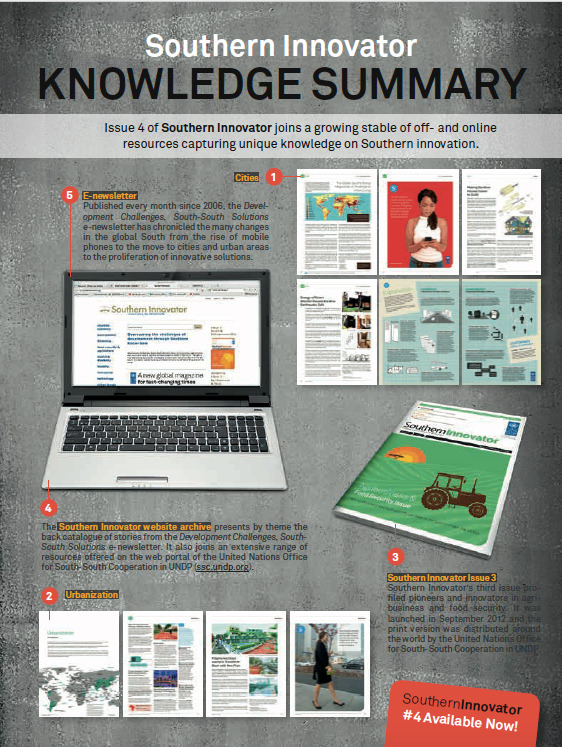
Follow @SouthSouth1

Google Books: https://books.google.co.uk/books?id=waeXBgAAQBAJ&dq=Development+Challenges+February+2008&source=gbs_navlinks_s

Slideshare: http://www.slideshare.net/DavidSouth1/development-challengessouthsouthsolutionsfebruary2008issue

Southern Innovator Issue 1: https://books.google.co.uk/books?id=Q1O54YSE2BgC&dq=southern+innovator&source=gbs_navlinks_s

Southern Innovator Issue 2: https://books.google.co.uk/books?id=Ty0N969dcssC&dq=southern+innovator&source=gbs_navlinks_s

Southern Innovator Issue 3: https://books.google.co.uk/books?id=AQNt4YmhZagC&dq=southern+innovator&source=gbs_navlinks_s

Southern Innovator Issue 4: https://books.google.co.uk/books?id=9T_n2tA7l4EC&dq=southern+innovator&source=gbs_navlinks_s

Southern Innovator Issue 5: https://books.google.co.uk/books?id=6ILdAgAAQBAJ&dq=southern+innovator&source=gbs_navlinks_s

Creative Commons License

This work is licensed under a
Creative Commons Attribution-Noncommercial-No Derivative Works 3.0 License.

ORCID iD: https://orcid.org/0000-0001-5311-1052.

© David South Consulting 2023