Tag: southerninnovator.org

  • Riverwood: Kenyan Super-fast, Super-cheap Filmmaking

    Riverwood: Kenyan Super-fast, Super-cheap Filmmaking

    By David SouthDevelopment Challenges, South-South Solutions

    SOUTH-SOUTH CASE STUDY

    The African film-making success story of Nigeria’s Nollywood has been joined by another fast-rising star: Kenya’s Riverwood. Both are beneficiaries of the digital revolution in filmmaking over the last decade, and both are using low-cost digital filmmaking and editing to tell local stories — in the process making money and creating thousands of jobs.

    The power of creative industries to create jobs and wealth has been a focus of UNESCO, through its Global Alliance for Cultural Diversity. UNESCO has been in the forefront in helping African countries re-shape their policies to take cultural industries into consideration. The promotion of cultural industries also has been incorporated into the New Partnership for Africa’s Development (NEPAD).

    What is particularly attractive about this phenomenon for the poor in the South is its rough-and-ready approach to filmmaking: combining low-cost digital cameras and film editing software on personal computers, with small budgets and fast turn-around times. Films are made on location using local people. These factors make getting into filmmaking accessible and within reach of more people.

    Riverwood is named after River Road, a bustling creative and business hub in Nairobi. Riverwood operates at a furious pace, with 20 to 30 films made every week. It adds up to 1,000 films a year selling 500,000 copies at 200 Kenyan shillings (US $2.60) a piece: 1 billion shillings (US $13 million) in the past two years.

    The whole industry is totally self-sufficient, and is following the well-trodden path laid down by Hollywood and India’s Bollywood.

    One of Kenya’s woman directors is leading the renaissance in filmmaking. “Movies are very important because I think they are the most important art in Kenya – in Africa,” said Wanjiru Kinyanjui in the film, “Riverwood, the Blooming of a Film Industry,” by the World Intellectual Property Organization (www.wipo.org). “Basically, because Africans have an oral tradition, and a visual one, there is a huge market for local films.”

    Riverwood films share a common characteristic of on-the-spot sets and a resourceful and cheap approach.

    “They are shot in two, three days and edited in a week,” she continued. “They are selling because people can identify with them. The films being in Riverwood are basically the lives of people, reflecting the Kenyan way of life and entertaining Kenyans. “

    And it is a new form of employment for many people:  “When I am making a movie, I need people: you employ very many people. And you also employ yourself. It is a real way of getting rid of poverty. Because all this talent, which is untapped, could be working.”

    And as Riverwood rising star director John E. Maina puts it: “Hollywood is the model for any society that wants to develop.”

    While still in its infancy compared to Nigeria’s Nollywood, Riverwood is already pioneering ways to protect the creative rights of filmmakers and build a financially-sustainable industry. Inspired by Hollywood’s ownership of creative material, Kenyan filmmakers have come up with some ingenious solutions. Each production company has a rubber stamp and signs on the sleeve of the DVD (digital video disc) – even if it is 1,000 copies.

    If a director finds a pirated copy, and even if pirates have forged the rubber stamp, the signature will look like a forgery.

    “It is based on a business model,” said director John E. Maina. ”It is commercial. So it is self-sustaining. This is how Bollywood is growing, this is how Nollywood is growing, this is how Hollywood developed.”

    As pioneers in copyright protection, Riverwood directors strongly believe they are an important part of the country’s development.

    “When you pirate a product, and the resources are not channelled back to the person who created that product, he is losing out on creating a new product for you tomorrow,” said Maina. “So you are the loser: tomorrow you will not have another product.

    “Riverwood, Nollywood, Hollywood, are the model for any society that wants to develop. No society will develop without an audiovisual industry. And I think the way to protect an audiovisual industry is through strong copyright laws,” he said.

    “If you go to most of the cafes and the pubs in Kenya, people only turn to TV at 7 o’clock, watch the news, after the news is over, they tell the management to put for them the local DVDs from Riverwood. Because they see themselves, they identify with those images. They don’t identify with the foreign American films, the soaps from South America.<

    “The audiovisual industry is a mirror. If you don’t have a mirror to see yourself, you don’t know who you are. If you don’t have that mirror to see yourself, you are lost.”

    Published: November 2008

    Resources

    • The global charity Camfed (dedicated to eradicating poverty in Africa through the education of girls and empowerment of women) has projects to teach women filmmaking skills. Website: http://uk.camfed.org
    • Festival Panafricain du Cinéma et de la Television de Ouagadoogou 2009: Africa’s biggest film festival. Website: http://www.fespaco.bf/
    • Naijarules: Billing itself as the “largest online community of lovers and critics of Nollywood”, an excellent way to connect with all the players in the business.Website: http://www.naijarules.com/vb/index.php
    • A film by the World Intellectual Property Organization about the Riverwood phenomenon and an introduction to its up-and-coming directors. Website: http://uk.youtube.com/watch?v=OwSu5kcUErE

    Citations

    Cited in The Liverpool Companion to World Science Fiction Film by Sonja Fritzsche (2014).

    Accentuating the positive: Building capacity for creative industries into the development agenda for global intellectual property law by Sean A. Pager, Michigan State University College of Law, American University International Law Review, 2012
    Cinema as cultural discourse: A study of cultural symbols in selected contemporary Gikuyu comedies by Stanley Mbugua Njoroge, School of Creative and Performing Arts, Film and Media Studies, Kenyatta University, 2019

    Other Film Stories

    https://davidsouthconsulting.org/2022/03/30/angolan-film-grabs-attention-at-film-festival/

    https://davidsouthconsulting.org/2022/04/01/bolivian-film-schools-film-scene-paying-off/

    https://davidsouthconsulting.org/2022/10/21/local-animation-a-way-out-of-poverty/

    https://davidsouthconsulting.org/2021/02/04/new-cuban-film-seeks-to-revive-sector/

    https://davidsouthconsulting.org/2020/11/30/nollywood-booming-nigerian-film-industry/

    Creative Commons License

    This work is licensed under a
    Creative Commons Attribution-Noncommercial-No Derivative Works 3.0 License.

    ORCID iD: https://orcid.org/0000-0001-5311-1052.

    © David South Consulting 2023
  • Global South Eco-cities Show How the Future Can Be

    Global South Eco-cities Show How the Future Can Be

    By David SouthDevelopment Challenges, South-South Solutions

    SOUTH-SOUTH CASE STUDY

    The world is currently undergoing a high-stress transition on a scale not seen since the great industrial revolution that swept Europe in the 19th and 20th centuries. Today’s urban and industrial transition involves many more people and is taking place on a greater proportion of the planet. With rapid urbanization comes a demand for middle class lifestyles, with their high-energy usage and high consumption of raw materials.

    This is stretching the planet’s resources to breaking point. And as many have pointed out, if the world’s population is to continue past today’s 7 billion to reach 9 billion and beyond, new ways of living are urgently required. Radical thinking will be necessary to match the contradictory goals of raising global living standards for the world’s poor with pressured resources and environmental conditions.

    But there are innovative projects already under development to build a new generation of 21st-century cities that use less energy while offering their inhabitants a modern, high quality of life. Two examples are in China and the Middle East.

    Both projects are seen as a way to earn income and establish viable business models to build the eco-cities of the future. Each project is seeking to develop the expertise and intellectual capacity to build functioning eco-cities elsewhere. In the case of the Masdar City project in the United Arab Emirates, international businesses are being encouraged to set up in Masdar City and to develop technologies that can be sold to other countries and cities – in short, to create a green technology hub akin to California’s hi-technology hub ‘Silicon Valley’. Masdar City is also being built in stages as investors are found to help with funding. Both projects hope to prove there is money to be made in being green and sustainable.

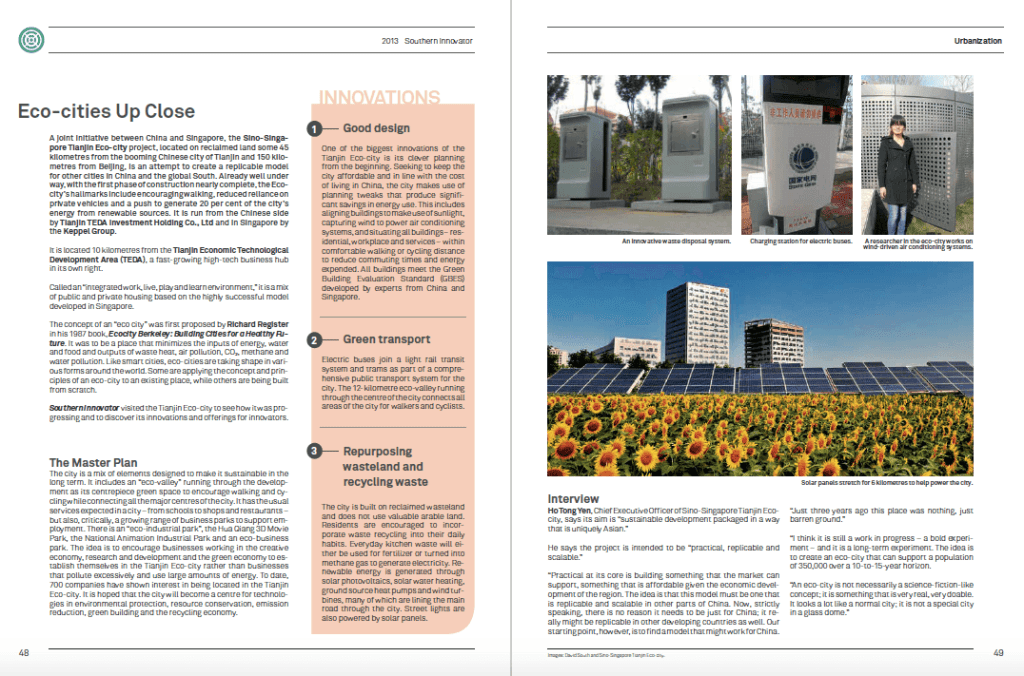
    The Tianjin Eco-city (tianjinecocity.gov.sg) project is a joint venture between China and Singapore to build a 30 square kilometre city to house 350,000 residents.

    Tianjin (http://en.wikipedia.org/wiki/Tianjin) is a large industrial city southeast of China’s capital, Beijing. It is a place that wears the effects of its industrial expansion on the outside. Air pollution is significant and the city has a grimy layer of soot on most outdoor infrastructure.

    China has received a fair bit of criticism for its polluted cities as the country has rapidly modernized in the past two decades. This sprint to be one of the world’s top economic powers has come at a cost to the environment. In this respect, China is not unusual or alone. Industrialization can be brutal and polluting, as Europe found out during its earlier industrial revolution.

    But China is recognizing this can’t go on forever and is already piloting many initiatives to forge a more sustainable future and bring development and high living standards back in line with what the environment can handle.

    Sino-Singapore Tianjin Eco-city is the second large-scale collaboration between the Chinese government and Singapore. The first was the Suzhou Industrial Park (http://www.sipac.gov.cn/english/).The Tianjin project came up in 2007 as both countries contemplated the challenges of rapid urbanization and sustainable development.

    The project’s vision, according to its website, is to be “a thriving city which is socially harmonious, environmentally-friendly and resource-efficient – a model for sustainable development.”

    The philosophy behind the project is to find a way of living that is in harmony, with the environment, society and the economy. It is also about creating something that could be replicated elsewhere and be scaled up to a larger size.

    The city is being built 40 kilometres from Tianjin centre and 150 kilometres from Beijing. It is located in the Tianjin Binhai New Area, considered one of the fastest growing places in China.

    Construction is well underway and can be followed on the project’s website (http://www.tianjinecocity.gov.sg/gal.htm). It will be completed in 2020.

    This year, the commercial street was completed and is ready for residents to move in.

    Residents will be encouraged to avoid motorized transport and to either use public transport or people-powered transport such as bicycles and walking.

    An eco-valley runs down the centre of the city and is meant to be a place for pedestrians and cyclists to enjoy.

    The basic building block of the Eco-city – its version of a city block – is called the Eco Cell. Each Eco Cell measures 400 metres by 400 metres, a comfortable walking distance. Four Eco Cells make a neighbourhood. Several Eco Neighbourhoods make an Eco District and there are four Eco Districts in the Eco-city. It is a structure with two ideas in mind: to keep development always on a walkable, human scale and also to provide a formula for scaling up the size of the Eco-city as the number of residents increases.

    It is a logical approach and seeks to address one of the most common problems with conventional cities: sprawling and unmanageable growth that quickly loses sight of human need.

    Agreement was also reached on the standards that should be achieved for a wide variety of criteria, from air and water quality to vegetation, green building standards, and how much public space there should be per person.

    An ambitious project in the United Arab Emirates is trying to become both the world’s top centre for eco cities and a living research centre for renewable energy. Masdar City (http://www.masdarcity.ae/en/)is planned to be a city for 40,000 people. It is billed as a high-density, pedestrian-friendly development where current and future renewable energy and clean technologies will be “marketed, researched, developed, tested and implemented.”

    The city hopes to become home to hundreds of businesses, a research university and technology clusters.

    This version of an eco-city is being built in three layers in the desert, 17 kilometres from the Emirati capital Abu Dhabi. The goal is to make a city with zero carbon emissions, powered entirely by renewable energy. It is an ambitious goal but there are examples in the world of cities that use significant renewable energy for their power, such as Reykjavik, Iceland in Northern Europe, which draws much of its energy from renewables and geothermal sources.

    Masdar City is designed by world-famous British architect Norman Foster (fosterandpartners.com) and will be 6.5 square kilometres in size.

    The design is highly innovative. The city will be erected on 6 metre high stilts to increase air circulation and reduce the heat coming from the desert floor. The city will be built on three levels or decks, to make a complete separation between transport and residential and public spaces.

    The lowest deck will have a transportation system based on Personal Rapid Transport Pods. These look like insect eyes and are automated, controlled by touch screens, using magnetic sensors for propulsion. On top of this transport network will be the pedestrian streets, with businesses, shops and homes. No vehicles will be allowed there, and people will only be able to use bicycles or Segway (segway.com) people movers to get around. An overhead light railway system will run through the city centre, all the way to Abu Dhabi City.

    “By layering the city, we can make the transport system super-efficient and the street level a much better experience,” Gerard Evenden, senior partner at Foster + Partners, told The Sunday Times. “There will be no car pollution, it will be safer and have more open spaces. Nobody has attempted anything like this.”

    Masdar City is being built in stages as funding comes, with the goal of completion by 2016. It hopes to achieve its aspiration to be the most technologically advanced and environmentally friendly city in the world. As for water supplies in the desert, there is a plan: dew collected in the night and morning and a solar-powered desalination plant turning salt water into drinking water.

    Electricity will come from a variety of sources. Solar panels will be on every roof and double as shade on alleyways. Non-organic waste will be recycled, while organic waste will be turned into fuel for power plants. Dirty water will be cleaned and then used to irrigate green spaces. Because of the design, the planners hope the city will just use a quarter of the energy of a conventional city.

    To keep the city smart and the project on top of developments in renewable energy, the Masdar Institute of Science and Technology (http://www.masdar.ac.ae/) will specialize in renewable energy technology.

    The cost for the city was pegged at US $22 billion in 2009.

    The chief executive of Masdar – Abu Dhabi’s renewable-energy company – is Sultan Al Jaber. He sees the city as a beacon to show the way for the rest of the Emirate to convert from a highly inefficient consumer of energy to a pioneer in green technology.

    “The problem with the renewable-energy industry is that it is too fragmented,” he told The Sunday Times. “This is where the idea for Masdar City came from. We said, ‘Let’s bring it all together within the same boundaries, like the Silicon Valley model (in California, USA).’”

    The project needs to gather much of its funding as it progresses. The United Nations’ Clean Development Mechanism (http://cdm.unfccc.int/) is helping with financing. Companies can earn carbon credits if they help fund a low-carbon scheme in the global South. The sultan is ambitious and sees this as a “blueprint for the cities of the future.” It has been able to bring on board General Electric (GE) and the Massachusetts Institute of Technology (MIT) to sponsor the university.

    It is possible to visit Masdar City and take a tour (http://www.masdarcity.ae/en/105/visit-masdar-city/) and it is also possible to view online what has been built so far (http://www.masdarcity.ae/en/32/built-environment/).

    Published: June 2012

    Resources

    1) Center for Innovation, Testing and Evaluation (CITE): Located in Texas, USA, CITE is a fully functioning city with no residents to test new technologies before they are rolled out in real cities. Website: http://www.pegasusglobalholdings.com/test-center.html

    2) Digital Cities of the Future: In Digital Cities, people will arrive just in time for their public transportation as exact information is provided to their device. The Citizen-Centric Cities (CCC) is a new paradigm, allowing governments and municipalities to introduce new policies. Website: http://eit.ictlabs.eu/action-lines/digital-cities-of-the-future/

    3) Eco-city Administrative Committee: Website: http://www.eco-city.gov.cn/

    4) Sino-Singapore Tianjin Eco-city, Investment and Development Co., Ltd. Website: tianjineco-city.com

    5) ‘The Future Build’ initiative, a new green building materials portal from Masdar City. Website: thefuturebuild.com

    6) UNHABITAT: The United Nations Human Settlements Programme is the UN agency mandated to promote socially and environmentally sustainable towns and cities with the goal of providing adequate shelter for all. Website: http://www.unhabitat.org

    Creative Commons License

    This work is licensed under a
    Creative Commons Attribution-Noncommercial-No Derivative Works 3.0 License.

    ORCID iD: https://orcid.org/0000-0001-5311-1052.

    © David South Consulting 2022

  • Egyptian Youth Turns Plastic Waste into Fuel

    Egyptian Youth Turns Plastic Waste into Fuel

    By David SouthDevelopment Challenges, South-South Solutions

    SOUTH-SOUTH CASE STUDY

    The challenge of finding alternate fuel sources is capturing the imagination of innovators across the global South. As the world’s population increases – it recently reached 7 billion (UN) – and the number of people seeking a better life grows in turn, the energy demands on the planet are pushing up competition for existing conventional fuel sources.

    The modern lifestyle that many aspire to requires energy, whether it’s using electronic products which consume large quantities of electricity, driving personal vehicles or living in homes that are artificially heated and cooled.

    This energy hunger has opened up a whole new market demand that needs to be met. The scale of this market is enormous, but the solutions are ultimately limited only by people’s imaginations. An award-winning Egyptian teenage scientist is capturing attention for the imaginative solution of turning waste plastic into biofuel, sparking interest in the creation of a whole new source of wealth for her country.

    Sixteen-year-old Azza Abdel Hamid Faiad (http://tinyurl.com/dysemjg) has found a new way to take waste plastic and break it down into fuel. She has discovered aluminosilicate minerals (http://en.wikipedia.org/wiki/Aluminosilicate) – which contain aluminium, silicon and oxygen and are found in clays – can break down the polymers that make up plastic (http://en.wikipedia.org/wiki/Polymer) to produce the gases methane, propane and ethane, all of which can be turned into ethanol (http://en.wikipedia.org/wiki/Ethanol), which is useful as a biofuel.

    According to Inhabitat (inhabitat.com), a website dedicated to “green design, innovation, and the future of clean technology,” her solution could turn the country’s annual consumption of 1 million tonnes of plastic into a year’s supply of biofuel worth US $78 million.

    Clever innovators are sitting on a goldmine if they can come up with renewable energy solutions. The U.S. Army alone is looking to spend US $7 billion on renewable energy sources and is accepting bids from the private sector to meet its needs (http://www.forbes.com/sites/toddwoody/2012/08/08/u-s-army-opens-bids-to-buy-7-billionin-renewable-energy/). The army is looking to sign contracts stretching up to 30 years for buying electricity generated by solar, wind, geothermal and biomass projects.

    The options are numerous for renewable energy – from solar power to wind power to algae as a source of biofuels (http://en.wikipedia.org/wiki/Biofuel). The challenge is to find a fuel source that is plentiful, renewable, and crucially, doesn’t harm other needs.

    Using biofuel as a replacement for conventional petroleum-based fuels like gasoline and diesel appears to be an attractive solution, but it can lead to other problems. Some people are using used cooking oils to convert into biodiesels, but sometimes there is not enough used cooking oil to meet demand. In short, a constant supply source is required to meet ever-increasing energy demand.

    A famous example of where the use of renewable plant-based fuel sources can go wrong is the case of corn. The widespread use of corn as a source for biofuels – rather than for animal feed or human food – has led to accusations this is contributing to the global food crisis. The current drought in the United States is damaging corn crops and only making this problem more acute. The U.S. is the world’s largest producer of corn (US Department of Agriculture) and much of it is used as livestock feed around the world.

    Faiad’s solution is appealing because the fuel does not come from biomass – derived from plant matter – but turns waste plastic into the raw material for biofuel.

    Plastic waste is a common byproduct of modern life. Plastic is used extensively in packaging, bottles, bags and electronic products. It fills up landfill sites and is a blight on the landscape in many countries. It is also a product made from petrochemicals (http://en.wikipedia.org/wiki/Plastic), the very source of conventional fuel used by most of the world’s vehicles.

    Breaking down waste plastic from bottles, packaging and other products into what is called ‘biofuel feedstock’ – the substance necessary to start the creation of biofuel – requires a means to turn the plastic into fuel.

    According to Green Prophet (greenprophet.com), Faiad believes her technological breakthrough “can provide an economically efficient method for production of hydrocarbon fuel namely: cracked naphtha (http://en.wikipedia.org/wiki/Petroleum_naphtha) of about 40,000 tons per year and hydrocarbon gases of about 138,000 tons per year equivalent to US $78 million.”

    This could be a big economic boost to Egypt’s economy, simultaneously reducing dependence on petroleum-based fuels and creating a new source of income. Egypt’s economy has been hit hard since the start of the Arab Spring (http://en.wikipedia.org/wiki/Arab_Spring). The number of tourists fell 33 per cent in 2011 and revenue dropped by US $3.7 billion from 2010 (Egyptian Tourism Minister). In 2009 about 12.5 million tourists visited Egypt, bringing revenue of US $10.8 billion. The tourism sector is one of the country’s top sources of foreign revenue, accounting for more than 11 per cent of GDP, and offers jobs in a country beset by high unemployment – for Egypt, tourism makes up 11 per cent of its GDP (gross domestic product) (Reuters).

    Faiad’s innovation has not gone unnoticed. She received the European Fusion Development Agreement award (http://www.efda.org/) at the 2011 23rd European Union Contest for Young Scientists (http://ec.europa.eu/research/youngscientists/index_en.cfm). She is also receiving interest from the Egyptian Petroleum Research Institute (http://www.epri.sci.eg/), according to Inhabitat.

    Ambitious Faiad is also seeking to take ownership of her innovation by getting a patent from the Egyptian Patent Office (http://www.egypo.gov.eg/english/default.htm).

    Published: August 2012

    Resources

    1) Biofuel: A website with a good overview of biofuel options and directions on how to make biofuel. Website: http://biofuel.org.uk/

    2) Biogasmax: Biogas Highway – waste to energy concept, 18-19 September in Gothenburg, Sweden. Participate in an intensive two-day programme with complete focus on biogas at the Water and Wastewater Fair. Meet with exhibiting Swedish biogas companies and companies within the water and wastewater sectors. Participate at the “International biogas business opportunities” seminar and learn more about biogas concepts and strategies. Website: http://www.biogasmax.eu/

    3) New Techniques Create Butanol, A Superior Biofuel: A story from Science Daily about new techniques to produce a biofuel superior to ethanol. Website: http://www.sciencedaily.com/releases/2008/01/080123153142.htm

    4) Biofuels Digest: The Digest covers producer news, research, policy, policymakers, conferences, fleets and financial news. Website: http://www.biofuelsdigest.com/bdigest/

    Follow @SouthSouth1

    Slideshare: http://www.slideshare.net/DavidSouth1/development-challengessouthsouthsolutionsnovember2010issue

    Southern Innovator Issue 1: https://books.google.co.uk/books?id=Q1O54YSE2BgC&dq=southern+innovator&source=gbs_navlinks_s

    Southern Innovator Issue 2: https://books.google.co.uk/books?id=Ty0N969dcssC&dq=southern+innovator&source=gbs_navlinks_s

    Southern Innovator Issue 3: https://books.google.co.uk/books?id=AQNt4YmhZagC&dq=southern+innovator&source=gbs_navlinks_s

    Southern Innovator Issue 4: https://books.google.co.uk/books?id=9T_n2tA7l4EC&dq=southern+innovator&source=gbs_navlinks_s

    Southern Innovator Issue 5: https://books.google.co.uk/books?id=6ILdAgAAQBAJ&dq=southern+innovator&source=gbs_navlinks_s

    Creative Commons License

    This work is licensed under a
    Creative Commons Attribution-Noncommercial-No Derivative Works 3.0 License.

    ORCID iD: https://orcid.org/0000-0001-5311-1052.

    © David South Consulting 2023

  • Press Release 3 | Southern Innovator

    Press Release 3 | Southern Innovator

    Press Release for General Distribution

    Southern Innovator’s Fifth Issue Profiles Innovators in Waste and Recycling

    United Nations, New York, USA, 28 April 2014

    • Fifth issue of Southern Innovator tackles ways to improve human development in a world with finite resources
    • 60-page color magazine offers a snapshot of our fast-changing world

    The fifth issue of Southern Innovator (SI) magazine is out now. It explores how innovation can tackle the challenges of improving human development on a planet with finite resources.

    SI researchers identified innovative, low-polluting options to the world’s energy needs. They found that it is possible to alter the way that things are made to reduce or eliminate waste and toxic pollutants harming human health and damaging the environment. And not only that: they also discovered that there are sustainable incomes to be made from the economy of waste reduction and recycling – an opportunity that has yet to be fully realized. The innovations shared here demonstrate that raising living standards in the global South and responsible use of the world’s resources are not necessarily incompatible.

    Some innovators are transforming attitudes towards fashion, proving that it does not have to be a wasteful industry. Others are turning commonly found waste – food waste, or human or animal excrement – into fuel for heating. The link between good design and the efficient use of resources is apparent in many of the innovators’ solutions. If a new, green economy is to work, then it must appeal to people’s aspirations and be something that they want in their lives and are willing to work to achieve.

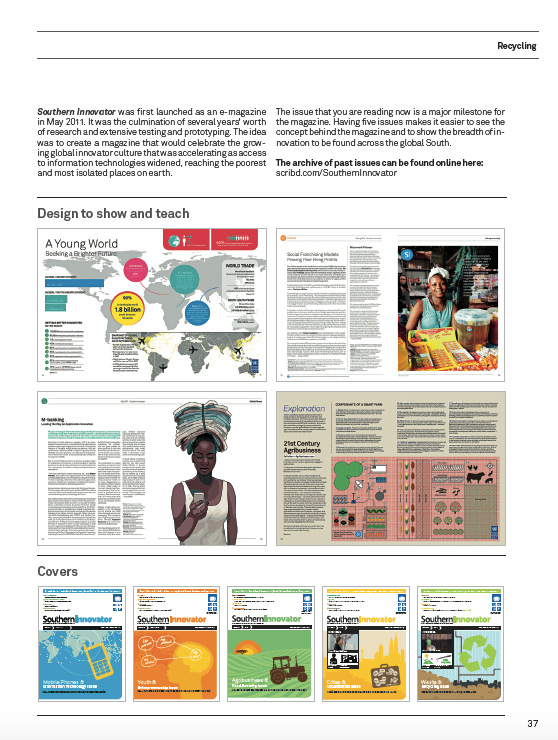
    Southern Innovator (southerninnovator.org) champions a 21st-century global innovator culture. It is based on intensive research and produced by the United Nations Office for South-South Cooperation in (UNOSSC) in UNDP. UNOSSC also organizes the annual Global South-South Development Expo (southsouthexpo.org), a traveling celebration bringing together Southern innovators, with previous venues in New York, Washington, D.C., Geneva, Rome,Vienna, Nairobi and Doha.

    We hope that you enjoy the magazine and find its content interesting and illuminating, a snapshot of a fast-changing world awash with innovators, creators and doers making their world a better place.

    For information on sponsoring issues of the magazine, either through helping to fund its print run, or through an insert relating to an issue’s theme with pertinent content for our readers, contact Cosmas Gitta at cosmas.gitta@undp.org.

    Online archives: southerninnovator.org; http://www.scribd.com/SouthernInnovator. Follow us @SouthSouth1

    Press Release 2

    Press Release 1

    United Nations General Assembly: Sixty-ninth session, Item 24 (b) of the provisional agenda, Operational activities for development: South-South cooperation for development, 17 July 2014.
    The research informing Southern Innovator Magazine played a part in the formulation of the UN’s post-2015 development agenda, including the Sustainable Development Goals (SDGs).

    https://davidsouthconsulting.org/southern-innovator-scale-up-fundraiser/

    ORCID iD: https://orcid.org/0000-0001-5311-1052.

    © David South Consulting 2022