Tag: southerninnovator.org

  • Innovative Ways to Collect Water from Air

    Innovative Ways to Collect Water from Air

    By David SouthDevelopment Challenges, South-South Solutions

    SOUTH-SOUTH CASE STUDY

     World water resources are being depleted quickly as populations grow, urbanize and demand better living standards. Many scientists believe we are reaching peak water – the point at which fresh water is consumed faster than it is replenished.

    According to Ensia (ensia.com), a magazine showcasing environmental solutions in action, 70 per cent of the earth’s fresh water reserves are locked up in snow or ice, and are expensive to tap and bring to the world’s water-stressed places. Of the remainder, most is in groundwater, soil moisture, swamps or permafrost, while just 0.3 per cent is easy to access in freshwater lakes and rivers.

    By far the biggest user of water in the world – accounting for 69 per cent of the total – is farm irrigation. That’s a serious concern when considering the world will need to grow more food to feed an increasing population. Just 1 per cent of water is used for livestock, while 15 per cent is used for electricity generation and 7 per cent for manufacturing. More water is currently being pumped from underground resources than is being replaced from underground aquifers.

    The average person needs to consume 0.6 to 1.3 gallons (2.72 liters to 6 liters) of water per day to survive in a moderate climate. For drinking, cooking, bathing and sanitation, an individual needs 13 gallons (59 liters) a day (Ensia).

    In many places, obtaining water requires a long trek to a well or stream. But non-desert climates have water as a resource readily available all around – trapped in the air. The clue to this resource’s existence is in the air’s humidity levels, the most visible sign of which is the dew that is found covering the grass and leaves every morning when people wake up. The trick is to extract that water from the air and create a steady supply of this essential resource.

    Italian architect and designer Arturo Vittori (http://www.vittori-lab.com/team/arturo-vittori), a lecturer on aerospace architecture, technology transfer and sustainability, believes he has an answer.

    Wired magazine (http://www.wired.com/2014/03/warka-water-africa/) reported that Vittori was inspired by a trip to Ethiopia, where he observed the daily struggle to get water. Access to water in northeastern Ethiopia often requires a long walk, which reduces the amount of time left in the day to do other things. Parents often take along their children, meaning the children cannot go to school. The time consumed by gathering water leaves people poorer and unable to dedicate more of their day to income-earning activities.

    And there is no guarantee the water is safe to drink or free of chemical contaminants. This situation left Vittori pondering ways of coming up with an inexpensive solution that would eliminate the daily hassle of finding water and guarantee its quality.

    The answer was a WarkaWater Tower (http://www.architectureandvision.com/projects/chronological/84-projects/art/492-073-warkawater-2012?showall=&start=1). The bamboo structure – which looks like an upended, latticework funnel – captures the dew and moisture in the air and collects it in a basket at the bottom.

    The water collector is inspired by the Warka tree, or Ficus vasta (http://en.wikipedia.org/wiki/Ficus_vasta). Native to Ethiopia, it is known for providing shade and as a rendezvous point for traditional gatherings.

    A WarkaWater Tower stands 8 meters in height and is made from either bamboo or reeds. Inside, a mesh traps humidity from the air and the water drips down into a basket. One tower can gather around 94 liters of water a day. The water is right there in the community and not kilometers away, meaning time and energy saved for income-generating tasks.

    A WarkaWater Tower is constructed in sections, which are assembled and then stacked on top of each other. The construction does not need special scaffolding or special machinery. Once the tower is in place, it can also be used as a solar-power generator.

    The tower is still a prototype and Vittori plans to build two towers for a launch in 2015.

    In Peru, reports the Latin American Herald Tribune (http://www.laht.com/article.asp?ArticleId=700400&CategoryId=14095), another innovative solution to the water crisis has been developed by students at the University of Engineering and Technology (UTEC) (http://www.utec.edu.pe/Utec.aspx). The students have developed a highway advertising billboard that can draw drinking water out of the air. Inspired by a campaign called “Ingenuity in Action”, the students teamed up with a local advertising agency to design the billboard. It is capable of extracting water from the air and processing it through a filtration system as it flows down to a series of taps at the bottom.

    The water-making billboard is at the 89.5 kilometer distance marker of the Pan-American Highway and has five electric-powered tanks that can hold a total of 96 liters of drinkable water. It is capable of providing enough water for hundreds of families. A true sign of our times!

    Published: July 2014

    Resources

    1) How to Build a Rainwater Collection System. Website: http://www.wikihow.com/Build-a-Rainwater-Collection-System

    2) The geopolitical difficulties of access to water covered in The Devil and the Disappearing Sea: A True Story about the Aral Sea Catastrophe by Robert Ferguson. Website: amazon.com

    3) “Earth may have underground ‘ocean’ three times that on surface” from The Guardian. Website: http://www.theguardian.com/science/2014/jun/13/earth-may-have-underground-ocean-three-times-that-on-surface

    An article on the impact of the water crisis on food supplies. Website: http://www.theguardian.com/lifeandstyle/2014/jul/09/enjoy-your-coffee-you-may-soon-not-be-able-to-afford-it

    5) How to Make Water in the Desert. Website: http://www.wikihow.com/Make-Water-in-the-Desert


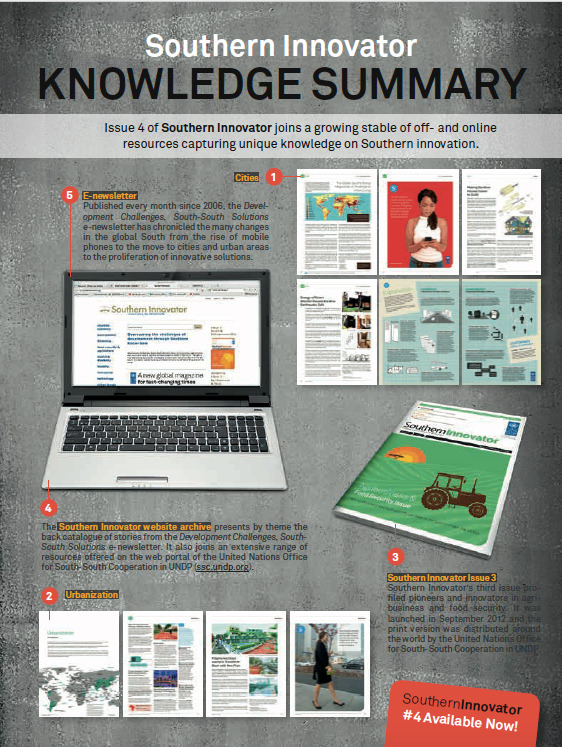
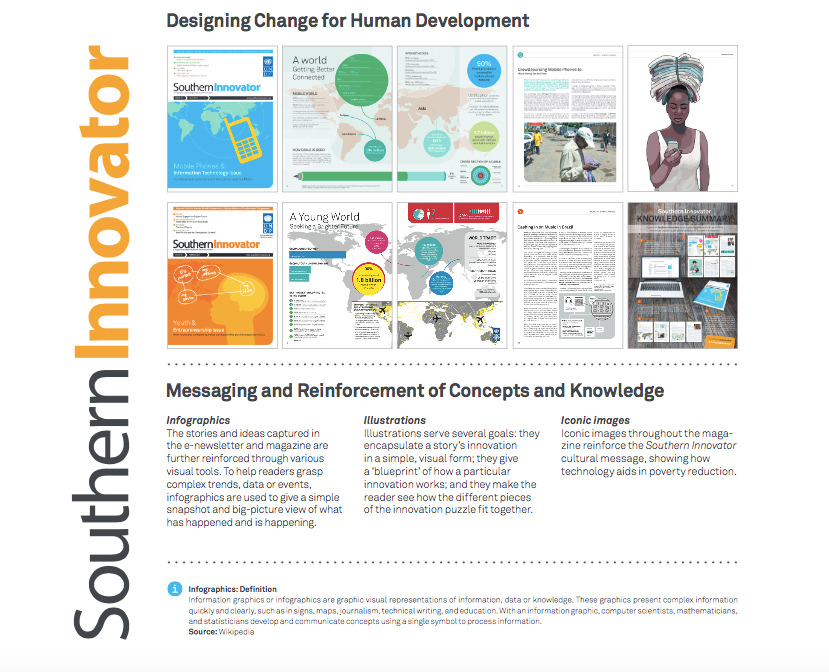
    Development Challenges, South-South Solutions was launched as an e-newsletter in 2006 by UNDP’s South-South Cooperation Unit (now the United Nations Office for South-South Cooperation) based in New York, USA. It led on profiling the rise of the global South as an economic powerhouse and was one of the first regular publications to champion the global South’s innovators, entrepreneurs, and pioneers. It tracked the key trends that are now so profoundly reshaping how development is seen and done. This includes the rapid take-up of mobile phones and information technology in the global South (as profiled in the first issue of magazine Southern Innovator), the move to becoming a majority urban world, a growing global innovator culture, and the plethora of solutions being developed in the global South to tackle its problems and improve living conditions and boost human development. The success of the e-newsletter led to the launch of the magazine Southern Innovator.  

    https://davidsouthconsulting.org/2022/11/02/clay-filters-are-simple-solution-for-clean-water/

    https://davidsouthconsulting.org/2023/01/16/hip-driven-pump-brings-water-to-parched-fields/

    https://davidsouthconsulting.org/2022/11/19/saving-water-to-make-money/

    https://davidsouthconsulting.org/2021/03/05/southern-innovator-issue-5/

    https://davidsouthconsulting.org/2022/02/10/urban-farmers-gain-from-waste-water/

    https://davidsouthconsulting.org/2022/10/17/the-water-free-south-african-bathing-solution/

    Follow @SouthSouth1

    Google Books: https://books.google.co.uk/books?id=waeXBgAAQBAJ&dq=Development+Challenges+February+2008&source=gbs_navlinks_s

    Slideshare: http://www.slideshare.net/DavidSouth1/development-challengessouthsouthsolutionsfebruary2008issue

    Southern Innovator Issue 1: https://books.google.co.uk/books?id=Q1O54YSE2BgC&dq=southern+innovator&source=gbs_navlinks_s

    Southern Innovator Issue 2: https://books.google.co.uk/books?id=Ty0N969dcssC&dq=southern+innovator&source=gbs_navlinks_s

    Southern Innovator Issue 3: https://books.google.co.uk/books?id=AQNt4YmhZagC&dq=southern+innovator&source=gbs_navlinks_s

    Southern Innovator Issue 4: https://books.google.co.uk/books?id=9T_n2tA7l4EC&dq=southern+innovator&source=gbs_navlinks_s

    Southern Innovator Issue 5: https://books.google.co.uk/books?id=6ILdAgAAQBAJ&dq=southern+innovator&source=gbs_navlinks_s

    Creative Commons License

    This work is licensed under a
    Creative Commons Attribution-Noncommercial-No Derivative Works 3.0 License.

    ORCID iD: https://orcid.org/0000-0001-5311-1052.

    © David South Consulting 2023

  • Carbon Credits Can Benefit African Farmers Thanks to New System

    Carbon Credits Can Benefit African Farmers Thanks to New System

    By David SouthDevelopment Challenges, South-South Solutions

    SOUTH-SOUTH CASE STUDY

    The global carbon credit trading schemes emanating from the Kyoto Protocol are now creating a multi-billion dollar market – the European carbon market was worth €14.6 billion in 2006 – and represents one of the fastest growing business opportunities in the world. Being green has finally come of age. Yet all the benefits of this are largely bypassing Africa despite more than 70 percent of the continent’s inhabitants earning a living off the land.

    The World Agroforestry Centre – whose mission is to advance the science and practice of agroforestry to transform the lives and landscapes of the rural poor in developing countries – in partnership with Michigan State University has developed a method using satellite imagery and infrared sensing that measures carbon storage in African farmland. They have completed a pilot programme in western Kenya and are ready to encourage poor farmers to plant trees as soon as the European Union allows carbon credits under the Kyoto Protocol to be awarded for this kind of scheme. Further pilot projects will be rolled out in 2007 in partnership with CARE International and the WWF.

    But European Union policies on carbon credits are holding back this significant opportunity to enhance African livelihoods. Europe’s Emissions Trading Scheme (ETS) is at present not willing to recognize the new method of verifying carbon storage in farmland. The ETS is the largest multi-country, multi-sector greenhouse gas emission trading scheme in the world. The issue of carbon storage, or carbon “sinks” as they are known, is very controversial in the world of Kyoto agreement implementation. Non-government organizations that advocate for forests and indigenous people have worked hard to exclude the use of forestry credits to offset fossil fuel burning, arguing that forestry offsets to date have been for big monoculture plantations of fast-growing eucalyptus or pine trees. It is claimed they are net carbon emitters over their lifetimes and also cause additional environmental and social problems.

    But the World Agroforestry Centre’s approach is very different from a monoculture plantation. Their scheme is to help rural Africans to integrate more trees into their agricultural production systems, with benefits besides storing carbon. They argue that the right kinds of trees can increase the productivity and resilience of the land. Trees provide food, fuel, fertilizer, and medicine – medicinal trees are the main source of medication for 80 percent of Africa’s population.

    Louis Verchon, the lead scientist for climate change at the World Agroforestry Centre, believes that if the EU would put in place a new scheme to credit farmers who capture carbon in their land, “millions of dollars in carbon credits could begin flowing to the world’s rural poor.” At present, Verchon says two-thirds of the carbon credit business is being captured by Asian countries who are mostly offering industrial solutions. “Africa has something to offer on this – it can’t compete with the likes of South Korea on industrial solutions, but it has plenty of land.”

    In order to make the scheme work, two things will need to be improved: Africa’s institutional weakness and the paucity of qualified carbon credit verifiers. A network of verifiers would be required to inspect farm sites and make the calculations required to allocate carbon credits to poor farmers. At present, there are no qualified African-born verifiers in Africa according to Verchon.

    The WAC are working with WWF and CARE to build up NGO capacity and start demonstration projects to prove it can work – two pilot projects are already up and running in Kenya. They are also automating much of the process by building a web portal.

    Verchon says the WAC “are in it for the long-haul and we will see this grow over the next ten years.”

    Published: January 2007

    Resources

    • More on emissions trading: Click here
    • Kenya’s Greenbelt Movement: Founded by Nobel Peace Prize winner Wangari Maathai, it provides income and sustenance to millions of people in Kenya through the planting of trees.
    Creative Commons License


    This work is licensed under a
    Creative Commons Attribution-Noncommercial-No Derivative Works 3.0 License.

    ORCID iD: https://orcid.org/0000-0001-5311-1052.

    © David South Consulting 2023

  • Insects Can Help in Food Crisis

    Insects Can Help in Food Crisis

    By David SouthDevelopment Challenges, South-South Solutions

    SOUTH-SOUTH CASE STUDY

    For many years it was a given that the world’s problem was not a lack of food, but that it was unfairly shared. But as the switch to biofuels gathers pace, farmland is being diverted away from growing food for people, to food for fuel. On top of this, growing prosperity in many countries in the South has boosted demand for better quality food, including grain-devouring meat diets – it takes 10 kilograms of grain to get one kilogram of meat from a cow. The crisis has deeply alarmed the UN’s World Food Programme and the World Bank. In the economic battle for food, the poor are the most vulnerable.

    So-called agflation (agricultural inflation) has seen spiraling food prices, which in turn are causing food shortages, hunger and malnutrition around the world. For example, rice in Thailand has jumped from US $400 per 100 kilograms in January, to US $760. World grain stocks are at their lowest level in four decades.

    But where can new sources of food be found? And what would be a more efficient use of the world’s resources to feed the growing population? One answer, surprisingly, is insects.

    In February this year the UN’s Food and Agriculture Organization held a conference in Chiang Mai, Thailand to devour the dietary value of insects as food and discuss how to harvest more of them. The working group of three dozen scientists from 15 countries probed the role of edible forest insects in food security. They explored insect protein as a contributor to better nutrition, the economics of collecting edible forest insects, methods of harvesting, processing and marketing edible forest insects, and ways of promoting insect eating with snacks, dishes, condiments — even recipes.

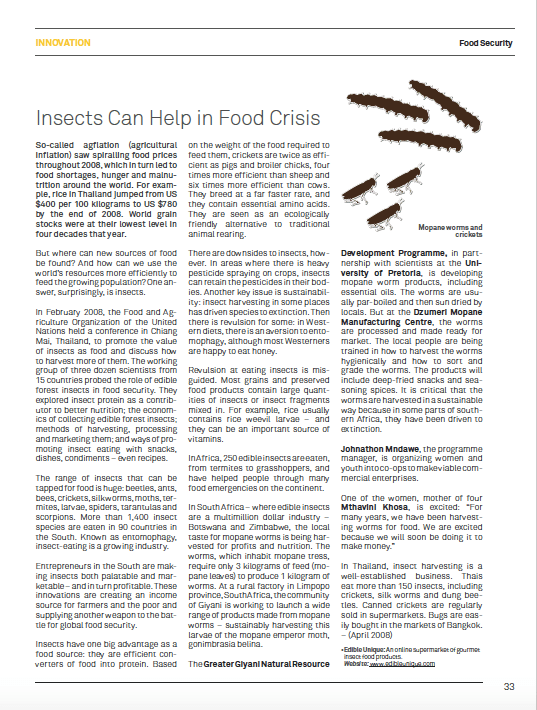
    The range of insects that can be tapped for food is huge: beetles, ants, bees, crickets, silk worms, moths, termites, larvae, spiders, tarantulas and scorpions. More than 1,400 insect species are eaten in 90 countries in the South. Known as entomophagy, insect eating is a growing industry. Entrepreneurs in the South are making insects both palatable and marketable – and in turn profitable. These innovations are adding another income source for farmers and the poor, and supplying another weapon to the battle for global food security.

    Insects have one big advantage as a food source: they are efficient converters of food into protein. Based on the weight of the food required to feed them, crickets are twice as efficient as pigs and broiler chicks, four times more efficient than sheep and six times more efficient than cows. They breed at a far faster rate, and they contain essential amino acids. They are seen as an ecologically friendly alternative to traditional animal rearing.

    There are downsides to insects, however. In areas where there is heavy pesticide spraying on crops, insects can retain the pesticides in their bodies. Another key issue is sustainability: insect harvesting in some places has driven species to extinction. Then there is revulsion for some: in Western diets, there is an aversion to entomophagy, although most Westerners are happy to eat honey.

    Revulsion at eating of insects is misguided. Most grains and preserved food products contain large quantities of insects or insect fragments mixed in. For example, rice usually contains rice weevil larvae – and they can be an important source of vitamins.

    In Africa, 250 edible insects are eaten, from termites to grasshoppers, and have helped people through many food emergencies on the continent.

    In South Africa — where edible insects are a multimillion dollar industry — Botswana and Zimbabwe, the local taste for mopane worms is being harvested for profits and nutrition. The worms, which inhabit mopane tress, require only three kilograms of feed (mopane leaves) to produce one kilogram of worms. At a rural factory in Limpopo province, South Africa, the community of Giyani is working to launch a wide range of products made from mopane worms – sustainably harvesting this larvae of the mopane emperor moth, gonimbrasia belina.

    The Greater Giyani Natural Resources Development Programme in partnership with scientists at the University of Pretoria, is developing mopane worm products, including essential oils. The worms are usually par-boiled and then sun dried by locals. But at the Dzumeri Mopane Manufacturing Centre, the worms are processed and made ready for market. The local people are being trained in how to harvest the worms hygienically, and how to sort and grade the worms. The products will include deep-fried snacks and seasoning spices. It is critical the worms are harvested in a sustainable way, because in some parts of southern Africa, they have been driven to extinction.

    Johnathon Mndawe, the programme manager, is organizing women and youth into co-ops to make viable commercial enterprises. “We expect the product to hit supermarket shelves in 2009,” said Morewane Mampuru, coordinator for the Centre for Scientific and Industrial Research, another partner.

    One of the women, mother of four Mthavini Khosa, is excited: “For many years, we have been harvesting worms for food. We are excited because we will soon be doing it to make money.”

    In Thailand, insect harvesting is a well-established business. Thais eat more than 150 insects, including crickets, silk worms and dung beetles. Canned crickets are regularly sold in supermarkets. Bugs are easily bought in the markets of Bangkok.

    Online vendor Thailand Unique, based in Udon Thani, sells and markets a wide range of edible insects. They include edible scorpions, preserved giant water bugs, roasted grasshoppers, edible big crickets, bamboo worms, crushed giant bug paste, and introducing this year, Bug Snackz and Scorpion Thai Green Curry. There is even a ‘Bug Sample Pack’, containing a mix of seven edible insects and arachnids, all slow roasted for easy snacking.

    Another important centre for insect harvesting is Latin America. In Venezuala, the Pemon Indians eat fire ants during the rainy season.

    In Colombia, so-called “fatass ant” or “hormiga culona” is eaten like popcorn in movie theatres. Some believe it is a defence against cancer, or a natural aphrodisiac. Eating the ants or culona, has been happening right back to the ancient Guane Indians.

    In Santander province, farmers are exporting the ants for sale, some being dipped in Belgian chocolate and sold as a luxury food in London’s Harrods and Fortnum and Mason department stores. The abundant ant population brings in US $11 a pound (kilogram conversion) for the farmers, a doubling in price since 2000.

    Farmers in the artist colony of Barichara harvest the ants – though concerns have been raised that they have been over-harvesting the population. Restaurants in the area offer ant-based spreads for bread and an ant-flavored lamb sauce.

    “It’s an age-old dilemma for the farmer — should I kill it or eat it?” said Andres Santamaria to CBS News, who was given a $40,000 grant from Santander’s government to develop an environmentally sustainable, export-oriented programme for breeding the ants.

    In Tijuana, Mexico, ancient Aztec, pre-Colombian insect meals are on offer at this restaurant, joining a global trend. Cien Anios (“100 Years”), specialises in pre-Colombian, Aztec insect recipes. It is proof there is money in preparing insects for food. Typical dishes include garlicky ant eggs and cactus worms in butter.

    Published: April 2008

    Resources

    • A network for insect collectors: Website: www.insect.net
    • Sunrise Land Shrimp: A do-it-yourself guide to raising and harvesting insects for food, with important information on health and hygiene: Website: www.slshrimp.com
    • Edible Unique: An online supermarket of gourmet insect food products. Website: www.edibleunique.com

    https://davidsouthconsulting.org/2022/11/18/farmers-weather-fertilizer-crisis-by-going-organic/

    https://davidsouthconsulting.org/2022/11/11/urban-farming-to-tackle-global-food-crisis/

    Tijuana‘s Cien Años was the original inspiration for this story. As one of the first stories to draw attention to the insects-for-food market, it contributed to a growing awareness of this exciting food source. I had a delicious all-insect meal there in 2002.

    https://davidsouthconsulting.org/2021/03/05/southern-innovator-issue-3/

    Creative Commons License

    This work is licensed under a
    Creative Commons Attribution-Noncommercial-No Derivative Works 3.0 License.

    ORCID iD: https://orcid.org/0000-0001-5311-1052.

    © David South Consulting 2022

  • African Youth Want to do Business in Fast-growing Economy

    African Youth Want to do Business in Fast-growing Economy

    By David SouthDevelopment Challenges, South-South Solutions

    SOUTH-SOUTH CASE STUDY

    Africa’s growing economy is meeting head-on an optimistic young population keen to start businesses. At least that is what a new poll of African youth says, finding that one in five Africans between the ages of 15 and 24 without a current business wants to start one in the next 12 months.

    The Gallup surveys (www.gallup.com) of 27 African countries and areas also found young women were just as keen as young men to start a business.

    Throughout the decade of the 2000s, Africa experienced an average economic growth rate of 5.4 percent (World Bank) – a big gain from the poor growth rates of the 1980s and early 1990s.

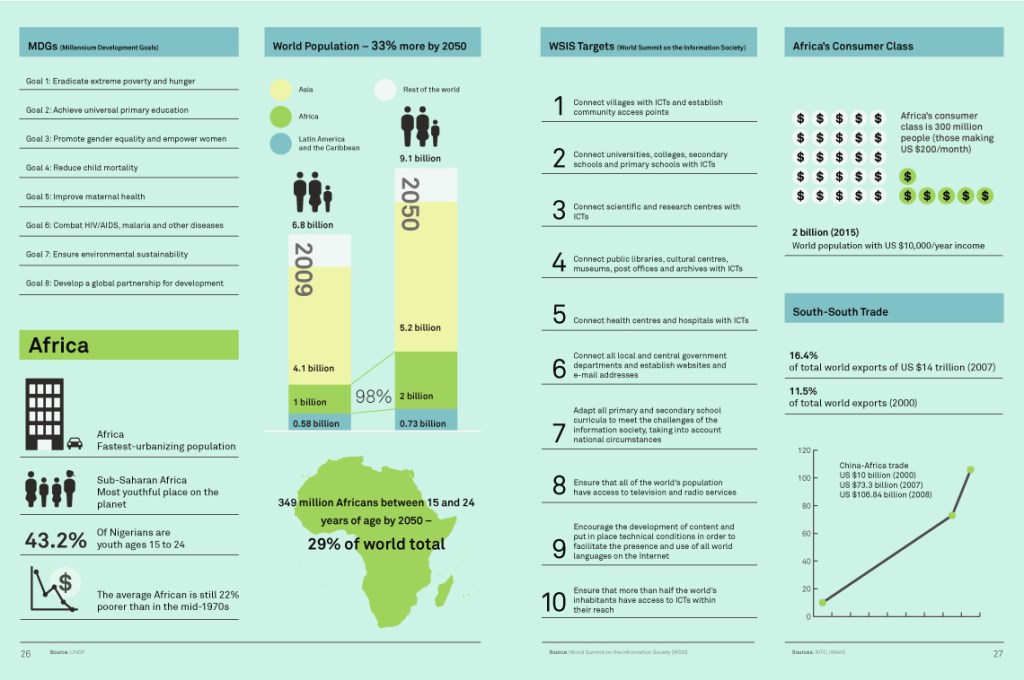
    The turnaround in Africa’s economic growth prospects was the product of a number of trends and factors. One has been better policies and easier trade. Other factors include rising tourism, a growing service sector, rising commodity prices, greater demand for African exports in emerging economies and rapidly improving communications: the surge in mobile phone usage during the last five years has surprised many. Africans are also avid spenders on goods and services, spending US $860 billion on them in 2008, more than India’s US $635 billion or Russia’s US $821 billion (Economic Report on Africa 2011).

    The African Development Bank predicts Africa’s growth rate for 2011 will decline to 3.7 percent from 2010’s 4.9 percent, largely as a result of turmoil in North Africa. East Africa is projected to grow the fastest this year at 6.7 percent, with West Africa close behind at 5.9 percent.

    Africa as a continent collectively had a gross domestic product in 2009 of US $1.6 trillion: equal to Brazil’s or Russia’s. The continent is considered among the fastest-expanding economic regions in the world (McKinsey & Company).

    In fact, while economic prospects are grim in many developed countries, Africa joined Asia as the only continents to grow during this recession.

    But major problems still confront the continent, among them youth unemployment. Those between 15 and 24 make up more than 60 percent of the continent’s population and are 45 percent of the total labor force (African Economic Outlook). Sub-Saharan Africa is experiencing a youth explosion, with the proportion of youth there to rise to 75 percent of the population by 2015. Demographers forecast this rising youth trend will not stop for the next 20 years.

    Getting these youth actively engaged in the economy and society is a major challenge for the continent. Already, 133 million African youth are illiterate. They have few skills and are marginalised from more productive sectors of the economy.

    Even those with an education find their skills often don’t match the needs of the labor market. In sub-Saharan Africa, youth unemployment is believed to be 20 percent.

    So even with better economic prospects and growing economies and incomes, youth unemployment looms large.

    The Economic Report on Africa 2011 (www.uneca.org/era2011/) finds the “persistent high youth unemployment rate is a cause of concern and a potential source of political instability.” Job creation is still not adequate: “The growth rates are still below the levels needed to make a significant impact on unemployment and poverty reduction.”

    While Africa will experience higher growth in 2011, for youth it is looking like a “jobless recovery,” according to the report. Overseas investors are mostly throwing their money at the resource sector, which doesn’t create many jobs in the economy.

    But for young Africans looking to start a business, the opportunities are there in sectors such as retailing, telecommunications, banking, infrastructure-related industries, resource-related businesses, and all along the agricultural value chain.

    The booming communications industry has added 316 million new subscribers since 2000, for example. And all those people now connected need new services.

    And once a business is up and running, it is possible to make higher profits in Africa than on other continents, according to the UN. Africa leads the emerging market economies for returns for businesses. This is because competition isn’t as intense and there is still plenty of built-up consumer demand that needs to be met.

    All of this means young people willing to start a business and put in the hard work, will have a better chance of reaping the rewards.

    Published: July 2011

    Resources

    1) iHub Nairobi: iHub Nairobi’s Innovation Hub for the technology community is an open space for the technologists, investors, tech companies and hackers in the area. This space is a tech community facility with a focus on young entrepreneurs, web and mobile phone programmers, designers and researchers. It is part open community workspace (co-working), part vector for investors and VCs and part incubator. Website: http://ihub.co.ke/pages/home.php

    2) The Other Side of Innovation: Solving the Execution Challenge by Vijay Govindarajan, Chris Trimble: On how businesses need to follow through with execution if they really want to innovate. Website: http://hbr.org/product/baynote/an/13219-HBK-ENG?referral=00505&cm_sp=baynote-_-featured_products-_-13219-HBK-ENG

    3) “The Globe: Cracking the Next Growth Market: Africa” by Mutsa Chironga et al, Harvard Business Review. Website: http://hbr.org/2011/05/the-globe-cracking-the-next-growth-market-africa/ar/1

    4) 2011 Global Youth Economic Opportunities Conference: This 5th anniversary conference will provide a learning platform for the world’s leading funders, practitioners, technical assistance providers, policy makers, and academics working to increase and improve economic opportunities for young people. Join 400 professionals from over 60 countries to share lessons learned, promising practices, and innovative ideas through technical workshops, engaging plenary sessions, and interactive networking. The result? Higher-impact programming, breakthrough solutions, and proven approaches. This year’s theme, Breakthroughs, reflects the focus on the innovative ideas, proven practices, and visionary insights that are taking this emerging field to new heights. Website: http://www.youtheconomicopportunities.org/

    5) Dutch Design in Development: DDiD is the agency for fair design, sustainable production and fair trade. They work with Dutch importers and designers and connect them to local producers in developing countries and emerging markets. Together products are made that are both profitable and socially and environmentally sustainable. Website: http://www.ddid.nl/english/index.html

    6) Francophone Africa Hackathon: Taking place on 24 September 2011, a ‘hackathon’ to develop mobile phone applications will take place for Francophone Africans. Website: http://www.mobilehackaf.com/

    By 2012, Southern Innovator had completed its global reader impact study.

    Follow @SouthSouth1

    Google Books: https://books.google.co.uk/books?id=waeXBgAAQBAJ&dq=Development+Challenges+February+2008&source=gbs_navlinks_s

    Slideshare: http://www.slideshare.net/DavidSouth1/development-challengessouthsouthsolutionsfebruary2008issue

    Southern Innovator Issue 1: https://books.google.co.uk/books?id=Q1O54YSE2BgC&dq=southern+innovator&source=gbs_navlinks_s

    Southern Innovator Issue 2: https://books.google.co.uk/books?id=Ty0N969dcssC&dq=southern+innovator&source=gbs_navlinks_s

    Southern Innovator Issue 3: https://books.google.co.uk/books?id=AQNt4YmhZagC&dq=southern+innovator&source=gbs_navlinks_s

    Southern Innovator Issue 4: https://books.google.co.uk/books?id=9T_n2tA7l4EC&dq=southern+innovator&source=gbs_navlinks_s

    Southern Innovator Issue 5: https://books.google.co.uk/books?id=6ILdAgAAQBAJ&dq=southern+innovator&source=gbs_navlinks_s

    Creative Commons License

    This work is licensed under a
    Creative Commons Attribution-Noncommercial-No Derivative Works 3.0 License.

    ORCID iD: https://orcid.org/0000-0001-5311-1052.

    © David South Consulting 2023