Tag: southerninnovator.org

  • Social Networking Websites: A Way Out of Poverty

    Social Networking Websites: A Way Out of Poverty

    By David SouthDevelopment Challenges, South-South Solutions

    SOUTH-SOUTH CASE STUDY

    Social networking websites also known as, Web 2.0 – the name given to the new wave of internet businesses and websites such as YouTube and MySpace that are transforming the way people interact with the Web – has been dubbed the social web for its power to bring people together. The label has been derided as a marketing gimmick by some, but many argue there are a number of characteristics to Web 2.0 that make it something different and a valuable tool for entrepreneurs seeking ways out of poverty.

    The new Web 2.0 applications offer many free software tools stored online, from accounting and business related tools, to new multimedia ways to communicate for free. Unlike Web 1.0 sites, which offered information to passive users, Web 2.0 sites allow interaction and comment. These qualities have meant Web 2.0 can be used to build communities and social and business networks. By being able to store vast quantities of information online, it becomes faster to work and reduces the painful delays brought on by slow connections.

    All these new tools are making it easier and easier for entrepreneurs to work from home, in internet centres, or anywhere there is a wireless connection, and is slashing the costs of managing a business. All the applications are online so there is no need to be hidebound by one operating system or hardware capability. The number of internet centres has increased significantly all over Asia and Africa, bringing the power of Web 2.0 to millions more people.

    Linking mobile phones and the internet is also remarkable. It is becoming more and more possible in Africa to send messages to weblogs via text messaging, to post photos and videos, or to stay connected with a community, advocacy or business group via messaging to its website.

    “Web 2.0 is a pre-occupation of ours that can be beneficial in fighting poverty,” said Tobias Eigan, founder and co-executive director of Kabissa.org, a web portal dedicated to promoting Web 2.0 in Africa. “It is really relevant for Africa. It makes the internet a read and write function, it is more user-friendly – that dynamic is going to make a big difference. It is so much easier to upload content with Web 2.0. It will build the capacity of local institutions and society and that will improve the lives of people – it will be much easier to fight poverty with this connectivity.”

    Two other champions of the Web 2.0 way out of poverty are Waleed al-Shobakky, science and technology reporter for alJazeera.net, and Jack Imsdahl, a consultant and technology commentator. While they admit subsistence farmers and the illiterate will not directly benefit, those who are students or are working in proximity to computers will definitely benefit. They point out how rapidly mobile phones have been taken up by the poor and that this is being driven by the new services they offer.

    There are still profound obstacles to more rapid take-up, however. Internet connection speeds will have to get better and more will need to be invested in this area. Web 2.0 tools will also need to be adapted to local languages if they hope to get past those who speak major web languages like English.

    Entrepreneurs in the global South can now easily sign up to a vast array of e-newsletters that are sent to email accounts and keep on top of trends and innovations in their field. The relative anonymity of these email lists mean subscribers are less likely to be judged on their physical circumstances.

    Published: March 2007

    Resources

    Afriville is a Web 2.0 service and an African Caribbean social network started by two Nigerian web entrepreneurs in their twenties, Folabi Ogunkoya and Lawrence Bassey-Oden.

    Afriville is a community website along the lines of the famous MySpace. Users are free to message and post profiles. The difference is that the user is able to choose how closed or open the networks are. The site features a state of the art music management system which allows African and Caribbean artists to get straight in touch with their fans.

    “We have created a solid app(lication) with features that will give the big players a run for their money,” said Ogunkoya.

    African entrepreneurs have already stepped in with other Web 2.0 offerings. These include: Mooziko.com (an African YouTube), Afribian.com (news sharing), Afriqueka.com (social networking), Yesnomayb (online dating).

    Both Yahoo! And Google offer extensive free online tools for entrepreneurs and businesses that integrate seamlessly with their email services.

    Kabissa: Space for Change in Africa: An online African web community promoting and supporting the transition to Web 2.0 services in Africa. Offers lots of opportunities to meet people throughout Africa and learn more.

    Alexa: Here can be found a detailed break down by country in Africa of web use and site popularity and trends.

    Digital Divide Network: A website linking together initiatives and offering opportunities to debate current issues and problems.

    Global Voices: An initiative from the Reuters news agency to aggregate the global conversation online from countries outside the US and Western Europe.

    Free Web 2.0 tools for entrepreneurs:

    Wikis: Here is a detailed article on wikis – collaborative websites that allow authorised users to rapidly and easily change the content of pages – and a detailed list of free or low-cost wiki services.

    >> Blogging (an online diary):

    Blogger.com – A free, easy-to-use, online service owned by Google.

    BlogPlanet.net – Blog from your mobile phone, free.

    Blogsome.com – An easy-to-use, free service with good support for photos.

    Movable Type – An open-source, free, easy to use, online publishing system popular with bloggers.

    WordPress – Another easy, free, and popular online publishing system popular with bloggers.

    >> Aggregators (these are programmes that gather links and resources off the web):

    AmphetaDesk – One of the first news aggregators to really catch on, it’s still popular.

    Bloglines – Allows bloggers and webmasters to search, subscribe to, publish, and share RSS news feeds online.

    Del.icio.us – Aggregate content from your favorite Web sites and share them with others.

    Feed Demon – The news you want delivered to your desktop.

    Technorati – A real-time search engine that keeps track of what is happening in the world of blogs.

    Techsoup.org is an excellent resource for all the latest developments in Web 2.0 and how to access free or low-cost resources. Being based in the US, it gets the inside scoop on cutting edge developments in Silicon Valley.

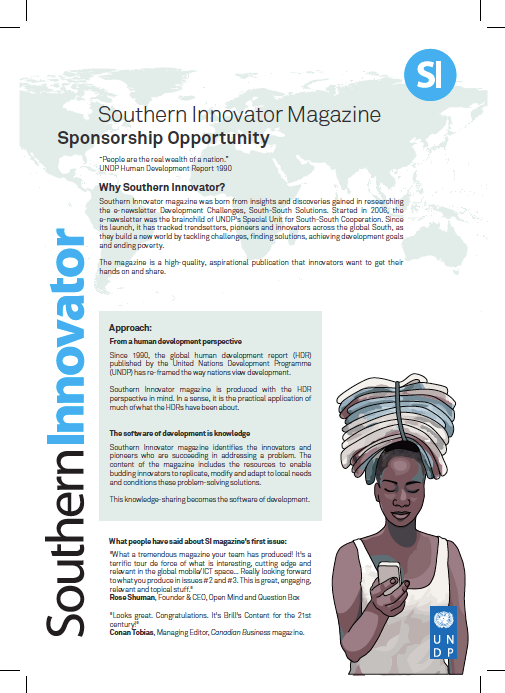
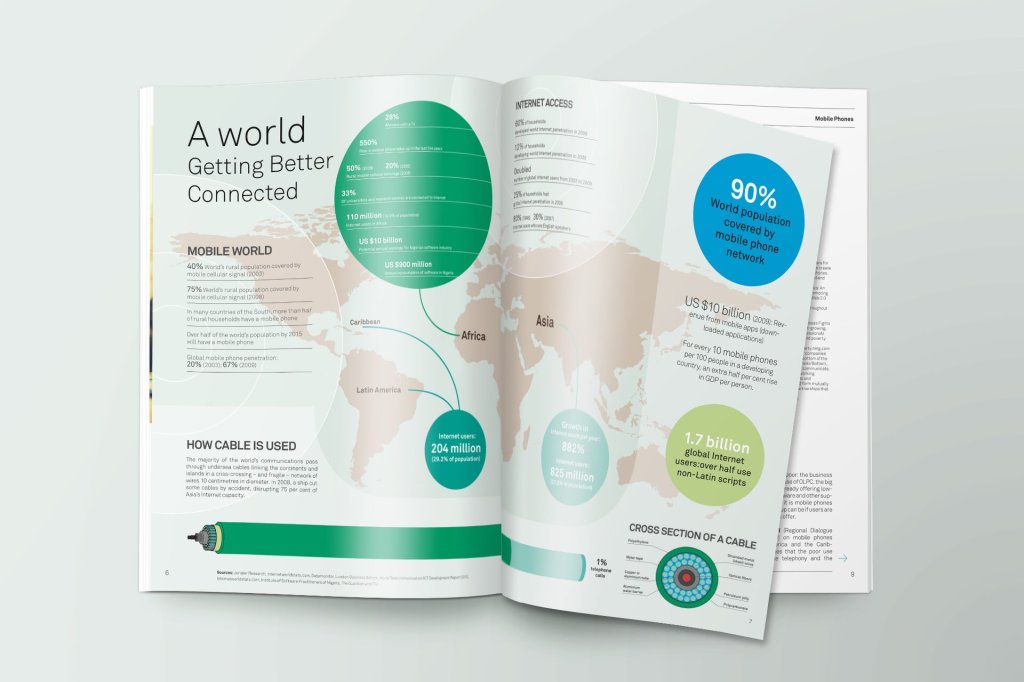
    Development Challenges, South-South Solutions was launched as an e-newsletter in 2006 by UNDP’s South-South Cooperation Unit (now the United Nations Office for South-South Cooperation) based in New York, USA. It led on profiling the rise of the global South as an economic powerhouse and was one of the first regular publications to champion the global South’s innovators, entrepreneurs, and pioneers. It tracked the key trends that are now so profoundly reshaping how development is seen and done. This includes the rapid take-up of mobile phones and information technology in the global South (as profiled in the first issue of magazine Southern Innovator), the move to becoming a majority urban world, a growing global innovator culture, and the plethora of solutions being developed in the global South to tackle its problems and improve living conditions and boost human development. The success of the e-newsletter led to the launch of the magazine Southern Innovator. 

    Creative Commons License

    This work is licensed under a
    Creative Commons Attribution-Noncommercial-No Derivative Works 3.0 License.

    ORCID iD: https://orcid.org/0000-0001-5311-1052.

    © David South Consulting 2023

  • Woman Wants African Farming to be Cool

    Woman Wants African Farming to be Cool

    By David SouthDevelopment Challenges, South-South Solutions

    SOUTH-SOUTH CASE STUDY

    Can farming be cool? Especially on a continent where it has long been associated with hardship and poverty, can agriculture be attractive to a young generation looking for big opportunities? A young woman in Nigeria thinks so and is on a mission to show farming is a great way to get ahead in modern Africa. And she hopes more people attracted to farming will boost the continent’s food security and reduce costly imports.

    Cynthia Mosunmola Umoru’s company, Honeysuckle PTL Ventures (http://www.tootoo.com/d-c3015227-Honeysuckles_Ptl_Ventures/), is based in Lagos , the business capital of Nigeria. The West African country has become dependent on food imports, despite many attempts to modernise its agricultural sector.

    The country’s heavy dependence on oil exports for its income has led to poor investment in its domestic economy. Over 80 percent of Nigeria’s university graduates struggle to find work. And it is these two problems – food security and high unemployment among the country’s young, educated and ambitious – that Umoru wants to change.

    Leading by example, Umoru has set up a successful and modern agribusiness focusing on high-quality food products using modern packaging and fast delivery. She produces meat products, from seafood like shrimps and prawns to snails, beef, chicken, and birds. Her niche is to deliver the product however the customer wishes: fresh, frozen or processed. Her business has its own farms and ponds but also has developed a sophisticated network with other farmers, providing them with standard contracts and benefits. This extra capacity means she can meet the demand and handle large volume orders.

    She is proudly self-taught. “I didn’t have a mentor in farming! Though I have other mentors,” Umoru told the Guardian Life Magazine. “My knowledge of agribusiness has been largely from personal education and research. The Internet has served greatly as my resource bank.”

    Umoru was initially on the path to study medicine, but had that dream upset by riots in the late 1990s. She then moved on to study zoology at Lagos State University. In her final year, she became interested in agribusiness. Her company was officially registered in 2004, but she had already begun at university providing meat products to fast-food outlets in Lagos.

    “It took five years to gain relevance,” she said. “My involvement in the agribusiness sector is really impacting people, particularly young people like me, who I always hear say ‘If you are involved with farming then it is probably not as bad as it seems’. Farming, before now in Nigeria, was termed business of low-lives and with the barrier to entry being so high for young people to actively participate.”

    “I have successfully, in my little way, impressed on my generation that farming could be glamorous and cool enough for us to trade places with the business executive in the large conglomerate and also the bank’s middle management cadre, which is the initial attraction for most young graduate(s) in Nigeria.”

    She is not shy talking about how rough it was in the beginning: “As a young entrepreneur, in my very early days, I lost a lot of the seed capital I got from financial mentors to poor and bad business decisions I took because there was no one to talk to.”

    Overall in sub-Saharan Africa, the long-term prospects for agriculture are good. The Food and Agricultural Organization (FAO) found in a 2009 paper that “the sub-Saharan agricultural sector — 80 percent of which consists of smallholder farmers — grew more than 3.5 percent in 2008, well above the 2 percent rate of population growth.”

    Sub-Saharan Africa’s population is predicted to grow from 770 million in 2005 to 1.5 to 2 billion in 2050 (FAO). Despite rapid migration from the countryside to cities and the growth in urban population, the absolute number of rural people is also likely to continue to increase.

    Agriculture is the motor for rural development, poverty and hunger reduction in sub-Saharan Africa. The FAO paper said that agricultural growth in sub-Saharan Africa is likely to be led by domestic and intra-African demand for food commodities due to urbanization and the growing population.

    African farming has been able to benefit from rising global food prices and demand. The policy environment has also become more favourable, according to the FAO. The paper found “There is a particular need for programmes and policies to increase the capacity of smallholder farmers to enter dynamic sectors of national, regional and international markets.”

    African farming can see serious productivity gains if it changes and it takes on new techniques. At the moment only 3 percent of the region’s food crops are produced using irrigation, compared to more than 20 percent globally.

    The irony is that Nigeria has already hatched one of the world’s most successful food companies, Olam (www.olamonline.com). A global food supply company in ‘agri-products’ that got its start in Nigeria, it shows Umoru is on to something – a Southern brand can grow and go global, and overcome the difficulties of cross-border trade in Africa.

    Olam currently supplies well-known global food brands including Cadbury (chocolate), Nestle, Lavazza (coffee), Mars (chocolate), Tchibo and Planters (peanuts).

    With some 218 million people in Africa — around 30 percent of the total population — estimated to be suffering from chronic hunger and malnutrition, a thriving local food sector would bring many gains.

    Turning to more sophisticated business models offers solutions to chronic problems. With 80 percent of Africa’s farms less than two hectares in size – and there are 33 million of them – cereal yields have grown little and are still around 1.2 tonnes per hectare in the region, compared to an average of some 3 tonnes per hectare in the developing world as a whole. Fertilizer consumption was only 13 kg per hectare in sub-Saharan Africa in 2002, compared to 73 kg in the Middle East and North Africa and 190 kg in East Asia and the Pacific. The FAO has estimated that the potential additional land area available for cultivation in sub-Saharan Africa amounts to more than 700 million hectares – a boon to the continent’s and the world’s food needs in coming years if handled well.

    And the demand is there: Between 2001 and 2007, annual increases in the global consumption of agricultural commodities were larger than during the 1980s and 1990s. The quantity of agri-products harvested in the world is 5.2 billion metric tonnes a year.

    “I have been able to reach out to so many people across the nation, preaching the agribusiness development and adoption gospel,” said Umoru. “I have also worked closely with other youth agencies to empower many more young people to aspire in Nigeria.”

    One such agency is the Harambe Nigeria Endeavour. Harambe Nigeria (http://www.hendeavor.org/content/bgroups/nigeria.php) is a programme designed to stimulate growth in the agricultural sector and open up opportunities for youth to become leaders and entrepreneurs in this area. And this means future young entrepreneurs going into the agricultural sector will not feel as alone as Umoru once did.

    As Obinna Ukwuani, creative director of Harambe Nigeria says: “We wish to rectify the tarnished image of agriculture in Nigeria, making it a viable investment for Nigerian youth from all walks of life.”

    Published: May 2010

    Resources

    1) World Vegetable Center: The World Vegetable Center is the world’s leading international non-profit research and development institute committed to alleviating poverty and malnutrition in developing countries through vegetable research and development. Website: http://www.avrdc.org

    2) Marketing African Leafy Vegetables: Challenges and Opportunities in the Kenyan Context by Kennedy M. Shiundu and Ruth. K. Oniang. Website: http://www.ajfand.net/Issue15/PDFs/8%20Shiundu-IPGR2_8.pdf

    3) 2050: Africa’s Food Challenge: Prospects good, resources abundant, policy must improve: A discussion paper from the Food and Agricultural Organization (FAO). Website: http://www.fao.org/wsfs/forum2050/wsfs-background-documents/issues-briefs/en/

    4) African Alliance for Capital Expansion: A management consultancy focused on private sector development and agribusiness in West Africa. Website: http://www.africanace.com/v3

    5) Branding Strategy Insider: This blog provides advice and case studies on how to build trust for your brand. Website: www.brandingstrategyinsider.com

    6) Growing Inclusive Markets, a web portal from UNDP packed with case studies, heat maps and strategies on how to use markets to help the poor. Website: www.growinginclusivemarkets.org

    7) Starting a SME (small, medium enterprise): This website is packed with advice and tips for starting a small business and how to grow it with limited resources. Website: http://www.smallbusiness.co.uk

    8) World Business Fair: The World Business Fair is an international trade platform for global entrepreneurs and professionals. Website: http://www.worldbusinessfair.com

    Development Challenges, South-South Solutions was launched as an e-newsletter in 2006 by UNDP’s South-South Cooperation Unit (now the United Nations Office for South-South Cooperation) based in New York, USA. It led on profiling the rise of the global South as an economic powerhouse and was one of the first regular publications to champion the global South’s innovators, entrepreneurs, and pioneers. It tracked the key trends that are now so profoundly reshaping how development is seen and done. This includes the rapid take-up of mobile phones and information technology in the global South (as profiled in the first issue of magazine Southern Innovator), the move to becoming a majority urban world, a growing global innovator culture, and the plethora of solutions being developed in the global South to tackle its problems and improve living conditions and boost human development. The success of the e-newsletter led to the launch of the magazine Southern Innovator. 
    Creative Commons License

    This work is licensed under a
    Creative Commons Attribution-Noncommercial-No Derivative Works 3.0 License.

    ORCID iD: https://orcid.org/0000-0001-5311-1052.

    © David South Consulting 2023

  • Lagos Traffic Crunch Gets a New Solution

    Lagos Traffic Crunch Gets a New Solution

    By David SouthDevelopment Challenges, South-South Solutions

    SOUTH-SOUTH CASE STUDY

    Around the world, traffic congestion is often accepted as the price paid for rapid development and a dynamic economy. But as anyone who lives in a large city knows, there comes a tipping point where the congestion begins to harm economic activity by wasting people’s time in lengthy and aggravating commuting, and leaving commuters frazzled and burned out by the whole experience.

    According to the World Business Council for Sustainable Development, 95 per cent of congestion growth in the coming years will be in developing countries. Even in developed countries like the United States, in 2000, the average driver experienced 27 hours of delays (up seven hours from 1980) (MIT Press). This balloons to 136 hours in Los Angeles.

    Developing countries are seeing vehicle numbers rise by between 10 and 30 per cent per year (World Bank). In economic hotspots, growth is even faster.

    Lagos, Nigeria, the throbbing business hub of West Africa’s most populous nation, has a network of over 2,700 km of roads with a vehicle density of 740 vehicles per kilometre (E.I. Bello). All those cars consume over 85 per cent of the petroleum products imported into the country – a costly expense for a country that actually imports oil. All this driving is necessary because the city has no rail or sea mass transit system and all movements of people and goods are by road.

    Nigeria suffers from the irony of being a country that makes 95 per cent of its export earnings and 80 per cent of its revenue from oil, yet has to import most of its fuel because its refineries are constantly breaking down.

    The overwhelming majority of mega-cities are now located in developing countries, including sprawling conurbations such as São Paulo, Brazil (18.8 million inhabitants in 2007), Delhi, India (15.9 million), and Manila, Philippines (11.1 million). By 2015 Lagos will have 12.8 million inhabitants and by 2025, it is estimated it will have 16.8 million citizens.

    That will be a lot of cars and frustrated people trying to get around.

    One project trying to alleviate the pain of a daily commute in the city is called Traffic (Traffic.com.ng). The computer application, or ‘app’, has a live feed of traffic on its homepage, collecting information from a wide variety of sources: the web, mobile phones and SMS (short message service) text messages sent in by mobile telephone. The service is also looking to extract information from microblogging site Twitter (twitter.com).

    The service says it aims to “reduce stress on Lagos road by providing up-to-the-minute traffic status in the state.”

    It uses the powerful concept of ‘crowdsourcing’, in which a large group of people contributes to solve a problem by combining the technological power of mobile phones and the Internet. These two technologies mean it is possible to solve problems in real time and draw on a very large group of people spread out over a wide geographical area.

    So, how does it work? A user can go to the homepage and click “View Traffic Report From” and see live data streaming in. If the user wants to see traffic conditions in a particular area, they type in the road and area in a box on the page and click to see the report.

    Those who are stuck in a traffic jam and want to alert others can send an SMS message with the keywords to 07026702053.

    The Traffic app came under scrutiny by the anonymous blogger Cherchez la Curl, whose blog is about “celebrating African women and natural hair”: “It’s no Einstein-worthy revelation to say that solving Lagos’ traffic problem (and, more generally, improving Nigeria’s poor transportation network) is one of the keys to sustaining growth and economic development in Nigeria,” the blog said.

    The blog’s author found the service was still in its early days: “While the idea is a fantastic application of modern technology to developing Africa, the only problem I see is that it seems like no-one is sending through traffic alerts! On a recent visit to the site, the alert stream was empty of alerts save for a few tweets. It’s a shame as this service would be extremely handy as a counterpoint/band-aid whilst government sorts out the root cause of the traffic.”

    It sounds like it is still early days for the Traffic app and Lagos residents will be its harshest critics.

    Published: January 2012

    Resources

    1) LagosMet.com: An Internet bulletin board offering rolling updates on Lagos traffic and security reports. Users can also post their reports. Website: http://lagosmet.com

    2) eNowNow: A website offering live updates on Lagos traffic congestion. Website: http://traffic.enownow.com

    3) SENSEable City: A project at the Massachusetts Institute of Technology’s SENSEable City Laboratory to use the new generation of sensors and hand-held electronics to change how cities are understood and navigated. This includes creating real-time maps of cities that can then be used to help with avoiding traffic congestion and other problems. Website: http://senseable.mit.edu

    4) Mobility 2001: World Mobility at the End of the Twentieth Century and its Sustainability published by the World Business Council for Sustainable Development. Website: http://www.wbcsd.org

    5) Lagos Traffic Crowdmap: A mix of user-contributed reports on the traffic conditions in Lagos. Website: https://lagostraffic.crowdmap.com/main

    6) A study of Urban Traffic Management – A Case Study of Lagos State Traffic Management Authority by E. I, Bello et al., 2009. Website: http://www.scientific.net/AMR.62-64.599

    7) Cities for All: An interview on book seeking to find solutions to the congested cities of the South. Website: http://globalurbanist.com/2010/08/24/cities-for-all-shows-how-the-worlds-poor-are-building-tiesacross-the-global-south

    Development Challenges, South-South Solutions was launched as an e-newsletter in 2006 by UNDP’s South-South Cooperation Unit (now the United Nations Office for South-South Cooperation) based in New York, USA. It led on profiling the rise of the global South as an economic powerhouse and was one of the first regular publications to champion the global South’s innovators, entrepreneurs, and pioneers. It tracked the key trends that are now so profoundly reshaping how development is seen and done. This includes the rapid take-up of mobile phones and information technology in the global South (as profiled in the first issue of magazine Southern Innovator), the move to becoming a majority urban world, a growing global innovator culture, and the plethora of solutions being developed in the global South to tackle its problems and improve living conditions and boost human development. The success of the e-newsletter led to the launch of the magazine Southern Innovator. 

    Creative Commons License

    This work is licensed under a
    Creative Commons Attribution-Noncommercial-No Derivative Works 3.0 License.

    ORCID iD: https://orcid.org/0000-0001-5311-1052.

    © David South Consulting 2023

  • Crowdfunding Technology Start-up Success in Africa

    Crowdfunding Technology Start-up Success in Africa

    By David SouthDevelopment Challenges, South-South Solutions

    SOUTH-SOUTH CASE STUDY

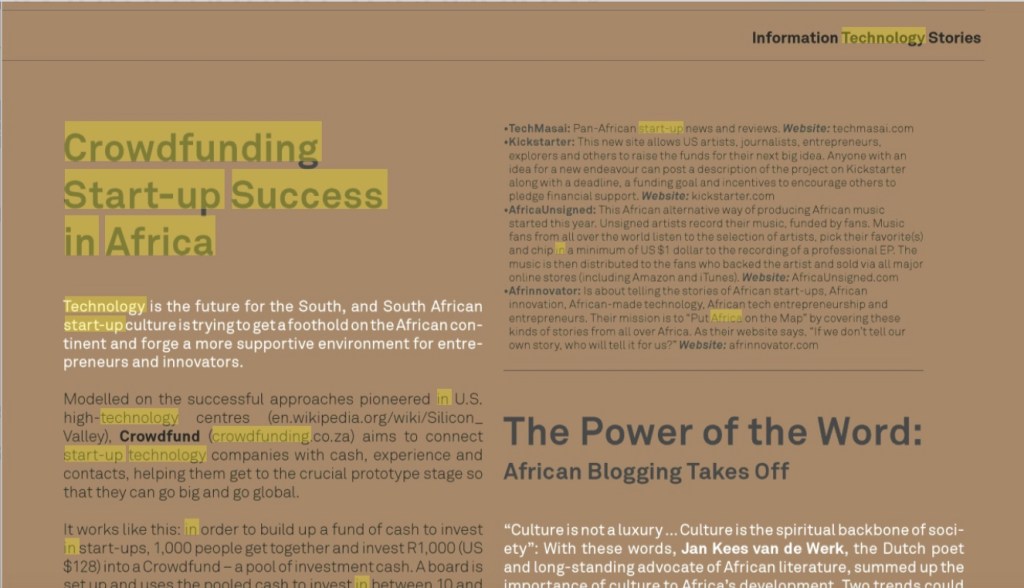
    Technology is the future for the South, and South African start-up culture is trying to get a foothold on the African continent and forge a more supportive environment for entrepreneurs and innovators.

    Modelled on the successful approaches pioneered in U.S. high-technology centres like California’s Silicon Valley (http://en.wikipedia.org/wiki/Silicon_Valley) , Crowdfund (http://www.crowdfunding.co.za) aims to connect start-up technology companies with cash, experience and contacts, helping them get to the crucial prototype stage so that they can go big and go global.

    It works like this: in order to build up a fund of cash to invest in start-ups, 1,000 people get together and invest R1,000 (US $128) into a Crowdfund – a pool of investment cash. A board is set up and uses the pooled cash to invest in between 10 and 20 of the best start-up ideas submitted. The ideas are funded and developed into working prototypes in return for a stake in the business. Once the working prototype is up and running, traditional venture capitalists are approached for further funding and usually Crowdfund will then cash in its equity.

    The concept of crowdfunding allows groups of people to use the internet to pool their money together to help support a person or a cause (http://en.wikipedia.org/wiki/Crowd_funding) . There are now many variations on the concept, with online services providing crowdfunding for artists, designers, film-makers, causes, scientists and technology pioneers.

    As a model for raising funds for small businesses, the concept has a long history in poor communities across the South. Often, it can be a group of poor women pooling their resources to help each other start small businesses. Technology in the form of the internet and mobile phones has helped the concept jump to the next level, and expanded the pool of people who can support a crowdfunded idea around the world.

    It is an answer to the need for so-called “angel funding” (http://en.wikipedia.org/wiki/Angel_investor) : somebody with lots of cash who is willing to help a start-up entrepreneur. Crowdfund’s founders felt South Africa lacked enough angel funders to meet the needs of the country’s technology start-ups. This can be a big problem in countries where there is no history or culture of angel funding and searching far and wide for the “next big idea.”

    In April of this year, Crowdfund was able to raise R1 million (over US $128,000) from 229 investors.

    Venture capitalists (http://en.wikipedia.org/wiki/Venture_capital) – people or investment groups looking for high-growth start-ups to invest in – usually prefer to put their money into proven ideas for big, fast returns. They often lack interest in smaller ideas that may grow more slowly. It is a classic dilemma: how can an entrepreneur know if their idea will work if nobody will give them the cash to prove it?

    This is a critical problem in the information age. As broadband technology spreads across Africa, the opportunities for online businesses will just grow and grow. But few will be able to benefit and African start-ups will not stand a chance against global competition if funding is not available to nurture new businesses.

    Crowdfund assesses ideas and identifies skill shortfalls. The cash is used to help with the skills shortage, provide office space, bandwidth, hosting and mentorship. The funded team will also have access to legal, marketing and management experts to get through the development stage and avoid costly mistakes. The development process in stage one takes three months. The Crowdfund Board will then search for potential investors to take the start-up to stage two and a working prototype.

    By this stage negotiations will take place to set the start-up off on the path to global success. They are helped with the tricky negotiation process with investors.

    Apart from the start-up cash, the powerful idea behind Crowdfund is the network of support and advice that comes with it. Two of the board members are South Africans based in San Francisco, USA, and can make that crucial connection with the buzzing U.S. technology scene. Investors are asked to mentor the start-up concepts, meaning start-ups are accessing normally costly business advice.

    Crowdfund tries to get a response back to potential start-ups within 48 hours (http://digitalgarage.co.za/2010/04/12/filtering-the-applications-for-funding/) , so, if you have a great idea, get submitting!

    Published: June 2010

    Resources

    • TechMasai: Pan-African start-up news and reviews. Website: www.techmasai.com
    • Kickstarter: This new site allows US artists, journalists, entrepreneurs, explorers and others to raise the funds for their next big idea. Anyone with an idea for a new endeavour can post a description of their project on Kickstarter along with a deadline, a funding goal and incentives to encourage others to pledge financial support. Website: http://www.kickstarter.com/
    • AfricaUnsigned: This African alternative way of producing African music started this year. Unsigned artists record their music, funded by fans. Music fans from all over the world listen to the selection of artists, pick their favorite(s) and chip in a minimum of $1 dollar to the recording of a professional EP. The music is then distributed to the fans who backed the artist and sold on all major online stores (incl. Amazon & iTunes). Website: www.AfricaUnsigned.com
    • Afrinnovator: Is about telling the stories of African start-ups, African innovation, African made technology, African tech entrepreneurship and entrepreneurs. Their mission is to ‘Put Africa on the Map’ by covering these kinds of stories from all over Africa. As their website says, “if we don’t tell our own story, who will tell it for us?” Website: http://afrinnovator.com

    Development Challenges, South-South Solutions was launched as an e-newsletter in 2006 by UNDP’s South-South Cooperation Unit (now the United Nations Office for South-South Cooperation) based in New York, USA. It led on profiling the rise of the global South as an economic powerhouse and was one of the first regular publications to champion the global South’s innovators, entrepreneurs, and pioneers. It tracked the key trends that are now so profoundly reshaping how development is seen and done. This includes the rapid take-up of mobile phones and information technology in the global South (as profiled in the first issue of magazine Southern Innovator), the move to becoming a majority urban world, a growing global innovator culture, and the plethora of solutions being developed in the global South to tackle its problems and improve living conditions and boost human development. The success of the e-newsletter led to the launch of the magazine Southern Innovator. 

    Creative Commons License

    This work is licensed under a
    Creative Commons Attribution-Noncommercial-No Derivative Works 3.0 License.

    ORCID iD: https://orcid.org/0000-0001-5311-1052.

    © David South Consulting 2022