Tag: southerninnovator.org

  • Bolivia Grabs World Media Attention with Salt Hotel

    Bolivia Grabs World Media Attention with Salt Hotel

    By David SouthDevelopment Challenges, South-South Solutions

    SOUTH-SOUTH CASE STUDY

    Tourism is a great way to attract foreign currency to a country and build local economies, especially in remote or isolated places. But the catch is finding a way to get people to go the distance and come and visit and spend their money.

    In a global South twist on the well-known Ice Hotel in Sweden(www.icehotel.com) – a hotel entirely built out of ice – enterprising Bolivians have built a hotel out of salt.

    A Bolivian hotel in the middle of the world’s largest salt flats has found a clever way to attract tourists to this remote holiday destination: build the hotel entirely out of salt, right down to its furniture.

    The South American nation is one of the poorest inLatin America, and its income distribution is among the region’s most unequal. Bringing in foreign currency and attracting more tourists can help to reduce this poverty. According to the World Travel and Tourism Council, travel and tourism will contribute 2 percent to the country’s gross domestic product (GDP) in 2011. Around 75,000 jobs are directly dependent on the tourism business in the country and this is projected to rise to 96,000 jobs by 2021.

    And it is a good business to be involved in: “Travel and tourism is one of the world’s great industries, providing 9 percent of global GDP and 260 million jobs; it drives economic growth, business relationships and social mobility,” according to David Scowsill, President and CEO of the World Travel and Tourism Council.

    The Hotel de Sal Cristal (http://www.hosteldesal.com/?L=2), near Colchani, hosts guests who come to visit the salt flats of Salar de Uyuni (http://en.wikipedia.org/wiki/Salar_de_Uyuni). They are believed to store 50 to 70 percent of the world’s lithium supplies and an economic boom has started in the area. The striking and blinding white salt flats were featured in the James Bond film “Quantum of Solace.”

    The hotel’s unique construction from rock-hard salt hewn from the salt flats is working to encourage tourists to stay longer in the area during their holiday. Before, they would just take a quick excursion on to the salt flats before moving on to their next destination.

    The Hotel de Sal Cristal is built using blocks of salt cut from the surrounding flats. The architectural design is inspired by the ancient Chinese balancing philosophy of Feng Shui (http://en.wikipedia.org/wiki/Feng_shui). Following the principles of the philosophy, it faces the sun and balances both masculine and feminine energies. Shaped like three coca leaves, the feminine side, this balances with the more masculine side reflected in the salt flats, the hotel’s website claims.

    The hotel has 27 rooms with hot water and heating. – and beds made of salt. In the dining room, people can sit on chairs made of salt and eat at salt tables. The rooms are wall-to-wall salt, bright and white.

    The hotel’s pool is surrounded by sand-like salt.

    The hotel’s ‘Resto-Bar’ offers views of the salt flats and promises it will “allow the cosmic energy…” to flow freely.

    The menu offers llama meat and risotto of quinoa (http://en.wikipedia.org/wiki/Quinoa) alongside traditional Bolivian dishes, salads and soups and Bolivian-themed treats.

    The hotel has an ‘astronomic observatory’ for star gazing, making the most of the low level of light pollution on the flats.

    One of the hotel’s tour guides, Pedro Pablo Michel Rocha from Hidalgo Tours (http://www.salardeuyuni.net/), told the Daily Mail newspaper: “I love it when visitors come to this place for the first time.

    “They can’t get over the fact that everything is made out of salt and I’ve even seen a few people lick the furniture to make sure!

    “It is a wonderful experience to come somewhere like this where they’ve used the natural materials available to create something like a hotel.”

    The salt flats, formed from prehistoric lakes, have a salt crust hard-baked by the sun with a pool of salty water underneath which is rich in the rare element lithium. Lithium (http://en.wikipedia.org/wiki/Lithium) is sought-after for its use in things like re-chargeable batteries for mobile phones, computers and electric cars.

    The area’s economy has boomed since 3.4 million tons of lithium – believed to be half the world’s supply – was discovered underneath the salt flats.

    The power of tourism to alleviate poverty has been documented by Caroline Ashley, co-author of Tourism and Poverty Reduction: Pathways to Prosperity (http://www.earthscan.co.uk/?TabId=92842&v=497073), after extensive research on tourism’s impact on poverty in countries across Africa andAsia.

    She argues that “tourism can fight poverty.”

    “Note, we say ‘can’, not that it always does. The share of spending by tourists within a destination that reaches poor people can vary from less than 10 percent to a high of 30 percent,” Ashley told BusinessFightsPoverty (http://www.businessfightspoverty.org).

    “When it works, international tourism is actually a very good way of channelling resources from rich to poor. In destinations as diverse as hiking on Mount Kilimanjaro in Tanzania, business tourism in Vietnam and cultural tourism in Ethiopia, between one quarter and one third of all in-country tourist spending accrues to poor households in and around the destination.”    

    Ashley said a successful tourism strategy needs to focus on “the 4Ps: pay, procurement, persuasion and partnership.”

    “Pay a living wage to local employees; take a hard look at procurement and potential to source locally … persuade – or at least inform – your clients how to take up opportunities to spend in the local economy…” and build a partnership with government to integrate tourism into the local economy.

    And it looks like the hotel can’t get more connected to the local economy than being made of the very salt that surrounds it.

    Published: November 2011

    Resources

    1) The Global Summit: World Travel and Tourism Council: Taking place in Tokyo/Sendai from 16-19 April 2012. Website: http://www.wttc.org

    2) A website packed with resources for planning a trip to Bolivia. Website: http://www.boliviacontact.com/turismo/

    3) The Intercontinental Hotels Group has an interactive website showing the many ways hotels can become sustainable. Website: http://innovation.ihgplc.com/

    4) Hotel designs: A website for interior designers, architects and hoteliers. Website: http://www.hoteldesigns.net/home.php

    https://davidsouthconsulting.org/2022/10/20/african-tourism-leads-the-world-and-brings-new-opportunities/

    https://davidsouthconsulting.org/2022/10/20/africas-tourism-sector-can-learn-from-asian-experience/

    https://davidsouthconsulting.org/2022/02/07/boosting-tourism-in-india-with-surfing-culture/

    https://davidsouthconsulting.org/2022/09/27/caribbean-island-st-kitts-goes-green-for-tourism/

    https://davidsouthconsulting.org/2022/11/20/ecotourism-to-heal-the-scars-of-the-past/

    https://davidsouthconsulting.org/2022/11/21/from-warriors-to-tour-guides/

    https://davidsouthconsulting.org/2022/11/23/kenyan-safari-begins-minutes-from-airport/

    https://davidsouthconsulting.org/2022/10/10/a-solution-to-stop-garbage-destroying-tourism/

    https://davidsouthconsulting.org/2021/03/05/southern-innovator-issue-2/

    https://davidsouthconsulting.org/2021/03/05/southern-innovator-issue-5/

    Development Challenges, South-South Solutions was launched as an e-newsletter in 2006 by UNDP’s South-South Cooperation Unit (now the United Nations Office for South-South Cooperation) based in New York, USA. It led on profiling the rise of the global South as an economic powerhouse and was one of the first regular publications to champion the global South’s innovators, entrepreneurs, and pioneers. It tracked the key trends that are now so profoundly reshaping how development is seen and done. This includes the rapid take-up of mobile phones and information technology in the global South (as profiled in the first issue of magazine Southern Innovator), the move to becoming a majority urban world, a growing global innovator culture, and the plethora of solutions being developed in the global South to tackle its problems and improve living conditions and boost human development. The success of the e-newsletter led to the launch of the magazine Southern Innovator. 

    Creative Commons License

    This work is licensed under a
    Creative Commons Attribution-Noncommercial-No Derivative Works 3.0 License.

    ORCID iD: https://orcid.org/0000-0001-5311-1052.

    © David South Consulting 2023

  • Diaspora Bonds to Help Build up Infrastructure

    Diaspora Bonds to Help Build up Infrastructure

    By David SouthDevelopment Challenges, South-South Solutions

    SOUTH-SOUTH CASE STUDY

    Many people are aware of the significant role played in global development by remittance payments from migrant workers working in the wealthy North to the global South. But they may not be aware of the significant sums migrant workers have saved in bank accounts in these wealthy countries. Across the global South, efforts are underway to lure these sums back to home countries to boost development efforts.

    As the hard-earned money migrant workers save sits in bank accounts in wealthy Western countries earning very low interest rates – a consequence of the current global economic crisis – so-called “Diaspora Bonds” seek to offer a way to earn good interest returns and help build up home countries at the same time.

    The money can help developing countries build facilities they need but cannot afford: roads, bridges, railways, water supplies, power, sewerage, street lighting. It is a way to bypass dependence on foreign aid and borrowing from aid agencies or the general marketplace.

    US $501 billion in remittance payments was sent in 2011, of which US $372 billion went to developing countries, involving some 192 million migrants or 3 per cent of the world’s population (World Bank). On top of this, migrants from developing countries have saved an estimated US $400 billion – and these funds are being targeted by those selling diaspora bonds (The Economist).

    The idea is being promoted by the World Bank and draws on the successful experiences with bonds for Israel and India. Both countries have long histories of turning to diaspora communities to raise funds through bonds.

    The bonds work by playing on patriotism and the genuine desire of migrants to want to see conditions improve back home. As the thinking goes, patriotic investors are more likely to be patient. This is critical because many countries cannot offer rapid profits and a quick pay off – something sought by short-term investors obsessed with the ups and downs of the stock market. They are also sterner investors, less likely to run away when the going gets tough. Their local knowledge means they will not panic and pull their investments when bad news hits the headlines. And probably best of all, they don’t mind if the local currency declines in value – that just means they can pick up a local house on the cheap or buy a business for even less money.

    One business working in this area is Homestrings (homestrings.com): Motto “Come make a difference.” An Internet platform offering diaspora bonds, it is run by founder and chief executive officer Eric-Vincent Guichard. An American born to a Guinean father and American mother, he spent 20 years growing up in rural Guinea and knows the country well. He also heads up GRAVITAS Capital Advisors, Inc. (gravitascapital.com), founded in 1996, which advises governments on how to manage their assets. A graduate of HarvardBusinessSchool and a former World Bank scholar, he is based in Washington, D.C.

    According to its website, Homestrings works like this: “It all starts with your ability to scan through a catalog of projects, funds and public-private partnership opportunities that focus on regions you come from or that you care deeply about. Each of these projects and/or funds is detailed in a Fact Sheet that is set up to help you do the due diligence needed to make an investment decision. Then, Homestrings directs your investment into the selected project or fund, with the help of our administrator.”

    Investments are monitored on a monthly or quarterly basis and are selected for their socio-economic impact and investment profitability.

    The website has a personal “Dashboard” that allows investors to use the site to vote for or against investments and make comments. And Homestrings will promote the investments that receive the most support and positive comments.

    To make an investment, a potential investor selects a fund or project that matches their interest. They read the Fact Sheet and choose. The funds are then passed on to the investment bond and an interest percentage or dividend is paid at regular intervals. Investors can keep track of the investment through the personal Dashboard on the website.

    Fact Sheets are organized by geographical region, industry focus, and development theme. Investments “cover infrastructure, health care, education, transportation, and small and medium sized enterprise finance – all critical areas of economic growth.”

    The Homestrings Catalog of investments includes the governments of Kenya, Senegal, Ghana, Nigeria and also AFREN PLC, which is looking to finance oil and gas exploration off the coast of Nigeria.

    Dramatic improvements in global communications in the past five years have also made it much easier for everyone involved to stay in touch and for bond promoters to identify and target potential customers.

    The World Bank is currently advising countries on how to run diaspora bond schemes. Kenya, Nigeria and the Philippines have schemes in the works, according to The Economist.

    Ethiopia has announced the “Renaissance Dam Bond” (http://grandmillenniumdam.net/). Proceeds will be used to fund the construction of the Grand Renaissance Dam, the largest hydroelectric power plant in Africa, able to generate 5,250 megawatts. Ethiopia tried a similar scheme before with the Millennium Corporate Bond to raise funds for the Ethiopian Electric Power Corporation (EEPCO). This did not entirely meet expectations and sales were slow. Reasons given for this included a perception that EEPCO could not meet payment expectations when the hydroelectric power plant was operating. There was also a lack of trust in the government and its financial stability and the overall political risks.

    The second attempt at a bond is believed to better thought through. It comes with an aggressive marketing and awareness-raising campaign aimed at the diaspora, and it starts at US $50, making it more affordable for more people.  It can be used as collateral in Ethiopia – an advantage for those wanting to do business back in the home country.

    For potential investors, it is worth remembering that bonds are debts that are rewarded with regular interest payments and paid back at the end of the bond term. They are not risk-free and the risk can lie either in the sovereign solvency of the country or in the investment.

    The secret to a successful bond issue is to keep up good relations with the diaspora; countries that are too oppressive could find themselves short of people willing to take up the offer.

    Published: October 2012

    Resources

    1) Remittance Payments Worldwide: A website by the World Bank tracking remittance prices worldwide. Website:http://remittanceprices.worldbank.org/About-Us

    2) The World Bank blog on diaspora bonds. Website:http://blogs.worldbank.org/category/tags/diaspora-bond

    3) A critical perspective on diaspora bonds at Africa Unchained. Website:http://africaunchained.blogspot.co.uk/2012/03/are-diaspora-bonds-worth-risk.html

    Development Challenges, South-South Solutions was launched as an e-newsletter in 2006 by UNDP’s South-South Cooperation Unit (now the United Nations Office for South-South Cooperation) based in New York, USA. It led on profiling the rise of the global South as an economic powerhouse and was one of the first regular publications to champion the global South’s innovators, entrepreneurs, and pioneers. It tracked the key trends that are now so profoundly reshaping how development is seen and done. This includes the rapid take-up of mobile phones and information technology in the global South (as profiled in the first issue of magazine Southern Innovator), the move to becoming a majority urban world, a growing global innovator culture, and the plethora of solutions being developed in the global South to tackle its problems and improve living conditions and boost human development. The success of the e-newsletter led to the launch of the magazine Southern Innovator. 

    Creative Commons License

    This work is licensed under a
    Creative Commons Attribution-Noncommercial-No Derivative Works 3.0 License.

    ORCID iD: https://orcid.org/0000-0001-5311-1052.

    © David South Consulting 2022

  • African Botanicals to be used to Boost Fight against Parasites

    African Botanicals to be used to Boost Fight against Parasites

    By David SouthDevelopment Challenges, South-South Solutions

    SOUTH-SOUTH CASE STUDY

    More than 1 billion people in the developing world currently suffer from tropical diseases, which leave a trail of disfigurement, disability and even death. Yet only 16 out of 1,393 – 0.01 percent – of new medicines marketed between 1975 and 1999 targeted tropical diseases (International Journal of Public Health).

    A combination of poverty and lack of political will means disease-ridden countries do not invest enough in research and development to find new medical remedies to save lives.

    A pioneering project hopes to turn to the continent’s plants to dig up new remedies to tackle the many diseases borne by parasites.

    It seeks to boost prosperity in Africa while taking on the many diseases that harm and kill people and hold back economic progress on the continent. If successful, it will make disease-fighting part of the future prosperity of African science – and boost the woefully neglected field of tropical medicine.

    What is at stake is the future of Africa, as the continent has the lowest life expectancies in the world. With just 15 percent of the world’s population, Africa carries a high disease burden, for example it has 60 percent of the global HIV/AIDS-infected population. Access to clean water is poor, with only 58 percent of people living in sub-Saharan Africa having access to safe water supplies (WHO). This leaves people exposed to water-borne parasites like Schistosoma (http://en.wikipedia.org/wiki/Schistosoma), which infects hundreds of millions and is the most crucial parasitic disease to tackle after malaria.

    Africa’s biggest killers in order of severity are HIV/AIDS, diarrhoeal diseases, tuberculosis, malaria, childhood diseases, sexually transmitted diseases, meningitis, tropical diseases, Hepatitis B and C, Japanese encephalitis, intestinal nematode and leprosy.

    Health resources are not being proportionately allocated: only 10 percent of financing for global health research is allocated to problems that affect 90 percent of the world’s population. This has been called the 10/90 gap (http://www.globalforumhealth.org/About/10-90-gap).

    “The untapped potential of African innovation capacity is enormous,” explains Dr. Éliane Ubalijoro, an adjunct professor of practice for public and private sector partnerships at Canada’s McGill University Institute for the Study of International Development (ISID) (http://www.mcgill.ca/isid). Her research interests focus on innovation in global health and sustainable development.

    “Using African biodiversity to produce solutions to local (and global) problems will provide a generous return on investment in an area of the world that is destined for growth.”

    Ubalijoro was recently awarded, along with Professor Timothy Geary, director of McGill’s Institute of Parasitology, a Grand Challenges Canada (http://www.grandchallenges.ca)grant of CAD $1 million (US $1.04 million) to address parasitic disease through African biodiversity.

    The Grand Challenges Canada grants are “dedicated to improving the health and well-being of people in developing countries by integrating scientific, technological, business and social innovation.”

    It’s predicted Africa’s growing population will reach between 1.5 and 2 billion inhabitants before 2050: a lot of people needing affordable remedies and treatments.

    Innovators have spotted an opportunity to simultaneously improve public health while also boosting Africa’s income from discovering new drugs. Traditional knowledge can play a critical part in the evolving innovation and commercialisation of Africa’s medicines and treatments.

    Turning to these remedies and botanicals needs careful stewardship: Africa has a terrible reputation for counterfeit medicines, which kill and harm many people every year. The medicines also need to be affordable and accessible.

    In some Asian and African countries, 80 percent of people use traditional medicines for primary care at some point (WHO). There may be sceptics amongst those used to name-brand medicines but traditional African medicines have a rich cultural heritage and have sustained Africans over the centuries. It is estimated the continent has over 50,000 plants to draw from, with fewer than 10 percent so far investigated to tap their potential medical utility.

    From the start, most of the new funding for the McGill project will be spent in Africa. Out of the CAD $1 million dollar grant, more than half the funds will go directly to partners at the University of Cape Town and the University of Botswana. At first, the funds will be used to screen local biodiversity for promising leads. These will then be subjected to chemical testing in the lab to extract their potential utility for treatments.

    “This system allows selection of natural product compounds that act on multiple target sites in the parasite,” according to Ubalijoro, “thus reducing the chances of developing resistance to the kinds of novel drugs that we hope to develop based on promising leads derived from this effort.”

    The approach being taken by the project hopes to reduce the time it takes to get drugs to market and to shift the power and initiative to local solutions and scientists, rather than waiting for outsiders to come to the rescue.

    The project hopes to contribute to not only improving people’s health but to stimulating local economies. This will be done by growing local pharmaceutical industries, retaining local talent which often now leaves the continent and doing rewarding and dynamic science within Africa. In short: making being in Africa attractive.

    It is hoped the success of the project will breed more success, as has happened in other places – think Silicon Valley in California, or Bangalore in India.

    “Success in this project will diminish the risk for technology-based investments related to health innovation,” said Ubalijoro, “helping to encourage local venture capital to help grow African science entrepreneurs. The overall benefit is improved livelihoods and prosperity locally as well as reduced spread of disease threats locally and internationally as we travel globally. ”

    By bringing the science closer to those who need the help, it is hoped the painfully slow process of new drug development will take on a greater urgency.

    “Discovery to production of a marketable drug can be a lengthy process,” said Ubalijoro. “But as novel methodologies are used to decrease candidate drug failure through the development and clinical processes, we can decrease the time it takes to bring drugs to market while empowering local innovation systems to lead the process instead of waiting for others to do so.

    “The sense of urgency felt by local scientists to solve local problems can stimulate innovation and safe delivery of new medicines for African populations.”

    Ubalijoro wants to see greater cooperation across disciplines and for people to come together in “innovation clusters,” that bring together policy, business and technical capability.

    “I would like to see local investment in innovation coming from the public, private and NGO sectors,” explained Ubalijoro. “I would also like to see women scientists taking an active role in leadership and in becoming the next generation of innovating African scientists.”

    Ubalijoro says that for those with money to invest, this is a vast opportunity waiting to be tapped. And she would like to see a dedicated African Innovation Fund set up for this purpose

    “The message for venture capitalists and investors is simple: by cultivating local talent, we can help African scientists and entrepreneurs explore indigenous-based solutions to local health problems while taking advantage of the most advanced technologies available globally to ensure that quality, risk mitigation and profits can grow hand in hand with healing the ailments of African populations.”

    Published: May 2011

    Resources

    1) RISE-AFNNET: African Natural Products Network: RISE-AFNNET works to develop Africa’s rich biodiversity into a natural products industry of social and economic significance. Building on an already active research network of 10 member countries called NAPRECA, RISE-AFNNET expands existing research programs and formalizes educational activities in such natural products (NP) fields as engineering, biochemistry, environmental science, pharmacology, economic development and nutrition. Students work on natural product research projects in the context of poverty alleviation, gender equity, and Millennium Development Goals. Website:http://sites.ias.edu/sig/rise/rise-afnnet

    2) GIBEX: The Global Institute for Bioexploration is a global research and development network that promotes ethical, natural product-based pharmacological bio exploration to benefit human health and the environment in developing countries. GIBEX was established by Rutgers, the State University of New Jersey, and the University of Illinois at Urbana-Champaign. Both are leading US universities with strong records of building successful international programs in discovering and developing life-saving medicines. Website: http://www.gibex.org/index.php

    3) Screens-to-Nature Training: Scientists Learn New Way of Screening Plants for Pharmaceutical Applications. Website:http://www.gibex.org/article.php?id=132

    Development Challenges, South-South Solutions was launched as an e-newsletter in 2006 by UNDP’s South-South Cooperation Unit (now the United Nations Office for South-South Cooperation) based in New York, USA. It led on profiling the rise of the global South as an economic powerhouse and was one of the first regular publications to champion the global South’s innovators, entrepreneurs, and pioneers. It tracked the key trends that are now so profoundly reshaping how development is seen and done. This includes the rapid take-up of mobile phones and information technology in the global South (as profiled in the first issue of magazine Southern Innovator), the move to becoming a majority urban world, a growing global innovator culture, and the plethora of solutions being developed in the global South to tackle its problems and improve living conditions and boost human development. The success of the e-newsletter led to the launch of the magazine Southern Innovator. 

    Creative Commons License

    This work is licensed under a
    Creative Commons Attribution-Noncommercial-No Derivative Works 3.0 License.

    ORCID iD: https://orcid.org/0000-0001-5311-1052.

    © David South Consulting 2023

  • Southern Innovator Magazine | 2010 – 2014 

    Southern Innovator Magazine | 2010 – 2014 

    By David South

    “I think you [David South] and the designer [Solveig Rolfsdottir] do great work and I enjoy Southern Innovator very much!” 

    Ines Tofalo, Programme Specialist, United Nations Office for South-South Cooperation
    Southern Innovator in Tianjin, China.
    Issue 5 of Southern Innovator at the Global South-South Development Expo (GSSD Expo) 2014 held in Washington, D.C.
    Volunteers in Nairobi, Kenya pose with Southern Innovator Issue 4 at the Global South-South Development Expo (GSSD Expo) in 2013.
    Southern Innovator Editor and Writer David South in Australia.
    Southern Innovator Graphic Designer and Illustrator Sólveig Rolfsdóttir in Iceland.

    Some comments that have come in so far about SI’s first issue:

    “What a tremendous magazine your team has produced! It’s a terrific tour de force of what is interesting, cutting edge and relevant in the global mobile/ICT space… Really looking forward to what you produce in issues #2 and #3. This is great, engaging, relevant and topical stuff.”, to “Looks great. Congratulations. It’s Brill’s Content for the 21st century!”

    What they are saying about SI on Twitter: From @CapacityPlus Nice job RT @ActevisCGroup: RT @UNDP: Great looking informative @SouthSouth1 mag on South-South Innovation; @UNDP Great looking informative @SouthSouth1 mag on South-South Innovation; @JeannineLemaireGraphically beautiful & informative @UNDP Southern Innovator mag on South-South Innov. 

    And on Pinterest:

    Peggy Lee • 1 year ago 

    “Beautiful, inspiring magazine from UNDP on South-South innovation. Heart is pumping adrenaline and admiration just reading it”

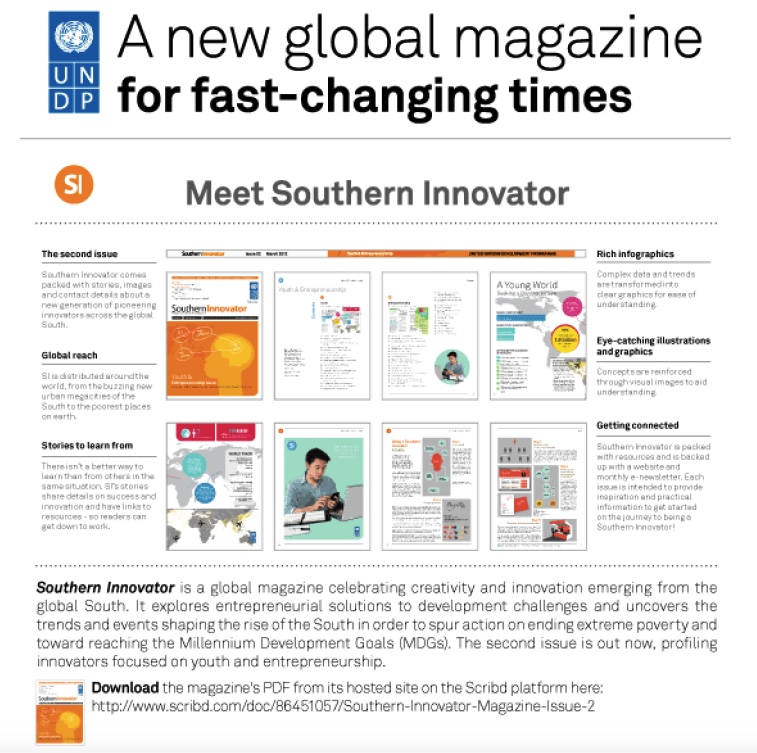
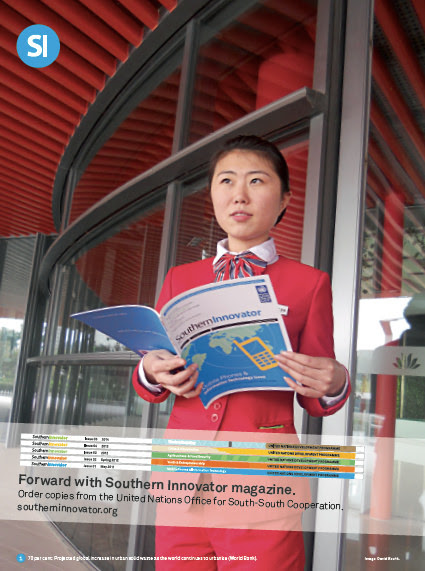
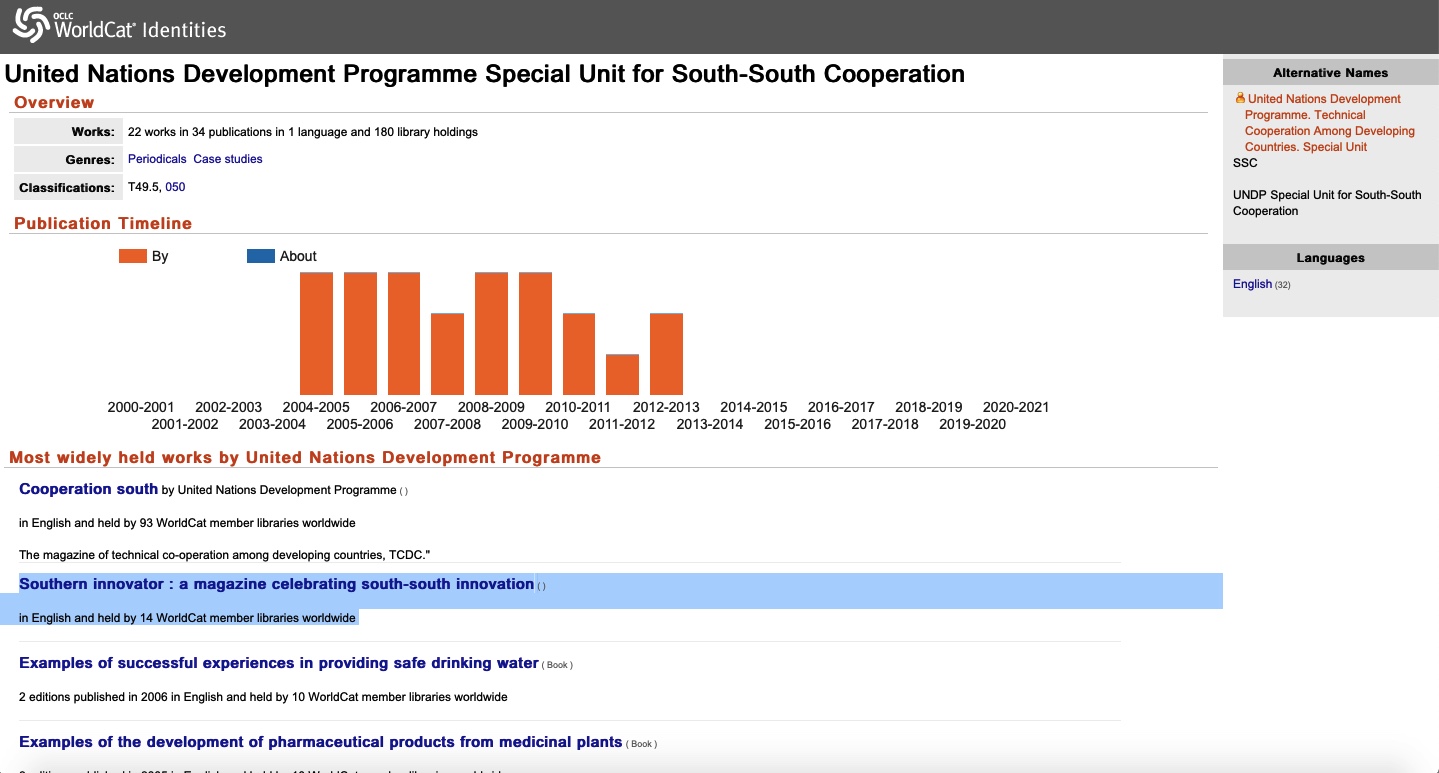
    Southern Innovator Magazine can be found in libraries around the world.

    Development Challenges, South-South Solutions was launched as an e-newsletter in 2006 by UNDP’s South-South Cooperation Unit (now the United Nations Office for South-South Cooperation) based in New York, USA. It led on profiling the rise of the global South as an economic powerhouse and was one of the first regular publications to champion the global South’s innovators, entrepreneurs, and pioneers. It tracked the key trends that are now so profoundly reshaping how development is seen and done. This includes the rapid take-up of mobile phones and information technology in the global South (as profiled in the first issue of magazine Southern Innovator), the move to becoming a majority urban world, a growing global innovator culture, and the plethora of solutions being developed in the global South to tackle its problems and improve living conditions and boost human development. The success of the e-newsletter led to the launch of the magazine Southern Innovator. 

    https://davidsouthconsulting.org/southern-innovator-scale-up-fundraiser/

    Creative Commons License

    This work is licensed under a
    Creative Commons Attribution-Noncommercial-No Derivative Works 3.0 License.

    ORCID iD: https://orcid.org/0000-0001-5311-1052.

    © David South Consulting 2022