Tag: Southern Innovator

  • Lagos Traffic Crunch Gets a New Solution

    Lagos Traffic Crunch Gets a New Solution

    By David SouthDevelopment Challenges, South-South Solutions

    SOUTH-SOUTH CASE STUDY

    Around the world, traffic congestion is often accepted as the price paid for rapid development and a dynamic economy. But as anyone who lives in a large city knows, there comes a tipping point where the congestion begins to harm economic activity by wasting people’s time in lengthy and aggravating commuting, and leaving commuters frazzled and burned out by the whole experience.

    According to the World Business Council for Sustainable Development, 95 per cent of congestion growth in the coming years will be in developing countries. Even in developed countries like the United States, in 2000, the average driver experienced 27 hours of delays (up seven hours from 1980) (MIT Press). This balloons to 136 hours in Los Angeles.

    Developing countries are seeing vehicle numbers rise by between 10 and 30 per cent per year (World Bank). In economic hotspots, growth is even faster.

    Lagos, Nigeria, the throbbing business hub of West Africa’s most populous nation, has a network of over 2,700 km of roads with a vehicle density of 740 vehicles per kilometre (E.I. Bello). All those cars consume over 85 per cent of the petroleum products imported into the country – a costly expense for a country that actually imports oil. All this driving is necessary because the city has no rail or sea mass transit system and all movements of people and goods are by road.

    Nigeria suffers from the irony of being a country that makes 95 per cent of its export earnings and 80 per cent of its revenue from oil, yet has to import most of its fuel because its refineries are constantly breaking down.

    The overwhelming majority of mega-cities are now located in developing countries, including sprawling conurbations such as São Paulo, Brazil (18.8 million inhabitants in 2007), Delhi, India (15.9 million), and Manila, Philippines (11.1 million). By 2015 Lagos will have 12.8 million inhabitants and by 2025, it is estimated it will have 16.8 million citizens.

    That will be a lot of cars and frustrated people trying to get around.

    One project trying to alleviate the pain of a daily commute in the city is called Traffic (Traffic.com.ng). The computer application, or ‘app’, has a live feed of traffic on its homepage, collecting information from a wide variety of sources: the web, mobile phones and SMS (short message service) text messages sent in by mobile telephone. The service is also looking to extract information from microblogging site Twitter (twitter.com).

    The service says it aims to “reduce stress on Lagos road by providing up-to-the-minute traffic status in the state.”

    It uses the powerful concept of ‘crowdsourcing’, in which a large group of people contributes to solve a problem by combining the technological power of mobile phones and the Internet. These two technologies mean it is possible to solve problems in real time and draw on a very large group of people spread out over a wide geographical area.

    So, how does it work? A user can go to the homepage and click “View Traffic Report From” and see live data streaming in. If the user wants to see traffic conditions in a particular area, they type in the road and area in a box on the page and click to see the report.

    Those who are stuck in a traffic jam and want to alert others can send an SMS message with the keywords to 07026702053.

    The Traffic app came under scrutiny by the anonymous blogger Cherchez la Curl, whose blog is about “celebrating African women and natural hair”: “It’s no Einstein-worthy revelation to say that solving Lagos’ traffic problem (and, more generally, improving Nigeria’s poor transportation network) is one of the keys to sustaining growth and economic development in Nigeria,” the blog said.

    The blog’s author found the service was still in its early days: “While the idea is a fantastic application of modern technology to developing Africa, the only problem I see is that it seems like no-one is sending through traffic alerts! On a recent visit to the site, the alert stream was empty of alerts save for a few tweets. It’s a shame as this service would be extremely handy as a counterpoint/band-aid whilst government sorts out the root cause of the traffic.”

    It sounds like it is still early days for the Traffic app and Lagos residents will be its harshest critics.

    Published: January 2012

    Resources

    1) LagosMet.com: An Internet bulletin board offering rolling updates on Lagos traffic and security reports. Users can also post their reports. Website: http://lagosmet.com

    2) eNowNow: A website offering live updates on Lagos traffic congestion. Website: http://traffic.enownow.com

    3) SENSEable City: A project at the Massachusetts Institute of Technology’s SENSEable City Laboratory to use the new generation of sensors and hand-held electronics to change how cities are understood and navigated. This includes creating real-time maps of cities that can then be used to help with avoiding traffic congestion and other problems. Website: http://senseable.mit.edu

    4) Mobility 2001: World Mobility at the End of the Twentieth Century and its Sustainability published by the World Business Council for Sustainable Development. Website: http://www.wbcsd.org

    5) Lagos Traffic Crowdmap: A mix of user-contributed reports on the traffic conditions in Lagos. Website: https://lagostraffic.crowdmap.com/main

    6) A study of Urban Traffic Management – A Case Study of Lagos State Traffic Management Authority by E. I, Bello et al., 2009. Website: http://www.scientific.net/AMR.62-64.599

    7) Cities for All: An interview on book seeking to find solutions to the congested cities of the South. Website: http://globalurbanist.com/2010/08/24/cities-for-all-shows-how-the-worlds-poor-are-building-tiesacross-the-global-south

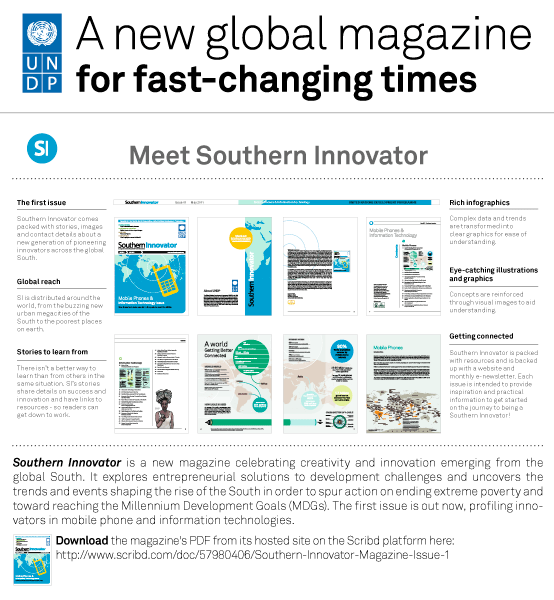
    Development Challenges, South-South Solutions was launched as an e-newsletter in 2006 by UNDP’s South-South Cooperation Unit (now the United Nations Office for South-South Cooperation) based in New York, USA. It led on profiling the rise of the global South as an economic powerhouse and was one of the first regular publications to champion the global South’s innovators, entrepreneurs, and pioneers. It tracked the key trends that are now so profoundly reshaping how development is seen and done. This includes the rapid take-up of mobile phones and information technology in the global South (as profiled in the first issue of magazine Southern Innovator), the move to becoming a majority urban world, a growing global innovator culture, and the plethora of solutions being developed in the global South to tackle its problems and improve living conditions and boost human development. The success of the e-newsletter led to the launch of the magazine Southern Innovator. 

    Creative Commons License

    This work is licensed under a
    Creative Commons Attribution-Noncommercial-No Derivative Works 3.0 License.

    ORCID iD: https://orcid.org/0000-0001-5311-1052.

    © David South Consulting 2023

  • Wireless Internet Culture Helping Zimbabwe Economy Recover

    Wireless Internet Culture Helping Zimbabwe Economy Recover

    By David SouthDevelopment Challenges, South-South Solutions

    SOUTH-SOUTH CASE STUDY

    Zimbabwe’s turbulent descent into hyperinflation at the beginning of the 2000s – and the food crisis it caused as prices soared and purchasing power shrank – captured the world’s attention. From refugees fleeing the country to widespread hunger and poverty, the impact of hyperinflation was stark and distressing. Since the country’s economy stabilized in 2009, various signals are showing that Zimbabwe is slowly making its way back to growth and stability.

    The scale of the hyperinflation is summed up by Zimbabwe’s eye-popping inflation rate. By December 2008, inflation was estimated at 6.5 quindecillion novemdecillion percent (or 65 followed by 107 zeros — 65 million googol) (Forbes Asia).

    One recovery strategy is emerging in Zimbabwe’s booming eating and drinking establishments. It seems the urge to socialize and network has become the source of economic vitality where so much else has been damaged.

    The proliferation of coffee shops with wi-fi (wireless internet access) (http://en.wikipedia.org/wiki/Wi-Fi) has spawned a new, connected business culture that is flexible and entrepreneurial.

    Zimbabwe’s unity government was formed in September 2008. By the beginning of 2009, the government relented on the crippling hyperinflation and allowed business to be conducted in the US dollar. This made it possible to save again and do business with greater predictability. At this time, the country had the world’s highest inflation rate and the central bank printed a 100 trillion Zimbabwe dollar note.

    The economic result of greater stability has been new shopping malls opening and a boom in new eating and drinking establishments.

    During the hyperinflation, eating out was the last thing on most people’s minds. Just surviving was the paramount daily task.

    In the capital, Harare (http://en.wikipedia.org/wiki/Harare), the shopping mall Sam Levy’s Village (http://samlevysvillage.com), in the prosperous Borrowdale area of the northern suburbs, is full of thriving coffee shops, restaurants and pubs.

    Outside of the wealthy enclaves, coffee shops have sprung up in the city’s art gallery, in sports clubs and a local supermarket chain.

    While the coffees are still expensive relative to local wages, the Zimbabwe Online Hotspots (ZOL) (http://www.zol.co.zw) in the coffee shops have proved a big attraction. Most people in Zimbabwe have unreliable or non-existent electricity or, if lucky, poor-quality phone and internet dial-up in their homes.

    ZOL Hotspots typically offer the first half hour of internet use for free. To surf longer, users must buy a voucher.

    The damage done to the economy from hyperinflation and the political crisis means the country is still on the mend. But people have now resorted to what they call “networking,” according to Bryony Rheam in the Daily Telegraph newspaper. The functioning economy is all about making deals. And coffee shops with wi-fi are the perfect place to meet with a potential business partner.

    But while the coffee shops are buzzing with people doing business, the proprietors still need to work out how to make better profits. Sales are still poor as people are mostly fixated on the wi-fi. One owner told the Telegraph: “We need to start charging people who sit here all day surfing the net.”

    It is the restaurants who seem to be enjoying the boost in incomes and better spirits after the economic troubles. Zimbabwe’s black middle class are enjoying big occasions and celebrating with friends and family in restaurants.

    “We went without for so long, that a lot of people almost see it as their right to spend money on eating out,” one patron told the Telegraph.

    More good news has come from outside investors as well: Amstel Securities NV (http://www.amstelsec.com), based in Amsterdam, Netherlands calls Zimbabwe’s economy “the final frontier market in Africa”. It believes the country has the potential to grow its GDP (gross domestic product) to US $12 billion by 2015. The International Monetary Fund says the economy jumped from US $4.4 billion in 2009 to US $9 billion now.

    In Amstel Securities’ report, it pegs the dollarization of the economy as the reason for stability: “These improvements have made Zimbabwe a much more vibrant economy with good further recovery potential.”

    And these good vibes are contagious: it has been reported that the American hamburger chain McDonald’s is revisiting the idea of setting up in Zimbabwe. McDonald’s is currently present in a handful of African countries: South Africa has 132 restaurants.

    Published: September 2010

    Resources

    Development Challenges, South-South Solutions was launched as an e-newsletter in 2006 by UNDP’s South-South Cooperation Unit (now the United Nations Office for South-South Cooperation) based in New York, USA. It led on profiling the rise of the global South as an economic powerhouse and was one of the first regular publications to champion the global South’s innovators, entrepreneurs, and pioneers. It tracked the key trends that are now so profoundly reshaping how development is seen and done. This includes the rapid take-up of mobile phones and information technology in the global South (as profiled in the first issue of magazine Southern Innovator), the move to becoming a majority urban world, a growing global innovator culture, and the plethora of solutions being developed in the global South to tackle its problems and improve living conditions and boost human development. The success of the e-newsletter led to the launch of the magazine Southern Innovator. 
    Creative Commons License

    This work is licensed under a
    Creative Commons Attribution-Noncommercial-No Derivative Works 3.0 License.

    ORCID iD: https://orcid.org/0000-0001-5311-1052.

    © David South Consulting 2023

  • Crowdfunding Technology Start-up Success in Africa

    Crowdfunding Technology Start-up Success in Africa

    By David SouthDevelopment Challenges, South-South Solutions

    SOUTH-SOUTH CASE STUDY

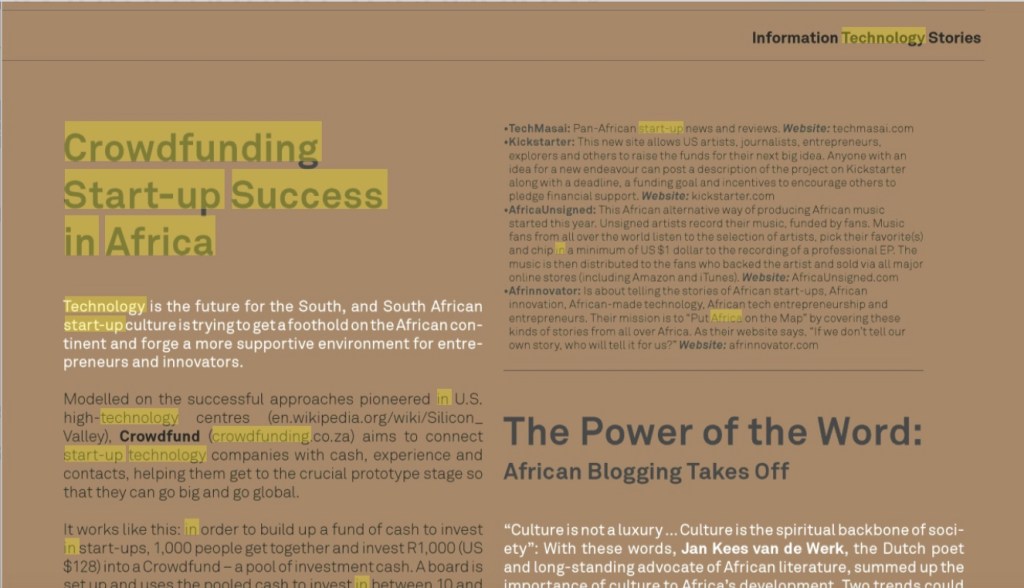
    Technology is the future for the South, and South African start-up culture is trying to get a foothold on the African continent and forge a more supportive environment for entrepreneurs and innovators.

    Modelled on the successful approaches pioneered in U.S. high-technology centres like California’s Silicon Valley (http://en.wikipedia.org/wiki/Silicon_Valley) , Crowdfund (http://www.crowdfunding.co.za) aims to connect start-up technology companies with cash, experience and contacts, helping them get to the crucial prototype stage so that they can go big and go global.

    It works like this: in order to build up a fund of cash to invest in start-ups, 1,000 people get together and invest R1,000 (US $128) into a Crowdfund – a pool of investment cash. A board is set up and uses the pooled cash to invest in between 10 and 20 of the best start-up ideas submitted. The ideas are funded and developed into working prototypes in return for a stake in the business. Once the working prototype is up and running, traditional venture capitalists are approached for further funding and usually Crowdfund will then cash in its equity.

    The concept of crowdfunding allows groups of people to use the internet to pool their money together to help support a person or a cause (http://en.wikipedia.org/wiki/Crowd_funding) . There are now many variations on the concept, with online services providing crowdfunding for artists, designers, film-makers, causes, scientists and technology pioneers.

    As a model for raising funds for small businesses, the concept has a long history in poor communities across the South. Often, it can be a group of poor women pooling their resources to help each other start small businesses. Technology in the form of the internet and mobile phones has helped the concept jump to the next level, and expanded the pool of people who can support a crowdfunded idea around the world.

    It is an answer to the need for so-called “angel funding” (http://en.wikipedia.org/wiki/Angel_investor) : somebody with lots of cash who is willing to help a start-up entrepreneur. Crowdfund’s founders felt South Africa lacked enough angel funders to meet the needs of the country’s technology start-ups. This can be a big problem in countries where there is no history or culture of angel funding and searching far and wide for the “next big idea.”

    In April of this year, Crowdfund was able to raise R1 million (over US $128,000) from 229 investors.

    Venture capitalists (http://en.wikipedia.org/wiki/Venture_capital) – people or investment groups looking for high-growth start-ups to invest in – usually prefer to put their money into proven ideas for big, fast returns. They often lack interest in smaller ideas that may grow more slowly. It is a classic dilemma: how can an entrepreneur know if their idea will work if nobody will give them the cash to prove it?

    This is a critical problem in the information age. As broadband technology spreads across Africa, the opportunities for online businesses will just grow and grow. But few will be able to benefit and African start-ups will not stand a chance against global competition if funding is not available to nurture new businesses.

    Crowdfund assesses ideas and identifies skill shortfalls. The cash is used to help with the skills shortage, provide office space, bandwidth, hosting and mentorship. The funded team will also have access to legal, marketing and management experts to get through the development stage and avoid costly mistakes. The development process in stage one takes three months. The Crowdfund Board will then search for potential investors to take the start-up to stage two and a working prototype.

    By this stage negotiations will take place to set the start-up off on the path to global success. They are helped with the tricky negotiation process with investors.

    Apart from the start-up cash, the powerful idea behind Crowdfund is the network of support and advice that comes with it. Two of the board members are South Africans based in San Francisco, USA, and can make that crucial connection with the buzzing U.S. technology scene. Investors are asked to mentor the start-up concepts, meaning start-ups are accessing normally costly business advice.

    Crowdfund tries to get a response back to potential start-ups within 48 hours (http://digitalgarage.co.za/2010/04/12/filtering-the-applications-for-funding/) , so, if you have a great idea, get submitting!

    Published: June 2010

    Resources

    • TechMasai: Pan-African start-up news and reviews. Website: www.techmasai.com
    • Kickstarter: This new site allows US artists, journalists, entrepreneurs, explorers and others to raise the funds for their next big idea. Anyone with an idea for a new endeavour can post a description of their project on Kickstarter along with a deadline, a funding goal and incentives to encourage others to pledge financial support. Website: http://www.kickstarter.com/
    • AfricaUnsigned: This African alternative way of producing African music started this year. Unsigned artists record their music, funded by fans. Music fans from all over the world listen to the selection of artists, pick their favorite(s) and chip in a minimum of $1 dollar to the recording of a professional EP. The music is then distributed to the fans who backed the artist and sold on all major online stores (incl. Amazon & iTunes). Website: www.AfricaUnsigned.com
    • Afrinnovator: Is about telling the stories of African start-ups, African innovation, African made technology, African tech entrepreneurship and entrepreneurs. Their mission is to ‘Put Africa on the Map’ by covering these kinds of stories from all over Africa. As their website says, “if we don’t tell our own story, who will tell it for us?” Website: http://afrinnovator.com

    Development Challenges, South-South Solutions was launched as an e-newsletter in 2006 by UNDP’s South-South Cooperation Unit (now the United Nations Office for South-South Cooperation) based in New York, USA. It led on profiling the rise of the global South as an economic powerhouse and was one of the first regular publications to champion the global South’s innovators, entrepreneurs, and pioneers. It tracked the key trends that are now so profoundly reshaping how development is seen and done. This includes the rapid take-up of mobile phones and information technology in the global South (as profiled in the first issue of magazine Southern Innovator), the move to becoming a majority urban world, a growing global innovator culture, and the plethora of solutions being developed in the global South to tackle its problems and improve living conditions and boost human development. The success of the e-newsletter led to the launch of the magazine Southern Innovator. 
    Creative Commons License

    This work is licensed under a
    Creative Commons Attribution-Noncommercial-No Derivative Works 3.0 License.

    ORCID iD: https://orcid.org/0000-0001-5311-1052.

    © David South Consulting 2022

  • Burgeoning African E-commerce Industry Full of Opportunity

    Burgeoning African E-commerce Industry Full of Opportunity

    By David SouthDevelopment Challenges, South-South Solutions

    SOUTH-SOUTH CASE STUDY

    Africa has seen huge change since 2000 in the way people access information and do business electronically. The most championed accomplishment has been the widespread take-up of mobile phones. This has given birth to countless entrepreneurs and innovators who are using  phones to help people, do business and sell goods and services.

    Not as quick to spread, mostly because of high cost and poor infrastructure, is access to the Internet. While Web access is taken for granted in many wealthy countries and is increasingly commonplace in many developing nations, Africa as a whole still suffers from poor infrastructure for access to the Internet. But this is changing by the month as  more undersea cables connect countries and bandwidth is increased (http://www.submarinecablemap.com/).

    Africa’s population can be expected to at least double from 1.1 billion to about 2.3 billion by 2050 – and most will live in urban areas (Population Reference Bureau).

    And incomes are rising. Africa is richer than India on the basis of gross national income (GNI) per capita, and a dozen African countries have a higher GNI per capita than China (Africa Rising).

    According to the McKinsey Global Institute, “The incomes of these new consuming classes are rising even faster than the number of individuals in the consuming classes. This means that many products and services are hitting take-off points at which their consumption rises swiftly and steeply. By 2025 urban consumers are likely to inject around (US) $20 trillion a year in additional spending into the world economy.”

    Research firm Jana (jana.com) – which specializes in emerging markets – studied the consumer preferences of people in Nigeria, Kenya and South Africa. They surveyed 600 consumers in each country, seeking to unearth what their preferences were when it came to using e-commerce services (https://en.wikipedia.org/wiki/E-commerce). E-commerce is the buying and selling of products and services over electronic systems such as the Internet and other computer-enabled systems. This is still a young industry in Africa and one ripe with opportunity for hardworking and innovative players. Many are starting to realize they had better move fast because this is a market that still has much up for grabs and is not – yet – dominated by mature players such as eBay or Amazon.

    The survey uncovered five trends driving e-commerce in Africa. These trends address the unique conditions present in Africa and what challenges need to be met.

    The first trend the firm identified is cash on delivery. This has become the main way people do e-commerce in Africa because of the lack of trust in the security of online payments. Cash is still king in the region. The second trend is having a proprietary logistics network. This comes in response to the poor infrastructure present in much of Africa. This has meant e-commerce companies need to take charge of the whole process of getting a good to the customer’s home. This is, of course, costly and places a big restraint on any new company in the e-commerce market.

    The third big trend is one that reflects the reality of how people communicate electronically in Africa. Mobile phones are king, and this means e-commerce needs to be mobile phone-friendly or lose out on reaching many customers. The fourth trend is related to the fact Africa is still off the logistics route for much world trade. This means e-commerce companies need to set aside space for large warehouses to store the goods so that they are on hand when the customer wants them.

    And, finally, the fifth trend is the importance of good customer service as the clincher for success in the marketplace. Word of mouth gets around if a company is not able to deliver on what is promised so it is important to have high-quality customer service to build trust, keep engaged with consumers and let them know problems are being resolved.

    South Africa has emerged as the continent’s powerhouse when it comes to e-commerce, according to Jana. Successful players in that country include Zando (http://www.zando.co.za/) an online fashion store by Rocket Internet, MIH Internet Africa’s Kalahari online store (http://www.kalahari.com/) and entertainment and consumer electronics online store Takealot.com supported by Tiger Global. Research firm World Wide Worx (http://www.worldwideworx.com/) calculated that online retail in South Africa is growing by 30 per cent a year.

    But South Africa cannot rest on its laurels: the survey found Nigeria is fast overtaking South Africa as its large population takes to the Internet. Impressively, Nigeria’s Government has pledged to expand broadband Internet access to 80 per cent of the country over the next five years.

    In East Africa, Kenya’s Rocket Internet’s service Jumia (http://www.jumia.co.ke/) is now one of the top 100 online destinations in the country.

    Jana also found there were various key areas for improvement for the e-commerce industry in Africa. One, was the importance of explaining to African consumers the basics of online shopping. Many respondents to the survey seemed confused about making purchases on the Internet and through e-commerce. They also showed low levels of understanding about payment methods and available financial products. And finally, one of the big obstacles to expanding the industry is improving delivery reliability.

    But all these problems and challenges spell opportunity for innovators who can solve them and make some money too!

    Published: July 2013

    Resources
     
    1) E-commerce: The latest news from The Guardian newspaper. Website: http://www.guardian.co.uk/technology/efinance

    2) E-commerce Expo: From 2 to 3 October 2013 in London, UK, the eCommerce Expo is the industry event for the UK and, increasingly, Europe. It ranks as one of the largest gatherings of e-commerce professionals in Europe and boasts over 180 exhibiting companies plus a comprehensive conference programme. Website: http://www.ecommerceexpo.co.uk/page.cfm/newSection=Yes

    3) Mashable e-commerce: E-commerce (or electric commerce) refers to the buying and selling of goods and services via electronic channels, primarily the Internet. Online retail is decidedly convenient due to its 24-hour availability, global reach and generally efficient customer service. Website: http://mashable.com/category/e-commerce/

    4) Actinic: An online software system for setting up an online e-commerce website. Website: actinic.co.uk/

    Development Challenges, South-South Solutions was launched as an e-newsletter in 2006 by UNDP’s South-South Cooperation Unit (now the United Nations Office for South-South Cooperation) based in New York, USA. It led on profiling the rise of the global South as an economic powerhouse and was one of the first regular publications to champion the global South’s innovators, entrepreneurs, and pioneers. It tracked the key trends that are now so profoundly reshaping how development is seen and done. This includes the rapid take-up of mobile phones and information technology in the global South (as profiled in the first issue of magazine Southern Innovator), the move to becoming a majority urban world, a growing global innovator culture, and the plethora of solutions being developed in the global South to tackle its problems and improve living conditions and boost human development. The success of the e-newsletter led to the launch of the magazine Southern Innovator.  

    Creative Commons License

    This work is licensed under a
    Creative Commons Attribution-Noncommercial-No Derivative Works 3.0 License.

    ORCID iD: https://orcid.org/0000-0001-5311-1052.

    © David South Consulting 2023