“I think you [David South] and the designer [Solveig Rolfsdottir] do great work and I enjoy Southern Innovator very much!”
Ines Tofalo, Programme Specialist, United Nations Office for South-South Cooperation
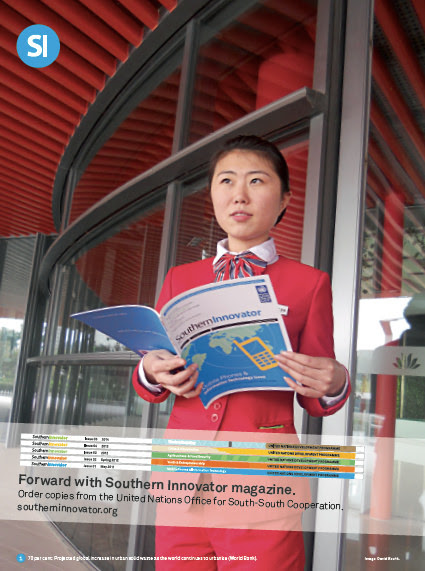
Southern Innovator in Tianjin, China.Issue 5 of Southern Innovator at the Global South-South Development Expo (GSSD Expo) 2014 held in Washington, D.C.Volunteers in Nairobi, Kenya pose with Southern Innovator Issue 4 at the Global South-South Development Expo (GSSD Expo) in 2013.Southern Innovator Editor and Writer David South in Australia.Southern Innovator Graphic Designer and Illustrator Sólveig Rolfsdóttir in Iceland.
Some comments that have come in so far about SI’s first issue:
“What a tremendous magazine your team has produced! It’s a terrific tour de force of what is interesting, cutting edge and relevant in the global mobile/ICT space… Really looking forward to what you produce in issues #2 and #3. This is great, engaging, relevant and topical stuff.”, to “Looks great. Congratulations. It’s Brill’s Content for the 21st century!”
What they are saying about SI on Twitter: From @CapacityPlus Nice job RT @ActevisCGroup: RT @UNDP: Great looking informative@SouthSouth1 mag on South-South Innovation; @UNDP Great looking informative @SouthSouth1 mag on South-South Innovation; @JeannineLemaireGraphically beautiful & informative @UNDP Southern Innovator mag on South-South Innov.
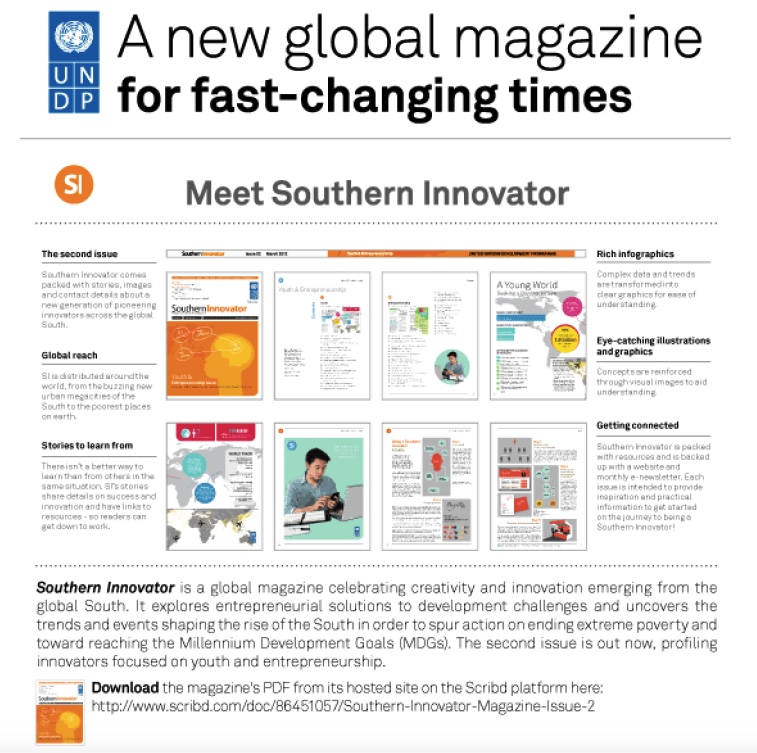
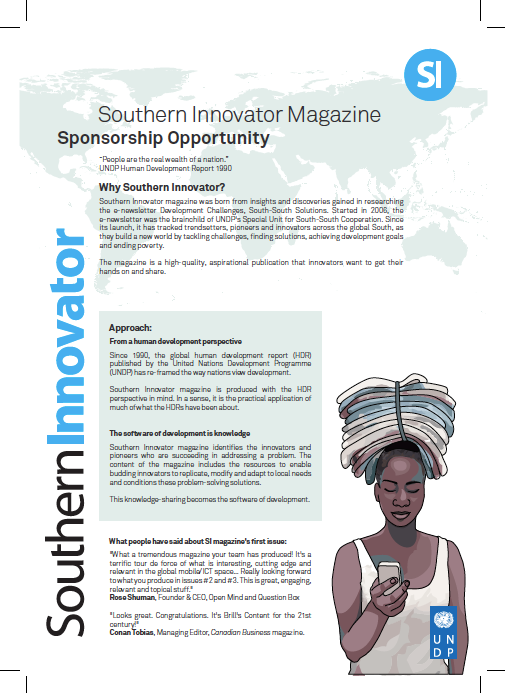
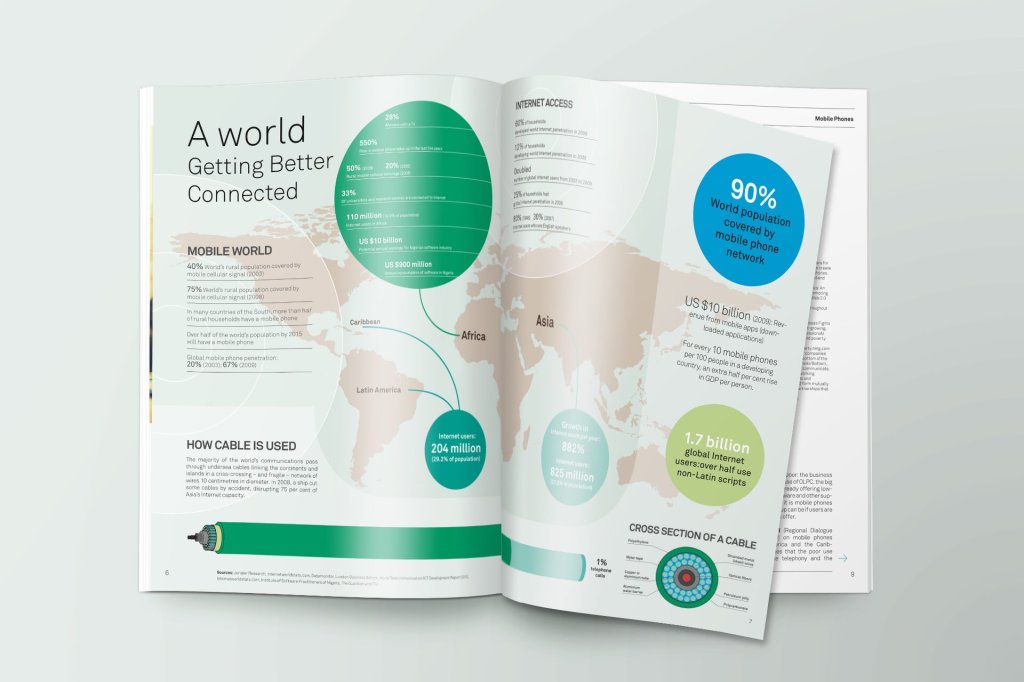
Development Challenges, South-South Solutions was launched as an e-newsletter in 2006 by UNDP’s South-South Cooperation Unit (now the United Nations Office for South-South Cooperation) based in New York, USA. It led on profiling the rise of the global South as an economic powerhouse and was one of the first regular publications to champion the global South’s innovators, entrepreneurs, and pioneers. It tracked the key trends that are now so profoundly reshaping how development is seen and done. This includes the rapid take-up of mobile phones and information technology in the global South (as profiled in the first issue of magazine Southern Innovator), the move to becoming a majority urban world, a growing global innovator culture, and the plethora of solutions being developed in the global South to tackle its problems and improve living conditions and boost human development. The success of the e-newsletter led to the launch of the magazine Southern Innovator.
One of the more remarkable creative developments since 2000 has been the explosion in animation production in the developing world, in particular Asia. Once seen as frivolous or unnecessary, animation is now acknowledged as a high-growth area and a critical component in the emerging economies being shaped by information technology.
The demand for more animation is being fuelled by several trends. Lucrative outsourcing contracts with major global film studios like Walt Disney and Warner Brothers get much of the attention. But even more importantly for small entrepreneurs, the rapid growth of information technology and mobile phones is fuelling demand for animation with a local flavour, which is an excellent way to make applications more attractive to users. As computers and animation software become cheaper, it is easier for entrepreneurs to compete with the bigger studios. It all started with the popularity of Japanese anime animation, which kicked the door open in the West, sparking an appetite for fresh, new styles unseen before.
The animation leaders in Asia are Japan, Republic of Korea, Philippines and Taiwan Province of China, with India rising quickly. As animation production is very lucrative and a labor-intensive business (labor takes up 70 to 80 percent of business costs), other Asian countries such as India, China, Vietnam, Malaysia and Singapore have recently started their own industries.
The National Association of Software and Service Companies (NASSCOM) has forecast the Indian animation sector to gross overall turnover of US $950 million in 2009, while its gaming industry will reach US $300 million in 2009 (from US $30 million in 2005). The global industry is huge: it is estimated that games will gross US $11 billion and animation US $35 billion by 2009. In the Philippines, growth has been 25 per cent a year since 2005 (National Statistics Office), and the government has been heavily promoting animation as a viable career and business opportunity. China was able to make US $604 million in 2005. The AWN’s Animation Industry Database lists 48 studios operating in the Philippines alone. Others benefiting are Thailand, Taiwan Province of China and Republic of Korea. And even in Africa, there have been attempts to get things going.
Ambitiously, China hopes to raise its home-made share of the animation pie from 10 per cent and to increase its overall animation programming from 5,000 hours/year to 16, 7000/year. In 2004, the Chinese government set up four animation schools: Communication University of China, Beijing Film Academy, China Academy of Art, and Tianjin Sorun Digital Media School. More than 200 animated films were produced in 2004.
Indian animation feature productions have exploded in the past few years. In 2005, animated feature Jai Hanuman started the current boom. Its quality marked a departure from past Indian productions and heralded in a new era. Importantly, it out-grossed any Disney film in India, and proved films featuring local topics could be commercially successful. It is a difficult market with 14 official languages and 1,400 dialects. At present, the huge Indian market has little locally produced animation to feed its needs. But by 2007, 71 Indian animation films were announced to be in production.
Productions in development draw heavily on India’s culture and love of gods. They include Epiphany Films’ The Dream Blanket, a Tibetan fairy tale, and Graphiti studios’ Action Hero BC, a teenager who fights evil.
The world’s animation producers scour India for talent to outsource. Global films with some Indian production in them include Finding Nemo, The Lion King and The Adventures of Tenali Raman. Toonz Animation Studio based at the Technopark in Kerala, was called by Animation Magazine one of the top ten studios in the world.
In Africa, South Africa has by far the most dynamic and sophisticated animation sector. Ten years after the birth of democracy, hundreds of production companies and several 2D animation houses were established. In turn, South Africa advertises itself as a cheaper place to produce animation.
The highly successful South African 3D animated series Magic Cellar by Morula Pictures – the first of its kind based on African culture – was successfully sold to the US Home Box Office channel this year. Based on 20 folk tales, the stories were collected through interviews with elders in African villages. Mfundi Vundla, 58, who owns Johannesburg’s Morula Pictures, South Africa’s largest black-led studio, said his productions are meant to counter the perception of “Africans as unsophisticated, superstitious idiots who visited witch doctors to solve problems.” It employs 60 people and dozens of actors.
In 2004, UNESCO’s Africa Animated! was launched, with East Africa’s first animation project. The participants undertook animation, drawing techniques, scriptwriting for animation and storyboarding. The project was launched to assemble resources and expertise for the production of culturally relevant children’s animated cartoons and programmes in Africa. It sought to create a high-quality “African branded” training and production model, in order to make African animation competitive for regional organizations to produce animated TV series, Public Service Announcements (PSA) and short films.
The Nairobi office is seeking to establish a Regional Training and Production Centre for Animation in Kenya in 2008.
Moustapha Alassane of Niger and one of Africa’s film pioneers, said: “The good thing about animation is that you can do it on a shoe-string budget. With the computer, animation is getting easier and anyone can do it now. I want to encourage young Africans to use new technologies for animation.”
AnimationSA.org: The South African Animation Directory: The official website for the South African animation industry, it hosts lots of information on jobs, training, events and developments.
Animation World Network: this is the global networking portal for the world’s animation industry, and is packed with news, jobs, tips, and training opportunities.
Development Challenges, South-South Solutions was launched as an e-newsletter in 2006 by UNDP’s South-South Cooperation Unit (now the United Nations Office for South-South Cooperation) based in New York, USA. It led on profiling the rise of the global South as an economic powerhouse and was one of the first regular publications to champion the global South’s innovators, entrepreneurs, and pioneers. It tracked the key trends that are now so profoundly reshaping how development is seen and done. This includes the rapid take-up of mobile phones and information technology in the global South (as profiled in the first issue of magazine Southern Innovator), the move to becoming a majority urban world, a growing global innovator culture, and the plethora of solutions being developed in the global South to tackle its problems and improve living conditions and boost human development. The success of the e-newsletter led to the launch of the magazine Southern Innovator.
Social networking websites also known as, Web 2.0 – the name given to the new wave of internet businesses and websites such as YouTube and MySpace that are transforming the way people interact with the Web – has been dubbed the social web for its power to bring people together. The label has been derided as a marketing gimmick by some, but many argue there are a number of characteristics to Web 2.0 that make it something different and a valuable tool for entrepreneurs seeking ways out of poverty.
The new Web 2.0 applications offer many free software tools stored online, from accounting and business related tools, to new multimedia ways to communicate for free. Unlike Web 1.0 sites, which offered information to passive users, Web 2.0 sites allow interaction and comment. These qualities have meant Web 2.0 can be used to build communities and social and business networks. By being able to store vast quantities of information online, it becomes faster to work and reduces the painful delays brought on by slow connections.
All these new tools are making it easier and easier for entrepreneurs to work from home, in internet centres, or anywhere there is a wireless connection, and is slashing the costs of managing a business. All the applications are online so there is no need to be hidebound by one operating system or hardware capability. The number of internet centres has increased significantly all over Asia and Africa, bringing the power of Web 2.0 to millions more people.
Linking mobile phones and the internet is also remarkable. It is becoming more and more possible in Africa to send messages to weblogs via text messaging, to post photos and videos, or to stay connected with a community, advocacy or business group via messaging to its website.
“Web 2.0 is a pre-occupation of ours that can be beneficial in fighting poverty,” said Tobias Eigan, founder and co-executive director of Kabissa.org, a web portal dedicated to promoting Web 2.0 in Africa. “It is really relevant for Africa. It makes the internet a read and write function, it is more user-friendly – that dynamic is going to make a big difference. It is so much easier to upload content with Web 2.0. It will build the capacity of local institutions and society and that will improve the lives of people – it will be much easier to fight poverty with this connectivity.”
Two other champions of the Web 2.0 way out of poverty are Waleed al-Shobakky, science and technology reporter for alJazeera.net, and Jack Imsdahl, a consultant and technology commentator. While they admit subsistence farmers and the illiterate will not directly benefit, those who are students or are working in proximity to computers will definitely benefit. They point out how rapidly mobile phones have been taken up by the poor and that this is being driven by the new services they offer.
There are still profound obstacles to more rapid take-up, however. Internet connection speeds will have to get better and more will need to be invested in this area. Web 2.0 tools will also need to be adapted to local languages if they hope to get past those who speak major web languages like English.
Entrepreneurs in the global South can now easily sign up to a vast array of e-newsletters that are sent to email accounts and keep on top of trends and innovations in their field. The relative anonymity of these email lists mean subscribers are less likely to be judged on their physical circumstances.
Published: March 2007
Resources
Afriville is a Web 2.0 service and an African Caribbean social network started by two Nigerian web entrepreneurs in their twenties, Folabi Ogunkoya and Lawrence Bassey-Oden.
Afriville is a community website along the lines of the famous MySpace. Users are free to message and post profiles. The difference is that the user is able to choose how closed or open the networks are. The site features a state of the art music management system which allows African and Caribbean artists to get straight in touch with their fans.
“We have created a solid app(lication) with features that will give the big players a run for their money,” said Ogunkoya.
African entrepreneurs have already stepped in with other Web 2.0 offerings. These include: Mooziko.com (an African YouTube), Afribian.com (news sharing), Afriqueka.com (social networking), Yesnomayb (online dating).
Both Yahoo! And Google offer extensive free online tools for entrepreneurs and businesses that integrate seamlessly with their email services.
Kabissa: Space for Change in Africa: An online African web community promoting and supporting the transition to Web 2.0 services in Africa. Offers lots of opportunities to meet people throughout Africa and learn more.
Alexa: Here can be found a detailed break down by country in Africa of web use and site popularity and trends.
Digital Divide Network: A website linking together initiatives and offering opportunities to debate current issues and problems.
Global Voices: An initiative from the Reuters news agency to aggregate the global conversation online from countries outside the US and Western Europe.
Free Web 2.0 tools for entrepreneurs:
Wikis: Here is a detailed article on wikis – collaborative websites that allow authorised users to rapidly and easily change the content of pages – and a detailed list of free or low-cost wiki services.
>> Blogging (an online diary):
Blogger.com – A free, easy-to-use, online service owned by Google.
Blogsome.com – An easy-to-use, free service with good support for photos.
Movable Type – An open-source, free, easy to use, online publishing system popular with bloggers.
WordPress – Another easy, free, and popular online publishing system popular with bloggers.
>> Aggregators (these are programmes that gather links and resources off the web):
AmphetaDesk – One of the first news aggregators to really catch on, it’s still popular.
Bloglines – Allows bloggers and webmasters to search, subscribe to, publish, and share RSS news feeds online.
Del.icio.us – Aggregate content from your favorite Web sites and share them with others.
Feed Demon – The news you want delivered to your desktop.
Technorati – A real-time search engine that keeps track of what is happening in the world of blogs.
Techsoup.org is an excellent resource for all the latest developments in Web 2.0 and how to access free or low-cost resources. Being based in the US, it gets the inside scoop on cutting edge developments in Silicon Valley.
Development Challenges, South-South Solutions was launched as an e-newsletter in 2006 by UNDP’s South-South Cooperation Unit (now the United Nations Office for South-South Cooperation) based in New York, USA. It led on profiling the rise of the global South as an economic powerhouse and was one of the first regular publications to champion the global South’s innovators, entrepreneurs, and pioneers. It tracked the key trends that are now so profoundly reshaping how development is seen and done. This includes the rapid take-up of mobile phones and information technology in the global South (as profiled in the first issue of magazine Southern Innovator), the move to becoming a majority urban world, a growing global innovator culture, and the plethora of solutions being developed in the global South to tackle its problems and improve living conditions and boost human development. The success of the e-newsletter led to the launch of the magazine Southern Innovator.
Throughout the history of farming, around 7,000 species of plants have been domesticated. Yet everyday diets only draw on 30 percent of these plants and even this number has been going down as more people consume mass-market foods (FAO).
One consequence has been poor nutrition resulting from the reduction in consumption of high-vitamin foods, leading to stunted mental and physical development across the global South.
Once-rich culinary traditions have wilted and left many people not knowing what to do with formerly common vegetables and fruits, even if they can actually find them in markets.
Between 94,000 and 144,000 plant species — a quarter to a half of the world’s total — could die out in the coming years, according to an estimate by Scientific American (2002). Among them are vital food crops, threatened by a world in which climate change is causing more weather turbulence and diseases and viruses can spread rapidly and destroy crops.
This scale of plant loss risks leaving the world’s food security dependent on fewer – and more vulnerable – domesticated species.
Despite being rich in vitamins, minerals and trace elements, African leafy vegetables have been overlooked in preference for cabbage, tomatoes, carrots, and other imported produce. But with rising food prices at local markets, people are looking again at these neglected African vegetables. In East Africa, this includes indigenous plants like amaranth (http://en.wikipedia.org/wiki/Amaranth), African eggplant, Ethiopian mustard, cowpea, jute mallow and spider plant.
Like tomatoes and potatoes, some of these vegetables are members of the nightshade family — but unlike those imports, they are indigenous to Africa. According to Patrick Maundu of Bioversity International (http://www.bioversityinternational.org/), African nightshades provide good levels of protein, iron, vitamin A, iodine, zinc, and selenium at seven times the amounts derived from cabbage. The high levels of vitamins and micronutrients, he says, are especially important to people at risk of malnutrition and disease, particularly HIV/AIDS.
As the cost for basic foodstuffs have shot up during the global economic crisis, growing food has become an increasingly lucrative source of income. Estimates of the number of people doing this across Africa range from hundreds of thousands to millions.
In the bid to reduce the over-dependence on imported foods, urban farming is coming to the rescue and becoming an effective survival tactic in Africa’s fast-growing cities. Thousands of urban workers in Kenya’s capital, Nairobi, are supplementing their wages by investing in farms growing food.
Eunice Wangari, a nurse in Kenya, supplements her US $350/month salary with money earned from growing food. “For too long our country has been flooded with imported food and westernized foods,” Wangari told The Guardian newspaper. “This is our time to fight back – and grow our own.”
In Kenya, this type of agriculture usually involves an urbanite taking a stake in farmland outside the city. Relatives then do the farming. Mobile phones play a key role in this approach. The urban dweller can keep in touch with the farm by phone and receive updates on progress. They use their knowledge of urban food tastes to then adjust the crops and increase profits.
An accountant, James Memusi in Nairobi, is growing mushrooms in a spare bedroom in his home and then selling them to hotels and supermarkets, according to The Guardian. Miringo Kinyanjui is selling unrefined maize and wheat. Loved for its nutritional qualities, the flour is also flavoured with amarathan, a common green vegetable in Kenya.It is a clever way to make the most of the fact that many urban dwellers have some access to land in the countryside.
Pride is also returning to the topic of food, as people re-discover traditional foods and vegetables and fruits.
In Liberia, president Ellen Johnson-Sirleaf has launched a “Back to the Soil” campaign to get urban dwellers to farm and help the country lose its dependence on foreign food imports.
Liberia is trying to reduce the importing of rice and tomatoes.
In Zambia, the embracing of traditional foods has been fuelled by recipes used by a chain of popular restaurants. This appetite has driven demand for dried pumpkins, ‘black jack’ leaves and fresh okra.
The success of this revival of traditional foods has attracted big multinationals as well. Unilever Kenya ran a campaign in 2008 called ‘taste our culture,’ promoting African herbs and spices.
Published: November 2009
Resources
1) The Global Trees Campaign, a partnership between Fauna & Flora International, Botanic Gardens Conservation International and many other organisations around the world, aims to save threatened tree species through provision of information, conservation action and support for sustainable use. Website:http://www.globaltrees.org
2) World Vegetable Center: The World Vegetable Center is the world’s leading international non-profit research and development institute committed to alleviating poverty and malnutrition in developing countries through vegetable research and development. Website:http://www.avrdc.org/
3) Sylva Professional Catering and College: A well-known Zambian food entrepreneur who runs a range of businesses, including restaurants, a cooking school and a guest house. Website:http://sadcbiz.com/countries/zambia/categories/index.htm
Development Challenges, South-South Solutions was launched as an e-newsletter in 2006 by UNDP’s South-South Cooperation Unit (now the United Nations Office for South-South Cooperation) based in New York, USA. It led on profiling the rise of the global South as an economic powerhouse and was one of the first regular publications to champion the global South’s innovators, entrepreneurs, and pioneers. It tracked the key trends that are now so profoundly reshaping how development is seen and done. This includes the rapid take-up of mobile phones and information technology in the global South (as profiled in the first issue of magazine Southern Innovator), the move to becoming a majority urban world, a growing global innovator culture, and the plethora of solutions being developed in the global South to tackle its problems and improve living conditions and boost human development. The success of the e-newsletter led to the launch of the magazine Southern Innovator.














 David South Consulting
You must be logged in to post a comment.