Tag: Southern Innovator magazine

  • Cuban Entrepreneurs Embracing Changes to Economy

    Cuban Entrepreneurs Embracing Changes to Economy

    By David SouthDevelopment Challenges, South-South Solutions

    SOUTH-SOUTH CASE STUDY

    The Caribbean island of Cuba has gone its own way economically and socially since its revolution in 1959. The country has seen significant gains in its human development in the decades since, and can boast impressive education levels and good public health care.

    Cuba enjoys a good ranking on the Human Development Index (HDI) – 59 out of 187 countries – and it has been rising since 1980. For Latin America and the Caribbean, Cuba is above the regional average (http://hdrstats.undp.org/en/countries/profiles/CUB.html).

    But the country has also had a turbulent economy with periods of severe economic contraction. This has increased poverty levels and hunger, in particular during the Special Period beginning in 1990 (http://www.historyofcuba.com/history/havana/lperez2.htm) when the significant subsidies enjoyed by the country from the Soviet Union were pulled and the country saw a steep drop in its ability to import fuel and other goods. Cuba is still trying to repair the economic damage.

    In the book Cuba: Between Reform and Revolution, Louis A. Perez, Jr. explains: “The old socialist bloc Council of Mutual Economic Assistance (CMEA) had accounted for almost 85 percent of Cuban trade, transactions conducted almost entirely in nonconvertible currency. Commercial relations with the former Soviet Union declined by more than 90 percent, from $8.7 billion in 1989 to $4.5 billion in 1991 and $750 million in 1993. Trade with eastern European countries ended almost completely.

    “Soviet oil imports decreased by almost 90 percent, from 13 million tons in 1989 to 1.8 million tons in 1992. Shipments of capital grade consumer goods, grains, and foodstuff declined and imports of raw materials and spare parts essential for Cuban industry ceased altogether.”

    Conducting private business in Cuba was discouraged after the revolution as the state became the dominant arbiter of all economic transactions. Since the fall of the Soviet Union, Cuba has experimented at various times with moving to a mixed economy, only to pull back and return to the old ways. But now things are changing significantly after economic reforms that have accelerated since Cuban President Raul Castro took over from his brother Fidel in 2008.The reforms began in 2008 with the liberalizing of access to mobile phones, and accelerated between 2010 and 2013, when the number of people working in small businesses tripled.

    Cuentapropistas – the Cuban term for entrepreneurs, named after “cuenta propria,” the ability to do business for oneself – have flocked to be officially registered as small businesses, with the number shooting up from 143,000 in 2010, to 429,000 by June 2013 (Report on Business).

    Gustavo Kouri told the Report on Business magazine, “Although I enjoyed the work I was doing before – at an information centre in specialized health sciences – it wasn’t possible to earn enough to support my family.

    “And then the state opened more opportunities to develop private businesses, for cuenta propia.”

    He now owns the Rio Mar restaurant (https://www.facebook.com/restauranteriomar).

    Artists and athletes have also been attracted to the opportunities that have opened up.

    One is former volleyball Olympic gold medalist Mireya Luis (http://en.wikipedia.org/wiki/Mireya_Luis), who now owns Las Tres Medallas (http://www.alamesacuba.com/en/la-habana/restaurant/las-tres-medallas/), a pizza-and-pasta restaurant.

    For Luis, becoming an entrepreneur means the chance to “realize a dream.”

    “Being able to open a place – a restaurant, a bar, a cafeteria, whatever – is a good opportunity for self-development, for people to demonstrate a capacity for business, and for them to grow personally,” she said. “It’s something incredible.”

    Gilberto Valladares owns a hair salon in Old Havana, Arte Corte Studio, and has been able to employ others.

    “Initially, it was a dream of dignifying and recovering a certain degree of respect for the trade of hairdresser and barber,” he told the Report on Business. “As my business grew, so did the dream.” He now employs a half dozen people from the neighborhood.

    Cuba is attempting to reform and modernize its economy while holding on to the things people hold dear and see as the good achievements of the revolution: free healthcare, education and other public services.

    Gregory Biniowsky is a Canadian-trained lawyer and political scientist who has spent more than 15 years living and working in Cuba and works for Havanada Consulting, a firm that focuses on sustainable development projects and social enterprise initiatives. “The irony is those that will save the Revolution are the emerging small- and medium-sized private businesses,” he said. “And those that could destroy it are those elements in the bureaucracy that resist those changes.”

    The entrepreneurial spirt gripping the island is infectious. At one time, much of the only reading material available in bookshops were works with a communist or socialist theme.
    But Cubans now have an alternative: an English-language bookshop called Cuba Libro (https://www.facebook.com/cubalibroHAV). It is filing an urgent gap in the marketplace for English-language books and foreign works in general.

    Set up by an American writer and journalist Conner Gorry (connergorry.com), who has been living in Havana, Cuba since 2002, the bookshop has become a hub for free thinking and new ideas.

    “I know how hard it is to get English-language sources here,” she told The Associated Press. “So I started cooking this idea.”

    Libro is the Spanish word for book and the play on words is meant to evoke a Cuba Libre, a rum-and-cola drink named for the country’s liberation from colonial Spain. The store bills itself as a “cafe, bookstore, oasis,” and  its logo features a woman reclining with a cup of coffee and a good book for reading.

    The idea came about when a friend of Gorry could not find a place to unload 35 books she had. In time, Gorry amassed a collection of 300 English-language books, and this embryonic library became the book shop. The store also carries magazines, including U.S. titles The New Yorker and Rolling Stone.

    So far, the store faces little competition. Government book shops feature the occasional Cuban novel translated into English or the English-language versions of state-run newspapers such as Granma (http://www.granma.cu/ingles/).

    Cubans are enjoying the slow thaw and what it could bring. “It is increasing in Cuba, the possibility to have different alternatives,” said Carlos Menendez, a 77-year-old retired economist Menendez.

    Cuba Libro has two licenses to operate – one for selling food and one for selling used books – and is run as a type of cooperative, a group-owned private enterprise with five Cubans.

    Doing business in Cuba is not without challenges. The bookshop needs to steer a steady path and avoid selling anything that would be considered “counterrevolutionary.” Gorry also needs to avoid problems with the U.S. government, which bans Americans from any financial transactions with the Cuban government.

    “I’ve had to tread extremely carefully, everything above-board and legal, because I’m an American, I’m a North American, I am beholden to U.S. laws,” she said. “And so I’m not in agreement with those laws, but I abide by them.”

    The bookshop has the benefit of a well-educated pool of potential customers; the annual Havana book festival is a popular draw in the country (http://feriadellibro.cubaliteraria.cu/).
    There is a strong thirst for self-improvement in Cuba, and to gain knowledge is to get a better paying job. To widen access to the shop, there will be a lending library for those who can’t afford to buy the books on offer, and there will also be English classes.

    And how will the bookshop get restocked in a country that still exercises a lot of control over information?

    “Getting donations is going to be another interesting piece of it, because importing books here is very difficult,” Gorry said.

    Published: October 2013

    Resources

    1) Cuba Research Center: The Cuba Research Center is a nonprofit organization based in Alexandria, Virginia.  Founded in 2013, its purpose is to provide information about Cuba and U.S.-Cuba relations, to participate in public debate about those subjects, and to build bridges between Americans and Cubans interested in those topics. Website: http://www.us-crc.org/

    2) Havanada Consulting: Havanada Consulting is a consulting firm which focuses on sustainable development projects and social enterprise initiatives in Cuba. Website: havanada.com

    3) Havana Cuba Business: If you are engaged in or would like to learn more about Cuba-related business or travel activities, Havana Cuba Business offer a customized consulting service that will address your questions and concerns. Website: cuentapropistas.com

    4) A business-friendly Cuba gets a hand from Canada (Report on Business). Website: http://www.theglobeandmail.com/report-on-business/rob-magazine/a-business-friendly-cuba-gets-a-hand-from-canada/article14006239/?page=all

    https://davidsouthconsulting.org/2021/02/04/cubas-hurricane-recovery-solution/

    https://davidsouthconsulting.org/2021/02/04/new-cuban-film-seeks-to-revive-sector/

    https://davidsouthconsulting.org/2022/11/11/urban-farming-to-tackle-global-food-crisis/

    https://davidsouthconsulting.org/2021/03/05/southern-innovator-issue-3/


    This work is licensed under a Creative Commons Attribution 4.0 International License.

    ORCID iD: https://orcid.org/0000-0001-5311-1052.

    © David South Consulting 2023

  • Cuba’s Hurricane Recovery Solution

    Cuba’s Hurricane Recovery Solution

    By David SouthDevelopment Challenges, South-South Solutions

    (Havana, Cuba), November 2008

    SOUTH-SOUTH CASE STUDY

    The frequency of extreme weather in the past decade has been attributed to global warming (http://tinyurl.com/5peel). Many scientists believe the future will bring even more turbulent weather events and disasters. The devastation and hardship brought by natural disasters can eradicate development gains, and destroy livelihoods and health. It is critical countries help people to get back to their normal lives as fast as possible.

    The Intergovernmental Panel on Climate Change (http://www.ipcc.ch) says extreme weather events will become more frequent, more widespread and/or more intense during the 21st century. Extreme weather is already costly for countries in the global South. The United Nations Environment Program (UNEP) found that the cost of droughts, storm surges, hurricanes and floods reached a record US$210 billion in 2005.

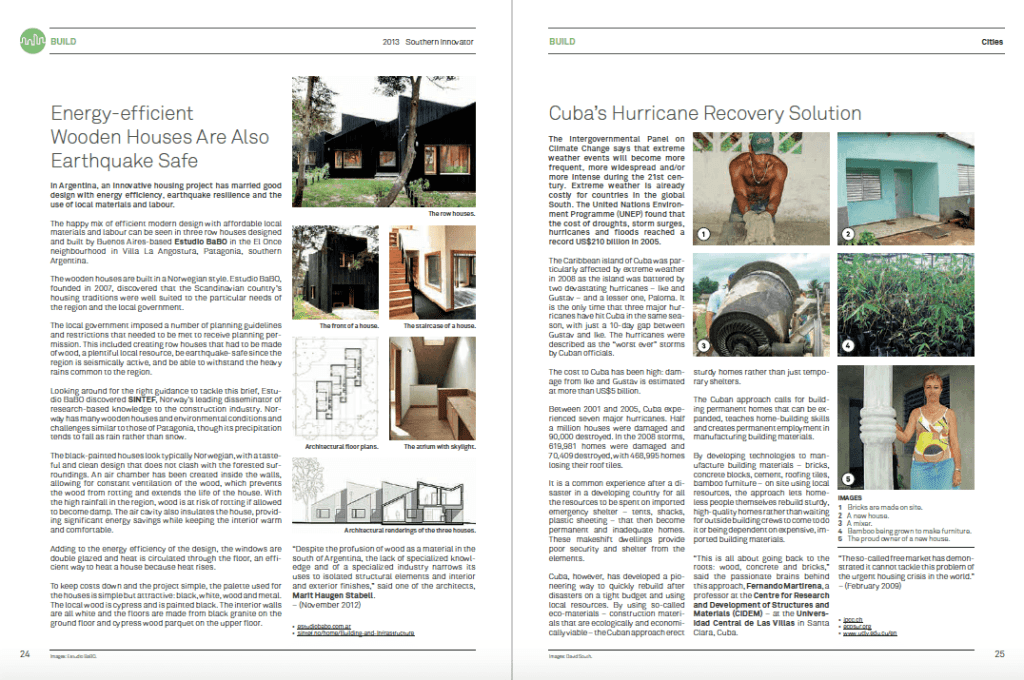
    The Caribbean island of Cuba (http://en.wikipedia.org/wiki/Cuba) was particularly affected in 2008 by extreme weather, as the island was battered by two devastating hurricanes – Ike and Gustav – and a lesser one, Paloma.  It was the only time that three major hurricanes have hit Cuba in the same season, with just a 10 day gap between Gustav and Ike. The hurricanes were described as the “worst ever” storms by Cuban officials

    The cost to Cuba has been high: Damages from Ike and Gustav are estimated at more than US$5 billion (http://tinyurl.com/ba7xny).

    Between 2001 and 2005, Cuba experienced seven major hurricanes. Half a million houses were damaged, and 90,000 destroyed. In the 2008 storms, 619,981 homes were damaged and 70,409 destroyed, with 468,995 homes losing their roof tiles.

    But Cuba has developed a pioneering way to quickly rebuild after disasters on a tight budget and using local resources. By using so-called ecomaterials – construction materials that are ecologically and economically viable – the Cuban approach erects sturdy homes, rather than just temporary shelters.

    It is a common experience after a disaster in a developing country for all the resources to be spent on imported emergency shelter – tents, shacks, plastic sheeting – that then become permanent and inadequate homes. These makeshift dwellings provide poor security and shelter from the elements. For Cuba, the enormous scale of the repair and reconstruction job is especially difficult because of the fuel shortages and building supply restrictions brought on by the United States’ embargo on the country (http://tinyurl.com/4alwrb). In turn, Cubans are adaptable and creative with their solutions.

    The Cuban approach builds permanent homes that can be expanded, teaches homebuilding skills and creates permanent employment in manufacturing building materials.

    By developing technologies to manufacture building materials – bricks, concrete blocks, cement, roofing tiles, bamboo furniture – on site using local resources, the approach lets homeless people themselves rebuild sturdy, high-quality homes, rather than waiting for outside building crews to come and do it, or being dependent on expensive, imported building materials. By doing this, jobs are created and wealth and gets the community back on its feet after the disaster.

    “This is all about going back to the roots: wood, concrete and bricks,” said the passionate brains behind this approach, Fernando Martirena, a professor at CIDEM  — the Centre for Research and Development of Structures and Materials — at the Universidad Central de Las Villas, in Santa Clara , Cuba (www.ecosur.org).

    “The so-called free market has demonstrated it can not tackle this problem of the urgent housing crisis in the world.”

    At the heart of the Cuban approach are easy-to-use machines that produce the building materials. They range from hand-cranked presses that make mud and clay bricks, to vibrating presses for concrete brick making.

    Training the homeless population to do the building themselves allows reconstruction work to begin straight away, rather than waiting for professional building crews to arrive on the scene. It is also psychologically more empowering for the people to be active participants in the rebuilding of their lives. The pride the people have in their new homes is visible.

    And quality has been critical for the programme so it can become sustainable and long-lasting:

    “The driving force for this project is need,” Martirena said. “If we want to obtain sustainability, we must go beyond need. After disaster, need is the driving force. But after two years, when most things have been completed, it must be a business. Good, beautiful, cheap. Normally, this technology is cheaper than industrial technology.”

    To stay prepared for future natural disasters that destroy or damage homes, the Cubans have established strategic reserves of micro-concrete roofing tiles. The lightweight but strong tiles can be used to quickly erect a small module home, and then the home can be expanded and built on as resources and time allow.

    Martirena, a former UNHABITAT award-winner, believes this approach to building materials brings prosperity back to rural areas and helps stem the flood of people to cities and urban sprawl seen across the global South.

    “You have to go back to the origin of the problem: people are looking for money and better jobs. It is not because they like the cities; they hate the cities!”

    “Bamboo harvesting (for furniture making) can bring people three times more income than they would make in the cities. They are really making money.”

    For Cuba, this has been a journey from a highly centralised and fuel-dependent approach to house building, to a decentralised, low-fuel approach. From 1959, the year of the revolution, until 1988, Cuba built housing using a centralised factory method to make building materials. Prefabricated houses were erected across the country. The materials were delivered by road and rail, all fuelled by cheap oil from the former Soviet Union.

    After the collapse of the Soviet Union in the early 1990s, oil became scarce and the transport network the building industry depended on fell apart. This time was called the “special period.”

    Apart from natural disasters, Cuba’s housing stock has suffered under the US embargo. The country’s housing began to decay as repairs were not happening and new houses were not being built. When people did want to do the repairs themselves, the lack of building supplies made it difficult for them to do so. Cuba realized it had to do things differently: the solutions had to be local, energy-efficient, and easy to use.

    CIDEM oversees workshops, training and building teams across the country. It tests new materials and designs in its labs before they are deployed as building solutions. The ecomaterials are chosen for low energy use and the ability to recycle waste. Being inexpensive, they offer a sustainable solution for the poor.

    In the community of Jatibonico, single mothers make up 40 percent of those who have benefited from the building projects. One woman proudly showed off the home she had built in the Spanish style, complete with Greco-roman columns on the porch. It has a clean, modern bathroom with shower and toilet.

    Martirena is currently working on a book of case studies about CIDEM’s projects helping Cubans cope with reduced oil dependency.

    CIDEM collaborates with universities around the world and has 19 workshops employing over 200 people in Cuba, and 15 in other countries in Latin America and Africa. It works with the Ecosur initiative and all the machines and advice on how to use them is available from the Ecosur website (www.ecosur.org).

    Published: November 2008

    Resources

    • “How Cuba Survived Peak Oil” is an award-winning film on how Cuba transitioned from a highly mechanized, industrial agricultural system to one using organic methods of farming and local, urban gardens. It is an unusual look into the Cuban culture during this economic crisis, which they call “The Special Period.” Website:http://www.powerofcommunity.org/cm/index.php
    • Global Greenhouse Warming is a website that tracks extreme weather events around the world: drought, flooding, severe storms, severe winter, tropical cyclone, wildfires, and extreme heat waves.Website:http://www.global-greenhouse-warming.com/extreme-weather.html
    • Cuba Hurricanes: Real-time reports of current hurricane threats to Cuba provided by an office in Old Havana. Also information on hurricanes of historical significance to Cuba. Website: http://www.cubahurricanes.org/
    • Gerd Niemoeller has developed flat pack, cardboard homes that can be deployed quickly after a disaster and can become permanent homes. Website: http://tinyurl.com/6t6jtf and the company website: http://www.wall.de/en/home
    • CIDEM and Ecosur specialise in building low-cost community housing using eco-materials. They have projects around the world and are based in Cuba. Website: http://www.ecosur.org

    https://davidsouthconsulting.org/2021/10/03/a-new-house-kit-for-slum-dwellers-that-is-safe-and-easy-to-build/

    https://davidsouthconsulting.org/2022/05/23/debt-free-homes-for-the-poor/

    https://davidsouthconsulting.org/2021/11/11/decent-and-affordable-housing-for-the-poor/

    https://davidsouthconsulting.org/2022/11/16/housing-innovation-in-souths-urban-areas/

    https://davidsouthconsulting.org/2021/11/11/housing-solution-for-worlds-growing-urban-population/

    https://davidsouthconsulting.org/2021/02/12/rammed-earth-houses-china-shows-how-to-improve-and-respect-traditional-homes/

    https://davidsouthconsulting.org/2021/02/12/rebuilding-after-chinese-earthquake-beautiful-bamboo-homes/

    https://davidsouthconsulting.org/2022/05/23/solar-bottle-bulbs-light-up-dark-homes/

    https://davidsouthconsulting.org/2022/09/26/3d-home-printing-landmark-10-houses-in-a-day/

    https://davidsouthconsulting.org/2022/11/17/tiny-homes-to-meet-global-housing-crisis/

    https://davidsouthconsulting.org/2021/03/05/southern-innovator-issue-4/

    Sponsored by BSHF. BSHF is now called World Habitat and it aims to seek out and share the best solutions to housing problems from around the world.

    Creative Commons License

    This work is licensed under a
    Creative Commons Attribution-Noncommercial-No Derivative Works 3.0 License.

    ORCID iD: https://orcid.org/0000-0001-5311-1052.

    © David South Consulting 2023

  • Geothermal Energy to Boost Global South’s Development

    Geothermal Energy to Boost Global South’s Development

    By David SouthDevelopment Challenges, South-South Solutions

    SOUTH-SOUTH CASE STUDY

    The geothermal heat produced by the earth’s molten core is a resource receiving more and more attention across the global South. Properly harnessed, geothermal energy (http://en.wikipedia.org/wiki/Geothermal_energy) offers a low-cost, non-polluting source of power and hot water that does not harm the environment or contribute to climate change (http://en.wikipedia.org/wiki/Climate_change).

    The country that has made the most of this resource is the Scandinavian island nation of Iceland (http://www.visiticeland.com/), one of the world’s most volcanically active places.

    The country was once one of the poorest in Europe, dependent on fishing as its main income source. But by 2007-2008, Iceland was ranked as having the highest level of human development in the world.

    One of the contributors to this impressive improvement in human development is the tapping of the country’s geothermal energy reserves (http://www.geothermal.is/).

    According to the Geothermal Energy Association (GEA), “Iceland is widely considered the success story of the geothermal community. The country of just over 300,000 people is now fully powered by renewable forms of energy, with 17 per cent of electricity and 87 per cent of heating needs provided by geothermal energy.”

    Worldwide, geothermal energy supplies power to 24 countries, producing enough electricity to meet the needs of 60 million people (GEA).

    The Philippines generates 23 per cent of its electricity from geothermal energy, and is the world’s second biggest producer behind the U.S.  Geothermal energy is also helping provide power in Indonesia, Guatemala, Costa Rica and Mexico.

    Energy is critical to advances in human development. Electricity enables the introduction of lighting in homes, the use of washing machines and other modern appliances and of communications tools such as computers and televisions.

    Geothermally heated water can be used to heat homes, provide hot water for bathing, heat swimming pools and bathing places and power electricity turbines. Industry can benefit from the low-cost energy, giving a boost to economic development.

    And, crucially, it does not harm the natural environment like conventional energy sources such as coal, gas or nuclear power with its legacy of radioactive waste.

    While not all countries are as well positioned as volcanically active Iceland or the Philippines, many can find a way to tap this natural resource.

    Interest in this power source is increasing in Central and South America, whose energy consumption is forecast to increase by 72 per cent by 2035 (International Energy Outlook 2011).

    South America currently relies heavily on hydro-electric power, but this is proving insufficient to meet the growing demand (http://www.esmap.org/esmap/node/1136). A World Bank study says “Latin American and Caribbean countries could boost region-wide electricity supply by 30 percent by 2030 by diversifying the energy mix to include hydropower, natural gas, and renewable energy” (ESMAP).

    The report estimates the region has the potential to generate 300 terawatts of geothermal energy per year, roughly equivalent to the output of fifty 1,000-megawatt power plants or the emission of 210 million metric tons of carbon greenhouse gases (ARPA).

    The areas best placed to tap this resource are located along the Pacific Rim from Mexico to Chile, and in parts of the Caribbean.

    The 2012 Geothermal International Market Overview Report by the Geothermal Energy Association (GEA) (http://www.geo-energy.org/reports.aspx) found Argentina, Chile and Peru are moving ahead with plans.

    In Argentina, Earth Heat Resources (http://www.earthheat.com.au/) is developing geothermal energy in the volcanic Copahue region in partnership with Xtrata Pachon SA (http://www.xstratacopper.com/EN/Operations/Pages/ElPachon.aspx).

    Because of government support and legislation, there are now 83 geothermal exploration concessions under review in Chile, according to Renewable Energy World.com.

    The Renewable Energy Center (http://www.ecpamericas.org/initiatives/?id=23) has been established in Chile and is the fruit of a partnership between the US Department of Energy (DOE) and the Chilean National Energy Commission. It is being used to gather data on global best practices and techniques to be adapted for use in Chile, and hopes to become a knowledge source for the region. A law is also in place to oblige power utilities with a capacity above 200 megawatts (MW) to have 10 per cent of their energy come from renewable sources.

    Central America has already enthusiastically embraced geothermal resources, according to the report by the GEA.

    Currently, El Salvador and Costa Rica derive 24 per cent (204 MW) and 12 per cent (163 MW) of their electricity production from geothermal energy. Nicaragua and Guatemala are also generating a portion of their electricity from geothermal energy.

    And Central America has still more geothermal potential it can tap. Estimates place this between 3,000 megawatts and 13,000 megawatts at 50 identified geothermal sites.

    Published: October 2012

    Resources

    1) Geothermal Basic from the Geothermal Energy Association. Website: http://www.geo-energy.org/currentUse.aspx

    2) Geothermal information for children. Website: http://www.eia.gov/kids/energy.cfm?page=geothermal_home-basics

    3) Geoexchange: A website connecting contractors, manufacturers , drilling contractors, ground loop installers, engineers, designers, distributors, architects, builders, utilities, training, financing, software and suppliers. Website: http://www.geoexchange.org/

    4) Iceland Geothermal: Icelandic geothermal cluster mapping, geothermal energy consumption. Website: http://www.icelandgeothermal.is/index.php/e-samstarfsverkefni/data-collection.html

    5) Iceland Geothermal Conference 2013: An international conference on geothermal will be held 5-8 March 2013 at Harpa Conference Centre in Reykjavik, Iceland and is hosted by the Iceland Geothermal initiative. Website:http://geothermalconference.is/

    https://davidsouthconsulting.org/2021/02/01/ethiopia-and-djibouti-join-push-to-tap-geothermal-sources-for-green-energy/

    https://davidsouthconsulting.org/2022/03/20/global-south-eco-cities-show-how-the-future-can-be/

    https://davidsouthconsulting.org/2021/02/01/kenya-turns-to-geothermal-energy-for-electricity-and-growth/

    https://davidsouthconsulting.org/2021/03/05/southern-innovator-issue-5/

    https://davidsouthconsulting.org/2022/11/01/southern-innovator-magazine-2010-2014/

    https://davidsouthconsulting.org/2021/09/07/10-years-ago/

    https://davidsouthconsulting.org/2021/10/28/2012-development-challenges-south-south-solutions/

    Creative Commons License

    This work is licensed under a
    Creative Commons Attribution-Noncommercial-No Derivative Works 3.0 License.

    ORCID iD: https://orcid.org/0000-0001-5311-1052.

    © David South Consulting 2023

  • Ethiopia and Djibouti Join Push to Tap Geothermal Sources for Green Energy

    Ethiopia and Djibouti Join Push to Tap Geothermal Sources for Green Energy

    By David SouthDevelopment Challenges, South-South Solutions

    SOUTH-SOUTH CASE STUDY

    Ethiopia and Djibouti are the latest global South countries to make a significant commitment to developing geothermal energy – a green energy source that draws on the heat below the earth’s surface (http://en.wikipedia.org/wiki/Geothermal_energy) – to meet future development goals.

    Ambitiously, Ethiopia also hopes to build Africa’s largest geothermal power plant.

    It joins Kenya, which in 2012, announced projects to expand its geothermal capacity further. Currently, Kenya is Africa’s largest geothermal producer and has geothermal resources concentrated near a giant volcanic crater in the Great Rift Valley with 14 fields reaching from Lake Magadi to Lake Turkana. There are also low temperature fields in Homa Hills and Massa Mukwe (http://www.gdc.co.ke/index.php?option=com_content&view=article&id=191&Itemid=163). Around 1,400 steam holes are being drilled.

    Cooperating with Reykjavik Geothermal (rg.is), a US-Icelandic private developer, Ethiopia will spend US $4 billion to build a 1,000 megawatt geothermal plant at Corbetti (http://www.volcano.si.edu/volcano.cfm?vn=221290). It is expected to be ready in eight to 10 years. The country wants to be carbon neutral by 2025.

    Drilling will need to go down as deep as 3 kilometers to tap the source. This is expensive and a technological challenge, thus the need for international expertise. The country hopes to develop this source of energy and then export electricity to neighboring African countries.

    Another plant, Aluto Langano 7, is being built 201 kilometers south of Addis Ababa, the capital, by a partnership between the Japanese government, Ethiopia and the World Bank.

    Ethiopia has enormous potential for geothermal energy, according to a paper in the journal Geothermics: “Ethiopia holds an enormous capacity to generate geothermal energy in the volcano-tectonically active zones of the East African Rift System (http://www.sciencedirect.com/science/article/pii/S0375650513000023).”

    At present, 70 per cent of people in sub-Saharan Africa, some 600 million, are without a domestic electricity supply (USAID). Electricity and other sources of energy are required if living standards are to be raised for millions of the world’s poor. The danger of this, however, is to the planet if the energy comes from polluting sources.

    In March 2013 the World Bank announced a significant push to increase development of geothermal resources around the world, and in particular in energy-hungry, fast-developing countries.

    “Geothermal energy could be a triple win for developing countries: clean, reliable, locally produced power,” the bank says. “And once it is up and running, it is cheap and virtually endless.”

    The bank joined forces with Iceland to make a pledge to secure US $500 million in financing to get geothermal projects up and running. The announcement was made at the Iceland Geothermal Conference (http://geothermalconference.is/) in Reykjavík, the Icelandic capital.

    Few countries have such easy access to geothermal energy as Iceland, with its plentiful volcanoes, geysers and hot springs bursting through the surface. But it is there, under the ground, and through the Global Geothermal Development Plan (GGDP), it is hoped this plentiful energy source will become the norm for countries around the world.

    The World Bank believes at least 40 countries can get into geothermal on a significant scale with the correct investment. Many developing world regions are rich in geothermal resources, including East Africa, Southeast Asia, Central America, and the Andean region.

    Just 11 gigawatts of geothermal capacity is currently being tapped in the world. Nuclear power, for example, generates 370 gigawatts a year (2012) (EIA). What has held back many countries has been the high upfront costs involved in getting projects going. A site must be found, drilled and tested to see if it is viable.

    The GGDP plan is to raise US $500 million from donors and others to fund geothermal exploration and development. The GGDP will identify promising sites and then acquire funding to pay for drilling to identify commercially viable projects.

    The World Bank has increased financing for geothermal development from US $73 million in 2007 to US $336 million in 2012. It comprises 10 per cent of the Bank’s renewable energy lending.

    The Icelandic International Development Agency (iceida.is) signed a partnership in September 2013 with the government of Ethiopia to undergo geothermal surface exploration and to build Ethiopia’s capacity to develop this energy source. The World Bank estimates that Ethiopia has the potential to generate 5,000 megawatts (MW) of energy from geothermal sources.

    The Geological Survey of Ethiopia (GSE) and the Ethiopian Electric Power Corporation (EEPCO) will undertake exploration at sites in Tendaho Alalobeda and Aluto Langano.

    It fits in with a wider push by Ethiopia to develop its renewable energy resources. The country is also increasing investment in hydro-electric power.

    The Ethiopia project is part of the wider World Bank-Iceland compact to develop global geothermal energy capacity. It is the second such arrangement, with the first already underway in Rwanda.

    Djibouti is also moving into geothermal, with a new agreement with the World Bank to develop a site at Lake Assal. The World Bank will provide US $6 million to evaluate its commercial potential. Djibouti tried to develop its geothermal resources privately but was not successful.

    Overall, geothermal power has the potential to help reduce Djibouti’s electricity production costs by 70 per cent, boost access to electricity for the population and alleviate the country’s energy dependency. The country hopes to have 100 per cent green energy by 2020.

    Joining forces on helping boost geothermal in Africa is USAID’s Power Africa fund, which is providing US $7 billion in financial support and loan guarantees for energy projects.

    Apart from generating electricity, what else can this powerful resource do? Countries such as Iceland now use hot geothermal water to heat homes and provide domestic hot water. Iceland also has an extensive network of swimming pools and spas in each town. The Blue Lagoon (bluelagoon.com) is a good example of how geothermal power generation can have lots of side benefits. The giant, steamy blue-colored lagoon is the consequence of an accident in 1976 at the nearby geothermal power plant; it’s now a spa and one of the country’s main tourist attractions.

    The geothermal-heated pools and spas play a key role in keeping the cold north Atlantic country healthy – Iceland ranked number one on the UNDP human development index in 2007 – and provide a recreational source even in the depths of winter.

    Published: December 2013

    Resources

    1) Iceland Review: A great way to learn about life on an island powered by geothermal energy. Website: icelandreview.com

    2) Nordic Development Fund: The Nordic Development Fund (NDF) is the joint development finance institution of the five Nordic countries. The objective of NDF’s operations is to facilitate climate change investments in low-income countries. Website: ndf.fi

    3) Icelandic International Development Agency (ICEIDA): The Icelandic International Development Agency (ICEIDA) is an autonomous agency under the Ministry of Foreign Affairs and is responsible for the implementation of official Icelandic bilateral development cooperation.  It follows the Icelandic government’s Act on Development Cooperation No 121/2008, which is in keeping with the UN Millennium Development Goals and other international commitments, such as the Monterrey Consensus on Financing for Development and the Paris Declaration on Aid Effectiveness. Website: iceida.is

    4) Geothermal Exploration Project, NDF: The main objective of the Geothermal Exploration Project is to assist countries in East Africa to enhance geothermal knowledge and capacity in order to enable further actions on geothermal energy development in the respective countries. The project could extend to 13 countries in the East Africa Rift Valley: Burundi, Comoros, Djibouti, DR Congo, Eritrea, Ethiopia, Kenya, Malawi, Mozambique, Rwanda, Tanzania, Uganda and Zambia. Website: http://www.iceida.is/iceida-projects/nr/1488

    5) Power Africa: Power Africa – an initiative to double the number of people with access to power in sub-Saharan Africa. Power Africa will achieve this goal by unlocking the substantial wind, solar, hydropower, natural gas, and geothermal resources in the region to enhance energy security, decrease poverty, and advance economic growth. Website: http://www.usaid.gov/powerafrica

    6) Geological Survey of Ethiopia: The GSE has been generating , collecting  and managing geoinformation of the country for the last 4 decades. Website: http://www.gse.gov.et/index.php

    7) Home geothermal: A feature from Popular Mechanics on how geothermal can work in the home. Website: http://www.popularmechanics.com/science/energy/hydropowergeothermal/4331401

    Like geothermal energy? Then we think you will like our Southern Innovator Magazine. Designed and laid out in Iceland using 100% renewable energy (much of which is geothermal). 


    This work is licensed under a Creative Commons Attribution 4.0 International License.

    ORCID iD: https://orcid.org/0000-0001-5311-1052.

    © David South Consulting 2023