Tag: Southern Innovator magazine

  • Food Diplomacy Next Front for South’s Nations

    Food Diplomacy Next Front for South’s Nations

    By David SouthDevelopment Challenges, South-South Solutions

    SOUTH-SOUTH CASE STUDY

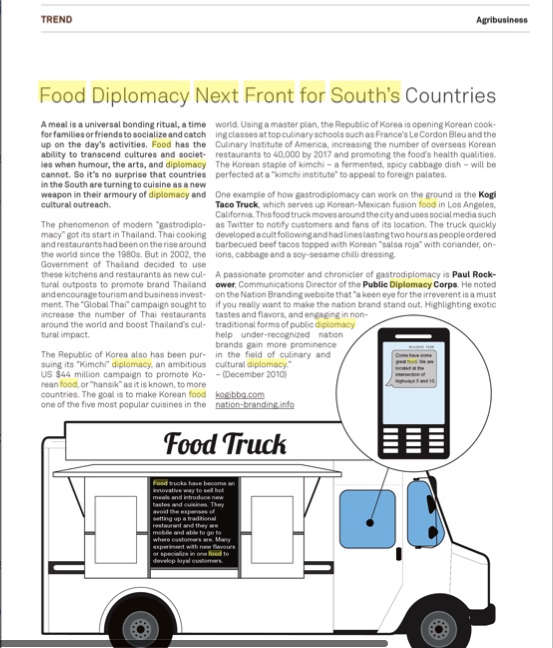
    The meal is a universal bonding ritual, a time for families or friends to socialize and catch up on the day’s activities. Food has the ability to transcend cultures and societies when humour, the arts, and diplomacy cannot. A person may know nothing about a particular country or culture, but they know what their appetite and palate likes. So it’s no surprise that countries in the South are turning to cuisine as a new weapon in their armoury of diplomacy and cultural outreach.

    The phenomenon of ‘gastrodiplomacy’ got its start in Thailand. Thai cooking and restaurants had been on the rise around the world since the 1980s. But in 2002 the Thai government decided to use these kitchens and restaurants as new cultural outposts to promote brand Thailand and encourage tourism and business investment. The “Global Thai” campaign sought to increase the number of Thai restaurants around the world and boost Thailand’s cultural impact.

    As The Economist reported at the time, more restaurants “will not only introduce delicious spicy Thai food to thousands of new tummies and persuade more people to visit Thailand, but it could subtly help deepen relations with other countries.”

    Thailand’s 2002 campaign boosted the number of Thai restaurants around the world and made popular dishes like pad Thai and tom yum soup (http://www.bbc.co.uk/food/recipes/tomyumsoup_85069) familiar to many more people. They are now signature dishes, as synonymous with Thailand as hamburgers are with the United States.

    Malaysia, whose varied and delicious cuisine is less known globally than that if its neighbour Thailand, has been running an aggressive campaign in Britain to promote its food. This included setting up a street market in the famous Trafalgar Square in central London: a high foot-traffic spot guaranteed to get the city’s attention.

    South Korea also has been pursuing its “Kimchi” diplomacy, an ambitious US $44 million campaign to promote Korean food, or hansik (http://www.visitkorea.or.kr/enu/CU/CU_EN_8_1_5.jsp) as it is known, to more nations. They aim to make Korean food one of the top five most popular cuisines in the world. Using a master plan, South Korea is opening Korean cooking classes at top culinary schools like France’s Le Cordon Bleu and the Culinary Institute of America, increasing the number of overseas Korean restaurants to 40,000 by 2017, and promoting the food’s health qualities. The Korean staple of kimchi – a fermented, spicy cabbage dish – will be perfected at a “kimchi institute” to appeal to foreign palates (http://www.korea.net/detail.do?guid=45469).

    Neighbouring North Korea has also turned to gastrodiplomacy with its chain of “Pyongyang Restaurants” (http://www.pyongyangrestaurant.com) around Asia and Europe. These eateries first appeared in China, near the border with North Korea, but have expanded widely during the last decade. Pyongyang Restaurants can be found in Vientiane, Laos; Siem Reap and Phnom Penh, Cambodia; and Bangkok and Pattaya, Thailand. In Europe, a restaurant has opened in the Dutch city of Amsterdam. The restaurants’ formula offers staff in traditional clothing, authentic North Korean interiors, North Korean art, cooking lessons, cultural performances, and singing. The food includes traditional Korean dishes like kimchi (fermented spicy cabbage), Pyongyang “cold noodle” and barbecued cuttlefish (squid).

    One example of how gastrodiplomacy can work on the ground is the Kogi Taco Truck (http://kogibbq.com/), which serves up Korean-Mexican fusion food  in Los Angeles, California. This food truck moves around the city and uses social media like Twitter (www.twitter.com) to notify customers and fans of its location. The truck quickly developed a cult following and had lines lasting two hours as people ordered barbecued beef tacos topped in Korean “salsa roja” with coriander, onions, cabbage and a soy-sesame chilli dressing. The truck has been praised for bringing the appreciation of Korean food and culture to parts of the city that knew little about Korea.

    A passionate promoter and chronicler of gastrodiplomacy is Paul Rockower, Communications Director of the Public Diplomacy Corps (http://publicdiplomacycorps.org), an organization dedicated to bringing
    diplomacy to the public. He noted on the Nation Branding (www.nation-branding.info) website that “a keen eye for the irreverent is a must if you really want to make the nation brand stand out. Highlighting exotic tastes and flavors, and engaging in nontraditional forms of public diplomacy help under-recognized nation brands gain more prominence in the field of culinary and cultural diplomacy.”

    For Taiwan, which has tense relations with China, which does not recognize it as a nation, gastrodiplomacy is a way to get the island’s message across. Taiwan is spending US $31 million on its food diplomacy campaign around the world.

    “Taiwan has figured out it can do better outreach work through the kitchen table,” Rockower told The Guardian newspaper. “When someone tries a sea-salt latte (a Taiwanese drink) it creates awareness about Taiwanese culture. The Koreans embarked on Kimchi diplomacy partly because their brands weren’t being recognized as Korean – Samsung was being recognized as a Japanese brand.”

    Published: December 2010

    Resources

    • Unrepresented Nations and Peoples Organization: Is an international, nonviolent, and democratic membership organization. Its members are indigenous peoples, minorities, and unrecognized or occupied territories who have joined together to protect and promote their human and cultural rights, to preserve their environments, and to find nonviolent solutions to conflicts which affect them. Website:http://www.unpo.org/
    Creative Commons License

    This work is licensed under a
    Creative Commons Attribution-Noncommercial-No Derivative Works 3.0 License.

    Citations

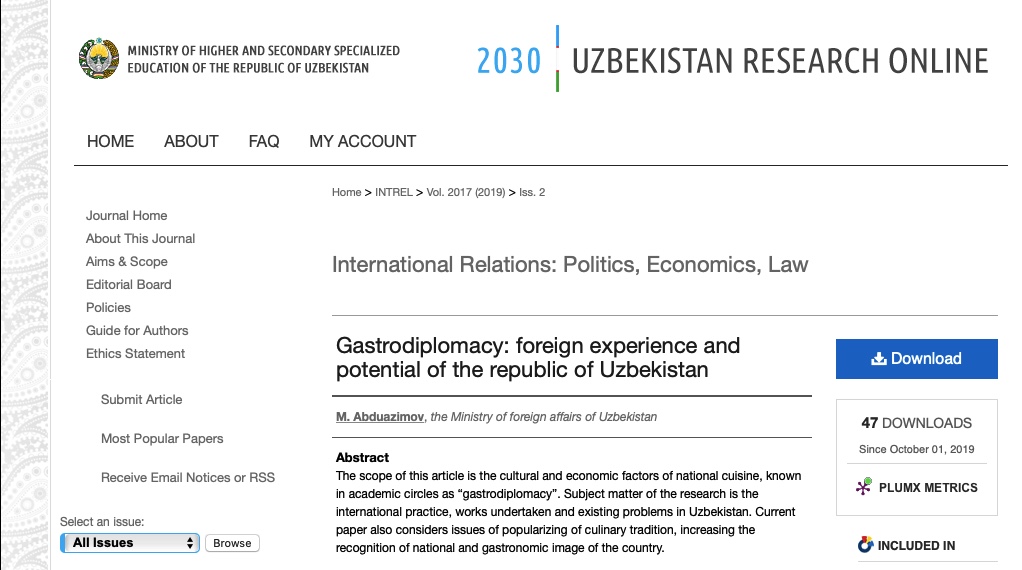
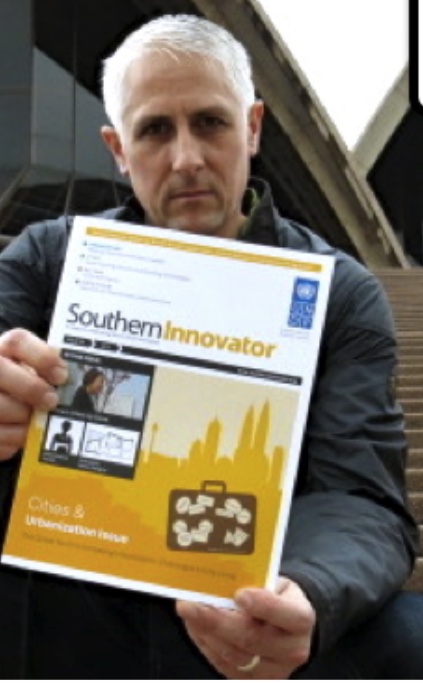
    Launched in 2011, Southern Innovator’s first issue on mobile phones and information technology proved highly influential, profiling the work of a new generation of innovators. It has been cited in books, papers and strategic plans.  The third issue focused on agribusiness and food security, including the phenomenon of ‘gastrodiplomacy’. In 2017, the story Food Diplomacy Next Front for South’s Nations was cited in a paper on its potential for Uzbekistan. By 2019, Uzbekistan had launched its gastrodiplomacy strategy: Uzbekistan Embassy in Jakarta Launches its Gastrodiplomacy Project to Promote Tourism.

    Abduazimov, M. (2017) “Gastrodiplomacy: foreign experience and potential of the republic of Uzbekistan,” International Relations: Politics, Economics, Law: Vol. 2017 : Iss. 2 , Article 2. 
    Available at: https://uzjournals.edu.uz/intrel/vol2017/iss2/2.
    Gastrodiplomacy: foreign experience and potential of the republic of Uzbekistan by M. Abduazimov, International Relations: Politics, Economics, Law, 2017. 
    Anugrahningtyas, Wilda and Meganingratna, Andi (2023) “Analisis Gastrodiplomasi Melalui Samyang Challenge Terhadap Diplomasi Korea Selatan Di INDONESIA Tahun 2015-2017,” Jurnal Ilmiah Hubungan Internasional Fajar.

    This work is licensed under a Creative Commons Attribution 4.0 International License.

    ORCID iD: https://orcid.org/0000-0001-5311-1052.

    © David South Consulting 2025

  • New 3D Technology Makes Innovation Breakthrough and Puts Mind over Matter

    New 3D Technology Makes Innovation Breakthrough and Puts Mind over Matter

    By David SouthDevelopment Challenges, South-South Solutions

    SOUTH-SOUTH CASE STUDY

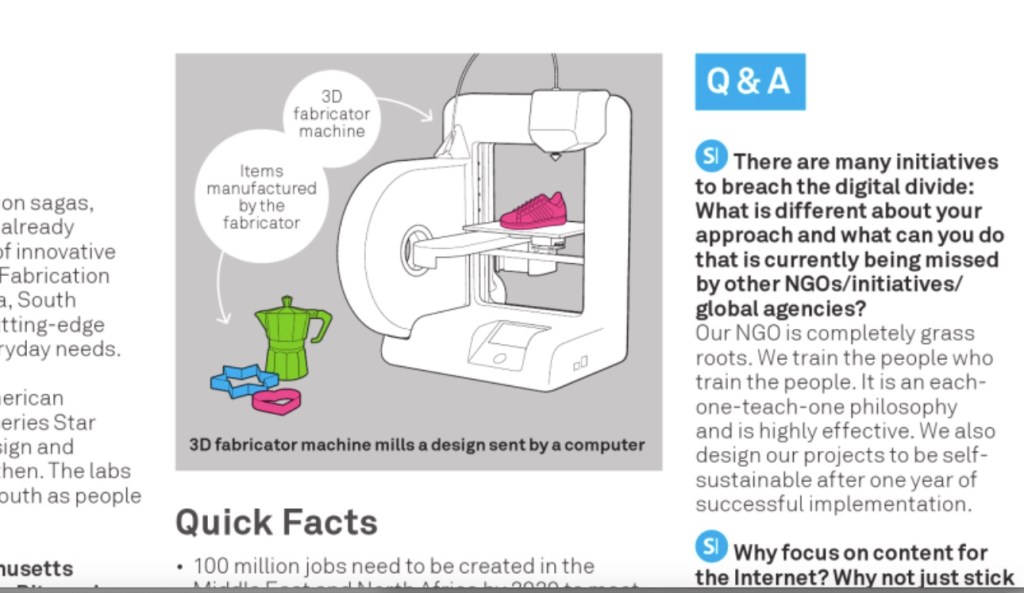
    Revolutions in technology are placing more and more power into the hands of the individual, and 3D printing and fabrication machines are opening a whole new chapter.

    These devices come in many forms, but they all do one thing: they can manufacture pretty well any three-dimensional object on the spot, from digital plans. These machines come in many sizes, from factory scale to smaller, home versions which are no bigger than personal computer printers, such as the well-known MakerBot Replicator 2 (makerbot.com).

    3D printers introduce sophisticated precision manufacturing to the individual much in the same way the personal computer and the Internet have empowered people to make their own software, build websites and start online businesses.

    A pioneering educational innovation in Chile is taking the technology even further, in a way that is truly mind-blowing. Thinker Thing (thinkerthing.com) promises to transform the way people interact with this new technology. “We have built a machine that will allow you to make real objects with your mind,” its website states.

    And, it wants to do more: “We want to use our invention to light a fire of inspiration throughout the remote and often disadvantaged schools of South America and we can do this with your help.”

    Thinker Thing allows the user to wear a headset and communicate through brain waves to the 3D printer. The printer then manufactures a three-dimensional model of the thoughts. These can be squiggly shapes or even, it is hoped, more sophisticated forms.

    Thinker Thing’s Chilean Chief Technology Officer is George Laskowsky. Laskowsky has a games console engineering background and was a research assistant in charge of high-energy particle experiments.

    The Chilean government is funding this experiment to help children to improve their creative skills. The idea is to use the technology to eliminate the technical side of creating objects and focus the effort on the creative thought process. Thinker Thing was selected from more than 1,400 applicants to participate in the prestigious global accelerator program, “Start Up Chile” (http://startupchile.org). Start-Up Chile is a program created by the Chilean government that seeks to attract early-stage high potential entrepreneurs to develop startups using Chile as a platform to go global, in line with the national goal of converting Chile into the innovation and entrepreneurship hub of Latin America.

    Based in Santiago, Chile, Laskowsky is seeking support for further development on IndieGoGo (http://www.indiegogo.com/projects/children-creating-real-objects-with-their-mind), an international crowdfunding platform for projects.

    The plan is to tour Thinker Thing all around Chile and use the science, art and engineering principles behind the invention to help very young children in remote rural regions to learn through understanding the project. Its creators also hope to take the exhibition – called the Monster Dreamer School Outreach Program and the Fantastical Mind Creatures of Chile Exhibition – on the road and show it in major global cities.

    The children are being asked to imagine fantastical creatures that will then be made into 3D forms with the machine. The idea is to then sell these 3D creatures to supporters of the project to help fund the initiative. As well, these creatures will go on display in an exhibition to help educate visitors about Chile’s children and their communities.

    To increase interest, exclusive photographic prints and limited edition figurines are available of the creatures the children create.

    The prototype uses what is called an EmotivEPOC, basically a wireless neuroheadset collecting signals from the user’s brain. In operation, the software allows users to make 3D models with the power of thought which are then made into a plastic model using a MakerBot Industries Replicator.

    This is experimental stuff and neurotechnology is in its early stages. It can detect simple emotions such as excitement or boredom and cognitive thoughts such as push and pull. Despite being in its early stages, the technology can evolve a 3D object over a number of steps by detecting the user’s emotional response to design changes.

    Thinker Thing has been working alongside neuroscientists to understand the workings of the brain. Amazingly, in one experiment they were able to get a person to control the leg of a cockroach using their own thoughts. Called the Salt Shaker (http://www.thinkerthing.com/about-2/salt-shaker/), it is an experimental kit for young students and hobbyists that allows them to take control of a biological limb quickly and simply.

    The 3D printing revolution is energizing for large and small-scale manufacturers alike. It means a business can now engage in precision manufacturing of products and spare parts quickly. It means it is possible to download from the Internet plans for new innovations and manufacture them within minutes. It also means communities off the mainstream supply line can make what they need and repair machinery without needing to wait weeks or months for items to be shipped from afar or spend vast sums on shipping costs.

    The Fab Labs project based at the Massachusetts Institute of Technology (MIT) has been at the forefront of pioneering and prototyping this technology, including running testing labs across the global South to prove the relevance of the technology to the world’s poorest communities.

    As of 2012, these include Fab Lab Afghanistan (http://www.fablab.af/), in Chile the FabLab Santiago (www.designlab.uai/fablab), Fab Lab Egypt (www.fablab-egypt.com), in Colombia the FabLab Medellin (http://www.fablabcolombia.com), in Ghana the Takoradi Technical Institute (http://ttifab.wikispaces.com/How+to+Use+the+TTI+Fab+Lab+Wiki), in India at various locations, Indonesia’s HONFablab (http://honfablab.org), ARO FabLab Kenya West (http://www.fablab.co.ke), and in Peru, South Africa, Suriname and many more are in the works (http://fab.cba.mit.edu/about/labs/).

    If Thinker Thing has its way, maybe people in the future will say “I think, therefore I print!”

    Published: August 2013

    Resources

    1) Stratasys: The company manufactures 3D printers and materials that create prototypes and manufactured goods directly from 3D CAD files or other 3D content. Stratasys systems are used by manufacturers to create models and prototypes to aid in the new product design process. And they are becoming widely used for production of finished goods in low-volume manufacturing. Systems range from affordable desktop 3D printers to large production systems for direct digital manufacturing. Website: http://www.stratasys.com/

    2) 3D Systems: 3D Systems is a leading provider of 3D content-to-print solutions including 3D printers, print materials and on-demand custom parts services for professionals and consumers alike. Website: http://www.3dsystems.com/

    ExOne: With decades of manufacturing experience and significant investment in research and product development, ExOne has pioneered the evolution of nontraditional manufacturing. This investment has yielded a new generation of rapid production technology in the field of additive manufacturing as well as advanced micromachining processes. Website: http://www.exone.com/

    FabCentral: This site supports a digital fabrication facility and global network of field fab labs managed by MIT’s Center for Bits and Atoms. Website: http://fab.cba.mit.edu

    Maker Shed: 3D Printing and Fabrication:  An outstanding resource for getting all you need to understand 3D printing and manufacturing, with 3D printers, supplies, Whether you want to print out physical objects or machine something from plastic, wood, or other materials, we have the tools and accessories you need. Website: http://www.makershed.com/3D_Printing_Fabrication_s/220.htm

    EMachineShop: The first and leading machine shop designed from the start for the Internet, eMachineShop’s mission is to provide easy, convenient and low-cost fabrication of custom parts via the web. Website: emachineshop.com/

    Development Challenges, South-South Solutions was launched as an e-newsletter in 2006 by UNDP’s South-South Cooperation Unit (now the United Nations Office for South-South Cooperation) based in New York, USA. It led on profiling the rise of the global South as an economic powerhouse and was one of the first regular publications to champion the global South’s innovators, entrepreneurs, and pioneers. It tracked the key trends that are now so profoundly reshaping how development is seen and done. This includes the rapid take-up of mobile phones and information technology in the global South (as profiled in the first issue of magazine Southern Innovator), the move to becoming a majority urban world, a growing global innovator culture, and the plethora of solutions being developed in the global South to tackle its problems and improve living conditions and boost human development. The success of the e-newsletter led to the launch of the magazine Southern Innovator.  

    Follow @SouthSouth1

    Google Books: https://books.google.co.uk/books?id=YfRcAwAAQBAJ&dq=development+challenges+august+2013&source=gbs_navlinks_s

    Slideshare: http://www.slideshare.net/DavidSouth1/development-challenges-august-2013-issue

    Southern Innovator Issue 1: https://books.google.co.uk/books?id=Q1O54YSE2BgC&dq=southern+innovator&source=gbs_navlinks_s

    Southern Innovator Issue 2: https://books.google.co.uk/books?id=Ty0N969dcssC&dq=southern+innovator&source=gbs_navlinks_s

    Southern Innovator Issue 3: https://books.google.co.uk/books?id=AQNt4YmhZagC&dq=southern+innovator&source=gbs_navlinks_s

    Southern Innovator Issue 4: https://books.google.co.uk/books?id=9T_n2tA7l4EC&dq=southern+innovator&source=gbs_navlinks_s

    Southern Innovator Issue 5: https://books.google.co.uk/books?id=6ILdAgAAQBAJ&dq=southern+innovator&source=gbs_navlinks_s

    Creative Commons License

    This work is licensed under a
    Creative Commons Attribution-Noncommercial-No Derivative Works 3.0 License.

    ORCID iD: https://orcid.org/0000-0001-5311-1052.

    © David South Consulting 2023

  • New Paper Citation For Southern Innovator Issue 3

    New Paper Citation For Southern Innovator Issue 3

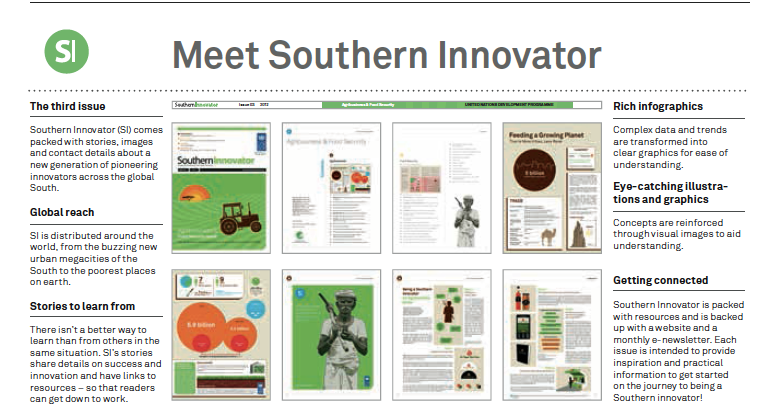
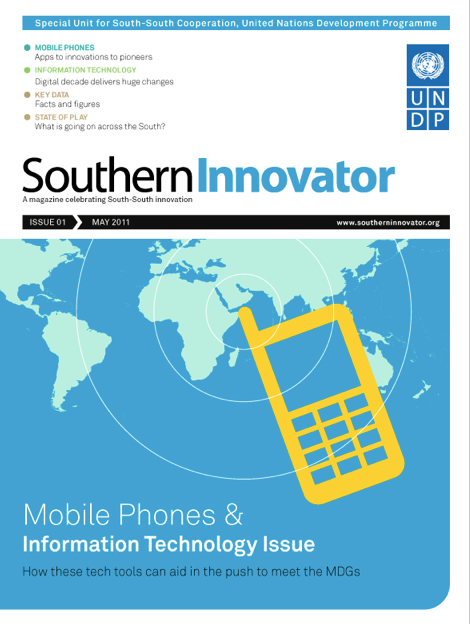
    Launched in 2011, Southern Innovator’s first issue on mobile phones and information technology proved highly influential, profiling the work of a new generation of innovators. It has been cited in books, papers and strategic plans.  The third issue focused on agribusiness and food security, including the phenomenon of ‘gastrodiplomacy’.

    Abduazimov, M. (2017) “Gastrodiplomacy: foreign experience and potential of the republic of Uzbekistan,” International Relations: Politics, Economics, Law: Vol. 2017 : Iss. 2 , Article 2. 
    Available at: https://uzjournals.edu.uz/intrel/vol2017/iss2/2.
    Gastrodiplomacy: foreign experience and potential of the republic of Uzbekistan by M. Abduazimov, International Relations: Politics, Economics, Law, 2017. 

    This work is licensed under a Creative Commons Attribution 4.0 International License.

    ORCID iD: https://orcid.org/0000-0001-5311-1052.

    © David South Consulting 2021

  • Team | Southern Innovator Phase 1 Development (2010 – 2015)

    Team | Southern Innovator Phase 1 Development (2010 – 2015)

    Work began in 2010 to develop what became the United Nations magazine Southern Innovator. A highly talented global team of international development and design professionals based in New York and London collaborated with an Icelandic studio to create an innovation media brand showcasing global South innovators inspired by the mobile and information technology revolutions. It was launched in 2011 at the UN General Assembly in New York.

    Cosmas Gitta

    Editor-in-Chief

    “Dr. Cosmas Gitta is a senior UN consultant and the former Assistant Director for Policy and UN Affairs at the UN Office for South-South Cooperation, where he oversaw the convening of various intergovernmental and interagency forums as well as the preparation of related reports and studies, including the biennial reports of the Secretary-General on the state of South-South cooperation. He was Editor-in-Chief of the magazine Southern Innovator and an e-newsletter, Development Challenges, South-South Solutions, both of which are media to share information on development related innovations with partners around the world. He was for many years Managing Editor of Cooperation South, a print and electronic development journal promoting collaboration among developing countries. Mr. Gitta holds a PhD in international and comparative education from Columbia University and he has lectured on human rights education at his alma mater, and on a range of other subjects at various campuses of the City University of New York.” (From Integral Leadership Review)

    David South

    Editor and Writer

    David South is the founder and senior partner for David South International and David South Consulting. He has worked around the world for the United Nations and has led a number of groundbreaking projects for major institutions. Clients have included the United Nations Office for South-South Cooperation (UNOSSC), the United Nations Development Programme (UNDP), the Great Ormond Street Hospital for Children (GOSH)/Institute of Child Health (ICH)/National Health Service (NHS), Harvard Institute for International Development, UNICEF, World Bank, USAID, and the Hannah Institute for the History of Medicine, among others.

    He has worked for, or side-by-side, with many high-level senior professionals and executives. These experienced professionals had roles under close public scrutiny and needed to show the impact of their work to a tight deadline.

    He has been the editor for the United Nations magazine Southern Innovator since 2010. He also researched and wrote the influential United Nations e-newsletter Development Challenges, South-South Solutions (2007-2014). He has over two decades’ experience in media and journalism (developing strong relationships with many top journalists and media professionals), health and human development, and the role innovation plays in transforming major organisations while getting the most from people tackling complex problems in challenging environments.

    Email me: davidsouthconsulting@gmail.com

    Audette Bruce

    Managing Editor

     Sólveig Rolfsdóttir

    Graphic Designer and Ilustrator

    Eva Hrönn Guðnadóttir

    Graphic Designer and Illustrator


    Launched in May 2011, the new global magazine Southern Innovator (ISSN 2222-9280) is about the people across the global South shaping our new world, eradicating poverty and working towards the achievement of the Millennium Development Goals (MDGs).

    They are the innovators.

    Follow the magazine on Twitter @SouthSouth1.

    Southern Innovator Issue 1

    Southern Innovator Issue 2

    Southern Innovator Issue 3

    Southern Innovator Issue 4

    Southern Innovator Issue 5

    If you would like hard copies of the magazine for distribution, then please contact the United Nations Office for South-South Cooperation (UNOSSC) (https://www.unsouthsouth.org/2014/12/25/southern-innovator-magazine/).

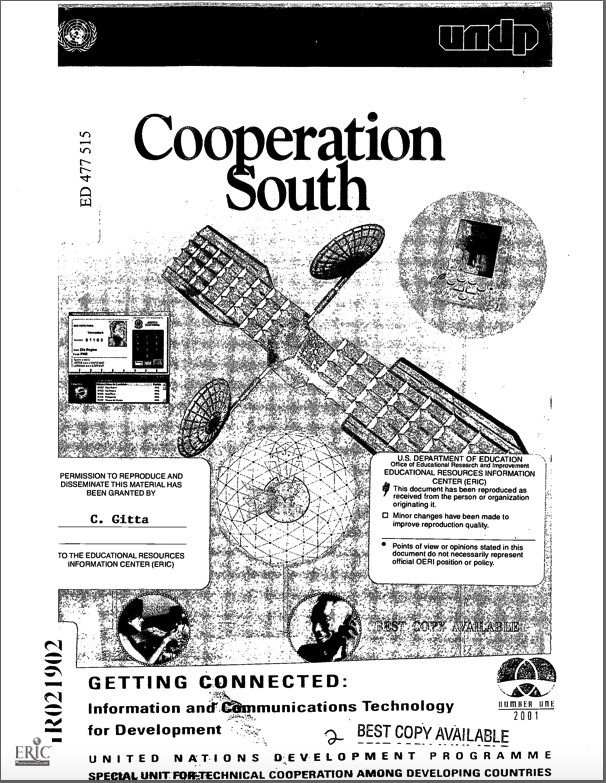
    Read more of Dr. Gitta’s work here: Cooperation South, Getting Connected: Information and Communications Technology for Development, Number 1, 2001, United Nations Development Programme, ISSN-0259-3882.

    Cooperation South, Getting Connected: Information and Communications Technology for Development, Number 1, 2001, United Nations Development Programme, ISSN-0259-3882. The team behind Cooperation South joined up with a team from Canada/UK/Iceland to create Southern Innovator Magazine (ISSN 2222-9280). Both publications highlighted the innovators behind the global South’s connectivity revolution.

    This work is licensed under a Creative Commons Attribution 4.0 International License.

    ORCID iD: https://orcid.org/0000-0001-5311-1052.

    © David South Consulting 2021