With awareness of global warming at an all-time high – and governments seeking real-world solutions to solve this enormous problem – bioethanol fuel has risen up the agenda as a replacement for conventional fuel sources. At present, most bioethanol fuel is produced from either corn or sugar but a less known plant jatropha could be the real solution. Brazil has been a pioneer in producing bioethanol fuel from sugar, while the United States has focused on its substantial corn crop as a source, and both contribute more than half the world’s supply. Brazil alone made US $5.4 billion from biofuels (ethanol and biodiesel combined) in 2005, while global production is estimated at 48 billion litres (Biofuel Market Worldwide (2007-2010) www.canbiotech.com).
Global prices for crude oil, under pressure from a number of sources, are volatile and far above 1990s levels. This hurts the poorest countries most (Human Development Report 2005). Expensive fuel means the world’s poor are denied affordable access to machinery and appliances that can make life more comfortable. Poorer nations are often more dependent on oil imports than richer countries. As well, most of their industries are energy intensive, and their cars and homes are less energy efficient. This means low-income countries spend twice as much of their national income on imported oil than do developed countries (World Bank). A US $10 per barrel increase in the cost of crude oil shaves half a percentage point from economic growth in the West; in the poorest countries, it is nearly three times higher.
The two common sources of bioethanol fuel – corn and cane sugar – have a major drawback: they are diverting food sources into fuel for vehicles. Already, the massive US diversion of corn into the bioethanol fuel market has sent the price of corn skyrocketing, making this hardy food staple in countries like Mexico more expensive for the poor. Some estimates claim ethanol plants will burn up to half of the United States’ domestic corn supplies within a few years (Foreign Affairs). To fill the fuel tank of a sports utility vehicle (SUV) with pure ethanol requires 450 pounds of corn – enough calories to feed one person for a year.
And this is why many are now advocating a non-edible Indian fruit bush called jatropha as a better solution. It is like a grapefruit, with each fruit containing three plum-sized seeds. Each seed contains 35 percent oil which can be converted into biodiesel. A shrub from the family euphorbiaceae, jatropha’s lifespan is 50 years. It bears fruit several times a year, and each bunch is five to eight fruits. Being unedible, the oil is mostly used for soap and varnishes.
Cultivation of the jatropha was prioritised a year ago by the Indian Railway Minister, Lalu Prasad Yadav. Disused railways lands were to be put aside for growing the crop. Brazil’s biodiesel company, Biomasa, plans to plant two million hectares with jatropha this year, and it is believed jatropha will surpass sugar cane as the principal source for bioethanol in Brazil.
The advantages of jatropha include its hardy nature: it does not require pesticide, manure, or irrigation to grow and it is drought resistant. A single jatropha plant will yield one litre of biodiesel per year for 40 years, and it yields 1,300 kg of seeds per hectare per year. Its advocates hope to see jatropha bushes planted alongside existing crops, with an acre producing 100 litres of fuel per year.
The downsides of cultivating jatropha as a fuel source would need to be overcome. At present, jatropha’s high acidity means its seeds degrade quickly in humid environments (much of the global South) when exposed to air. Steel tanks used for storage require a nitrogen blanket to prevent water absorption. During the processing stage (something called transesterification), the large quantities of glycerine are produced as a byproduct. Demand is low for this byproduct and disposal is a problem. A cake is also produced that has no real value or use. To make it economically worthwhile to grow in India for example, farmers would need to receive four rupees per kg of seed. This would produce a biofuel costing 50 rupees per litre – considered too expensive at present. Jatropha advocates are urging government subsidies to kick-start production and make the price competitive.
In Ghana, smallholder farmers have already rebelled against growing jatropha. They say that since the oil is inedible, and growing the crop leaves them at the mercy of price-setting by the refineries, they do not want to run the risk.
“What may encourage farmers to venture into jatropha,” said Wisdom Yao Adjah-Cudjoe, a cereal farmers’ representative, “would be a guaranteed price arrangement, as is the case with cocoa.”
In Africa, research by the South African Biodiversity Institute has estimated that 50 percent of the landmass of the continent is suitable for jatropha cultivation (a total of 1,080 million hectares). It could be a huge opportunity for African farmers and a big cost saving for poor countries, but if farmers are to be encouraged to grow jatropha, they will need the right price incentives and guarantees.
Published: June 2007
Resources
Jain Irrigation Systems Ltd: An Indian company specialising in helping farmers to begin growing jatropha plants.
Centre for Jatropha Promotion: Based in Charu, Rajasthan, India, it researches all aspects of jatropha cultivation and acts as a seed bank.
Kick Start Oil Press: Developed in 1993, the Kick Start Oil Press was designed for use in Africa by farmers. It is manufactured in Kenya and sold as a complete kit for entrepreneurs to get started pressing seed for oil. The Kick Start NGO designs technologies for private entrepreneurs of small-scale enterprises, and has offices in Kenya, Tanzania and Mali.
Haiti Innovation: Established by former Peace Corps volunteers, and links Haitian NGOs with aid donors. It encourages projects to post on the web and contributors to donate directly to them. It is currently promoting the growing of jatropha in Haiti.
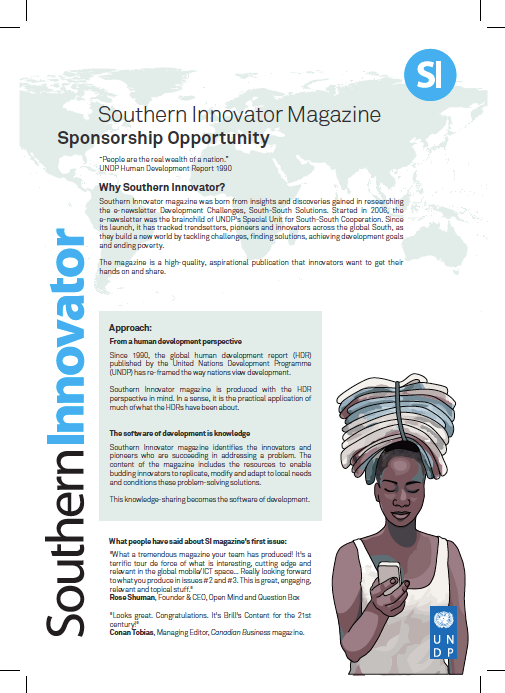
Development Challenges, South-South Solutions was launched as an e-newsletter in 2006 by UNDP’s South-South Cooperation Unit (now the United Nations Office for South-South Cooperation) based in New York, USA. It led on profiling the rise of the global South as an economic powerhouse and was one of the first regular publications to champion the global South’s innovators, entrepreneurs, and pioneers. It tracked the key trends that are now so profoundly reshaping how development is seen and done. This includes the rapid take-up of mobile phones and information technology in the global South (as profiled in the first issue of magazine Southern Innovator), the move to becoming a majority urban world, a growing global innovator culture, and the plethora of solutions being developed in the global South to tackle its problems and improve living conditions and boost human development. The success of the e-newsletter led to the launch of the magazine Southern Innovator.
A small sample by theme of stories previously published in the UNOSSC (United Nations Office for South-South Cooperation) e-newsletter Development Challenges, South-South Solutions. It was published from 2006 to 2014.
Carbon Credits Can Benefit African Farmers Thanks to New System Development Challenges: The global carbon credit trading schemes emanating from the Kyoto Protocol are now creating a multi-billion dollar market – the European carbon market was worth €14.6 billion in 2006 – and represents one of the fastest growing business opportunities in the world. Being green has finally come of age. Yet all the benefits of this are largely bypassing Africa despite more than 70 percent of the continent’s inhabitants earning a living off the land.
Securing Land Rights for the Poor Now Reaping Rewards Development Challenges: The hotly debated issue of land rights for the poor has never been more relevant. There is mounting evidence that access to land rights can catapult the poor out of poverty and spur growth for the economy. Experience in India and China is now showing the economic power unleashed when the poor gain full legal rights over their land.
Trade to Benefit the Poor Up in 2006 and to Grow in 2007 Development Challenges:The global fair trade market – in which goods and services are traded under the Fairtrade logo, guaranteeing a minimum fair price to producers experienced unprecedented growth in 2006. In the UK alone, 2006 sales totalled £290 million – a jump of 46 percent from 2005. The Fairtrade Foundation predicts sales will reach UK £300 million in 2007.
Bio-ethanol From Sturdy and Once-Unwanted Indian Plant Development Challenges:With awareness of global warming at an all-time high – and governments seeking real-world solutions to solve this enormous problem – bioethanol fuel has risen up the agenda as a replacement for conventional fuel sources. At present, most bioethanol fuel is produced from either corn or sugar but a less known plant jatropha could be the real solution. Brazil has been a pioneer in producing bioethanol fuel from sugar, while the United States has focused on its substantial corn crop as a source, and both contribute more than half the world’s supply.
Afrocoffee: Blending Good Design and Coffee Development Challenges: The importance of good design and a strong brand in the success of a business cannot be emphasised enough. That extra effort and thought can take a business from local success to regional and even global success. As consultants KPMG make clear, “For many businesses, the strength of their brands is a key driver of profitability and cash flow “. Yet the majority of small businesses fail to think about their brand values or how design will improve their product or service.
Cooking up a Recipe to End Poverty Development Challenges: Like music, food has a powerful ability to jump across cultural and regional barriers and unite people in the sheer pleasure of the meal. Tapping the rich vein of regional culinary heritages is also a great way to make money. Promoting local recipes and foods has other benefits: as the global obesity (or globesity as WHO calls it) epidemic reaches into the urban areas of cities in the developing world, anything that pulls people away from fast food and high-fat foods is a good thing. Doctors have found home cooking keeps people thin and is better for them.
Dabbawallahs Use Web and Text to Make Lunch on Time Development Challenges:The developing world’s rapidly growing cities are bringing with them whole new ways of living and working. One rapidly expanding category of citizen is the office worker. A symbol of growing prosperity, the office worker also tends to be a time-poor person who often must commute large distances between home and workplace.
Putting Worms to Work Development Challenges: Overuse of pesticides is now acknowledged as one of the gravest mistakes of the Green Revolution, launched in the 1970s to dramatically increase food production in the developing world. Pesticides have polluted the environment, poisoned fertile soil, contaminated ground water and damaged human health.
Innovative Stoves to Help the PoorDevelopment Challenges: Half of the world’s population cook with a fuel-burning stove, and this figure rises to 80 per cent of households in rural areas in developing countries. Typical fuels burned include wood, coal, crop leftovers and animal dung. The indoor pollution from smoke and carbon monoxide is a top health hazard in the developing world, ranking just behind dirty water, poor sanitation and malnutrition. The World Health Organization (WHO) estimates that 1.6 million people die each year as a result of toxic indoor air.
Insects Can Help in a Food CrisisDevelopment Challenges: For many years it was a given that the world’s problem was not a lack of food, but that it was unfairly shared. But as the switch to biofuels gathers pace, farmland is being diverted away from growing food for people, to food for fuel. On top of this, growing prosperity in many countries in the South has boosted demand for better quality food, including grain-devouring meat diets – it takes 10 kilograms of grain to get one kilogram of meat from a cow. The crisis has deeply alarmed the UN’s World Food Programme and the World Bank. In the economic battle for food, the poor are the most vulnerable.
Agricultural Waste Generating ElectricityDevelopment Challenges: Agriculture around the world produces a great deal of waste as a by-product. It can be animal faeces, or the discarded plant husks thrown away when rice, grains or maize are harvested. When this waste meets the urgent need for electricity, something special can happen.
Connoisseur Chocolate from the South Gets a Higher PriceDevelopment Challenges: Like coffee beans, cocoa beans are grown around the world and are a major commodity, highly prized in wealthy countries. West Africa accounts for 70 percent of the world’s output, with the rest grown either in Indonesia and Brazil (20 percent), or on a smaller scale in countries across the South, from Belize to Madagascar.
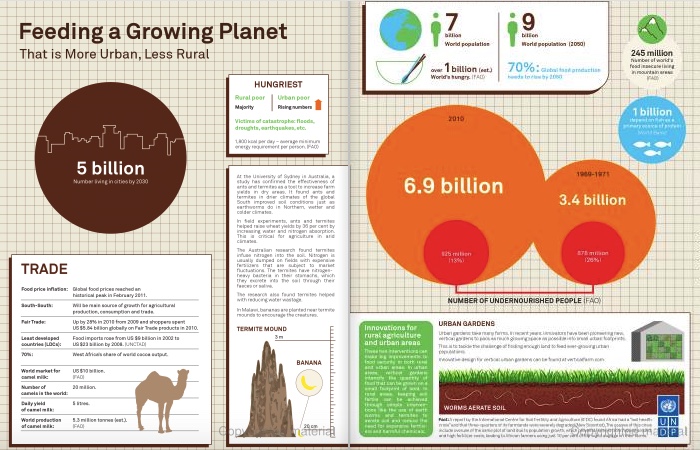
Urban Farming to Tackle Global Food Crisis Development Challenges: The world’s population is becoming more urban by the day. By 2030, some five billion people around the world will live in cities. This year is the tipping point: urban dwellers (3.3 billion people) now outnumber rural residents for the first time (UNFPA’s State of the World Population 2007 Report).
Small-scale Farmers Can Fight Malaria BattleDevelopment Challenges: Malaria is one of Africa’s biggest killers. Each year globally 300 to 500 million people are infected, and around 1 million die from the disease (theglobalfund). Ninety percent of malaria deaths occur in sub-Saharan Africa – mostly to children under the age of five. The disease costs African countries US$12 billion a year in lost gross domestic product.
Milk Co-operatives Help Hungry Haiti Development Challenges: The global food crisis has hit the impoverished Caribbean country of Haiti especially hard. Already suffering from decades of food crises brought on by the collapse of domestic farming, the country has become notorious for its people being reduced to eating cakes made of mud to stave off hunger pains. It is the poorest country of Latin America and the Caribbean and one of the poorest in the world.
Urban Farmers Gain from Waste Water Development Challenges: The global food crisis continues to fuel food price inflation and send many into hunger and despair. Around the world, solutions are being sought to the urgent need for more food and cheaper food. U.N. Secretary General Ban Ki-moon has called for food production to increase 50 percent by 2030 just to meet rising demand – and right now there are 862 million people undernourished (FAO).
Farmers Weather Fertilizer Crisis by Going OrganicDevelopment Challenges: Around the world, large-scale agriculture relies on the use of chemical fertilizers. But increasing expense and decreasing supply of fertilizer is driving up the cost of food, and in turn contributing to the overall food crisis.
Picking Money from the Baobab TreeDevelopment Challenges: The fruit of the highly revered African baobab tree is being seen as a great new opportunity for the poor, after a recent decision by the European Commission to allow its importation. According to one study, gathering the fruit has the potential to earn an extra US $1 billion a year for Africa, and bring work and income to 2.5 million households, most of them African bush dwellers (Britain’s Natural Resources Institute).
Rats a Solution in Food Crisis Development Challenges: The global food crisis continues to fuel food price inflation and send many into hunger and despair. Around the world, solutions are being sought to the urgent need for more and cheaper food. Right now there are 862 million undernourished people around the world (FAO), and U.N. Secretary General Ban Ki-moon has called for food production to increase 50 percent by 2030 just to meet rising demand.
Model Indian Villages to Keep Rural Relevant Development Challenges:The world’s rush to urban centres is the great challenge of the 21st century. In 2007, the world became a majority urban place. The consequences of this shift can be seen in the blight of urban poverty, with its slums and squalor, environmental degradation, and rising social tensions. But there are people working on keeping rural areas relevant and pleasant places to live. These rural advocates see a vibrant countryside as part of the solution to the world’s plethora of crises.
Brazil Preserves Family Farms and Keeps Food Local and Healthy Development Challenges: Today’s global food crisis sparked by a toxic mix of events – high oil and commodity prices, food scarcity, growing populations, and environmental catastrophes – has woken many up to the urgent need to secure food supplies and help those who grow the world’s food. More and more countries are turning to local and small farms – or family farms – to offer food security when times get rough.
Afghanistan’s Juicy Solution to Drug TradeDevelopment Challenges:Afghanistan is the world’s largest source of the illegal drugs opium and heroin (International Narcotics Control Board), both of which are derived from the bright-red flower, the poppy (http://en.wikipedia.org/wiki/Poppy).The country produced 8,200 tons of heroin in 2007, up 34 percent from the previous year.The negative consequences of the flourishing drug trade are numerous: it is destabilizing Afghanistan’s neighbours and undermining political and legal institutions, addiction rates are soaring, and addicts are spreading HIV/AIDS.
Camel Ice Cream Delivering Desert Dessert Development Challenges: The global food crisis is forcing people around the world to think differently about how food is produced and what new products can boost the incomes of farmers. U.N. Secretary General Ban Ki-moon has called for food production to increase 50 percent by 2030 just to meet rising demand – and right now there are 862 million people worldwide who are undernourished (FAO). The world’s over 19.4 million camels (FAO, 2003) are now being tapped for their highly nutritious, healing and tasty milk.
Rainforest Gum Gets Global MarketDevelopment Challenges: Mexico is home to the second largest rainforest in the Americas after the Amazon jungle. But the country’s forests face serious threats from logging, cattle ranching and agriculture. As much as 80 percent of Mexico’s original forests have already been lost. A group of Mexican farmers is now using sophisticated product marketing to preserve their income, and the 1.3 million hectares of rainforest as well.
Cleaner Stoves To Reduce Global WarmingDevelopment Challenges: The use of polluting fuel-burning stoves by half the world’s population – including 80 percent of rural households – is a documented contributor to a host of health problems. Poor households not only have to contend with the ill health effects of dirty water and poor sanitation, the fumes from burning dung, wood, coal or crop leftovers lead to the deaths of more than 1.6 million people a year from breathing toxic indoor air (WHO).
SOS Shops Keep Food Affordable for Poor, UnemployedDevelopment Challenges: As the global downturn bears down on country after country, governments around the world are introducing austerity measures to try to keep their economies going. Many countries are now facing financial crisis and the need for loans and support from the International Monetary Fund (IMF). Formerly comfortable people are going from regular employment to unemployment or erratic employment, and growing numbers of people are finding it hard even to afford basics such as food.
Successful Fuel-Efficient Cookers Show the WayDevelopment Challenges: Kenyan entrepreneur has cooked up a fuel-efficient stove and oven that uses less of a precious national resource: wood from trees. Most African households using fuel-burning stoves either cannot afford clean-burning fuels like natural gas or electric stoves, or do not have access to them. They are stuck having to burn wood or other materials like animal dung – collectively called biomass – on open fires.
Southern Drink Challenges Corporate DominanceDevelopment Challenges: Across the global South, its thirsty people have long been a target market for Northern drinks companies. The ubiquity of the American soft drink Coca Cola, or even its rival Pepsi Cola, is testimony to that. Even the most remote village on the impoverished island of Haiti can offer an ice-cold Coke.
Protecting Threatened Fruits and Nuts in Central AsiaDevelopment Challenges:Between 94,000 and 144,000 plant species — a quarter to a half of the world’s total — could die out in the coming years, according to an estimate by Scientific American (2002). Among them are vital food crops, threatened by a world in which climate change is causing more weather turbulence and diseases and viruses can spread rapidly and destroy crops.
Avoiding Wasting Food and Human Potential with ICTsDevelopment Challenges: Creative use of information technology in the South is helping to address two very different kinds of waste – of food and of human and community potential.
Growing a Southern Brand to Global Success: The Olam StoryDevelopment Challenges: Most people haven’t heard of Olam International, but they know the brands they work for and they more than likely eat their produce. The story of Olam (www.olamonline.com) – a global food supply company in ‘agri-products’ that got its start in Nigeria – shows how a Southern brand can grow and go global, and overcome the difficulties of cross-border trade.
New Appetite for Nutritious Traditional VegetablesDevelopment Challenges:Throughout the history of farming, around 7,000 species of plants have been domesticated. Yet everyday diets only draw on 30 percent of these plants and even this number has been going down as more people consume mass-market foods (FAO).
Brewing Prosperity Creates Good JobsDevelopment Challenges: In the Democratic Republic of Congo – home to the world’s largest United Nations peacekeeping mission and decades of bloody civil war – a brewery has not only survived, it has thrived to become a popular brand throughout central Africa. By being a success, the Brasimba brewery has brought prosperity and high-quality jobs to Congo’s second largest city, Lubumbashi (http://en.wikipedia.org/wiki/Lubumbashi), and proven that a modern business can do well there despite the obstacles.
Cool Food for the PoorDevelopment Challenges: A whole wave of high-tech, innovative products are now being developed and marketed for the world’s poor. These products are designed to raise the quality of life of poor people and treat them as a market with real needs, rather than a mass of people to be ignored.
A Local Drink Beats Global CompetitionDevelopment Challenges: For many decades, strong American and multinational food brands have penetrated markets in the South. This is a global business success story for those companies, but the downside has been the marginalizing of local alternatives. This not only reduces wealth-creating opportunities for local entrepreneurs, but also leads to products like sugary soda pops (http://tinyurl.com/yzwal98) pushing aside healthier, local alternatives like tea.
The Battle for India’s Coffee Drinkers in Buzzing EconomyDevelopment Challenges: A showdown in India over coffee is creating new opportunities. It is also demonstrating how the country is changing, with rising incomes in some places and great disparities in others.
West African Chocolate Success StoryDevelopment Challenges: A Ghanaian chocolate company has become a big success in the United Kingdom and shown how it is possible to develop and market a high-quality product grown in West Africa. While the chocolate bars are manufactured in the Netherlands, the cooperative that owns the company initiated the push into producing a mass-market chocolate brand – and shares in the profits.
Açaí Berry Brazil’s Boon Development Challenges: A formerly obscure berry from the Amazon rainforest in Brazil has become a global marketing success. The açaí berry – a dark, small fruit similar in appearance to blueberries – has surged in popularity around the world and brought newfound prosperity to poor communities.
Woman Wants African Farming to be CoolDevelopment Challenges: Can farming be cool? Especially on a continent where it has long been associated with hardship and poverty, can agriculture be attractive to a young generation looking for big opportunities? A young woman in Nigeria thinks so and is on a mission to show farming is a great way to get ahead in modern Africa. And she hopes more people attracted to farming will boost the continent’s food security and reduce costly imports.
Kenyan Products a Global Success StoryDevelopment Challenges: The East African nation of Kenya has become synonymous with high-quality agricultural products, and offers lessons for other countries across the South. The country has been able to combine innovation in new technologies (it is a pioneer in mobile phone applications like m-banking), with quality control for its products like the Coffee Kenya Brand logo (http://www.coffeeboardkenya.org) and ease of access to information on Kenyan products and resources via the internet – crucial to drumming up international business – like the SME Toolkit Kenya (http://kenya.smetoolkit.org/kenya/en).
Rwandan Coffee Brand BoostDevelopment Challenges: A successful Rwandan company is using coffee shops to promote the nation’s high-quality coffee brands at home and abroad. Started by two Rwandan entrepreneurs three years ago, Bourbon Coffee (http://www.bourboncoffeeusa.com/) now has three shops in the country’s capital, Kigali, and a savvily positioned shop in Washington DC.
Brazil’s Agriculture Success Teaches South How to GrowDevelopment Challenges: Inflation, environmental stresses and population and economic growth are testing the world’s food supply systems. There is a strong need to boost yields and improve the quality of food. Between now and 2050 the world’s population will rise from 7 billion to 9 billion. Urban populations will probably double and incomes will rise. City dwellers tend to eat more meat and this will boost demand.
Palestinian Olive Oil’s Peaceful ProsperityDevelopment Challenges: The economic devastation of the conflict between Israel and the Palestinians (http://en.wikipedia.org/wiki/Palestine) has brought much hardship to the Palestinian people. The United Nations under the UNRWA mission has been working to lesson the hardship for over 60 years (http://www.unrwa.org). But there is only so much it can do.
South African Wine Industry Uncorks Opportunities Development Challenges: Wine-making is one of South Africa’s oldest industries and plays a key part in the country’s economy. And now both wine making and production are being transformed and creating new economic opportunities. Once seen only as the preserve of the country’s white minority population, wine is slowly becoming a black thing too.
Mongolian Enterprises Target Healthy Urban Lifestyles Development Challenges: In the Northeast Asian nation of Mongolia – landlocked between Russia and China – the traditional diet is based on the nomadic ways of its herders. Rich in meat and milk products, it is a diet that has evolved from the need to survive in a harsh climate doing hard physical labour – winter temperatures can drop below minus 50 degrees Celsius.
Food Diplomacy Next Front for South’s NationsDevelopment Challenges: The meal is a universal bonding ritual, a time for families or friends to socialize and catch up on the day’s activities. Food has the ability to transcend cultures and societies when humour, the arts, and diplomacy cannot. A person may know nothing about a particular country or culture, but they know what their appetite and palate likes.
Food Inflation: Ways to Fight ItDevelopment Challenges: Food inflation has taken off at the beginning of 2011. As the global economic crisis enters its next phase, both developed and developing countries are experiencing inflation. There are many factors fuelling the rise in prices – inefficient distribution and storage systems, lack of investment in agriculture, devaluing currencies, high demand, natural and man-made disasters, use of food products like corn to make biofuels – but there are also ways to counter the effects of food inflation that have been tried and tested across the South.
China’s Booming Wine Market Can Boost SouthDevelopment Challenges: A great South-South opportunity has emerged with the recent boom in wine drinking in China and the pursuit of quality tastes. Matching high-quality wine producers from the global South – including South Africa, Chile, Morocco, and Lebanon – with China’s thirsty wine drinkers could deliver a major income boost.
Indonesian Food Company Helps Itself by Making Farmers More Efficient Development Challenges: The current global economic crisis is taking place at the same time as a global food crisis. Food inflation took off at the beginning of 2011. This is having a devastating affect on countries dependent on food imports and experiencing decreasing domestic production capabilities. The least developed countries (LDCs) saw food imports rise from US $9 billion in 2002, to US $23 billion by 2008 (UNCTAD), prompting Supachai Panitchpakdi, secretary general of UNCTAD, to say “the import dependence has become quite devastating.”
Civet Cat Coffee Brews Filipino OpportunityDevelopment Challenges: In the Philippines, one animal’s call of nature has become a business opportunity.The civet cat, a member of the mongoose family, ingests the fruit of coffee plants, and expels the beans. This has created an unexpected by-product – a prized beverage for the world’s savvy coffee drinkers seeking the next taste sensation. The partially digested coffee beans are gathered from the faeces of the cat and used to make a much-coveted, smooth-flavoured cup of coffee.
Brazilian Restaurant Serves Amazonian TreatsDevelopment Challenges: The vast Amazon rainforest has inspired a cuisine pioneer in Brazil. Combining the sensual pleasures of fine dining and the joy of tasting new flavours with a pursuit of sustainable and profitable local farming, a chef is inventing a new Brazilian cuisine and showing the way to create sustainable incomes.
Pulque: Aztec Drink Ferments New EconomyDevelopment Challenges:Reviving traditional foods and drinks can be an income-boosting source of new economic activity. Many cultures can benefit from looking again at their rich traditions to find new ways to increase enterprise. This can be difficult at first. Big global brands have many initial advantages: they are backed by wealthy and experienced international companies and can deploy aggressive marketing and distribution power to get products into the hands of consumers. The power of Coca Cola to reach all corners of the earth is legendary.
Cheap Farming Kit Hopes to Help More Become FarmersDevelopment Challenges:Food security is key to economic growth and human development. A secure and affordable food supply means people can meet their nutrition needs and direct their resources to improving other aspects of their lives, such as housing, clothing, health services or education.
“Pocket-Friendly” Solution to Help Farmers Go OrganicDevelopment Challenges:Interest in organic food and farming is high, and organics have become a growing global industry. The worldwide market for organic food grew by more than 25 per cent between 2008 and 2011, to US $63 billion, according to pro-organic group the Soil Association. That is an impressive accomplishment given the backdrop of the global economic crisis, and evidence that people value quality food, even in tough times.
Bolivia Grabs World Media Attention with Salt HotelDevelopment Challenges: Tourism is a great way to attract foreign currency to a country and build local economies, especially in remote or isolated places. But the catch is finding a way to get people to go the distance and come and visit and spend their money.
Pulque: Aztec Drink Ferments New EconomyDevelopment Challenges:Reviving traditional foods and drinks can be an income-boosting source of new economic activity. Many cultures can benefit from looking again at their rich traditions to find new ways to increase enterprise. This can be difficult at first. Big global brands have many initial advantages: they are backed by wealthy and experienced international companies and can deploy aggressive marketing and distribution power to get products into the hands of consumers. The power of Coca Cola to reach all corners of the earth is legendary.
Brazilian Restaurant Serves Amazonian TreatsDevelopment Challenges: The vast Amazon rainforest has inspired a cuisine pioneer in Brazil. Combining the sensual pleasures of fine dining and the joy of tasting new flavours with a pursuit of sustainable and profitable local farming, a chef is inventing a new Brazilian cuisine and showing the way to create sustainable incomes.
Bolivian Film School’s Film Scene Paying Off Development Challenges: A film school in Bolivia shows how a creative hub can become the start of something much bigger. The school is inspiring a new generation of young people to get into filmmaking. And one of its lecturers is already experiencing global success acting in an award-winning new Spanish film.
Chilean Eco-Buildings Pioneering Construction MethodsDevelopment Challenges: Across the global South, the search is on for new ways to build without extracting a high price from local environments.More and more people are recognizing the advantages of energy-saving methods like prefabrication. Prefab building techniques involve assembling a structure from pre-assembled parts or modules made in a factory, or transporting a completed, factory-made structure to a site (http://en.wikipedia.org/wiki/Prefabricated_building).
Energy-Efficient Wooden Houses are also Earthquake Safe Development Challenges:In Argentina, an innovative housing project has married good design with energy efficiency, earthquake resilience and the use of local materials and labour. As energy resources continue to be stretched around the global South, innovative building designs will be critical to the creation of sustainable housing for the future.
New Swimwear for Plus-size Women in BrazilDevelopment Challenges: Brazil is well known for its stylish swimwear, with styles usually targeted at young women and those with more conventional, media-friendly body shapes. But now a company is making visiting the beach more comfortable and empowering for plus-size women.
Business Leads on Tackling Violence in Mexican City Development Challenges: The damaging affects of crime and violence can ruin a city. They act as a drag on efforts to increase wealth and improve living conditions, and a city that gets a bad reputation, especially in the age of the Internet, will lose investment opportunities.
Latin American Food Renaissance Excites DinersDevelopment Challenges: Food is essential for a good life and plays a critical part in overall human health and development. The better the quality of food available to the population, the better each individual’s overall health will be, and this will have a direct impact on mental and physical performance (http://www.sciencedirect.com/science/article/pii/S2213453012000055).
Brazilian Design for New Urban, Middle-Class WorldDevelopment Challenges: Countries across the global South are experiencing rapid urbanization as people move to cities for better economic opportunities — and this massive social change is creating new business opportunities. Those who recognize how fundamentally people’s lifestyles are changing will be those who will benefit from this big shift in populations.
Mapping to Protect Kenya’s Environment: the eMazingira SolutionDevelopment Challenges:Powerful new grassroots crowd-mapping tools have sprung up in the past few years across the global South, from Brazil’s Wikicrimes (www.wikicrimes.org) real-time crime mapping technology to the now famous Ushahidi(http://ushahidi.com) – a non-profit company making the free and open source Ushahidi software for information collection, visualization and interactive mapping – from its base in Kenya. They share some common features. All draw on the widespread use of mobile phones in the global South combined with growing access to the Internet, either through 3G mobile phone services, WiFi wireless connections, Internet centres or increasingly available broadband Internet services.
Building an Interactive Radio Network for Farmers in NigeriaDevelopment Challenges:As solar power technology has improved, new pioneers have emerged to exploit this innovation. Several decades ago, solar power was seen as too expensive for wide-scale roll out in poor countries and communities. But today, an army of solar technology pioneers has fanned out across the world to show the new wave of innovations and how they make solar power affordable.
African Manufacturing Pioneers Proving it is Possible to ThriveDevelopment Challenges:Africa’s paradox is that it is home to the greatest share of the world’s unexploited resources, yet has some of the world’s lowest per capita incomes. History has shown that exploiting the continent’s resources alone for export markets does little to improve incomes and living conditions in Africa, which in turn does nothing to improve human development. The key to resolving this paradox is made-in-Africa jobs, in particular high-value jobs that make products.
New African Film Proving Power of Creative EconomyDevelopment Challenges:A new movie is generating excitement around life in the war-torn, chaotic and impoverished Democratic Republic of the Congo (http://en.wikipedia.org/wiki/Democratic_Republic_of_the_Congo) – the central African nation – and proving how versatile and resilient a creative economy can be in a crisis.
Ghana: Oil-rich City Sparks Entrepreneurs and DebateDevelopment Challenges:Commodity booms can seem like the answer to a poor nation’s prayers, a way to fulfil all their development dreams and goals. The reality, however, is far more complex. More often than not, the discovery of resources sparks a mad scramble for profits and patronage, as politicians and politically connected elites carve out their slice of the new resource boom before anyone else.
Turning African Youth on to TechnologyDevelopment Challenges:An African NGO believes the Internet is the single biggest key to rapid development in Africa – and it is working to connect youth, women and rural populations to the web, and in turn, switch them on to the vast resources stored across the world’s Internet sites.
Bringing the Invention and Innovation Mindset to Young KenyansDevelopment Challenges:A highly innovative new way to teach the basics of electronics, computing and technological innovation is being pioneered in the slums of Nairobi, Kenya. Driven by the desire to counter perceptions of apathy among young people, NGO Kuweni Serious is running a training course for girls aged over 8 years in some of the poorest parts of the city to turn on a new generation to the power of technology to make change.
African Youth Want to do Business in Fast-growing EconomyDevelopment Challenges:Africa’s growing economy is meeting head-on an optimistic young population keen to start businesses. At least that is what a new poll of African youth says, finding that one in five Africans between the ages of 15 and 24 without a current business wants to start one in the next 12 months.
Kenyan Safari Begins Minutes from AirportDevelopment Challenges:Many people find the prospect of staying in airport hotels dreary at best. They tend to be located in industrial parts of cities or far from city centres. They can be surrounded by roads and highways and are built to move lots of people, not to look nice. The surrounding areas can be very common to all nations – warehouses, office parks, nondescript restaurants and hotels – and give few clues to where you are apart from the weather and the languages on the sign boards.
African Botanicals to be used to Boost Fight against ParasitesDevelopment Challenges:More than 1 billion people in the developing world currently suffer from tropical diseases, which leave a trail of disfigurement, disability and even death. Yet only 16 out of 1,393 – 0.01 percent – of new medicines marketed between 1975 and 1999 targeted tropical diseases (International Journal of Public Health).
Solar Sisters Doing it for Themselves: Tackling African Light FamineDevelopment Challenges:A social enterprise is seeking to capture the power of the sun to bring light and economic opportunity to women in Africa. Using a direct-marketing distribution system, it sells solar lamps and lanterns to some of Africa’s remotest communities. Solar Sister (www.solarsister.org), launched in Uganda in 2010, is hoping to do for power generation what mobile phones have done for communication in Africa: make a technological leap to a model of grassroots power generation, rather than waiting for large-scale power schemes to eventually reach the poor and rural.
South Africa Innovates Healthcare with Prepay Phone VouchersDevelopment Challenges:Pioneers in Africa are experimenting with new ways to fund the delivery of healthcare that is affordable and sustainable and not dependent on foreign aid and donations. A South African company is prototyping the selling of pre-payment healthcare services through mobile phones with a range of vouchers that can be bought and downloaded at the tap of a keypad.
Ghana’s Funeral Economy Innovates and Exports Development Challenges:The West African nation of Ghana’s funeral economy is attracting innovation and grabbing attention outside the country. The nation’s elaborate – but expensive – funeral rituals provide craftsmen with a good income. And new products are being introduced to handle the financial consequences of this unavoidable fact of life.
Happy Nigeria: West African Nation Has Good AttitudeDevelopment Challenges:In the last 10 years, an increasing amount of attention has been paid to the concept of national happiness. The notion was first developed in the tiny Asian Kingdom of Bhutan (http://en.wikipedia.org/wiki/Bhutan), whose advocacy of ‘gross national happiness’(http://www.grossnationalhappiness.com/) as a measure of national achievement just as important as Gross National Product (GNP), has been met with equal parts ridicule, respect and research.
Africa’s Consumer Market in Spotlight for 2011Development Challenges:While other parts of the world will spend 2011 worrying about their debt levels and how to spur economic growth, many factors are pointing to Africa potentially following a different story. A frenzy of activity has been building around Africa’s market opportunities and its growing middle class consumer population.
Ugandan Fish Sausages Transform Female Fortunes Development Challenges: What to do when your food production enterprise is just not making much money? It is a common problem in the global South, where farmers and fishers often struggle to survive and can face the threat of bankruptcy and destitution when trying to provide essential food for their communities.
African Supercomputers to Power Next Phase of DevelopmentDevelopment Challenges:Information technology developments in Africa have long lagged behind those in other parts of the world. But the transformation being brought about by the widespread adoption and use of mobile phones – each one a mini-computer – and the expansion of undersea fibre optic cable connections to Africa are creating the conditions for an exciting new phase of computing growth on the continent.
Africa to Get Own Internet DomainDevelopment Challenges: Africa is in the midst of an Internet revolution that is set only to accelerate. The continent is one of the last places to experience the information technology revolution that has swept the world in the past two decades.
Profile of African Innovators Continues to RiseDevelopment Challenges:A mix of developments is proving that African innovators no longer need to see themselves as lone operators working in isolation.
The Water-Free South African Bathing SolutionDevelopment Challenges: As the world’s population grows from its current 7 billion to a projected 9 billion in 2050 (UN), competition for access to the Earth’s resources will become fiercer. The most essential resource for life on the planet – and an increasingly precious resource – is water. Water is necessary for the very survival of humans, animals and plants, and is also used in vast quantities by industries and farms.
Mobile Phone Shopping to Create Efficient Markets across BordersDevelopment Challenges:An anticipated game-changing revolution in African trading set for 2013 is getting one innovative business very excited.
Egyptian Youth Turns Plastic Waste into FuelDevelopment Challenges: The challenge of finding alternate fuel sources is capturing the imagination of innovators across the global South. As the world’s population increases – it recently reached 7 billion (UN) – and the number of people seeking a better life grows in turn, the energy demands on the planet are pushing up competition for existing conventional fuel sources.
Shopping and Flying in Africa’s Boom TownsDevelopment Challenges: As economies across Africa grow, the continent still has a long way to go to create infrastructure to match people’s rising expectations of what a modern, prosperous life looks like.
Teenager Uses Technology to Protect Livestock from Lions Development Challenges: In Kenya, a teenage Maasai (http://en.wikipedia.org/wiki/Maasai_people) inventor has developed a way to chase lions away from livestock that doesn’t harm the lions. It is a common practice to kill lions when they threaten or kill livestock, and this has led to a precipitous drop in the local lion population at Nairobi National Park (http://www.kws.org/parks/parks_reserves/NANP.html/), near the country’s capital, Nairobi. Lions are a significant tourist attraction for Kenya and the population decline is a threat to the future of the tourist industry.
African Innovation Eco-system Taking ShapeDevelopment Challenges: How to increase the rate of innovation in Africa? And specifically, innovation that actually improves people’s lives and reduces poverty. It is a hard question to answer, but some are putting in place the building blocks of a 21st century innovation culture by riding the information technology revolution as it rolls across Africa.
African Fuel Pioneer Uses Crisis to InnovateDevelopment Challenges: Crisis, as the old saying goes, is also a window of opportunity. And there is one African entrepreneur who knows this better than most. Daniel Mugenga has been on a journey of innovation that has led him to become a pioneer in the emerging new field of algae technologies. The story of how he got there is a testament to the power of using business to both solve problems and make profits.
Turning Human Waste to Fertilizer: An African SolutionDevelopment Challenges: While South Africa has been free of the racist Apartheid regime since the mid-1990s, the expected boost to living standards for the majority black population has not been as widespread and as quick as many had expected.
East Africa to get its First Dedicated Technology CityDevelopment Challenges:An ambitious scheme is underway to create a vast technology city on the outskirts of Nairobi, Kenya.
Mauritanian Music Shop Shares Songs and FriendshipDevelopment Challenges:Around the world, traditional music stores selling vinyl records, tapes and CDs (compact discs) are closing down. Digital downloads distributed over the Internet and mobile phones make it unnecessary to build a music collection in these hard formats.
New Journal Celebrates Vibrancy of Modern AfricaDevelopment Challenges:Africa has seen huge changes to its communications and media in the past five years. The rise and rise of mobile phones, the expansion of the Internet and the explosion in African blogging and social media, on top of flourishing print and broadcast media, all bring an increasing range of options for telling African stories and increasing dialogue.
An Innovator’s ‘Big Chicken Agenda’ for AfricaDevelopment Challenges:Increasing the quantity and quality of food in Africa will be critical to improving the continent’s human development. And a key element in giving Africa a more secure food supply will be boosting science and knowledge on the continent and making sure it is focused on Africa’s needs and situation.
Kenya Turns to Geothermal Energy for Electricity and GrowthDevelopment Challenges:In an effort to diversify its power supply and meet growing electricity demand, Kenya is looking to increase its use of geothermal energy sources (http://en.wikipedia.org/wiki/Geothermal_electricity). Tapping the abundant heat and steam that lurks underground to drive electric power plants offers a sustainable and long-term source of low-cost energy.
African Afro Beats Leads New Music Wave to EuropeDevelopment Challenges:A surge in interest in African music in Britain is creating new economic opportunities for the continent’s musicians. The new sound heating up the U.K. music scene is “Afro Beats” – a high energy hybrid that mixes Western rap influences with Ghanaian and Nigerian popular music.
Venture Capital Surge in Africa to Help BusinessesDevelopment Challenges: Africa’s potential economic powerhouse lies in its small and medium enterprises (SMEs). Foreign direct investment (FDI) into Africa ebbs and flows based on the state of the global economy – and most of it is directed towards large enterprises and multinational companies.
Africa’s Tourism Sector Can Learn from Asian ExperienceDevelopment Challenges:Africa continues to be seen as new territory for global tourism, yet it still is not even close to meeting its potential, according to a report by a South African think tank. In fact, many resorts and tourist areas are failing to fill up with visitors. This contrasts with the booming world tourism industry, which broke records in arrivals in 2011 (UNWTO).
African Farming Wisdom Now Scientifically ProvenDevelopment Challenges:Increasing the agricultural productivity of Africa is critical for the continent’s future development, and the world’s. Two-thirds of Africans derive their main income from agriculture, but the continent has the largest quantity of unproductive – or unused – potential agricultural land in the world.
Lagos Traffic Crunch Gets a New SolutionDevelopment Challenges: Around the world, traffic congestion is often accepted as the price paid for rapid development and a dynamic economy. But as anyone who lives in a large city knows, there comes a tipping point where the congestion begins to harm economic activity by wasting people’s time in lengthy and aggravating commuting, and leaving commuters frazzled and burned out by the whole experience.
New Kenyan Services to Innovate Mobile Health and FarmingDevelopment Challenges:Kenya is home to a vibrant innovation culture centred around mobile phones. While not all the services launched will be successful, the flurry of start-ups shows the country has the right combination of technical skills, bright ideas and cash to make a go of new services.
Baker Cookstoves – Designing for the African CustomerDevelopment Challenges:An innovative social enterprise is using design to create an energy-efficient cookstove for Kenya. By turning to an experienced Swedish architecture and design firm, the people behind the Baker cookstove wanted to make sure the stove’s design was as efficient as possible and relevant to the customers’ needs, while also making sure it is visually appealing and something a person would proudly want in their home.
Texting for Cheaper Marketplace Food with SokoTextDevelopment Challenges:An international group of graduate-social entrepreneurs from the London School of Economics (LSE) is pioneering a way to reduce food prices in Kenya using mobile phones.
Ethiopia and Djibouti Join Push to Tap Geothermal Sources for Green EnergyDevelopment Challenges:Ethiopia and Djibouti are the latest global South countries to make a significant commitment to developing geothermal energy – a green energy source that draws on the heat below the earth’s surface (http://en.wikipedia.org/wiki/Geothermal_energy) – to meet future development goals.
Ghana Wants to Tap Global Trendy Party SceneDevelopment Challenges:Tourism is big business – and one of the most resilient parts of the global economy. Despite the international economic crisis that has wreaked havoc and increased unemployment and poverty in many countries since 2007, tourism is still going strong.
US $450 Million Pledged for Green Economy Investments at Kenyan ExpoDevelopment Challenges:Innovators working in the global green economy could benefit from over US $450 million in investment recently pledged at the UN’s Global South-South Development Expo held in Nairobi, Kenya.
African Fashion’s Growing Global Marketplace ProfileDevelopment Challenges:Tales of African global fashion successes have multiplied in the last few years. African fashion is seeing its profile rise as more and more shows and festivals boost awareness of the continent’s designs, designers and models. In turn, African fashion and design is being taken more seriously as an income and job generator, and as a sector able to weather the ups and downs of the global economy: people always need to wear clothes.
Pioneering African Airlines Help to Expand RoutesDevelopment Challenges:The last decade has seen a revolution in African air travel. The number of air routes has grown and this has paralleled the economic growth across the continent. As demand has been strong for Africa’s resources, it has also fueled a consumer boom that is benefiting an increasing number of people.
Solar-Powered Mobile Clinics to Boost Rural Healthcare in AfricaDevelopment Challenges:Around the world, innovative thinking is finding new ways of using solar power technology to bring electricity to underserved areas of the global South. Innovators are experimenting with new technologies, new business models and new ways to finance getting solar power into the hands of the poor.
More Futuristic African Cities in the WorksDevelopment Challenges: It has been well documented that China is undergoing the largest migration in human history from rural areas to cities. But this urbanization trend is occurring across the global South, including in Africa, as well. According to the UN, more than half the world’s population already lives in cities, and 70 per cent will live in urban areas by 2050. Most of the world’s population growth is concentrated in urban areas in the global South.
African Infrastructure Dreams Back on AgendaDevelopment Challenges:Africa’s patchy infrastructure is not keeping pace with the continent’s economic growth. Satellite photos of Africa at night show a place where light is concentrated overwhelmingly in the South – primarily South Africa – and in the North, with a sprinkling of lights on the west and east coasts (http://geology.com/articles/satellite-photo-earth-at-night.shtml).
Burgeoning African E-commerce Industry Full of OpportunityDevelopment Challenges:Africa has seen huge change since 2000 in the way people access information and do business electronically. The most championed accomplishment has been the widespread take-up of mobile phones. This has given birth to countless entrepreneurs and innovators who are using phones to help people, do business and sell goods and services.
African Innovators Celebrated in PrizeDevelopment Challenges:Innovation is increasingly being recognized as the key to tackling long-standing development problems in Africa, as well as across the developing and developed world. While it is easy to draw up a list of challenges facing the global South, it takes a special person to see not problems but solutions.
New Beer Helping to Protect ElephantsDevelopment Challenges:How to match the often conflicting goals of protecting animal habitats and supporting local economies? One clever solution may draw amusement but is actually a sharp marketing strategy to get attention for a product that is helping to preserve the elephants of Thailand’s Golden Triangle (http://en.wikipedia.org/wiki/Golden_Triangle_(Southeast_Asia).
Solar Solution to Lack of Electricity in AfricaDevelopment Challenges:Electricity is critical to improving human development and living standards. Yet, for many in the global South, electricity is either non-existent or its provision is patchy, erratic, unreliable or expensive.
US $1 Trillion Opportunity for Africa’s Agribusinesses Says ReportDevelopment Challenges:As the world’s population continues to grow – surpassing 9 billion people by 2050, the United Nations estimates – and more and more people move to urban areas, producing enough food to feed this population will be one of the biggest economic challenges and opportunities in the global South.
Kenya Reaches Mobile Phone Banking LandmarkDevelopment Challenges:Financial transactions and banking with mobile phones have been a Kenyan success story.
Online Education Could Boost African DevelopmentDevelopment Challenges:Education is recognized as a major catalyst for human development. During a high-level meeting on the Millennium Development Goals (MDGs) (http://www.undp.org/content/undp/en/home/mdgoverview.html) in 2010, UNESCO – the United Nations Educational, Scientific and Cultural Organization – pointed out the necessity of making rapid gains in education if all the MDGs are to be achieved. The goals deadline is 2015 – just two years away.
African Digital Laser Breakthrough Promises Future InnovationDevelopment Challenges: For decades many African countries have experienced low investment in research and development (R&D) and scientific innovation. One of the few nations to benefit from a sophisticated university network and research and development sector was South Africa. It still ranks top on the continent for funding R&D and its high number of scientific journals.
Preserving Beekeeping Livelihoods in MoroccoDevelopment Challenges: The clever combining of tourism and long-standing beekeeping skills has revived a local craft and is also helping to preserve the ecology of Morocco. Beekeeping, or apiculture (http://en.wikipedia.org/wiki/Beekeeping), has two clear benefits. Bee products, including honey, beeswax, propolis, pollen and royal jelly can be a valuable source of income. The other benefit is the critical role bees play in the ecology by pollinating flowers and plants as they go about their daily business.
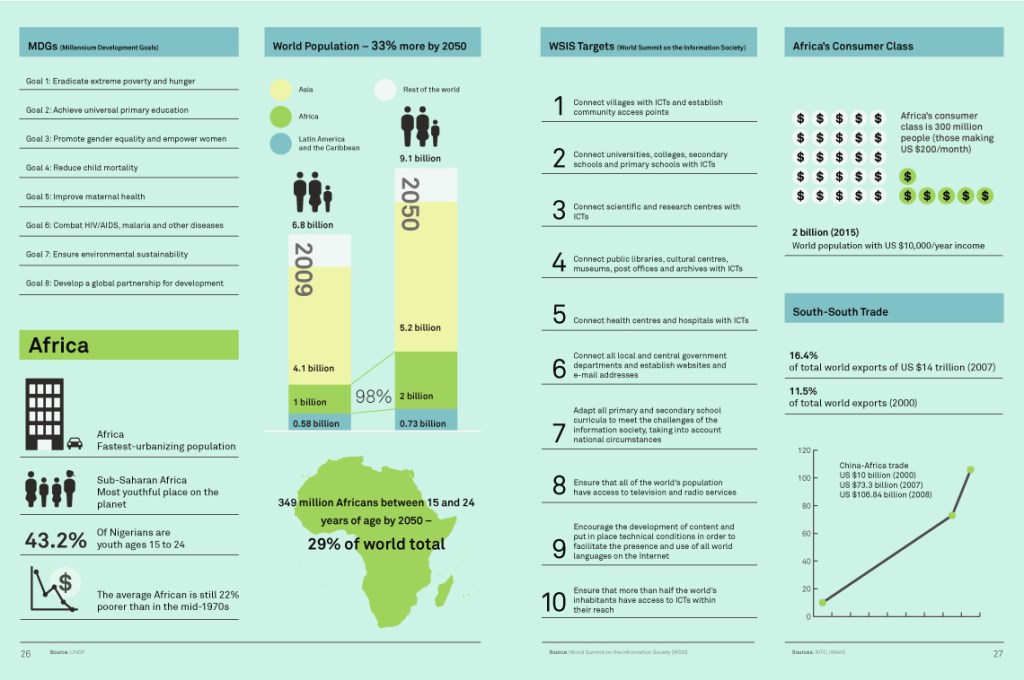
A New African Beer Helps Smallholder FarmersDevelopment Challenges:Africa’s growth in the past decade has held steady despite the trauma of the global economic crisis and the tumult of the “Arab Spring” in several countries of North Africa. African economies are growing because of a number of resilient trends. These include growing regional trade links, greater investment in infrastructure and the remarkable rise of China to become Africa’s number one trade partner, pushing the United States to second place (Technology + Policy). This has given birth to a growing consumer marketplace and consumer class – some 300 million people earning about US $200 a month (Africa Rising).
Made-in-Africa Fashion Brand Pioneers Aim for Global SuccessDevelopment Challenges:African fashion brands have not always been the first place fashionistas turned to when shopping for new clothes or shoes in developed economies. While Africa has long been a source of inspiration in contemporary and traditional fashion, the continent has had a weak reputation for manufacturing and selling mass market global fashion brands.
Kenyan Book Company Brings Online Sales to East AfricaDevelopment Challenges:The Internet has revolutionized retail sales in many developed countries – and nowhere more so than for booksellers. The ability to offer an almost unlimited supply of books through a website is revolutionizing the way people shop and giving life to books long out of print or by unknown authors.
African Innovation Helps Make Banking Transactions SaferDevelopment Challenges:As economies grow in Africa, more and more people are conducting their financial transactions electronically. This can be either through mobile phones and digital devices, or through the hole-in-the-wall of the automatic teller machine, or ATM.
New Apps Make Driving and Travelling in Egypt Easier, SaferDevelopment Challenges:Mobile phones are ubiquitous across the global South. They have spawned whole new business opportunities and changed the way people solve problems and find solutions.
Angolan Film Grabs Attention at Film Festival Development Challenges:The power of the creative economy to transform lives, livelihoods – and perceptions – should never be underestimated. Creativity can transform the image of places and situations often seen in a negative light. A film from Angola is shining a light on the country’s music scene and showing the vitality of the nation in the wake of a long-running civil war.
Old Boats Become New Furniture in SenegalDevelopment Challenges:Every country has its fair share of waste and the remnants of past economic activity. Old cars nobody wants, discarded tins of food, old plastic bags, spare copper wire, cast-off clothing – all can have a new life in the right hands.
3D Printing Gives Boy a New Arm in SudanDevelopment Challenges:3D printing is rapidly going mainstream and is now starting to make a big impact in health care. One innovative solution is using the technology to manufacture artificial arms for amputees harmed by war in Africa.
African Hotel Boom Bringing in New Investment and Creating JobsDevelopment Challenges:Africa is experiencing a boom not seen for decades. The IMF forecasts economic growth in sub-Saharan Africa of 6 per cent in 2014, compared to global growth of 3.6 per cent.
The BRCK: Kenyan-Developed Solution to Boost Internet AccessDevelopment Challenges:Using the Internet in Africa has its challenges, as anyone who has worked there knows. Issues can include weak Wi-Fi signals, slow Internet service providers, electricity outages and power surges that can damage or destroy sensitive electronic devices.
Women Empowered by Fair Trade ManufacturerDevelopment Challenges:There is sometimes a great deal of negativity surrounding the issue of manufacturing in Africa. Some claim the risks of doing business are too high or that the workers are not motivated enough. But one garment manufacturer is out to prove the skeptics wrong. It pays decent wages and gives its mostly female workforce a stake in the business in a bid to drive motivation and make it worthwhile to work hard.
Global South Trade Boosted with Increasing China-Africa Trade in 2013Development Challenges:It was announced in January 2014 that China has surpassed the United States to become the world’s number one trading nation, as measured by the total value of exports and imports. This new economic behemoth also continued to grow its trade relationships with Africa.
“Pocket-Friendly” Solution to Help Farmers Go OrganicDevelopment Challenges:Interest in organic food and farming is high, and organics have become a growing global industry. The worldwide market for organic food grew by more than 25 per cent between 2008 and 2011, to US $63 billion, according to pro-organic group the Soil Association. That is an impressive accomplishment given the backdrop of the global economic crisis, and evidence that people value quality food, even in tough times.
Cheap Farming Kit Hopes to Help More Become FarmersDevelopment Challenges:Food security is key to economic growth and human development. A secure and affordable food supply means people can meet their nutrition needs and direct their resources to improving other aspects of their lives, such as housing, clothing, health services or education.











 David South Consulting
You must be logged in to post a comment.